Program: B.Sc Nursing, 3rd Year
BNSG-501 MSN
Unit No.2.
Topic- Menstrual Cycle
Lecture No. 3
Dr. Sudharani B Banappagoudar
Professor, SONS/OBG
1
BNSG 501
Outline
• Introduction
• Phases of Menstrual cycle
• Learning outcomes
• Exercise
• References
2
BNSG 501
INTRODUCTION
3
<SELO: 1,3,4,6,8,10,20>
<Reference No.: R1,R3>
BNSG 501
A branch of medicine that specializes in the care of women during pregnancy and childbirth and
in the diagnosis and treatment of diseases of the female reproductive organs. It also specializes in
other women's health issues, such as menopause, hormone problems, contraception (birth
control), and infertility.
OB/GYN: A commonly used abbreviation. ... An obstetrician/gynecologist (OB/GYN) is
therefore a physician who both delivers babies and treats diseases of the female reproductive
organs.
Objectives
• The student will be able to Explain
• Phases of Menstrual Cycle
4
<SELO: 1,3,4,6,8,10,20>
<Reference No.: R1,R2>
BNSG 501
Menstrual cycle
DEFINITION
Rhythmical series of physiological changes that occur in fertile women
Under the control of the endocrine system
Necessary for reproduction
Average length: 28 days, but typically varies, with shorter and longer cycles
6
<SELO: 1,3,4,6,8,10,20>
<Reference No.: R1,R2>
BNSG 501
DEFINITION
Menarche: a woman's first menstruation
typically occurs around age 12
occurrence depends on overall health and diet
Menopause: end of a woman's reproductive phase, commonly occurs
between ages 45 and 55
age of menopause is largely the result of genetics
7
<SELO: 1,3,4,6,8,10,20>
<Reference No.: R1,R2>
BNSG 501
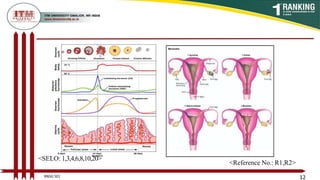
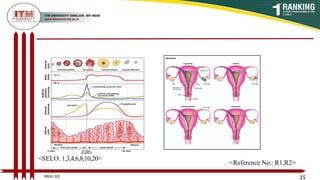
Physiological changes during menstrual cycle can be observed at three different levels:
neuroendocrine level
ovaries
uterus
Menstrual cycle can be divided into 3 phases:
menstrual phase
proliferative / follicular (estrogen) phase
secretory / luteal phase (progesterone) phase
8
<SELO: 1,3,4,6,8,10,20>
<Reference No.: R1,R2>
BNSG 501
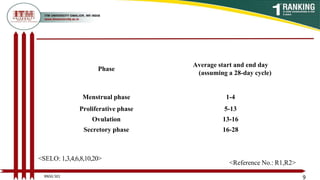
Phase
Average start and end day
(assuming a 28-day cycle)
Menstrual phase 1-4
Proliferative phase 5-13
Ovulation 13-16
Secretory phase 16-28
9
<SELO: 1,3,4,6,8,10,20>
<Reference No.: R1,R2>
BNSG 501
MENSTRUAL PHASE
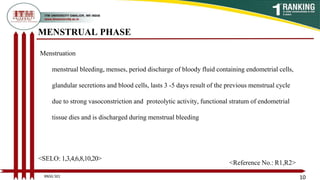
Menstruation
menstrual bleeding, menses, period discharge of bloody fluid containing endometrial cells,
glandular secretions and blood cells, lasts 3 -5 days result of the previous menstrual cycle
due to strong vasoconstriction and proteolytic activity, functional stratum of endometrial
tissue dies and is discharged during menstrual bleeding
10
<SELO: 1,3,4,6,8,10,20>
<Reference No.: R1,R2>
BNSG 501
MENSTRUAL PHASE
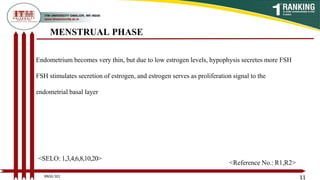
Endometrium becomes very thin, but due to low estrogen levels, hypophysis secretes more FSH
FSH stimulates secretion of estrogen, and estrogen serves as proliferation signal to the
endometrial basal layer
11
<SELO: 1,3,4,6,8,10,20>
<Reference No.: R1,R2>
BNSG 501
12
<SELO: 1,3,4,6,8,10,20>
<Reference No.: R1,R2>
BNSG 501
FOLLICULAR PHASE
Due to the rise of follicle stimulating hormone (FSH) during the first days of the cycle, several
ovarian follicles are stimulated
Follicles compete with each other for dominance
The follicle that reaches maturity is called a Graafian follicle
13
<SELO: 1,3,4,6,8,10,20>
<Reference No.: R1,R2>
BNSG 501
FOLLICULAR PHASE
As they mature, the follicles secrete increasing amounts of estrogen, which thickens the new
functional layer of endometrium in the uterus
Estrogen also stimulates crypts in the cervix to produce fertile cervical mucus
At the end of this phase ovulation occurs
14
<SELO: 1,3,4,6,8,10,20>
<Reference No.: R1,R2>
BNSG 501
15
<SELO: 1,3,4,6,8,10,20>
<Reference No.: R1,R2>
BNSG 501
OVULATION
During the follicular phase, estrogen suppresses production of luteinizing hormone (LH) from the
pituitary gland
When the ovum has nearly matured, levels of estrogen reach a threshold above which they
stimulate production of LH (positive feedback loop)
The release of LH matures the ovum and weakens the wall of the follicle in the ovary, causing
the fully developed follicle to release its secondary oocyte
After being released from the ovary, the ovum is swept into the fallopian tube
16
<SELO: 1,3,4,6,8,10,20>
<Reference No.: R1,R2>
BNSG 501
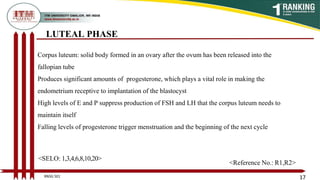
LUTEAL PHASE
Corpus luteum: solid body formed in an ovary after the ovum has been released into the
fallopian tube
Produces significant amounts of progesterone, which plays a vital role in making the
endometrium receptive to implantation of the blastocyst
High levels of E and P suppress production of FSH and LH that the corpus luteum needs to
maintain itself
Falling levels of progesterone trigger menstruation and the beginning of the next cycle
17
<SELO: 1,3,4,6,8,10,20>
<Reference No.: R1,R2>
BNSG 501
EXERCISE
18
BNSG 501
Explain the menstrual cycle
LEARNING OUTCOMES
BNSG 701 19
The student explain about
Explain about menstrual cycle.
Student effective learning outcome
1.Application of concepts of topic & it’s technological application.
2. Critical and innovative thinking skills
3.Life long learning ability
4.Ability to observe and develop sense making , logical skills for abstract concepts.
5.Ability to understand subject related concepts clearly along with contemporary issues
6.Ability to collaborate
7.Ability to be a lifelong learner
BNSG 501 20
REFERENCES
• Sara Howard (2013) Midwifery retrieved April 17, 2014 from www.powershow.com
• CordeliaS.H.(2014) A brief History Of Midwifery in America. Retrieved April 11, 2014 from
wholisticmaternalnewbornhealth.org/professio nal-education/history-of-midwifery
• midwifeinsight.com/articles/a-short-history-of- midwifery/,retrieved April 18,2014.
21
BNSG 501
BNSG 501 22

3.Menestrual Hygiene.pptx

  • 1.
    Program: B.Sc Nursing,3rd Year BNSG-501 MSN Unit No.2. Topic- Menstrual Cycle Lecture No. 3 Dr. Sudharani B Banappagoudar Professor, SONS/OBG 1 BNSG 501
  • 2.
    Outline • Introduction • Phasesof Menstrual cycle • Learning outcomes • Exercise • References 2 BNSG 501
  • 3.
    INTRODUCTION 3 <SELO: 1,3,4,6,8,10,20> <Reference No.:R1,R3> BNSG 501 A branch of medicine that specializes in the care of women during pregnancy and childbirth and in the diagnosis and treatment of diseases of the female reproductive organs. It also specializes in other women's health issues, such as menopause, hormone problems, contraception (birth control), and infertility. OB/GYN: A commonly used abbreviation. ... An obstetrician/gynecologist (OB/GYN) is therefore a physician who both delivers babies and treats diseases of the female reproductive organs.
  • 4.
    Objectives • The studentwill be able to Explain • Phases of Menstrual Cycle 4 <SELO: 1,3,4,6,8,10,20> <Reference No.: R1,R2> BNSG 501
  • 5.
  • 6.
    DEFINITION Rhythmical series ofphysiological changes that occur in fertile women Under the control of the endocrine system Necessary for reproduction Average length: 28 days, but typically varies, with shorter and longer cycles 6 <SELO: 1,3,4,6,8,10,20> <Reference No.: R1,R2> BNSG 501
  • 7.
    DEFINITION Menarche: a woman'sfirst menstruation typically occurs around age 12 occurrence depends on overall health and diet Menopause: end of a woman's reproductive phase, commonly occurs between ages 45 and 55 age of menopause is largely the result of genetics 7 <SELO: 1,3,4,6,8,10,20> <Reference No.: R1,R2> BNSG 501
  • 8.
    Physiological changes duringmenstrual cycle can be observed at three different levels: neuroendocrine level ovaries uterus Menstrual cycle can be divided into 3 phases: menstrual phase proliferative / follicular (estrogen) phase secretory / luteal phase (progesterone) phase 8 <SELO: 1,3,4,6,8,10,20> <Reference No.: R1,R2> BNSG 501
  • 9.
    Phase Average start andend day (assuming a 28-day cycle) Menstrual phase 1-4 Proliferative phase 5-13 Ovulation 13-16 Secretory phase 16-28 9 <SELO: 1,3,4,6,8,10,20> <Reference No.: R1,R2> BNSG 501
  • 10.
    MENSTRUAL PHASE Menstruation menstrual bleeding,menses, period discharge of bloody fluid containing endometrial cells, glandular secretions and blood cells, lasts 3 -5 days result of the previous menstrual cycle due to strong vasoconstriction and proteolytic activity, functional stratum of endometrial tissue dies and is discharged during menstrual bleeding 10 <SELO: 1,3,4,6,8,10,20> <Reference No.: R1,R2> BNSG 501
  • 11.
    MENSTRUAL PHASE Endometrium becomesvery thin, but due to low estrogen levels, hypophysis secretes more FSH FSH stimulates secretion of estrogen, and estrogen serves as proliferation signal to the endometrial basal layer 11 <SELO: 1,3,4,6,8,10,20> <Reference No.: R1,R2> BNSG 501
  • 12.
  • 13.
    FOLLICULAR PHASE Due tothe rise of follicle stimulating hormone (FSH) during the first days of the cycle, several ovarian follicles are stimulated Follicles compete with each other for dominance The follicle that reaches maturity is called a Graafian follicle 13 <SELO: 1,3,4,6,8,10,20> <Reference No.: R1,R2> BNSG 501
  • 14.
    FOLLICULAR PHASE As theymature, the follicles secrete increasing amounts of estrogen, which thickens the new functional layer of endometrium in the uterus Estrogen also stimulates crypts in the cervix to produce fertile cervical mucus At the end of this phase ovulation occurs 14 <SELO: 1,3,4,6,8,10,20> <Reference No.: R1,R2> BNSG 501
  • 15.
  • 16.
    OVULATION During the follicularphase, estrogen suppresses production of luteinizing hormone (LH) from the pituitary gland When the ovum has nearly matured, levels of estrogen reach a threshold above which they stimulate production of LH (positive feedback loop) The release of LH matures the ovum and weakens the wall of the follicle in the ovary, causing the fully developed follicle to release its secondary oocyte After being released from the ovary, the ovum is swept into the fallopian tube 16 <SELO: 1,3,4,6,8,10,20> <Reference No.: R1,R2> BNSG 501
  • 17.
    LUTEAL PHASE Corpus luteum:solid body formed in an ovary after the ovum has been released into the fallopian tube Produces significant amounts of progesterone, which plays a vital role in making the endometrium receptive to implantation of the blastocyst High levels of E and P suppress production of FSH and LH that the corpus luteum needs to maintain itself Falling levels of progesterone trigger menstruation and the beginning of the next cycle 17 <SELO: 1,3,4,6,8,10,20> <Reference No.: R1,R2> BNSG 501
  • 18.
  • 19.
    LEARNING OUTCOMES BNSG 70119 The student explain about Explain about menstrual cycle.
  • 20.
    Student effective learningoutcome 1.Application of concepts of topic & it’s technological application. 2. Critical and innovative thinking skills 3.Life long learning ability 4.Ability to observe and develop sense making , logical skills for abstract concepts. 5.Ability to understand subject related concepts clearly along with contemporary issues 6.Ability to collaborate 7.Ability to be a lifelong learner BNSG 501 20
  • 21.
    REFERENCES • Sara Howard(2013) Midwifery retrieved April 17, 2014 from www.powershow.com • CordeliaS.H.(2014) A brief History Of Midwifery in America. Retrieved April 11, 2014 from wholisticmaternalnewbornhealth.org/professio nal-education/history-of-midwifery • midwifeinsight.com/articles/a-short-history-of- midwifery/,retrieved April 18,2014. 21 BNSG 501
  • 22.