Construction Issues:
                           EPC Contracting and
                            FIDIC Silver Book
            Francis Ho                              An Update on Real Estate Laws in
            Senior Associate, King & Spalding LLP   the UAE and Saudi Arabia
            Email: fho@kslaw.com                    Radisson Blu Media City Hotel,
            Tel: +971 2 652 3426                    Dubai, UAE
            Mob: +971 50 557 0446                   31 January – 1 February 2010


428006 v1
EPC Contracts
        §  Engineering, procurement and construction contracts are most
            common form of contract used in major international infrastructure
            projects
        §  An EPC Contractor s obligations typically include:
        §  Turnkey responsibility to deliver:
              §  a complete facility
              §  for a guaranteed price
              §  by a guaranteed date
              §  which must perform to a specified level
        §  Because EPC Contracts involve Contractor taking a high level of
            risk they are, to some extent, resisted by contractors (partially due
            to high insurance costs). That said, they are still the dominant
            model because sponsors and lenders prefer certainty they offer

428006 v1                                                                           2
FIDIC Silver Book
        §  FIDIC – International Federation of Consulting
            Engineers
        §  Standard Forms of Contract widely used in international
            engineering and construction projects
        §  Range of contracts – White, Red, Yellow, Orange and
            Silver Books
        §  Silver book – Turnkey contract which departs from usual
            balance of risk allocation in FIDIC contracts


428006 v1                                                             3
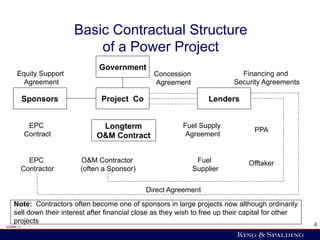
Basic Contractual Structure
                           of a Power Project
                                Government
      Equity Support                              Concession                  Financing and
        Agreement                                 Agreement                 Security Agreements

            Sponsors            Project Co                          Lenders


             EPC                Longterm                    Fuel Supply
                                                                                   PPA
            Contract           O&M Contract                  Agreement


          EPC             O&M Contractor                        Fuel             Offtaker
        Contractor        (often a Sponsor)                    Supplier

                                               Direct Agreement
    Note: Contractors often become one of sponsors in large projects now although ordinarily
    sell down their interest after financial close as they wish to free up their capital for other
    projects                                                                                         4
428006 v1
Bankability
        §  EPC contracts must have risk allocation that satisfies Lenders
        §  Lenders focus on ability (or more particularly the lack of) Contractor to
            claim:
             §  Additional costs; and/or
             §  Extensions of time
        §  Lenders also look to Contractor s security (e.g. parent company
            guarantees/bank guarantees securing Contractor s performance)
        §  The less comfortable Lenders are with the above, the more equity the
            Sponsors will be required to contribute
        §  Lenders will also need to be satisfied with technical risk
        §  Price is a general bankability issue also (but a broader project issue)
        §  Engineering, procurement and construction contracts are most common
            form of contract used


428006 v1                                                                               5
General Bankability Issues in
                    Construction Contracts
        §  Fixed completion date (Silver Book Art. 8.2)
        §  Fixed completion price (Silver Book Arts. 4.11 and 14.1)
        §  No or limited technology risk (Silver Book Arts. 5.8, 7.5, 9.1 and 11
            etc)
        §  Output guarantees (Silver Book – no performance LDs, rather
            obligations to remedy defects and/or reduction in contract price)
        §  Liquidated damages for both delay and performance
        §  Security from Contractor and/or its parent (Silver Book Art. 4.2)
        §  Large caps on liability – ideally none but often one is negotiated
            (Silver Book Art. 17.6)
        §  Restrictions on ability of Contractor to claim extensions of time and
            additional costs (Silver Book Arts. 13.1 and 13.4)
        §  An EPC Contract (and Silver Book with amendments) generally
            delivers above
428006 v1                                                                           6
Key Clauses in EPC Contracts and
                 Common Approaches (1)
        §  Single point of responsibility – Contractor is responsible for all design,
            engineering, procurement, construction, commissioning and testing
            activities. If EPC Contractor is a joint venture, liability/responsibility is joint
            and several (Silver Book Arts. 4.1 & 5 – fit for purpose )
        §  Fixed Contract Price – limited opportunities for Contractor to claim extra
            costs/time. Generally limited to directed variations to works (Silver Book
            Arts. 13.1, 14.1 and 20)
        §  Fixed completion date – guaranteed date for completion. Failure to meet
            this date will attract LDs. In order for these to be enforceable they must be
            a genuine pre-estimate of the loss that the project company will suffer if the
            power station is not completed on time (Silver Book Arts. 8.2, 13 and 20)
        §  Note: Additionally extension of time clause must provide for an EOT to be
            granted where Contractor is delayed due to act/omissions of owner/project
            company (Silver Book Art. 8.4(c))


428006 v1                                                                                         7
Key Clauses in EPC Contracts and
                Common Approaches (2)
        §  Performance Guarantees: Project Co s revenue will come from revenue
            from project. This is important to service project debt. It is vital then that
            facility performs in respect of output, efficiency and reliability. This is
            purpose of the Performance Liquidated Damages payable by the
            Contractor if performance requirements are not met. (Silver Book does not
            provide for performance liquidated damages – see e.g. Art. 9.4. Can be
            amended as required.)
        §  Performance Liquidated Damages must also be genuine pre-estimate of
            loss. They are usually calculated on net present value (less expenses)
            calculation of revenue foregone over the project
        §  E.g. in case of a power station what this might mean is if plant output is 5
            MW less than required performance liquidated damages will be designed
            to compensate project company for that loss of revenue for life of project
            by being unable to sell that 5 MW


428006 v1                                                                                    8
Key Clauses in EPC Contracts and
                Common Approaches (3)
        §  Caps on liability: most EPC Contractors will baulk at unlimited
            liability. Market is generally a cap at 100% of the Contract Price.
            Sub-caps of 20% of Contract Price on delay and performance
            liquidated damages also common (Silver Book – LOL is dealt with
            in Special Conditions – see Art. 17.6)
        §  Consequential damages are also generally excluded. Profit also
            often expressly excluded (Silver Book Art. 17.6)
        §  There may be some exceptions to those caps (e.g. wilful
            misconduct, breach of patent rights)
        §  Security – EPC Contract will require that performance security be
            supplied by the Contractor in respect of its obligations under EPC
            Contract (Silver Book Art. 4.2)


428006 v1                                                                         9
Key Clauses in EPC Contracts and
                Common Approaches (4)
        §  Market security includes:
             §  Bank guarantee for between 5-15% of Contract Price
             §  Retention (withholding of 5-15%) of each payment under EPC
                 contract (Silver Book Arts. 4.2 and 14.3(c) and Annex F)
             §  Advance Payment Guarantee – if an advance payment is made
                 (Silver Book Art. 4.2 and Annex E)
             §  Parent Company Guarantee – to secure Contractor s
                 performance if it does not perform (Silver Book Art. 4.2 and
                 Annex A)
        Variations
        §  Project Co must have right to order variations/agree to suggested
            variations – clause must contemplate omission of work as well as
            pricing (Silver Book Arts. 3.5 and 13)

428006 v1                                                                       10
Key Clauses in EPC Contracts and
                Common Approaches (5)
        Defects Liability
        §  Contractors required to repair defects 12-24 months following
            completion of performance testing – can be one period or tiered
            (Silver Book Art. 11)
        Intellectual Property
        §  Contractor must warrant it has the rights regarding any proposed
            LP. Also note there is often an indemnity for breach (Silver Book
            Art. 17.5)
        Force Majeure
        §  Parties excused from performance for certain Force Majeure events
            (Silver Book Art. 19)
        Suspension
        §  Project Co has this right (Silver Book Arts. 8.8 to 8.12)

428006 v1                                                                       11
Termination
        §  Contractor has very limited rights e.g. non-payment/
            extended suspension, material breach by employer
            (Silver Book Art. 16.2)

        §  Project company has much broader rights. This will be
            tied with third party agreements. Can terminate:
             §  For convenience (Silver Book Art. 15.5)
             §  For breach/insolvency, otherwise (Silver Book Art.
                 15.2)


428006 v1                                                             12
Power-specific Clauses in EPC
                        Contracts
        §  General interface issues:
            §  Commencement and completion dates
            §  LDs amounts and trigger points (NB: Silver Book does not
                provide for performance liquidated damages and will need
                adaptation)
            §  Caps on liability
            §  Indemnities
            §  Entitlements to extensions of time
            §  Force Majeure (Silver Book fairly wide, beyond a Party s
                Control and could not reasonably have been provided against
                before entering into the Contract )
            §  Third party interfaces
            §  Intellectual Property

428006 v1                                                                     13
Key Power Issues
        §  Grid Access
        §  EPC Contract must provide that Project Company provides Grid Access –
            this has 2 levels:
             §  (a) obligation to ensure that the infrastructure is in place; and
             §  (b) obligation to ensure that Contractor is permitted to export power
        §  Interfacing of commissioning and testing regimes (fuel for testing?)
        §  Consistency between testing/offtake/PPA regime? – important that they
            relate
        §  Interfacing of issues between the Offtaker and EPC Contractor
        §  Project company must control relationship with Offtaker (on-going
            relationship)
        §  Silver Book will require substantial modification – issues such as
            connection, metering, point of delivery and third party interfaces to be dealt
            with


428006 v1                                                                                    14
Key Performance Issues in Power
                       Projects (1)
        §  Liquidated Damages is main relevant provision governing
            performance
             §  Output LDs (how many mega watts produced)
             §  Heat rate (how much fuel burnt to produce required power
                 output)
        §  Delay liquidated damages
        Testing performance – most common approaches
        §  Functional Tests – pumps/conveyers/pressure vessels. Test
            functionality of parts at station but not whole station. Important as
            condition LDs will attach
        §  Emissions Tests – compliance against environmental requirements.
            Absolute obligation – generally not linked to LDs


428006 v1                                                                           15
Key Performance Issues in Power
                       Projects (2)
        §  Silver Book will require substantial modification to provide for
            performance liquidated damages and testing in power projects:
             §  Employer s remedy for defective plant accepted into service is
                 a reduction in the Contract Price; and
             §  Testing and commissioning provisions are generally defined
                 and require further definition – can use technical schedules
             §  Guarantee Tests – these are the ability of power station to meet
                 the performance criteria set out in Contract
             §  Generally these are set at maximum level of required
                 performance. Lender s input will be important in determining
                 this level. Lender s interest though will be that debt service
                 obligations are met – Sponsor s interest will be to get optimal
                 performances


428006 v1                                                                           16
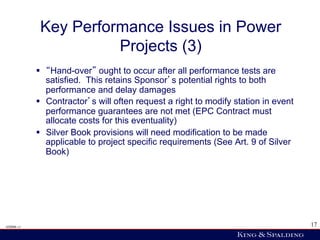
Key Performance Issues in Power
                        Projects (3)
            §   Hand-over ought to occur after all performance tests are
                satisfied. This retains Sponsor s potential rights to both
                performance and delay damages
            §  Contractor s will often request a right to modify station in event
                performance guarantees are not met (EPC Contract must
                allocate costs for this eventuality)
            §  Silver Book provisions will need modification to be made
                applicable to project specific requirements (See Art. 9 of Silver
                Book)


428006 v1                                                                            17
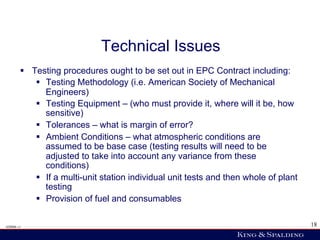
Technical Issues
        §  Testing procedures ought to be set out in EPC Contract including:
             §  Testing Methodology (i.e. American Society of Mechanical
                 Engineers)
             §  Testing Equipment – (who must provide it, where will it be, how
                 sensitive)
             §  Tolerances – what is margin of error?
             §  Ambient Conditions – what atmospheric conditions are
                 assumed to be base case (testing results will need to be
                 adjusted to take into account any variance from these
                 conditions)
             §  If a multi-unit station individual unit tests and then whole of plant
                 testing
             §  Provision of fuel and consumables

428006 v1                                                                                18
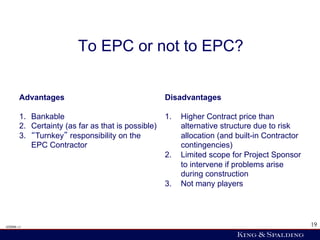
To EPC or not to EPC?


       Advantages                                   Disadvantages

       1.  Bankable                                 1.    Higher Contract price than
       2.  Certainty (as far as that is possible)         alternative structure due to risk
       3.  Turnkey responsibility on the                  allocation (and built-in Contractor
           EPC Contractor                                 contingencies)
                                                    2.    Limited scope for Project Sponsor
                                                          to intervene if problems arise
                                                          during construction
                                                    3.    Not many players


428006 v1                                                                                       19
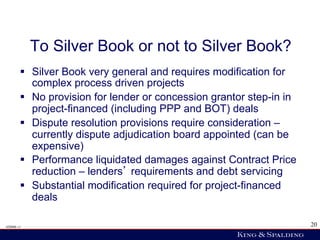
To Silver Book or not to Silver Book?
        §  Silver Book very general and requires modification for
            complex process driven projects
        §  No provision for lender or concession grantor step-in in
            project-financed (including PPP and BOT) deals
        §  Dispute resolution provisions require consideration –
            currently dispute adjudication board appointed (can be
            expensive)
        §  Performance liquidated damages against Contract Price
            reduction – lenders requirements and debt servicing
        §  Substantial modification required for project-financed
            deals

428006 v1                                                              20

FIDIC SIlver Book in Power Projects

  • 1.
    Construction Issues: EPC Contracting and FIDIC Silver Book Francis Ho An Update on Real Estate Laws in Senior Associate, King & Spalding LLP the UAE and Saudi Arabia Email: fho@kslaw.com Radisson Blu Media City Hotel, Tel: +971 2 652 3426 Dubai, UAE Mob: +971 50 557 0446 31 January – 1 February 2010 428006 v1
  • 2.
    EPC Contracts §  Engineering, procurement and construction contracts are most common form of contract used in major international infrastructure projects §  An EPC Contractor s obligations typically include: §  Turnkey responsibility to deliver: §  a complete facility §  for a guaranteed price §  by a guaranteed date §  which must perform to a specified level §  Because EPC Contracts involve Contractor taking a high level of risk they are, to some extent, resisted by contractors (partially due to high insurance costs). That said, they are still the dominant model because sponsors and lenders prefer certainty they offer 428006 v1 2
  • 3.
    FIDIC Silver Book §  FIDIC – International Federation of Consulting Engineers §  Standard Forms of Contract widely used in international engineering and construction projects §  Range of contracts – White, Red, Yellow, Orange and Silver Books §  Silver book – Turnkey contract which departs from usual balance of risk allocation in FIDIC contracts 428006 v1 3
  • 4.
    Basic Contractual Structure of a Power Project Government Equity Support Concession Financing and Agreement Agreement Security Agreements Sponsors Project Co Lenders EPC Longterm Fuel Supply PPA Contract O&M Contract Agreement EPC O&M Contractor Fuel Offtaker Contractor (often a Sponsor) Supplier Direct Agreement Note: Contractors often become one of sponsors in large projects now although ordinarily sell down their interest after financial close as they wish to free up their capital for other projects 4 428006 v1
  • 5.
    Bankability §  EPC contracts must have risk allocation that satisfies Lenders §  Lenders focus on ability (or more particularly the lack of) Contractor to claim: §  Additional costs; and/or §  Extensions of time §  Lenders also look to Contractor s security (e.g. parent company guarantees/bank guarantees securing Contractor s performance) §  The less comfortable Lenders are with the above, the more equity the Sponsors will be required to contribute §  Lenders will also need to be satisfied with technical risk §  Price is a general bankability issue also (but a broader project issue) §  Engineering, procurement and construction contracts are most common form of contract used 428006 v1 5
  • 6.
    General Bankability Issuesin Construction Contracts §  Fixed completion date (Silver Book Art. 8.2) §  Fixed completion price (Silver Book Arts. 4.11 and 14.1) §  No or limited technology risk (Silver Book Arts. 5.8, 7.5, 9.1 and 11 etc) §  Output guarantees (Silver Book – no performance LDs, rather obligations to remedy defects and/or reduction in contract price) §  Liquidated damages for both delay and performance §  Security from Contractor and/or its parent (Silver Book Art. 4.2) §  Large caps on liability – ideally none but often one is negotiated (Silver Book Art. 17.6) §  Restrictions on ability of Contractor to claim extensions of time and additional costs (Silver Book Arts. 13.1 and 13.4) §  An EPC Contract (and Silver Book with amendments) generally delivers above 428006 v1 6
  • 7.
    Key Clauses inEPC Contracts and Common Approaches (1) §  Single point of responsibility – Contractor is responsible for all design, engineering, procurement, construction, commissioning and testing activities. If EPC Contractor is a joint venture, liability/responsibility is joint and several (Silver Book Arts. 4.1 & 5 – fit for purpose ) §  Fixed Contract Price – limited opportunities for Contractor to claim extra costs/time. Generally limited to directed variations to works (Silver Book Arts. 13.1, 14.1 and 20) §  Fixed completion date – guaranteed date for completion. Failure to meet this date will attract LDs. In order for these to be enforceable they must be a genuine pre-estimate of the loss that the project company will suffer if the power station is not completed on time (Silver Book Arts. 8.2, 13 and 20) §  Note: Additionally extension of time clause must provide for an EOT to be granted where Contractor is delayed due to act/omissions of owner/project company (Silver Book Art. 8.4(c)) 428006 v1 7
  • 8.
    Key Clauses inEPC Contracts and Common Approaches (2) §  Performance Guarantees: Project Co s revenue will come from revenue from project. This is important to service project debt. It is vital then that facility performs in respect of output, efficiency and reliability. This is purpose of the Performance Liquidated Damages payable by the Contractor if performance requirements are not met. (Silver Book does not provide for performance liquidated damages – see e.g. Art. 9.4. Can be amended as required.) §  Performance Liquidated Damages must also be genuine pre-estimate of loss. They are usually calculated on net present value (less expenses) calculation of revenue foregone over the project §  E.g. in case of a power station what this might mean is if plant output is 5 MW less than required performance liquidated damages will be designed to compensate project company for that loss of revenue for life of project by being unable to sell that 5 MW 428006 v1 8
  • 9.
    Key Clauses inEPC Contracts and Common Approaches (3) §  Caps on liability: most EPC Contractors will baulk at unlimited liability. Market is generally a cap at 100% of the Contract Price. Sub-caps of 20% of Contract Price on delay and performance liquidated damages also common (Silver Book – LOL is dealt with in Special Conditions – see Art. 17.6) §  Consequential damages are also generally excluded. Profit also often expressly excluded (Silver Book Art. 17.6) §  There may be some exceptions to those caps (e.g. wilful misconduct, breach of patent rights) §  Security – EPC Contract will require that performance security be supplied by the Contractor in respect of its obligations under EPC Contract (Silver Book Art. 4.2) 428006 v1 9
  • 10.
    Key Clauses inEPC Contracts and Common Approaches (4) §  Market security includes: §  Bank guarantee for between 5-15% of Contract Price §  Retention (withholding of 5-15%) of each payment under EPC contract (Silver Book Arts. 4.2 and 14.3(c) and Annex F) §  Advance Payment Guarantee – if an advance payment is made (Silver Book Art. 4.2 and Annex E) §  Parent Company Guarantee – to secure Contractor s performance if it does not perform (Silver Book Art. 4.2 and Annex A) Variations §  Project Co must have right to order variations/agree to suggested variations – clause must contemplate omission of work as well as pricing (Silver Book Arts. 3.5 and 13) 428006 v1 10
  • 11.
    Key Clauses inEPC Contracts and Common Approaches (5) Defects Liability §  Contractors required to repair defects 12-24 months following completion of performance testing – can be one period or tiered (Silver Book Art. 11) Intellectual Property §  Contractor must warrant it has the rights regarding any proposed LP. Also note there is often an indemnity for breach (Silver Book Art. 17.5) Force Majeure §  Parties excused from performance for certain Force Majeure events (Silver Book Art. 19) Suspension §  Project Co has this right (Silver Book Arts. 8.8 to 8.12) 428006 v1 11
  • 12.
    Termination §  Contractor has very limited rights e.g. non-payment/ extended suspension, material breach by employer (Silver Book Art. 16.2) §  Project company has much broader rights. This will be tied with third party agreements. Can terminate: §  For convenience (Silver Book Art. 15.5) §  For breach/insolvency, otherwise (Silver Book Art. 15.2) 428006 v1 12
  • 13.
    Power-specific Clauses inEPC Contracts §  General interface issues: §  Commencement and completion dates §  LDs amounts and trigger points (NB: Silver Book does not provide for performance liquidated damages and will need adaptation) §  Caps on liability §  Indemnities §  Entitlements to extensions of time §  Force Majeure (Silver Book fairly wide, beyond a Party s Control and could not reasonably have been provided against before entering into the Contract ) §  Third party interfaces §  Intellectual Property 428006 v1 13
  • 14.
    Key Power Issues §  Grid Access §  EPC Contract must provide that Project Company provides Grid Access – this has 2 levels: §  (a) obligation to ensure that the infrastructure is in place; and §  (b) obligation to ensure that Contractor is permitted to export power §  Interfacing of commissioning and testing regimes (fuel for testing?) §  Consistency between testing/offtake/PPA regime? – important that they relate §  Interfacing of issues between the Offtaker and EPC Contractor §  Project company must control relationship with Offtaker (on-going relationship) §  Silver Book will require substantial modification – issues such as connection, metering, point of delivery and third party interfaces to be dealt with 428006 v1 14
  • 15.
    Key Performance Issuesin Power Projects (1) §  Liquidated Damages is main relevant provision governing performance §  Output LDs (how many mega watts produced) §  Heat rate (how much fuel burnt to produce required power output) §  Delay liquidated damages Testing performance – most common approaches §  Functional Tests – pumps/conveyers/pressure vessels. Test functionality of parts at station but not whole station. Important as condition LDs will attach §  Emissions Tests – compliance against environmental requirements. Absolute obligation – generally not linked to LDs 428006 v1 15
  • 16.
    Key Performance Issuesin Power Projects (2) §  Silver Book will require substantial modification to provide for performance liquidated damages and testing in power projects: §  Employer s remedy for defective plant accepted into service is a reduction in the Contract Price; and §  Testing and commissioning provisions are generally defined and require further definition – can use technical schedules §  Guarantee Tests – these are the ability of power station to meet the performance criteria set out in Contract §  Generally these are set at maximum level of required performance. Lender s input will be important in determining this level. Lender s interest though will be that debt service obligations are met – Sponsor s interest will be to get optimal performances 428006 v1 16
  • 17.
    Key Performance Issuesin Power Projects (3) §  Hand-over ought to occur after all performance tests are satisfied. This retains Sponsor s potential rights to both performance and delay damages §  Contractor s will often request a right to modify station in event performance guarantees are not met (EPC Contract must allocate costs for this eventuality) §  Silver Book provisions will need modification to be made applicable to project specific requirements (See Art. 9 of Silver Book) 428006 v1 17
  • 18.
    Technical Issues §  Testing procedures ought to be set out in EPC Contract including: §  Testing Methodology (i.e. American Society of Mechanical Engineers) §  Testing Equipment – (who must provide it, where will it be, how sensitive) §  Tolerances – what is margin of error? §  Ambient Conditions – what atmospheric conditions are assumed to be base case (testing results will need to be adjusted to take into account any variance from these conditions) §  If a multi-unit station individual unit tests and then whole of plant testing §  Provision of fuel and consumables 428006 v1 18
  • 19.
    To EPC ornot to EPC? Advantages Disadvantages 1.  Bankable 1.  Higher Contract price than 2.  Certainty (as far as that is possible) alternative structure due to risk 3.  Turnkey responsibility on the allocation (and built-in Contractor EPC Contractor contingencies) 2.  Limited scope for Project Sponsor to intervene if problems arise during construction 3.  Not many players 428006 v1 19
  • 20.
    To Silver Bookor not to Silver Book? §  Silver Book very general and requires modification for complex process driven projects §  No provision for lender or concession grantor step-in in project-financed (including PPP and BOT) deals §  Dispute resolution provisions require consideration – currently dispute adjudication board appointed (can be expensive) §  Performance liquidated damages against Contract Price reduction – lenders requirements and debt servicing §  Substantial modification required for project-financed deals 428006 v1 20