FRP
FIBRE
REINFORCED
PLASTIC
About FRP
• Fibre-reinforced plastic is a
composite material made of a
polymer matrix reinforced with
fibers.
• The fibers are usually glass, carbon,
aramid, or basalt.
• Rarely, other fibers such as paper,
wood, or asbestos have been used
Add a footer 2
Add a footer 3
PROCESS DESCRIPTION
• FRP involves two distinct processes, the first is the process whereby the
fibrous material is manufactured and formed, the second is the process
whereby fibrous materials are bonded with the matrix during moulding
• When combined with various agents to enhance or in any way alter the
material properties of polymers the result is referred to as plastic.
• Composite plastics refer to those types of plastics that result from bonding
two or more homogenous materials with different material properties to
derive a final product with certain desired material and mechanical
properties.
• Fibre reinforced plastics are a category of composite plastics
that specifically use fibre materials to mechanically enhance
the strength and elasticity of plastics.
• The original plastic material without fibre reinforcement is
known as the matrix. The matrix is a tough but relatively weak
plastic that is reinforced by stronger stiffer reinforcing
filaments or fibres.
COMMONLY USED FIBRES
Add a footer 5
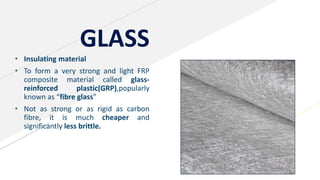
GLASS
• Insulating material
• To form a very strong and light FRP
composite material called glass-
reinforced plastic(GRP),popularly
known as “fibre glass”
• Not as strong or as rigid as carbon
fibre, it is much cheaper and
significantly less brittle.
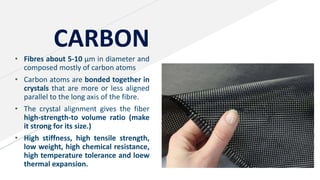
CARBON
• Fibres about 5-10 µm in diameter and
composed mostly of carbon atoms
• Carbon atoms are bonded together in
crystals that are more or less aligned
parallel to the long axis of the fibre.
• The crystal alignment gives the fiber
high-strength-to volume ratio (make
it strong for its size.)
• High stiffness, high tensile strength,
low weight, high chemical resistance,
high temperature tolerance and loew
thermal expansion.
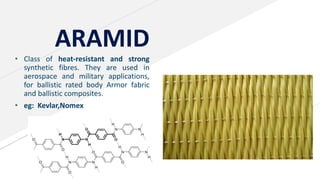
ARAMID
• Class of heat-resistant and strong
synthetic fibres. They are used in
aerospace and military applications,
for ballistic rated body Armor fabric
and ballistic composites.
• eg: Kevlar,Nomex
Add a footer 9
Silicon, aluminium oxide and metal wires are also
used as reinforcing material
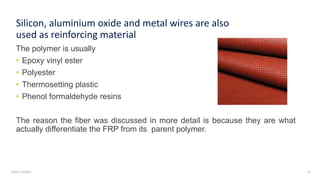
The polymer is usually
• Epoxy vinyl ester
• Polyester
• Thermosetting plastic
• Phenol formaldehyde resins
The reason the fiber was discussed in more detail is because they are what
actually differentiate the FRP from its parent polymer.
Add a footer 10
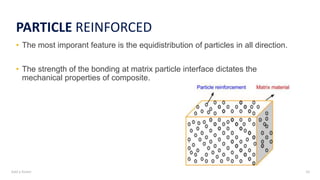
PARTICLE REINFORCED
• The most imporant feature is the equidistribution of particles in all direction.
• The strength of the bonding at matrix particle interface dictates the
mechanical properties of composite.
Add a footer 11
PROPERTIES
• Low coefficient of expansion
• High dimensional stability
• High tensile strength
• High heat stability
• Better toughness and impact strength
APPLICATIONS
Add a footer 12
AEROSPACE
MISSILE TECH
AUTOMOTIVES
• HIGH SPEED MACHINERY
• EQIPMENT PARTS
• COOLERS
• OFFICE CABINS
• ROOM INSULATIONS

Fiber Reinforced Plastic

  • 1.
  • 2.
    About FRP • Fibre-reinforcedplastic is a composite material made of a polymer matrix reinforced with fibers. • The fibers are usually glass, carbon, aramid, or basalt. • Rarely, other fibers such as paper, wood, or asbestos have been used Add a footer 2
  • 3.
    Add a footer3 PROCESS DESCRIPTION • FRP involves two distinct processes, the first is the process whereby the fibrous material is manufactured and formed, the second is the process whereby fibrous materials are bonded with the matrix during moulding • When combined with various agents to enhance or in any way alter the material properties of polymers the result is referred to as plastic. • Composite plastics refer to those types of plastics that result from bonding two or more homogenous materials with different material properties to derive a final product with certain desired material and mechanical properties.
  • 4.
    • Fibre reinforcedplastics are a category of composite plastics that specifically use fibre materials to mechanically enhance the strength and elasticity of plastics. • The original plastic material without fibre reinforcement is known as the matrix. The matrix is a tough but relatively weak plastic that is reinforced by stronger stiffer reinforcing filaments or fibres.
  • 5.
  • 6.
    GLASS • Insulating material •To form a very strong and light FRP composite material called glass- reinforced plastic(GRP),popularly known as “fibre glass” • Not as strong or as rigid as carbon fibre, it is much cheaper and significantly less brittle.
  • 7.
    CARBON • Fibres about5-10 µm in diameter and composed mostly of carbon atoms • Carbon atoms are bonded together in crystals that are more or less aligned parallel to the long axis of the fibre. • The crystal alignment gives the fiber high-strength-to volume ratio (make it strong for its size.) • High stiffness, high tensile strength, low weight, high chemical resistance, high temperature tolerance and loew thermal expansion.
  • 8.
    ARAMID • Class ofheat-resistant and strong synthetic fibres. They are used in aerospace and military applications, for ballistic rated body Armor fabric and ballistic composites. • eg: Kevlar,Nomex
  • 9.
    Add a footer9 Silicon, aluminium oxide and metal wires are also used as reinforcing material The polymer is usually • Epoxy vinyl ester • Polyester • Thermosetting plastic • Phenol formaldehyde resins The reason the fiber was discussed in more detail is because they are what actually differentiate the FRP from its parent polymer.
  • 10.
    Add a footer10 PARTICLE REINFORCED • The most imporant feature is the equidistribution of particles in all direction. • The strength of the bonding at matrix particle interface dictates the mechanical properties of composite.
  • 11.
    Add a footer11 PROPERTIES • Low coefficient of expansion • High dimensional stability • High tensile strength • High heat stability • Better toughness and impact strength
  • 12.
  • 13.
  • 14.
  • 15.
  • 16.
    • HIGH SPEEDMACHINERY • EQIPMENT PARTS • COOLERS • OFFICE CABINS • ROOM INSULATIONS