BUILDING MATERIALS
EPOXY GRANITE
WHAT IS EPOXY GRANITE AND ITS
HISTORY?
• Also known as “Synthetic granite” or “Polymer Concrete”.
• Mixture of epoxy resin as a binder and granite as the core material.
• Commonly used as an alternative material for machine tool bases.
• Epoxy granite is used instead of cast iron and steel for better vibration damping, longer tool life, and
lower assembly cost.
History
• Although new to many machine tool builders, especially those in the United States, the composite base
has been available in Europe for several years.
• Fritz Studer AG of Switzerland first came up with its Granitan S-100 technology in the early 1970s.
• The Granitan base is a mixture of reactable epoxy-resin binder developed by Ciba-Geigy Ltd.,
Switzerland, and granite or gravel.
• Granitan produced with sand and gravel was developed specifically for the requirements of machine
structure manufacturing. Studer has also been selling licenses for its technology. So far, between 20 and
30 companies worldwide have purchased such licenses, including six U.S machine tool builders.
MANUFACTURING PROCESS
• Epoxy granite aggregate
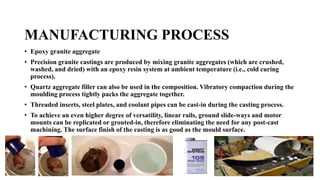
• Precision granite castings are produced by mixing granite aggregates (which are crushed,
washed, and dried) with an epoxy resin system at ambient temperature (i.e., cold curing
process).
• Quartz aggregate filler can also be used in the composition. Vibratory compaction during the
moulding process tightly packs the aggregate together.
• Threaded inserts, steel plates, and coolant pipes can be cast-in during the casting process.
• To achieve an even higher degree of versatility, linear rails, ground slide-ways and motor
mounts can be replicated or grouted-in, therefore eliminating the need for any post-cast
machining. The surface finish of the casting is as good as the mould surface.
WHY & WHERE IS IT USED?
• Used as Machine Tool Base
• Machine tools and other high-precision machines rely upon high stiffness, long-term stability, and
excellent damping characteristics of the base material for their static and dynamic performance.
• Good-quality natural granite is becoming more and more difficult to find, but has a higher damping
capacity than cast iron. Again, as with cast iron, the machining of natural granite is labour intensive
and expensive.
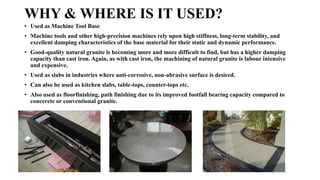
• Used as slabs in industries where anti-corrosive, non-abrasive surface is desired.
• Can also be used as kitchen slabs, table-tops, counter-tops etc.
• Also used as floorfinishing, path finishing due to its improved footfall bearing capacity compared to
concerete or conventional granite.
ADVANTAGES
• Vibration damping.
• Flexibility: custom linear ways, hydraulic fluid tanks, threaded inserts, cutting fluid, and conduit
piping can all be integrated into the polymer base.
• Inclusion of inserts etc. allows greatly reduced machining of the finished casting.
• Assembly time is reduced by incorporating multiple components into one casting.
• Does not require a uniform wall thickness, allowing for greater design flexibility of your base.
• Chemical resistance to most common solvents, acids, alkalis, and cutting fluids.
• Does not require painting.
• Composite has a density approximately the same as aluminum (but pieces are thicker to achieve
equivalent strength).
• The composite polymer concrete casting process uses much less energy than metallic castings. Polymer
cast resins use very little energy to produce, and the casting process is done at room temperature.
• Epoxy granite material has an internal damping factor up to ten times better than cast iron, up to three
times better than natural granite, and up to thirty times better than steel fabricated structure. It is
more cost-effective, unaffected by coolants, has excellent long-term stability, improved thermal
stability, high torsional and dynamic stiffness, excellent noise absorption, and it's low exothermic
curing property aids toward negligible internal stresses.

Epoxy granite

  • 1.
  • 2.
    WHAT IS EPOXYGRANITE AND ITS HISTORY? • Also known as “Synthetic granite” or “Polymer Concrete”. • Mixture of epoxy resin as a binder and granite as the core material. • Commonly used as an alternative material for machine tool bases. • Epoxy granite is used instead of cast iron and steel for better vibration damping, longer tool life, and lower assembly cost. History • Although new to many machine tool builders, especially those in the United States, the composite base has been available in Europe for several years. • Fritz Studer AG of Switzerland first came up with its Granitan S-100 technology in the early 1970s. • The Granitan base is a mixture of reactable epoxy-resin binder developed by Ciba-Geigy Ltd., Switzerland, and granite or gravel. • Granitan produced with sand and gravel was developed specifically for the requirements of machine structure manufacturing. Studer has also been selling licenses for its technology. So far, between 20 and 30 companies worldwide have purchased such licenses, including six U.S machine tool builders.
  • 3.
    MANUFACTURING PROCESS • Epoxygranite aggregate • Precision granite castings are produced by mixing granite aggregates (which are crushed, washed, and dried) with an epoxy resin system at ambient temperature (i.e., cold curing process). • Quartz aggregate filler can also be used in the composition. Vibratory compaction during the moulding process tightly packs the aggregate together. • Threaded inserts, steel plates, and coolant pipes can be cast-in during the casting process. • To achieve an even higher degree of versatility, linear rails, ground slide-ways and motor mounts can be replicated or grouted-in, therefore eliminating the need for any post-cast machining. The surface finish of the casting is as good as the mould surface.
  • 4.
    WHY & WHEREIS IT USED? • Used as Machine Tool Base • Machine tools and other high-precision machines rely upon high stiffness, long-term stability, and excellent damping characteristics of the base material for their static and dynamic performance. • Good-quality natural granite is becoming more and more difficult to find, but has a higher damping capacity than cast iron. Again, as with cast iron, the machining of natural granite is labour intensive and expensive. • Used as slabs in industries where anti-corrosive, non-abrasive surface is desired. • Can also be used as kitchen slabs, table-tops, counter-tops etc. • Also used as floorfinishing, path finishing due to its improved footfall bearing capacity compared to concerete or conventional granite.
  • 5.
    ADVANTAGES • Vibration damping. •Flexibility: custom linear ways, hydraulic fluid tanks, threaded inserts, cutting fluid, and conduit piping can all be integrated into the polymer base. • Inclusion of inserts etc. allows greatly reduced machining of the finished casting. • Assembly time is reduced by incorporating multiple components into one casting. • Does not require a uniform wall thickness, allowing for greater design flexibility of your base. • Chemical resistance to most common solvents, acids, alkalis, and cutting fluids. • Does not require painting. • Composite has a density approximately the same as aluminum (but pieces are thicker to achieve equivalent strength). • The composite polymer concrete casting process uses much less energy than metallic castings. Polymer cast resins use very little energy to produce, and the casting process is done at room temperature. • Epoxy granite material has an internal damping factor up to ten times better than cast iron, up to three times better than natural granite, and up to thirty times better than steel fabricated structure. It is more cost-effective, unaffected by coolants, has excellent long-term stability, improved thermal stability, high torsional and dynamic stiffness, excellent noise absorption, and it's low exothermic curing property aids toward negligible internal stresses.