Fiberglass

                a.k.a.
   Glass-reinforced plastic (GRP)
Glass-fiber reinforced plastic (GFRP)
Source: http://chemsrv1.uwsp.edu/fire/FireCD/macrog/mpm/composit/fiber/fibeglas/history.htm


                                                       History
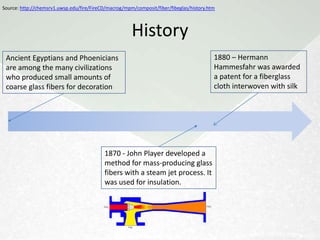
 Ancient Egyptians and Phoenicians                                                        1880 – Hermann
 are among the many civilizations                                                         Hammesfahr was awarded
 who produced small amounts of                                                            a patent for a fiberglass
 coarse glass fibers for decoration                                                       cloth interwoven with silk


                                           1870 - John Player developed a
                                           method for mass-producing glass
                                           fibers with a steam jet process. It
                                           was used for insulation.
Source: http://chemsrv1.uwsp.edu/fire/FireCD/macrog/mpm/composit/fiber/fibeglas/history.htm


                                                       History
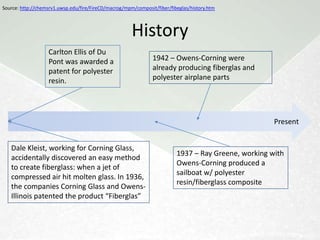
                   Carlton Ellis of Du
                   Pont was awarded a                           1942 – Owens-Corning were
                   patent for polyester                         already producing fiberglas and
                   resin.                                       polyester airplane parts


                                                                                                      Present


   Dale Kleist, working for Corning
                                                                          1937 – Ray Greene, working with
   Glass, accidentally discovered an easy
                                                                          Owens-Corning produced a
   method to create fiberglass: when a jet
                                                                          sailboat w/ polyester
   of compressed air hit molten glass. In
                                                                          resin/fiberglass composite
   1936, the companies Corning Glass and
   Owens-Illinois patented the product
   “Fiberglas”
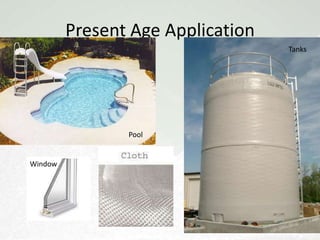
Present Age Application
                                   Tanks


                Pool


Window
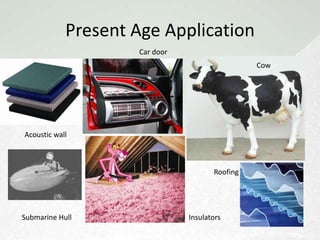
Present Age Application
                    Car door
                                                Cow


Acoustic wall


                                      Roofing


Submarine Hull                 Insulators
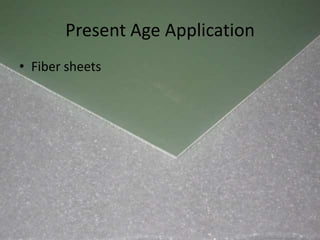
Present Age Application


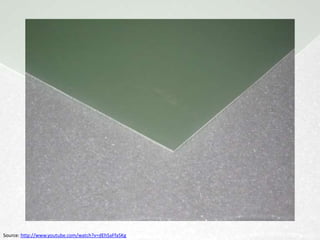
• Fiber sheets
Fiberglass

• Composite material using resin as matrix and
  glass fiber as reinforcement
Reinforcement

GLASS FIBER
Source: http://www.umaine.edu/adhesion/gardner/5502002/glass%20fibers.pdf


                                               Glass Fiber
       • Properties
             – Mechanical Properties
                    • similar to glass but different strength value
             – Chemical Stability
                    • Susceptible to alkaline solutions and hot water
             – Thermal Properties
                    • High heat resistance
             – Electrical Properties
                    • insulator
         Return to Contents                                                 Next: Processing
Source: http://www.madehow.com/Volume-2/Fiberglass.html#b


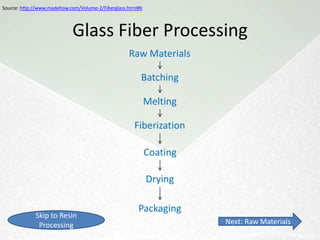
                            Glass Fiber Processing
                                                   Raw Materials

                                                        Batching

                                                            Melting

                                                     Fiberization

                                                            Coating

                                                            Drying

                                                       Packaging
         Return to Contents                                           Next: Raw Materials
Source: http://www.madehow.com/Volume-2/Fiberglass.html#b

                               Glass Fiber Processing
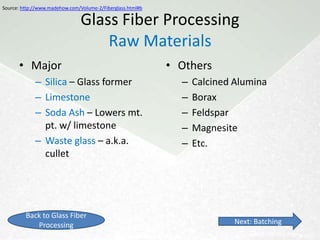
                                   Raw Materials
      • Major                                               • Others
             – Silica – Glass former                          –   Calcined Alumina
             – Limestone                                      –   Borax
             – Soda Ash – Lowers mt.                          –   Feldspar
               pt. w/ limestone                               –   Magnesite
             – Waste glass – a.k.a.                           –   Etc.
               cullet


         Return to Contents                                                Next: Batching
Source: http://www.compositesworld.com/articles/the-making-of-glass-fiber

                                  Glass Fiber Processing
                                         Batching
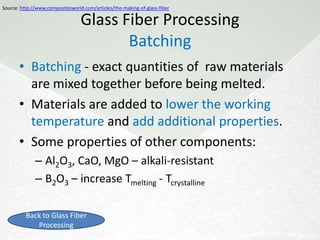
       • Batching - exact quantities of raw materials
         are mixed together before being melted.
       • Materials are added to lower the working
         temperature and add additional properties.
       • Some properties of other components:
              – Al2O3, CaO, MgO – alkali-resistant
              – B2O3 – increase Tmelting - Tcrystalline
Source: http://www.compositesworld.com/articles/the-making-of-glass-fiber

                                  Glass Fiber Processing
                                         Batching
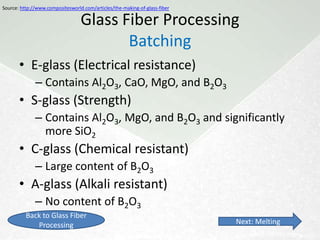
       • E-glass (Electrical resistance)
              – Contains Al2O3, CaO, MgO, and B2O3
       • S-glass (Strength)
              – Contains Al2O3, MgO, and B2O3 and significantly
                more SiO2
       • C-glass (Chemical resistant)
              – Large content of B2O3
       • A-glass (Alkali resistant)
              – No content of B2O3
          Return to Contents                                                Next: Melting
Source: http://www.compositesworld.com/articles/the-making-of-glass-fiber

                                  Glass Fiber Processing
                                         Melting
       • Common furnaces has three sections:
              – “Receiver”
                     • The batch is melted and uniformly. Bubbles are also
                       removed
                     • High temperature ( 1400oC or 2552oF)
              – Refiner
                     • High temperature ( 1370oC or 2500oF)
              – Forehearth – beneath this is are bushings
Source: http://www.compositesworld.com/articles/the-making-of-glass-fiber

                                  Glass Fiber Processing
                                         Melting
       • Three approaches to melting
              – Indirect melt – a.k.a. marble remelt
                     • Molten glass is sheared and rolled into marbles w/
                       diameter of 0.62 inch (15-16 mm), then cooled and
                       packaged to a fiberization process.
                     • Useful for outsourcing
              – Large-scale direct melt
                     • 8000-100000 tons per year
              – Small-scale direct melt – a.k.a. paramelters
                     • 150 to 200 metric tons per year

          Return to Contents                                                Next: Fiberization
Source: http://www.compositesworld.com/articles/the-making-of-glass-fiber

                                  Glass Fiber Processing
                                       Fiberization
       • Extrusion                                                     • Attenuation
              – Extruded through 200-                                       – Drawing extruded
                8000 bushings made of                                         molten glass into
                Pt-Rh alloy                                                   filaments using high-
              – Bushings are heated                                           speed winder (tangential
                electronically to                                             speed of ~2miles/~3km
                maintain T                                                    per minute)
                ( 1204oC/2200oF) and                                        – High-speed winding
                consequently, glass                                           applies tension
                viscosity and thickness                                     – Diameter 4 m to 34 m

       *Varying cooling process change the form of the fiber
Source: http://www.compositesworld.com/articles/the-making-of-glass-fiber

                                  Glass Fiber Processing
                                       Fiberization


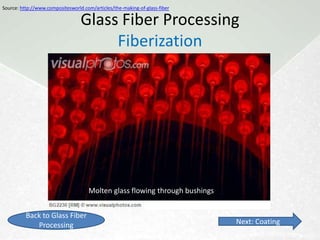
                                     Molten glass flowing through bushings


          Back to Glass Fiber
             Processing                                                      Next: Coating
Source: http://www.compositesworld.com/articles/the-making-of-glass-fiber

                                  Glass Fiber Processing
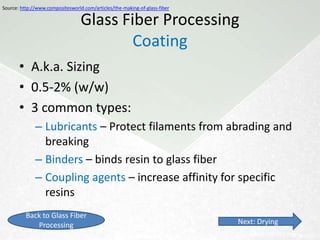
                                          Coating
       • A.k.a. Sizing
       • 0.5-2% (w/w)
       • 3 common types:
              – Lubricants – Protect filaments from abrading and
                breaking
              – Binders – binds resin to glass fiber
              – Coupling agents – increase affinity for specific
                resins
          Back to Glass Fiber
             Processing                                                     Next: Drying
Source: http://www.compositesworld.com/articles/the-making-of-glass-fiber

                                  Glass Fiber Processing
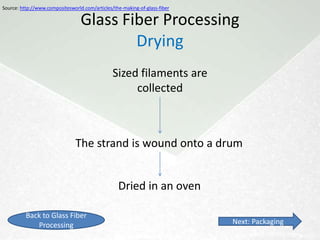
                                          Drying
                                                Sized filaments are
                                                     collected


                               The strand is wound onto a drum


                                                  Dried in an oven
Source: http://www.umaine.edu/adhesion/gardner/5502002/glass%20fibers.pdf

                                Glass Fiber Processing
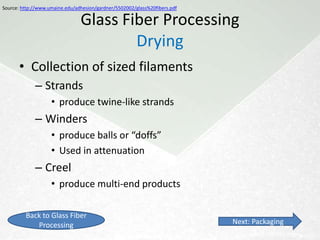
                                        Drying
       • Collection of sized filaments
             – Strands
                    • produce twine-like strands
             – Winders
                    • produce balls or “doffs”
                    • Used in attenuation
             – Creel
                    • produce multi-end products

         Back to Glass Fiber
            Processing                                                      Next: Packaging
Source: http://www.madehow.com/Volume-2/Fiberglass.html#b

                               Glass Fiber Processing
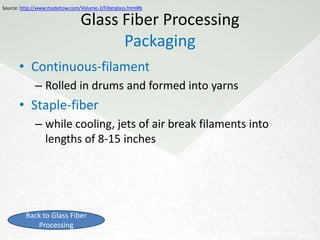
                                     Packaging


      • Continuous-filament
             – Rolled in drums and formed into yarns
      • Staple-fiber
             – while cooling, jets of air break filaments into
               lengths of 8-15 inches
Source: http://www.madehow.com/Volume-2/Fiberglass.html#b

                               Glass Fiber Processing
                                     Packaging
      • Chopped fiber
             – Yarns are chopped into short, uniform lengths
      • Glass wool
             – Cooling involves a downward jet of (hot)
               air, making the fibers fall randomly onto a
               conveyor belt, forming a fleecy mass


         Back to Glass Fiber
            Processing                                      Next: Resins
Matrix

RESINS
Resins


• Three major types of resin:
  Polyester, Epoxy, and Vinyl, all of which are
  thermosets.


 Return to Contents                   Next: Properties
Source: http://www.ce.sc.edu/deptinfo/members/faculty/ray/web1/Ugrad/ECIV%20303/Student%20Presentations/Glass-reinforced%20Plastic.ppt


                                       Resin Properties


       • Polyester
             – Permeable to moisture
             – Stable
             – For light-weight objects
             – Cure time ~20-30 min.
             – Lower cost than epoxy
Source: http://www.ce.sc.edu/deptinfo/members/faculty/ray/web1/Ugrad/ECIV%20303/Student%20Presentations/Glass-reinforced%20Plastic.ppt


                                       Resin Properties
       • Epoxy
             – Moisture resistant
             – Superior reliability, properties, and lifespan
             – Withstands more extreme conditions (acid, heat)
             – Can bond dissimilar materials
             – High tensile strength
             – More flexible
             – Variable cure time
Source: http://scholar.lib.vt.edu/theses/available/etd-42198-113329/unrestricted/ch1.pdf


                                          Resin Properties
       • Vinyl
              – Combined properties of Unsaturated Polyester
                and Epoxy
              – Easy to handle at room T
              – Better chemical resistance
              – Greater corrosion resistance
              – Greater cure rate control
              – Cheaper than epoxy, but more costly than
                polyesters
          Return to Contents                                                               Next: Processing
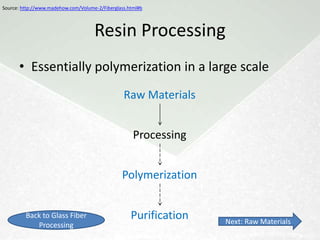
Resin Processing
• Essentially polymerization in a large scale
                         Raw Materials


                           Processing


                         Polymerization


 Return to Contents       Purification    Next: Raw Materials
Resin Processing
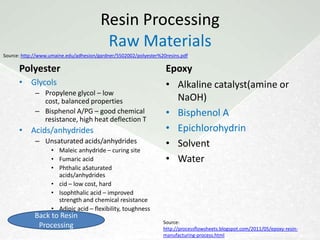
                                Raw Materials
Polyester                                               Epoxy
• Glycols                                               • Alkaline catalyst(amine or
     – Propylene glycol – low                             NaOH)
       cost, balanced properties                        • Bisphenol A
     – Bisphenol A/PG – good
       chemical resistance, high heat                   • Epichlorohydrin
       deflection T                                     • Solvent
• Acids/anhydrides                                      • Water
     – Unsaturated acids/anhydrides
     – Saturated acids/anhydrides


 Source:                                               Source:
 http://www.umaine.edu/adhesion/gardner/5502002/poly   http://processflowsheets.blogspot.com/2011/05/epoxy-resin-
 ester%20resins.pdf                                    manufacturing-process.html
Source: http://scholar.lib.vt.edu/theses/available/etd-42198-113329/unrestricted/ch1.pdf

                                            Resin Processing
                                             Raw Materials
       • Vinyl esters
              – There are various ways to produce vinyl
                esters, usually of resins and unsaturated acids
                      • Addition products of epoxide resin and ethylenically
                        unsaturated monocarboxylic acids
                      • Glycidyl methacrylate + multifunctional phenol (e.g.
                        Bisphenol-A)


          Return to Contents                                                               Next: Polymerization
Resin Processing
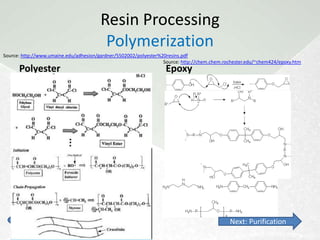
                                         Polymerization
Source: http://www.umaine.edu/adhesion/gardner/5502002/polyester%20resins.pdf
                                                                  Source: http://chem.chem.rochester.edu/~chem424/epoxy.htm
      Polyester                                                    Epoxy
Source: http://scholar.lib.vt.edu/theses/available/etd-42198-113329/unrestricted/ch1.pdf

                                            Resin Processing
                                             Polymerization
       • Vinyl


          Return to Contents                                                               Next: Purification
Resin Processing
                        Purification
• Evaporators and phase separators in the
  processes separate the final resin from
  unreacted reactants and unwanted brine.


 Return to Contents                      Next: Application
Resins
                       Application to Glass Fibers
Source: http://centralfloridafieros.com/forum/index.php?topic=149.0;wap2

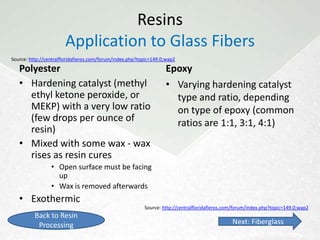
   Polyester                                                       Epoxy
   • Hardening catalyst (methyl                                    • Varying hardening catalyst
     ethyl ketone peroxide, or                                       type and ratio, depending
     MEKP) with a very low ratio                                     on type of epoxy (common
     (few drops per ounce of                                         ratios are 1:1, 3:1, 4:1)
     resin)
   • Mixed with some wax - wax
     rises as resin cures
                 • Open surface must be facing
                   up
                 • Wax is removed afterwards
   • Exothermic
                                                          Source: http://centralfloridafieros.com/forum/index.php?topic=149.0;wap2
Resins
            Application to Glass Fibers
• Vinyl Esters
   – Ideally catalyzed by triphenylphosphine, but can
     cure by itself
   – Requires diluents (e.g. styrene)
        • Usually composed of 40-50 wt. % styrene


 Return to Contents                            Next: Fiberglass
Combining the resin and glass fiber

FIBERGLASS
Source: http://www.youtube.com/watch?v=dEhSaFfaSKg
Fiberglass – the Combo
Strength: High Tensile and Compressive strength   Strength: Elastic
Weakness: Shear                                   Weakness: Low stiffness
Source: http://www.ce.sc.edu/deptinfo/members/faculty/ray/web1/Ugrad/ECIV%20303/Student%20Presentations/Glass-reinforced%20Plastic.ppt


                                                 Fiberglass
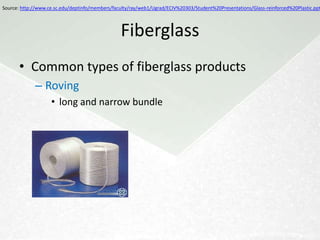
       • Common types of fiberglass products
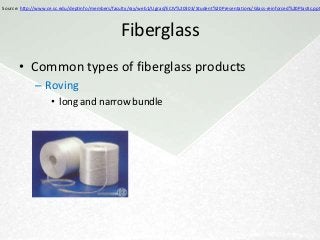
             – Roving
                    • long and narrow bundle
Source: http://www.ce.sc.edu/deptinfo/members/faculty/ray/web1/Ugrad/ECIV%20303/Student%20Presentations/Glass-reinforced%20Plastic.ppt


                                                 Fiberglass
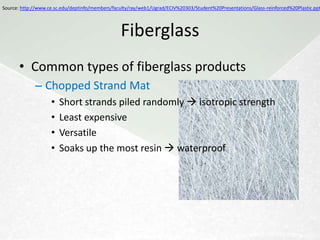
       • Common types of fiberglass products
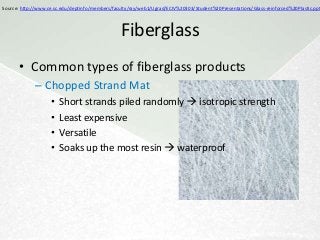
             – Chopped Strand Mat
                    •   Short strands piled randomly  isotropic strength
                    •   Least expensive
                    •   Versatile
                    •   Soaks up the most resin  waterproof
Source: http://www.ce.sc.edu/deptinfo/members/faculty/ray/web1/Ugrad/ECIV%20303/Student%20Presentations/Glass-reinforced%20Plastic.ppt


                                                 Fiberglass
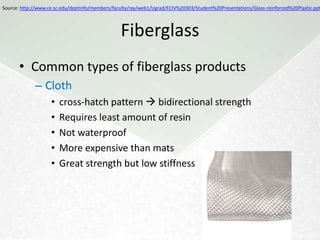
       • Common types of fiberglass products
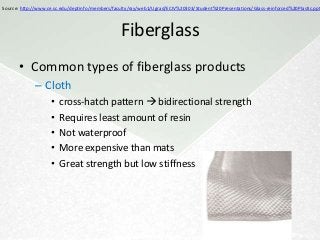
             – Cloth
                    •   cross-hatch pattern  bidirectional strength
                    •   Requires least amount of resin
                    •   Not waterproof
                    •   More expensive than mats
                    •   Great strength but low stiffness
Source: http://www.ce.sc.edu/deptinfo/members/faculty/ray/web1/Ugrad/ECIV%20303/Student%20Presentations/Glass-reinforced%20Plastic.ppt


                                                 Fiberglass
       • Common types of fiberglass products
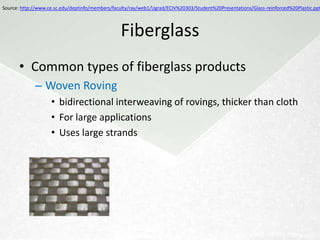
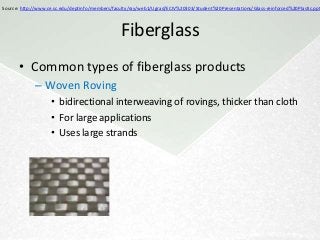
             – Woven Roving
                    • bidirectional interweaving of rovings, thicker than cloth
                    • For large applications
                    • Uses large strands
Source: http://www.ce.sc.edu/deptinfo/members/faculty/ray/web1/Ugrad/ECIV%20303/Student%20Presentations/Glass-reinforced%20Plastic.ppt


                                                 Fiberglass
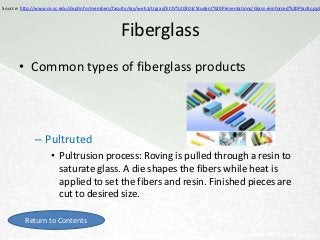
       • Common types of fiberglass products


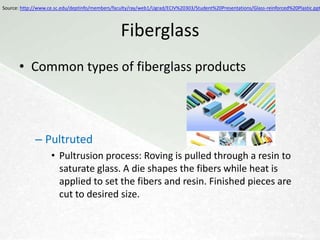
             – Pultruted
                    • Pultrusion process: Roving is pulled through a resin to
                      saturate glass. A die shapes the fibers while heat is
                      applied to set the fibers and resin. Finished pieces are
                      cut to desired size.

         Return to Contents
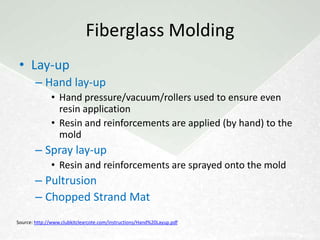
Source: http://www.clubkitclearcote.com/instructions/Hand%20Layup.pdf


                                  Fiberglass Processing
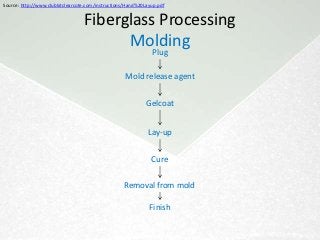
                                        Molding
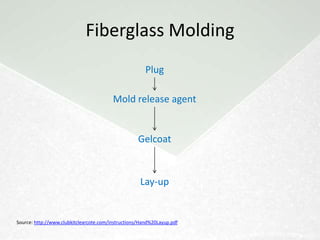
                                                               Plug

                                                    Mold release agent

                                                             Gelcoat


                                                              Lay-up

                                                               Cure

                                                   Removal from mold

                                                              Finish
Source http://centralfloridafieros.com/forum/index.php?topic=149.0;wap2


                                   Fiberglass Processing
                                         Molding
      • Plug
             – Object with desired shape
             – Can be formed with foams, wood, plaster, etc.
      • Mold
             – Supports glass fibers during resin curing
      • Mold release agent
             – E.g. Polyvinyl alcohol
      • Gelcoat
             – Pigmented resin, harder, more durable finish
             – Followed by a coating of a fiberglass
Source: http://www.clubkitclearcote.com/instructions/Hand%20Layup.pdf


                                  Fiberglass Processing
                                        Molding
      • Lay-up
             – Hand lay-up
                    • Hand pressure/vacuum/rollers used to ensure even
                      resin application
             – Spray lay-up
                    • Resin and reinforcements are sprayed onto the vertical
                      mold
             – Vacuum bag
                    • Fiber and resin are sucked to conform to the mold using
                      a vacuum
Source: http://www.clubkitclearcote.com/instructions/Hand%20Layup.pdf


                                  Fiberglass Processing
                                        Molding
      • Cure
             – Longer curing time = greater shrinkage
      • Removal from mold
      • Finish


         Return to Contents
Fiberglass

   End

Fiberglass

Editor's Notes

  • #7 Fiber sheet
  • #30 Unsaturated acids/anhydridesMaleic anhydride – curing siteFumaric acidPhthalic acid – low cost, hardSaturated acids/anhydridesIsophthalic acid – improved strength and chemical resistanceAdipic acid – flexibility, toughness
  • #31 Some common Resins and Unsaturated Acids:ResinsDiglycidyl Ether of Bisphenol AEpoxy NovolacCycloaliphatic EpoxyUnsaturated acidsAcrylic acidMethacrylic acidCrotonic acidCinnamic acid