FIBER GLASS
KUMAR SATYAM
NABANIL
KHELANG
B.ARCH 7TH SEM
WHAT IS FIBER GLASS
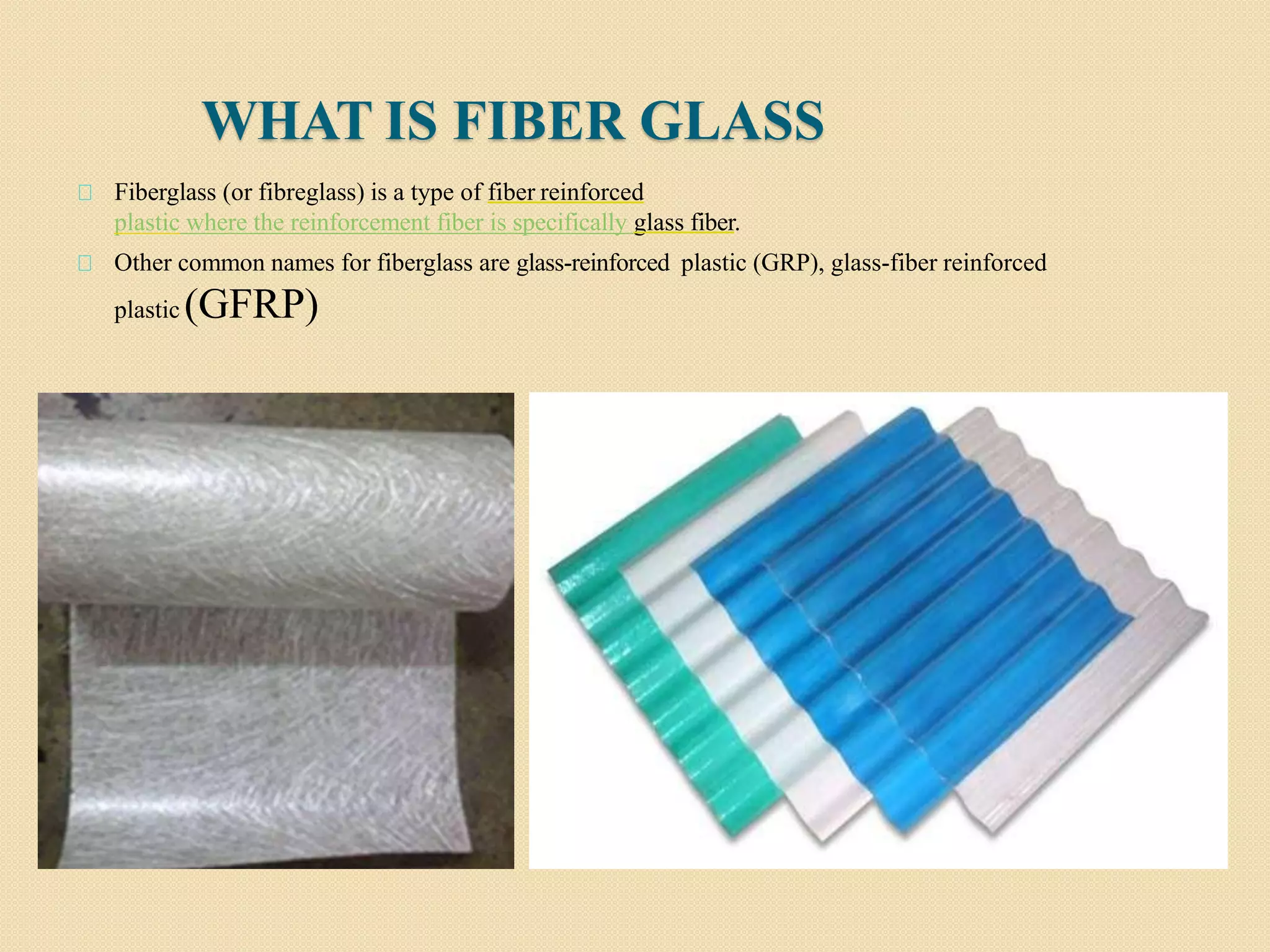
Fiberglass (or fibreglass) is a type of fiber reinforced
plastic where the reinforcement fiber is specifically glass fiber.
Other common names for fiberglass are glass-reinforced plastic (GRP), glass-fiber reinforced
plastic (GFRP)
BACKGROUND
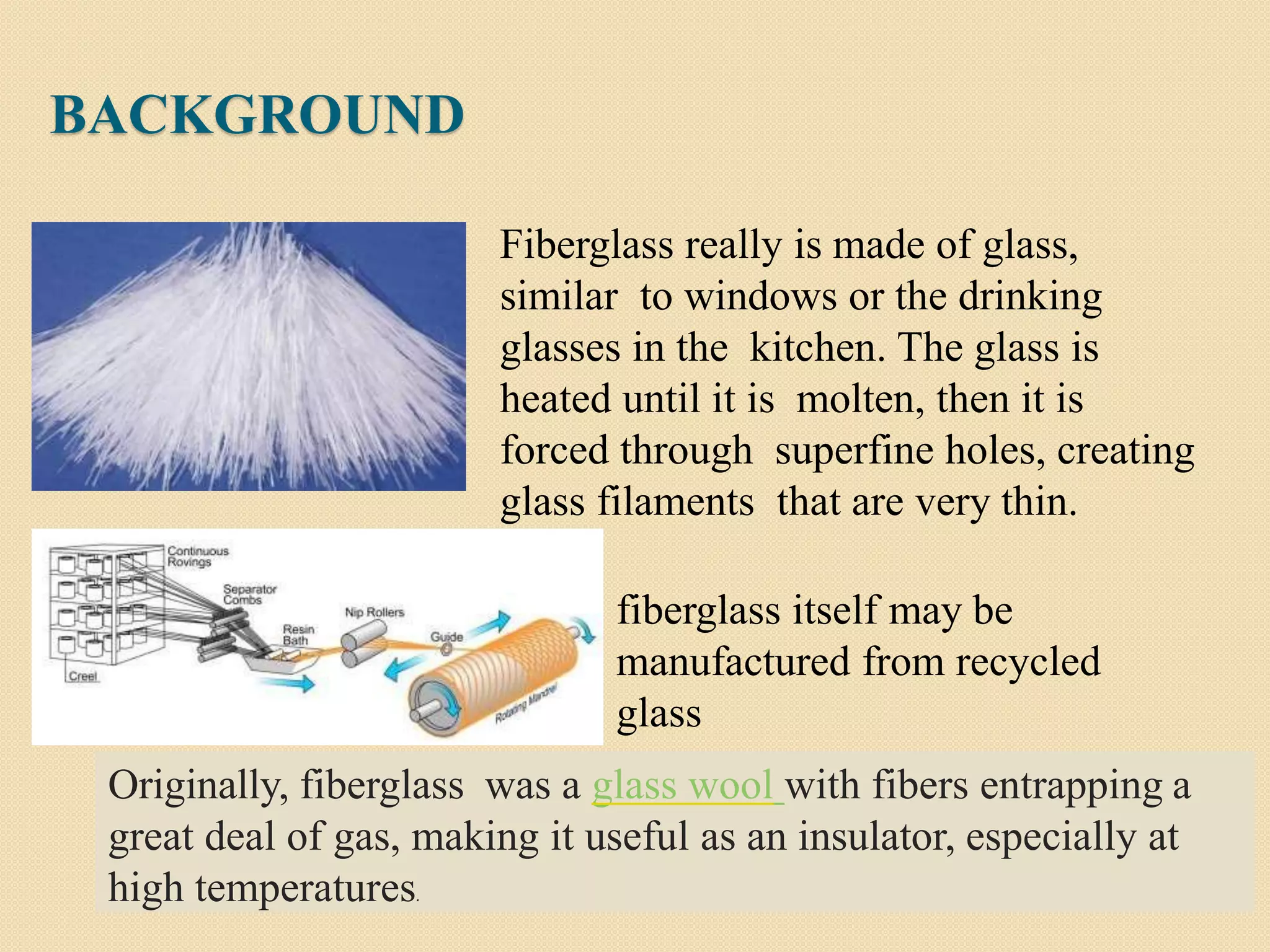
Fiberglass really is made of glass,
similar to windows or the drinking
glasses in the kitchen. The glass is
heated until it is molten, then it is
forced through superfine holes, creating
glass filaments that are very thin.
fiberglass itself may be
manufactured from recycled
glass
Originally, fiberglass was a glass wool with fibers entrapping a
great deal of gas, making it useful as an insulator, especially at
high temperatures.
RAW MATERIAL
The basic raw materials for fiberglass products are a variety of
natural minerals and manufactured chemicals. The major ingredients
are
•silica sand,
•limestone, and
•soda ash.
Silica sand is used as the glass
former, and
soda ash and limestone help primarily
to lower the melting temperature
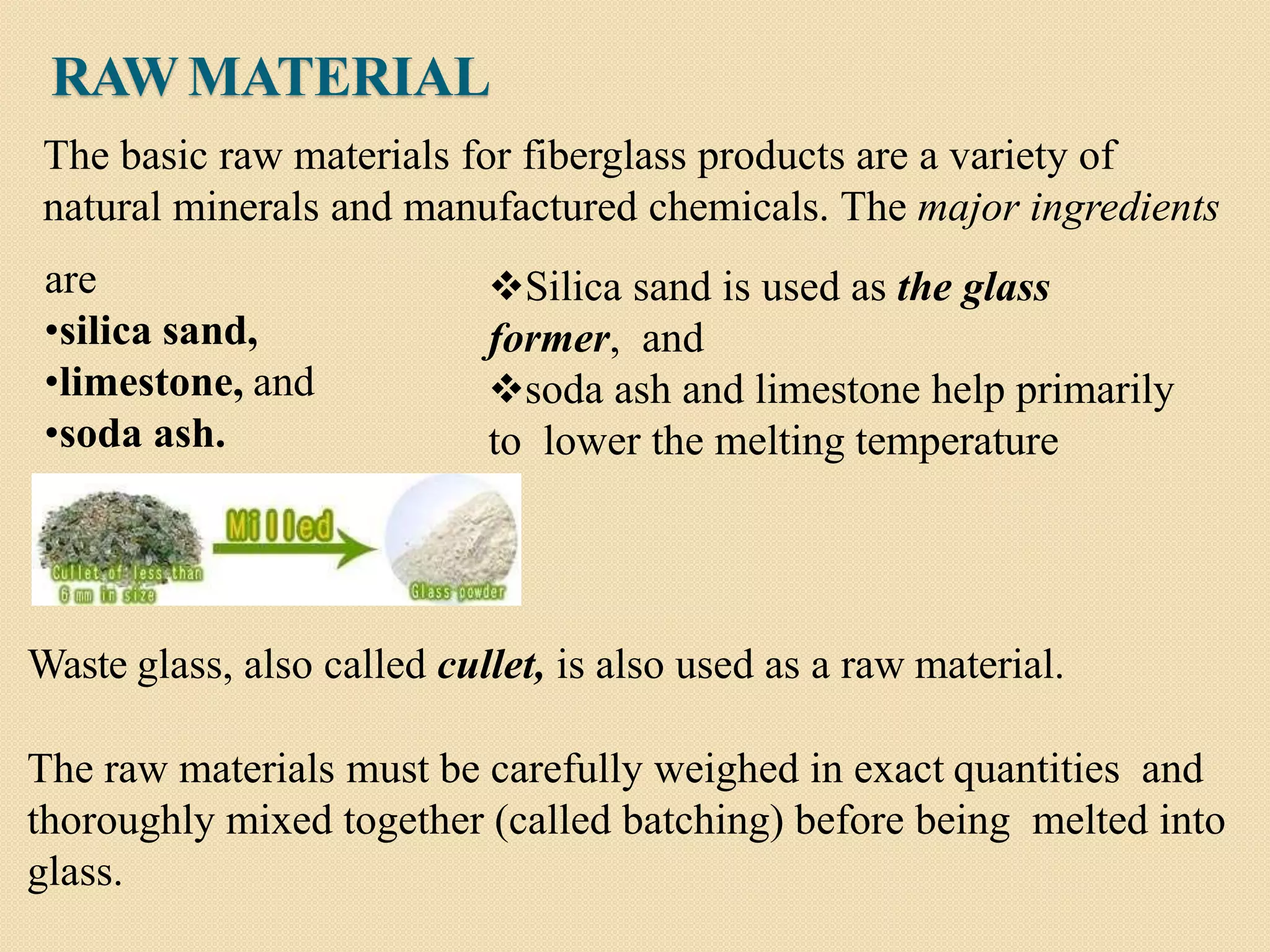
Waste glass, also called cullet, is also used as a raw material.
The raw materials must be carefully weighed in exact quantities and
thoroughly mixed together (called batching) before being melted into
glass.
TYPES OF FIBER GLASS
The following classification is known:
1. A-glass: With regard to its composition, it is close to window glass
2. C-glass: This kind of glass shows better resistance to chemical
impact.
3.E-glass: This kind of glass combines the characteristics of C-
glass with very good insulation to electricity.
4. AE-glass: Alkali resistant glass.
PROPERTIES
CHEMICAL RESISTANCE- Fiberglass textile fabrics will not
rot, mildew or deteriorate. They resist most acids with the
exceptions of hydrofluoric acid and phosphoric acid.
DIMENSIONAL STABILITY- Fiberglass fabrics will not stretch
or shrink. Nominal elongation break is 3-4 percent. The average
linear thermal expansion coefficient of "E" glass is 5.4 by 10.6
cm/cm/°C.
GOOD THERMAL PROPERTIES- Fiberglass fabrics have a low
coefficient of thermal expansion and relatively high thermal
conductivity. Glass fabrics will dissipate heat more rapidly than
asbestos or organic fibers.
HIGH TENSILE STRENGTH- Fiberglass yarn has a high
strength-to- weight ratio. Fiberglass yarn is twice as strong
as steel wire.
LOW MOISTURE ABSORPTION-Fiberglass yarn has
extremely low moisture absorption.
ELECTRICAL INSULATION- High dielectrical strength
and relatively low dielectrical constants make fiberglass
fabrics outstanding for electrical insulation purposes.
OTHER
• resistance to corrosive attacks;
• tight structure;
• superior shock and wear resistance;
• lightweight;
• simple assembling;
• damage and breakage resistance;
• aesthetical and attractive look;
• at temperatures below zero it doesn’t become slippery or
covered
with ice
• hardly bendable material
• superior durability
GREEN AND SUSTAINABILITY
Fiberglass is a natural choice when you’re seeking energy-efficient,
green, sustainable solutions.
Due to its composition, fiberglass is known for its very low embodied
energy ─ the total energy required to produce a product from the raw
materials stage through delivery of fiberglass products
Typically fiberglass requires no added materials to reinforce it,
reducing the bulk and weight of windows and doors, helping
cut transportation costs in the process.
─an abundant, natural, non-depleting resource ─ fiberglass is a
highly- sustainable solution
Because of their low coefficient of thermal expansion, fiberglass
windows and doors provide energy-efficient solutions that help
seal out the elements - even in extreme hot and cold climate
conditions.
─ COST – 75RS/ SQ FEET
─ COLORS DOES NOT AFFECT THE COST
Sustainability starts with sand ─
An abundant natural resource
The main ingredient in fiberglass is glass. Since glass is made from sand
Fiber Reinforced Polymers (FRP, Fiberglass)
FRP products generally produced as a thin rigid laminate
shell formed by pouring a polyester or epoxy resin gel coat
into a mold.
Application : Its good molding ability and versatility to represent
stone, wood, metal and terra cotta make it an alternative to ornate or
carved building elements such as column capitals, bases, spandrel
panels, belt courses, balustrades, window hoods or parapets. Its ability
to reproduce bright colors is a great advantage.
Advantages:
•lightweight, long spans available with a separate structural frame
•high ratio of strength to weight
•good molding ability
•easily installed, can be cut, patched, sanded
•non-corrosive, rot-resistant
Disadvantages:
•ultraviolet sensitive unless surface is coated or pigments are in gel
coat
•vapor impermeability may require ventilation detail
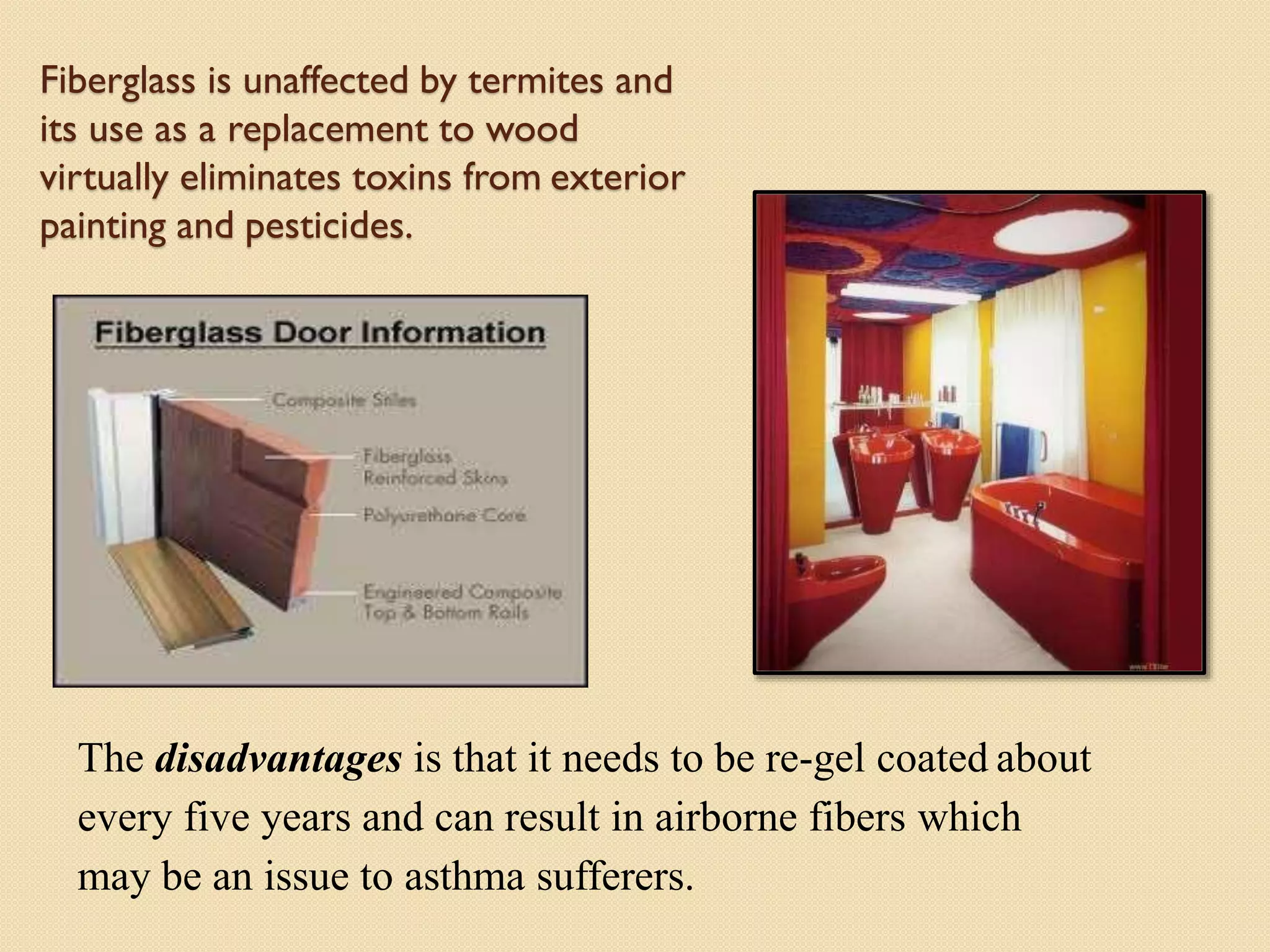
Fiberglass is unaffected by termites and
its use as a replacement to wood
virtually eliminates toxins from exterior
painting and pesticides.
The disadvantages is that it needs to be re-gel coated about
every five years and can result in airborne fibers which
may be an issue to asthma sufferers.
APPLICATION
Fiberglass Roofing
 Cooling tower casing
Structural Day lighting
Panel Features
 Natural light transmission
 Lasting aesthetics Reduced energy bills
Maintenance free
Range of profiles & colors
Physical Properties
 Tenacity: 6.3 to 6.9 gm/den.
 Density: 2.5gm/c.c.
 Elongation at break: 3%.
 Elasticity: Bad.
 Moisture Regain: 0%.
 Resiliency : Excellent.
 Ability to protest friction: Not good.
 Color :White or Color less.
 Ability to Protect Heat : It can protect up to 315ᵒc.
 Melting point: High. Soften after 1200 ᵒc and start melting 1713 ᵒc.
 Luster: Bright to light.
Chemical properties
 Acids: Hydro Choleric acid and hot phosphoric acid causes harm to the glass fiber.
 Basic: It has enough protection ability to alkali.
 Effect of bleaching: Bleaching agent does not cause harm to glass fiber.
 Organic solvent: It does not changes with the effect of organic solvent.
 Protection ability against mildew: It is not affected by mildew.
 Protection ability against micro-organism: Micro-organism does not harm glass fiber.
 Dyeing: It is not possible to dye after production, it is dyed in solution bath.
DESIGN ANDARCHITECTURE
 TheWolfgang Feierbach
'Kunststofhaus FG 2000" was
constructed in Altenstadt
Germany in 1968-1970.
 This is one amazing prefab
modular fiberglass house.
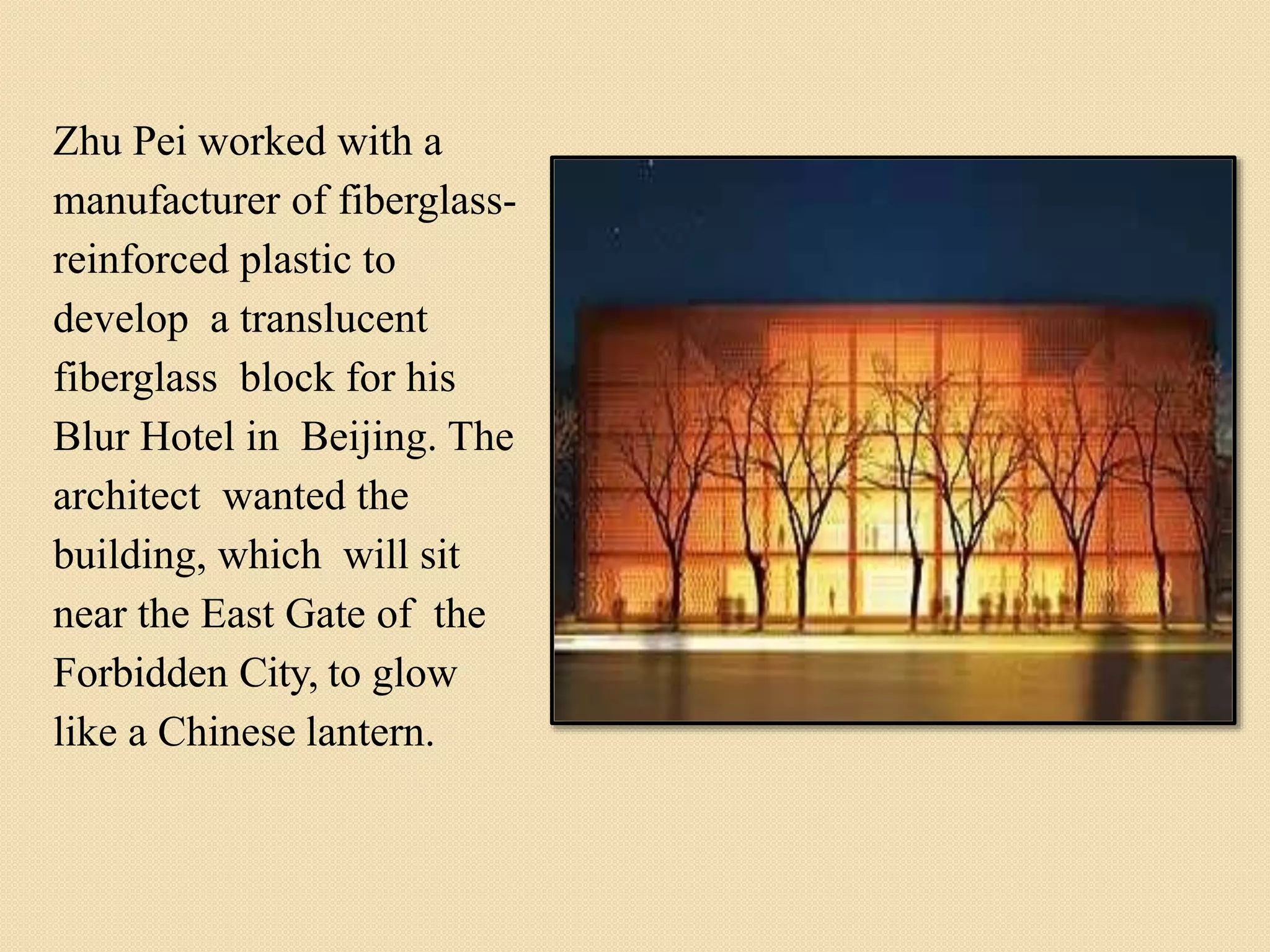
Zhu Pei worked with a
manufacturer of fiberglass-
reinforced plastic to
develop a translucent
fiberglass block for his
Blur Hotel in Beijing. The
architect wanted the
building, which will sit
near the East Gate of the
Forbidden City, to glow
like a Chinese lantern.
REFERENCE
https://www.slideshare.net/shehadchowdhury/presentation-on-glass-fiber
https://www.slideshare.net/shouryagoswami969/fiberglass-55362236
https://www2.slideshare.net/breaker561994/fiberglass-14153803
www.google.com
https://en.wikipedia.org/wiki/Glass_fiber
FIBERGLASS PPT..pdf

FIBERGLASS PPT..pdf

  • 1.
  • 2.
    WHAT IS FIBERGLASS Fiberglass (or fibreglass) is a type of fiber reinforced plastic where the reinforcement fiber is specifically glass fiber. Other common names for fiberglass are glass-reinforced plastic (GRP), glass-fiber reinforced plastic (GFRP)
  • 3.
    BACKGROUND Fiberglass really ismade of glass, similar to windows or the drinking glasses in the kitchen. The glass is heated until it is molten, then it is forced through superfine holes, creating glass filaments that are very thin. fiberglass itself may be manufactured from recycled glass Originally, fiberglass was a glass wool with fibers entrapping a great deal of gas, making it useful as an insulator, especially at high temperatures.
  • 4.
    RAW MATERIAL The basicraw materials for fiberglass products are a variety of natural minerals and manufactured chemicals. The major ingredients are •silica sand, •limestone, and •soda ash. Silica sand is used as the glass former, and soda ash and limestone help primarily to lower the melting temperature Waste glass, also called cullet, is also used as a raw material. The raw materials must be carefully weighed in exact quantities and thoroughly mixed together (called batching) before being melted into glass.
  • 5.
    TYPES OF FIBERGLASS The following classification is known: 1. A-glass: With regard to its composition, it is close to window glass 2. C-glass: This kind of glass shows better resistance to chemical impact. 3.E-glass: This kind of glass combines the characteristics of C- glass with very good insulation to electricity. 4. AE-glass: Alkali resistant glass.
  • 6.
    PROPERTIES CHEMICAL RESISTANCE- Fiberglasstextile fabrics will not rot, mildew or deteriorate. They resist most acids with the exceptions of hydrofluoric acid and phosphoric acid. DIMENSIONAL STABILITY- Fiberglass fabrics will not stretch or shrink. Nominal elongation break is 3-4 percent. The average linear thermal expansion coefficient of "E" glass is 5.4 by 10.6 cm/cm/°C. GOOD THERMAL PROPERTIES- Fiberglass fabrics have a low coefficient of thermal expansion and relatively high thermal conductivity. Glass fabrics will dissipate heat more rapidly than asbestos or organic fibers.
  • 7.
    HIGH TENSILE STRENGTH-Fiberglass yarn has a high strength-to- weight ratio. Fiberglass yarn is twice as strong as steel wire. LOW MOISTURE ABSORPTION-Fiberglass yarn has extremely low moisture absorption. ELECTRICAL INSULATION- High dielectrical strength and relatively low dielectrical constants make fiberglass fabrics outstanding for electrical insulation purposes.
  • 8.
    OTHER • resistance tocorrosive attacks; • tight structure; • superior shock and wear resistance; • lightweight; • simple assembling; • damage and breakage resistance; • aesthetical and attractive look; • at temperatures below zero it doesn’t become slippery or covered with ice • hardly bendable material • superior durability
  • 9.
    GREEN AND SUSTAINABILITY Fiberglassis a natural choice when you’re seeking energy-efficient, green, sustainable solutions. Due to its composition, fiberglass is known for its very low embodied energy ─ the total energy required to produce a product from the raw materials stage through delivery of fiberglass products Typically fiberglass requires no added materials to reinforce it, reducing the bulk and weight of windows and doors, helping cut transportation costs in the process.
  • 10.
    ─an abundant, natural,non-depleting resource ─ fiberglass is a highly- sustainable solution Because of their low coefficient of thermal expansion, fiberglass windows and doors provide energy-efficient solutions that help seal out the elements - even in extreme hot and cold climate conditions. ─ COST – 75RS/ SQ FEET ─ COLORS DOES NOT AFFECT THE COST Sustainability starts with sand ─ An abundant natural resource The main ingredient in fiberglass is glass. Since glass is made from sand
  • 11.
    Fiber Reinforced Polymers(FRP, Fiberglass) FRP products generally produced as a thin rigid laminate shell formed by pouring a polyester or epoxy resin gel coat into a mold. Application : Its good molding ability and versatility to represent stone, wood, metal and terra cotta make it an alternative to ornate or carved building elements such as column capitals, bases, spandrel panels, belt courses, balustrades, window hoods or parapets. Its ability to reproduce bright colors is a great advantage.
  • 12.
    Advantages: •lightweight, long spansavailable with a separate structural frame •high ratio of strength to weight •good molding ability •easily installed, can be cut, patched, sanded •non-corrosive, rot-resistant Disadvantages: •ultraviolet sensitive unless surface is coated or pigments are in gel coat •vapor impermeability may require ventilation detail
  • 13.
    Fiberglass is unaffectedby termites and its use as a replacement to wood virtually eliminates toxins from exterior painting and pesticides. The disadvantages is that it needs to be re-gel coated about every five years and can result in airborne fibers which may be an issue to asthma sufferers.
  • 14.
    APPLICATION Fiberglass Roofing  Coolingtower casing Structural Day lighting Panel Features  Natural light transmission  Lasting aesthetics Reduced energy bills Maintenance free Range of profiles & colors
  • 15.
    Physical Properties  Tenacity:6.3 to 6.9 gm/den.  Density: 2.5gm/c.c.  Elongation at break: 3%.  Elasticity: Bad.  Moisture Regain: 0%.  Resiliency : Excellent.  Ability to protest friction: Not good.  Color :White or Color less.  Ability to Protect Heat : It can protect up to 315ᵒc.  Melting point: High. Soften after 1200 ᵒc and start melting 1713 ᵒc.  Luster: Bright to light.
  • 16.
    Chemical properties  Acids:Hydro Choleric acid and hot phosphoric acid causes harm to the glass fiber.  Basic: It has enough protection ability to alkali.  Effect of bleaching: Bleaching agent does not cause harm to glass fiber.  Organic solvent: It does not changes with the effect of organic solvent.  Protection ability against mildew: It is not affected by mildew.  Protection ability against micro-organism: Micro-organism does not harm glass fiber.  Dyeing: It is not possible to dye after production, it is dyed in solution bath.
  • 17.
    DESIGN ANDARCHITECTURE  TheWolfgangFeierbach 'Kunststofhaus FG 2000" was constructed in Altenstadt Germany in 1968-1970.  This is one amazing prefab modular fiberglass house.
  • 18.
    Zhu Pei workedwith a manufacturer of fiberglass- reinforced plastic to develop a translucent fiberglass block for his Blur Hotel in Beijing. The architect wanted the building, which will sit near the East Gate of the Forbidden City, to glow like a Chinese lantern.
  • 19.