Accounts Payable Journal
PURCHASE RELATED ACTIVITIES
Accounting entries get generated at the time of GR/IR, and invoice verification.
At the time of GR/IR, the following entry gets generated.
Inventory a/c………….…………..Dr. xxx
To GR/IR a/c……………………………..xxx
On doing the Invoice verification, the following entry gets generated and the liability is
booked.
GR/IR a/c…………………………..Dr. xxx
To Vendor a/c……………………………xxx
At the time of invoice verification if there are differences between GR value and IR and if
stock is not available the difference amount would go to price differences A/c.
1) PURCHASE – RAW MATERIAL
At the time of Goods Receipt the following entry gets generated (Ex. with notional figures).
For a P.O of Rs. 100(Basic 70 + Freight 10 ) (when freight is borne by the company)
Inventory (Raw-material) a/c………………….Dr 80
To GR/IR Clearing a/c……………………………….70
To Freight clearing a/c………………………………10
On doing the Invoice Verification, the following entry gets generated.
GR/IR Clearing a/c……..……………..Dr. 70
Freight Clearing a/c……………………Dr. 10
To Vendor a/c ……………………………….70
To Vendor a/c………….……………………10
2) PURCHASE – TRADED GOODS
In case of traded goods, the entries would be as below:
On receipt of the goods
Inventory (Traded) a/c…………………………..Dr. xxx
To GR/IR Clearing a/c………………………………….xxx
On doing the Invoice Verification, the following entry is generated.
GR/IR Clearing a/c……………………………Dr. xxx
To Vendor a/c…………………………………………..xxx
3) PURCHASE – CONSUMABLES
In case of Consumables, the entries would be as below:
On receipt of the Consumables
Inventory (Consumables) a/c…………………………..Dr. xxx
To GR/IR Clearing a/c………………………………….xxx
On doing the Invoice Verification, the following entry is generated.
GR/IR Clearing a/c……………………………Dr. xxx
To Vendor a/c…………………………………………..xxx
4) PURCHASE – PACKING MATERIAL
In case of Packing Material, the entries would be as below:
On receipt of the Packing Material
Inventory (Packing Material) a/c…………………………..Dr. xxx
To GR/IR Clearing a/c………………………………….xxx
On doing the Invoice Verification, the following entry is generated.
GR/IR Clearing a/c……………………………Dr. xxx
To Vendor a/c…………………………………………..xxx
5) IMPORT PURCHASES
In case of Import Purchases, the process remains the same but for the additional charges,
which are included in the cost of inventory.
The same is processed in MM module.
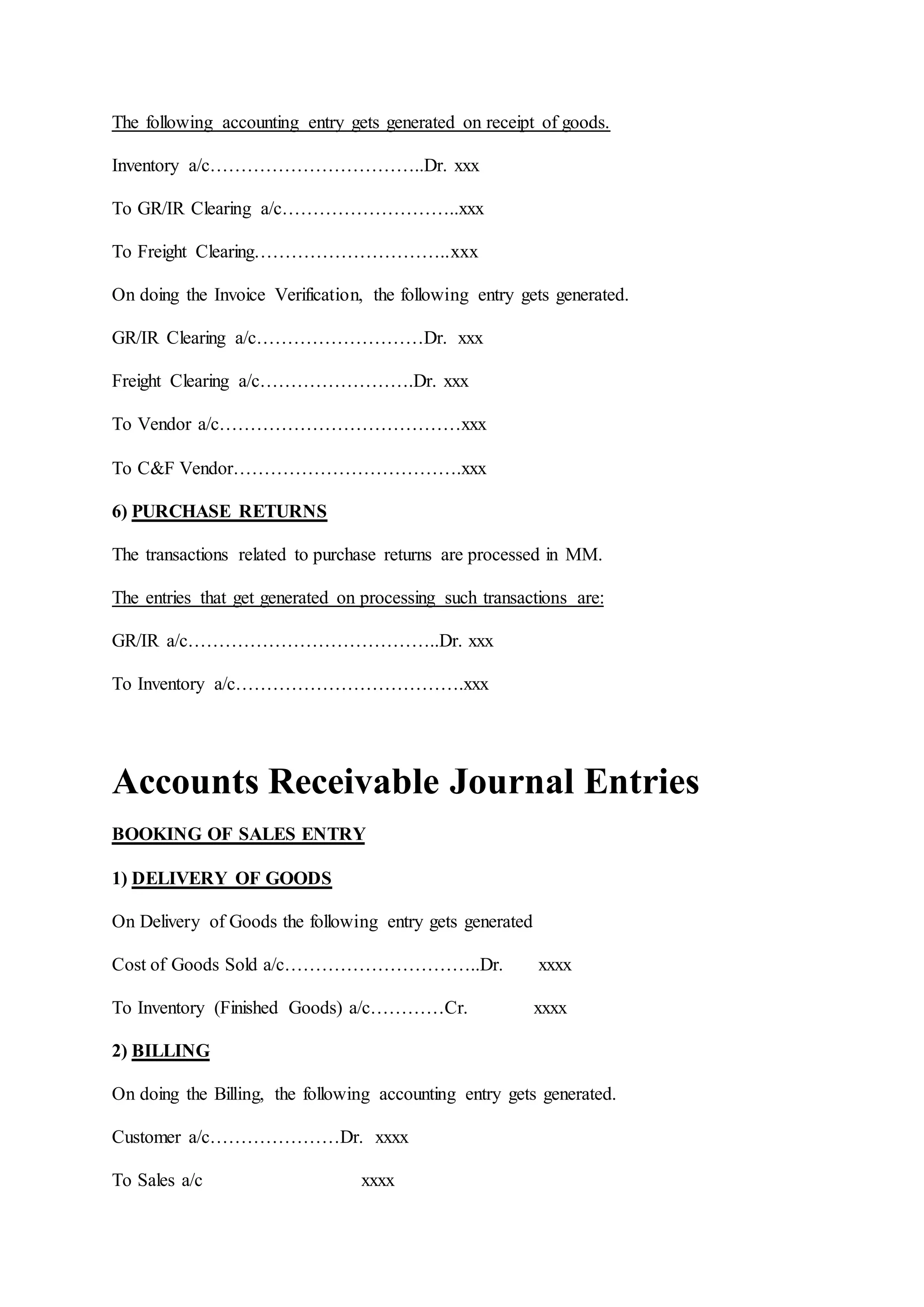
The following accounting entry gets generated on receipt of goods.
Inventory a/c……………………………..Dr. xxx
To GR/IR Clearing a/c………………………..xxx
To Freight Clearing…………………………..xxx
On doing the Invoice Verification, the following entry gets generated.
GR/IR Clearing a/c………………………Dr. xxx
Freight Clearing a/c…………………….Dr. xxx
To Vendor a/c…………………………………xxx
To C&F Vendor……………………………….xxx
6) PURCHASE RETURNS
The transactions related to purchase returns are processed in MM.
The entries that get generated on processing such transactions are:
GR/IR a/c…………………………………..Dr. xxx
To Inventory a/c……………………………….xxx
Accounts Receivable Journal Entries
BOOKING OF SALES ENTRY
1) DELIVERY OF GOODS
On Delivery of Goods the following entry gets generated
Cost of Goods Sold a/c…………………………..Dr. xxxx
To Inventory (Finished Goods) a/c…………Cr. xxxx
2) BILLING
On doing the Billing, the following accounting entry gets generated.
Customer a/c…………………Dr. xxxx
To Sales a/c xxxx
To Sales Tax Payable a/c xxxx
3) SALE OF TRADED GOODS
Accounting Entry for Sale of Traded goods
Customer a/c…….………….Dr. xxxx
To Sales a/c xxxx
To Sales Tax Payable a/c xxxx
4) RECEIPT FROM CUSTOMER (INCOMING PAYMENT)
The receipts from Customers are handled through Finance Accounting (Accounts
Receivable).
The respective document type for receipt from customers is to be used.
Incoming Bank a/c………………………..Dr. xxxx
To Customer a/c xxxx
5) SALES RETURNS (CREDIT NOTES)
The Sales Returns are processed from SD module.
Inventory Finished goods a/c…….Dr. xxxx
To Cost of goods sold Cr. xxxx
The accounting entry that gets generated in the system is as below:
Sales a/c…………………………………. Dr xxxx
Sales Tax Liability a/c…………………….Dr. xxxx
To Customer a/c xxxx
Asset Accounting Journal Entri
1) ASSET ACQUISITION
The entry that gets generated on processing this transaction is as follows:
Dr Asset a/c
Cr Vendor a/c
The asset value dates are mentioned at the time of purchase. The asset value dates determine
the date from which the depreciation would be calculated.
2) RETIREMENT/SALE OF AN ASSET
The entries that get generated are as below: (with notional figures)
 When asset is sold
Dr. Accumulated Depreciation A/c
Dr. Loss on Sale of Asset A/c (if applicable)
Dr. Clearing Account from Asset Sale
Cr. Asset (APC Value) A/c
Cr. Profit on Sale of Asset A/c (if applicable)
 When the asset sold is cleared against the customer invoice
Dr. Customer A/c
Cr. Clearing Account from Asset Sale
 At the time of payment,
Dr. Bank Incoming A/c
Cr. Customer A/c
3) WRITE-UP OF AN ASSET
The accounting entry that gets generated is:
Dr Accumulated depreciation a/c
Cr Depreciation
4) DEPRECIATION POSTING RUN
The entries that get generated are as below:
Dr Depreciation a/c
Cr Accumulated Depreciation a/c
Banking Transaction Financial
Accounting Entries
Settlement Of Tour Advances Domestic/Foreign
1) Settlement of advance w ill be done by the Accounts Department based on the Travel Expense Statement submitted
by the employee, w hich is approved by the Concerned Department Head.
2) Expenses Account DR
Cash/Bank Account DR (if, refund)
Employee Advance Account CR
Cash/Bank Sub ledger Account CR (if, payable)
3) Banking Operations - Maintenance Of Bank Master
4) A House Bank is a combination of a Bank and a Branch. Account id is the account number. A house bank can have
multiple account IDs.. There could be a main account as also payable account, w hich w ill be defined as separate
account ids. General Ledger accounts have to be created for each combination of a house bank and account ID. The
bank master details are to be provided by HZL.
5) General Ledger accounts have to be created for each account ID in the house bank. Bank Account Master data w ill
be maintained by the Finance Department centrally.
6) Each house bank and account ID combination shall have one main general ledger account and several sub accounts
mainly based on broad transaction types. These sub accounts are necessary to facilitate automatic bank reconciliation
process in R/3 system.
Bank Accounting
7) The accounting entries w ill be generated automatically according to the posting rules attached to the Transaction
type. The follow ing accounting entry is passed by the system in respect of cheque deposit on account of collection fr om
domestic customers.
Bank cheque deposit account Debit
Customer account Credit
8) In this case, a bank sub account is selected based on the transaction code entered by the user. The customer
account is cleared i.e. invoice is cleared against the receipt. In respect of any other deposits, the relevant accounts to
be credited w ill depend on the nature of transaction.
9) Payment against bills for collection. Based on the bank advices falling due on a particular day one payment advice is
made debiting the vendors and crediting bank.
Cheque Deposit - Customer Receipts
10) All cheques received from customers shall be accounted at the point of receipt. The entry posted shall be
Bank Sub account Dr
Customer Account Cr
Cheque Deposit - Other Than Customer Receipts
11) All other receipts w ill be accounted through the Incoming Payment Transaction of the Accounts Receivables
module.
Cheque Bouncing - Other Than Customer Receipts
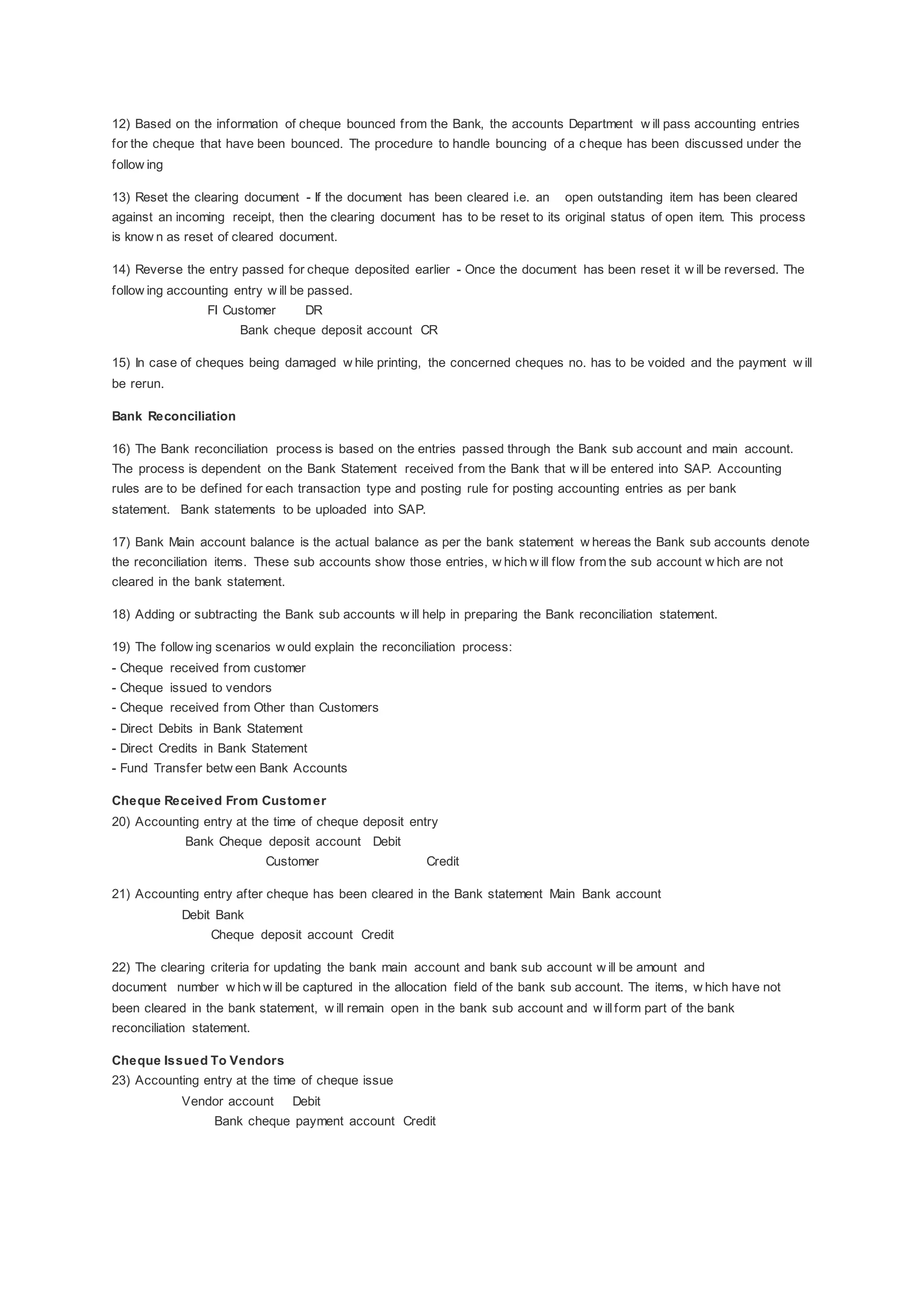
12) Based on the information of cheque bounced from the Bank, the accounts Department w ill pass accounting entries
for the cheque that have been bounced. The procedure to handle bouncing of a cheque has been discussed under the
follow ing
13) Reset the clearing document - If the document has been cleared i.e. an open outstanding item has been cleared
against an incoming receipt, then the clearing document has to be reset to its original status of open item. This process
is know n as reset of cleared document.
14) Reverse the entry passed for cheque deposited earlier - Once the document has been reset it w ill be reversed. The
follow ing accounting entry w ill be passed.
FI Customer DR
Bank cheque deposit account CR
15) In case of cheques being damaged w hile printing, the concerned cheques no. has to be voided and the payment w ill
be rerun.
Bank Reconciliation
16) The Bank reconciliation process is based on the entries passed through the Bank sub account and main account.
The process is dependent on the Bank Statement received from the Bank that w ill be entered into SAP. Accounting
rules are to be defined for each transaction type and posting rule for posting accounting entries as per bank
statement. Bank statements to be uploaded into SAP.
17) Bank Main account balance is the actual balance as per the bank statement w hereas the Bank sub accounts denote
the reconciliation items. These sub accounts show those entries, w hich w ill flow from the sub account w hich are not
cleared in the bank statement.
18) Adding or subtracting the Bank sub accounts w ill help in preparing the Bank reconciliation statement.
19) The follow ing scenarios w ould explain the reconciliation process:
- Cheque received from customer
- Cheque issued to vendors
- Cheque received from Other than Customers
- Direct Debits in Bank Statement
- Direct Credits in Bank Statement
- Fund Transfer betw een Bank Accounts
Cheque Received From Customer
20) Accounting entry at the time of cheque deposit entry
Bank Cheque deposit account Debit
Customer Credit
21) Accounting entry after cheque has been cleared in the Bank statement Main Bank account
Debit Bank
Cheque deposit account Credit
22) The clearing criteria for updating the bank main account and bank sub account w ill be amount and
document number w hich w ill be captured in the allocation field of the bank sub account. The items, w hich have not
been cleared in the bank statement, w ill remain open in the bank sub account and w illform part of the bank
reconciliation statement.
Cheque Issued To Vendors
23) Accounting entry at the time of cheque issue
Vendor account Debit
Bank cheque payment account Credit
24) Accounting entry after cheque has been presented in the Bank
Bank cheque payment account Debit
Main Bank account Credit
25) The clearing criteria used for updating vendor account and Bank cheque payment account w ill be amount and
cheque number. The cheques presented to the bank and are cleared are transferred to the bank main account. The
remaining cheque issued w ill form part of the bank reconciliation statement.
Direct Debit In Bank
26) Direct debit instructions w illbe given to the bank for example, LC payments or certain bank charges are directly
debited in the Bank Statement. In this case accounting entry is passed only after the entry is passed in the bank
statement.
Vendor / Expense Account Debit
Bank clearing account Credit
Direct Credit In Bank
27) Customer receipts are sometimes directly credited in Bank. E.g. export receipts. In this scenario accounting entry is
passed only at the time of bank statement entry. The follow ing accounting entry is passed
Bank clearing account Debit
Customer account Credit
Main Bank A/c Debit
Bank Clearing A/c Credit
Bank Fixed Deposits
28) HZL has a practice of converting any amount above Rs. 1 crore in its Main bank account, to a fixed deposit subject
to a minimum of Rs. 1.01 crores. The FDR number can be filled in one of the fields available in the accounting
document.
Cheque Management / Cheque Printing Cum Advice
29) The function of cheque management w ill enable printing of cheque through SAP. Cheque series w ill be defined for a
combination of a Company code and Bank Account. Cheque numbering w ill be sequential order.
30) Cheque series for automatic payment has to be in sequential order. Cheque printing facility w ill be available for the
bank account.

Fi accountinng entries Anilkumar chowdary

  • 1.
    Accounts Payable Journal PURCHASERELATED ACTIVITIES Accounting entries get generated at the time of GR/IR, and invoice verification. At the time of GR/IR, the following entry gets generated. Inventory a/c………….…………..Dr. xxx To GR/IR a/c……………………………..xxx On doing the Invoice verification, the following entry gets generated and the liability is booked. GR/IR a/c…………………………..Dr. xxx To Vendor a/c……………………………xxx At the time of invoice verification if there are differences between GR value and IR and if stock is not available the difference amount would go to price differences A/c. 1) PURCHASE – RAW MATERIAL At the time of Goods Receipt the following entry gets generated (Ex. with notional figures). For a P.O of Rs. 100(Basic 70 + Freight 10 ) (when freight is borne by the company) Inventory (Raw-material) a/c………………….Dr 80 To GR/IR Clearing a/c……………………………….70 To Freight clearing a/c………………………………10 On doing the Invoice Verification, the following entry gets generated. GR/IR Clearing a/c……..……………..Dr. 70 Freight Clearing a/c……………………Dr. 10 To Vendor a/c ……………………………….70 To Vendor a/c………….……………………10 2) PURCHASE – TRADED GOODS In case of traded goods, the entries would be as below:
  • 2.
    On receipt ofthe goods Inventory (Traded) a/c…………………………..Dr. xxx To GR/IR Clearing a/c………………………………….xxx On doing the Invoice Verification, the following entry is generated. GR/IR Clearing a/c……………………………Dr. xxx To Vendor a/c…………………………………………..xxx 3) PURCHASE – CONSUMABLES In case of Consumables, the entries would be as below: On receipt of the Consumables Inventory (Consumables) a/c…………………………..Dr. xxx To GR/IR Clearing a/c………………………………….xxx On doing the Invoice Verification, the following entry is generated. GR/IR Clearing a/c……………………………Dr. xxx To Vendor a/c…………………………………………..xxx 4) PURCHASE – PACKING MATERIAL In case of Packing Material, the entries would be as below: On receipt of the Packing Material Inventory (Packing Material) a/c…………………………..Dr. xxx To GR/IR Clearing a/c………………………………….xxx On doing the Invoice Verification, the following entry is generated. GR/IR Clearing a/c……………………………Dr. xxx To Vendor a/c…………………………………………..xxx 5) IMPORT PURCHASES In case of Import Purchases, the process remains the same but for the additional charges, which are included in the cost of inventory. The same is processed in MM module.
  • 3.
    The following accountingentry gets generated on receipt of goods. Inventory a/c……………………………..Dr. xxx To GR/IR Clearing a/c………………………..xxx To Freight Clearing…………………………..xxx On doing the Invoice Verification, the following entry gets generated. GR/IR Clearing a/c………………………Dr. xxx Freight Clearing a/c…………………….Dr. xxx To Vendor a/c…………………………………xxx To C&F Vendor……………………………….xxx 6) PURCHASE RETURNS The transactions related to purchase returns are processed in MM. The entries that get generated on processing such transactions are: GR/IR a/c…………………………………..Dr. xxx To Inventory a/c……………………………….xxx Accounts Receivable Journal Entries BOOKING OF SALES ENTRY 1) DELIVERY OF GOODS On Delivery of Goods the following entry gets generated Cost of Goods Sold a/c…………………………..Dr. xxxx To Inventory (Finished Goods) a/c…………Cr. xxxx 2) BILLING On doing the Billing, the following accounting entry gets generated. Customer a/c…………………Dr. xxxx To Sales a/c xxxx
  • 4.
    To Sales TaxPayable a/c xxxx 3) SALE OF TRADED GOODS Accounting Entry for Sale of Traded goods Customer a/c…….………….Dr. xxxx To Sales a/c xxxx To Sales Tax Payable a/c xxxx 4) RECEIPT FROM CUSTOMER (INCOMING PAYMENT) The receipts from Customers are handled through Finance Accounting (Accounts Receivable). The respective document type for receipt from customers is to be used. Incoming Bank a/c………………………..Dr. xxxx To Customer a/c xxxx 5) SALES RETURNS (CREDIT NOTES) The Sales Returns are processed from SD module. Inventory Finished goods a/c…….Dr. xxxx To Cost of goods sold Cr. xxxx The accounting entry that gets generated in the system is as below: Sales a/c…………………………………. Dr xxxx Sales Tax Liability a/c…………………….Dr. xxxx To Customer a/c xxxx Asset Accounting Journal Entri 1) ASSET ACQUISITION The entry that gets generated on processing this transaction is as follows:
  • 5.
    Dr Asset a/c CrVendor a/c The asset value dates are mentioned at the time of purchase. The asset value dates determine the date from which the depreciation would be calculated. 2) RETIREMENT/SALE OF AN ASSET The entries that get generated are as below: (with notional figures)  When asset is sold Dr. Accumulated Depreciation A/c Dr. Loss on Sale of Asset A/c (if applicable) Dr. Clearing Account from Asset Sale Cr. Asset (APC Value) A/c Cr. Profit on Sale of Asset A/c (if applicable)  When the asset sold is cleared against the customer invoice Dr. Customer A/c Cr. Clearing Account from Asset Sale  At the time of payment, Dr. Bank Incoming A/c Cr. Customer A/c 3) WRITE-UP OF AN ASSET The accounting entry that gets generated is: Dr Accumulated depreciation a/c Cr Depreciation 4) DEPRECIATION POSTING RUN The entries that get generated are as below: Dr Depreciation a/c Cr Accumulated Depreciation a/c
  • 6.
    Banking Transaction Financial AccountingEntries Settlement Of Tour Advances Domestic/Foreign 1) Settlement of advance w ill be done by the Accounts Department based on the Travel Expense Statement submitted by the employee, w hich is approved by the Concerned Department Head. 2) Expenses Account DR Cash/Bank Account DR (if, refund) Employee Advance Account CR Cash/Bank Sub ledger Account CR (if, payable) 3) Banking Operations - Maintenance Of Bank Master 4) A House Bank is a combination of a Bank and a Branch. Account id is the account number. A house bank can have multiple account IDs.. There could be a main account as also payable account, w hich w ill be defined as separate account ids. General Ledger accounts have to be created for each combination of a house bank and account ID. The bank master details are to be provided by HZL. 5) General Ledger accounts have to be created for each account ID in the house bank. Bank Account Master data w ill be maintained by the Finance Department centrally. 6) Each house bank and account ID combination shall have one main general ledger account and several sub accounts mainly based on broad transaction types. These sub accounts are necessary to facilitate automatic bank reconciliation process in R/3 system. Bank Accounting 7) The accounting entries w ill be generated automatically according to the posting rules attached to the Transaction type. The follow ing accounting entry is passed by the system in respect of cheque deposit on account of collection fr om domestic customers. Bank cheque deposit account Debit Customer account Credit 8) In this case, a bank sub account is selected based on the transaction code entered by the user. The customer account is cleared i.e. invoice is cleared against the receipt. In respect of any other deposits, the relevant accounts to be credited w ill depend on the nature of transaction. 9) Payment against bills for collection. Based on the bank advices falling due on a particular day one payment advice is made debiting the vendors and crediting bank. Cheque Deposit - Customer Receipts 10) All cheques received from customers shall be accounted at the point of receipt. The entry posted shall be Bank Sub account Dr Customer Account Cr Cheque Deposit - Other Than Customer Receipts 11) All other receipts w ill be accounted through the Incoming Payment Transaction of the Accounts Receivables module. Cheque Bouncing - Other Than Customer Receipts
  • 7.
    12) Based onthe information of cheque bounced from the Bank, the accounts Department w ill pass accounting entries for the cheque that have been bounced. The procedure to handle bouncing of a cheque has been discussed under the follow ing 13) Reset the clearing document - If the document has been cleared i.e. an open outstanding item has been cleared against an incoming receipt, then the clearing document has to be reset to its original status of open item. This process is know n as reset of cleared document. 14) Reverse the entry passed for cheque deposited earlier - Once the document has been reset it w ill be reversed. The follow ing accounting entry w ill be passed. FI Customer DR Bank cheque deposit account CR 15) In case of cheques being damaged w hile printing, the concerned cheques no. has to be voided and the payment w ill be rerun. Bank Reconciliation 16) The Bank reconciliation process is based on the entries passed through the Bank sub account and main account. The process is dependent on the Bank Statement received from the Bank that w ill be entered into SAP. Accounting rules are to be defined for each transaction type and posting rule for posting accounting entries as per bank statement. Bank statements to be uploaded into SAP. 17) Bank Main account balance is the actual balance as per the bank statement w hereas the Bank sub accounts denote the reconciliation items. These sub accounts show those entries, w hich w ill flow from the sub account w hich are not cleared in the bank statement. 18) Adding or subtracting the Bank sub accounts w ill help in preparing the Bank reconciliation statement. 19) The follow ing scenarios w ould explain the reconciliation process: - Cheque received from customer - Cheque issued to vendors - Cheque received from Other than Customers - Direct Debits in Bank Statement - Direct Credits in Bank Statement - Fund Transfer betw een Bank Accounts Cheque Received From Customer 20) Accounting entry at the time of cheque deposit entry Bank Cheque deposit account Debit Customer Credit 21) Accounting entry after cheque has been cleared in the Bank statement Main Bank account Debit Bank Cheque deposit account Credit 22) The clearing criteria for updating the bank main account and bank sub account w ill be amount and document number w hich w ill be captured in the allocation field of the bank sub account. The items, w hich have not been cleared in the bank statement, w ill remain open in the bank sub account and w illform part of the bank reconciliation statement. Cheque Issued To Vendors 23) Accounting entry at the time of cheque issue Vendor account Debit Bank cheque payment account Credit
  • 8.
    24) Accounting entryafter cheque has been presented in the Bank Bank cheque payment account Debit Main Bank account Credit 25) The clearing criteria used for updating vendor account and Bank cheque payment account w ill be amount and cheque number. The cheques presented to the bank and are cleared are transferred to the bank main account. The remaining cheque issued w ill form part of the bank reconciliation statement. Direct Debit In Bank 26) Direct debit instructions w illbe given to the bank for example, LC payments or certain bank charges are directly debited in the Bank Statement. In this case accounting entry is passed only after the entry is passed in the bank statement. Vendor / Expense Account Debit Bank clearing account Credit Direct Credit In Bank 27) Customer receipts are sometimes directly credited in Bank. E.g. export receipts. In this scenario accounting entry is passed only at the time of bank statement entry. The follow ing accounting entry is passed Bank clearing account Debit Customer account Credit Main Bank A/c Debit Bank Clearing A/c Credit Bank Fixed Deposits 28) HZL has a practice of converting any amount above Rs. 1 crore in its Main bank account, to a fixed deposit subject to a minimum of Rs. 1.01 crores. The FDR number can be filled in one of the fields available in the accounting document. Cheque Management / Cheque Printing Cum Advice 29) The function of cheque management w ill enable printing of cheque through SAP. Cheque series w ill be defined for a combination of a Company code and Bank Account. Cheque numbering w ill be sequential order. 30) Cheque series for automatic payment has to be in sequential order. Cheque printing facility w ill be available for the bank account.