CHAPTER TWO
AUDIT OF THE SALES AND
COLLECTION CYCLE
Introduction
• The Sales and Collection Cycle refers to the process through
which a business generates revenue by selling goods or services
and receives payment for these sales.
• This cycle involves a series of activities related to the sale of
products, from order receipt to cash collection. Auditing this
cycle ensures that financial transactions are accurate, legitimate,
and properly recorded.
• When conducting an audit of the Sales and Collection Cycle,
the auditor examines the processes, records, and controls to
verify that the revenue and related cash inflows are accurate,
properly authorized, and not subject to fraud or misstatement.
•Before studying the process of assessing control risk and
designing tests of controls and substantive tests of transactions
for each class of transactions, it is important to know the sales
and collection cycle classes of transactions and account
balances.
•It is also important to understand the typical documents and
records used in the cycle.
I. Accounts and Classes of Transactions in the Sales and
Collection Cycle
• The overall objective in the audit of the sales and collection cycle is
to evaluate whether the account balances affected by the cycles
are fairly presented :
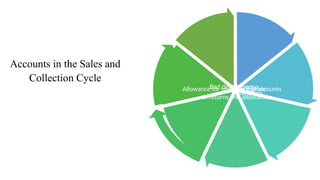
1. Accounts in the Sales and Collection Cycle:
Accounts refer to the financial statement line items that reflect a
company’s financial position and performance. These include
assets, liabilities, equity, revenue, and expenses. The accounts related
with sales and collection cycle are:
Accounts in the Sales and
Collection Cycle
Sales
Accounts receivable
Cash in bank
Cash discount taken
Sales returns and allowances
Allowance for uncollectible accounts
Bad debt expense
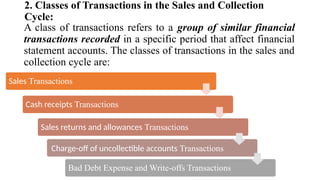
2. Classes of Transactions in the Sales and Collection
Cycle:
A class of transactions refers to a group of similar financial
transactions recorded in a specific period that affect financial
statement accounts. The classes of transactions in the sales and
collection cycle are:
Sales Transactions
Cash receipts Transactions
Sales returns and allowances Transactions
Charge-off of uncollectible accounts Transactions
Bad Debt Expense and Write-offs Transactions
II. Business Functions and Related Documents &Records in the Cycle
• A business function in the sales cycle refers to a specific activity that takes
place in the process of selling goods or services. These functions ensure
that sales transactions are properly executed, recorded, and controlled.
• Each function involves documents and records that serve as evidence of
transactions and help maintain accuracy in financial reporting.
• The Sales and Collection Cycle involves the decisions and processes
necessary for the transfer of the ownership of goods and services to
customers after they are made available for sale.
• It begins with a request by a customer and ends with the conversion of
material or service into an account receivable, and ultimately into cash.
•There are eight Business Functions for sales and collection
cycle. They occur in every business in the recording of the five
classes of transactions in the sales and collection cycle.
•Below you will find summary discussions of the Classes of
Transactions, Accounts, Business functions, and related
Documents and Records for the Sales and Collection Cycle.
1. Sales Transaction
Accounts affected by sales transaction:
 Sales
 Accounts receivable
Business Functions
i. Processing customer orders, - Customer places an order using Customer
Order document. The request for goods by a customer is the starting point for
the entire cycle
o This is often followed by the issuance of Sales Order.
ii. Granting credit- a properly authorized person must approve credit to the
customer for sales on account.
o Minimizes the possibility of bad debts.
o It may be a programmed approval- based on preapproved credit limit
maintained in a customer master file.
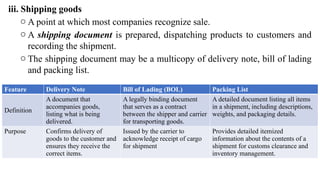
iii. Shipping goods
o A point at which most companies recognize sale.
o A shipping document is prepared, dispatching products to customers and
recording the shipment.
o The shipping document may be a multicopy of delivery note, bill of lading
and packing list.
Feature Delivery Note Bill of Lading (BOL) Packing List
Definition
A document that
accompanies goods,
listing what is being
delivered.
A legally binding document
that serves as a contract
between the shipper and carrier
for transporting goods.
A detailed document listing all items
in a shipment, including descriptions,
weights, and packaging details.
Purpose Confirms delivery of
goods to the customer and
ensures they receive the
correct items.
Issued by the carrier to
acknowledge receipt of cargo
for shipment
Provides detailed itemized
information about the contents of a
shipment for customs clearance and
inventory management.
iv. Billing customers and recording sales- Billing is a means by
which the customer is informed of the amount due for the
goods.
oAll shipments should be billed and no shipment should be
billed more than once.
oBilling should consider authorized price, quantity shipped
and other terms.
oDone with multicopy sales invoice and simultaneously
updating of the sales transaction file, accounts receivable
master file, and the general ledger master file for sales and
accounts receivable.
Documents and Records
 Customer Order- a request for merchandise by a customer.
o It may be received in differing formats.
 Sales Order- used to communicate the description, quantity and related specification of
goods ordered with in the company.
o Often used to indicate credit approval and authorization for shipment.
 Shipping Document- a document prepared to initiate shipment of goods.
o Prepared in at lease in three copies – customer, accounts, retained
 Sales invoice-a document indicating the description and quantity of goods sold, price,
freight charges, insurance, terms, and other relevant data.
o Prepared in at least three copies.
 Sales transaction file- is a database (computer generated file) or record that
contains details of all sales transactions during a specific period. This file is
essential for financial reporting, auditing, and business analysis.
 It includes all information entered into the system and information for each
transaction- like invoice number date of sale, customer information(Name, ID,
address…), product detail(qty, price, total amount), payment term (credit or
cash, payment due date, discounts if any), account classifications, sales person,
and commission rate.
o The information in this file is used for a variety of records, listing, or
reports- e.g. sales journal, A/R master file, and transactions for certain
account balance or division.
 Sales journal or listing- a report generated from the sales transaction file that
typically includes the customer name, date, amount, and account classification
or classifications for each transaction, such as division or product line.
o It also identifies whether the sale was for cash or credit.
 Accounts receivable master file- a file used to record individual sales, cash
receipts, and sales returns and allowances for each customer and to maintain
customer account balances. A summary file that tracks customer balances and
outstanding receivables.
o The master file is updated from the sales, sales returns and allowances, and
cash receipts computer transaction files.
o It is also called the A/R subsidiary ledger or subledger
 Accounts Receivable trial balance- a list of the amounts owed by each
customer at a point in time.
o This is prepared directly from the A/R master file.
o It is often an aged trial balance.
 Monthly statements- a document sent by mail or electronically to each
customer indicating the beginning balance of A/R, the amount and due
date of each sale, cash payments received, credit memos issued, and the
ending balance due.
2. Cash Receipts Transaction
Accounts
 Cash in bank (debits from cash receipts)
 Accounts receivable
Business Functions
v. Processing and recording cash receipts- includes receiving, depositing and
recording cash- currency & checks.
o The possibility of theft is the most important concern (both before and
after recorded).
o All cash receipts must be deposited intact and recorded in the cash receipts
transaction file.
o Remittance advices are important for this purpose.
Documents and Records
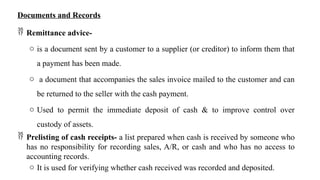
 Remittance advice-
o is a document sent by a customer to a supplier (or creditor) to inform them that
a payment has been made.
o a document that accompanies the sales invoice mailed to the customer and can
be returned to the seller with the cash payment.
o Used to permit the immediate deposit of cash & to improve control over
custody of assets.
 Prelisting of cash receipts- a list prepared when cash is received by someone who
has no responsibility for recording sales, A/R, or cash and who has no access to
accounting records.
o It is used for verifying whether cash received was recorded and deposited.
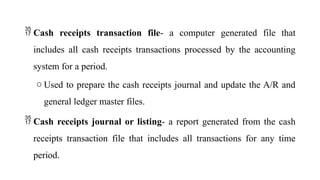
 Cash receipts transaction file- a computer generated file that
includes all cash receipts transactions processed by the accounting
system for a period.
o Used to prepare the cash receipts journal and update the A/R and
general ledger master files.
 Cash receipts journal or listing- a report generated from the cash
receipts transaction file that includes all transactions for any time
period.
3. Sales Returns and Allowances Transaction
Accounts
 Sales returns and allowances
 Accounts receivable
Business Functions
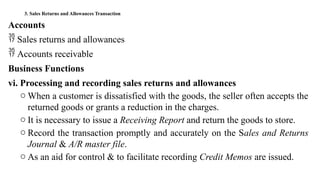
vi. Processing and recording sales returns and allowances
o When a customer is dissatisfied with the goods, the seller often accepts the
returned goods or grants a reduction in the charges.
o It is necessary to issue a Receiving Report and return the goods to store.
o Record the transaction promptly and accurately on the Sales and Returns
Journal & A/R master file.
o As an aid for control & to facilitate recording Credit Memos are issued.
Documents and Records
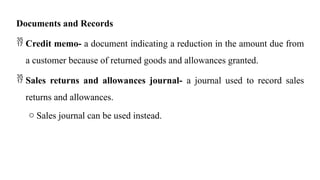
 Credit memo- a document indicating a reduction in the amount due from
a customer because of returned goods and allowances granted.
 Sales returns and allowances journal- a journal used to record sales
returns and allowances.
o Sales journal can be used instead.
4. Charge-off of uncollectible accounts Transactions
Accounts
 Allowance for uncollectible accounts
 Accounts receivable
Business Functions
vii. Charging off uncollectible accounts receivable
o When the company concludes that an amount is no longer collectible,
it must be charged off- e.g. if a customer becomes bankrupt.
o Necessary adjusting entries are made.
Documents and Records
 Uncollectible account authorization form- a document used initially to
indicate authority to write an account receivable off as uncollectible.
 General journal
5. Bad Debt Expense Transaction
Accounts
 Bad debt expense
 Allowance for uncollectible accounts
Business Functions
viii. Providing for bad debts
o The provision should be sufficient to allow for the current period sales
that the company will be unable to collect in the future.
o Allowance method is used.
Documents and Records
 General journal
III. Methodology for Designing Tests of Controls and
Substantive Tests of Transactions for Sales
When auditing sales transactions, auditors use a structured approach
to assess internal controls and test transactions for potential
misstatements. This methodology includes tests of controls and
substantive tests of transactions to ensure the accuracy,
completeness, and legitimacy of recorded sales.
1. Designing tests of control for sales :
Tests of controls assess whether a company’s internal controls over
sales transactions are operating effectively. The goal is to determine
whether the company is following established procedures to prevent
or detect errors and fraud.
Steps in Designing Tests of Controls of sales:
For each control the auditor plans to rely on to reduce assessed control risk,
one or more tests of controls must be designed to verify its effectiveness.
Step 1. Understanding Internal Controls
 Typical approach for sales involves studying the client's flowcharts,
Auditor prepares an internal control questionnaire, and performs walk-
through tests of sales. Identify key controls in the sales cycle (e.g., order
approvals, credit checks, invoicing procedures)
Example:
• The auditor observes the sales process and documents of x company that:
• Sales orders must be approved by a credit manager.
• Goods are only dispatched upon authorization.
• Sales invoices are automatically generated from the system after goods are
shipped.
Step 2. Assess Planned Control Risk- Sales i.e. Identify Key Control
Activities:
 Information obtained in understanding internal control is used to assess
control risk. i.e.
 Based on the understanding of internal controls, the auditor assesses
how much they can rely on controls to prevent or detect errors. This
influences how much substantive testing is needed.
 Make a preliminary control risk assessment (low, moderate, high)
 There are four essential steps:
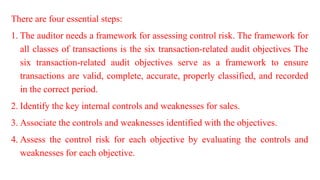
There are four essential steps:
1. The auditor needs a framework for assessing control risk. The framework for
all classes of transactions is the six transaction-related audit objectives The
six transaction-related audit objectives serve as a framework to ensure
transactions are valid, complete, accurate, properly classified, and recorded
in the correct period.
2. Identify the key internal controls and weaknesses for sales.
3. Associate the controls and weaknesses identified with the objectives.
4. Assess the control risk for each objective by evaluating the controls and
weaknesses for each objective.
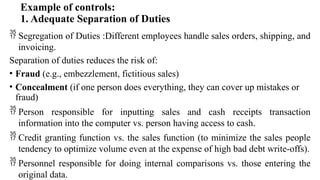
Example of controls:
1. Adequate Separation of Duties
 Segregation of Duties :Different employees handle sales orders, shipping, and
invoicing.
Separation of duties reduces the risk of:
• Fraud (e.g., embezzlement, fictitious sales)
• Concealment (if one person does everything, they can cover up mistakes or
fraud)
 Person responsible for inputting sales and cash receipts transaction
information into the computer vs. person having access to cash.
 Credit granting function vs. the sales function (to minimize the sales people
tendency to optimize volume even at the expense of high bad debt write-offs).
 Personnel responsible for doing internal comparisons vs. those entering the
original data.
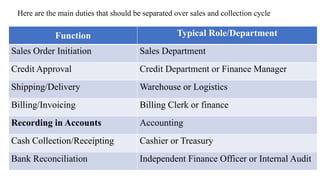
Here are the main duties that should be separated over sales and collection cycle
Function Typical Role/Department
Sales Order Initiation Sales Department
Credit Approval Credit Department or Finance Manager
Shipping/Delivery Warehouse or Logistics
Billing/Invoicing Billing Clerk or finance
Recording in Accounts Accounting
Cash Collection/Receipting Cashier or Treasury
Bank Reconciliation Independent Finance Officer or Internal Audit
2. Proper Authorization
 Authorization means approval of sales orders before processing.
Three key points of authorization
 Credit must be properly authorized before sales takes place,
 Goods should be shipped only after proper authorization, and
 Price, including freight and discount, must be properly approved- to
ensure sales is billed at the price set by company policy.
3. Adequate Documents and Records
Documents and records used must be adequate.
Should contain sufficient information.
Most companies automatically prepare a multi-copy prenumbered sales invoice at
the time the customer places an order. –Useful for minimizing the chance of failure
to bill the customer if all invoices are accounted for periodically.
Use of prenumbered documented prevents both the failure to bill or record sales
and the occurrence of duplicate billings and recordings. i.e. Use of pre-numbered
sales invoices to prevent missing transactions
4. Monthly Statements/Reconciliation
Matching sales records with shipping documents and bank deposits.
Sent by someone having no responsibility for handling cash or preparing
the sales and A/R records.
Encourages response from customers if the balance is improperly stated.
All disagreements about the balance in the account should be directed to
the independent designated official.
5. Internal Verification Procedure
For fulfilling each of the six transaction related audit objectives,
a computer program or an independent person check the
processing and recording of sales. e.g.
 accounting for numerical sequence of prenumbered documents,
Checking the accuracy of document preparation.
Reviewing reports for unusual or incorrect items.
Step 3: Select Control Tests:
•Observation: Watching employees perform sales transactions.
•Inspection: Reviewing sales documents for manager approvals.
•Reperformance: Recalculating discounts or credit limits to verify
system accuracy.
•Inquiry: Asking sales personnel about procedures for approving
orders.
Step 4: Evaluate Control Effectiveness:
•If controls are effective, the auditor may reduce substantive testing.
•If controls are weak, substantive tests of transactions are increased.
II: Designing Substantive Tests of Transactions for Sales
 Substantive tests of transactions are audit procedures used to verify the
monetary accuracy of transactions recorded in the accounting records.
 Substantive tests of transactions aim to detect misstatements in sales
transactions.
 Understanding the substantive tests of transactions for sale is crucial in
the auditing process. These tests are designed to uncover any monetary
misstatements with in sales transaction and are influenced by the
company’s internal controls and related audit objectives
• The procedures vary depending on the circumstances and often require
careful auditor’s judgement, especially when internal controls are deemed
inadequate.
Steps in Designing Substantive Tests of Transactions:
Step 1:Identify Key Assertions at Risk (The Six Transaction-Related Audit
Objectives)
i. Occurrence: Sales recorded actually took place.
ii. Completeness: All sales are recorded.
iii. Accuracy: Sales amounts are correctly calculated.
iv. Cutoff: Sales are recorded in the correct period.
v. Classification: Sales are recorded in the right accounts.
vi. Posting & Summarization: Trace sales from journal to general
ledger to verify correct account posting.
Let us see one by one:
i. Recorded Sales Exist (Occurrence Assertion)
 All sales transactions recorded in the accounting records actually
happened in reality. I.e.
 The sales it reports in the financial statements are genuine and
supported by documents.
 For this objective, the auditor is concerned with the possibility of three
types of misstatements:
a) Sales being included in the journals for which no shipment was made,
b) Sales recorded more than once, and
c) Shipments being made to nonexistent customers and recorded as sales
a) Recorded Sales for which there was no Shipment
 Trace selected entries from the sales journal to make sure that related copies
of the shipping and other supporting documents exist.
 If the possibility of fictitious duplicate copy of a shipping document, trace
amounts to the perpetual inventory records.
 Trace the credit in the A/r master file to its source- if collected or goods
returned, there must originally have been a sale. If credited for bad debt or if
the account was still unpaid, intensive follow-up by examining shipping
documents and customer order docs.
b) Sales Recorded More than Once
 Duplicate sales can be determined by reviewing a numerically sorted list of
recorded sales transactions for duplicate numbers.
 Also test proper cancellation of shipping documents.
c) Shipment Made to Nonexistent Customers
 Can occur only when the person recording sales is also in a position to
authorize shipments.
 If controls are weak, it is difficult to detect.
Sales is one of the highest-risk areas for misstatement due to:
• Pressure to meet revenue targets
• Incentives like performance bonuses
• Desire to show business growth to investors or lenders
Common risks related to the occurrence assertion include:
• Fictitious sales recorded near year-end to inflate revenue
• Recording duplicate sales
• Posting of sales without proper shipment or customer
approval
• Creating fake customers or invoices
ii. Existing Sales Transactions are Recorded ( completeness)
All sales transactions that actually happened have been fully recorded in
the accounting system. i.e. No real sales are left out or missed.
Normally, substantive test for completeness is less emphasized.
If real sales are not recorded:
• Revenue is understated
• Accounts receivable may be understated
• Financial statements become misleading
Common risks of incompleteness in sales include:
• Manual invoices that are not entered into the system
• Unauthorized deliveries without documentation
Direction of Testing activities
 Tracing from source documents to the journals-
a test for omitted transactions- Completeness Objective…likely starting
point could be a shipping doc…a sample selected and traced to sales
invoices and sales journal.
 Tracing from the journals back to source documents-
a test for nonexistent transactions- existence objective….likely starting
point could be the journal… a sample of invoice numbers is selected from
the journals and traced to duplicate sales invoices, shipping docs, and
customer orders.
iii. Sales are Accurately Recorded
Accurate recording of sales - shipping the amount of goods ordered,
accurate billing for the amount of goods shipped, and accurately recording
the amount billed.
Typical substantive tests include: Recomputing information in the
accounting records
 Start with entries in the sales journal to compare the total of selected
transactions with A/R master file entries & duplicate sales invoices.
 Compare prices on the duplicate sales invoices with an approved price
list,
 Recompute extensions and footings
 Compare details listed on the invoices with shipping records for description,
quantity, and customer identification
When sales invoices are automatically calculated and posted by a
computer, the auditor may be able to reduce substantive tests of
transactions for the accuracy objective.
If the auditor determines that the computer is programmed accurately and
the price list master file is authorized and correct, detailed invoice
calculations can be reduced or eliminated. In this case, the focus will be on
determining if effective computer controls exist.
iv. Sales are recorded on the correct dates (Cut-off Assertion )
The cutoff assertion ensures that transactions are recorded in the correct
accounting period. It is particularly important at the end of a reporting
period to prevent early or late recognition of revenue or expenses.
Sales should be billed and recorded as soon after shipment takes place
as possible to prevent the unintentional omission of transactions from
the records and to make sure that sales are recorded in the proper
period.
Importance of Cutoff Testing
1.Prevents Misstated Financial Statements – If sales or expenses are recorded
in the wrong period, financial statements will be misleading.
2.Ensures Compliance with Accounting Standards – GAAP and IFRS
require proper revenue and expense recognition.
3.Detects Revenue Manipulation (Fraud Risk) – Companies may shift
revenue to inflate earnings in a given period.
4.Affects Profitability Analysis – Incorrect timing of transactions can distort
financial ratios and performance evaluation.
V. RECORDED SALES ARE PROPERLY CLASSIFIED
The key idea, Sales must be posted to the correct account,
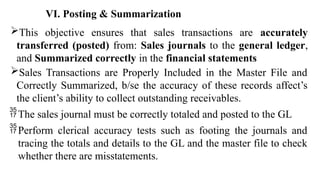
department, product line, or cost center based on their
nature.
Sales of cash vs. credit sales
Exclude sales of operating assets such as machinery
Use of more than one sales classification…..
Regular/domestic sale, export sale, installment sale…
Incorrect classification leads to:
 Misleading financial statements
 Wrong segment reporting
This objective ensures that sales transactions are accurately
transferred (posted) from: Sales journals to the general ledger,
and Summarized correctly in the financial statements
Sales Transactions are Properly Included in the Master File and
Correctly Summarized, b/se the accuracy of these records affect’s
the client’s ability to collect outstanding receivables.
The sales journal must be correctly totaled and posted to the GL
Perform clerical accuracy tests such as footing the journals and
tracing the totals and details to the GL and the master file to check
whether there are misstatements.
VI. Posting & Summarization
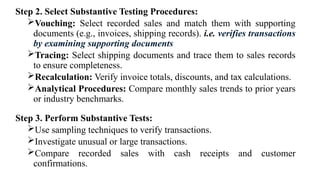
Step 2. Select Substantive Testing Procedures:
Vouching: Select recorded sales and match them with supporting
documents (e.g., invoices, shipping records). i.e. verifies transactions
by examining supporting documents
Tracing: Select shipping documents and trace them to sales records
to ensure completeness.
Recalculation: Verify invoice totals, discounts, and tax calculations.
Analytical Procedures: Compare monthly sales trends to prior years
or industry benchmarks.
Step 3. Perform Substantive Tests:
Use sampling techniques to verify transactions.
Investigate unusual or large transactions.
Compare recorded sales with cash receipts and customer
confirmations.
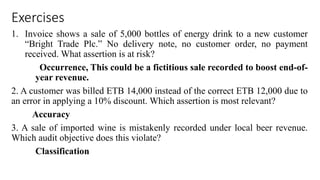
Exercises
1. Invoice shows a sale of 5,000 bottles of energy drink to a new customer
“Bright Trade Plc.” No delivery note, no customer order, no payment
received. What assertion is at risk?
Occurrence, This could be a fictitious sale recorded to boost end-of-
year revenue.
2. A customer was billed ETB 14,000 instead of the correct ETB 12,000 due to
an error in applying a 10% discount. Which assertion is most relevant?
Accuracy
3. A sale of imported wine is mistakenly recorded under local beer revenue.
Which audit objective does this violate?
Classification
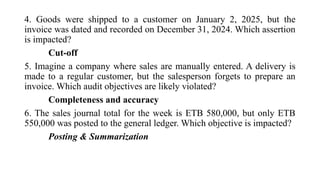
4. Goods were shipped to a customer on January 2, 2025, but the
invoice was dated and recorded on December 31, 2024. Which assertion
is impacted?
Cut-off
5. Imagine a company where sales are manually entered. A delivery is
made to a regular customer, but the salesperson forgets to prepare an
invoice. Which audit objectives are likely violated?
Completeness and accuracy
6. The sales journal total for the week is ETB 580,000, but only ETB
550,000 was posted to the general ledger. Which objective is impacted?
Posting & Summarization
7 Auditor finds that sales invoices are generated manually, and many
shipping documents are missing. Sales are still being recorded based on
sales manager’s verbal confirmation.
What are the potential assertions at risk?
Occurrence – No evidence the sale actually took place.
Completeness – Manual records may omit some real transactions.
Accuracy – Without supporting docs, amounts may be incorrect.
Iv. Methodology for Designing Tests of Controls and Substantive
Tests of Transactions for Cash Receipts
The same methodology used for designing tests of controls and substantive tests of
transactions for sales is used for cash receipts.
 Cash receipts tests of controls and substantive tests of transactions audit procedures
are developed around the same framework used for sales.
 Key internal controls for each objective are determined, tests of controls are developed
for each control, and substantive tests of transactions for the monetary misstatements
related to each objective are developed.
 The tests of controls depend on the controls the auditor has identified and the extent
they will be relied on to reduce assessed control risk.
 An essential part of the auditor’s responsibility in auditing cash receipts is
identification of weaknesses in internal control that increase the likelihood of fraud.
Determine Whether Cash Received was Recorded
It is difficult to detect a cash fraud occurred before the cash is recorded in the
cash receipt journal or other cash listing.
 Internal controls designed to satisfy completeness objective are important.
 Trace from prenumbered remittance advices or prelists of cash receipts to
the cash receipt journal and subsidiary A/R records as a substantive tests of
the recording of the actual cash received… effective only if a cash register
tape or some other prelisting was prepared at the time cash was received
Prepare Proof of Cash
 A useful audit procedure to test whether all recorded cash receipts have
been deposited in the bank account.
 Total cash receipts recorded in the journal vs. actual deposits made during
the month…
 Helps to detect recorded cash receipts that haven’t been deposited,
unrecorded deposits, unrecorded loans, bank loan deposited directly into the
bank account etc.
 Can not help to detect cash receipts that have not been recorded inn the
journals or time lags in making deposits.
 Performed only when controls are weak.
Test to Discover Lapping of A/R
Lapping of A/R is the postponement of entries for the collection of receivables
to conceal an existing cash shortage.
 The defalcation is perpetrated by a person who handles cash receipts and then
enters them into the computer system.
 Involves differing recording the cash receipts from one customer and covers
the shortage with receipts of another. This in turn is covered from the receipts
of a third customer few days later.
 Prevention…. Separate duties and mandatory vacation policy for employees
who both handle cash and enter cash receipts into the system.
 Detection… Compare the name, amount, and dates shown on remittance
advices with cash receipts journal entries and related duplicate deposit slips.
Chapter Two sales and collection cycle.pptx

Chapter Two sales and collection cycle.pptx

  • 1.
    CHAPTER TWO AUDIT OFTHE SALES AND COLLECTION CYCLE
  • 2.
    Introduction • The Salesand Collection Cycle refers to the process through which a business generates revenue by selling goods or services and receives payment for these sales. • This cycle involves a series of activities related to the sale of products, from order receipt to cash collection. Auditing this cycle ensures that financial transactions are accurate, legitimate, and properly recorded. • When conducting an audit of the Sales and Collection Cycle, the auditor examines the processes, records, and controls to verify that the revenue and related cash inflows are accurate, properly authorized, and not subject to fraud or misstatement.
  • 3.
    •Before studying theprocess of assessing control risk and designing tests of controls and substantive tests of transactions for each class of transactions, it is important to know the sales and collection cycle classes of transactions and account balances. •It is also important to understand the typical documents and records used in the cycle.
  • 4.
    I. Accounts andClasses of Transactions in the Sales and Collection Cycle • The overall objective in the audit of the sales and collection cycle is to evaluate whether the account balances affected by the cycles are fairly presented : 1. Accounts in the Sales and Collection Cycle: Accounts refer to the financial statement line items that reflect a company’s financial position and performance. These include assets, liabilities, equity, revenue, and expenses. The accounts related with sales and collection cycle are:
  • 5.
    Accounts in theSales and Collection Cycle Sales Accounts receivable Cash in bank Cash discount taken Sales returns and allowances Allowance for uncollectible accounts Bad debt expense
  • 6.
    2. Classes ofTransactions in the Sales and Collection Cycle: A class of transactions refers to a group of similar financial transactions recorded in a specific period that affect financial statement accounts. The classes of transactions in the sales and collection cycle are: Sales Transactions Cash receipts Transactions Sales returns and allowances Transactions Charge-off of uncollectible accounts Transactions Bad Debt Expense and Write-offs Transactions
  • 7.
    II. Business Functionsand Related Documents &Records in the Cycle • A business function in the sales cycle refers to a specific activity that takes place in the process of selling goods or services. These functions ensure that sales transactions are properly executed, recorded, and controlled. • Each function involves documents and records that serve as evidence of transactions and help maintain accuracy in financial reporting. • The Sales and Collection Cycle involves the decisions and processes necessary for the transfer of the ownership of goods and services to customers after they are made available for sale. • It begins with a request by a customer and ends with the conversion of material or service into an account receivable, and ultimately into cash.
  • 8.
    •There are eightBusiness Functions for sales and collection cycle. They occur in every business in the recording of the five classes of transactions in the sales and collection cycle. •Below you will find summary discussions of the Classes of Transactions, Accounts, Business functions, and related Documents and Records for the Sales and Collection Cycle.
  • 9.
    1. Sales Transaction Accountsaffected by sales transaction:  Sales  Accounts receivable Business Functions i. Processing customer orders, - Customer places an order using Customer Order document. The request for goods by a customer is the starting point for the entire cycle o This is often followed by the issuance of Sales Order. ii. Granting credit- a properly authorized person must approve credit to the customer for sales on account. o Minimizes the possibility of bad debts. o It may be a programmed approval- based on preapproved credit limit maintained in a customer master file.
  • 10.
    iii. Shipping goods oA point at which most companies recognize sale. o A shipping document is prepared, dispatching products to customers and recording the shipment. o The shipping document may be a multicopy of delivery note, bill of lading and packing list. Feature Delivery Note Bill of Lading (BOL) Packing List Definition A document that accompanies goods, listing what is being delivered. A legally binding document that serves as a contract between the shipper and carrier for transporting goods. A detailed document listing all items in a shipment, including descriptions, weights, and packaging details. Purpose Confirms delivery of goods to the customer and ensures they receive the correct items. Issued by the carrier to acknowledge receipt of cargo for shipment Provides detailed itemized information about the contents of a shipment for customs clearance and inventory management.
  • 11.
    iv. Billing customersand recording sales- Billing is a means by which the customer is informed of the amount due for the goods. oAll shipments should be billed and no shipment should be billed more than once. oBilling should consider authorized price, quantity shipped and other terms. oDone with multicopy sales invoice and simultaneously updating of the sales transaction file, accounts receivable master file, and the general ledger master file for sales and accounts receivable.
  • 12.
    Documents and Records Customer Order- a request for merchandise by a customer. o It may be received in differing formats.  Sales Order- used to communicate the description, quantity and related specification of goods ordered with in the company. o Often used to indicate credit approval and authorization for shipment.  Shipping Document- a document prepared to initiate shipment of goods. o Prepared in at lease in three copies – customer, accounts, retained  Sales invoice-a document indicating the description and quantity of goods sold, price, freight charges, insurance, terms, and other relevant data. o Prepared in at least three copies.
  • 13.
     Sales transactionfile- is a database (computer generated file) or record that contains details of all sales transactions during a specific period. This file is essential for financial reporting, auditing, and business analysis.  It includes all information entered into the system and information for each transaction- like invoice number date of sale, customer information(Name, ID, address…), product detail(qty, price, total amount), payment term (credit or cash, payment due date, discounts if any), account classifications, sales person, and commission rate. o The information in this file is used for a variety of records, listing, or reports- e.g. sales journal, A/R master file, and transactions for certain account balance or division.
  • 14.
     Sales journalor listing- a report generated from the sales transaction file that typically includes the customer name, date, amount, and account classification or classifications for each transaction, such as division or product line. o It also identifies whether the sale was for cash or credit.  Accounts receivable master file- a file used to record individual sales, cash receipts, and sales returns and allowances for each customer and to maintain customer account balances. A summary file that tracks customer balances and outstanding receivables. o The master file is updated from the sales, sales returns and allowances, and cash receipts computer transaction files. o It is also called the A/R subsidiary ledger or subledger
  • 15.
     Accounts Receivabletrial balance- a list of the amounts owed by each customer at a point in time. o This is prepared directly from the A/R master file. o It is often an aged trial balance.  Monthly statements- a document sent by mail or electronically to each customer indicating the beginning balance of A/R, the amount and due date of each sale, cash payments received, credit memos issued, and the ending balance due.
  • 16.
    2. Cash ReceiptsTransaction Accounts  Cash in bank (debits from cash receipts)  Accounts receivable Business Functions v. Processing and recording cash receipts- includes receiving, depositing and recording cash- currency & checks. o The possibility of theft is the most important concern (both before and after recorded). o All cash receipts must be deposited intact and recorded in the cash receipts transaction file. o Remittance advices are important for this purpose.
  • 17.
    Documents and Records Remittance advice- o is a document sent by a customer to a supplier (or creditor) to inform them that a payment has been made. o a document that accompanies the sales invoice mailed to the customer and can be returned to the seller with the cash payment. o Used to permit the immediate deposit of cash & to improve control over custody of assets.  Prelisting of cash receipts- a list prepared when cash is received by someone who has no responsibility for recording sales, A/R, or cash and who has no access to accounting records. o It is used for verifying whether cash received was recorded and deposited.
  • 18.
     Cash receiptstransaction file- a computer generated file that includes all cash receipts transactions processed by the accounting system for a period. o Used to prepare the cash receipts journal and update the A/R and general ledger master files.  Cash receipts journal or listing- a report generated from the cash receipts transaction file that includes all transactions for any time period.
  • 19.
    3. Sales Returnsand Allowances Transaction Accounts  Sales returns and allowances  Accounts receivable Business Functions vi. Processing and recording sales returns and allowances o When a customer is dissatisfied with the goods, the seller often accepts the returned goods or grants a reduction in the charges. o It is necessary to issue a Receiving Report and return the goods to store. o Record the transaction promptly and accurately on the Sales and Returns Journal & A/R master file. o As an aid for control & to facilitate recording Credit Memos are issued.
  • 20.
    Documents and Records Credit memo- a document indicating a reduction in the amount due from a customer because of returned goods and allowances granted.  Sales returns and allowances journal- a journal used to record sales returns and allowances. o Sales journal can be used instead.
  • 21.
    4. Charge-off ofuncollectible accounts Transactions Accounts  Allowance for uncollectible accounts  Accounts receivable Business Functions vii. Charging off uncollectible accounts receivable o When the company concludes that an amount is no longer collectible, it must be charged off- e.g. if a customer becomes bankrupt. o Necessary adjusting entries are made. Documents and Records  Uncollectible account authorization form- a document used initially to indicate authority to write an account receivable off as uncollectible.  General journal
  • 22.
    5. Bad DebtExpense Transaction Accounts  Bad debt expense  Allowance for uncollectible accounts Business Functions viii. Providing for bad debts o The provision should be sufficient to allow for the current period sales that the company will be unable to collect in the future. o Allowance method is used. Documents and Records  General journal
  • 23.
    III. Methodology forDesigning Tests of Controls and Substantive Tests of Transactions for Sales When auditing sales transactions, auditors use a structured approach to assess internal controls and test transactions for potential misstatements. This methodology includes tests of controls and substantive tests of transactions to ensure the accuracy, completeness, and legitimacy of recorded sales. 1. Designing tests of control for sales : Tests of controls assess whether a company’s internal controls over sales transactions are operating effectively. The goal is to determine whether the company is following established procedures to prevent or detect errors and fraud.
  • 24.
    Steps in DesigningTests of Controls of sales: For each control the auditor plans to rely on to reduce assessed control risk, one or more tests of controls must be designed to verify its effectiveness. Step 1. Understanding Internal Controls  Typical approach for sales involves studying the client's flowcharts, Auditor prepares an internal control questionnaire, and performs walk- through tests of sales. Identify key controls in the sales cycle (e.g., order approvals, credit checks, invoicing procedures) Example: • The auditor observes the sales process and documents of x company that: • Sales orders must be approved by a credit manager. • Goods are only dispatched upon authorization. • Sales invoices are automatically generated from the system after goods are shipped.
  • 25.
    Step 2. AssessPlanned Control Risk- Sales i.e. Identify Key Control Activities:  Information obtained in understanding internal control is used to assess control risk. i.e.  Based on the understanding of internal controls, the auditor assesses how much they can rely on controls to prevent or detect errors. This influences how much substantive testing is needed.  Make a preliminary control risk assessment (low, moderate, high)  There are four essential steps:
  • 26.
    There are fouressential steps: 1. The auditor needs a framework for assessing control risk. The framework for all classes of transactions is the six transaction-related audit objectives The six transaction-related audit objectives serve as a framework to ensure transactions are valid, complete, accurate, properly classified, and recorded in the correct period. 2. Identify the key internal controls and weaknesses for sales. 3. Associate the controls and weaknesses identified with the objectives. 4. Assess the control risk for each objective by evaluating the controls and weaknesses for each objective.
  • 27.
    Example of controls: 1.Adequate Separation of Duties  Segregation of Duties :Different employees handle sales orders, shipping, and invoicing. Separation of duties reduces the risk of: • Fraud (e.g., embezzlement, fictitious sales) • Concealment (if one person does everything, they can cover up mistakes or fraud)  Person responsible for inputting sales and cash receipts transaction information into the computer vs. person having access to cash.  Credit granting function vs. the sales function (to minimize the sales people tendency to optimize volume even at the expense of high bad debt write-offs).  Personnel responsible for doing internal comparisons vs. those entering the original data.
  • 28.
    Here are themain duties that should be separated over sales and collection cycle Function Typical Role/Department Sales Order Initiation Sales Department Credit Approval Credit Department or Finance Manager Shipping/Delivery Warehouse or Logistics Billing/Invoicing Billing Clerk or finance Recording in Accounts Accounting Cash Collection/Receipting Cashier or Treasury Bank Reconciliation Independent Finance Officer or Internal Audit
  • 29.
    2. Proper Authorization Authorization means approval of sales orders before processing. Three key points of authorization  Credit must be properly authorized before sales takes place,  Goods should be shipped only after proper authorization, and  Price, including freight and discount, must be properly approved- to ensure sales is billed at the price set by company policy.
  • 30.
    3. Adequate Documentsand Records Documents and records used must be adequate. Should contain sufficient information. Most companies automatically prepare a multi-copy prenumbered sales invoice at the time the customer places an order. –Useful for minimizing the chance of failure to bill the customer if all invoices are accounted for periodically. Use of prenumbered documented prevents both the failure to bill or record sales and the occurrence of duplicate billings and recordings. i.e. Use of pre-numbered sales invoices to prevent missing transactions
  • 31.
    4. Monthly Statements/Reconciliation Matchingsales records with shipping documents and bank deposits. Sent by someone having no responsibility for handling cash or preparing the sales and A/R records. Encourages response from customers if the balance is improperly stated. All disagreements about the balance in the account should be directed to the independent designated official.
  • 32.
    5. Internal VerificationProcedure For fulfilling each of the six transaction related audit objectives, a computer program or an independent person check the processing and recording of sales. e.g.  accounting for numerical sequence of prenumbered documents, Checking the accuracy of document preparation. Reviewing reports for unusual or incorrect items.
  • 33.
    Step 3: SelectControl Tests: •Observation: Watching employees perform sales transactions. •Inspection: Reviewing sales documents for manager approvals. •Reperformance: Recalculating discounts or credit limits to verify system accuracy. •Inquiry: Asking sales personnel about procedures for approving orders. Step 4: Evaluate Control Effectiveness: •If controls are effective, the auditor may reduce substantive testing. •If controls are weak, substantive tests of transactions are increased.
  • 34.
    II: Designing SubstantiveTests of Transactions for Sales  Substantive tests of transactions are audit procedures used to verify the monetary accuracy of transactions recorded in the accounting records.  Substantive tests of transactions aim to detect misstatements in sales transactions.  Understanding the substantive tests of transactions for sale is crucial in the auditing process. These tests are designed to uncover any monetary misstatements with in sales transaction and are influenced by the company’s internal controls and related audit objectives • The procedures vary depending on the circumstances and often require careful auditor’s judgement, especially when internal controls are deemed inadequate.
  • 35.
    Steps in DesigningSubstantive Tests of Transactions: Step 1:Identify Key Assertions at Risk (The Six Transaction-Related Audit Objectives) i. Occurrence: Sales recorded actually took place. ii. Completeness: All sales are recorded. iii. Accuracy: Sales amounts are correctly calculated. iv. Cutoff: Sales are recorded in the correct period. v. Classification: Sales are recorded in the right accounts. vi. Posting & Summarization: Trace sales from journal to general ledger to verify correct account posting. Let us see one by one:
  • 36.
    i. Recorded SalesExist (Occurrence Assertion)  All sales transactions recorded in the accounting records actually happened in reality. I.e.  The sales it reports in the financial statements are genuine and supported by documents.  For this objective, the auditor is concerned with the possibility of three types of misstatements: a) Sales being included in the journals for which no shipment was made, b) Sales recorded more than once, and c) Shipments being made to nonexistent customers and recorded as sales
  • 37.
    a) Recorded Salesfor which there was no Shipment  Trace selected entries from the sales journal to make sure that related copies of the shipping and other supporting documents exist.  If the possibility of fictitious duplicate copy of a shipping document, trace amounts to the perpetual inventory records.  Trace the credit in the A/r master file to its source- if collected or goods returned, there must originally have been a sale. If credited for bad debt or if the account was still unpaid, intensive follow-up by examining shipping documents and customer order docs.
  • 38.
    b) Sales RecordedMore than Once  Duplicate sales can be determined by reviewing a numerically sorted list of recorded sales transactions for duplicate numbers.  Also test proper cancellation of shipping documents. c) Shipment Made to Nonexistent Customers  Can occur only when the person recording sales is also in a position to authorize shipments.  If controls are weak, it is difficult to detect.
  • 39.
    Sales is oneof the highest-risk areas for misstatement due to: • Pressure to meet revenue targets • Incentives like performance bonuses • Desire to show business growth to investors or lenders Common risks related to the occurrence assertion include: • Fictitious sales recorded near year-end to inflate revenue • Recording duplicate sales • Posting of sales without proper shipment or customer approval • Creating fake customers or invoices
  • 40.
    ii. Existing SalesTransactions are Recorded ( completeness) All sales transactions that actually happened have been fully recorded in the accounting system. i.e. No real sales are left out or missed. Normally, substantive test for completeness is less emphasized. If real sales are not recorded: • Revenue is understated • Accounts receivable may be understated • Financial statements become misleading Common risks of incompleteness in sales include: • Manual invoices that are not entered into the system • Unauthorized deliveries without documentation
  • 41.
    Direction of Testingactivities  Tracing from source documents to the journals- a test for omitted transactions- Completeness Objective…likely starting point could be a shipping doc…a sample selected and traced to sales invoices and sales journal.  Tracing from the journals back to source documents- a test for nonexistent transactions- existence objective….likely starting point could be the journal… a sample of invoice numbers is selected from the journals and traced to duplicate sales invoices, shipping docs, and customer orders.
  • 42.
    iii. Sales areAccurately Recorded Accurate recording of sales - shipping the amount of goods ordered, accurate billing for the amount of goods shipped, and accurately recording the amount billed. Typical substantive tests include: Recomputing information in the accounting records  Start with entries in the sales journal to compare the total of selected transactions with A/R master file entries & duplicate sales invoices.  Compare prices on the duplicate sales invoices with an approved price list,  Recompute extensions and footings
  • 43.
     Compare detailslisted on the invoices with shipping records for description, quantity, and customer identification When sales invoices are automatically calculated and posted by a computer, the auditor may be able to reduce substantive tests of transactions for the accuracy objective. If the auditor determines that the computer is programmed accurately and the price list master file is authorized and correct, detailed invoice calculations can be reduced or eliminated. In this case, the focus will be on determining if effective computer controls exist.
  • 44.
    iv. Sales arerecorded on the correct dates (Cut-off Assertion ) The cutoff assertion ensures that transactions are recorded in the correct accounting period. It is particularly important at the end of a reporting period to prevent early or late recognition of revenue or expenses. Sales should be billed and recorded as soon after shipment takes place as possible to prevent the unintentional omission of transactions from the records and to make sure that sales are recorded in the proper period.
  • 45.
    Importance of CutoffTesting 1.Prevents Misstated Financial Statements – If sales or expenses are recorded in the wrong period, financial statements will be misleading. 2.Ensures Compliance with Accounting Standards – GAAP and IFRS require proper revenue and expense recognition. 3.Detects Revenue Manipulation (Fraud Risk) – Companies may shift revenue to inflate earnings in a given period. 4.Affects Profitability Analysis – Incorrect timing of transactions can distort financial ratios and performance evaluation.
  • 46.
    V. RECORDED SALESARE PROPERLY CLASSIFIED The key idea, Sales must be posted to the correct account, department, product line, or cost center based on their nature. Sales of cash vs. credit sales Exclude sales of operating assets such as machinery Use of more than one sales classification….. Regular/domestic sale, export sale, installment sale… Incorrect classification leads to:  Misleading financial statements  Wrong segment reporting
  • 47.
    This objective ensuresthat sales transactions are accurately transferred (posted) from: Sales journals to the general ledger, and Summarized correctly in the financial statements Sales Transactions are Properly Included in the Master File and Correctly Summarized, b/se the accuracy of these records affect’s the client’s ability to collect outstanding receivables. The sales journal must be correctly totaled and posted to the GL Perform clerical accuracy tests such as footing the journals and tracing the totals and details to the GL and the master file to check whether there are misstatements. VI. Posting & Summarization
  • 48.
    Step 2. SelectSubstantive Testing Procedures: Vouching: Select recorded sales and match them with supporting documents (e.g., invoices, shipping records). i.e. verifies transactions by examining supporting documents Tracing: Select shipping documents and trace them to sales records to ensure completeness. Recalculation: Verify invoice totals, discounts, and tax calculations. Analytical Procedures: Compare monthly sales trends to prior years or industry benchmarks. Step 3. Perform Substantive Tests: Use sampling techniques to verify transactions. Investigate unusual or large transactions. Compare recorded sales with cash receipts and customer confirmations.
  • 49.
    Exercises 1. Invoice showsa sale of 5,000 bottles of energy drink to a new customer “Bright Trade Plc.” No delivery note, no customer order, no payment received. What assertion is at risk? Occurrence, This could be a fictitious sale recorded to boost end-of- year revenue. 2. A customer was billed ETB 14,000 instead of the correct ETB 12,000 due to an error in applying a 10% discount. Which assertion is most relevant? Accuracy 3. A sale of imported wine is mistakenly recorded under local beer revenue. Which audit objective does this violate? Classification
  • 50.
    4. Goods wereshipped to a customer on January 2, 2025, but the invoice was dated and recorded on December 31, 2024. Which assertion is impacted? Cut-off 5. Imagine a company where sales are manually entered. A delivery is made to a regular customer, but the salesperson forgets to prepare an invoice. Which audit objectives are likely violated? Completeness and accuracy 6. The sales journal total for the week is ETB 580,000, but only ETB 550,000 was posted to the general ledger. Which objective is impacted? Posting & Summarization
  • 51.
    7 Auditor findsthat sales invoices are generated manually, and many shipping documents are missing. Sales are still being recorded based on sales manager’s verbal confirmation. What are the potential assertions at risk? Occurrence – No evidence the sale actually took place. Completeness – Manual records may omit some real transactions. Accuracy – Without supporting docs, amounts may be incorrect.
  • 52.
    Iv. Methodology forDesigning Tests of Controls and Substantive Tests of Transactions for Cash Receipts The same methodology used for designing tests of controls and substantive tests of transactions for sales is used for cash receipts.  Cash receipts tests of controls and substantive tests of transactions audit procedures are developed around the same framework used for sales.  Key internal controls for each objective are determined, tests of controls are developed for each control, and substantive tests of transactions for the monetary misstatements related to each objective are developed.  The tests of controls depend on the controls the auditor has identified and the extent they will be relied on to reduce assessed control risk.  An essential part of the auditor’s responsibility in auditing cash receipts is identification of weaknesses in internal control that increase the likelihood of fraud.
  • 53.
    Determine Whether CashReceived was Recorded It is difficult to detect a cash fraud occurred before the cash is recorded in the cash receipt journal or other cash listing.  Internal controls designed to satisfy completeness objective are important.  Trace from prenumbered remittance advices or prelists of cash receipts to the cash receipt journal and subsidiary A/R records as a substantive tests of the recording of the actual cash received… effective only if a cash register tape or some other prelisting was prepared at the time cash was received
  • 54.
    Prepare Proof ofCash  A useful audit procedure to test whether all recorded cash receipts have been deposited in the bank account.  Total cash receipts recorded in the journal vs. actual deposits made during the month…  Helps to detect recorded cash receipts that haven’t been deposited, unrecorded deposits, unrecorded loans, bank loan deposited directly into the bank account etc.  Can not help to detect cash receipts that have not been recorded inn the journals or time lags in making deposits.  Performed only when controls are weak.
  • 55.
    Test to DiscoverLapping of A/R Lapping of A/R is the postponement of entries for the collection of receivables to conceal an existing cash shortage.  The defalcation is perpetrated by a person who handles cash receipts and then enters them into the computer system.  Involves differing recording the cash receipts from one customer and covers the shortage with receipts of another. This in turn is covered from the receipts of a third customer few days later.  Prevention…. Separate duties and mandatory vacation policy for employees who both handle cash and enter cash receipts into the system.  Detection… Compare the name, amount, and dates shown on remittance advices with cash receipts journal entries and related duplicate deposit slips.