1
CHAPTER TWO
AUDIT OF THE SALES AND
COLLECTION CYCLE
2
INTRODUCTION
Accounts receivable is part of the "current assets“ section on a company's
balance sheet.
It represents the balance owed by customers for products sold or services
rendered.
For small businesses that sell on credit, this account can represent a large
portion of its current assets.
In many companies, individual transactions are small and frequent.
As such, there is ample opportunity for errors in prices and dates that could
leave accounts receivable misstated.
Audits can help clear up these errors.
Auditors typically follow a standard set of procedures when it comes to
auditing accounts receivable.
3
Sources of Accounts Receivable
Claims against customers from sale
of goods
Loans to officers or employees
Loans to subsidiaries
Claims against various other
refunds
Claims for tax refunds
Advances to suppliers
Sources of Notes Receivable
Written promises to pay certain
amounts at future dates
Notes for substantial amounts
Installment note or contract can
allow seller to hold lien (right) on
goods
•Examples:
Sale of industrial machinery, farm
equipment
Issuance of capital stock
4
2.1. SOURCES AND NATURE OF RECEIVABLE
 The sales and collection cycle involves the decisions and
processes necessary for the transfer of the ownership of goods
and services to customers after they are made available for
sale.
 It begins with a request by a customer and ends with the
conversion of material or service into an account receivable,
and ultimately into cash
 Receivables from customers include both accounts receivable
and various types of notes receivable.
 It is important to differentiate the origin and nature of
receivables to ensure their appropriate classification and
valuation.
5
What is the Sales and Collection Cycle?
• Also known as the Revenue, Receivables, and Receipts
(RRR) Cycle.
• Journal entries that debit accounts receivable and credit
sales revenue, and debit cash and credit accounts
receivable, respectively.
2.1.Overview of the cycle
6
Sales and Collection Cycle
7
Why Are Revenue Cycle Accounts Important?
Sales transactions are always material to a company's
financial statements
According to the SEC, a majority of financial statement
manipulations and audit failures involve overstated
revenues
Therefore, revenue cycle accounts must be examined with
great care
8
• The revenue cycle involves the process of
Receiving a customer’s order,
Approving credit for a sale,
Determining whether the goods are available for shipment,
Shipping the goods, billing the customer,
Collecting cash, and
Recognizing the effect of this process on other related
accounts such as accounts receivable, inventory, and sales
commission expense
In the revenue cycle, the most significant accounts include revenue and
accounts receivable. The auditor will likely obtain evidence related to each
of the financial statement assertions
9
The process usually begins when a customer approaches
the company and files a customer purchase order
The sales department receives the document and prepares
a sales order that is then sent to the credit department for a
credit check.
Remember that salespeople will not perform credit checks
because their position as a salesperson may influence their
bias when making credit decisions on customers. This
separation is called segregation of duties.
10
Once the credit department approves the customer and the
order, the sales order is sent to the shipping department,
which will generate a shipping document, also referred to
as a bill of lading or a waybill.
The approved sales order and the shipping document are
then sent to the accounts receivable clerk, who then
generates a sales invoice and makes the necessary journal
entry.
Finally, once the cash is received from the customer,
accounting or treasury records the credit to cash and debits
the balance in accounts receivable.
11
2.2. KEY INTERNAL CONTROL OF SALES AND RECEIVABLES
2.2.1 Internal Controls for Sales Class of Transactions
There are five applicable assertions: cut-off, classification, completeness,
occurrence, and accuracy.
Occurrence assertion is that each sales transaction is supported by the
necessary documents, such as the approved sales order, shipping
documents, and invoice.
Completeness assertion, shipping documents are typically sequentially pre-
numbered so that any duplicate transaction or a missing transaction can be
12
2.2.2 Internal Controls for Cash Receipts
• Some internal controls for the cash receipts class include
the segregation of duties between the cash handler and
the record-keeper, and monthly bank reconciliations.
• These two controls pertain mainly to the occurrence
assertion.
• In terms of the completeness assertion, monthly customer
statements are a strong control, as well as the use of
remittance invoices or pre-listing of cash, and the
reconciliation of the documents with deposit slips.
13
2.2.3. The objectives of internal controls over receivables
are to ensure:
All goods dispatched/Shipped are invoiced.
Invoicing is at correct price and discount.
Goods are only dispatched on credit to approved customers.
Invoices are recorded and related to subsequent cash
receipts.
Receivables are controlled and bad debts pursued.
Credit notes approved.
14
INTERNAL CONTROL OF SALES AND RECEIVABLES
In addition the internal control over receivables, there
should be such that the possibility of any falsification of
the receivables accounts is eliminated.
An important part of the controls would be to ensure
that the cashier does not have access to the sales
ledger, and the sales ledger clerk does not have access
to cash received.
15
Internal Control procedures, over sales and receivables include
the following.
Orders
The orders should be checked against the customer’s account
All orders received should be recorded on pre- numbered sales order
documents.
All orders should be authorized before goods are dispatched.
Dispatch
-Dispatch notes should be pre-numbered and a register kept of
them to relate to sales invoices and orders.
-Goods dispatch notes should be authorized as goods leave.
16
Control procedures, over sales and receivables include the following.
Invoicing
- Sales invoices should be authorized by a responsible official.
- Sales invoices should be checked for prices and calculations by a
person other than the one preparing the invoice.
- All invoices should be pre-numbered consecutively.
- Copies of cancelled invoices should be retained/booked.
17
Control procedures Contin…
Receivables.
- A receivable ledger control account should be prepared and checked to individual sales ledger
balances.
- Receivables ledger personnel should be independent of dispatch and cash receipt functions.
- Statements should be sent regularly to customers.
Bad Debts.
- The authority to write off a bad debt should be given in writing and adjustments made to
the accounts receivable ledger.
- The use of court action or write-off of a bad debt should be authorized by an official
independent of the cash receipts function.
18
19
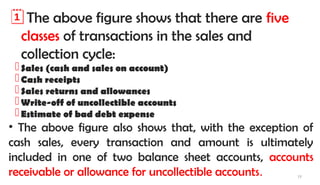
The above figure shows that there are five
classes of transactions in the sales and
collection cycle:
Sales (cash and sales on account)
Cash receipts
Sales returns and allowances
Write-off of uncollectible accounts
Estimate of bad debt expense
• The above figure also shows that, with the exception of
cash sales, every transaction and amount is ultimately
included in one of two balance sheet accounts, accounts
receivable or allowance for uncollectible accounts.
20
The Classes of Transactions, Accounts, Business functions, and related
Documents and Records for the Sales and Collection Cycle.
1. SALES TRANSACTION
Accounts
 Sales
 Accounts receivable
Business Functions
 Processing customer orders, - Customer places an order using
Customer Order document.
This is often followed by the issuance of Sales Order.
 Granting credit- a properly authorized person must approve credit to
the customer for sales on account.
•
21
Minimizes the possibility of bad debts.
• It may be a programmed approval- based on
preapproved credit limit maintained in a customer master
file.
 Shipping goods
• A point at which most companies recognize sale.
• A shipping document is prepared.
• The shipping document may be a multi copy bill of
lading.
• Update perpetual inventory record.
22
Billing customers and recording sales- Billing is a means by which the
customer is informed of the amount due for the goods.
• All shipments should be billed and no shipment should be billed
more than once.
• Billing should consider authorized price, quantity shipped and other
terms.
Done with multi copy sales invoice and simultaneously updating of
the sales transaction file, accounts receivable master file, and the general
ledger master file for sales and accounts receivable
23
Documents and Records
 Customer Order- a request for merchandise by a customer.
 Sales Order- used to communicate the description, quantity and
related specification of goods ordered.
 Shipping Document- a document prepared to initiate shipment of goods.
 Sales invoice-a document indicating the description and quantity
of goods sold the price, freight charges, insurance, terms, and
other relevant data.
 Sales transaction file- a computer generated file that includes all sales
transaction processed by the accounting system for a period.
24
• Sales journal or listing- a report generated from the
sales transaction file that typically includes the customer name,
date, amount, and account classification or classifications
for each transaction, such as division or product line.
• Accounts receivable master file- a file used to record
individual sales, cash receipts, and sales returns and
allowances for each customer and to maintain customer
account balances.
2. SALES RETURNS AND ALLOWANCES TRANSACTION
Accounts
 Sales returns and allowances
 Accounts receivable
Business Functions
 Processing and recording sales returns and allowances
• When a customer is dissatisfied with the goods, the seller often accepts
the returned goods or grants a reduction in the charges.
• It is necessary to issue a Receiving Report and return the goods to store
25
26
• Record the transaction promptly and accurately on the
Sales and Returns Journal & A/R master file.
• As an aid for control & to facilitate recording Credit
Memos are issued.
Documents and Records
 Credit memo- a document indicating a reduction in the amount due
from a customer because of returned goods and allowances granted.
 Sales returns and allowances journal- a journal used to
record sales returns and allowances.
27
3. CHARGE-OFF OF UNCOLLECTIBLE ACCOUNTS TRANSACTION
Accounts
1. Accounts receivable
2. Allowance for uncollectible accounts
Business Functions
Charging off uncollectible accounts receivable
• When the company concludes that an amount is no longer collectible, it must be charged off- e.g. if a
customer becomes bankrupt.
Documents and Records
a. Uncollectible account authorization form- a document used initially to indicate authority to write an account
receivable off as uncollectible.
b. General journal
4. CASH RECEIPTS
Accounts : Cash and Accounts Receivable Functions: Recording the accounts &Posting
28
5. BAD DEBT EXPENSE TRANSACTION
Accounts
 Bad debt expenses
 Allowance for uncollectible accounts
Business Functions is Providing for bad debts
 The provision should be sufficient to allow for the current period sales
that the company will be unable to collect in the future.
 Allowance method is used.
Documents and Records
• General journal
29
2.3 Tests of Controls & Substantive Tests of Transactions
(i) UNDERSTANDING INTERNAL CONTROLS-
SALES
 Typical approach- Auditor prepares an internal control questionnaire, and
performs walk-through tests of sales
ASSESS PLANNED CONTROL RISK- SALES
 Information obtained in understanding internal control is used to assess
control risk. There are four essential steps:
1. The auditor needs a framework for assessing control risk.
2. Identify the key internal controls and weaknesses for sales.
3. Associate the controls and weaknesses identified with the objectives.
4. Assess the control risk for each objective by evaluating the controls
and weaknesses for each objective. Step four is critical because it affects the
auditor’s decisions about both tests of controls and substantive tests
30
The following are key control points auditors will consider in
their evaluation of the internal control system of the client.
 Adequate Separation Of Duties
 Proper Authorization
 Adequate Documents And Records
 Prenumbered Documents
 Monthly Statements
 Internal Verification Procedure
31
ii) DESIGNING SUBSTANTIVE TESTS OF TRANSACTIONS FOR SALES
Additional procedures to be performed in relation to
the transaction related audit objectives.
RECORDED SALES EXIST
For this objective, the auditor is concerned with the
possibility of three types of misstatements.
1. Sales being included in the journals for which no shipment was
made,
2. Sales recorded more than once, and
3. Shipments being made to nonexistent customers and recorded
as sales
32
Methodology for Designing Controls
and Substantive Tests: Sales
Understand internal
control – sales
Assess planned
control risk – sales
Evaluate cost-benefit
of testing controls.
Design tests of controls
and substantive tests
of transactions for sales
to meet transaction-
related audit objectives.
Audit procedures
Sample size
Items to select
Timing
33
Transaction-Related Audit
Objectives for Sales
Existence:
Recorded sales are for shipments actually made.
Accuracy:
Recorded sales are for the amount shipped.
Completeness:
Existing sales transactions are recorded.
34
Design Substantive Tests
of Transactions for Sales
Classification:
Sales transactions are properly classified.
Timing:
Sales are recorded on the correct dates.
Posting and summarization:
Sales transactions are properly included
in the accounts receivable master file.
35
EXISTING SALES TRANSACTIONS ARE
RECORDED
Substantive test for completeness is
less emphasized.
But if controls are inadequate, which is likely
if the client does no independent internal
tracing from shipping documents to the sales
journal, substantive testes are necessary.
36
Direction of Testing
 Tracing from source documents
to the journals
 Tracing from the journals back
to source documents
37
Direction of Tests for Sales
Customer
order
Shipping
document
Duplicate
sales invoice
Sales
journal
General
ledger
Accounts
receivable
master file
=
Completeness Start
Existence Start
38
SALES ARE ACCURATELY RECORDED
Accurate recording of sales - shipping the amount of
goods ordered, accurate billing for the amount of
goods shipped, and accurately recording the amount
billed.
Typical substantive tests include:
Re computing information in the accounting records
39
RECORDED SALES ARE PROPERLY CLASSIFIED
• Sales of cash vs. credit sales
•Exclude sales of operating assets such as machinery
•Use of more than one sales classification….. Regular,
installment
SALES ARE RECORDED ON THE CORRECT DATES
•Sales should be billed and recorded as soon after
shipment takes place as possible to prevent the unintentional
omission of transactions from the records and to make sure that
sales are recorded in the proper period.
40
SALES TRANSACTIONS ARE PROPERLY INCLUDED
IN THE MASTER FILE AND CORRECTLY
SUMMARIZED
 Needed b/c the accuracy of these records affect’s
the client’s ability to collect outstanding
receivables.
 The sales journal must be correctly totaled and
posted to the GL
41
METHODOLOGY FOR DESIGNING TESTS OF
CONTROLS AND SUBSTANTIVE TESTS OF
TRANSACTIONS FOR CASH RECEIPTS
• The same methodology used for designing tests of
controls and substantive tests of transactions for sales is used
for cash receipts.
• An essential part of the auditor’s responsibility in auditing
cash receipts is identification of weaknesses in
internal control that increase the likelihood of fraud.
42
2.4 TESTS OF DETAILS OF BALANCES
METHODOLOGY FOR DESIGNING TESTS OF DETAILS OF BALANCES
Deciding the appropriate tests of details
of balances evidence is complicated because
it must be decided on an objective-by-objective
basis, and there are several interactions
that affect the evidence decision.
43
In designing tests of details of balances for accounts receivable, it is
essential to satisfy each of the nine balance-related audit objectives.
Existence
Completeness
Accuracy
Classification
Cutoff
Realizable value
Rights and obligations
Valuation and allocation
Presentation and disclosure
FINANCIAL REPORTING STANDARDS
• Financial reporting standards for receivables require:
separation of trade from non – trade receivables.
assurance of ownership disclosure.
assurance of collectability of receivables.
assurance of consideration for returns and allowances.
appropriate classification of current and non - current.
AUDIT OBJECTIVES OF:
the audit of the sales and collection cycle
• The audit objectives for the receivables and sales relate to obtain to
sufficient competent evidence about each significant financial statement
assertion that pertains receivables and sales transactions and balances.
• To achieve each of these specific audit objectives, the auditors employ
various parts of the audit planning and audit testing methodology.
The overall objective in balances affected by the cycle are fairly presented
in accordance with accounting standards (IFRS).
The auditors’ objectives in the examination of receivables and sales
are:
To consider internal control over receivables and sales transactions.
To determine the existence of receivables, the clients ownership of these
assets, and the occurrence of sales transactions.
To establish the completeness of receivables and sales transactions.
To establish the clerical accuracy of records and supporting schedules of
receivables and sales.
To determine that the valuation of receivables is at appropriate net
realizable values.
To determine that the statement presentation of receivables and sales is
adequate.
Assertion
Category
Transaction class
Audit objective
Account balance
Audit objective
Category Existence
or Occurrence
 Recorded sales transactions represent
goods shipped during the period.
 Recorded cash receipts transactions
represent cash received during the period.
 Accounts receivable include all
amounts owed by the customers exists
at the balance sheet date.
Completeness
 All sales, cash receipts sales adjustments
that occurred during the period have been
recorded.
 Accounts receivable include all claims
on customers at the balance sheet date.
Rights and
Obligations
 The entity has rights to the receivables and
cash resulting from sales transactions.
 Accounts receivable at the balance sheet
date represents legal claims of the
entity.
Valuation
 All sales, cash receipts and sales
adjustments transactions are correctly
journalized, summarized, and posted.
 Accounts receivable represent gross
claims, On customers at the balance
sheet date. The allowance for
uncollectible accounts represent a
reasonable estimate.
Presentation ad
disclosure
 The details of sales, cash receipts and sales  Accounts receivables are properly
identified and classified.
AUDIT PROGRAM FOR RECEIVABLES AND SALES
TRANSACTIONS
• The following audit procedures are typical of the work done in the
verification of notes, accounts receivable, and sales transaction.
A.) Consider internal control for receivables and sales.
Obtain an understanding of internal control for receivables and
sales.
The auditors’ consideration of internal controls over receivables
and sales may begin with the preparation of a written narrative or
flow chart and the completion of an internal control questionnaire.
As the auditors’ confirm their understanding of the sales and
collection cycle, they will observe whether there is appropriate
segregation of duties, and enquire as to who performed various
functions throughout the year.
Assess control risk and design additional tests of controls for
receivables and sales. After obtain an understanding of the
client’s internal control for receivables and sales transactions, the
auditors perform their initial assessment of control risk for the
variant financial statement assertions.
Perform additional tests and controls: Tests directed
towards the effectiveness of control that help to evaluate
the client’s internal control, and
*determine the extent to which the auditors are justified
in reducing their assessed levels of control risk for the
assertion about the receivables and sales accounts.
The following are examples of additional tests:
1. Examine significant aspects of a sample of sales transactions.
2. Compare a sample of shipping documents to related sales
invoices.
3. Review the use and authorization of credit memoranda.
 A credit memo indicates a reduction in the amount due from a
customer because of returned goods or an allowance.
 It often takes the same general form as a sales invoice, but it
supports reductions in accounts receivable rather than increases
4. Reconcile selected cash register tapes and sales invoices with sales
journals.
B) Substantive tests
1. Obtain an aged trail balance of trade accounts receivable and analyses of
other accounts receivable and reconcile to ledgers. When trial balances or
analyses of accounts receivable are furnished to the auditors by the client’s
employees, some independent verification of the listings is essential.
2. Obtain analyses of notes receivable and related interest.
3. Inspect notes on hand and confirm those not on hand with holders.
4. Confirm receivables with debtors.
5. Receive the year-end cutoff/limit of sales transactions.
6. Perform analytical procedures for accounts receivable, sales, notes
receivable, and interest revenue.
7. Verify interest earned on notes and accrued interest receivable.
8. Evaluate the propriety/ appropriate of the client’s accounting for
receivables and sales.
9. Determine adequacy of allowance for uncollectible accounts.
10. Ascertain whether any receivables have been pledged/promised.
11. Investigate fully any notes or accounts receivable from related
parties.
12. Evaluate financial statement presentation and disclosure.
54
END OF CHAPTER
THANK YOU VERY MUCH

PRI AUDITING II CHAPTER CHAPTER TWO.pptx

  • 1.
    1 CHAPTER TWO AUDIT OFTHE SALES AND COLLECTION CYCLE
  • 2.
    2 INTRODUCTION Accounts receivable ispart of the "current assets“ section on a company's balance sheet. It represents the balance owed by customers for products sold or services rendered. For small businesses that sell on credit, this account can represent a large portion of its current assets. In many companies, individual transactions are small and frequent. As such, there is ample opportunity for errors in prices and dates that could leave accounts receivable misstated. Audits can help clear up these errors. Auditors typically follow a standard set of procedures when it comes to auditing accounts receivable.
  • 3.
    3 Sources of AccountsReceivable Claims against customers from sale of goods Loans to officers or employees Loans to subsidiaries Claims against various other refunds Claims for tax refunds Advances to suppliers Sources of Notes Receivable Written promises to pay certain amounts at future dates Notes for substantial amounts Installment note or contract can allow seller to hold lien (right) on goods •Examples: Sale of industrial machinery, farm equipment Issuance of capital stock
  • 4.
    4 2.1. SOURCES ANDNATURE OF RECEIVABLE  The sales and collection cycle involves the decisions and processes necessary for the transfer of the ownership of goods and services to customers after they are made available for sale.  It begins with a request by a customer and ends with the conversion of material or service into an account receivable, and ultimately into cash  Receivables from customers include both accounts receivable and various types of notes receivable.  It is important to differentiate the origin and nature of receivables to ensure their appropriate classification and valuation.
  • 5.
    5 What is theSales and Collection Cycle? • Also known as the Revenue, Receivables, and Receipts (RRR) Cycle. • Journal entries that debit accounts receivable and credit sales revenue, and debit cash and credit accounts receivable, respectively. 2.1.Overview of the cycle
  • 6.
  • 7.
    7 Why Are RevenueCycle Accounts Important? Sales transactions are always material to a company's financial statements According to the SEC, a majority of financial statement manipulations and audit failures involve overstated revenues Therefore, revenue cycle accounts must be examined with great care
  • 8.
    8 • The revenuecycle involves the process of Receiving a customer’s order, Approving credit for a sale, Determining whether the goods are available for shipment, Shipping the goods, billing the customer, Collecting cash, and Recognizing the effect of this process on other related accounts such as accounts receivable, inventory, and sales commission expense In the revenue cycle, the most significant accounts include revenue and accounts receivable. The auditor will likely obtain evidence related to each of the financial statement assertions
  • 9.
    9 The process usuallybegins when a customer approaches the company and files a customer purchase order The sales department receives the document and prepares a sales order that is then sent to the credit department for a credit check. Remember that salespeople will not perform credit checks because their position as a salesperson may influence their bias when making credit decisions on customers. This separation is called segregation of duties.
  • 10.
    10 Once the creditdepartment approves the customer and the order, the sales order is sent to the shipping department, which will generate a shipping document, also referred to as a bill of lading or a waybill. The approved sales order and the shipping document are then sent to the accounts receivable clerk, who then generates a sales invoice and makes the necessary journal entry. Finally, once the cash is received from the customer, accounting or treasury records the credit to cash and debits the balance in accounts receivable.
  • 11.
    11 2.2. KEY INTERNALCONTROL OF SALES AND RECEIVABLES 2.2.1 Internal Controls for Sales Class of Transactions There are five applicable assertions: cut-off, classification, completeness, occurrence, and accuracy. Occurrence assertion is that each sales transaction is supported by the necessary documents, such as the approved sales order, shipping documents, and invoice. Completeness assertion, shipping documents are typically sequentially pre- numbered so that any duplicate transaction or a missing transaction can be
  • 12.
    12 2.2.2 Internal Controlsfor Cash Receipts • Some internal controls for the cash receipts class include the segregation of duties between the cash handler and the record-keeper, and monthly bank reconciliations. • These two controls pertain mainly to the occurrence assertion. • In terms of the completeness assertion, monthly customer statements are a strong control, as well as the use of remittance invoices or pre-listing of cash, and the reconciliation of the documents with deposit slips.
  • 13.
    13 2.2.3. The objectivesof internal controls over receivables are to ensure: All goods dispatched/Shipped are invoiced. Invoicing is at correct price and discount. Goods are only dispatched on credit to approved customers. Invoices are recorded and related to subsequent cash receipts. Receivables are controlled and bad debts pursued. Credit notes approved.
  • 14.
    14 INTERNAL CONTROL OFSALES AND RECEIVABLES In addition the internal control over receivables, there should be such that the possibility of any falsification of the receivables accounts is eliminated. An important part of the controls would be to ensure that the cashier does not have access to the sales ledger, and the sales ledger clerk does not have access to cash received.
  • 15.
    15 Internal Control procedures,over sales and receivables include the following. Orders The orders should be checked against the customer’s account All orders received should be recorded on pre- numbered sales order documents. All orders should be authorized before goods are dispatched. Dispatch -Dispatch notes should be pre-numbered and a register kept of them to relate to sales invoices and orders. -Goods dispatch notes should be authorized as goods leave.
  • 16.
    16 Control procedures, oversales and receivables include the following. Invoicing - Sales invoices should be authorized by a responsible official. - Sales invoices should be checked for prices and calculations by a person other than the one preparing the invoice. - All invoices should be pre-numbered consecutively. - Copies of cancelled invoices should be retained/booked.
  • 17.
    17 Control procedures Contin… Receivables. -A receivable ledger control account should be prepared and checked to individual sales ledger balances. - Receivables ledger personnel should be independent of dispatch and cash receipt functions. - Statements should be sent regularly to customers. Bad Debts. - The authority to write off a bad debt should be given in writing and adjustments made to the accounts receivable ledger. - The use of court action or write-off of a bad debt should be authorized by an official independent of the cash receipts function.
  • 18.
  • 19.
    19 The above figureshows that there are five classes of transactions in the sales and collection cycle: Sales (cash and sales on account) Cash receipts Sales returns and allowances Write-off of uncollectible accounts Estimate of bad debt expense • The above figure also shows that, with the exception of cash sales, every transaction and amount is ultimately included in one of two balance sheet accounts, accounts receivable or allowance for uncollectible accounts.
  • 20.
    20 The Classes ofTransactions, Accounts, Business functions, and related Documents and Records for the Sales and Collection Cycle. 1. SALES TRANSACTION Accounts  Sales  Accounts receivable Business Functions  Processing customer orders, - Customer places an order using Customer Order document. This is often followed by the issuance of Sales Order.  Granting credit- a properly authorized person must approve credit to the customer for sales on account. •
  • 21.
    21 Minimizes the possibilityof bad debts. • It may be a programmed approval- based on preapproved credit limit maintained in a customer master file.  Shipping goods • A point at which most companies recognize sale. • A shipping document is prepared. • The shipping document may be a multi copy bill of lading. • Update perpetual inventory record.
  • 22.
    22 Billing customers andrecording sales- Billing is a means by which the customer is informed of the amount due for the goods. • All shipments should be billed and no shipment should be billed more than once. • Billing should consider authorized price, quantity shipped and other terms. Done with multi copy sales invoice and simultaneously updating of the sales transaction file, accounts receivable master file, and the general ledger master file for sales and accounts receivable
  • 23.
    23 Documents and Records Customer Order- a request for merchandise by a customer.  Sales Order- used to communicate the description, quantity and related specification of goods ordered.  Shipping Document- a document prepared to initiate shipment of goods.  Sales invoice-a document indicating the description and quantity of goods sold the price, freight charges, insurance, terms, and other relevant data.  Sales transaction file- a computer generated file that includes all sales transaction processed by the accounting system for a period.
  • 24.
    24 • Sales journalor listing- a report generated from the sales transaction file that typically includes the customer name, date, amount, and account classification or classifications for each transaction, such as division or product line. • Accounts receivable master file- a file used to record individual sales, cash receipts, and sales returns and allowances for each customer and to maintain customer account balances.
  • 25.
    2. SALES RETURNSAND ALLOWANCES TRANSACTION Accounts  Sales returns and allowances  Accounts receivable Business Functions  Processing and recording sales returns and allowances • When a customer is dissatisfied with the goods, the seller often accepts the returned goods or grants a reduction in the charges. • It is necessary to issue a Receiving Report and return the goods to store 25
  • 26.
    26 • Record thetransaction promptly and accurately on the Sales and Returns Journal & A/R master file. • As an aid for control & to facilitate recording Credit Memos are issued. Documents and Records  Credit memo- a document indicating a reduction in the amount due from a customer because of returned goods and allowances granted.  Sales returns and allowances journal- a journal used to record sales returns and allowances.
  • 27.
    27 3. CHARGE-OFF OFUNCOLLECTIBLE ACCOUNTS TRANSACTION Accounts 1. Accounts receivable 2. Allowance for uncollectible accounts Business Functions Charging off uncollectible accounts receivable • When the company concludes that an amount is no longer collectible, it must be charged off- e.g. if a customer becomes bankrupt. Documents and Records a. Uncollectible account authorization form- a document used initially to indicate authority to write an account receivable off as uncollectible. b. General journal 4. CASH RECEIPTS Accounts : Cash and Accounts Receivable Functions: Recording the accounts &Posting
  • 28.
    28 5. BAD DEBTEXPENSE TRANSACTION Accounts  Bad debt expenses  Allowance for uncollectible accounts Business Functions is Providing for bad debts  The provision should be sufficient to allow for the current period sales that the company will be unable to collect in the future.  Allowance method is used. Documents and Records • General journal
  • 29.
    29 2.3 Tests ofControls & Substantive Tests of Transactions (i) UNDERSTANDING INTERNAL CONTROLS- SALES  Typical approach- Auditor prepares an internal control questionnaire, and performs walk-through tests of sales ASSESS PLANNED CONTROL RISK- SALES  Information obtained in understanding internal control is used to assess control risk. There are four essential steps: 1. The auditor needs a framework for assessing control risk. 2. Identify the key internal controls and weaknesses for sales. 3. Associate the controls and weaknesses identified with the objectives. 4. Assess the control risk for each objective by evaluating the controls and weaknesses for each objective. Step four is critical because it affects the auditor’s decisions about both tests of controls and substantive tests
  • 30.
    30 The following arekey control points auditors will consider in their evaluation of the internal control system of the client.  Adequate Separation Of Duties  Proper Authorization  Adequate Documents And Records  Prenumbered Documents  Monthly Statements  Internal Verification Procedure
  • 31.
    31 ii) DESIGNING SUBSTANTIVETESTS OF TRANSACTIONS FOR SALES Additional procedures to be performed in relation to the transaction related audit objectives. RECORDED SALES EXIST For this objective, the auditor is concerned with the possibility of three types of misstatements. 1. Sales being included in the journals for which no shipment was made, 2. Sales recorded more than once, and 3. Shipments being made to nonexistent customers and recorded as sales
  • 32.
    32 Methodology for DesigningControls and Substantive Tests: Sales Understand internal control – sales Assess planned control risk – sales Evaluate cost-benefit of testing controls. Design tests of controls and substantive tests of transactions for sales to meet transaction- related audit objectives. Audit procedures Sample size Items to select Timing
  • 33.
    33 Transaction-Related Audit Objectives forSales Existence: Recorded sales are for shipments actually made. Accuracy: Recorded sales are for the amount shipped. Completeness: Existing sales transactions are recorded.
  • 34.
    34 Design Substantive Tests ofTransactions for Sales Classification: Sales transactions are properly classified. Timing: Sales are recorded on the correct dates. Posting and summarization: Sales transactions are properly included in the accounts receivable master file.
  • 35.
    35 EXISTING SALES TRANSACTIONSARE RECORDED Substantive test for completeness is less emphasized. But if controls are inadequate, which is likely if the client does no independent internal tracing from shipping documents to the sales journal, substantive testes are necessary.
  • 36.
    36 Direction of Testing Tracing from source documents to the journals  Tracing from the journals back to source documents
  • 37.
    37 Direction of Testsfor Sales Customer order Shipping document Duplicate sales invoice Sales journal General ledger Accounts receivable master file = Completeness Start Existence Start
  • 38.
    38 SALES ARE ACCURATELYRECORDED Accurate recording of sales - shipping the amount of goods ordered, accurate billing for the amount of goods shipped, and accurately recording the amount billed. Typical substantive tests include: Re computing information in the accounting records
  • 39.
    39 RECORDED SALES AREPROPERLY CLASSIFIED • Sales of cash vs. credit sales •Exclude sales of operating assets such as machinery •Use of more than one sales classification….. Regular, installment SALES ARE RECORDED ON THE CORRECT DATES •Sales should be billed and recorded as soon after shipment takes place as possible to prevent the unintentional omission of transactions from the records and to make sure that sales are recorded in the proper period.
  • 40.
    40 SALES TRANSACTIONS AREPROPERLY INCLUDED IN THE MASTER FILE AND CORRECTLY SUMMARIZED  Needed b/c the accuracy of these records affect’s the client’s ability to collect outstanding receivables.  The sales journal must be correctly totaled and posted to the GL
  • 41.
    41 METHODOLOGY FOR DESIGNINGTESTS OF CONTROLS AND SUBSTANTIVE TESTS OF TRANSACTIONS FOR CASH RECEIPTS • The same methodology used for designing tests of controls and substantive tests of transactions for sales is used for cash receipts. • An essential part of the auditor’s responsibility in auditing cash receipts is identification of weaknesses in internal control that increase the likelihood of fraud.
  • 42.
    42 2.4 TESTS OFDETAILS OF BALANCES METHODOLOGY FOR DESIGNING TESTS OF DETAILS OF BALANCES Deciding the appropriate tests of details of balances evidence is complicated because it must be decided on an objective-by-objective basis, and there are several interactions that affect the evidence decision.
  • 43.
    43 In designing testsof details of balances for accounts receivable, it is essential to satisfy each of the nine balance-related audit objectives. Existence Completeness Accuracy Classification Cutoff Realizable value Rights and obligations Valuation and allocation Presentation and disclosure
  • 44.
    FINANCIAL REPORTING STANDARDS •Financial reporting standards for receivables require: separation of trade from non – trade receivables. assurance of ownership disclosure. assurance of collectability of receivables. assurance of consideration for returns and allowances. appropriate classification of current and non - current.
  • 45.
    AUDIT OBJECTIVES OF: theaudit of the sales and collection cycle • The audit objectives for the receivables and sales relate to obtain to sufficient competent evidence about each significant financial statement assertion that pertains receivables and sales transactions and balances. • To achieve each of these specific audit objectives, the auditors employ various parts of the audit planning and audit testing methodology. The overall objective in balances affected by the cycle are fairly presented in accordance with accounting standards (IFRS).
  • 46.
    The auditors’ objectivesin the examination of receivables and sales are: To consider internal control over receivables and sales transactions. To determine the existence of receivables, the clients ownership of these assets, and the occurrence of sales transactions. To establish the completeness of receivables and sales transactions. To establish the clerical accuracy of records and supporting schedules of receivables and sales. To determine that the valuation of receivables is at appropriate net realizable values. To determine that the statement presentation of receivables and sales is adequate.
  • 47.
    Assertion Category Transaction class Audit objective Accountbalance Audit objective Category Existence or Occurrence  Recorded sales transactions represent goods shipped during the period.  Recorded cash receipts transactions represent cash received during the period.  Accounts receivable include all amounts owed by the customers exists at the balance sheet date. Completeness  All sales, cash receipts sales adjustments that occurred during the period have been recorded.  Accounts receivable include all claims on customers at the balance sheet date. Rights and Obligations  The entity has rights to the receivables and cash resulting from sales transactions.  Accounts receivable at the balance sheet date represents legal claims of the entity. Valuation  All sales, cash receipts and sales adjustments transactions are correctly journalized, summarized, and posted.  Accounts receivable represent gross claims, On customers at the balance sheet date. The allowance for uncollectible accounts represent a reasonable estimate. Presentation ad disclosure  The details of sales, cash receipts and sales  Accounts receivables are properly identified and classified.
  • 48.
    AUDIT PROGRAM FORRECEIVABLES AND SALES TRANSACTIONS • The following audit procedures are typical of the work done in the verification of notes, accounts receivable, and sales transaction. A.) Consider internal control for receivables and sales. Obtain an understanding of internal control for receivables and sales. The auditors’ consideration of internal controls over receivables and sales may begin with the preparation of a written narrative or flow chart and the completion of an internal control questionnaire.
  • 49.
    As the auditors’confirm their understanding of the sales and collection cycle, they will observe whether there is appropriate segregation of duties, and enquire as to who performed various functions throughout the year. Assess control risk and design additional tests of controls for receivables and sales. After obtain an understanding of the client’s internal control for receivables and sales transactions, the auditors perform their initial assessment of control risk for the variant financial statement assertions.
  • 50.
    Perform additional testsand controls: Tests directed towards the effectiveness of control that help to evaluate the client’s internal control, and *determine the extent to which the auditors are justified in reducing their assessed levels of control risk for the assertion about the receivables and sales accounts.
  • 51.
    The following areexamples of additional tests: 1. Examine significant aspects of a sample of sales transactions. 2. Compare a sample of shipping documents to related sales invoices. 3. Review the use and authorization of credit memoranda.  A credit memo indicates a reduction in the amount due from a customer because of returned goods or an allowance.  It often takes the same general form as a sales invoice, but it supports reductions in accounts receivable rather than increases 4. Reconcile selected cash register tapes and sales invoices with sales journals.
  • 52.
    B) Substantive tests 1.Obtain an aged trail balance of trade accounts receivable and analyses of other accounts receivable and reconcile to ledgers. When trial balances or analyses of accounts receivable are furnished to the auditors by the client’s employees, some independent verification of the listings is essential. 2. Obtain analyses of notes receivable and related interest. 3. Inspect notes on hand and confirm those not on hand with holders. 4. Confirm receivables with debtors. 5. Receive the year-end cutoff/limit of sales transactions.
  • 53.
    6. Perform analyticalprocedures for accounts receivable, sales, notes receivable, and interest revenue. 7. Verify interest earned on notes and accrued interest receivable. 8. Evaluate the propriety/ appropriate of the client’s accounting for receivables and sales. 9. Determine adequacy of allowance for uncollectible accounts. 10. Ascertain whether any receivables have been pledged/promised. 11. Investigate fully any notes or accounts receivable from related parties. 12. Evaluate financial statement presentation and disclosure.
  • 54.