SAP – FI/CO OnlineTraining
NIKHIL-ERP TRAINING
NIKHIL SAP FICO ERP TRAINING Contact Number +91-7780759376
What is ERP?
NIKHIL SAP FICO ERP TRAINING Contact Number +91-7780759376
 ERP stands for Enterprise Resource Planning
 Enterprise stands for an entity, organization, artificial person
 Resource is 6 M’s concepts
1.MoneyFinance,Accounts,Costing/Controlling
2.Material MM, Stock inventory, Purchasing
3.Man Power HR
Machinery PP,PM,QA
5 . Marketing  SD
6 . Methods  CRM, SCM, SRM
Planning : is for utilization of Resources for a huge business organization.
ERP Applications
NIKHIL SAP FICO ERP TRAINING Contact Number +91-7780759376
 BAAN
 PEOPLESOFT
 ORACLE APPLICATIONS
 SAP R/3
 JD EDWARDS
 RAMCO
 ERP Basics
mySAP ERP Position
Organizational Levels
Master Data
Transaction Data
Reporting(including BI)
 Organizational levels and master data provide the framework that supports the business transactions.
Reporting allows you to view master data, as well as the output of business transactions. As project team
member, it is important that you understand the fundamental concepts of organizational levels, master
data, transaction data and reporting.
 Non- ERPApplications
 Oracle
 VB
 Data Ware House
 .Net
 Power Builder etc.
ERP is an Industry Package
NIKHIL SAP FICO ERP TRAINING Contact Number +91-7780759376
An Industry has several Departments
- Finance Department
- Purchasing Department
- Inventory Department
- Sales Department
- Marketing Department
- HR Department
- Production Department
- Plant Maintenance Department etc,.
Each Department in Industry is having its own functionality, In SAP we are calling asModule.
ERP is used for planning our Resources to get more profits with lessefforts
What is SAP AG ?
NIKHIL SAP FICO ERP TRAINING Contact Number +91-7780759376
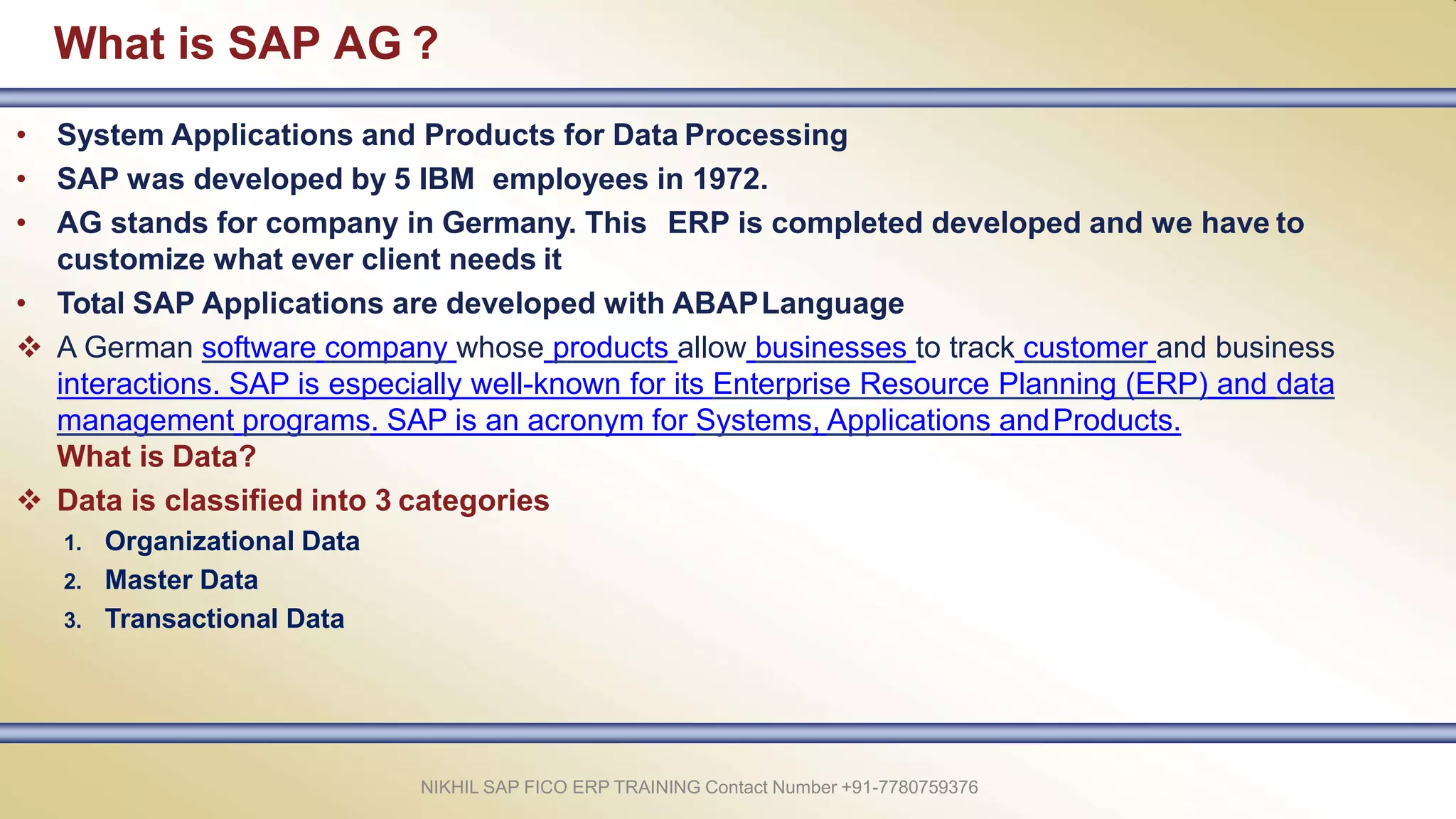
• System Applications and Products for Data Processing
• SAP was developed by 5 IBM employees in 1972.
• AG stands for company in Germany. This ERP is completed developed and we have to
customize what ever client needs it
• Total SAP Applications are developed with ABAPLanguage
 A German software company whose products allow businesses to track customer and business
interactions. SAP is especially well-known for its Enterprise Resource Planning (ERP) and data
management programs. SAP is an acronym for Systems, Applications andProducts.
What is Data?
 Data is classified into 3 categories
1. Organizational Data
2. Master Data
3. Transactional Data
SAP Overview
NIKHIL SAP FICO ERP TRAINING Contact Number +91-7780759376
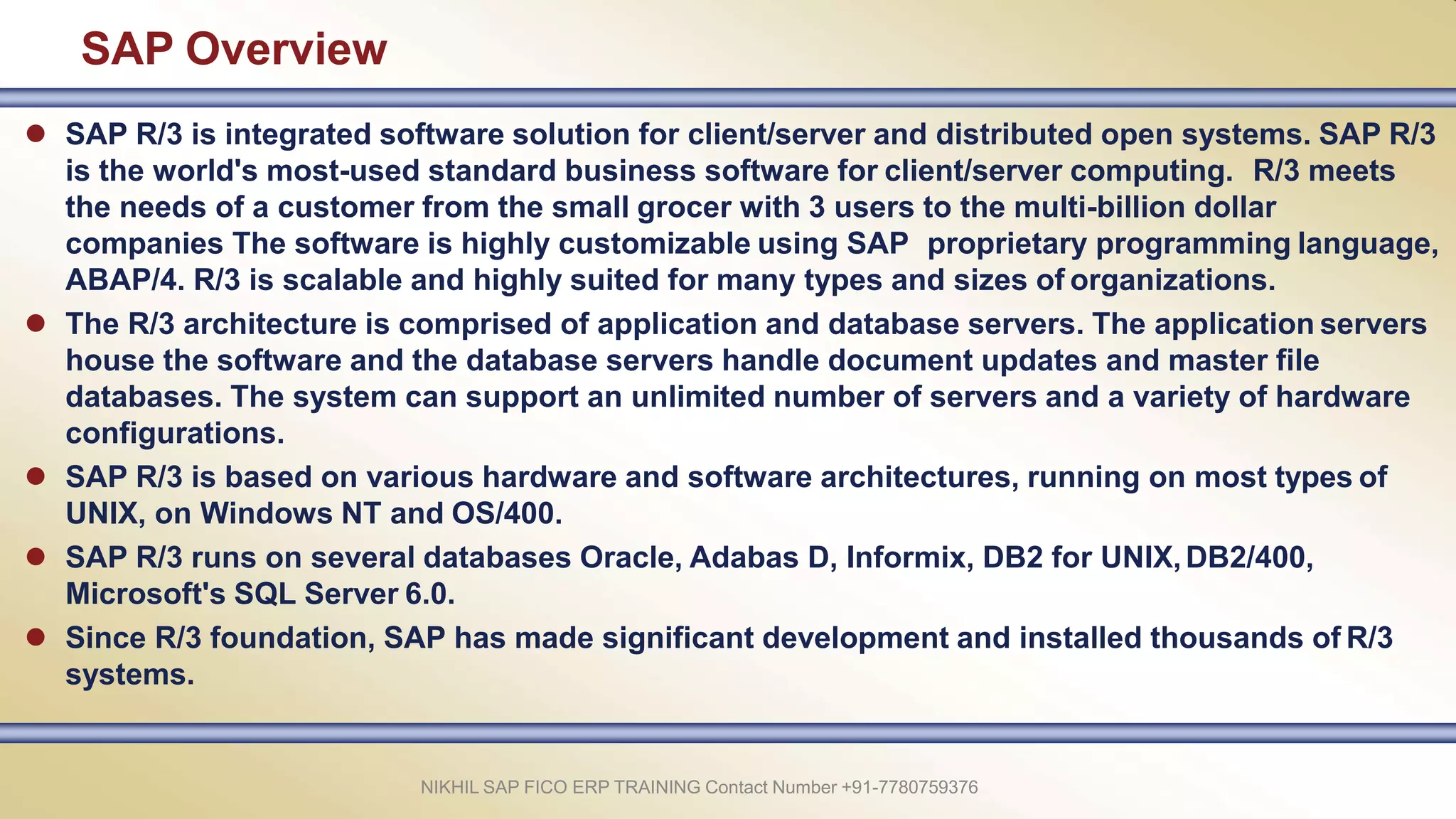
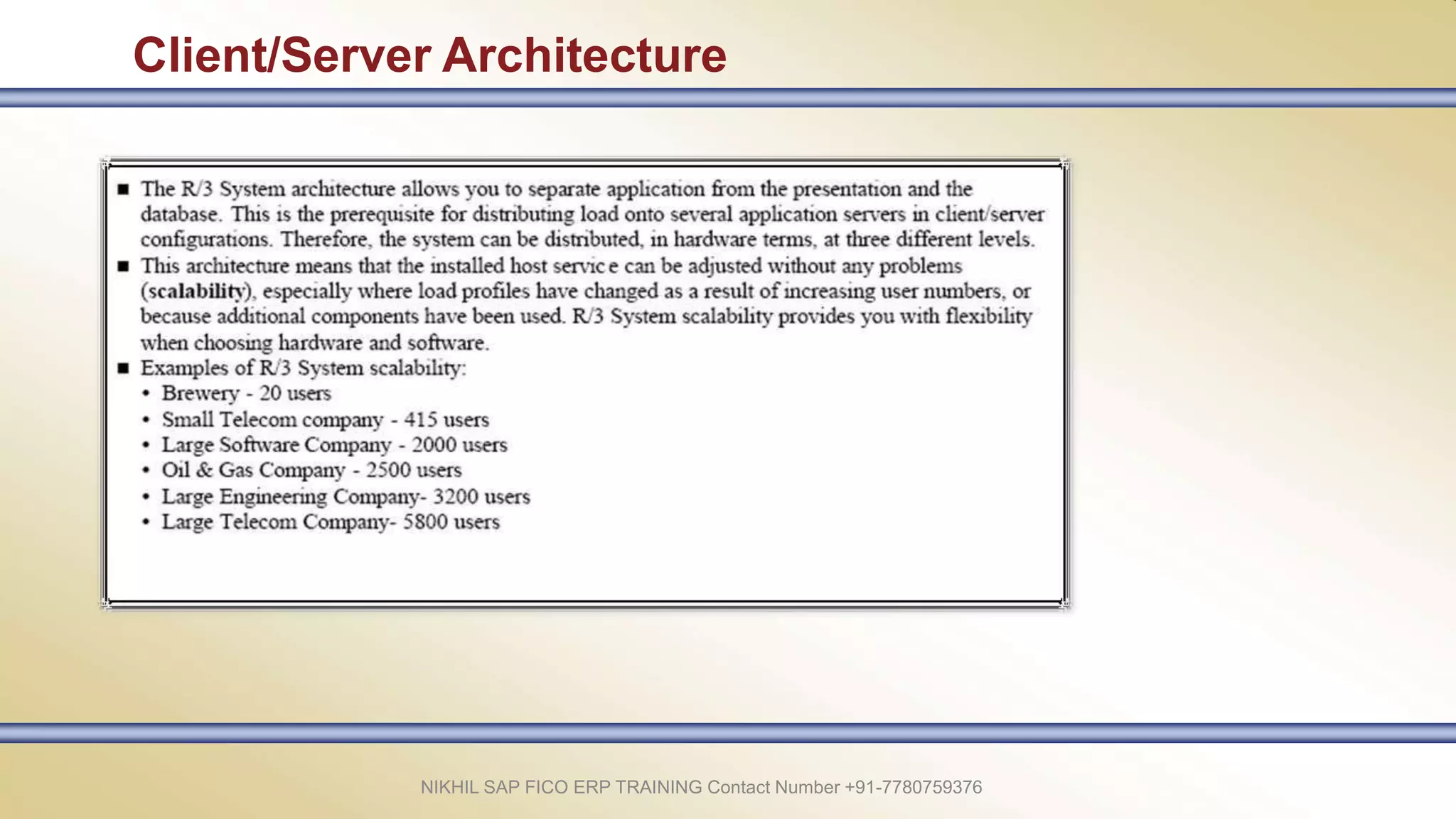
 SAP R/3 is integrated software solution for client/server and distributed open systems. SAP R/3
is the world's most-used standard business software for client/server computing. R/3 meets
the needs of a customer from the small grocer with 3 users to the multi-billion dollar
companies The software is highly customizable using SAP proprietary programming language,
ABAP/4. R/3 is scalable and highly suited for many types and sizes of organizations.
 The R/3 architecture is comprised of application and database servers. The application servers
house the software and the database servers handle document updates and master file
databases. The system can support an unlimited number of servers and a variety of hardware
configurations.
 SAP R/3 is based on various hardware and software architectures, running on most types of
UNIX, on Windows NT and OS/400.
 SAP R/3 runs on several databases Oracle, Adabas D, Informix, DB2 for UNIX,DB2/400,
Microsoft's SQL Server 6.0.
 Since R/3 foundation, SAP has made significant development and installed thousands of R/3
systems.
SAP Architecture
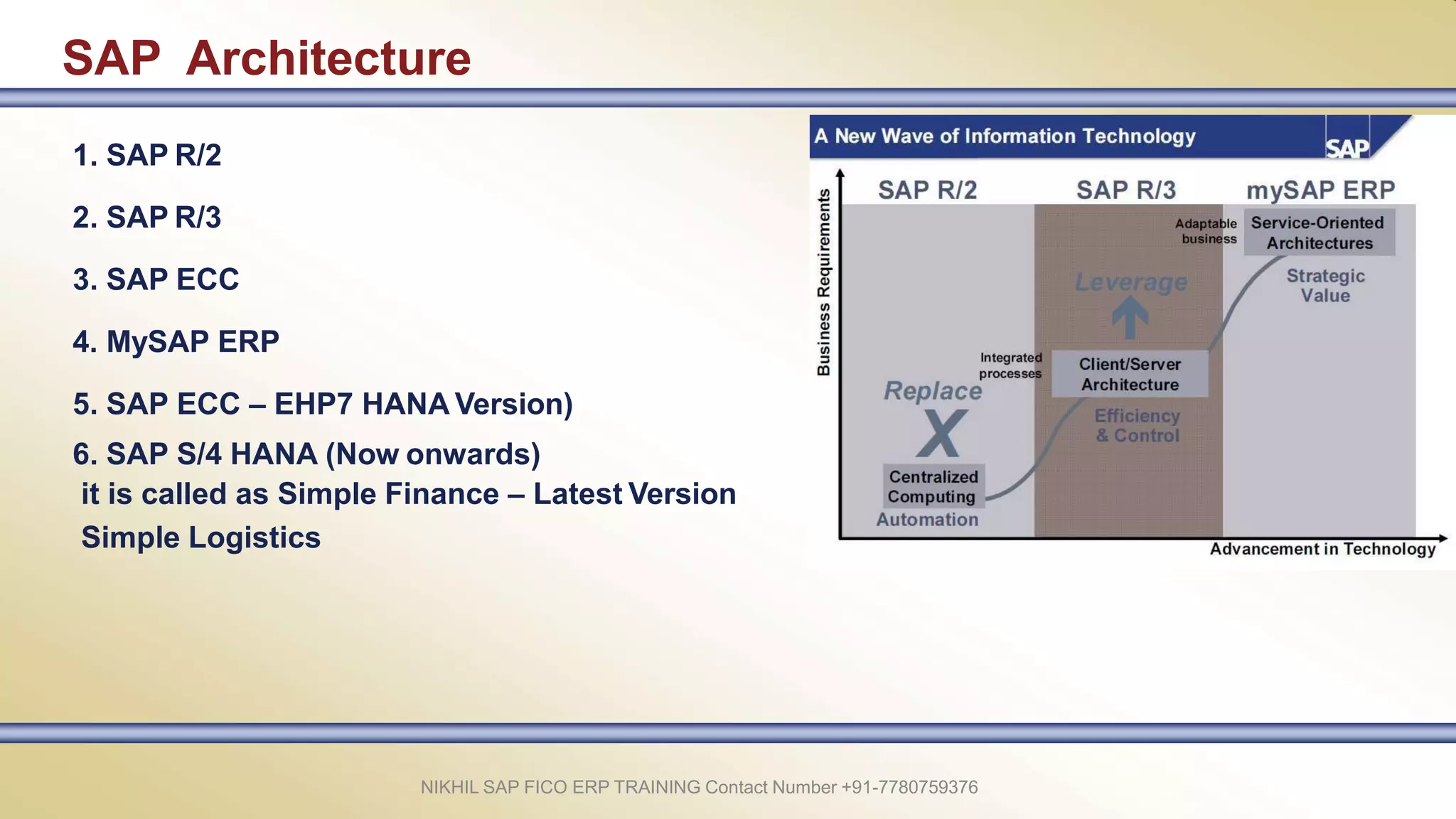
1. SAP R/2
2. SAP R/3
3. SAP ECC
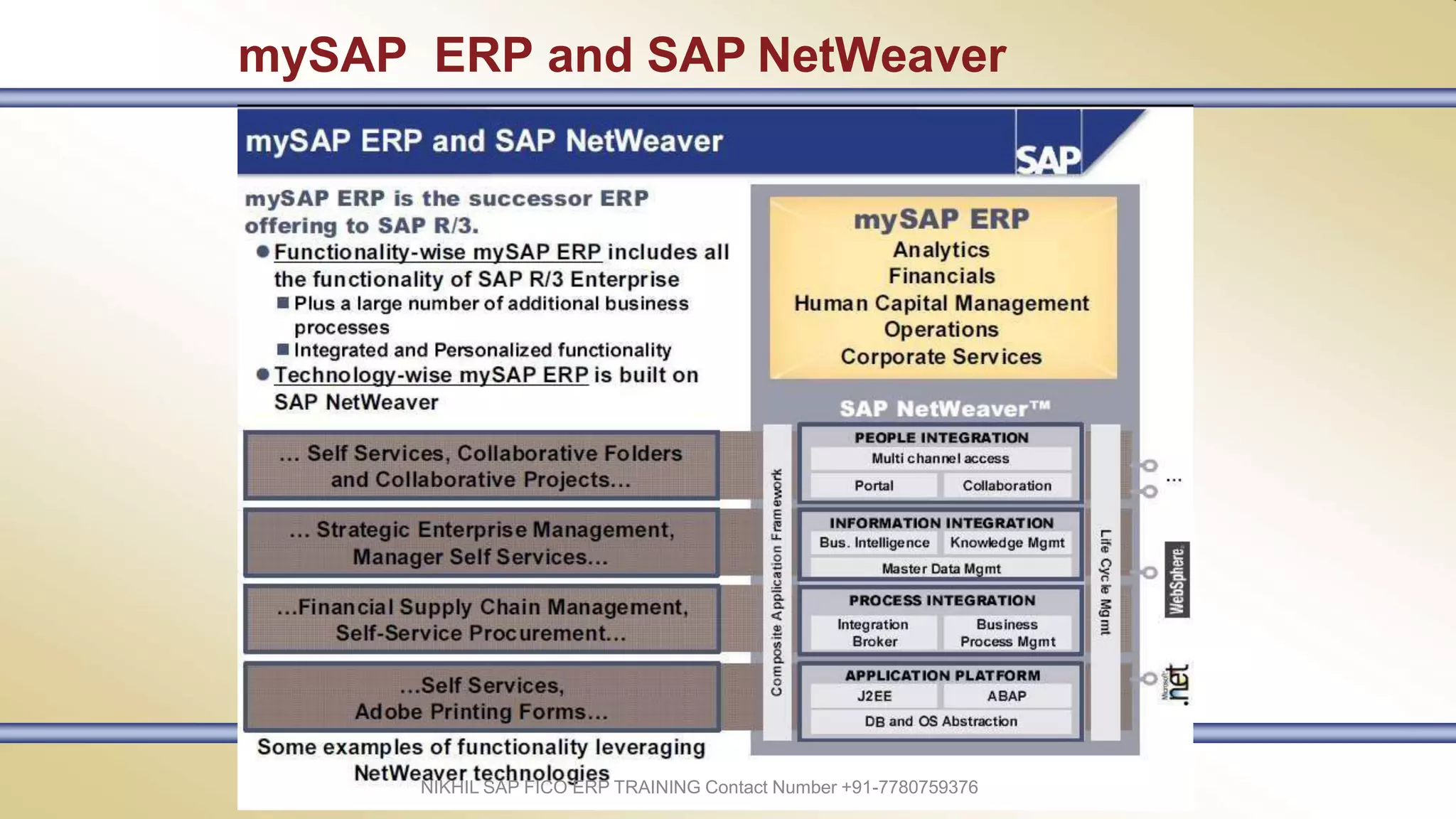
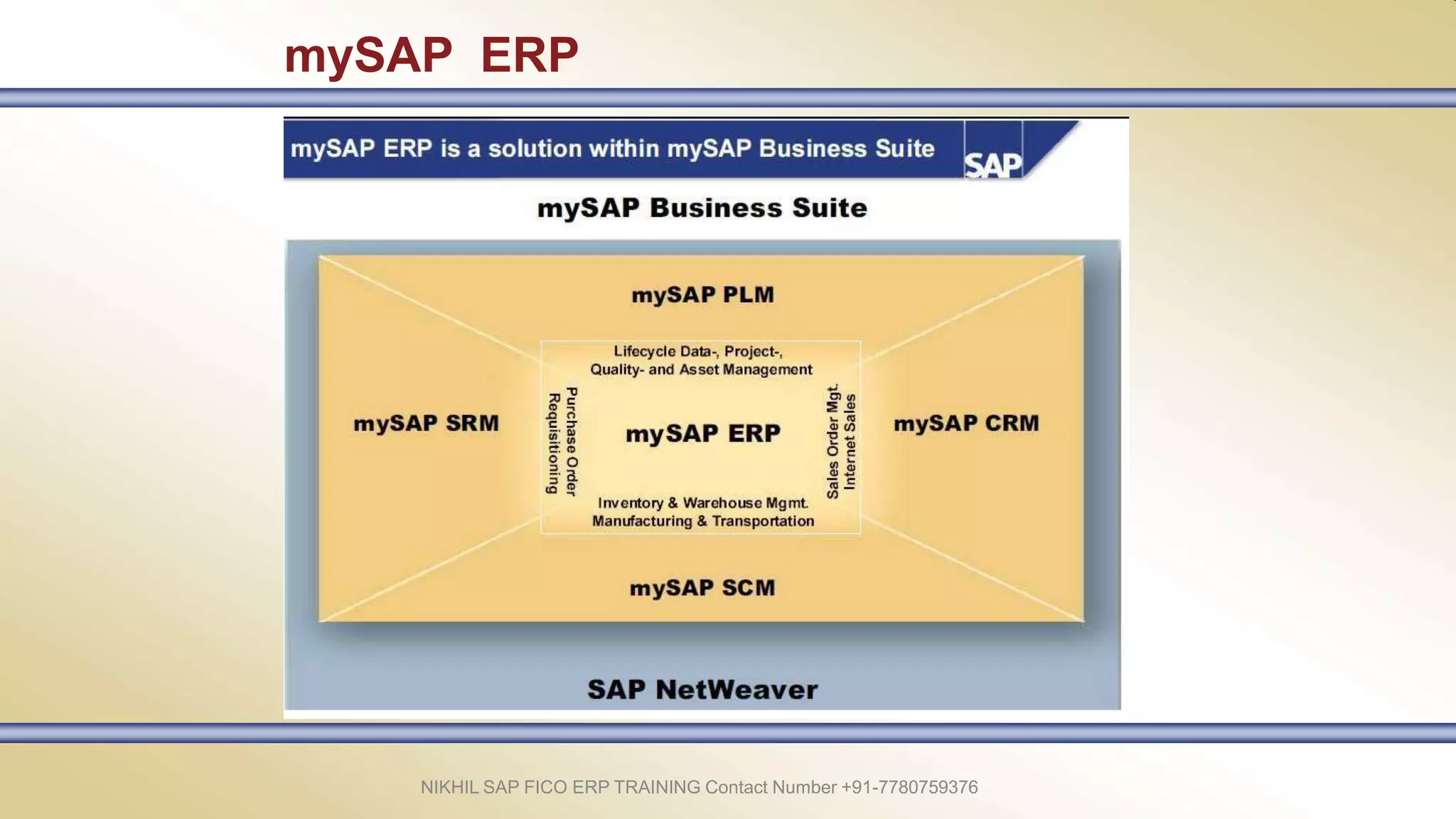
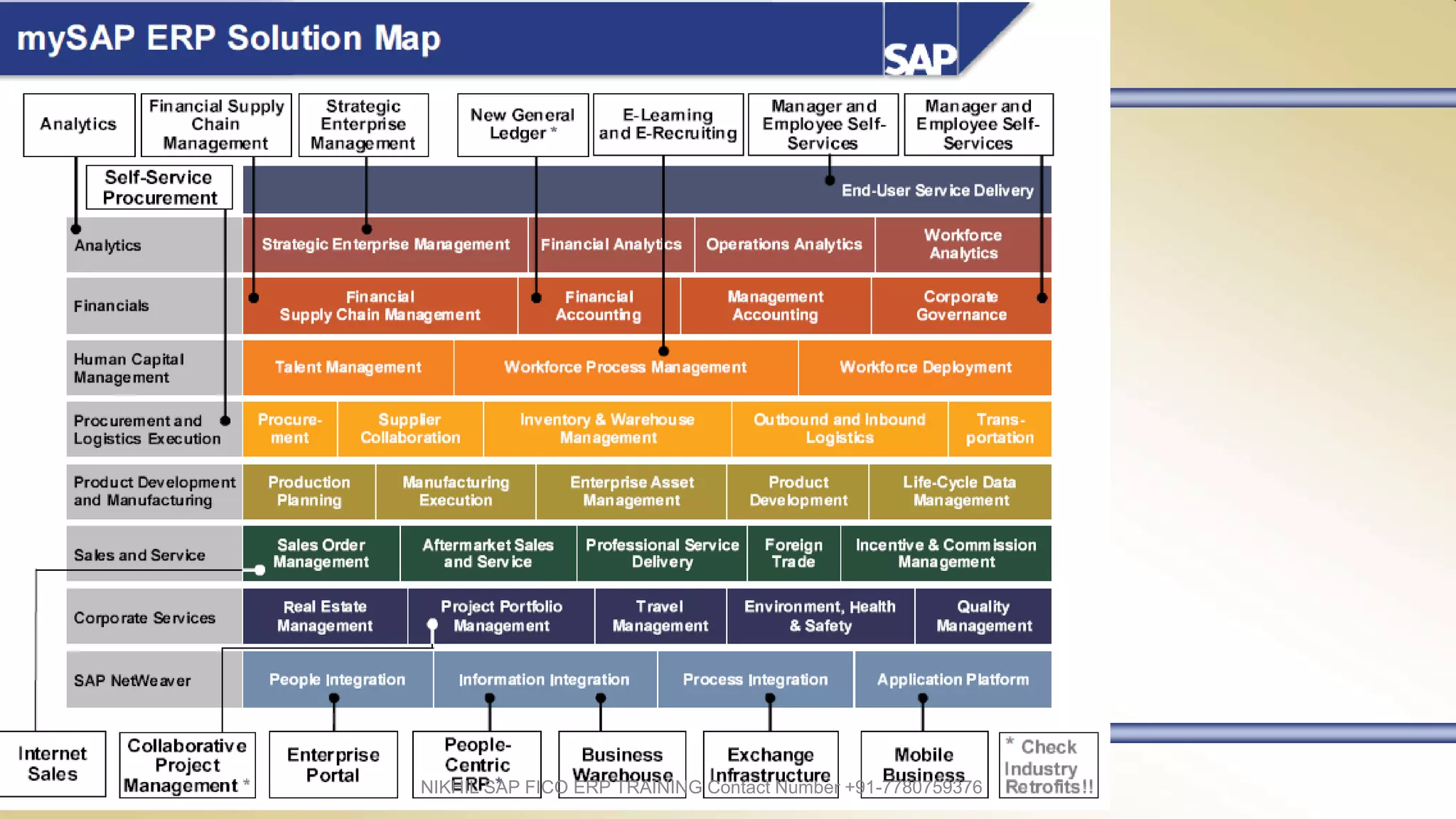
4. MySAP ERP
5. SAP ECC – EHP7 HANA Version)
6. SAP S/4 HANA (Now onwards)
it is called as Simple Finance – Latest Version
Simple Logistics
NIKHIL SAP FICO ERP TRAINING Contact Number +91-7780759376
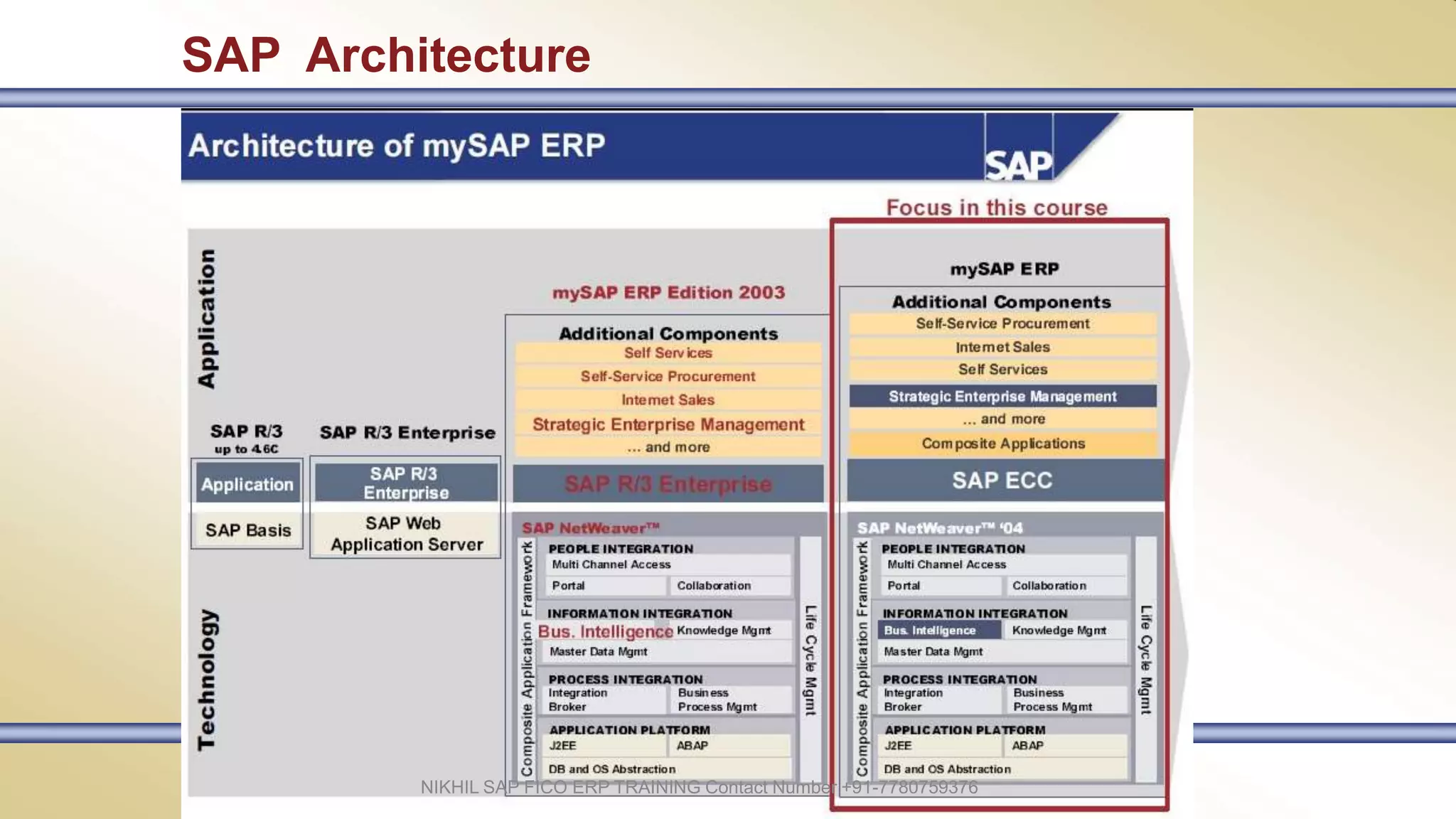
SAP Architecture
NIKHIL SAP FICO ERP TRAINING Contact Number +91-7780759376
mySAP ERP and SAP NetWeaver
NIKHIL SAP FICO ERP TRAINING Contact Number +91-7780759376
mySAP ERP
NIKHIL SAP FICO ERP TRAINING Contact Number +91-7780759376
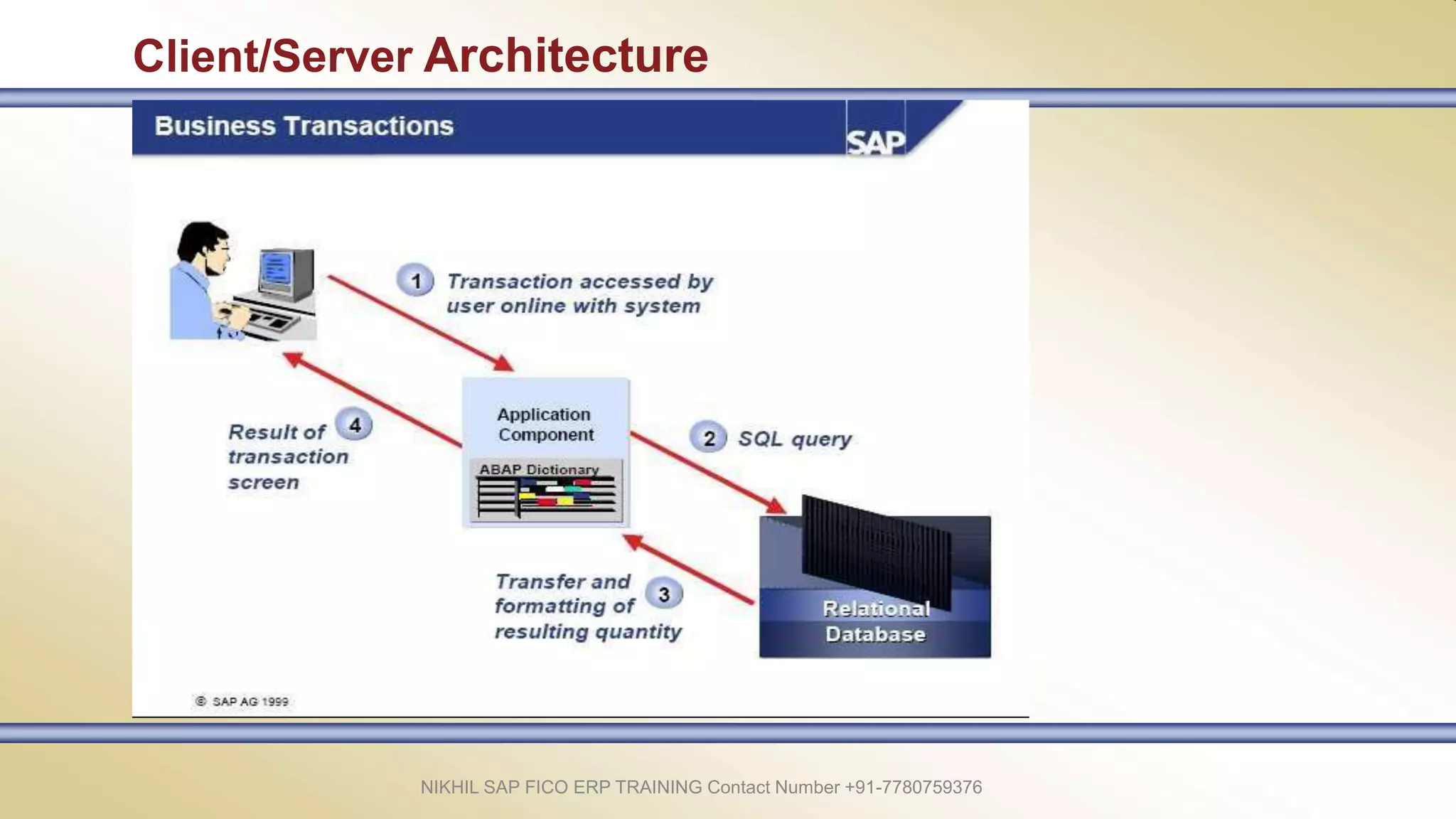
Client/Server Architecture
NIKHIL SAP FICO ERP TRAINING Contact Number +91-7780759376
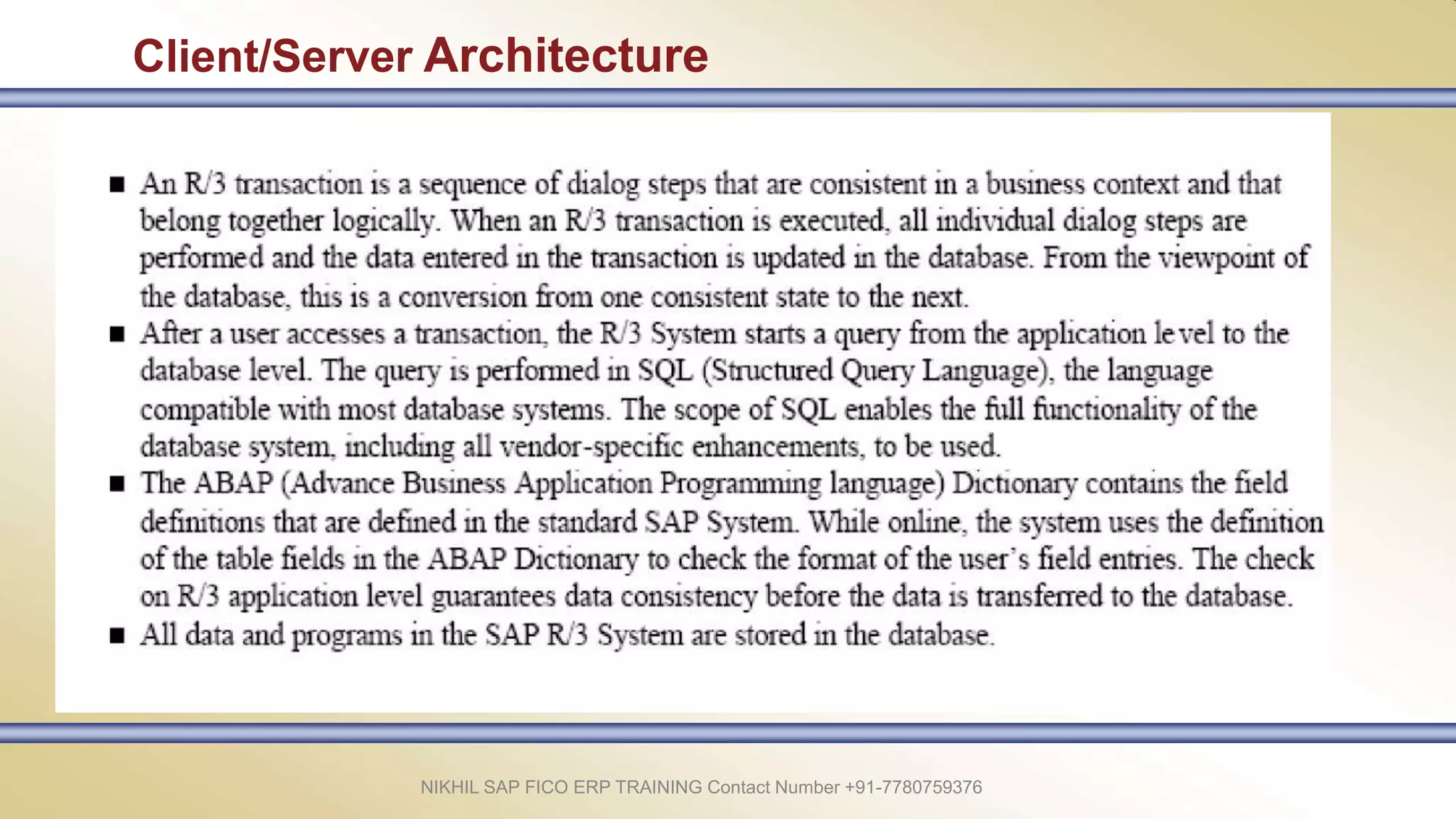
Client/Server Architecture
NIKHIL SAP FICO ERP TRAINING Contact Number +91-7780759376
Client/Server Architecture
NIKHIL SAP FICO ERP TRAINING Contact Number +91-7780759376
Client/Server Architecture
NIKHIL SAP FICO ERP TRAINING Contact Number +91-7780759376
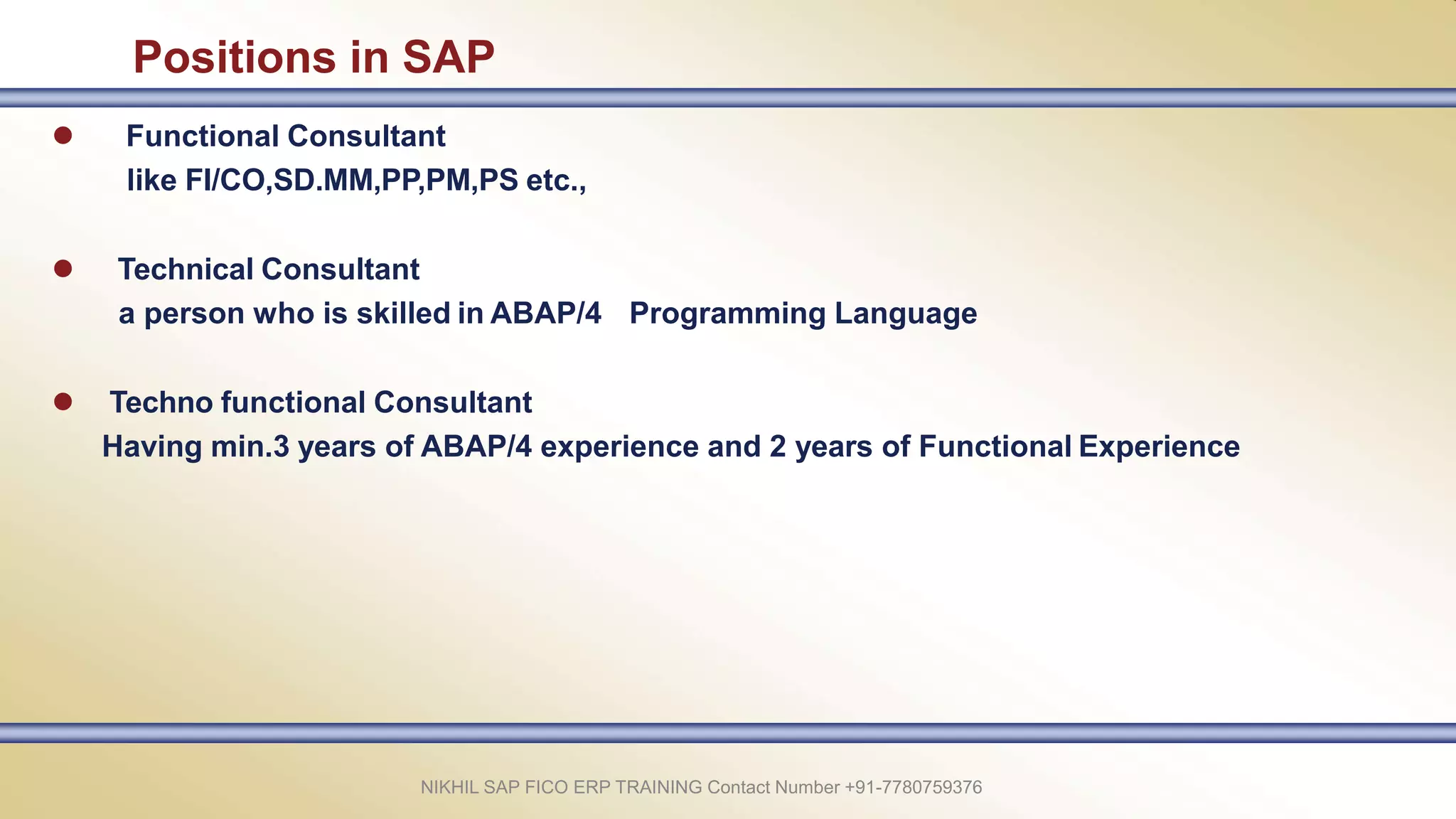
Positions in SAP
 Functional Consultant
like FI/CO,SD.MM,PP,PM,PS etc.,
 Technical Consultant
a person who is skilled in ABAP/4 Programming Language
 Techno functional Consultant
Having min.3 years of ABAP/4 experience and 2 years of Functional Experience
NIKHIL SAP FICO ERP TRAINING Contact Number +91-7780759376
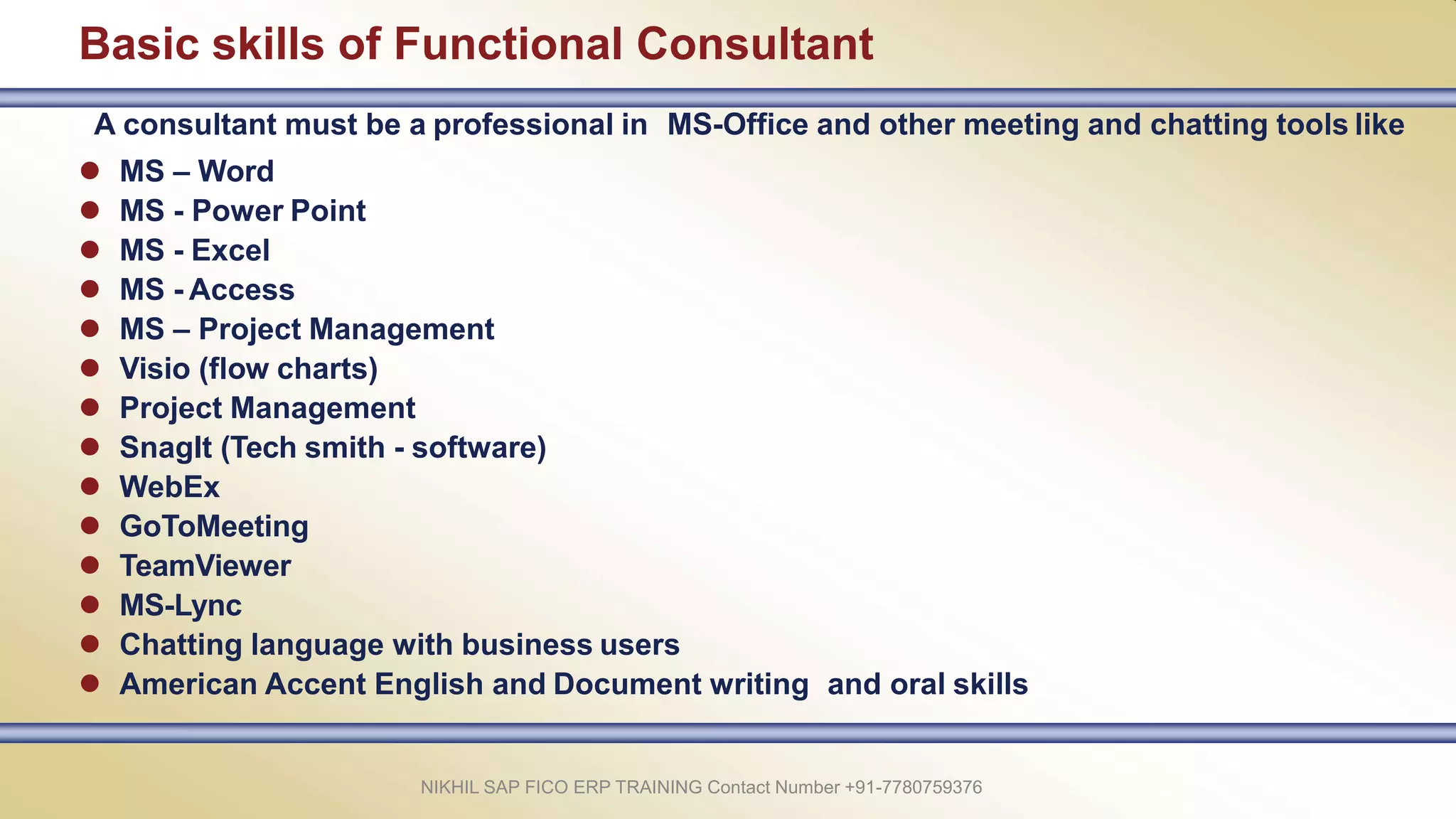
Basic skills of Functional Consultant
NIKHIL SAP FICO ERP TRAINING Contact Number +91-7780759376
A consultant must be a professional in MS-Office and other meeting and chatting tools like
 MS – Word
 MS - Power Point
 MS - Excel
 MS - Access
 MS – Project Management
 Visio (flow charts)
 Project Management
 SnagIt (Tech smith - software)
 WebEx
 GoToMeeting
 TeamViewer
 MS-Lync
 Chatting language with business users
 American Accent English and Document writing and oral skills
Roles of Functional Consultant
NIKHIL SAP FICO ERP TRAINING Contact Number +91-7780759376
1.Implementation
2. Production Support
3. Rollouts
4. Upgradation
SAP Technical
NIKHIL SAP FICO ERP TRAINING Contact Number +91-7780759376
 ABAP (Advanced Business Application Programming)
 Cross Application
 Net weaver
 Total SAP Applications are developed with ABAP Language
- ABAP Language developed based on ‘c’ language.
- Cross/Applications are used to communicate the distributed business system.
- To implement ERP for a business organization it takes 14 to 27 months approximately
ABAP Transactions: Using this concept we can add a fields to the applications.
BDC Concept : Using this concept we can transfer data from Non-SAP to SAP
SAP Scripts: Using this concept SAP R/3 Communicate business partners.
ABAP Reports are used for designing reports for SAP environments.
It is most important concepts.
ABAP Concepts
 ABAP Transaction
 BDC Concept (Batch Data Conversion)
SAP Scripts
ABAP Reports
SAP Modules
NIKHIL SAP FICO ERP TRAINING Contact Number +91-7780759376
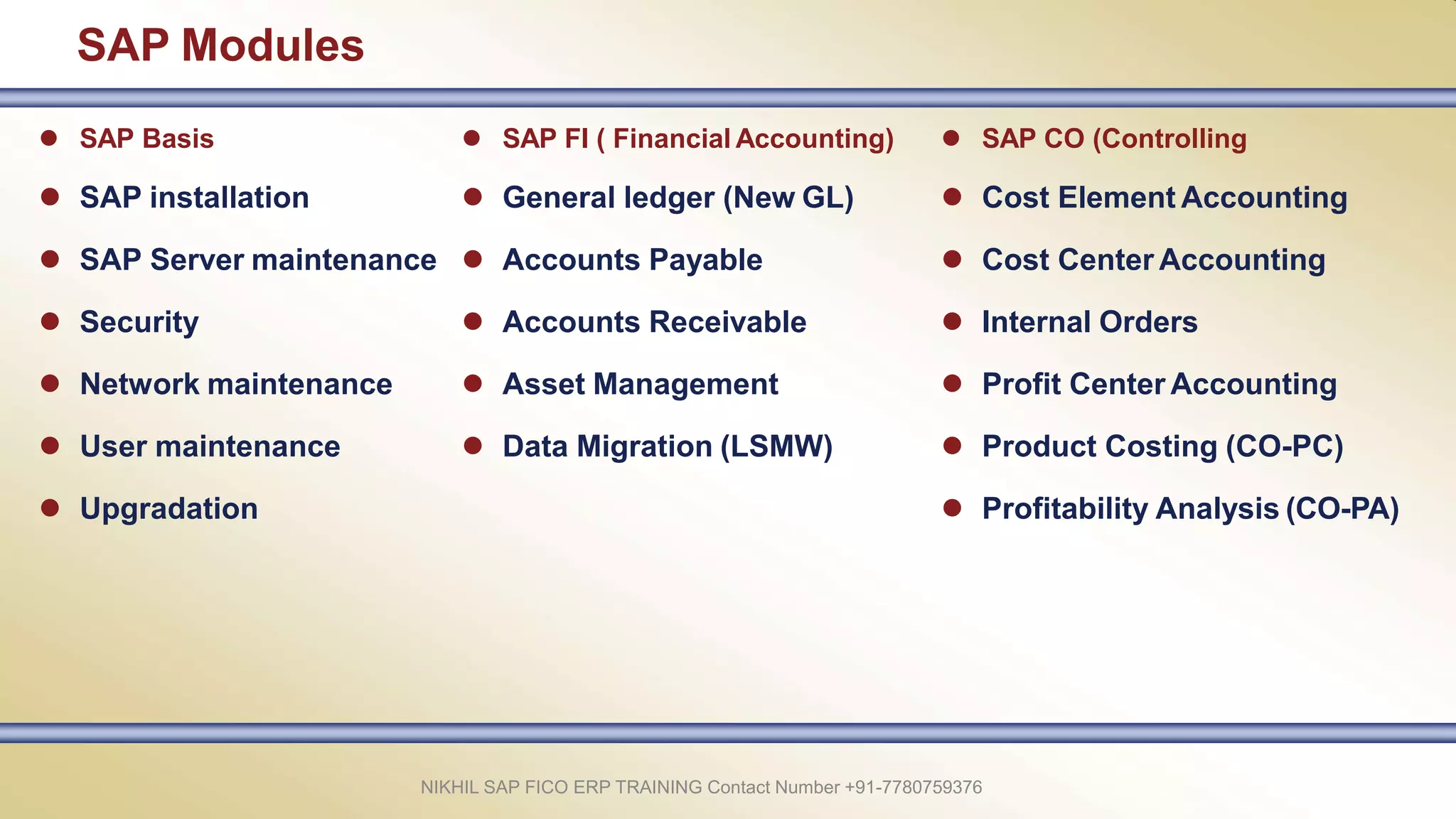
 SAP Basis
 SAP installation
 SAP Server maintenance
 Security
 Network maintenance
 User maintenance
 Upgradation
 SAP FI ( Financial Accounting)
 General ledger (New GL)
 Accounts Payable
 Accounts Receivable
 Asset Management
 Data Migration (LSMW)
 SAP CO (Controlling
 Cost Element Accounting
 Cost Center Accounting
 Internal Orders
 Profit Center Accounting
 Product Costing (CO-PC)
 Profitability Analysis (CO-PA)
What is Dashboard?
NIKHIL SAP FICO ERP TRAINING Contact Number +91-7780759376
 In management information systems, a dashboard is "an easy to read, often single page,
real-time user interface, showing a graphical presentation of the current status(snapshot)
and historical trends of an organization’s or computer appliances key performance
indicators to enable instantaneous and informed decisions to be made at a glance."[1]
 In real-world terms, "dashboard" is another name for "progress report" or "report." Often, the
"dashboard" is displayed on a web page that is linked to a database which allows the report
to be constantly updated.
 For example, a manufacturing dashboard may show numbers related to productivity suchas
number of parts manufactured, or number of failed quality inspections per hour. Similarly, a
human resources dashboard may show numbers related to staff recruitment, retention and
composition, for example number of open positions, or average days or cost per
recruitment.
What are Dashboard Tool?
NIKHIL SAP FICO ERP TRAINING Contact Number +91-7780759376
 SAP Lumira
 SAP Crystal Dashboard
 SAP Business Objects Dashboards
 Tableau
What is Dashboard ?
NIKHIL SAP FICO ERP TRAINING Contact Number +91-7780759376
 A dashboard is a visual display of the most important information needed to achieve one or more
objectives; consolidated and arranged on a single screen so the information can be monitored at a
glance.
 Here are the key characteristics of a dashboard:
 All the visualizations fit on a single computer screen — scrolling to see more violates the definition of a
dashboard.
 It shows the most important performance indicators / performance measures to bemonitored.
 Interactivity such as filtering and drill-down can be used in a dashboard; however, those typesof
actions should not be required to see which performance indicators are under performing.
 It is not designed exclusively for executives but rather should be used by the general workforceas
effective dashboards are easy to understand and use.
 The displayed data automatically updated without any assistance from the user. The frequency of the
update will vary by organization and by purpose. The most effective dashboards have data updatedat
least on a daily basis.
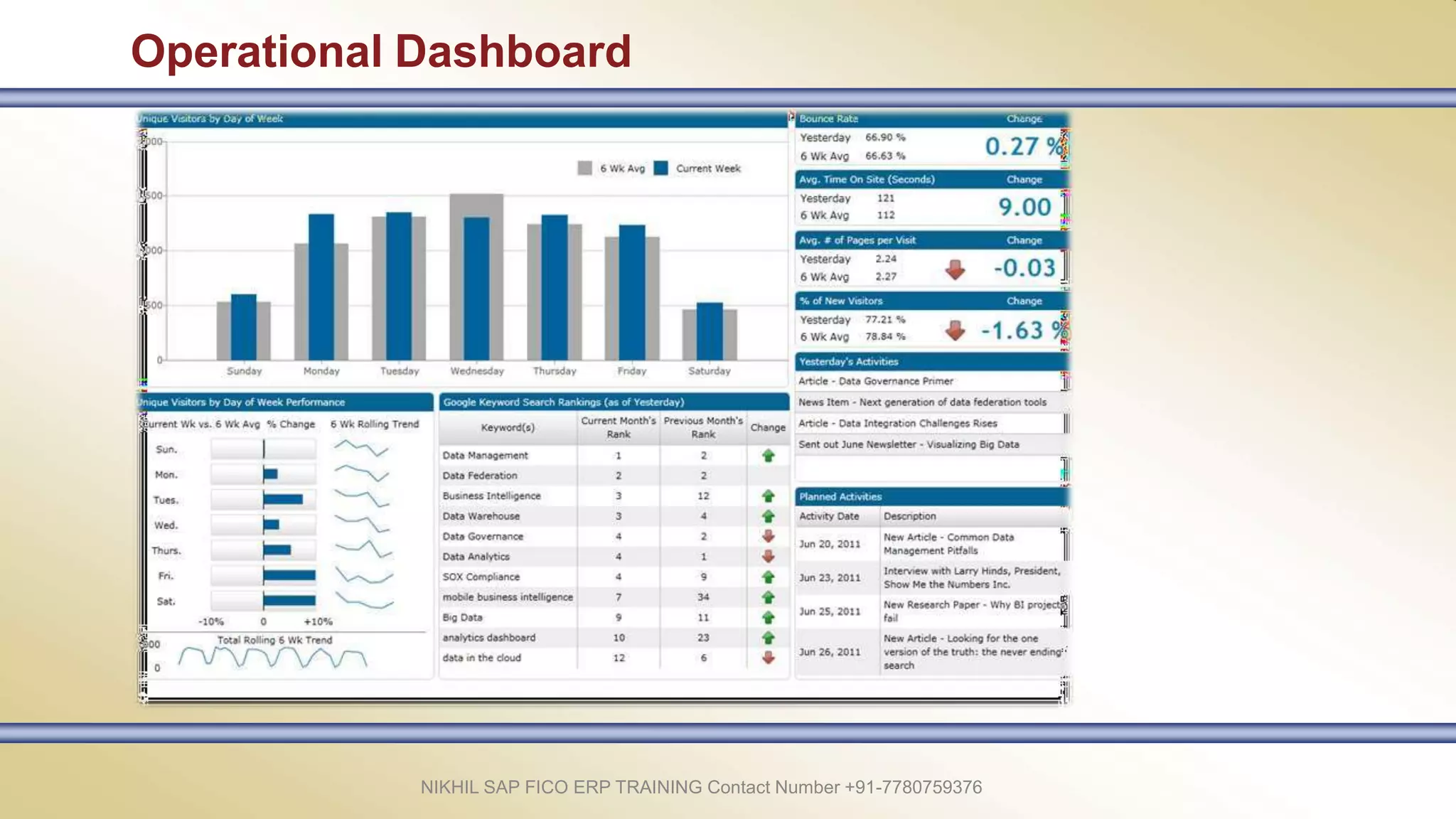
Operational Dashboard
NIKHIL SAP FICO ERP TRAINING Contact Number +91-7780759376
Visual Dashboard
Visual Analysis Tools
Some consider tools that offer the ability to select various date ranges, pick different products, or drill down to more
detailed data to be dashboards. At Dashboard Insight, we classify these as visual analysis tools.
Here are the key characteristics of a visual analysis tool:
•It fits on one screen, but there may be scroll bars for tables with too many rows or charts with too many data points.
•It is highly interactive and usually provides functionality like filtering and drill downs.
•It is primarily used to find correlations, trends, outliers (anomalies), patterns, and business conditions in data.
•The data used in a visual analysis tool is generally historical data. However, there are some cases where real-time
data is analyzed.
•It helps to identify performance indicators for use in dashboards.
•It is typically relied on by technically savvy users like data analysts and researchers.
-
NIKHIL SAP FICO ERP TRAINING Contact Number +91-7780759376
Scorecard
Scorecards
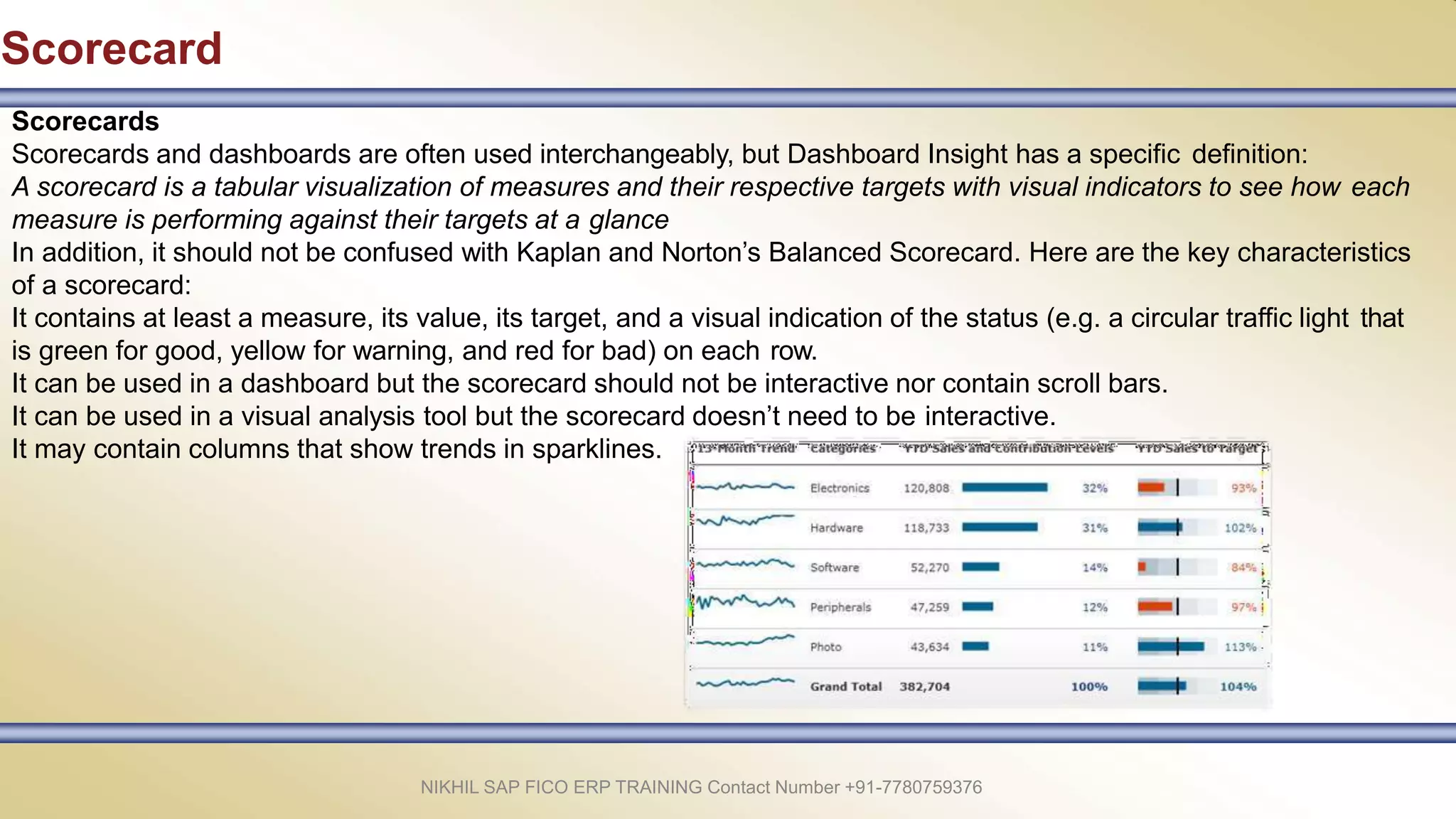
Scorecards and dashboards are often used interchangeably, but Dashboard Insight has a specific definition:
A scorecard is a tabular visualization of measures and their respective targets with visual indicators to see how each
measure is performing against their targets at a glance
In addition, it should not be confused with Kaplan and Norton’s Balanced Scorecard. Here are the key characteristics
of a scorecard:
It contains at least a measure, its value, its target, and a visual indication of the status (e.g. a circular traffic light that
is green for good, yellow for warning, and red for bad) on each row.
It can be used in a dashboard but the scorecard should not be interactive nor contain scroll bars.
It can be used in a visual analysis tool but the scorecard doesn’t need to be interactive.
It may contain columns that show trends in sparklines.
NIKHIL SAP FICO ERP TRAINING Contact Number +91-7780759376
Reports
Reports
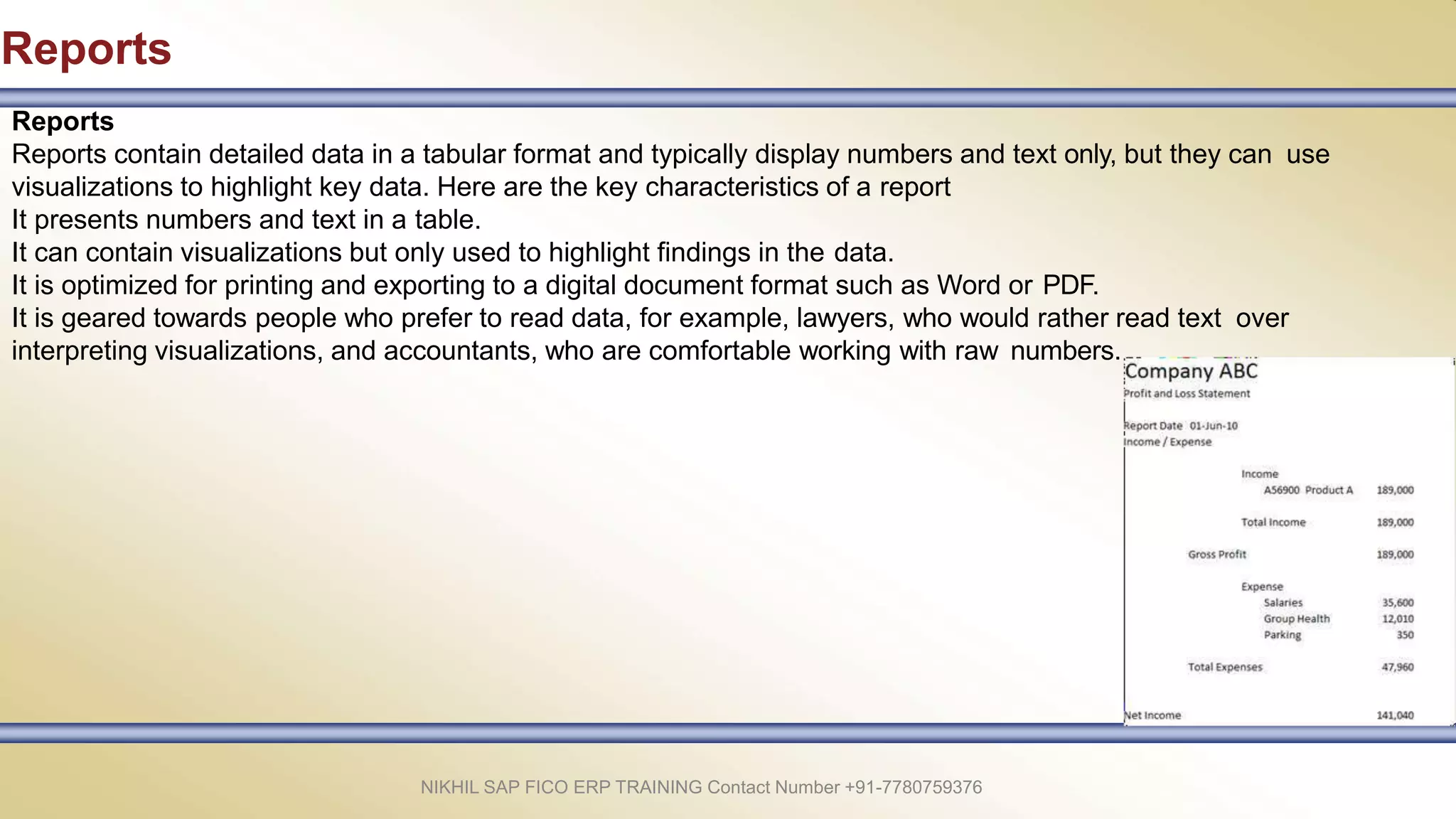
Reports contain detailed data in a tabular format and typically display numbers and text only, but they can use
visualizations to highlight key data. Here are the key characteristics of a report
It presents numbers and text in a table.
It can contain visualizations but only used to highlight findings in the data.
It is optimized for printing and exporting to a digital document format such as Word or PDF.
It is geared towards people who prefer to read data, for example, lawyers, who would rather read text over
interpreting visualizations, and accountants, who are comfortable working with raw numbers.
NIKHIL SAP FICO ERP TRAINING Contact Number +91-7780759376
SAP Business Objects
NIKHIL SAP FICO ERP TRAINING Contact Number +91-7780759376
SAP Business Objects
NIKHIL SAP FICO ERP TRAINING Contact Number +91-7780759376
SAP System Landscape
What exactly is SAP System Landscape? How does this phenomenon differ from SAP System Architecture? SAP
users, especially new comers misunderstands the two concepts.
The SAP architecture is typically the technology framework of the SAP system. SAP's architecture unlike the system
landscape has changed over time (and more recently) with the advent of SAP ECC.
They system landscape basically is the set-up or arrangement of your SAP servers. Ideally, in an SAP environment, a
three-system landscape exists. A three-system landscape consists of the Development Server-DEV, Quality Assurance
Server-QAS and the Production Server-PROD. This kind of set-up is not primarily designed to serve as server clusters
in case of system failure, the objective to enhance "configuration pipeline management".
DEV
100
QAS
200
PRD
400
Server Room
NIKHIL SAP FICO ERP TRAINING Contact Number +91-7780759376
SAP System Landscape
DEV
NIKHIL SAP FICO ERP TRAINING Contact Number +91-7780759376
QAS PRD
100
200
120 100
D01
Q01
P01
Server Room
D01 – 100 is called as Golden Client
We have to copy configuration and
development of data into D200 for
development testing or unit testing.
Transaction code: SCC4
D01 – 100 the changes we need to
transport into Quality System Q01
T.Code: SE09 or SE10.
Consultant has test the data and then
Business user has to test the data. It
is called as UAT. Business user has
to sign off the configuration
D01 – 100 the changes
we need to transport into
Production Server PRD
T.Code: SE09 or SE10.
We should have approval
of Managers
What is OLAP and OLTP
NIKHIL SAP FICO ERP TRAINING Contact Number +91-7780759376
OLTP
NIKHIL SAP FICO ERP TRAINING Contact Number +91-7780759376
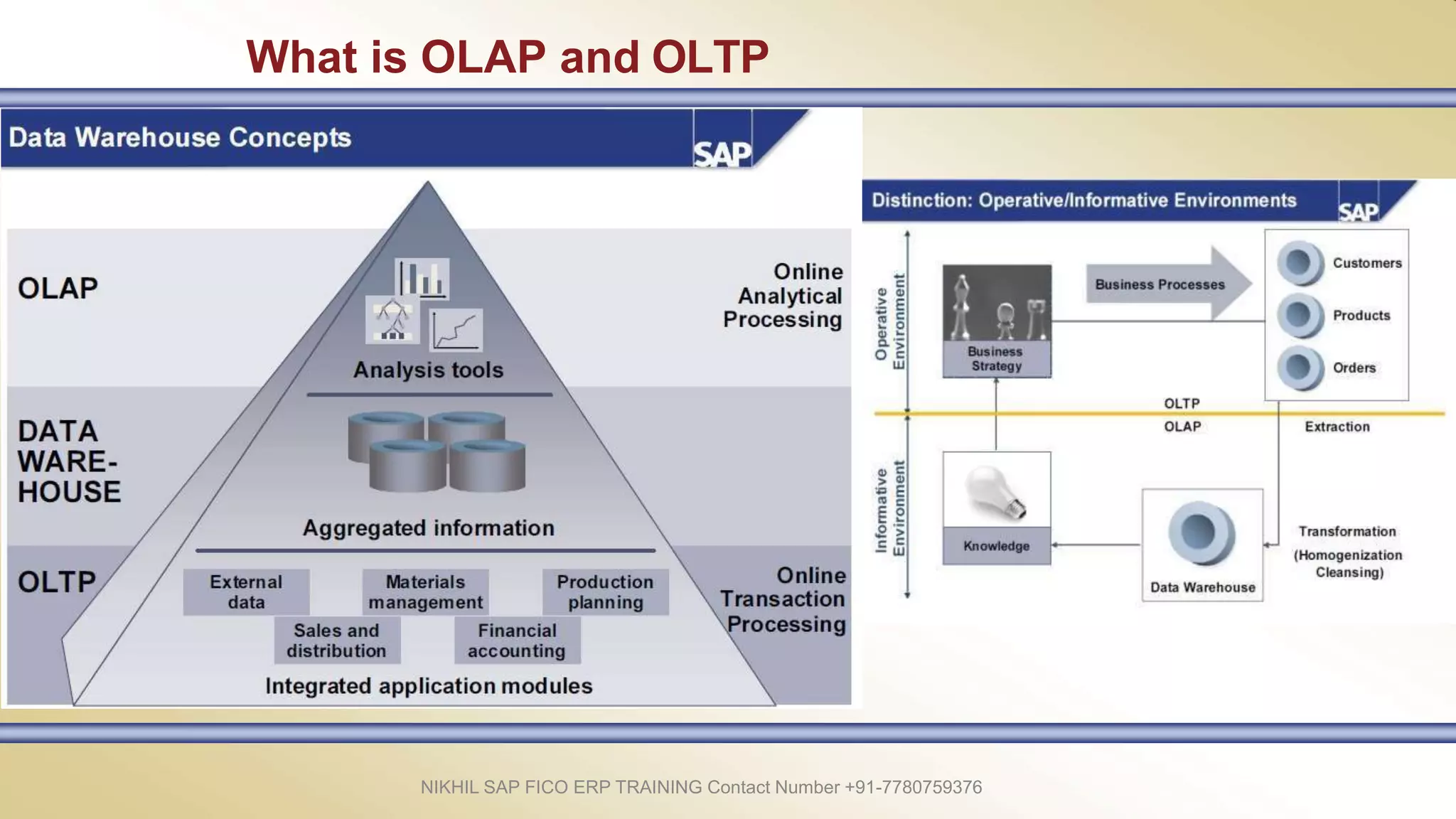
 OLTP - ONLINE TRANSACTION PROCESSING
 Online transaction processing, or OLTP, refers to a class of systems that facilitate and manage
transaction-oriented applications, typically for data entry and retrieval transaction processing . OLTPhas
also been used to refer to processing in which the system responds immediately to user requests .The
main emphasis for OLTP systems is put on very fast query processing, maintaining data integrityin
multi-access environments and an effectiveness measured by number of transactions per second. In
OLTP database there is detailed and current data, and schema used to store transactional databasesis
the entity model (usually 3NF).
 In general we can say that OLTP provides source data to data warehouses and the OLAP is used to
analyze it .So OLTP is also referred as Operative Environment and OLAP as InformativeEnvironment.
OLTP
PRD
P01
100
OLAP
 OLAP - ONLINE ANALYTICAL PROCESSING
 SAP BW enables Online Analytical Processing (OLAP) for the staging of information from large amounts of operative and historical
data. OLAP technology permits multi-dimensional analyses according to various business perspectives.
 At the core of any OLAP system is the concept of an OLAP cube (also called a 'multidimensional cube' or a hypercube). It consists
of numeric facts called measures which are categorized by dimensions. The cube metadata is typically created from a star
schema or snowflake schema of tables in a relational database.
 The OLAP Area can be divided into three components :
 1. BEx Analyzer
 2. BEx Web Application
 3. BEx Mobile Intelligence
PRD
100
P01
OLTP BPD
110
B01
OLAP
Extract the data from SAP
ECC to SAP BI
NIKHIL SAP FICO ERP TRAINING Contact Number +91-7780759376
ERPTECHLLC.COM Email: udaysap@yahoo.com; Contact: 281-66 0-6449 35
Difference between OLAP and OLTP
OLTP System OLAP System
Source of data Operational data; OLTPs are the Consolidation data; OLAP data comes
original source of the data. from the
various OLTP Databases
Purpose of data To control and run fundamental To help with planning, problem
business tasks solving, and decision support
Processing Speed Typically Very Fast Depends on the amount of data
involved; batch data refreshes and
complex queries may take many
hours; query speed can be improved
by creating indexes
Database Design Highly normalized with many tables Typically de-normalized with fewer
tables; use of star and/or snowflake
schemas.
Backup and Recovery Backup religiously; operational data is Instead of regular backups, some
critical to run the business, environments
data loss is likely to entail may consider simply reloading the
significant monetary loss and legal OLTP data as a
liability recovery methodNIKHIL SAP FICO ERP TRAINING Contact Number +91-7780759376
Difference between OLAP and OLTP
OLTP System OLAP System
Age Of Data Current Historical
Queries Relatively standardized and simple
queries Returning relatively few
records
Often complex queries involving
aggregations
Data Base Operations Add , Modify , Delete , Update and
Read
Read
What the data Reveals A snapshot of ongoing business
processes
Multi-dimensional views of various
kinds of business activities
Data Set 6 - 18 months 2 - 7 years
NIKHIL SAP FICO ERP TRAINING Contact Number +91-7780759376
HANA
SAP HANA is an in-memory data platform that is deployable as an on premise appliance, or in the cloud. It is a
revolutionary platform that's best suited for performing real-time analytics, and developing and deploying real-time
applications
NIKHIL SAP FICO ERP TRAINING Contact Number +91-7780759376
ERP Solution (Implementation)
1. Business Process Analysis
2. Document theAnalysis
3. Client Sign Off
4. Gap Analysis
5. Realization
6. Testing
7. QA (QualityAssurance)
8. End User Training
9. Go-live
10. Post Production Support
NIKHIL SAP FICO ERP TRAINING Contact Number +91-7780759376
ERP Solution (Implementation) cont.
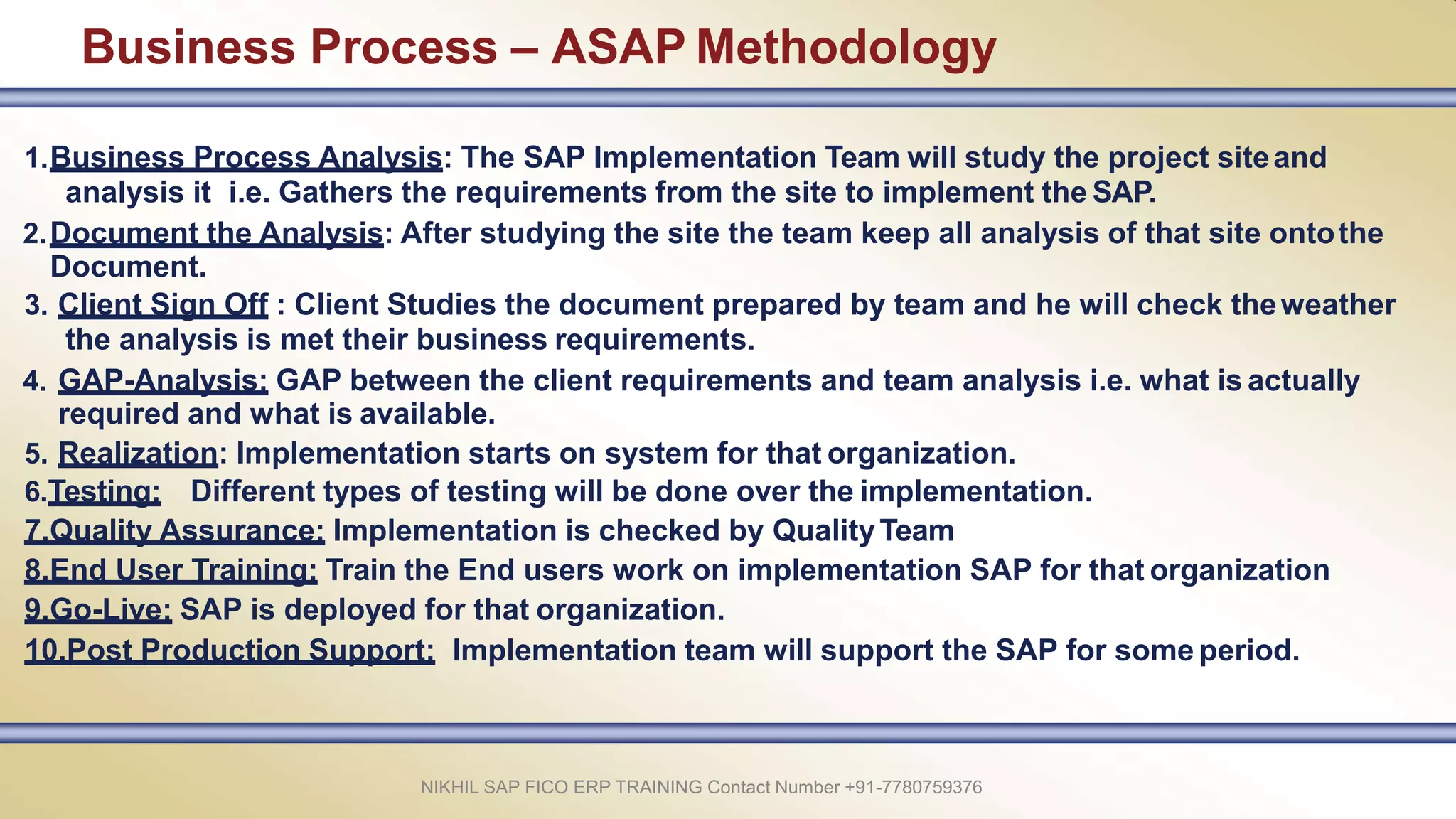
1.Business Process Analysis: The SAP Implementation Team will study the projectsite
and analysis it i.e. Gathers the requirements from the site to implement the SAP.
2.Document the Analysis: After studying the site the team keep all analysis of thatsite
onto the Document.
3. Client Sign Off : Client Studies the document prepared by team and he will checkthe
weather the analysis is met their business requirements.
4. GAP-Analysis: GAP between the client requirements and team analysis i.e. what is
actually required and what is available.
5. Realization: Implementation starts on system for that organization.
6.Testing: Different types of testing will be done over the implementation.
7.Quality Assurance: Implementation is checked by QualityTeam
8.End User Training: Train the End users work on implementation SAP for that
organization
9.Go-Live: SAP is deployed for that organization.
10.Post Production Support: Implementation team will support the SAP for someperiod.
NIKHIL SAP FICO ERP TRAINING Contact Number +91-7780759376
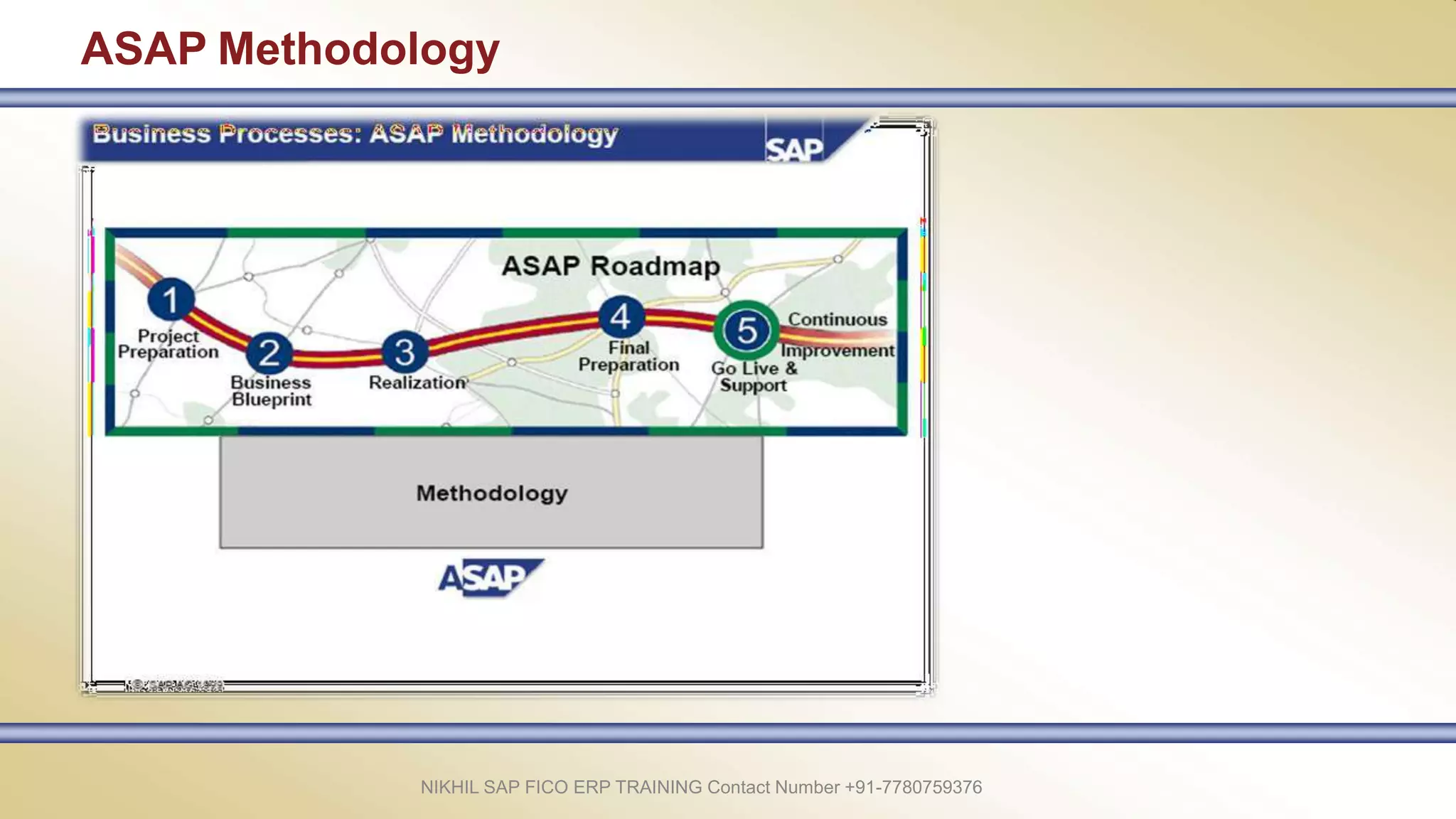
ASAP Methodology
NIKHIL SAP FICO ERP TRAINING Contact Number +91-7780759376
Business Process – ASAP Methodology
NIKHIL SAP FICO ERP TRAINING Contact Number +91-7780759376
1.Business Process Analysis: The SAP Implementation Team will study the project siteand
analysis it i.e. Gathers the requirements from the site to implement the SAP.
2.Document the Analysis: After studying the site the team keep all analysis of that site ontothe
Document.
3. Client Sign Off : Client Studies the document prepared by team and he will check theweather
the analysis is met their business requirements.
4. GAP-Analysis: GAP between the client requirements and team analysis i.e. what is actually
required and what is available.
5. Realization: Implementation starts on system for that organization.
6.Testing: Different types of testing will be done over the implementation.
7.Quality Assurance: Implementation is checked by QualityTeam
8.End User Training: Train the End users work on implementation SAP for that organization
9.Go-Live: SAP is deployed for that organization.
10.Post Production Support: Implementation team will support the SAP for some period.
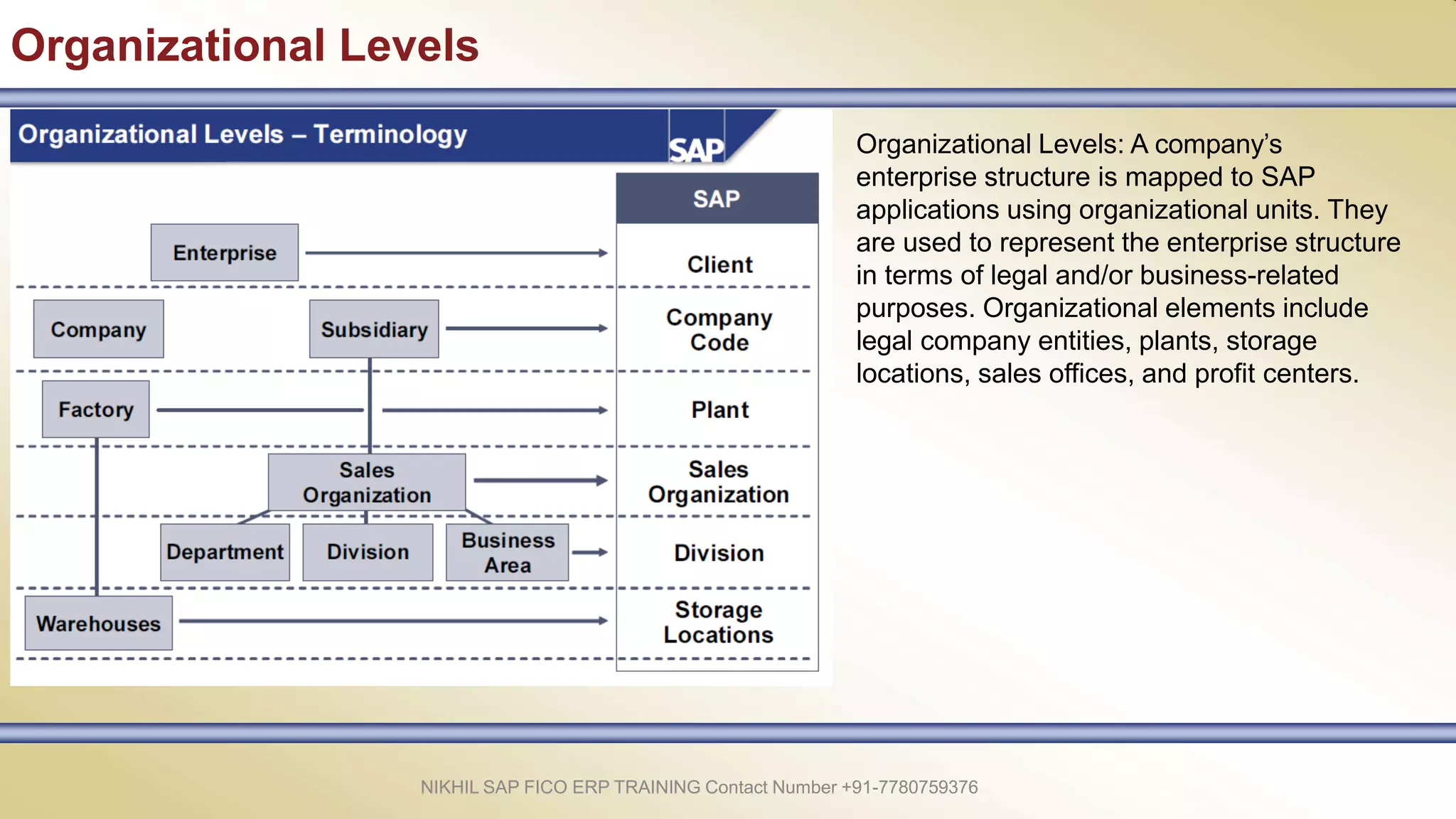
Organizational Levels
Organizational Levels: A company’s
enterprise structure is mapped to SAP
applications using organizational units. They
are used to represent the enterprise structure
in terms of legal and/or business-related
purposes. Organizational elements include
legal company entities, plants, storage
locations, sales offices, and profit centers.
NIKHIL SAP FICO ERP TRAINING Contact Number +91-7780759376
Organizational Levels
NIKHIL SAP FICO ERP TRAINING Contact Number +91-7780759376
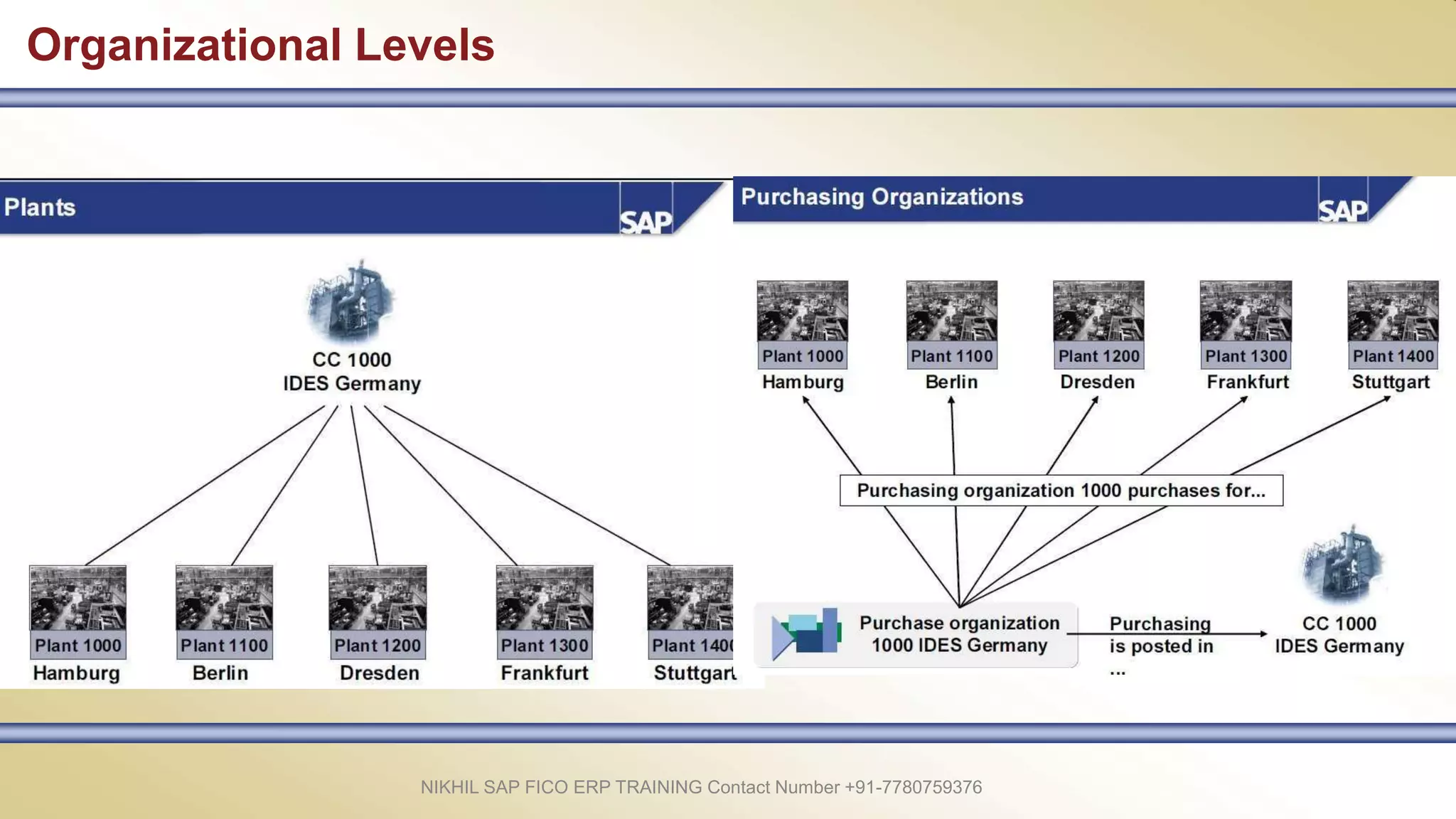
The highest-level unit of all organizational elements is the Client The Client represents the
enterprise/headquarters group.
 A Company Code is a unit included in the balance sheet of a legally-independent enterprise and is the central
organizational element of Financial Accounting.
 In the context of Sales and Distribution, the Sales Organization is the central organizational element that
controls the terms of sale to the customer. Division is usually used to represent product line.
 In the context of Production Planning, Plant is the central organizational unit. A Plant can manufacture product,
distribute product, or provide a service.
 In Inventory Management, material stocks can be differentiated within one plant according to Storage Location.
Organizational units may be assigned to a single application (such as Sales Organization assigned to Sales and
Distribution, or to several applications (such as Plant assigned to Materials Management and Production Planning).
Organizational Levels
NIKHIL SAP FICO ERP TRAINING Contact Number +91-7780759376
Organizational Levels
NIKHIL SAP FICO ERP TRAINING Contact Number +91-7780759376
Procurement Process
NIKHIL SAP FICO ERP TRAINING Contact Number +91-7780759376
 Purchase Requisition
 Advertising the Tender
 Receiving the Quotation
 Acceptance of selected vendors rejecting the others
 Rising the PO (legally binding document) (ME21N)
 Release the PO
 Good Receipt (MIGO)
 Invoice Receipt (3 way matching i.e. content , price, quantity) (MIRO)
 Goods Issue to Production
 Finished Stock received from the Production (Technically completed)
 In FI module after Invoice Receipt Vendor Account will be credited.
Vendor is open item. Any amount due to/ due from is known as Open Item.
We have to make the payment to the vendor on due date. Payment Process in SAP is called as
CLEARING Concept.
 This Payment process is done FI through Automatic Payment Program (APP).
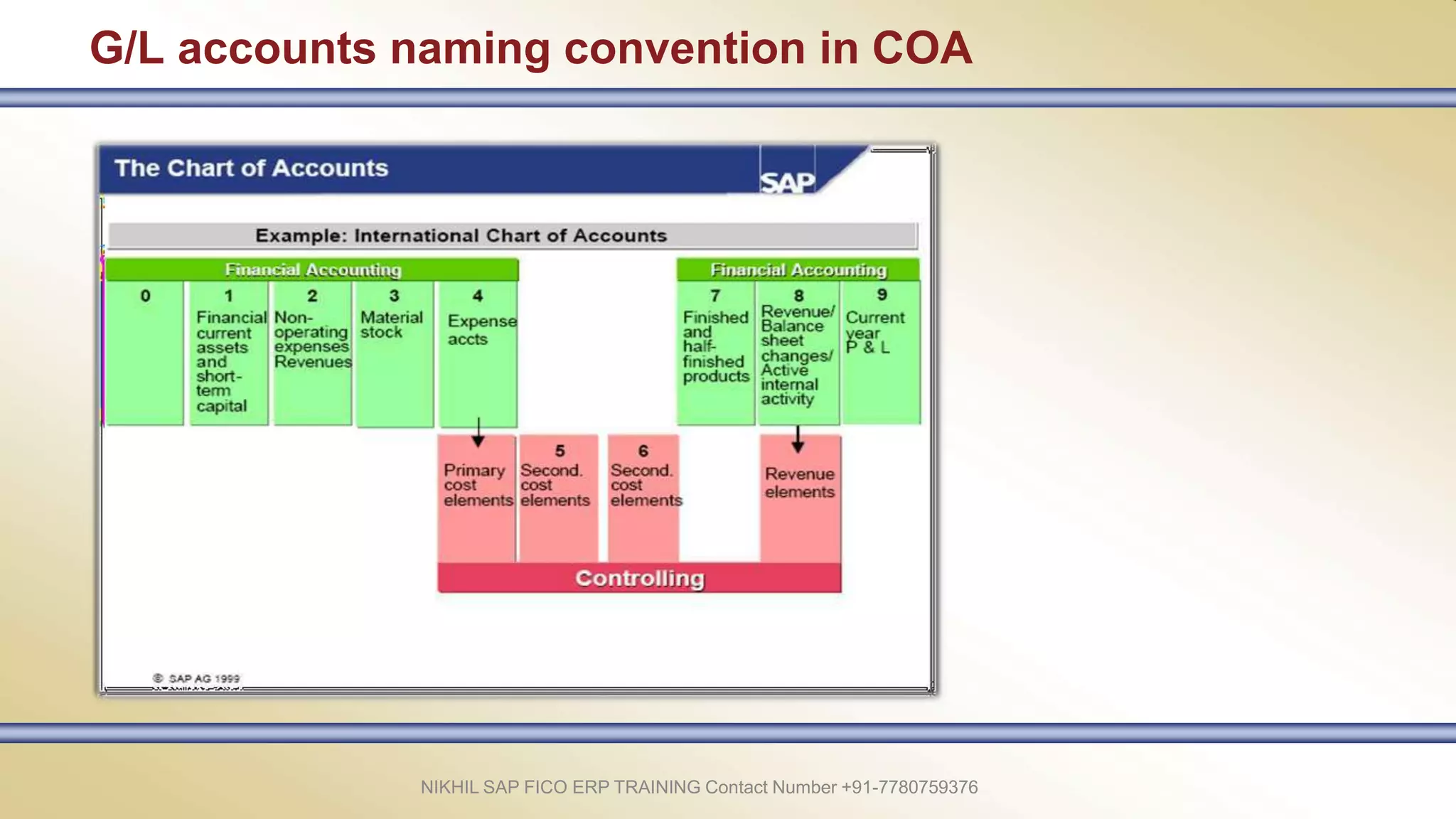
G/L accounts naming convention in COA
NIKHIL SAP FICO ERP TRAINING Contact Number +91-7780759376
Training Goals
NIKHIL SAP FICO ERP TRAINING Contact Number +91-7780759376
Initial Training
To gain a basic knowledge and understanding of the system for a particular application
area in order to efficiently carry out implementations
To learn about some typical project issues
To understand the tools available for use in project implementations
To be able to work as a project team member under the guidance of a senior consultant in
the first phase of a project (first year)
Advance Training
To gain a sound knowledge and understanding of the system for a particular application
area in order to efficiently direct/supervise implementations
To understand some typical integration issues in implementations
To apply knowledge of this particular application area in different customer scenarios
To be able to work as a senior consultant in a project with limited complexity

Nikhil sap fico training ppt

  • 1.
    SAP – FI/COOnlineTraining NIKHIL-ERP TRAINING NIKHIL SAP FICO ERP TRAINING Contact Number +91-7780759376
  • 2.
    What is ERP? NIKHILSAP FICO ERP TRAINING Contact Number +91-7780759376  ERP stands for Enterprise Resource Planning  Enterprise stands for an entity, organization, artificial person  Resource is 6 M’s concepts 1.MoneyFinance,Accounts,Costing/Controlling 2.Material MM, Stock inventory, Purchasing 3.Man Power HR Machinery PP,PM,QA 5 . Marketing  SD 6 . Methods  CRM, SCM, SRM Planning : is for utilization of Resources for a huge business organization.
  • 3.
    ERP Applications NIKHIL SAPFICO ERP TRAINING Contact Number +91-7780759376  BAAN  PEOPLESOFT  ORACLE APPLICATIONS  SAP R/3  JD EDWARDS  RAMCO  ERP Basics mySAP ERP Position Organizational Levels Master Data Transaction Data Reporting(including BI)  Organizational levels and master data provide the framework that supports the business transactions. Reporting allows you to view master data, as well as the output of business transactions. As project team member, it is important that you understand the fundamental concepts of organizational levels, master data, transaction data and reporting.  Non- ERPApplications  Oracle  VB  Data Ware House  .Net  Power Builder etc.
  • 4.
    ERP is anIndustry Package NIKHIL SAP FICO ERP TRAINING Contact Number +91-7780759376 An Industry has several Departments - Finance Department - Purchasing Department - Inventory Department - Sales Department - Marketing Department - HR Department - Production Department - Plant Maintenance Department etc,. Each Department in Industry is having its own functionality, In SAP we are calling asModule. ERP is used for planning our Resources to get more profits with lessefforts
  • 5.
    What is SAPAG ? NIKHIL SAP FICO ERP TRAINING Contact Number +91-7780759376 • System Applications and Products for Data Processing • SAP was developed by 5 IBM employees in 1972. • AG stands for company in Germany. This ERP is completed developed and we have to customize what ever client needs it • Total SAP Applications are developed with ABAPLanguage  A German software company whose products allow businesses to track customer and business interactions. SAP is especially well-known for its Enterprise Resource Planning (ERP) and data management programs. SAP is an acronym for Systems, Applications andProducts. What is Data?  Data is classified into 3 categories 1. Organizational Data 2. Master Data 3. Transactional Data
  • 6.
    SAP Overview NIKHIL SAPFICO ERP TRAINING Contact Number +91-7780759376  SAP R/3 is integrated software solution for client/server and distributed open systems. SAP R/3 is the world's most-used standard business software for client/server computing. R/3 meets the needs of a customer from the small grocer with 3 users to the multi-billion dollar companies The software is highly customizable using SAP proprietary programming language, ABAP/4. R/3 is scalable and highly suited for many types and sizes of organizations.  The R/3 architecture is comprised of application and database servers. The application servers house the software and the database servers handle document updates and master file databases. The system can support an unlimited number of servers and a variety of hardware configurations.  SAP R/3 is based on various hardware and software architectures, running on most types of UNIX, on Windows NT and OS/400.  SAP R/3 runs on several databases Oracle, Adabas D, Informix, DB2 for UNIX,DB2/400, Microsoft's SQL Server 6.0.  Since R/3 foundation, SAP has made significant development and installed thousands of R/3 systems.
  • 7.
    SAP Architecture 1. SAPR/2 2. SAP R/3 3. SAP ECC 4. MySAP ERP 5. SAP ECC – EHP7 HANA Version) 6. SAP S/4 HANA (Now onwards) it is called as Simple Finance – Latest Version Simple Logistics NIKHIL SAP FICO ERP TRAINING Contact Number +91-7780759376
  • 8.
    SAP Architecture NIKHIL SAPFICO ERP TRAINING Contact Number +91-7780759376
  • 9.
    mySAP ERP andSAP NetWeaver NIKHIL SAP FICO ERP TRAINING Contact Number +91-7780759376
  • 10.
    mySAP ERP NIKHIL SAPFICO ERP TRAINING Contact Number +91-7780759376
  • 11.
    NIKHIL SAP FICOERP TRAINING Contact Number +91-7780759376
  • 12.
    Client/Server Architecture NIKHIL SAPFICO ERP TRAINING Contact Number +91-7780759376
  • 13.
    Client/Server Architecture NIKHIL SAPFICO ERP TRAINING Contact Number +91-7780759376
  • 14.
    Client/Server Architecture NIKHIL SAPFICO ERP TRAINING Contact Number +91-7780759376
  • 15.
    Client/Server Architecture NIKHIL SAPFICO ERP TRAINING Contact Number +91-7780759376
  • 16.
    Positions in SAP Functional Consultant like FI/CO,SD.MM,PP,PM,PS etc.,  Technical Consultant a person who is skilled in ABAP/4 Programming Language  Techno functional Consultant Having min.3 years of ABAP/4 experience and 2 years of Functional Experience NIKHIL SAP FICO ERP TRAINING Contact Number +91-7780759376
  • 17.
    Basic skills ofFunctional Consultant NIKHIL SAP FICO ERP TRAINING Contact Number +91-7780759376 A consultant must be a professional in MS-Office and other meeting and chatting tools like  MS – Word  MS - Power Point  MS - Excel  MS - Access  MS – Project Management  Visio (flow charts)  Project Management  SnagIt (Tech smith - software)  WebEx  GoToMeeting  TeamViewer  MS-Lync  Chatting language with business users  American Accent English and Document writing and oral skills
  • 18.
    Roles of FunctionalConsultant NIKHIL SAP FICO ERP TRAINING Contact Number +91-7780759376 1.Implementation 2. Production Support 3. Rollouts 4. Upgradation
  • 19.
    SAP Technical NIKHIL SAPFICO ERP TRAINING Contact Number +91-7780759376  ABAP (Advanced Business Application Programming)  Cross Application  Net weaver  Total SAP Applications are developed with ABAP Language - ABAP Language developed based on ‘c’ language. - Cross/Applications are used to communicate the distributed business system. - To implement ERP for a business organization it takes 14 to 27 months approximately ABAP Transactions: Using this concept we can add a fields to the applications. BDC Concept : Using this concept we can transfer data from Non-SAP to SAP SAP Scripts: Using this concept SAP R/3 Communicate business partners. ABAP Reports are used for designing reports for SAP environments. It is most important concepts. ABAP Concepts  ABAP Transaction  BDC Concept (Batch Data Conversion) SAP Scripts ABAP Reports
  • 20.
    SAP Modules NIKHIL SAPFICO ERP TRAINING Contact Number +91-7780759376  SAP Basis  SAP installation  SAP Server maintenance  Security  Network maintenance  User maintenance  Upgradation  SAP FI ( Financial Accounting)  General ledger (New GL)  Accounts Payable  Accounts Receivable  Asset Management  Data Migration (LSMW)  SAP CO (Controlling  Cost Element Accounting  Cost Center Accounting  Internal Orders  Profit Center Accounting  Product Costing (CO-PC)  Profitability Analysis (CO-PA)
  • 21.
    What is Dashboard? NIKHILSAP FICO ERP TRAINING Contact Number +91-7780759376  In management information systems, a dashboard is "an easy to read, often single page, real-time user interface, showing a graphical presentation of the current status(snapshot) and historical trends of an organization’s or computer appliances key performance indicators to enable instantaneous and informed decisions to be made at a glance."[1]  In real-world terms, "dashboard" is another name for "progress report" or "report." Often, the "dashboard" is displayed on a web page that is linked to a database which allows the report to be constantly updated.  For example, a manufacturing dashboard may show numbers related to productivity suchas number of parts manufactured, or number of failed quality inspections per hour. Similarly, a human resources dashboard may show numbers related to staff recruitment, retention and composition, for example number of open positions, or average days or cost per recruitment.
  • 22.
    What are DashboardTool? NIKHIL SAP FICO ERP TRAINING Contact Number +91-7780759376  SAP Lumira  SAP Crystal Dashboard  SAP Business Objects Dashboards  Tableau
  • 23.
    What is Dashboard? NIKHIL SAP FICO ERP TRAINING Contact Number +91-7780759376  A dashboard is a visual display of the most important information needed to achieve one or more objectives; consolidated and arranged on a single screen so the information can be monitored at a glance.  Here are the key characteristics of a dashboard:  All the visualizations fit on a single computer screen — scrolling to see more violates the definition of a dashboard.  It shows the most important performance indicators / performance measures to bemonitored.  Interactivity such as filtering and drill-down can be used in a dashboard; however, those typesof actions should not be required to see which performance indicators are under performing.  It is not designed exclusively for executives but rather should be used by the general workforceas effective dashboards are easy to understand and use.  The displayed data automatically updated without any assistance from the user. The frequency of the update will vary by organization and by purpose. The most effective dashboards have data updatedat least on a daily basis.
  • 24.
    Operational Dashboard NIKHIL SAPFICO ERP TRAINING Contact Number +91-7780759376
  • 25.
    Visual Dashboard Visual AnalysisTools Some consider tools that offer the ability to select various date ranges, pick different products, or drill down to more detailed data to be dashboards. At Dashboard Insight, we classify these as visual analysis tools. Here are the key characteristics of a visual analysis tool: •It fits on one screen, but there may be scroll bars for tables with too many rows or charts with too many data points. •It is highly interactive and usually provides functionality like filtering and drill downs. •It is primarily used to find correlations, trends, outliers (anomalies), patterns, and business conditions in data. •The data used in a visual analysis tool is generally historical data. However, there are some cases where real-time data is analyzed. •It helps to identify performance indicators for use in dashboards. •It is typically relied on by technically savvy users like data analysts and researchers. - NIKHIL SAP FICO ERP TRAINING Contact Number +91-7780759376
  • 26.
    Scorecard Scorecards Scorecards and dashboardsare often used interchangeably, but Dashboard Insight has a specific definition: A scorecard is a tabular visualization of measures and their respective targets with visual indicators to see how each measure is performing against their targets at a glance In addition, it should not be confused with Kaplan and Norton’s Balanced Scorecard. Here are the key characteristics of a scorecard: It contains at least a measure, its value, its target, and a visual indication of the status (e.g. a circular traffic light that is green for good, yellow for warning, and red for bad) on each row. It can be used in a dashboard but the scorecard should not be interactive nor contain scroll bars. It can be used in a visual analysis tool but the scorecard doesn’t need to be interactive. It may contain columns that show trends in sparklines. NIKHIL SAP FICO ERP TRAINING Contact Number +91-7780759376
  • 27.
    Reports Reports Reports contain detaileddata in a tabular format and typically display numbers and text only, but they can use visualizations to highlight key data. Here are the key characteristics of a report It presents numbers and text in a table. It can contain visualizations but only used to highlight findings in the data. It is optimized for printing and exporting to a digital document format such as Word or PDF. It is geared towards people who prefer to read data, for example, lawyers, who would rather read text over interpreting visualizations, and accountants, who are comfortable working with raw numbers. NIKHIL SAP FICO ERP TRAINING Contact Number +91-7780759376
  • 28.
    SAP Business Objects NIKHILSAP FICO ERP TRAINING Contact Number +91-7780759376
  • 29.
    SAP Business Objects NIKHILSAP FICO ERP TRAINING Contact Number +91-7780759376
  • 30.
    SAP System Landscape Whatexactly is SAP System Landscape? How does this phenomenon differ from SAP System Architecture? SAP users, especially new comers misunderstands the two concepts. The SAP architecture is typically the technology framework of the SAP system. SAP's architecture unlike the system landscape has changed over time (and more recently) with the advent of SAP ECC. They system landscape basically is the set-up or arrangement of your SAP servers. Ideally, in an SAP environment, a three-system landscape exists. A three-system landscape consists of the Development Server-DEV, Quality Assurance Server-QAS and the Production Server-PROD. This kind of set-up is not primarily designed to serve as server clusters in case of system failure, the objective to enhance "configuration pipeline management". DEV 100 QAS 200 PRD 400 Server Room NIKHIL SAP FICO ERP TRAINING Contact Number +91-7780759376
  • 31.
    SAP System Landscape DEV NIKHILSAP FICO ERP TRAINING Contact Number +91-7780759376 QAS PRD 100 200 120 100 D01 Q01 P01 Server Room D01 – 100 is called as Golden Client We have to copy configuration and development of data into D200 for development testing or unit testing. Transaction code: SCC4 D01 – 100 the changes we need to transport into Quality System Q01 T.Code: SE09 or SE10. Consultant has test the data and then Business user has to test the data. It is called as UAT. Business user has to sign off the configuration D01 – 100 the changes we need to transport into Production Server PRD T.Code: SE09 or SE10. We should have approval of Managers
  • 32.
    What is OLAPand OLTP NIKHIL SAP FICO ERP TRAINING Contact Number +91-7780759376
  • 33.
    OLTP NIKHIL SAP FICOERP TRAINING Contact Number +91-7780759376  OLTP - ONLINE TRANSACTION PROCESSING  Online transaction processing, or OLTP, refers to a class of systems that facilitate and manage transaction-oriented applications, typically for data entry and retrieval transaction processing . OLTPhas also been used to refer to processing in which the system responds immediately to user requests .The main emphasis for OLTP systems is put on very fast query processing, maintaining data integrityin multi-access environments and an effectiveness measured by number of transactions per second. In OLTP database there is detailed and current data, and schema used to store transactional databasesis the entity model (usually 3NF).  In general we can say that OLTP provides source data to data warehouses and the OLAP is used to analyze it .So OLTP is also referred as Operative Environment and OLAP as InformativeEnvironment. OLTP PRD P01 100
  • 34.
    OLAP  OLAP -ONLINE ANALYTICAL PROCESSING  SAP BW enables Online Analytical Processing (OLAP) for the staging of information from large amounts of operative and historical data. OLAP technology permits multi-dimensional analyses according to various business perspectives.  At the core of any OLAP system is the concept of an OLAP cube (also called a 'multidimensional cube' or a hypercube). It consists of numeric facts called measures which are categorized by dimensions. The cube metadata is typically created from a star schema or snowflake schema of tables in a relational database.  The OLAP Area can be divided into three components :  1. BEx Analyzer  2. BEx Web Application  3. BEx Mobile Intelligence PRD 100 P01 OLTP BPD 110 B01 OLAP Extract the data from SAP ECC to SAP BI NIKHIL SAP FICO ERP TRAINING Contact Number +91-7780759376
  • 35.
    ERPTECHLLC.COM Email: udaysap@yahoo.com;Contact: 281-66 0-6449 35 Difference between OLAP and OLTP OLTP System OLAP System Source of data Operational data; OLTPs are the Consolidation data; OLAP data comes original source of the data. from the various OLTP Databases Purpose of data To control and run fundamental To help with planning, problem business tasks solving, and decision support Processing Speed Typically Very Fast Depends on the amount of data involved; batch data refreshes and complex queries may take many hours; query speed can be improved by creating indexes Database Design Highly normalized with many tables Typically de-normalized with fewer tables; use of star and/or snowflake schemas. Backup and Recovery Backup religiously; operational data is Instead of regular backups, some critical to run the business, environments data loss is likely to entail may consider simply reloading the significant monetary loss and legal OLTP data as a liability recovery methodNIKHIL SAP FICO ERP TRAINING Contact Number +91-7780759376
  • 36.
    Difference between OLAPand OLTP OLTP System OLAP System Age Of Data Current Historical Queries Relatively standardized and simple queries Returning relatively few records Often complex queries involving aggregations Data Base Operations Add , Modify , Delete , Update and Read Read What the data Reveals A snapshot of ongoing business processes Multi-dimensional views of various kinds of business activities Data Set 6 - 18 months 2 - 7 years NIKHIL SAP FICO ERP TRAINING Contact Number +91-7780759376
  • 37.
    HANA SAP HANA isan in-memory data platform that is deployable as an on premise appliance, or in the cloud. It is a revolutionary platform that's best suited for performing real-time analytics, and developing and deploying real-time applications NIKHIL SAP FICO ERP TRAINING Contact Number +91-7780759376
  • 38.
    ERP Solution (Implementation) 1.Business Process Analysis 2. Document theAnalysis 3. Client Sign Off 4. Gap Analysis 5. Realization 6. Testing 7. QA (QualityAssurance) 8. End User Training 9. Go-live 10. Post Production Support NIKHIL SAP FICO ERP TRAINING Contact Number +91-7780759376
  • 39.
    ERP Solution (Implementation)cont. 1.Business Process Analysis: The SAP Implementation Team will study the projectsite and analysis it i.e. Gathers the requirements from the site to implement the SAP. 2.Document the Analysis: After studying the site the team keep all analysis of thatsite onto the Document. 3. Client Sign Off : Client Studies the document prepared by team and he will checkthe weather the analysis is met their business requirements. 4. GAP-Analysis: GAP between the client requirements and team analysis i.e. what is actually required and what is available. 5. Realization: Implementation starts on system for that organization. 6.Testing: Different types of testing will be done over the implementation. 7.Quality Assurance: Implementation is checked by QualityTeam 8.End User Training: Train the End users work on implementation SAP for that organization 9.Go-Live: SAP is deployed for that organization. 10.Post Production Support: Implementation team will support the SAP for someperiod. NIKHIL SAP FICO ERP TRAINING Contact Number +91-7780759376
  • 40.
    ASAP Methodology NIKHIL SAPFICO ERP TRAINING Contact Number +91-7780759376
  • 41.
    Business Process –ASAP Methodology NIKHIL SAP FICO ERP TRAINING Contact Number +91-7780759376 1.Business Process Analysis: The SAP Implementation Team will study the project siteand analysis it i.e. Gathers the requirements from the site to implement the SAP. 2.Document the Analysis: After studying the site the team keep all analysis of that site ontothe Document. 3. Client Sign Off : Client Studies the document prepared by team and he will check theweather the analysis is met their business requirements. 4. GAP-Analysis: GAP between the client requirements and team analysis i.e. what is actually required and what is available. 5. Realization: Implementation starts on system for that organization. 6.Testing: Different types of testing will be done over the implementation. 7.Quality Assurance: Implementation is checked by QualityTeam 8.End User Training: Train the End users work on implementation SAP for that organization 9.Go-Live: SAP is deployed for that organization. 10.Post Production Support: Implementation team will support the SAP for some period.
  • 42.
    Organizational Levels Organizational Levels:A company’s enterprise structure is mapped to SAP applications using organizational units. They are used to represent the enterprise structure in terms of legal and/or business-related purposes. Organizational elements include legal company entities, plants, storage locations, sales offices, and profit centers. NIKHIL SAP FICO ERP TRAINING Contact Number +91-7780759376
  • 43.
    Organizational Levels NIKHIL SAPFICO ERP TRAINING Contact Number +91-7780759376 The highest-level unit of all organizational elements is the Client The Client represents the enterprise/headquarters group.  A Company Code is a unit included in the balance sheet of a legally-independent enterprise and is the central organizational element of Financial Accounting.  In the context of Sales and Distribution, the Sales Organization is the central organizational element that controls the terms of sale to the customer. Division is usually used to represent product line.  In the context of Production Planning, Plant is the central organizational unit. A Plant can manufacture product, distribute product, or provide a service.  In Inventory Management, material stocks can be differentiated within one plant according to Storage Location. Organizational units may be assigned to a single application (such as Sales Organization assigned to Sales and Distribution, or to several applications (such as Plant assigned to Materials Management and Production Planning).
  • 44.
    Organizational Levels NIKHIL SAPFICO ERP TRAINING Contact Number +91-7780759376
  • 45.
    Organizational Levels NIKHIL SAPFICO ERP TRAINING Contact Number +91-7780759376
  • 46.
    Procurement Process NIKHIL SAPFICO ERP TRAINING Contact Number +91-7780759376  Purchase Requisition  Advertising the Tender  Receiving the Quotation  Acceptance of selected vendors rejecting the others  Rising the PO (legally binding document) (ME21N)  Release the PO  Good Receipt (MIGO)  Invoice Receipt (3 way matching i.e. content , price, quantity) (MIRO)  Goods Issue to Production  Finished Stock received from the Production (Technically completed)  In FI module after Invoice Receipt Vendor Account will be credited. Vendor is open item. Any amount due to/ due from is known as Open Item. We have to make the payment to the vendor on due date. Payment Process in SAP is called as CLEARING Concept.  This Payment process is done FI through Automatic Payment Program (APP).
  • 47.
    G/L accounts namingconvention in COA NIKHIL SAP FICO ERP TRAINING Contact Number +91-7780759376
  • 48.
    Training Goals NIKHIL SAPFICO ERP TRAINING Contact Number +91-7780759376 Initial Training To gain a basic knowledge and understanding of the system for a particular application area in order to efficiently carry out implementations To learn about some typical project issues To understand the tools available for use in project implementations To be able to work as a project team member under the guidance of a senior consultant in the first phase of a project (first year) Advance Training To gain a sound knowledge and understanding of the system for a particular application area in order to efficiently direct/supervise implementations To understand some typical integration issues in implementations To apply knowledge of this particular application area in different customer scenarios To be able to work as a senior consultant in a project with limited complexity