FINCANCE
&
CONTROLLING
Page 2
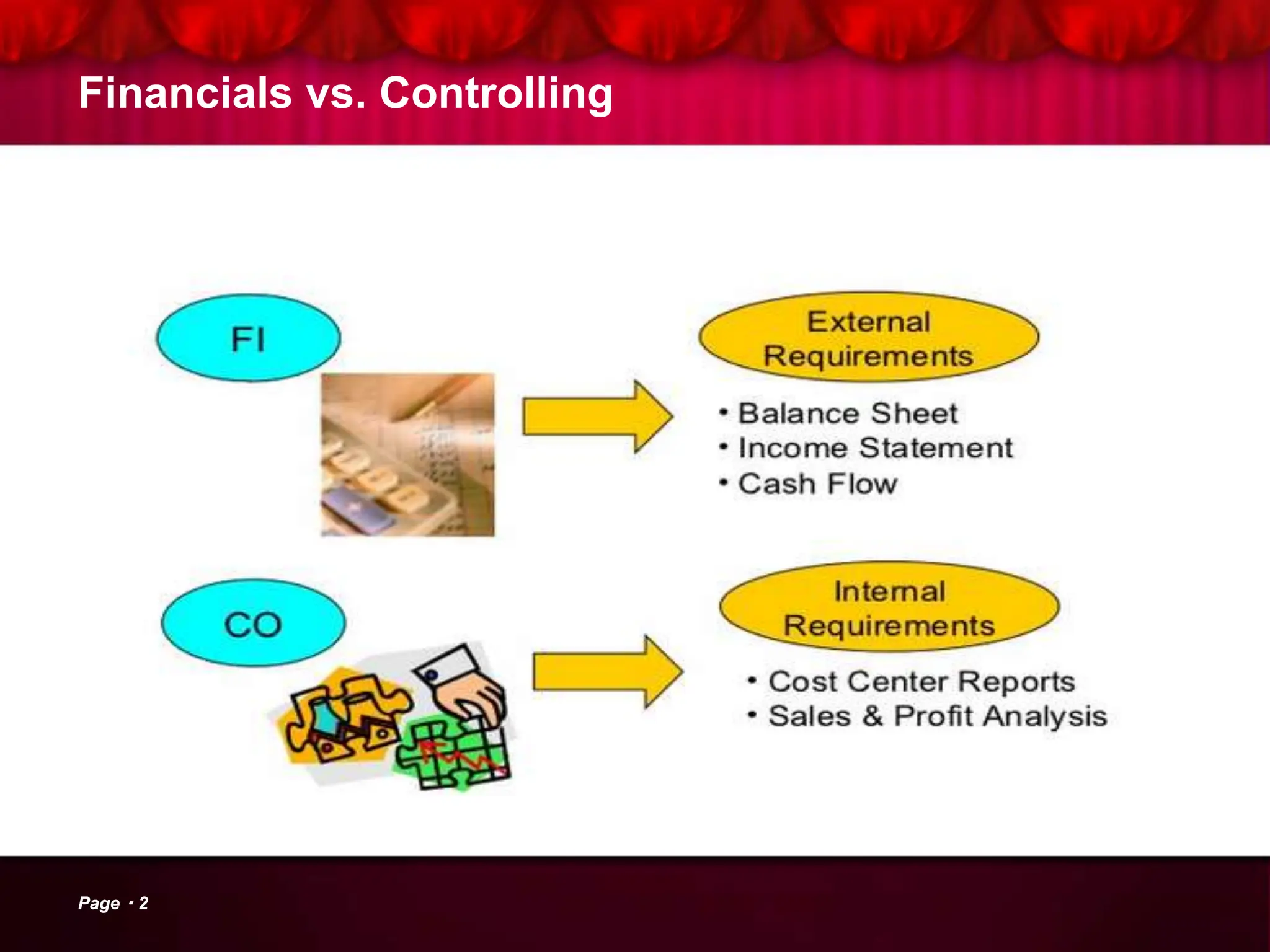
Financials vs. Controlling
1
2
3
Page 2
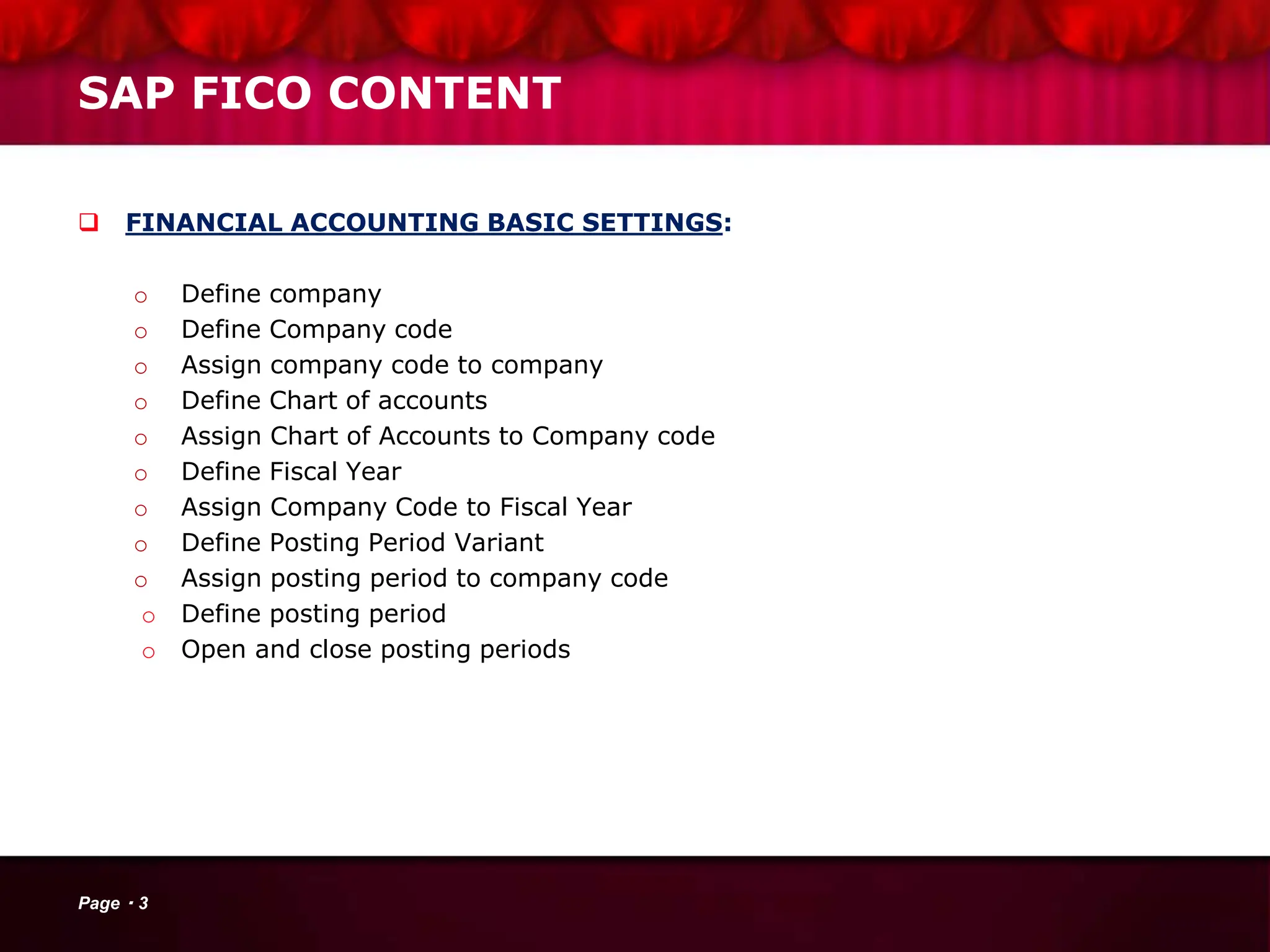
SAP FICO CONTENT
 FINANCIAL ACCOUNTING BASIC SETTINGS:
o Define company
o Define Company code
o Assign company code to company
o Define Chart of accounts
o Assign Chart of Accounts to Company code
o Define Fiscal Year
o Assign Company Code to Fiscal Year
o Define Posting Period Variant
o Assign posting period to company code
o Define posting period
o Open and close posting periods
Page 3
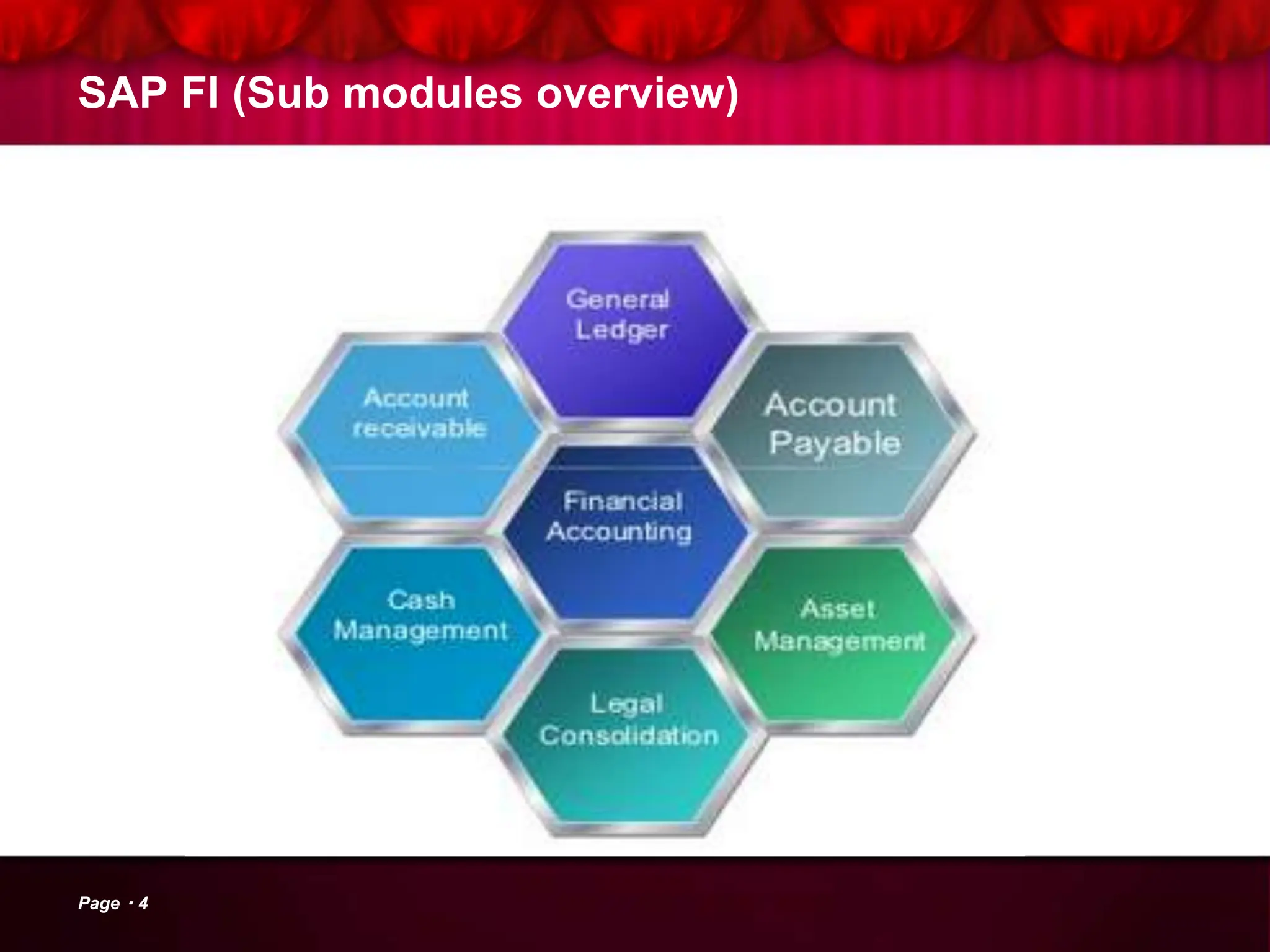
SAP FI (Sub modules overview)
Page 4
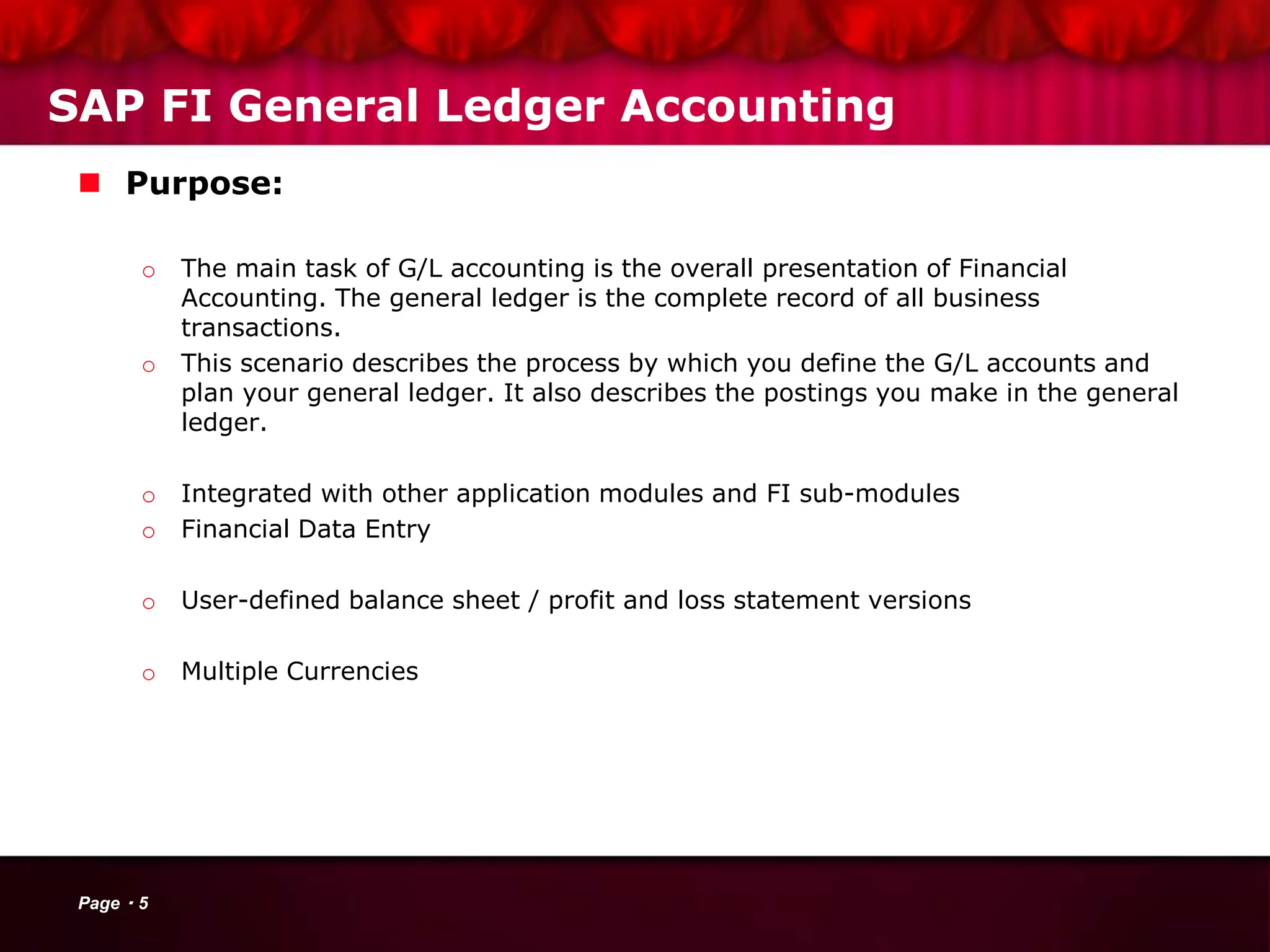
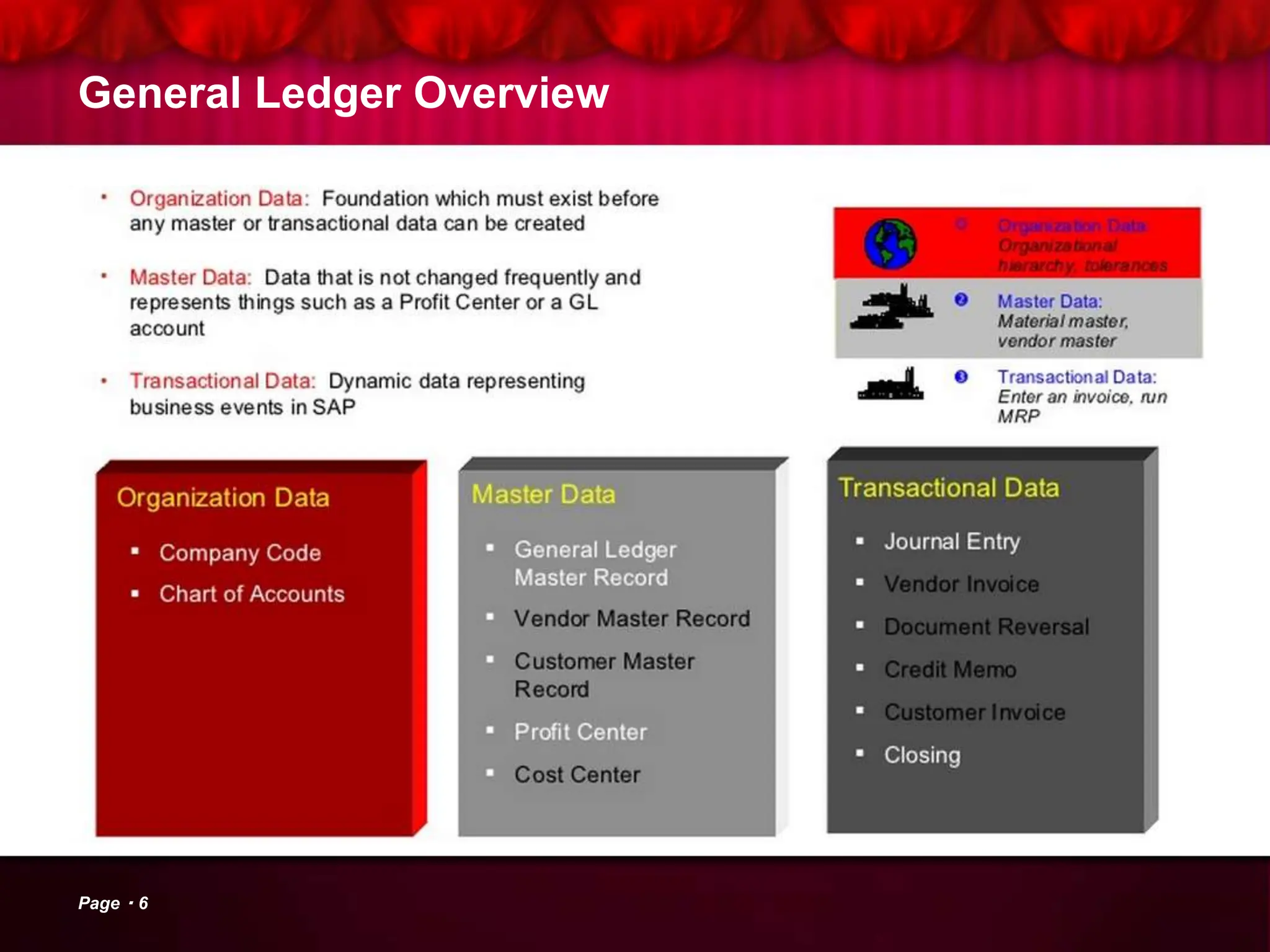
SAP FI General Ledger Accounting
 Purpose:
o The main task of G/L accounting is the overall presentation of Financial
Accounting. The general ledger is the complete record of all business
transactions.
o This scenario describes the process by which you define the G/L accounts and
plan your general ledger. It also describes the postings you make in the general
ledger.
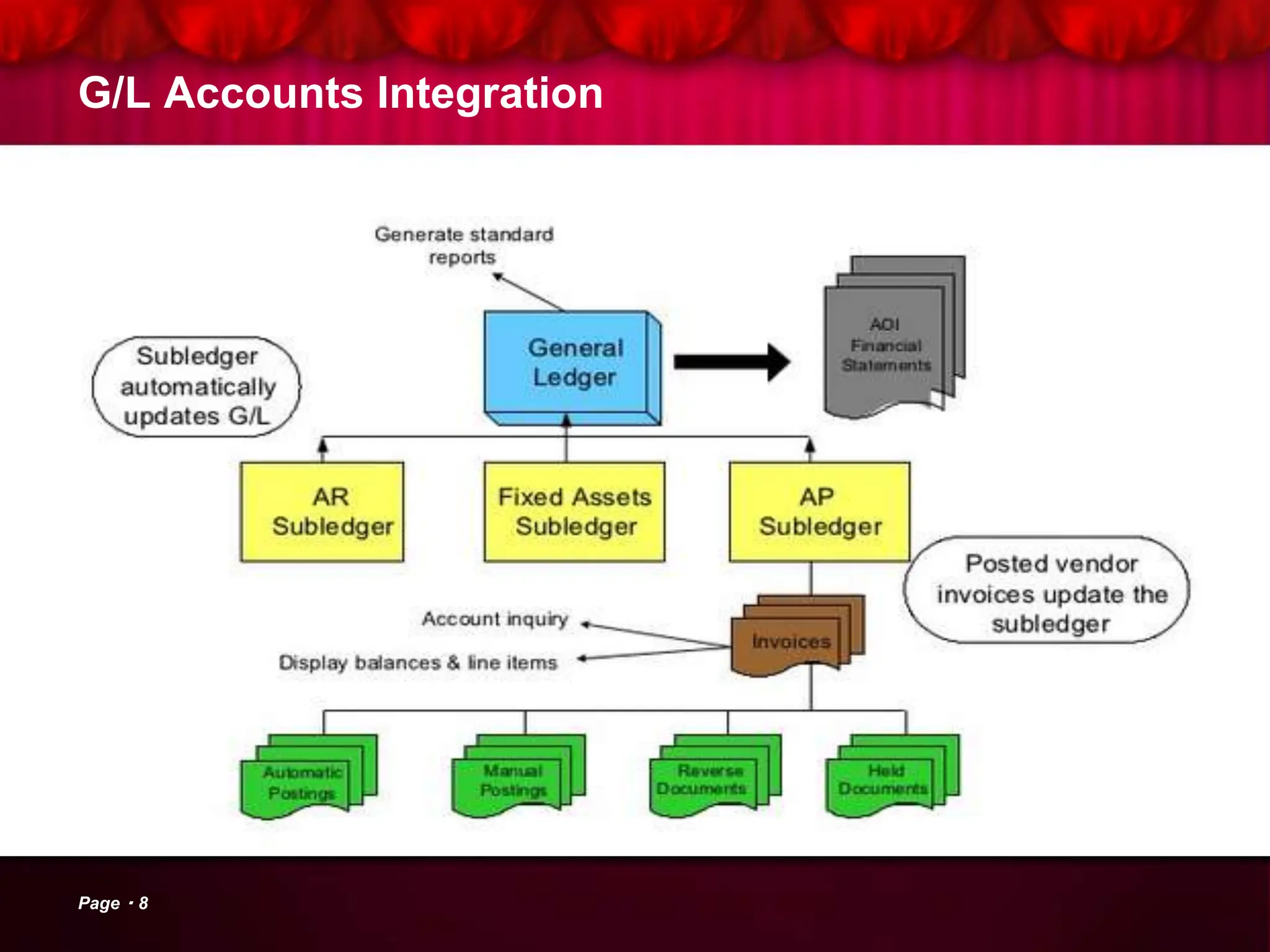
o Integrated with other application modules and FI sub-modules
o Financial Data Entry
o User-defined balance sheet / profit and loss statement versions
o Multiple Currencies
Page 5
General Ledger Overview
Page 6
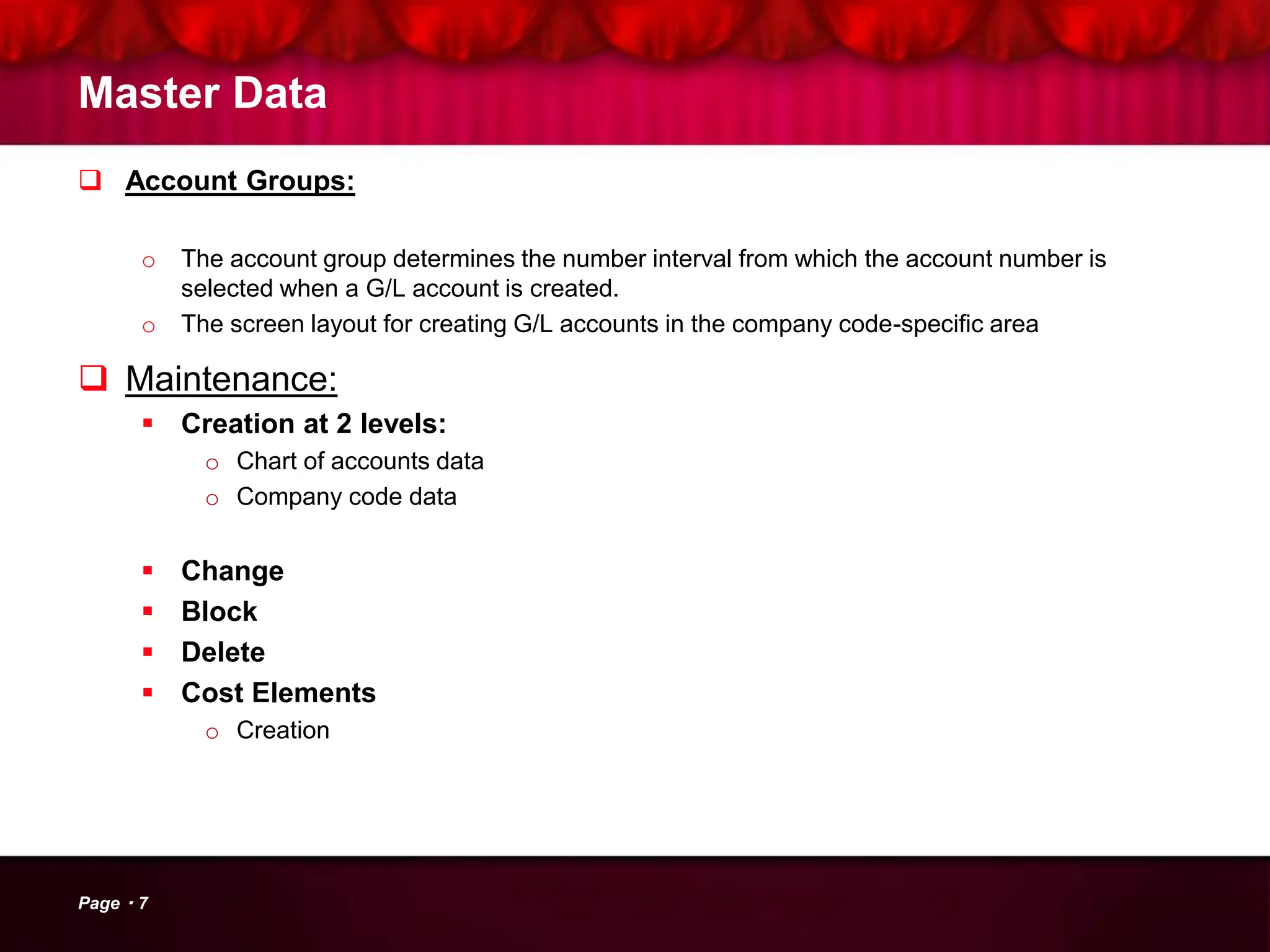
Master Data
 Account Groups:
o The account group determines the number interval from which the account number is
selected when a G/L account is created.
o The screen layout for creating G/L accounts in the company code-specific area
 Maintenance:
 Creation at 2 levels:
o Chart of accounts data
o Company code data
 Change
 Block
 Delete
 Cost Elements
o Creation
Page 7
G/L Accounts Integration
Page 8
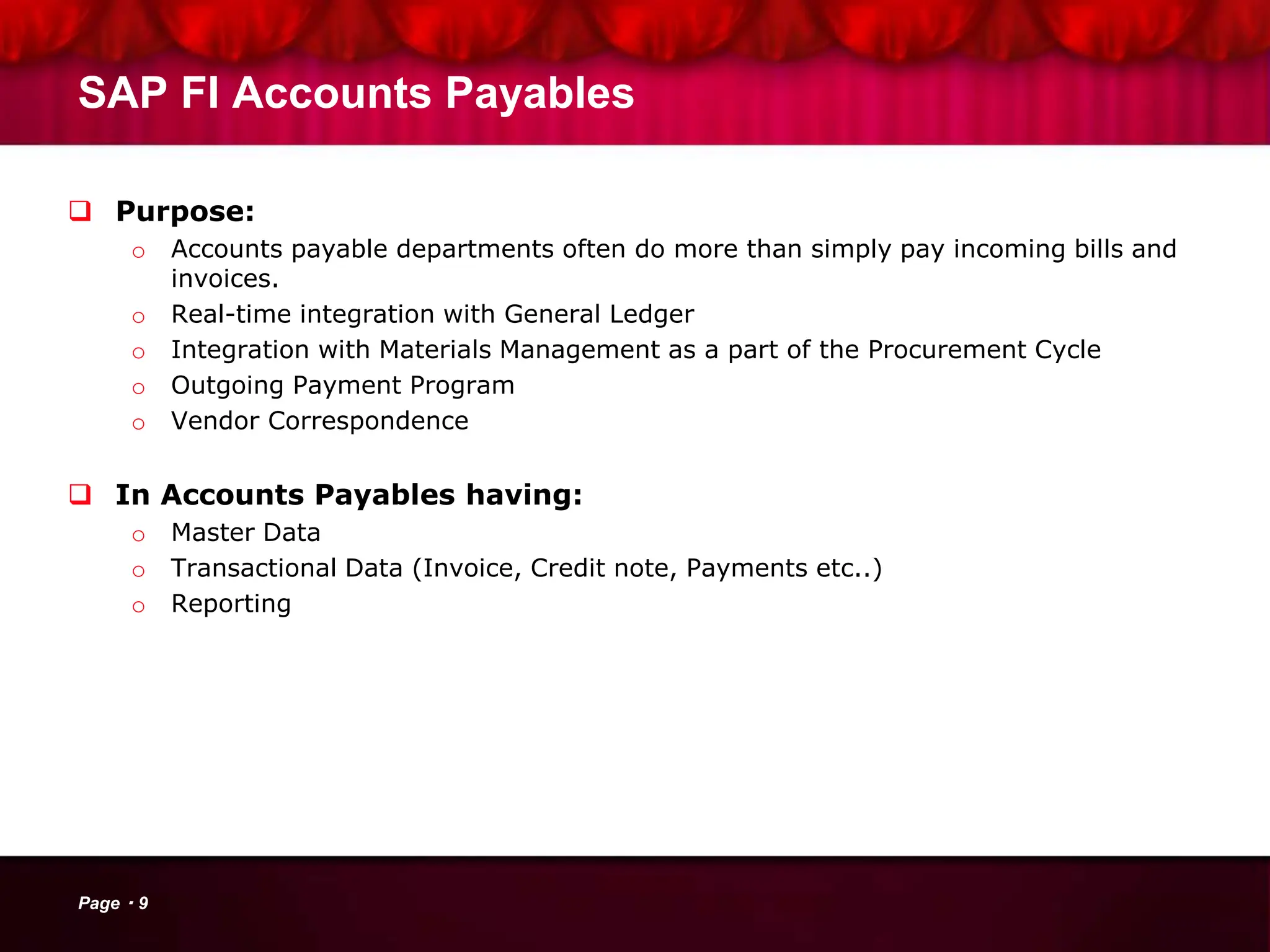
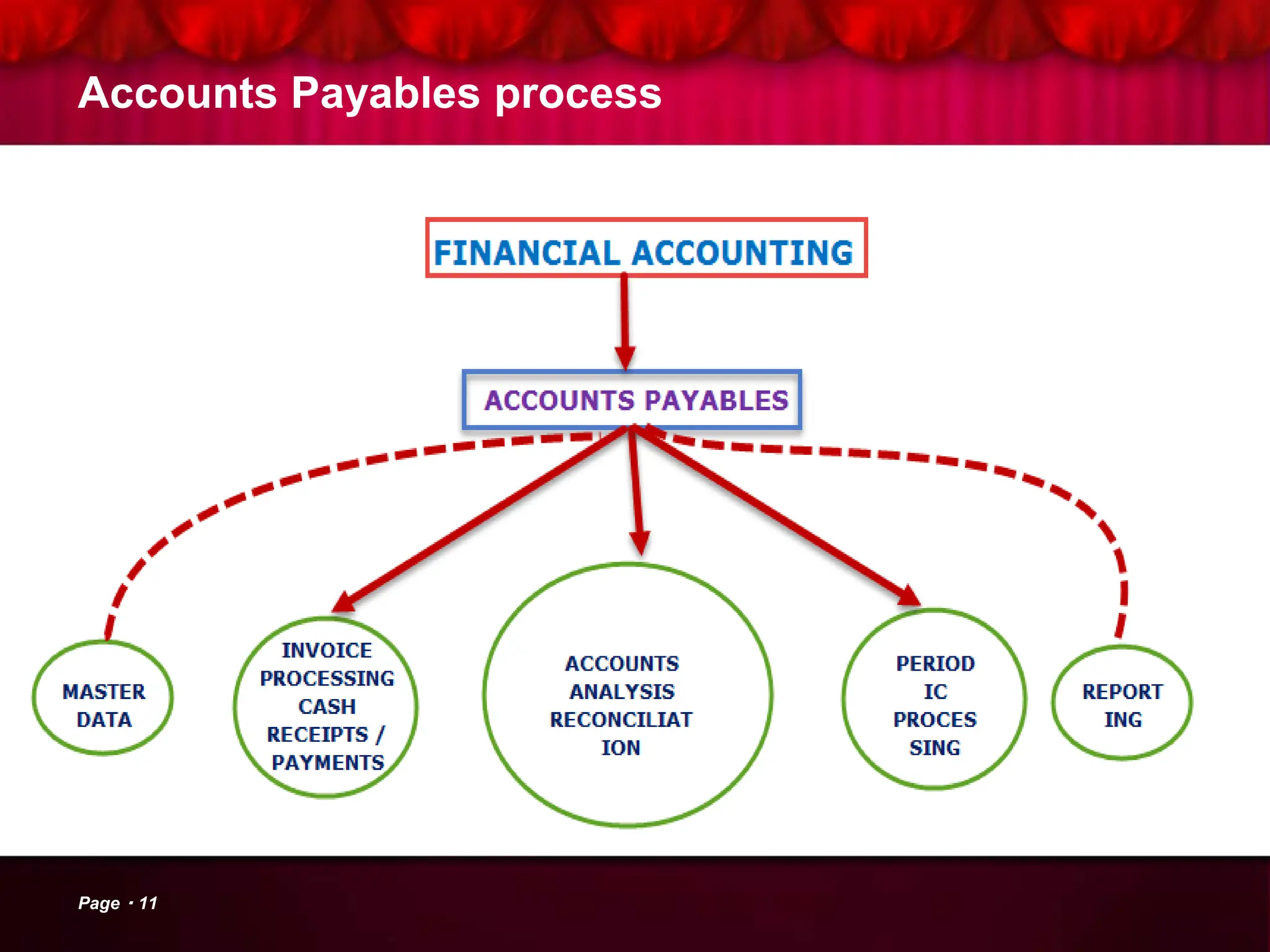
SAP FI Accounts Payables
 Purpose:
o Accounts payable departments often do more than simply pay incoming bills and
invoices.
o Real-time integration with General Ledger
o Integration with Materials Management as a part of the Procurement Cycle
o Outgoing Payment Program
o Vendor Correspondence
 In Accounts Payables having:
o Master Data
o Transactional Data (Invoice, Credit note, Payments etc..)
o Reporting
Page 9
Structure of the vendor master record
o Key terms for vendor master record consist of:
o General Data: Is data that applies to all company codes such as vendor
address and telephone numbers
o Company code data/accounting data: Is information specific to
accounting such as payment transaction data and the number of reconciliation
account
o Purchasing data: Is information relevant to purchasing, such as contact
parsons and terms of delivery
o Account Groups controls:
• The screen layout which is the field that must be populated and the fields
that are optional
• Automatic generation of vendor numbers
Page 10
Accounts Payables process
Page 11
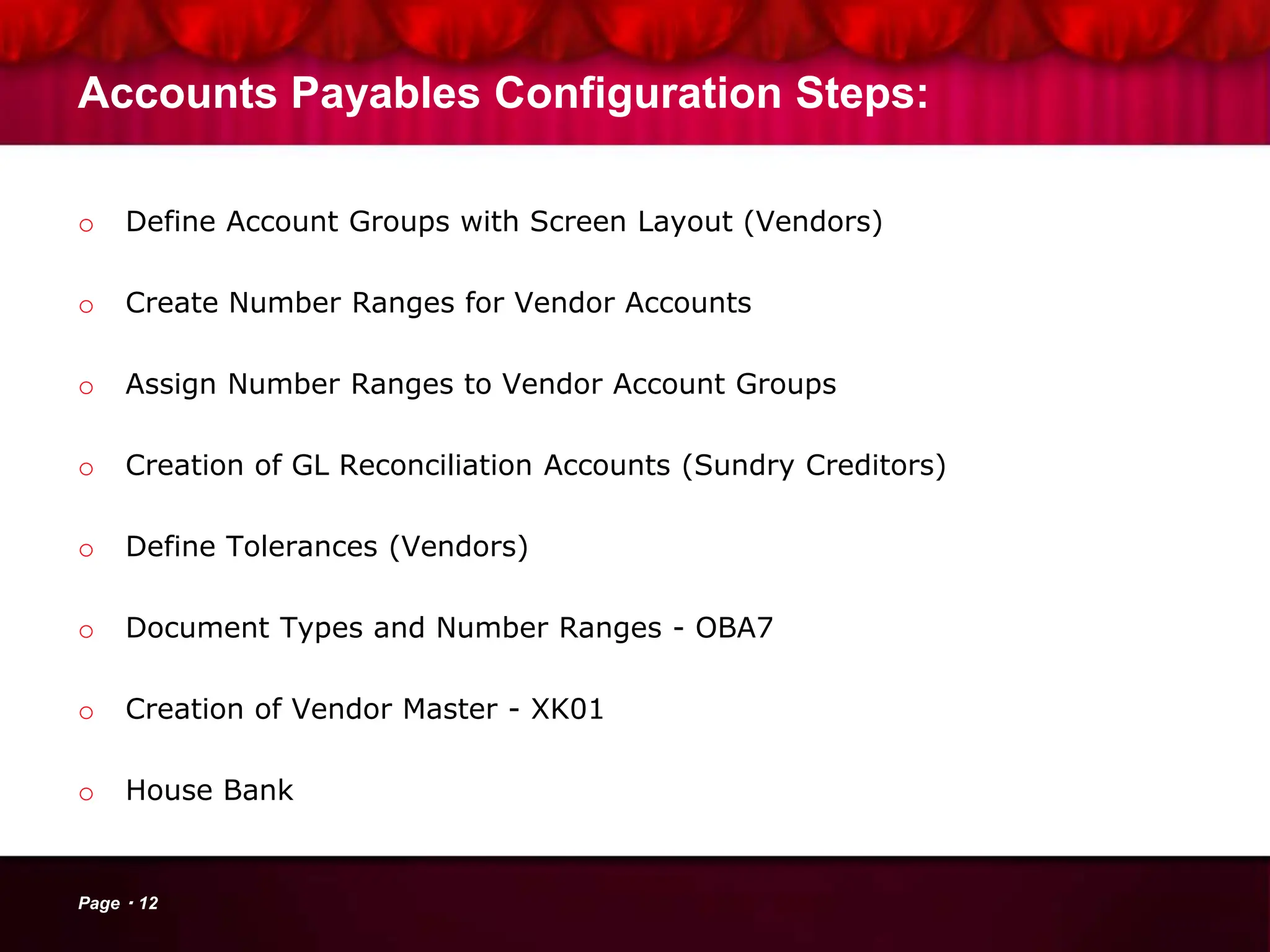
Accounts Payables Configuration Steps:
o Define Account Groups with Screen Layout (Vendors)
o Create Number Ranges for Vendor Accounts
o Assign Number Ranges to Vendor Account Groups
o Creation of GL Reconciliation Accounts (Sundry Creditors)
o Define Tolerances (Vendors)
o Document Types and Number Ranges - OBA7
o Creation of Vendor Master - XK01
o House Bank
Page 12
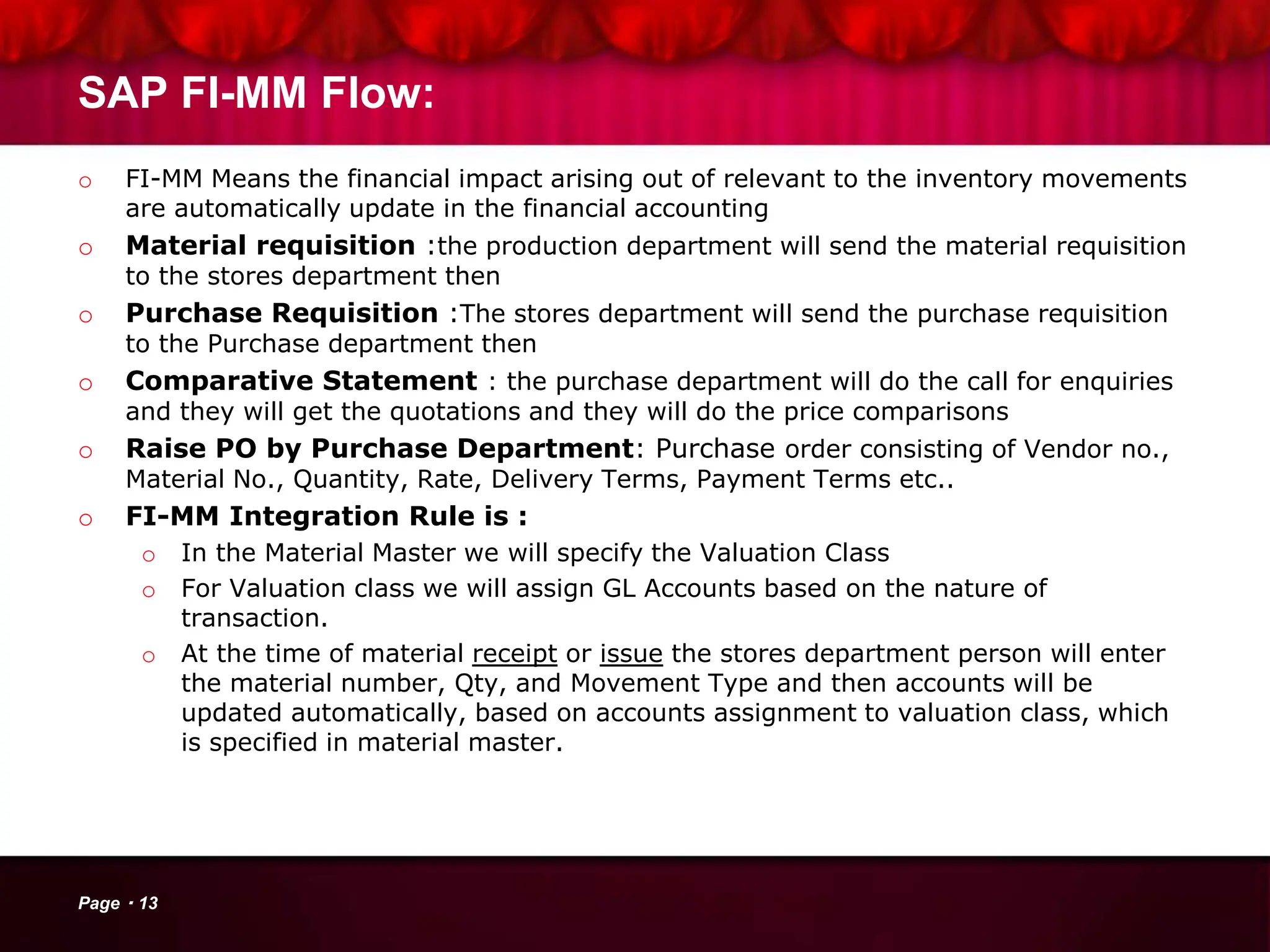
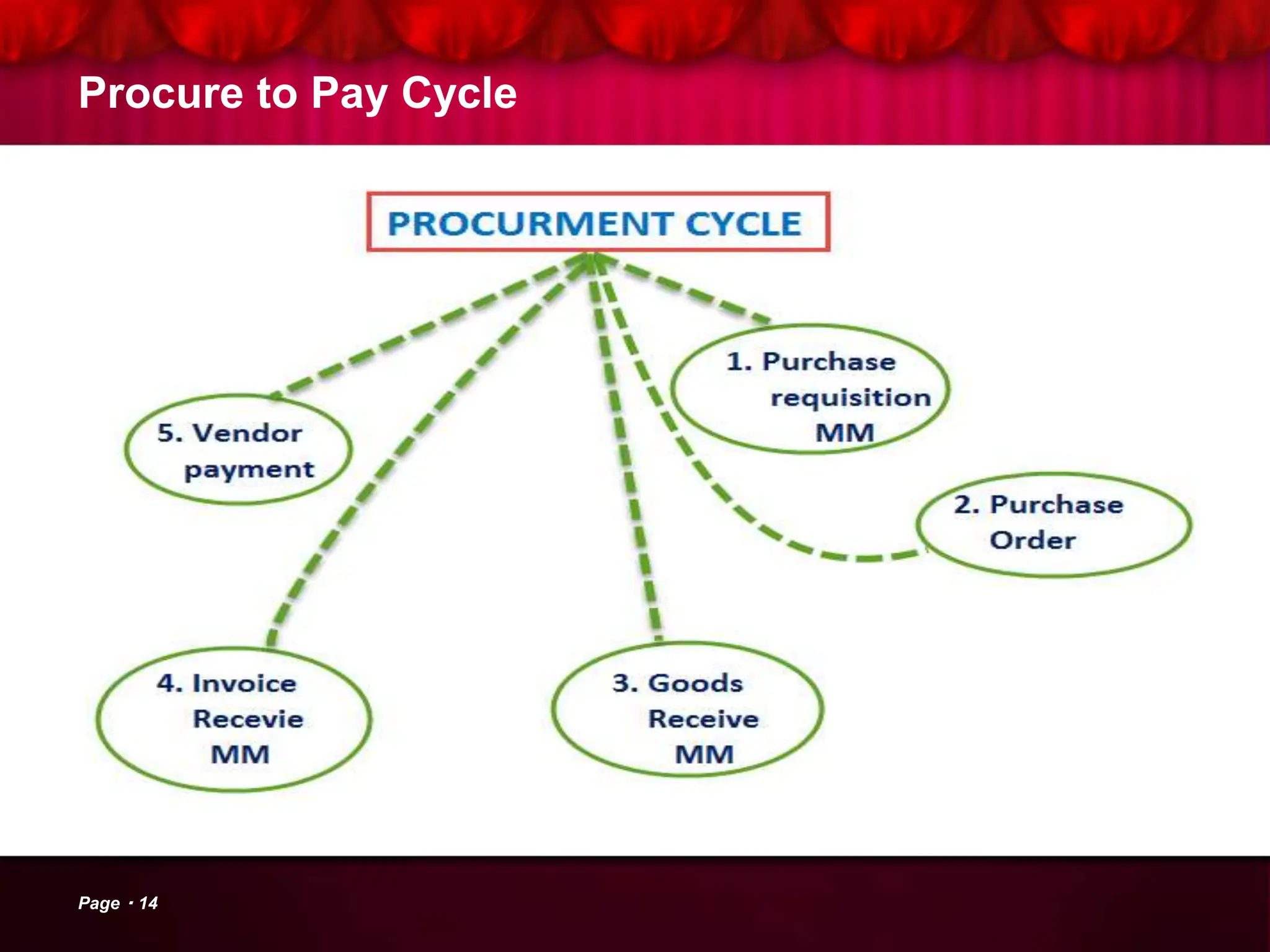
SAP FI-MM Flow:
o FI-MM Means the financial impact arising out of relevant to the inventory movements
are automatically update in the financial accounting
o Material requisition :the production department will send the material requisition
to the stores department then
o Purchase Requisition :The stores department will send the purchase requisition
to the Purchase department then
o Comparative Statement : the purchase department will do the call for enquiries
and they will get the quotations and they will do the price comparisons
o Raise PO by Purchase Department: Purchase order consisting of Vendor no.,
Material No., Quantity, Rate, Delivery Terms, Payment Terms etc..
o FI-MM Integration Rule is :
o In the Material Master we will specify the Valuation Class
o For Valuation class we will assign GL Accounts based on the nature of
transaction.
o At the time of material receipt or issue the stores department person will enter
the material number, Qty, and Movement Type and then accounts will be
updated automatically, based on accounts assignment to valuation class, which
is specified in material master.
Page 13
Procure to Pay Cycle
Page 14
SAP FI Accounts Receivable
o The Accounts Receivable application component records and manages
accounting data of all customers. It is also an integral part of sales
management.
o All postings in Accounts Receivable are also recorded directly in the
General Ledger. Different G/L accounts are updated depending on the
transaction involved (for example, receivables, down payments, and bills
of exchange).
o The system can use to monitor for open items, such as account analyses,
alarm reports, due date lists, and a flexible dunning program.
Page 15
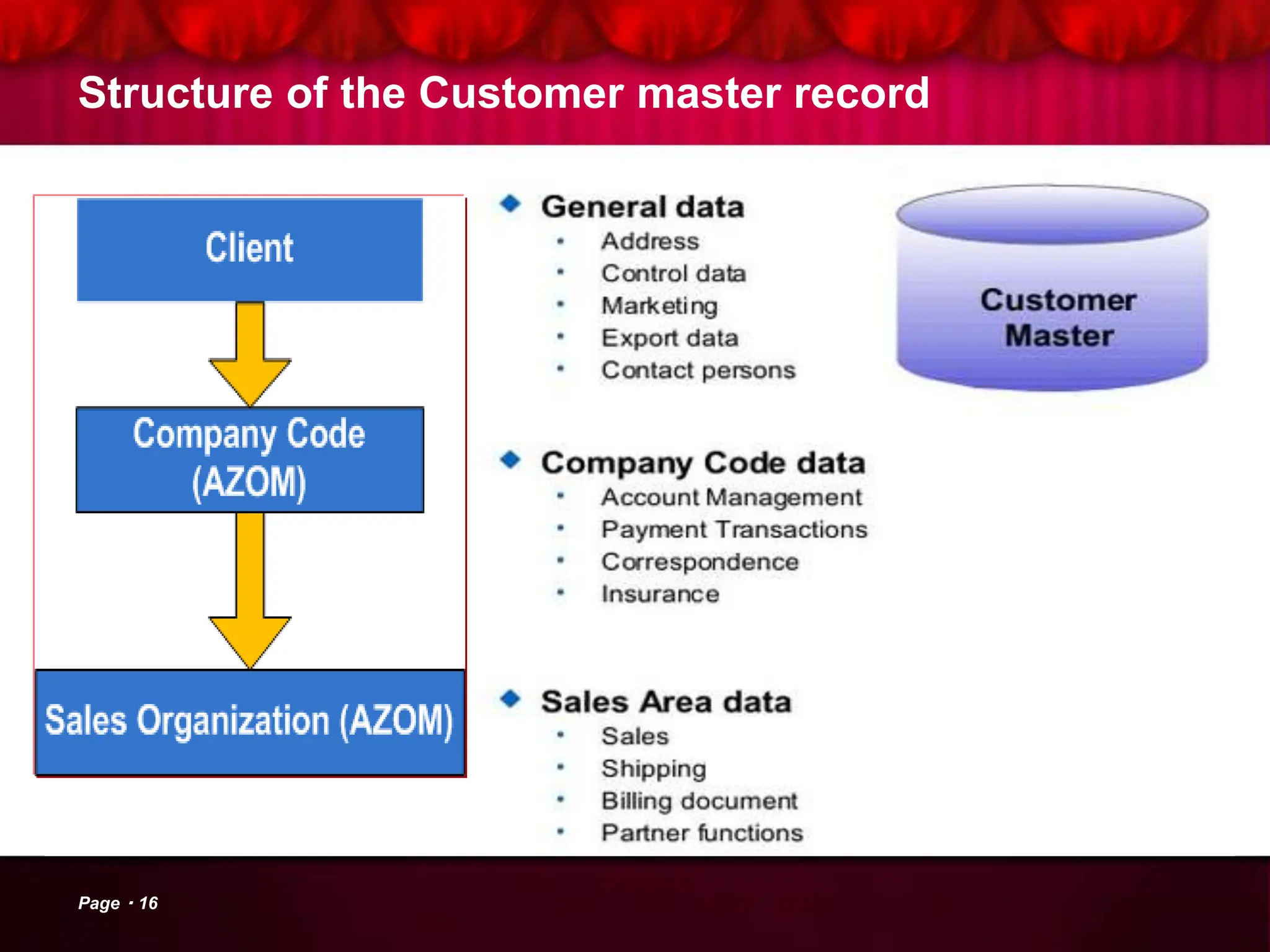
Structure of the Customer master record
Page 16
 General data:
o It does not depend on the company code or the sales and distribution
organization
o Applies to one business partner for all company codes and in all sales areas and
includes
o Company names
o Address
o Telephone numbers
o Data that is unique to a customer and shared by all departments
 Company code data:
o It is only applies to one company code (Legal business) this data only relevant
for financial accounting
o If you edit master record you must specify the customer number and company
code to access the screens containing company code data
o You can only invoice payer (partner function) if you have entered data in
financial accounting view.
Page 17
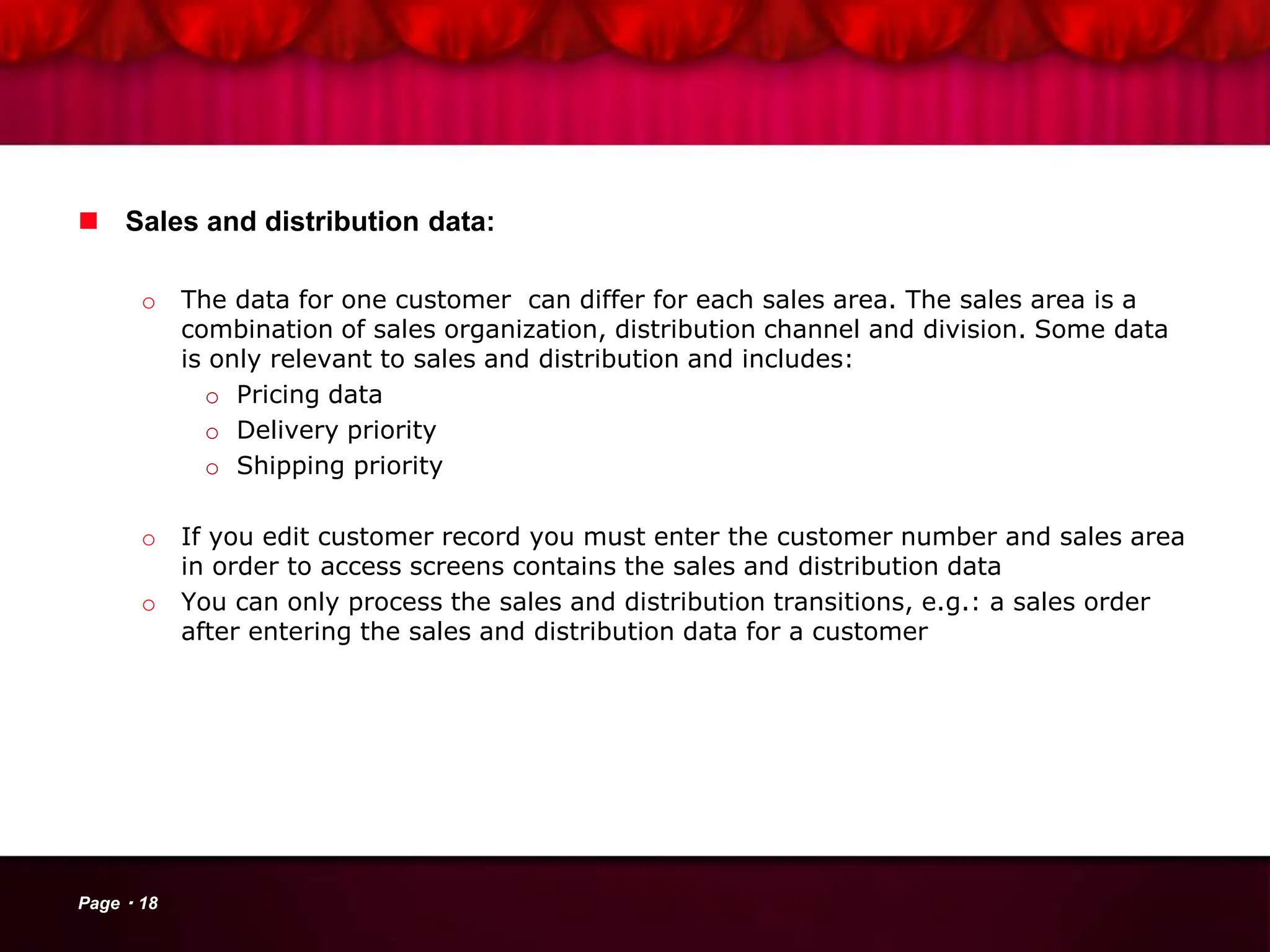
 Sales and distribution data:
o The data for one customer can differ for each sales area. The sales area is a
combination of sales organization, distribution channel and division. Some data
is only relevant to sales and distribution and includes:
o Pricing data
o Delivery priority
o Shipping priority
o If you edit customer record you must enter the customer number and sales area
in order to access screens contains the sales and distribution data
o You can only process the sales and distribution transitions, e.g.: a sales order
after entering the sales and distribution data for a customer
Page 18
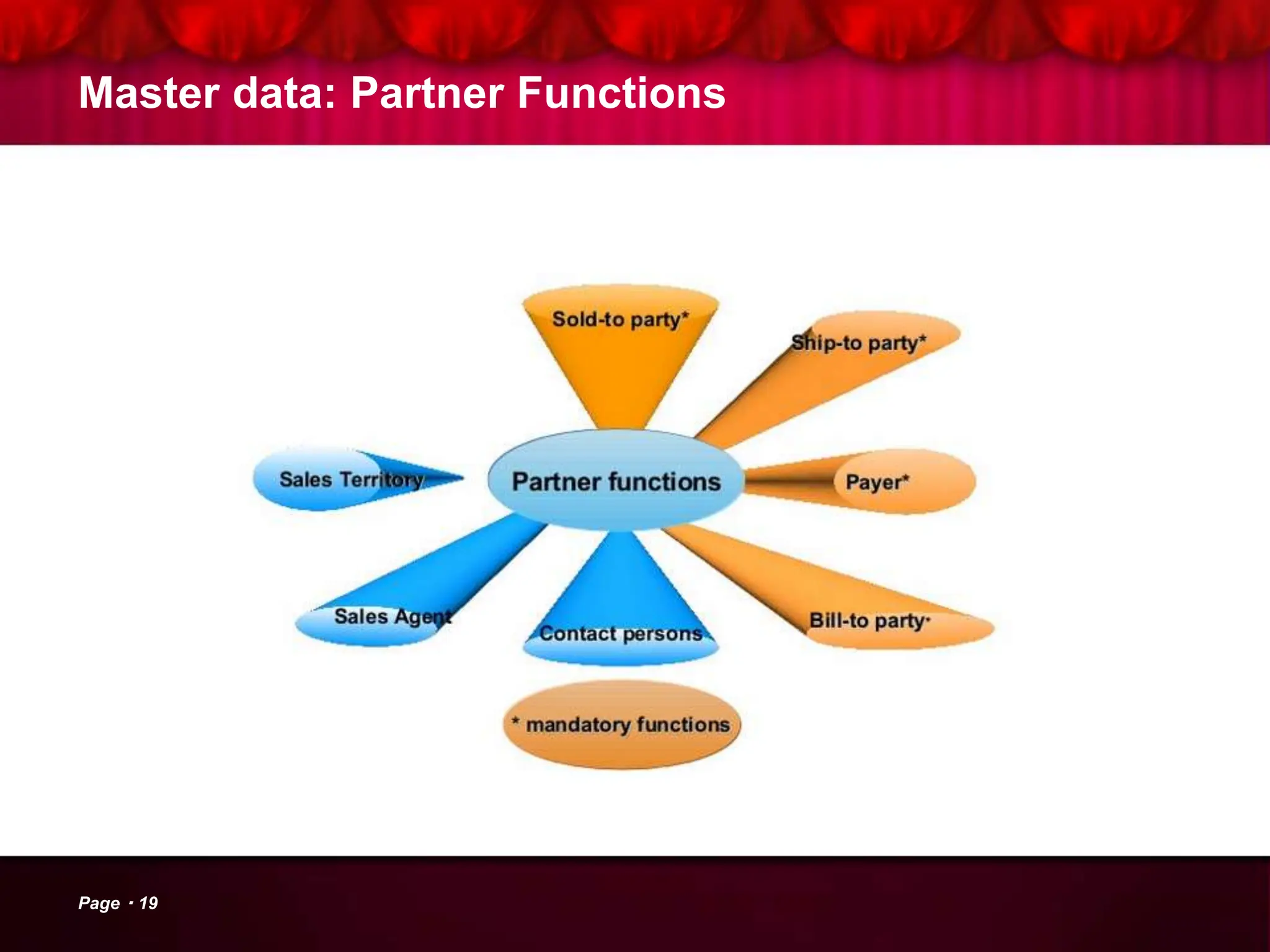
Master data: Partner Functions
Page 19
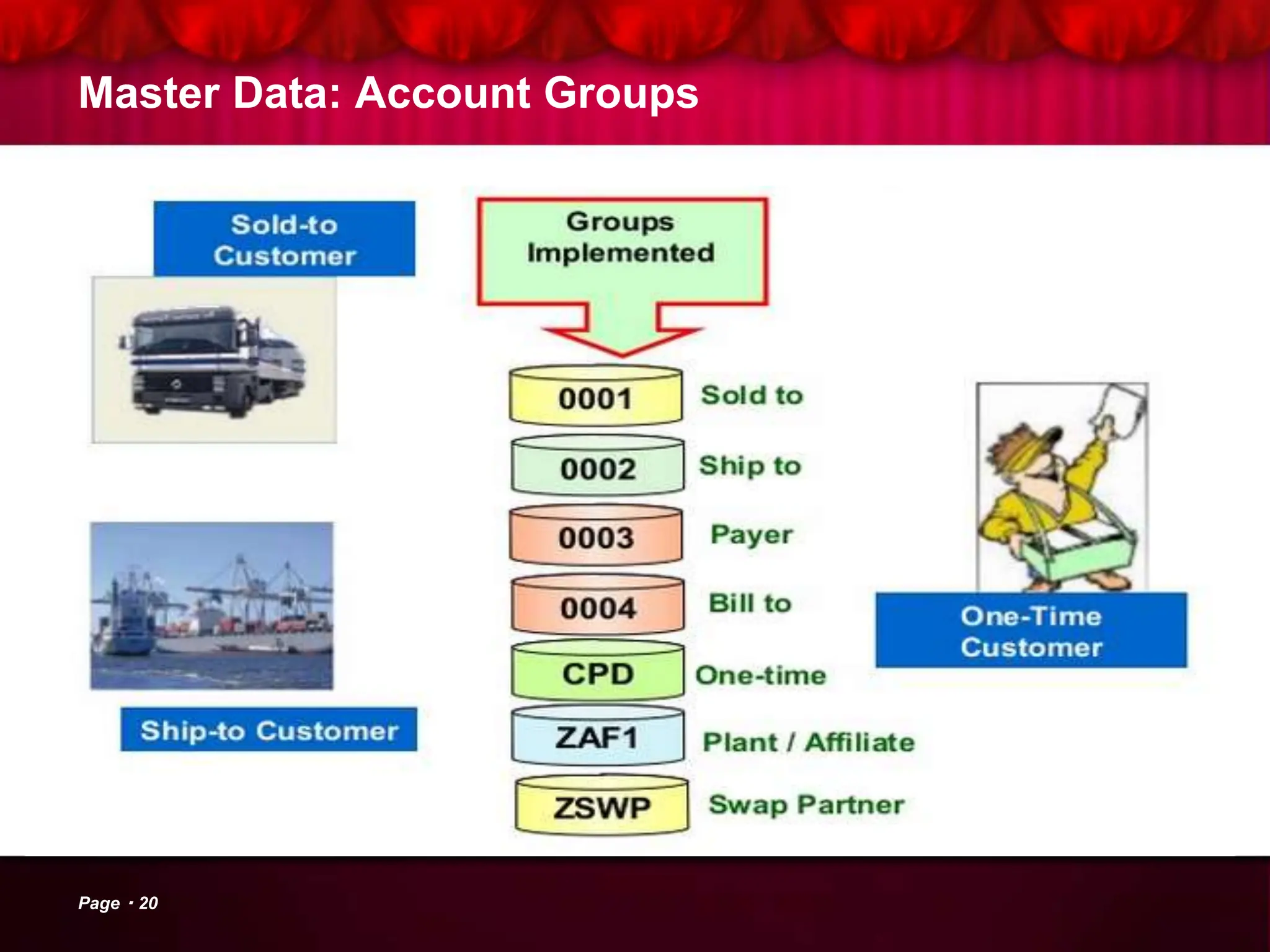
Master Data: Account Groups
Page 20
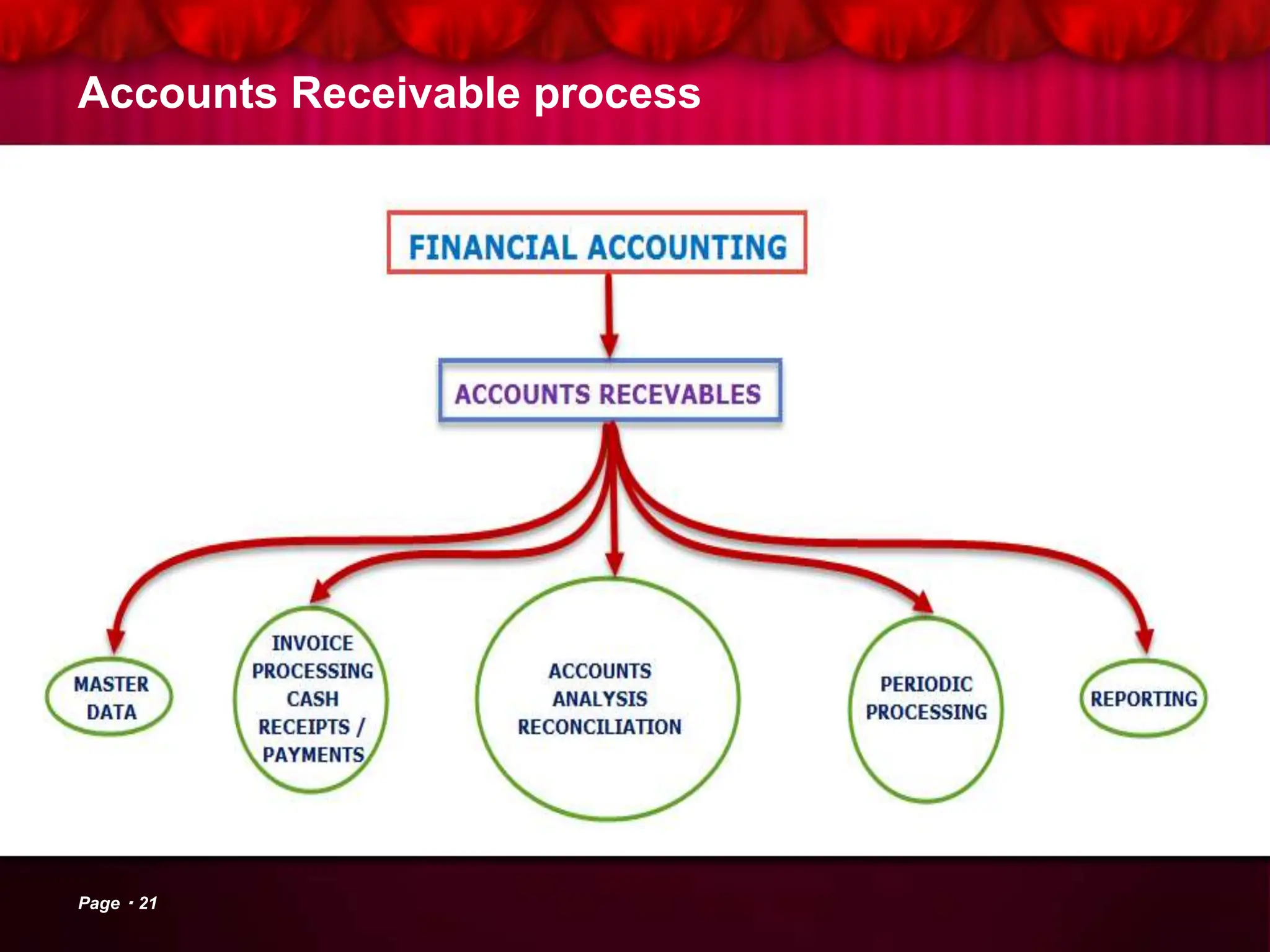
Accounts Receivable process
Page 21
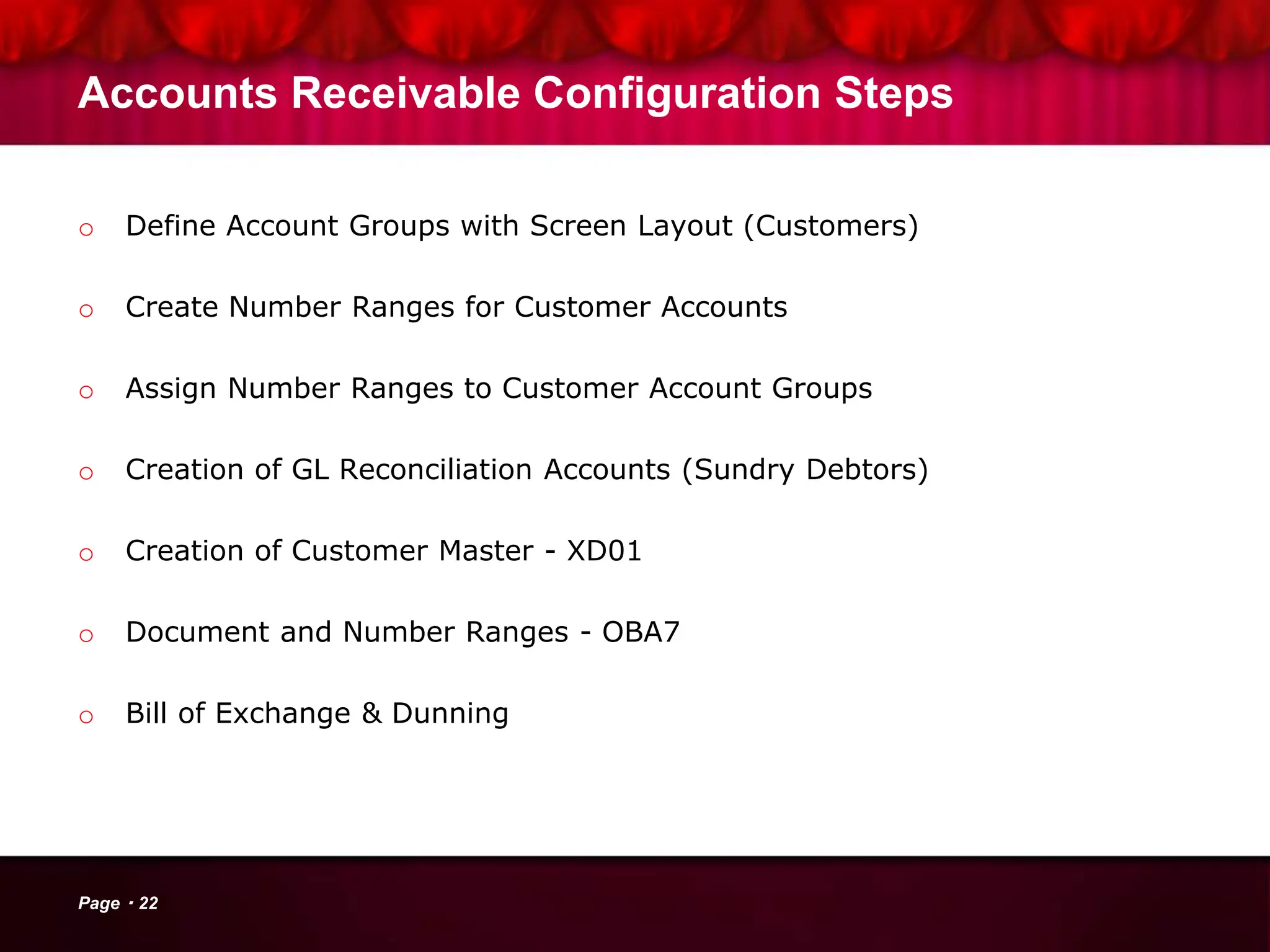
Accounts Receivable Configuration Steps
o Define Account Groups with Screen Layout (Customers)
o Create Number Ranges for Customer Accounts
o Assign Number Ranges to Customer Account Groups
o Creation of GL Reconciliation Accounts (Sundry Debtors)
o Creation of Customer Master - XD01
o Document and Number Ranges - OBA7
o Bill of Exchange & Dunning
Page 22
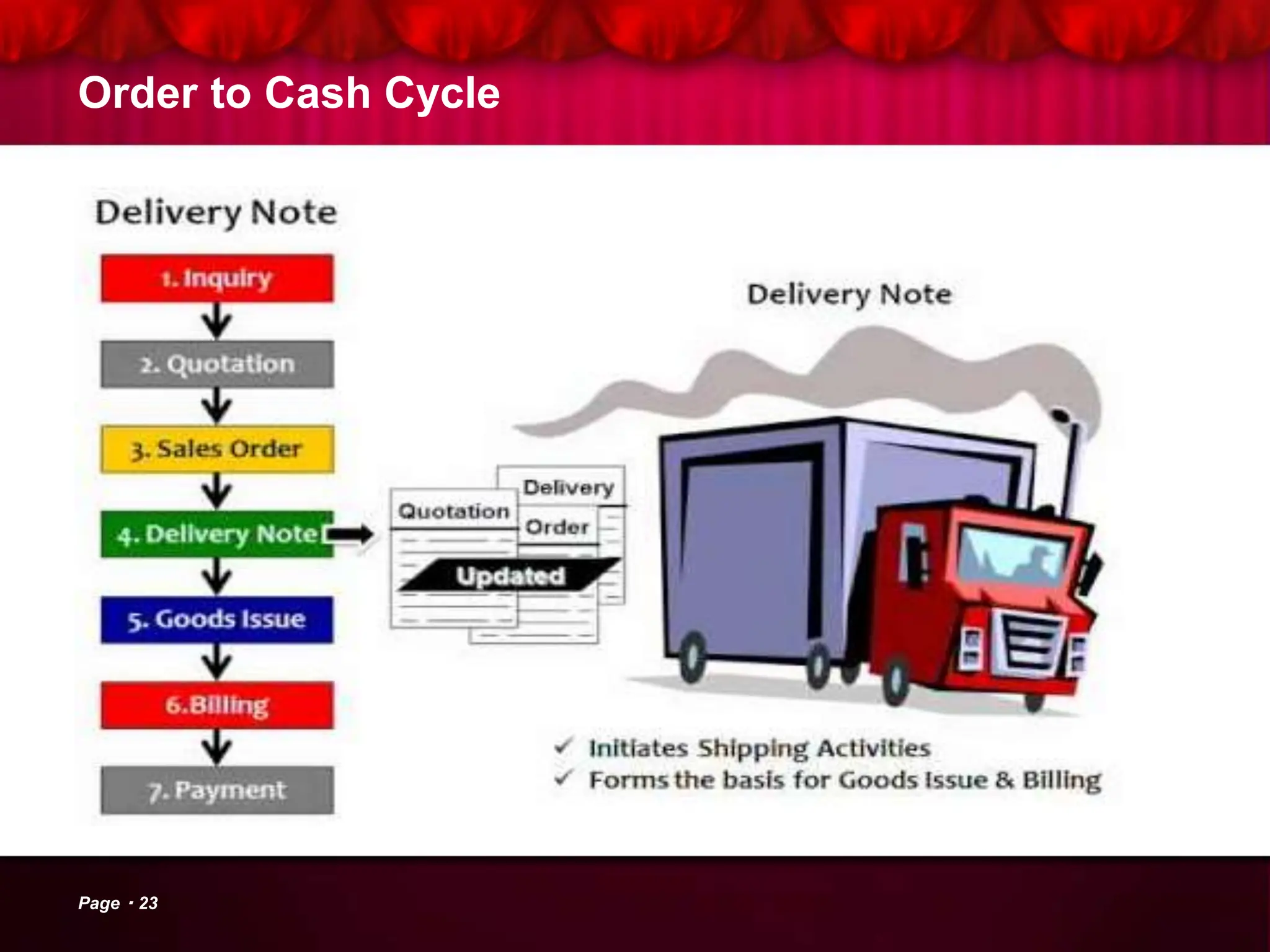
Order to Cash Cycle
Page 23
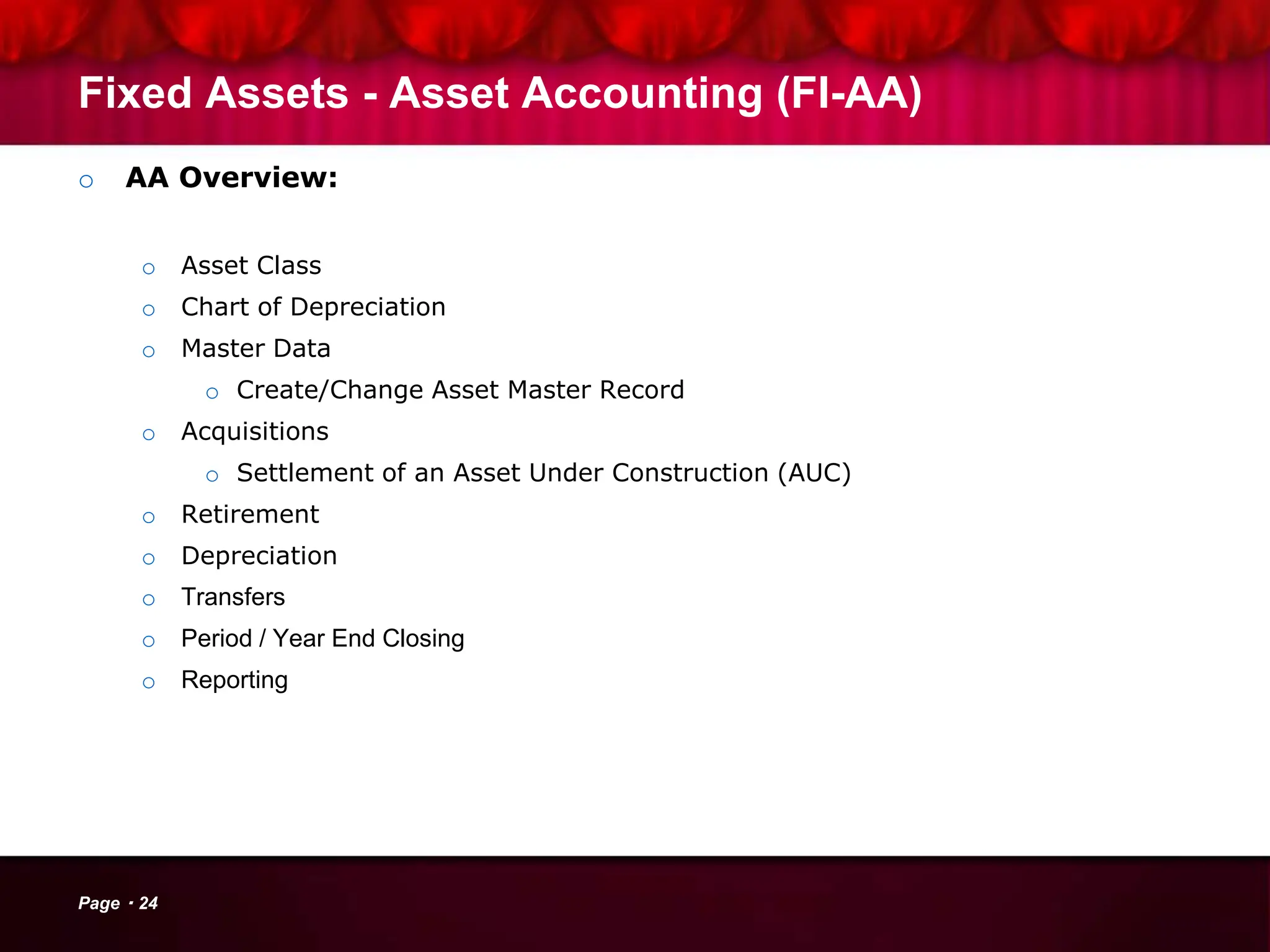
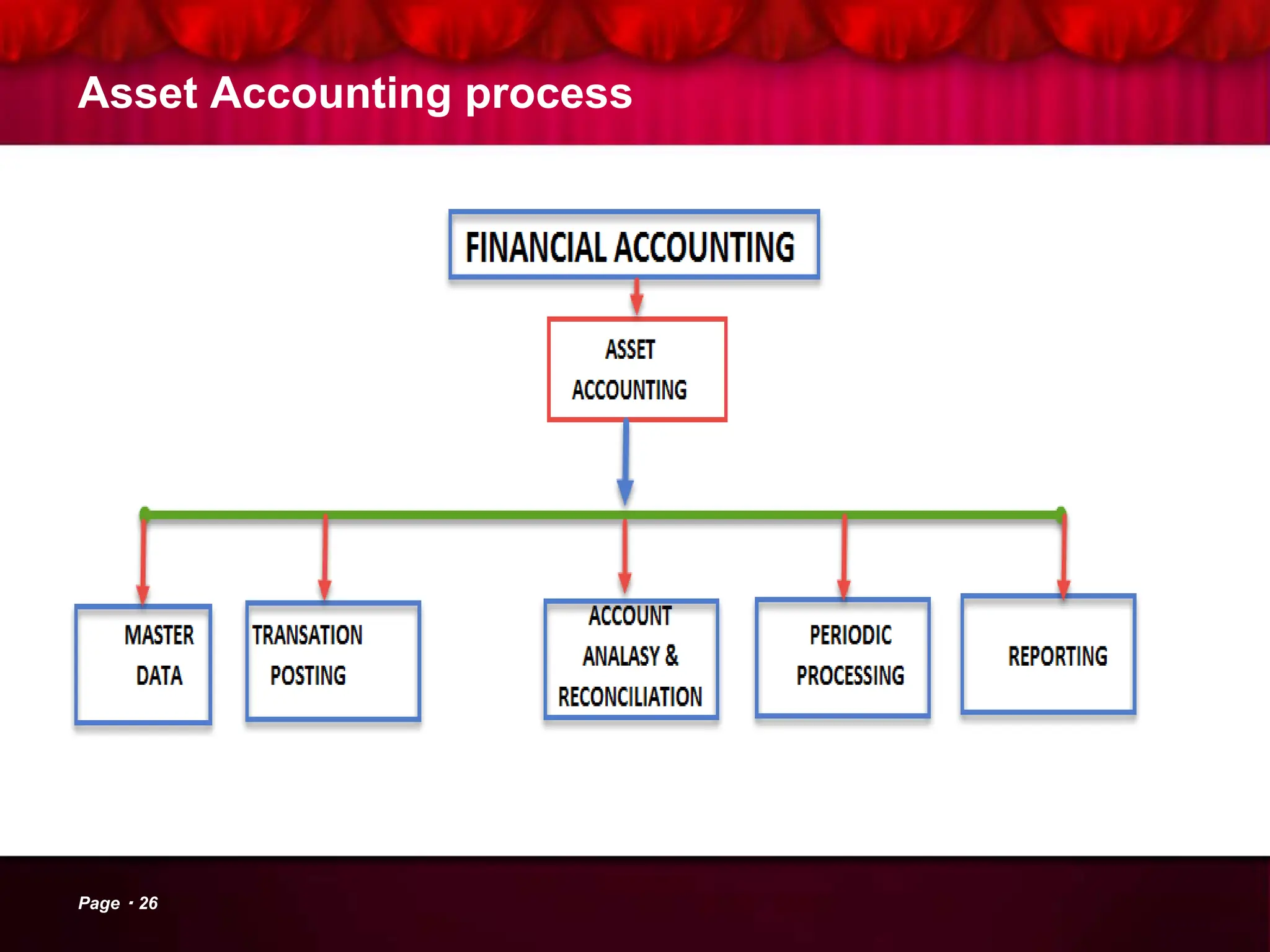
Fixed Assets - Asset Accounting (FI-AA)
o AA Overview:
o Asset Class
o Chart of Depreciation
o Master Data
o Create/Change Asset Master Record
o Acquisitions
o Settlement of an Asset Under Construction (AUC)
o Retirement
o Depreciation
o Transfers
o Period / Year End Closing
o Reporting
Page 24
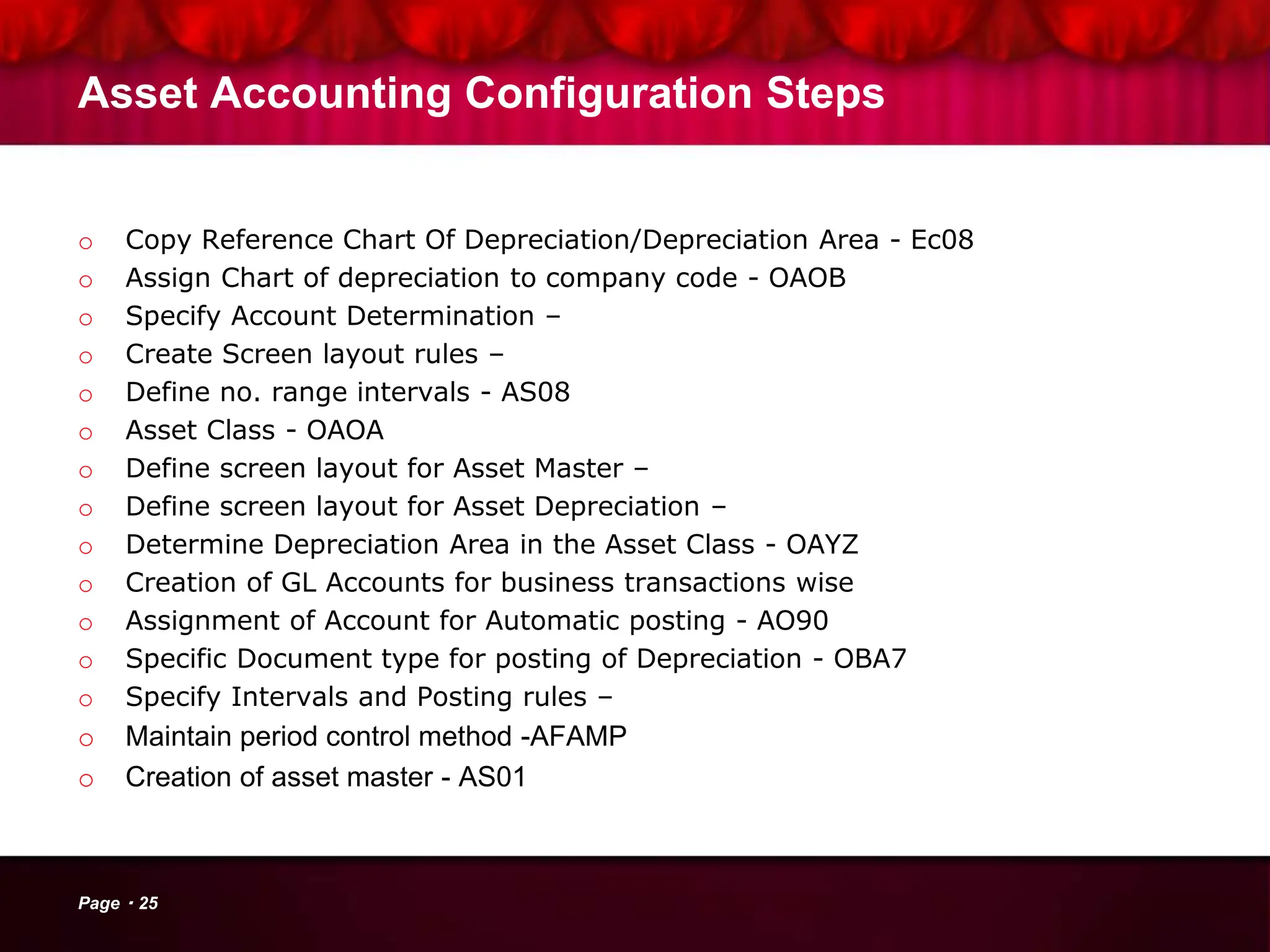
Asset Accounting Configuration Steps
o Copy Reference Chart Of Depreciation/Depreciation Area - Ec08
o Assign Chart of depreciation to company code - OAOB
o Specify Account Determination –
o Create Screen layout rules –
o Define no. range intervals - AS08
o Asset Class - OAOA
o Define screen layout for Asset Master –
o Define screen layout for Asset Depreciation –
o Determine Depreciation Area in the Asset Class - OAYZ
o Creation of GL Accounts for business transactions wise
o Assignment of Account for Automatic posting - AO90
o Specific Document type for posting of Depreciation - OBA7
o Specify Intervals and Posting rules –
o Maintain period control method -AFAMP
o Creation of asset master - AS01
Page 25
Asset Accounting process
Page 26
Account Determination
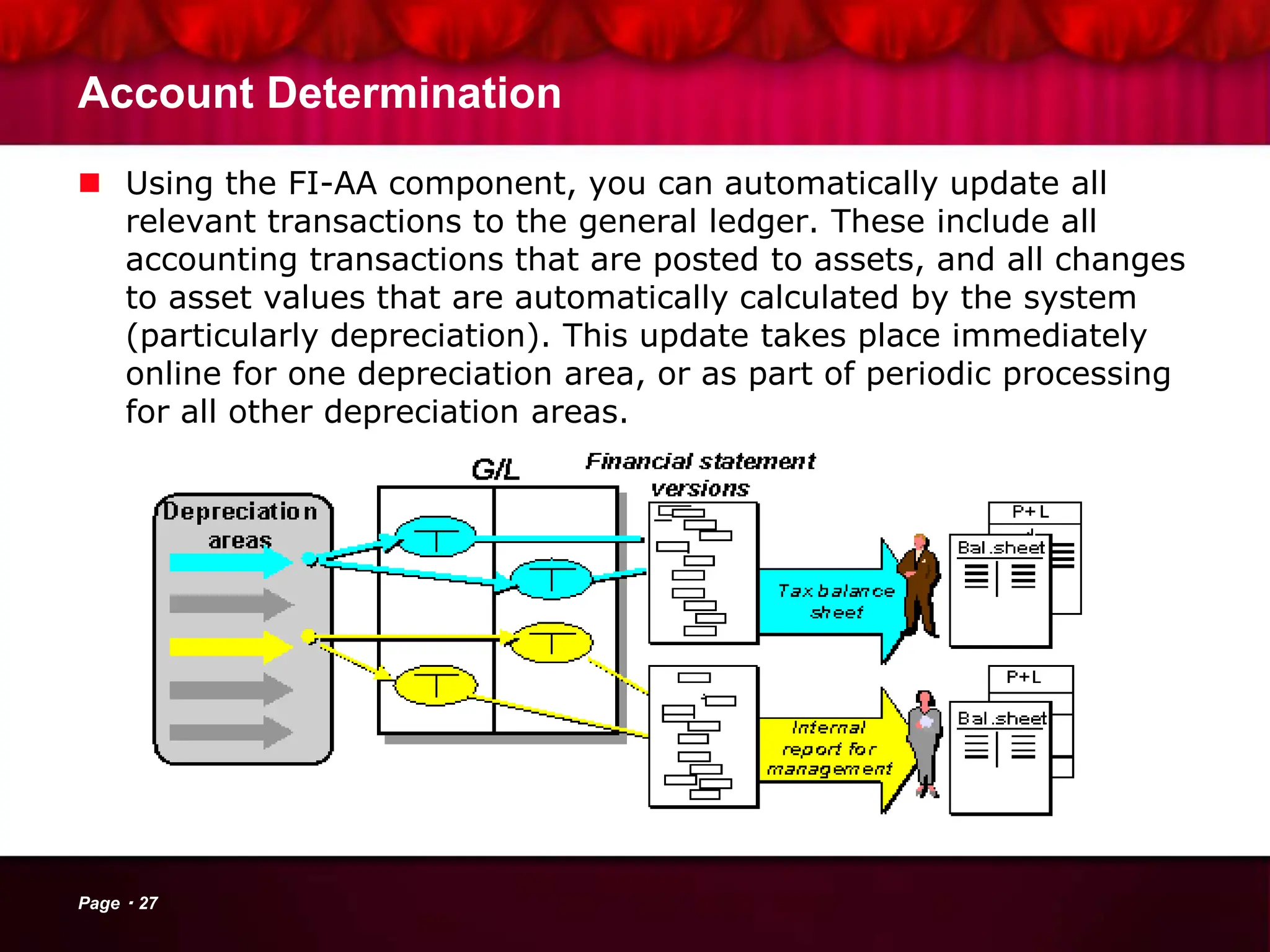
 Using the FI-AA component, you can automatically update all
relevant transactions to the general ledger. These include all
accounting transactions that are posted to assets, and all changes
to asset values that are automatically calculated by the system
(particularly depreciation). This update takes place immediately
online for one depreciation area, or as part of periodic processing
for all other depreciation areas.
Page 27
Asset Classes
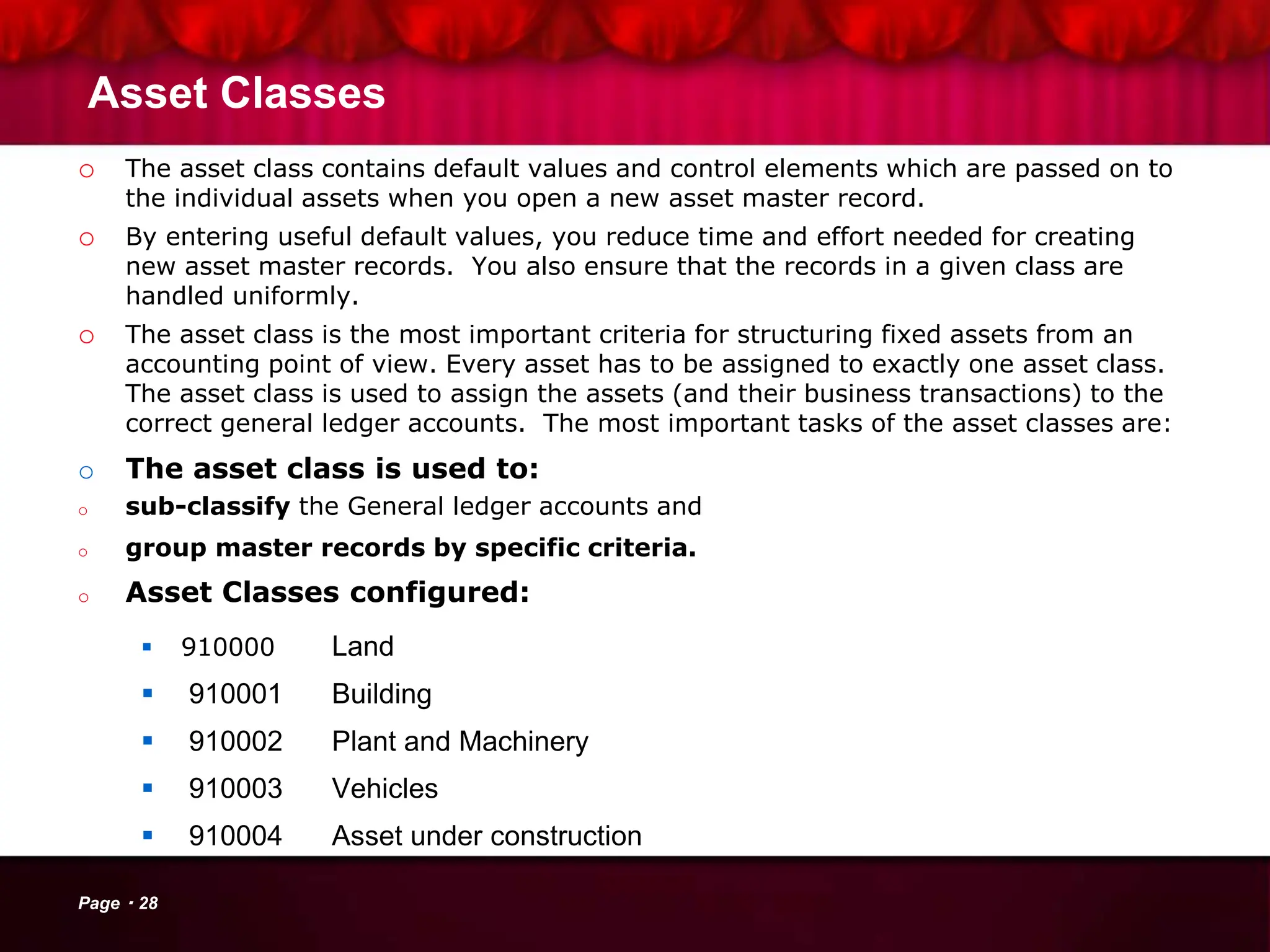
o The asset class contains default values and control elements which are passed on to
the individual assets when you open a new asset master record.
o By entering useful default values, you reduce time and effort needed for creating
new asset master records. You also ensure that the records in a given class are
handled uniformly.
o The asset class is the most important criteria for structuring fixed assets from an
accounting point of view. Every asset has to be assigned to exactly one asset class.
The asset class is used to assign the assets (and their business transactions) to the
correct general ledger accounts. The most important tasks of the asset classes are:
o The asset class is used to:
o sub-classify the General ledger accounts and
o group master records by specific criteria.
o Asset Classes configured:
 910000 Land
 910001 Building
 910002 Plant and Machinery
 910003 Vehicles
 910004 Asset under construction
Page 28
Function of Asset Classes
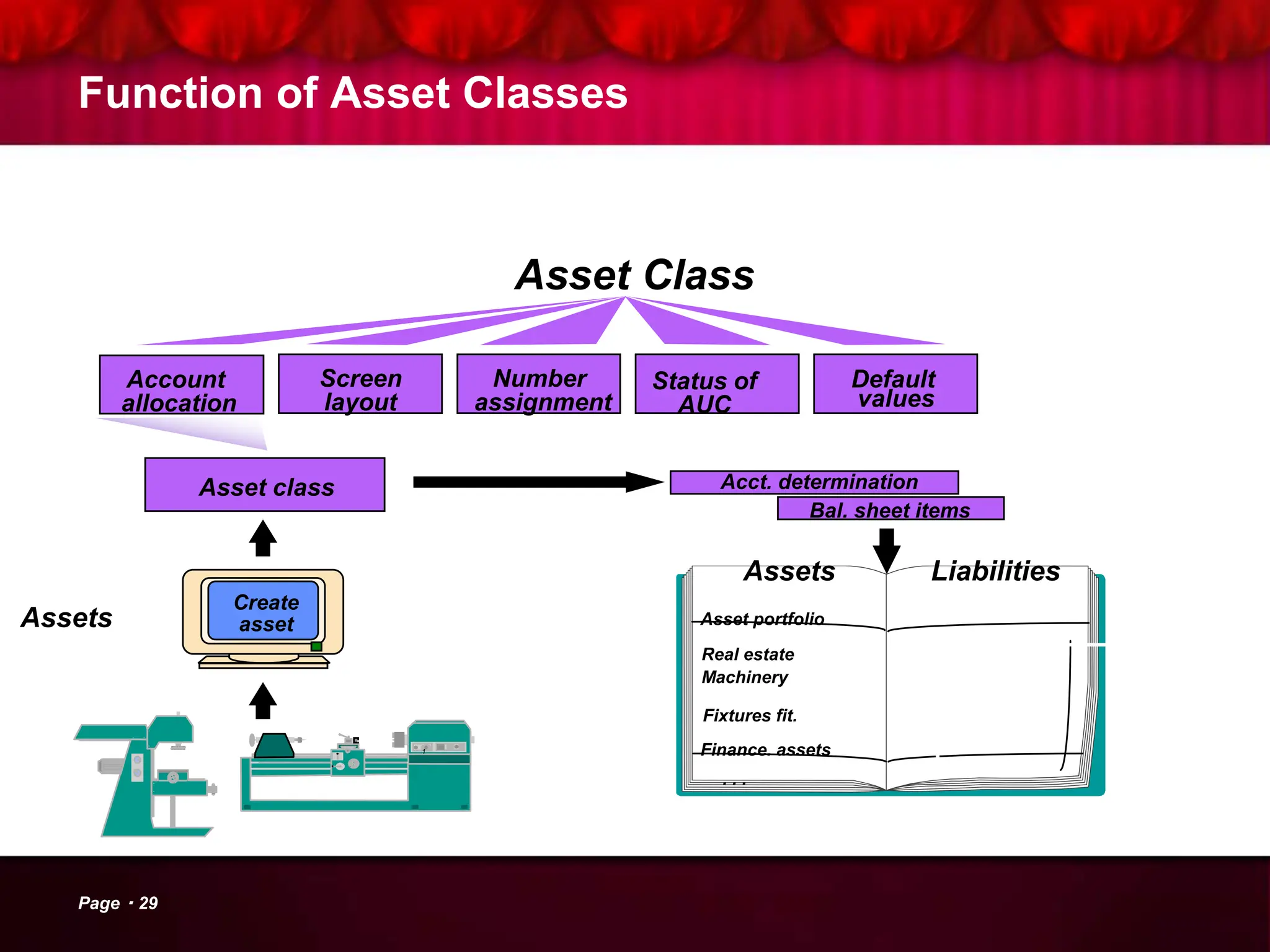
Asset Class
Account
allocation
Screen
layout
Number
assignment
Status of
AUC
Default
values
Assets Liabilities
Asset portfolio
Real estate
Machinery
Finance. assets
Fixtures fit.
. . .
Bal. sheet items
Acct. determination
Asset class
Create
asset
1
Assets
Page 29
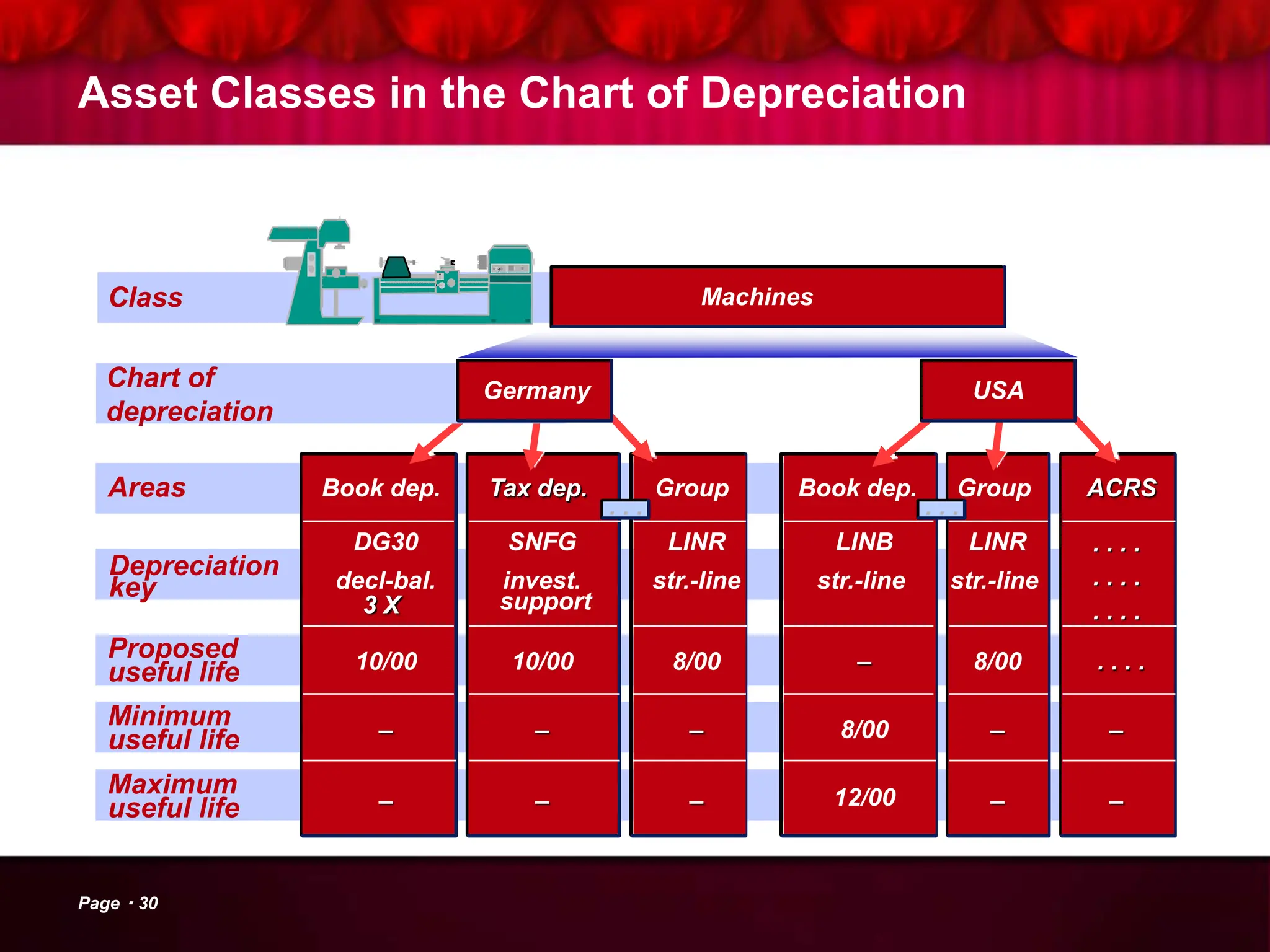
Asset Classes in the Chart of Depreciation
Areas
Depreciation
key
Proposed
useful life
Minimum
useful life
Maximum
useful life
Book dep.
10/00
_
_
DG30
decl-bal.
3 X
Tax dep.
10/00
_
_
SNFG
invest.
support
Group
8/00
_
_
LINR
str.-line
Book dep.
12/00
_
LINB
str.-line
Group
8/00
_
_
LINR
str.-line
ACRS
. . . .
_
_
. . . .
. . . .
. . . .
8/00
. . . . . .
Class
Chart of
depreciation
Machines
USA
Germany
1
Page 30
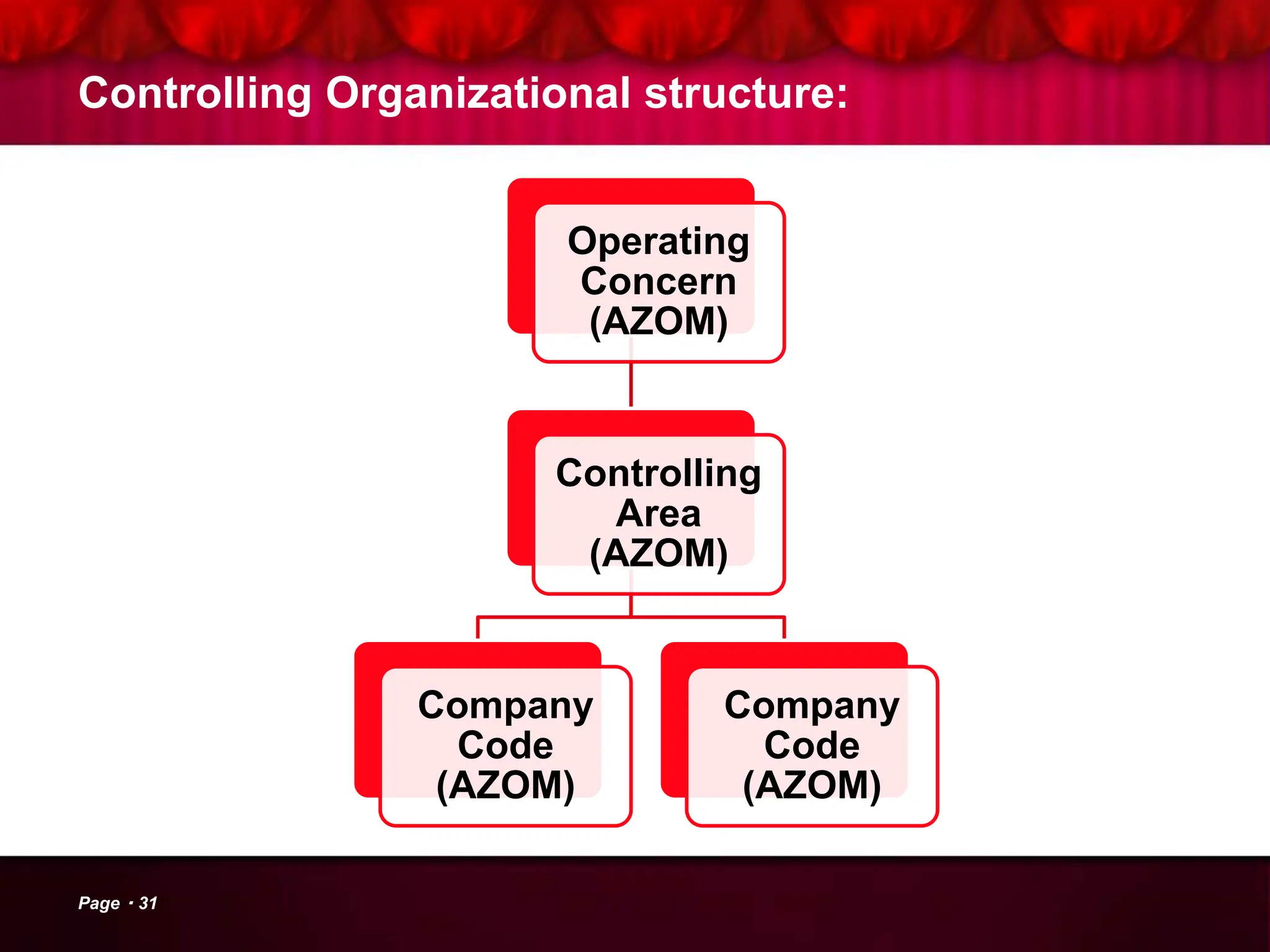
Controlling Organizational structure:
Operating
Concern
(AZOM)
Controlling
Area
(AZOM)
Company
Code
(AZOM)
Company
Code
(AZOM)
Page 31
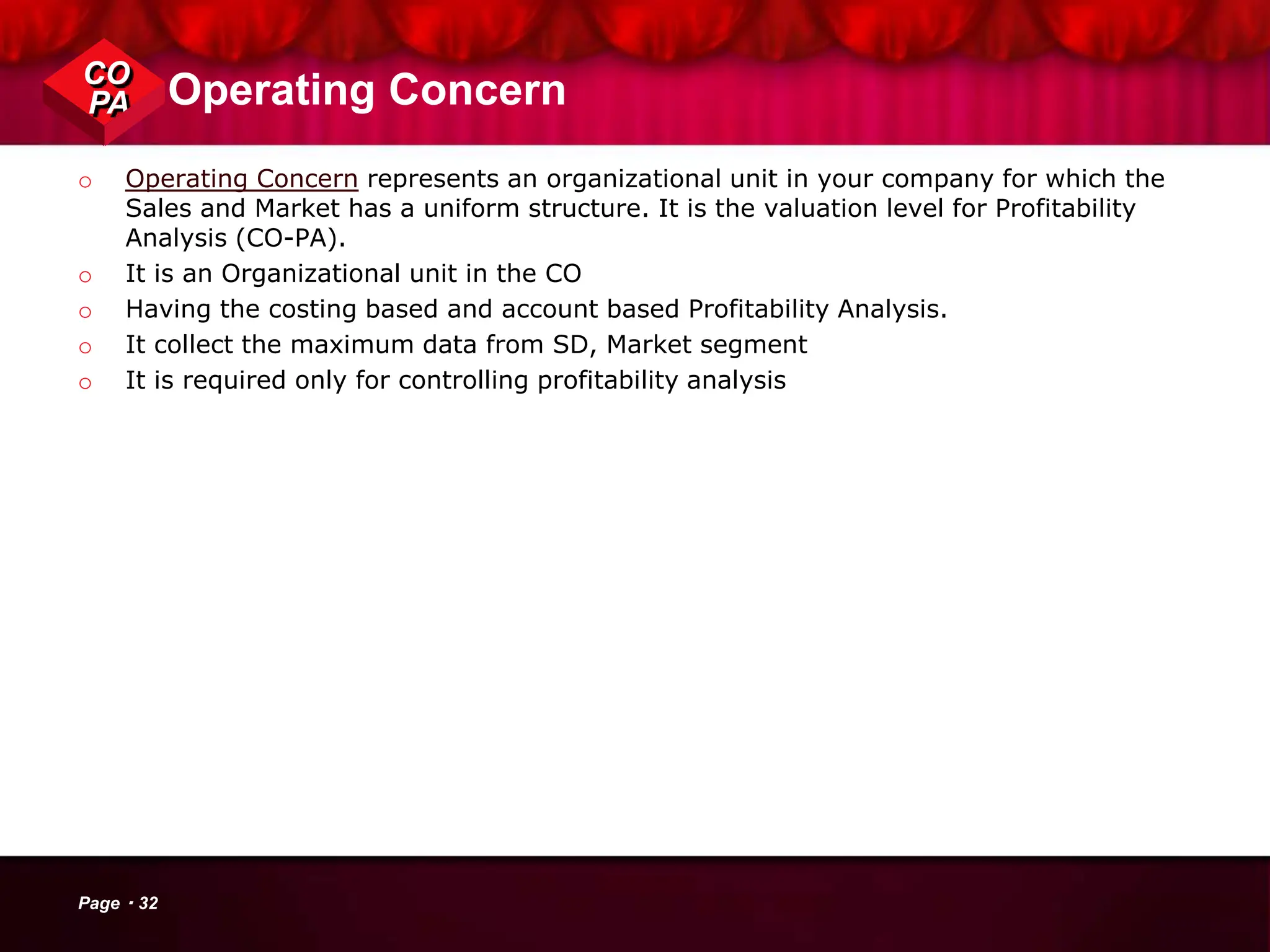
Operating Concern
o Operating Concern represents an organizational unit in your company for which the
Sales and Market has a uniform structure. It is the valuation level for Profitability
Analysis (CO-PA).
o It is an Organizational unit in the CO
o Having the costing based and account based Profitability Analysis.
o It collect the maximum data from SD, Market segment
o It is required only for controlling profitability analysis
CO
PA
Page 32
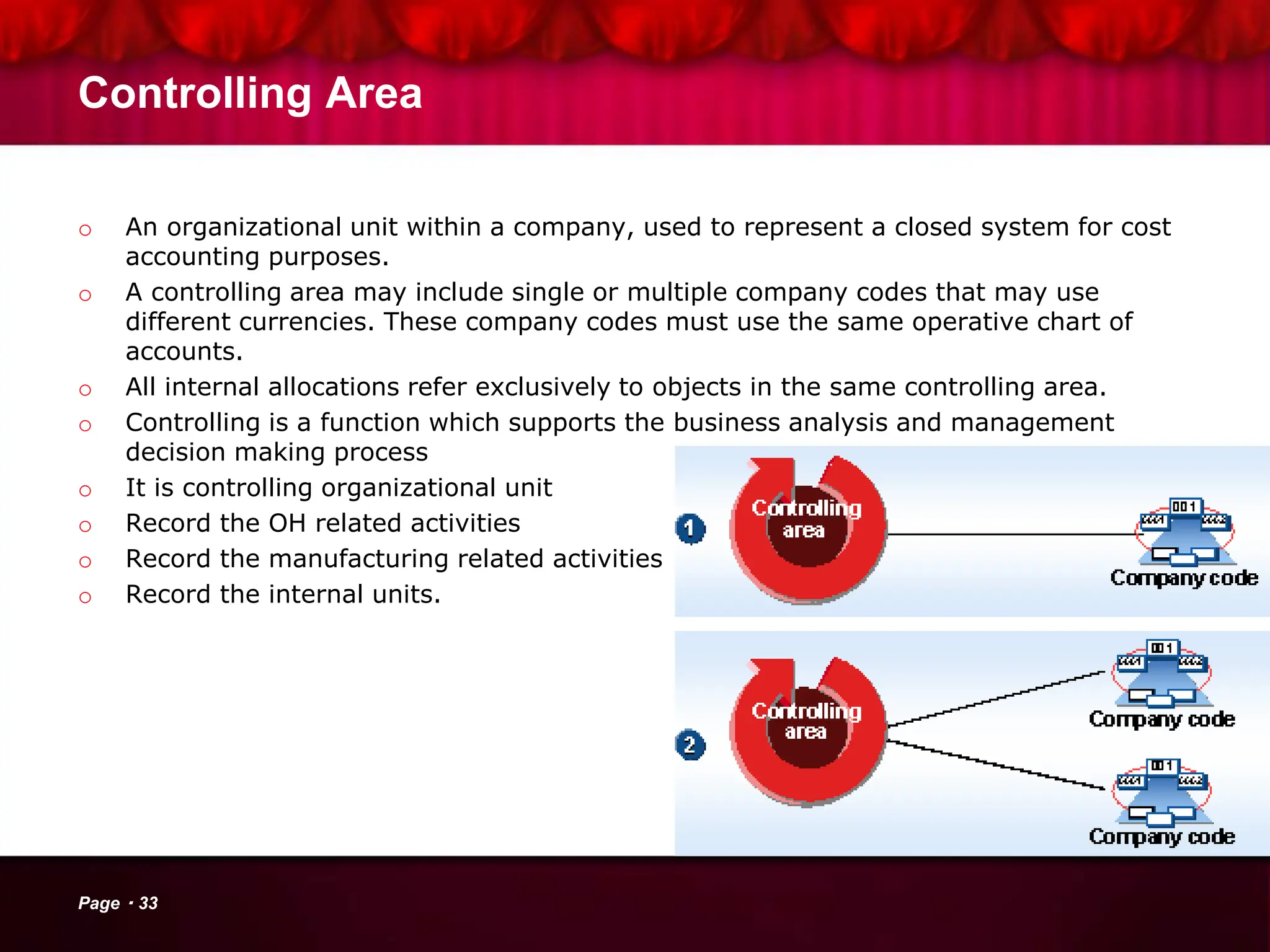
Controlling Area
o An organizational unit within a company, used to represent a closed system for cost
accounting purposes.
o A controlling area may include single or multiple company codes that may use
different currencies. These company codes must use the same operative chart of
accounts.
o All internal allocations refer exclusively to objects in the same controlling area.
o Controlling is a function which supports the business analysis and management
decision making process
o It is controlling organizational unit
o Record the OH related activities
o Record the manufacturing related activities
o Record the internal units.
Page 33
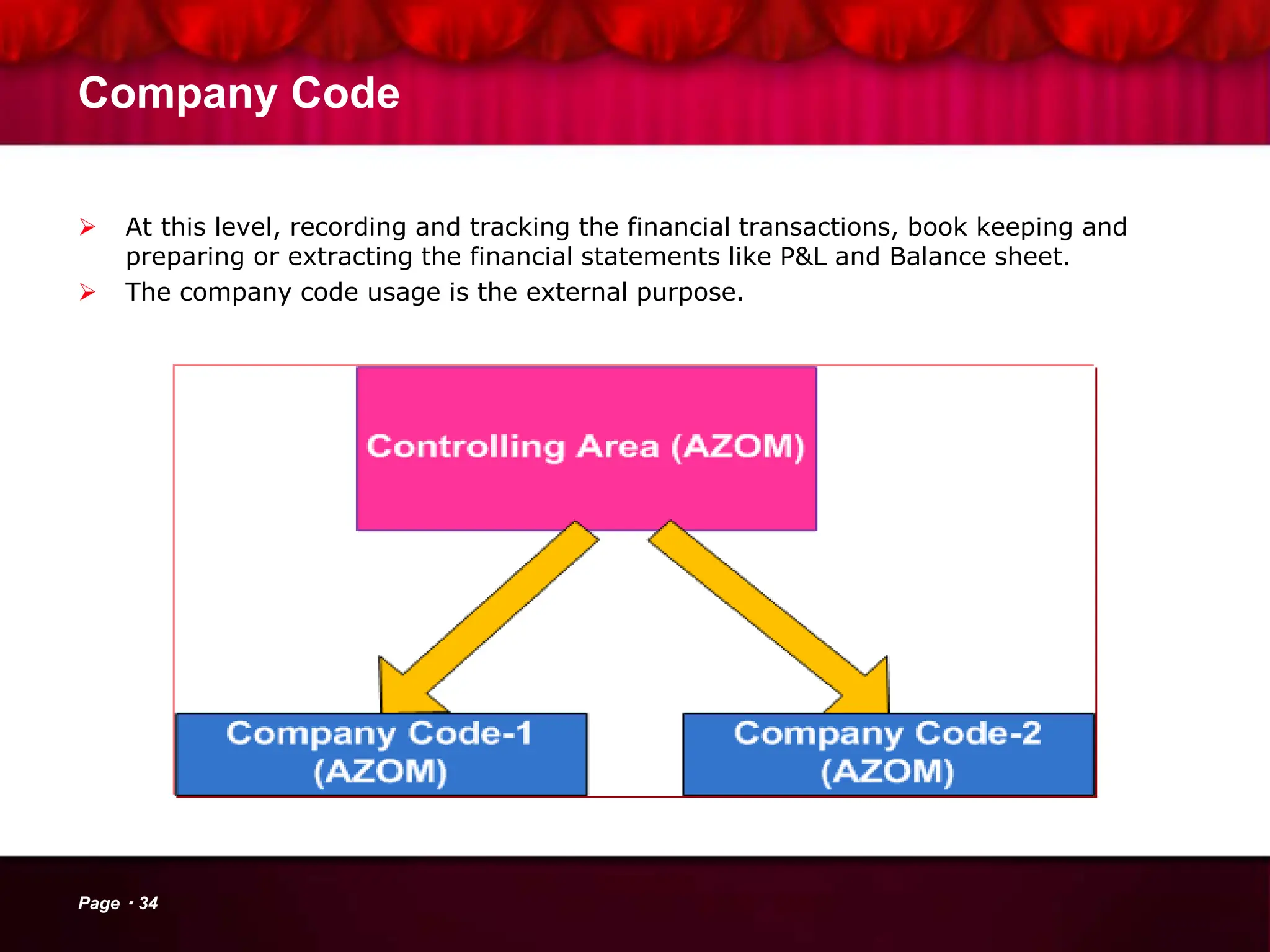
Company Code
 At this level, recording and tracking the financial transactions, book keeping and
preparing or extracting the financial statements like P&L and Balance sheet.
 The company code usage is the external purpose.
Page 34
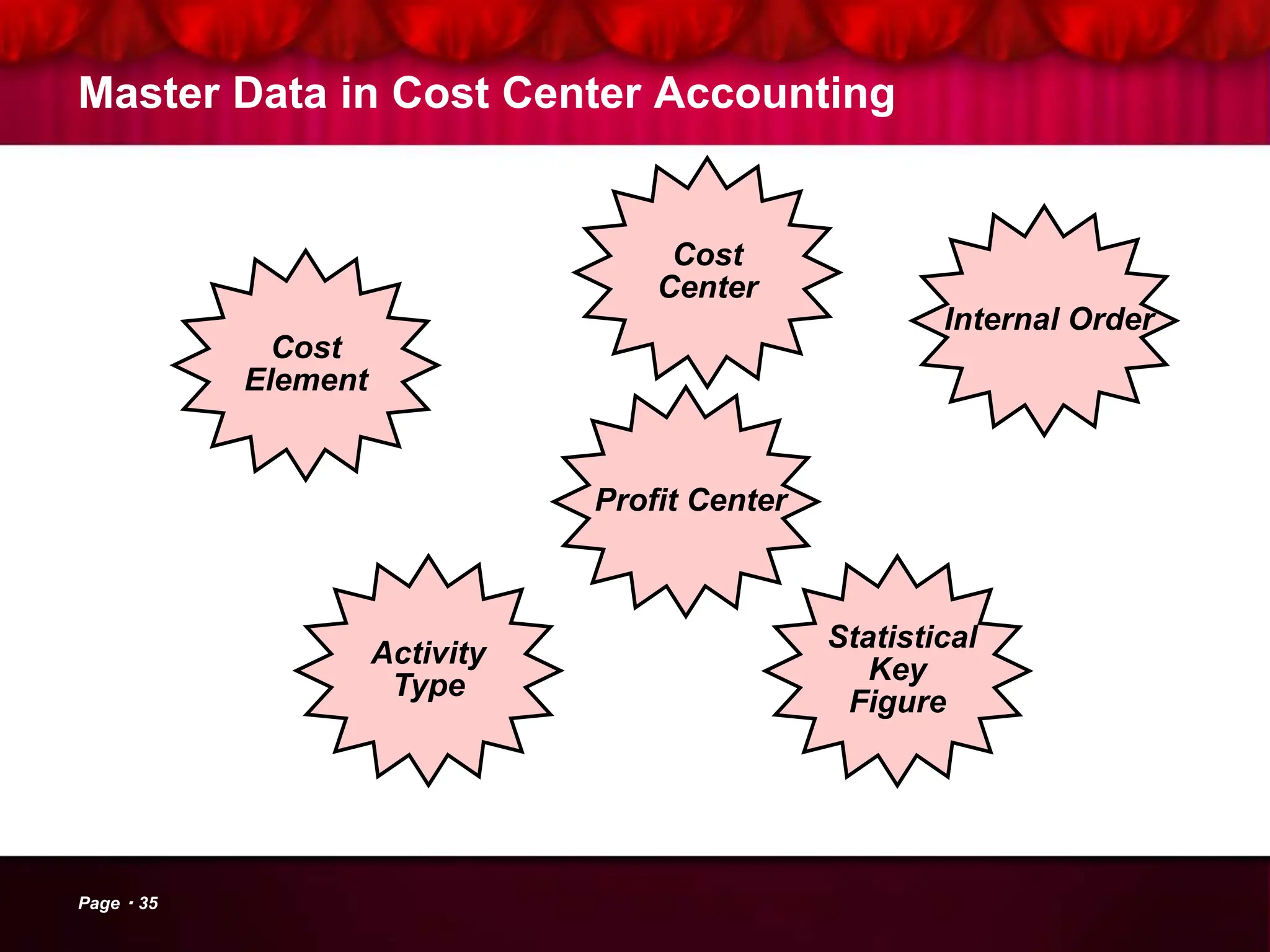
Master Data in Cost Center Accounting
Activity
Type
Statistical
Key
Figure
Cost
Center
Cost
Element
Page 35
Profit Center
Internal Order
Cost Element Accounting
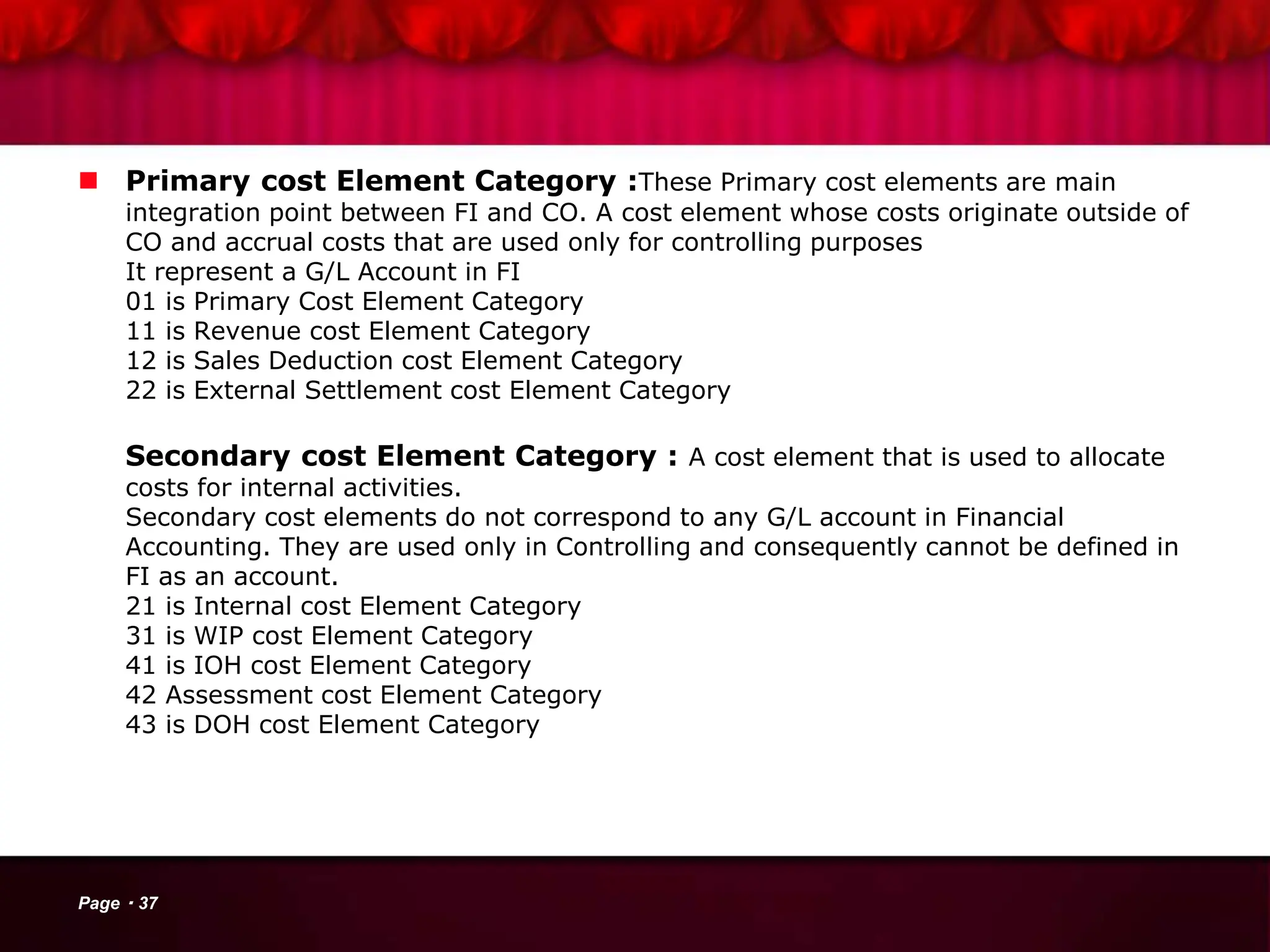
 A component of Controlling (CO) that collects and summarizes
postings that arise within CO in a reconciliation ledger.
 The Cost Element is divided in to Two types:
 Primary Cost elements
 Secondary Cost elements
CO
FI
G/L
Account
Primary
Cost
Element
Automatic
Interface
Page 36
 Primary cost Element Category :These Primary cost elements are main
integration point between FI and CO. A cost element whose costs originate outside of
CO and accrual costs that are used only for controlling purposes
It represent a G/L Account in FI
01 is Primary Cost Element Category
11 is Revenue cost Element Category
12 is Sales Deduction cost Element Category
22 is External Settlement cost Element Category
Secondary cost Element Category : A cost element that is used to allocate
costs for internal activities.
Secondary cost elements do not correspond to any G/L account in Financial
Accounting. They are used only in Controlling and consequently cannot be defined in
FI as an account.
21 is Internal cost Element Category
31 is WIP cost Element Category
41 is IOH cost Element Category
42 Assessment cost Element Category
43 is DOH cost Element Category
Page 37
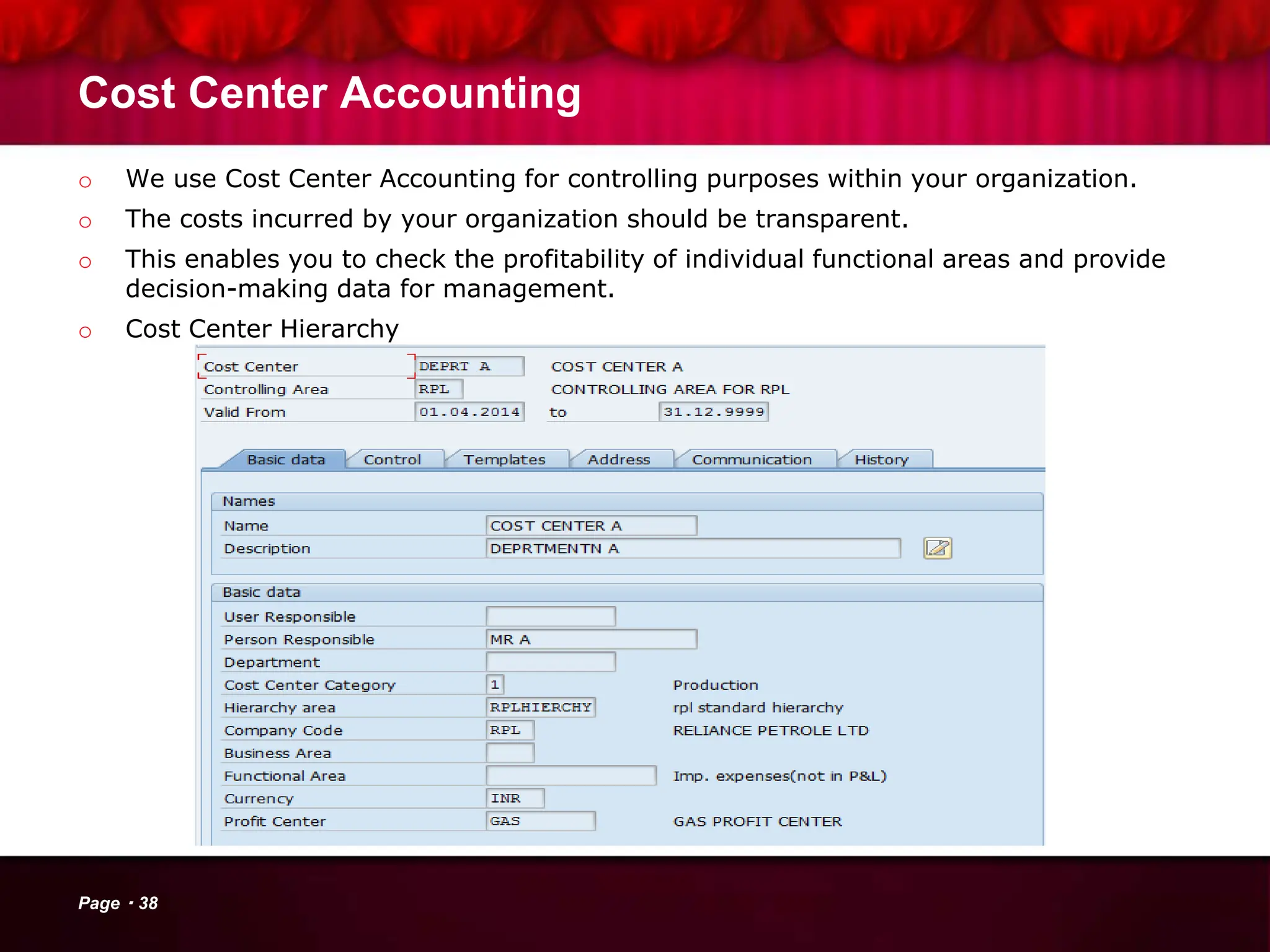
Cost Center Accounting
o We use Cost Center Accounting for controlling purposes within your organization.
o The costs incurred by your organization should be transparent.
o This enables you to check the profitability of individual functional areas and provide
decision-making data for management.
o Cost Center Hierarchy
Page 38
Cost Center Hierarchy
 Cost Centers are Structured into Organizational and/or Functional Hierarchical Groups .This is
known as the Cost Center Hierarchy.
 The Hierarchy created for Operational Management is called the Cost Center Standard Hierarchy
 Multiple Alternate Hierarchies can be created for Functional Management. These are simply
called Cost Center Groups
Page 39
Page 40
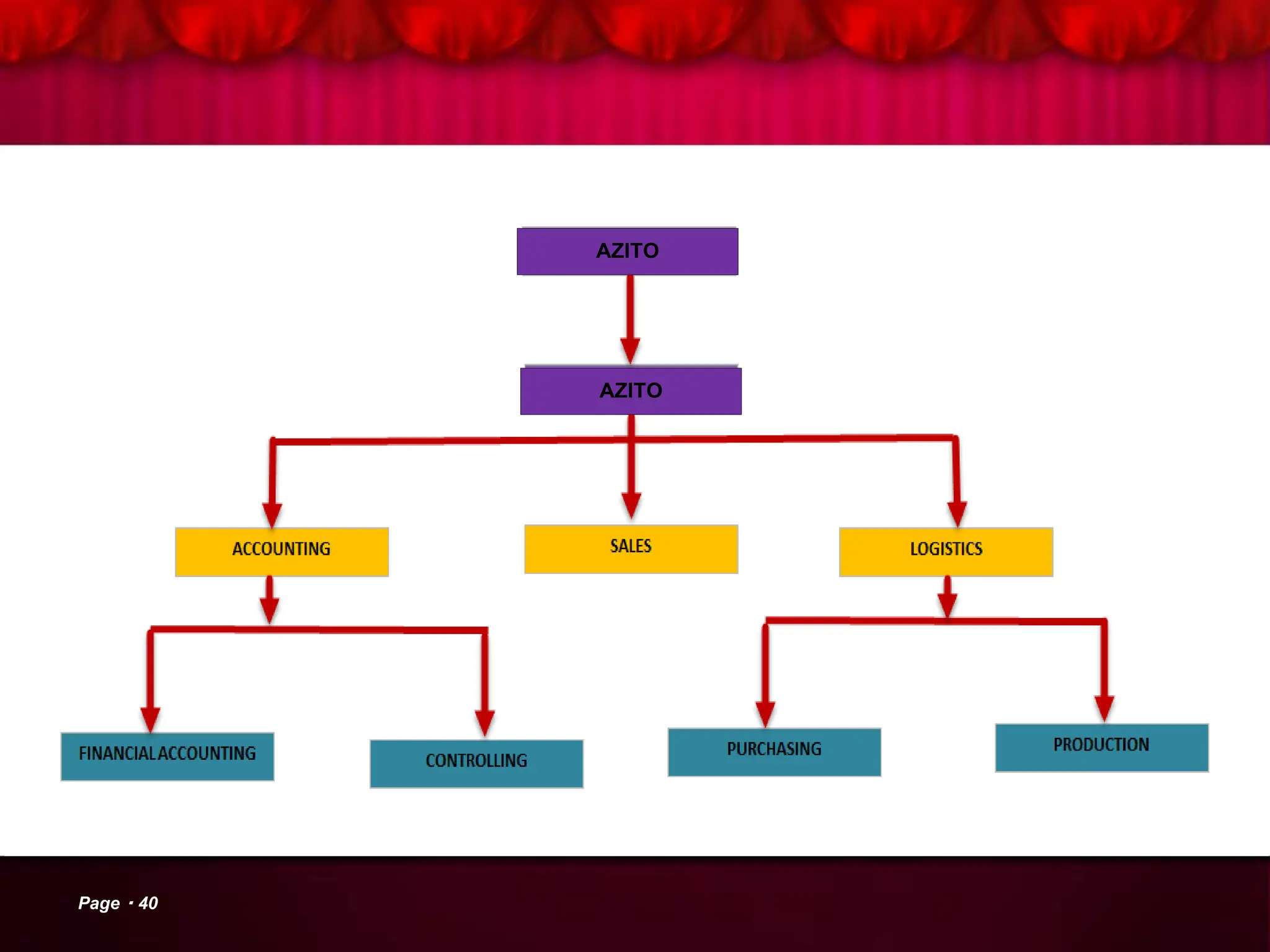
AZITO
AZITO
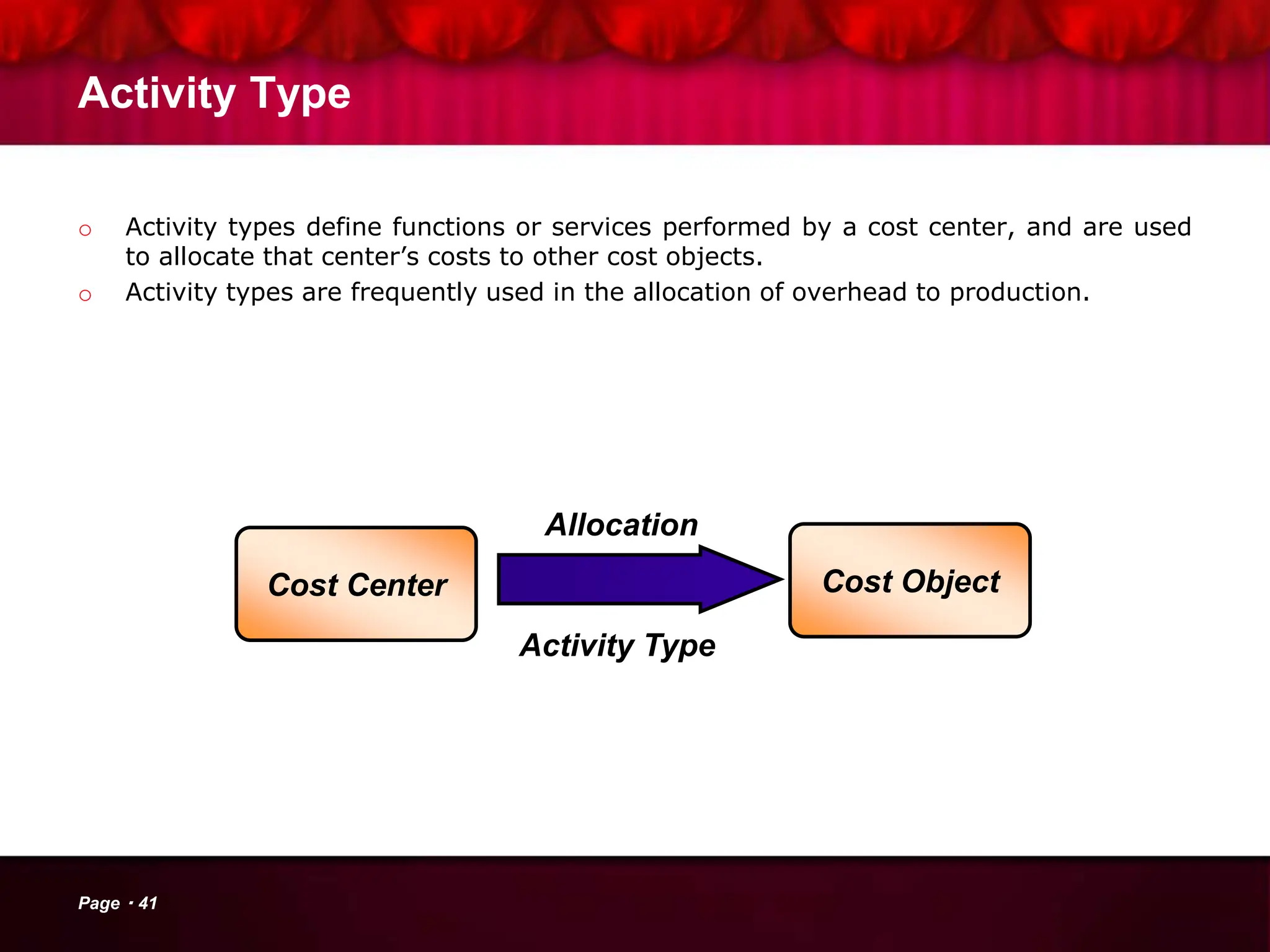
Activity Type
o Activity types define functions or services performed by a cost center, and are used
to allocate that center’s costs to other cost objects.
o Activity types are frequently used in the allocation of overhead to production.
Cost Center Cost Object
Allocation
Activity Type
Page 41
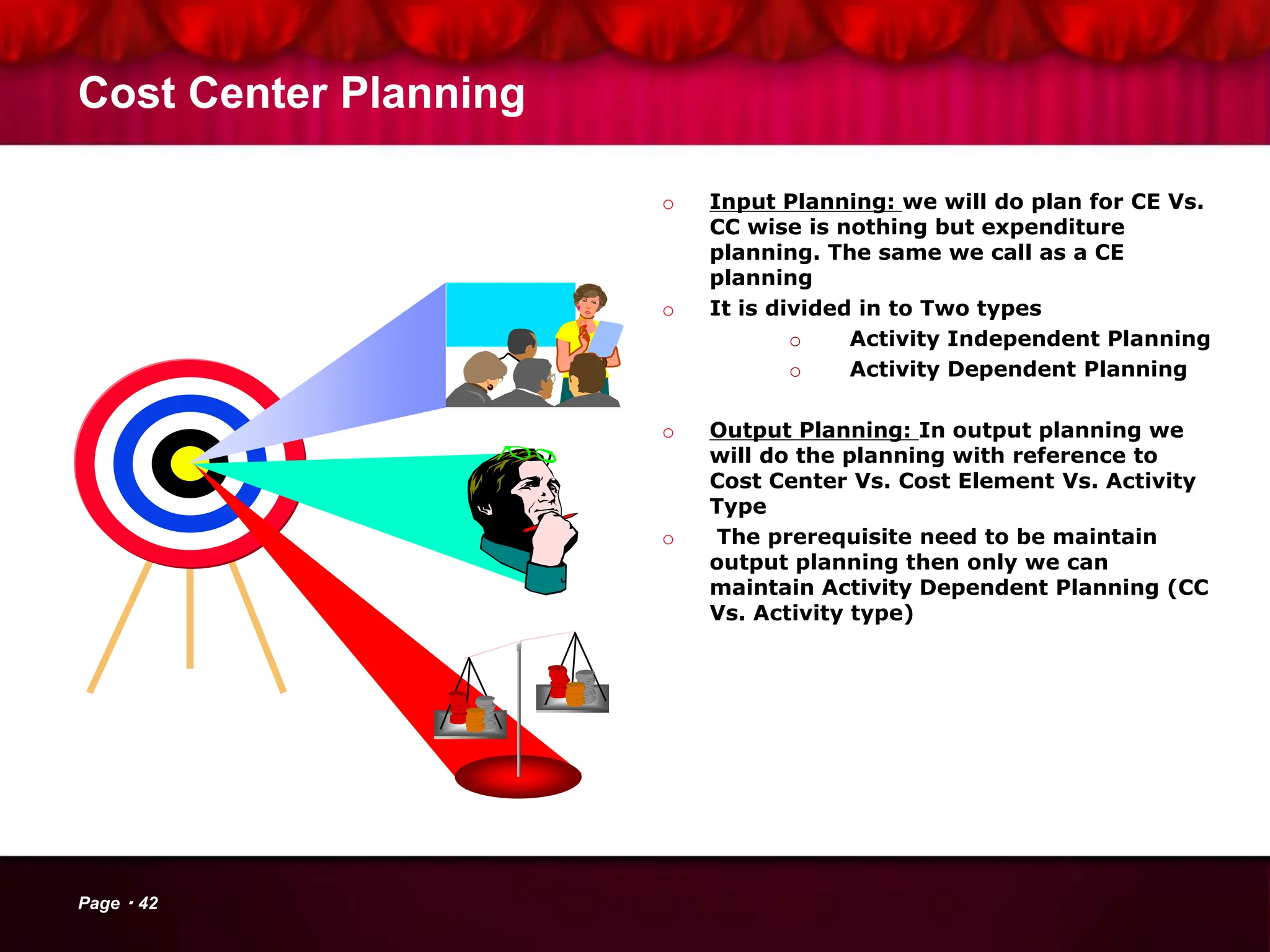
Cost Center Planning
o Input Planning: we will do plan for CE Vs.
CC wise is nothing but expenditure
planning. The same we call as a CE
planning
o It is divided in to Two types
o Activity Independent Planning
o Activity Dependent Planning
o Output Planning: In output planning we
will do the planning with reference to
Cost Center Vs. Cost Element Vs. Activity
Type
o The prerequisite need to be maintain
output planning then only we can
maintain Activity Dependent Planning (CC
Vs. Activity type)
Page 42
Internal Order (IO)
 Purpose:
o Internal orders are normally used to plan, collect, and settle the costs of internal
jobs and tasks. The SAP system enables you to monitor your internal orders
throughout their entire life-cycle; from initial creation, through the planning and
posting of all the actual costs, to the final settlement and archiving.
 Use:
o You can use master data to assign certain characteristics to your internal orders,
which enables you to control which business transactions can be used with the
internal order.
o Internal order planning enables you to roughly estimate the costs of a job before
the order starts and to make an exact calculation at a later date. You can choose
between various planning approaches to compare the effectiveness of different
methods. You can assign and manage budgets for internal orders.
o You apply the actual costs incurred by a job to your internal orders using actual
postings. In Financial Accounting, you can assign primary cost postings directly
to internal orders.
o In period-end closing you can use various different allocation methods (for
example, overhead costing) to allocate costs between different areas of Cost
Accounting.
o Order settlement enables you to transfer the costs incurred by an order to the
appropriate receivers.
Page 43
Internal Order Types:
 Two Types of Internal Order :
o Statistical Internal Order: It is only for reporting purpose , we
can't use for settlement.
o While posting any entry if we mention both Cost Center and Internal
Order system will check IO is real or statistical if IO is real system will
give priority to IO , If IO is statically Cost center is priority...
o Real Internal Order: If you want to settle any cost to different
object i.e. Cost Center, Internal Order, G/L, Asset etc... we use Real
order.
Page 44
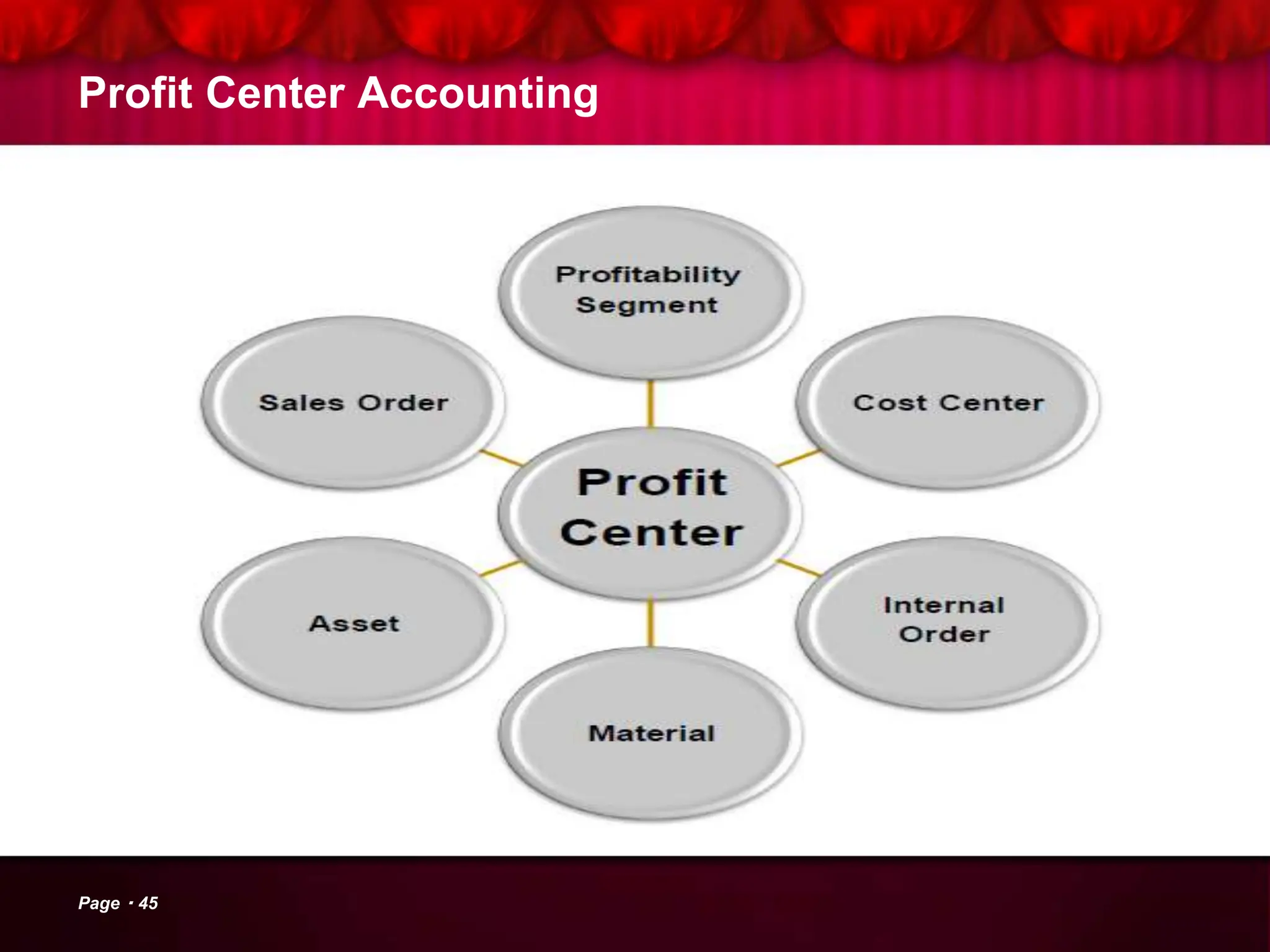
Profit Center Accounting
Page 45
Purpose of Profit Center Accounting
 A profit center is a management-oriented organizational unit used for internal
controlling purposes. Dividing your company up into profit centers allows you to
analyze areas of responsibility and to delegate responsibility to decentralized units,
thus treating them as “companies within the company”.
 The main aim of Profit Center Accounting is to determine profit for internal areas of
responsibility. It lets you determine profits and losses using either period accounting
or the cost-of-sales approach.
 Every profit center is assigned to the organizational unit Controlling area . The profit
centers in a company code belong to a standard profit center hierarchy that is also
assigned to the controlling area.
Page 46
Thank You
Page 47

SAP FICO SUB MODULE WISE PPT_14.10.2015(1).ppt

  • 1.
  • 2.
    Page 2 Financials vs.Controlling 1 2 3 Page 2
  • 3.
    SAP FICO CONTENT FINANCIAL ACCOUNTING BASIC SETTINGS: o Define company o Define Company code o Assign company code to company o Define Chart of accounts o Assign Chart of Accounts to Company code o Define Fiscal Year o Assign Company Code to Fiscal Year o Define Posting Period Variant o Assign posting period to company code o Define posting period o Open and close posting periods Page 3
  • 4.
    SAP FI (Submodules overview) Page 4
  • 5.
    SAP FI GeneralLedger Accounting  Purpose: o The main task of G/L accounting is the overall presentation of Financial Accounting. The general ledger is the complete record of all business transactions. o This scenario describes the process by which you define the G/L accounts and plan your general ledger. It also describes the postings you make in the general ledger. o Integrated with other application modules and FI sub-modules o Financial Data Entry o User-defined balance sheet / profit and loss statement versions o Multiple Currencies Page 5
  • 6.
  • 7.
    Master Data  AccountGroups: o The account group determines the number interval from which the account number is selected when a G/L account is created. o The screen layout for creating G/L accounts in the company code-specific area  Maintenance:  Creation at 2 levels: o Chart of accounts data o Company code data  Change  Block  Delete  Cost Elements o Creation Page 7
  • 8.
  • 9.
    SAP FI AccountsPayables  Purpose: o Accounts payable departments often do more than simply pay incoming bills and invoices. o Real-time integration with General Ledger o Integration with Materials Management as a part of the Procurement Cycle o Outgoing Payment Program o Vendor Correspondence  In Accounts Payables having: o Master Data o Transactional Data (Invoice, Credit note, Payments etc..) o Reporting Page 9
  • 10.
    Structure of thevendor master record o Key terms for vendor master record consist of: o General Data: Is data that applies to all company codes such as vendor address and telephone numbers o Company code data/accounting data: Is information specific to accounting such as payment transaction data and the number of reconciliation account o Purchasing data: Is information relevant to purchasing, such as contact parsons and terms of delivery o Account Groups controls: • The screen layout which is the field that must be populated and the fields that are optional • Automatic generation of vendor numbers Page 10
  • 11.
  • 12.
    Accounts Payables ConfigurationSteps: o Define Account Groups with Screen Layout (Vendors) o Create Number Ranges for Vendor Accounts o Assign Number Ranges to Vendor Account Groups o Creation of GL Reconciliation Accounts (Sundry Creditors) o Define Tolerances (Vendors) o Document Types and Number Ranges - OBA7 o Creation of Vendor Master - XK01 o House Bank Page 12
  • 13.
    SAP FI-MM Flow: oFI-MM Means the financial impact arising out of relevant to the inventory movements are automatically update in the financial accounting o Material requisition :the production department will send the material requisition to the stores department then o Purchase Requisition :The stores department will send the purchase requisition to the Purchase department then o Comparative Statement : the purchase department will do the call for enquiries and they will get the quotations and they will do the price comparisons o Raise PO by Purchase Department: Purchase order consisting of Vendor no., Material No., Quantity, Rate, Delivery Terms, Payment Terms etc.. o FI-MM Integration Rule is : o In the Material Master we will specify the Valuation Class o For Valuation class we will assign GL Accounts based on the nature of transaction. o At the time of material receipt or issue the stores department person will enter the material number, Qty, and Movement Type and then accounts will be updated automatically, based on accounts assignment to valuation class, which is specified in material master. Page 13
  • 14.
    Procure to PayCycle Page 14
  • 15.
    SAP FI AccountsReceivable o The Accounts Receivable application component records and manages accounting data of all customers. It is also an integral part of sales management. o All postings in Accounts Receivable are also recorded directly in the General Ledger. Different G/L accounts are updated depending on the transaction involved (for example, receivables, down payments, and bills of exchange). o The system can use to monitor for open items, such as account analyses, alarm reports, due date lists, and a flexible dunning program. Page 15
  • 16.
    Structure of theCustomer master record Page 16
  • 17.
     General data: oIt does not depend on the company code or the sales and distribution organization o Applies to one business partner for all company codes and in all sales areas and includes o Company names o Address o Telephone numbers o Data that is unique to a customer and shared by all departments  Company code data: o It is only applies to one company code (Legal business) this data only relevant for financial accounting o If you edit master record you must specify the customer number and company code to access the screens containing company code data o You can only invoice payer (partner function) if you have entered data in financial accounting view. Page 17
  • 18.
     Sales anddistribution data: o The data for one customer can differ for each sales area. The sales area is a combination of sales organization, distribution channel and division. Some data is only relevant to sales and distribution and includes: o Pricing data o Delivery priority o Shipping priority o If you edit customer record you must enter the customer number and sales area in order to access screens contains the sales and distribution data o You can only process the sales and distribution transitions, e.g.: a sales order after entering the sales and distribution data for a customer Page 18
  • 19.
    Master data: PartnerFunctions Page 19
  • 20.
    Master Data: AccountGroups Page 20
  • 21.
  • 22.
    Accounts Receivable ConfigurationSteps o Define Account Groups with Screen Layout (Customers) o Create Number Ranges for Customer Accounts o Assign Number Ranges to Customer Account Groups o Creation of GL Reconciliation Accounts (Sundry Debtors) o Creation of Customer Master - XD01 o Document and Number Ranges - OBA7 o Bill of Exchange & Dunning Page 22
  • 23.
    Order to CashCycle Page 23
  • 24.
    Fixed Assets -Asset Accounting (FI-AA) o AA Overview: o Asset Class o Chart of Depreciation o Master Data o Create/Change Asset Master Record o Acquisitions o Settlement of an Asset Under Construction (AUC) o Retirement o Depreciation o Transfers o Period / Year End Closing o Reporting Page 24
  • 25.
    Asset Accounting ConfigurationSteps o Copy Reference Chart Of Depreciation/Depreciation Area - Ec08 o Assign Chart of depreciation to company code - OAOB o Specify Account Determination – o Create Screen layout rules – o Define no. range intervals - AS08 o Asset Class - OAOA o Define screen layout for Asset Master – o Define screen layout for Asset Depreciation – o Determine Depreciation Area in the Asset Class - OAYZ o Creation of GL Accounts for business transactions wise o Assignment of Account for Automatic posting - AO90 o Specific Document type for posting of Depreciation - OBA7 o Specify Intervals and Posting rules – o Maintain period control method -AFAMP o Creation of asset master - AS01 Page 25
  • 26.
  • 27.
    Account Determination  Usingthe FI-AA component, you can automatically update all relevant transactions to the general ledger. These include all accounting transactions that are posted to assets, and all changes to asset values that are automatically calculated by the system (particularly depreciation). This update takes place immediately online for one depreciation area, or as part of periodic processing for all other depreciation areas. Page 27
  • 28.
    Asset Classes o Theasset class contains default values and control elements which are passed on to the individual assets when you open a new asset master record. o By entering useful default values, you reduce time and effort needed for creating new asset master records. You also ensure that the records in a given class are handled uniformly. o The asset class is the most important criteria for structuring fixed assets from an accounting point of view. Every asset has to be assigned to exactly one asset class. The asset class is used to assign the assets (and their business transactions) to the correct general ledger accounts. The most important tasks of the asset classes are: o The asset class is used to: o sub-classify the General ledger accounts and o group master records by specific criteria. o Asset Classes configured:  910000 Land  910001 Building  910002 Plant and Machinery  910003 Vehicles  910004 Asset under construction Page 28
  • 29.
    Function of AssetClasses Asset Class Account allocation Screen layout Number assignment Status of AUC Default values Assets Liabilities Asset portfolio Real estate Machinery Finance. assets Fixtures fit. . . . Bal. sheet items Acct. determination Asset class Create asset 1 Assets Page 29
  • 30.
    Asset Classes inthe Chart of Depreciation Areas Depreciation key Proposed useful life Minimum useful life Maximum useful life Book dep. 10/00 _ _ DG30 decl-bal. 3 X Tax dep. 10/00 _ _ SNFG invest. support Group 8/00 _ _ LINR str.-line Book dep. 12/00 _ LINB str.-line Group 8/00 _ _ LINR str.-line ACRS . . . . _ _ . . . . . . . . . . . . 8/00 . . . . . . Class Chart of depreciation Machines USA Germany 1 Page 30
  • 31.
  • 32.
    Operating Concern o OperatingConcern represents an organizational unit in your company for which the Sales and Market has a uniform structure. It is the valuation level for Profitability Analysis (CO-PA). o It is an Organizational unit in the CO o Having the costing based and account based Profitability Analysis. o It collect the maximum data from SD, Market segment o It is required only for controlling profitability analysis CO PA Page 32
  • 33.
    Controlling Area o Anorganizational unit within a company, used to represent a closed system for cost accounting purposes. o A controlling area may include single or multiple company codes that may use different currencies. These company codes must use the same operative chart of accounts. o All internal allocations refer exclusively to objects in the same controlling area. o Controlling is a function which supports the business analysis and management decision making process o It is controlling organizational unit o Record the OH related activities o Record the manufacturing related activities o Record the internal units. Page 33
  • 34.
    Company Code  Atthis level, recording and tracking the financial transactions, book keeping and preparing or extracting the financial statements like P&L and Balance sheet.  The company code usage is the external purpose. Page 34
  • 35.
    Master Data inCost Center Accounting Activity Type Statistical Key Figure Cost Center Cost Element Page 35 Profit Center Internal Order
  • 36.
    Cost Element Accounting A component of Controlling (CO) that collects and summarizes postings that arise within CO in a reconciliation ledger.  The Cost Element is divided in to Two types:  Primary Cost elements  Secondary Cost elements CO FI G/L Account Primary Cost Element Automatic Interface Page 36
  • 37.
     Primary costElement Category :These Primary cost elements are main integration point between FI and CO. A cost element whose costs originate outside of CO and accrual costs that are used only for controlling purposes It represent a G/L Account in FI 01 is Primary Cost Element Category 11 is Revenue cost Element Category 12 is Sales Deduction cost Element Category 22 is External Settlement cost Element Category Secondary cost Element Category : A cost element that is used to allocate costs for internal activities. Secondary cost elements do not correspond to any G/L account in Financial Accounting. They are used only in Controlling and consequently cannot be defined in FI as an account. 21 is Internal cost Element Category 31 is WIP cost Element Category 41 is IOH cost Element Category 42 Assessment cost Element Category 43 is DOH cost Element Category Page 37
  • 38.
    Cost Center Accounting oWe use Cost Center Accounting for controlling purposes within your organization. o The costs incurred by your organization should be transparent. o This enables you to check the profitability of individual functional areas and provide decision-making data for management. o Cost Center Hierarchy Page 38
  • 39.
    Cost Center Hierarchy Cost Centers are Structured into Organizational and/or Functional Hierarchical Groups .This is known as the Cost Center Hierarchy.  The Hierarchy created for Operational Management is called the Cost Center Standard Hierarchy  Multiple Alternate Hierarchies can be created for Functional Management. These are simply called Cost Center Groups Page 39
  • 40.
  • 41.
    Activity Type o Activitytypes define functions or services performed by a cost center, and are used to allocate that center’s costs to other cost objects. o Activity types are frequently used in the allocation of overhead to production. Cost Center Cost Object Allocation Activity Type Page 41
  • 42.
    Cost Center Planning oInput Planning: we will do plan for CE Vs. CC wise is nothing but expenditure planning. The same we call as a CE planning o It is divided in to Two types o Activity Independent Planning o Activity Dependent Planning o Output Planning: In output planning we will do the planning with reference to Cost Center Vs. Cost Element Vs. Activity Type o The prerequisite need to be maintain output planning then only we can maintain Activity Dependent Planning (CC Vs. Activity type) Page 42
  • 43.
    Internal Order (IO) Purpose: o Internal orders are normally used to plan, collect, and settle the costs of internal jobs and tasks. The SAP system enables you to monitor your internal orders throughout their entire life-cycle; from initial creation, through the planning and posting of all the actual costs, to the final settlement and archiving.  Use: o You can use master data to assign certain characteristics to your internal orders, which enables you to control which business transactions can be used with the internal order. o Internal order planning enables you to roughly estimate the costs of a job before the order starts and to make an exact calculation at a later date. You can choose between various planning approaches to compare the effectiveness of different methods. You can assign and manage budgets for internal orders. o You apply the actual costs incurred by a job to your internal orders using actual postings. In Financial Accounting, you can assign primary cost postings directly to internal orders. o In period-end closing you can use various different allocation methods (for example, overhead costing) to allocate costs between different areas of Cost Accounting. o Order settlement enables you to transfer the costs incurred by an order to the appropriate receivers. Page 43
  • 44.
    Internal Order Types: Two Types of Internal Order : o Statistical Internal Order: It is only for reporting purpose , we can't use for settlement. o While posting any entry if we mention both Cost Center and Internal Order system will check IO is real or statistical if IO is real system will give priority to IO , If IO is statically Cost center is priority... o Real Internal Order: If you want to settle any cost to different object i.e. Cost Center, Internal Order, G/L, Asset etc... we use Real order. Page 44
  • 45.
  • 46.
    Purpose of ProfitCenter Accounting  A profit center is a management-oriented organizational unit used for internal controlling purposes. Dividing your company up into profit centers allows you to analyze areas of responsibility and to delegate responsibility to decentralized units, thus treating them as “companies within the company”.  The main aim of Profit Center Accounting is to determine profit for internal areas of responsibility. It lets you determine profits and losses using either period accounting or the cost-of-sales approach.  Every profit center is assigned to the organizational unit Controlling area . The profit centers in a company code belong to a standard profit center hierarchy that is also assigned to the controlling area. Page 46
  • 47.

Editor's Notes

  • #11 All postings in FI-AP are also recorded simultaneously in FI-GL. The components of FI-AP are closely integrated with components of MM which, when properly configured, support an automated Procurement Cycle. The sub-module contains the following features: A reporting function to monitor vendor activity An Outgoing Payment program which supports all the standard Payment Methods (including checks and wire transfers) in printed form as well as in electronic form (data medium exchange on diskette and data transmission) Balance confirmations, account statements and other forms of correspondence with vendors to support business requirements
  • #30 The asset class contains default values and control elements which are passed on to the individual assets when you open a new asset master record. By entering useful default values, you reduce time and effort needed for creating new asset master records. You also ensure that the records in a given class are handled uniformly.
  • #31 You can define any number of asset classes in Customizing. You use the asset classes to categorize assets according to the needs of your enterprise. The asset classes are valid across company codes. The catalog of asset classes, therefore, applies uniformly to all company codes. This is true, even if the company codes use different charts of depreciation, and therefore different depreciation areas You can assign different charts of depreciation to an asset class, so that all assets in this class will be treated differently in each country.