Clinical Problem Solving  FEVERS   and Rheumatic Diseases
Introduction  Pyrexia  alone as a clinical presentation of rheumatic diseases - PUO differential diagnosis The investigation and differential diagnosis of fever presenting with  musculoskeletal  symptoms or signs MSc relevance -  Clinical practice  and  problem solving
Agenda Fever  -  Aetiopathogenesis Fever   - Periodicity and rheumatic disease: Childhood fevers   Fever  - PUO and the rheumatic diseases Fever   - and vasculitis - A simplified Guide to Investigation
Agenda Fever  -  Aetiopathogenesis Fever  - PUO and the rheumatic diseases  Fever   - Periodicity and rheumatic disease: Childhood fevers   Fever   - and vasculitis - A simplified Guide to Investigation
FEVER Hypothalamic control Cooling   - accelerated activity of skeletal muscle / Reduction of peripheral blood flow Heat  - Reduced muscle activity / Peripheral vasodilation and sweating  Endogenous Pyrogens  PMN / Macrophages but not lymphocytes :TNF / INF alpha / IL1 / IL6 found in many rheumatic diseases Exogenous pyrogens  Bacterial cell wall, LPS, drugs
LIPOPOLYSACCHARIDE Endotoxin on surface of bacterial cell wall Lipid A as active component “ Shock toxin”: Hypotension, peripheral shutdown Leucopaenia Activation of kinins and complement cascade Activation of macrophages and monocytes Inhibition of macrophage migration Inhibition of PMNs Vascular leakage and inflammation
Agenda Fever  - aetiopathogenesis Fever  -  PUO and the rheumatic diseases  Fever   - Periodicity and rheumatic disease: Childhood fevers   Fever   - and vasculitis - A simplified Guide to Investigation
Fever  as a symptom Pyrexia Joint and back pain Myalgia Weight loss Normochromic normocytic anaemia  Skin rash Lympadenopathy
PUO Prolonged obscure fever > 3 weeks  usually represents an atypical presentation of a well-known condition Pattern and periodicity rarely aid diagnosis Aggressive diagnostic efforts are usually justified - treatment
PUO  without localising signs INFECTION NEOPLASIA IMMUNOGENIC INFLAMMATION
PUO - Don’t Forget... Factitious Drug induced (anti-TB,cyclophosphamide) Recurrent PEs Chronic granulomatous hepatitis Sarcoidosis Occult bowel inflammation
PUO without localising signs-  Infection Viral longterm infection: EBV CMV  Chronic Pyogens and Granulomatous triggers :  TB Fungi (Candidiasis, histoplasma, actinomyces, coccidioidomycosis) Tropical diseases and parasites (Malaria, Toxoplasmosis etc etc)
PUO with rheumatological signs -  Infection JOINTS  -  Septic arthritis: Septic bursitis.  Aspirate and Culture for; Bacteria Fungi Parasites BONES  -  Osteomyelitis acute or chronic.  Culture and biopsy with stains  for; Bacteria including TB Fungi Parasites especially in HIV
PUO  - “Arthritogenic” Bacteria with few localising signs TB  Salmonella Brucella
Bacterial Endocarditis Systemic vasculitis Mimic of immunogenic disease Complement consumption and elevated ESR CRP Urinary RBC Disclosed by positive blood cultures except with difficult germs (Q fever, aspergillus)
BACTERIAL ENDOCARDITIS and Rheumatic Disease Infectious endocarditis has a higher incidence in SLE (?infected Libmann-Sachs) ? Antibiotic prophylaxis of SLE patients pre-surgery Endocarditis in patients with RA and AS with aortic involvement
Fever , Infection and Rheumatic disease - ? A sterile joint Viral septic arthritis (hepatitis B, AIDs)and reactive arthritis (parvovirus, measles etc) Reiter’s Syndrome (sexually transmitted and GI infection) Lyme disease Venereal diseases (Syphilis, GC) Mycoplasma Fungal and protozoal (joint and bone )
Back Pain and  fever Fever as an alert sign with back pain X RAY:FBC:CULTURE:SCAN:BIOPSY SPINAL  - Infected disc and vertebral lesions:  TB 40%: Gram neg 20%: Staph 20%:Strep 20%. PARASPINAL  - Psoas abscesses usually secondary to vertebral OM
PUO  with arthralgia, myalgia and vasculitis-  Neoplasia Lymphoma - endogenous pyrogens from Hodgkins LNs Leukaemia - Usually due to infections Solid Tumours - Hypernephroma, Pancreatic carcinoma, GI carcinoma (tissue necrosis and release of LPS)
PUO -  Immunogenic Rheumatic fever RA - Adult Stills SLE Systemic Vasculitides JIA GCA - 15% PUO >65 years
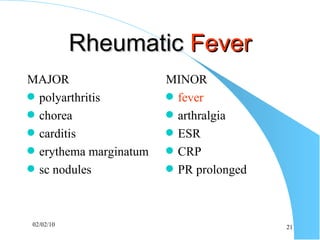
Rheumatic  Fever MAJOR polyarthritis chorea carditis erythema marginatum sc nodules MINOR fever arthralgia ESR CRP PR prolonged
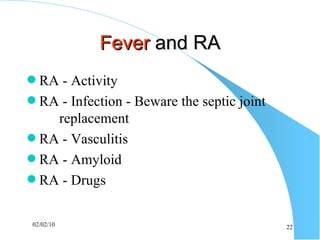
Fever  and RA RA - Activity RA - Infection - Beware the septic joint  replacement RA - Vasculitis RA - Amyloid RA - Drugs
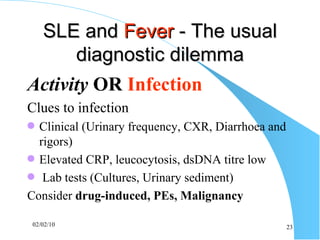
SLE and  Fever  - The usual diagnostic dilemma Activity  OR  Infection  Clues to infection  Clinical (Urinary frequency, CXR, Diarrhoea  and rigors) Elevated CRP, leucocytosis,  dsDNA titre low Lab tests (Cultures, Urinary sediment) Consider  drug-induced, PEs, Malignancy
Agenda Fever  - aetiopathogenesis Fever  - PUO and the rheumatic diseases Fever   -  Periodicity and rheumatic disease: Childhood fevers   Fever   - and vasculitis - A simplified Guide to Investigation
Childhood  fevers  and Arthritis Infection:  Viruses and Streptococci Post-Viral reactive arthritis Post - Viral vasculitic syndromes JIA and Stills disease
Familial Mediterranean  Fever Genetic: autosomal recessive Sephardic jews and ethnic Armenians: Short arm of chromosome 16 Childhood or early adolescence Brief high fevers at irregular intervals Peritonitis, arthritis and pleuritis Amyloid AA systemic as nephropathy
Agenda Fever  - aetiopathogenesis Fever   - Periodicity and rheumatic disease: Childhood fevers   Fever  - PUO and the rheumatic diseases Fever   -  and vasculitis - A simplified Guide to Investigation
ABC of  PUO  - ? Vasculitis A  - Acute phase Proteins (ESR, CRP) B  - Blood tests - Other (U and E, LFT,  CPK, ANA, ANCA, C3 and C4) C  - Cultures (Blood, MSU, throat swab,  Stool) D  - Dipstix urinalysis and renal function E  - ECG/Echocardiogram  F  - Films (CXR)
ABC of Vasculitis Investigation More complex serology Biopsy - liver, BM, Temporal artery  HIV Cryoglobulins Hepatitis serology CSF Neuroelectrics
Summary Pyrexia is  common  in disease and does not usually aid diagnosis Do  not ignore  fever - investigate as it normally represents pathology Exclude  infection  especially SBE After investigation consider alternatives such as drug induced fevers/PEs Basic  vasculitis  work up

Fevers And Rheum Disease

  • 1.
    Clinical Problem Solving FEVERS and Rheumatic Diseases
  • 2.
    Introduction Pyrexia alone as a clinical presentation of rheumatic diseases - PUO differential diagnosis The investigation and differential diagnosis of fever presenting with musculoskeletal symptoms or signs MSc relevance - Clinical practice and problem solving
  • 3.
    Agenda Fever - Aetiopathogenesis Fever - Periodicity and rheumatic disease: Childhood fevers Fever - PUO and the rheumatic diseases Fever - and vasculitis - A simplified Guide to Investigation
  • 4.
    Agenda Fever - Aetiopathogenesis Fever - PUO and the rheumatic diseases Fever - Periodicity and rheumatic disease: Childhood fevers Fever - and vasculitis - A simplified Guide to Investigation
  • 5.
    FEVER Hypothalamic controlCooling - accelerated activity of skeletal muscle / Reduction of peripheral blood flow Heat - Reduced muscle activity / Peripheral vasodilation and sweating Endogenous Pyrogens PMN / Macrophages but not lymphocytes :TNF / INF alpha / IL1 / IL6 found in many rheumatic diseases Exogenous pyrogens Bacterial cell wall, LPS, drugs
  • 6.
    LIPOPOLYSACCHARIDE Endotoxin onsurface of bacterial cell wall Lipid A as active component “ Shock toxin”: Hypotension, peripheral shutdown Leucopaenia Activation of kinins and complement cascade Activation of macrophages and monocytes Inhibition of macrophage migration Inhibition of PMNs Vascular leakage and inflammation
  • 7.
    Agenda Fever - aetiopathogenesis Fever - PUO and the rheumatic diseases Fever - Periodicity and rheumatic disease: Childhood fevers Fever - and vasculitis - A simplified Guide to Investigation
  • 8.
    Fever asa symptom Pyrexia Joint and back pain Myalgia Weight loss Normochromic normocytic anaemia Skin rash Lympadenopathy
  • 9.
    PUO Prolonged obscurefever > 3 weeks usually represents an atypical presentation of a well-known condition Pattern and periodicity rarely aid diagnosis Aggressive diagnostic efforts are usually justified - treatment
  • 10.
    PUO withoutlocalising signs INFECTION NEOPLASIA IMMUNOGENIC INFLAMMATION
  • 11.
    PUO - Don’tForget... Factitious Drug induced (anti-TB,cyclophosphamide) Recurrent PEs Chronic granulomatous hepatitis Sarcoidosis Occult bowel inflammation
  • 12.
    PUO without localisingsigns- Infection Viral longterm infection: EBV CMV Chronic Pyogens and Granulomatous triggers : TB Fungi (Candidiasis, histoplasma, actinomyces, coccidioidomycosis) Tropical diseases and parasites (Malaria, Toxoplasmosis etc etc)
  • 13.
    PUO with rheumatologicalsigns - Infection JOINTS - Septic arthritis: Septic bursitis. Aspirate and Culture for; Bacteria Fungi Parasites BONES - Osteomyelitis acute or chronic. Culture and biopsy with stains for; Bacteria including TB Fungi Parasites especially in HIV
  • 14.
    PUO -“Arthritogenic” Bacteria with few localising signs TB Salmonella Brucella
  • 15.
    Bacterial Endocarditis Systemicvasculitis Mimic of immunogenic disease Complement consumption and elevated ESR CRP Urinary RBC Disclosed by positive blood cultures except with difficult germs (Q fever, aspergillus)
  • 16.
    BACTERIAL ENDOCARDITIS andRheumatic Disease Infectious endocarditis has a higher incidence in SLE (?infected Libmann-Sachs) ? Antibiotic prophylaxis of SLE patients pre-surgery Endocarditis in patients with RA and AS with aortic involvement
  • 17.
    Fever , Infectionand Rheumatic disease - ? A sterile joint Viral septic arthritis (hepatitis B, AIDs)and reactive arthritis (parvovirus, measles etc) Reiter’s Syndrome (sexually transmitted and GI infection) Lyme disease Venereal diseases (Syphilis, GC) Mycoplasma Fungal and protozoal (joint and bone )
  • 18.
    Back Pain and fever Fever as an alert sign with back pain X RAY:FBC:CULTURE:SCAN:BIOPSY SPINAL - Infected disc and vertebral lesions: TB 40%: Gram neg 20%: Staph 20%:Strep 20%. PARASPINAL - Psoas abscesses usually secondary to vertebral OM
  • 19.
    PUO witharthralgia, myalgia and vasculitis- Neoplasia Lymphoma - endogenous pyrogens from Hodgkins LNs Leukaemia - Usually due to infections Solid Tumours - Hypernephroma, Pancreatic carcinoma, GI carcinoma (tissue necrosis and release of LPS)
  • 20.
    PUO - Immunogenic Rheumatic fever RA - Adult Stills SLE Systemic Vasculitides JIA GCA - 15% PUO >65 years
  • 21.
    Rheumatic FeverMAJOR polyarthritis chorea carditis erythema marginatum sc nodules MINOR fever arthralgia ESR CRP PR prolonged
  • 22.
    Fever andRA RA - Activity RA - Infection - Beware the septic joint replacement RA - Vasculitis RA - Amyloid RA - Drugs
  • 23.
    SLE and Fever - The usual diagnostic dilemma Activity OR Infection Clues to infection Clinical (Urinary frequency, CXR, Diarrhoea and rigors) Elevated CRP, leucocytosis, dsDNA titre low Lab tests (Cultures, Urinary sediment) Consider drug-induced, PEs, Malignancy
  • 24.
    Agenda Fever - aetiopathogenesis Fever - PUO and the rheumatic diseases Fever - Periodicity and rheumatic disease: Childhood fevers Fever - and vasculitis - A simplified Guide to Investigation
  • 25.
    Childhood fevers and Arthritis Infection: Viruses and Streptococci Post-Viral reactive arthritis Post - Viral vasculitic syndromes JIA and Stills disease
  • 26.
    Familial Mediterranean Fever Genetic: autosomal recessive Sephardic jews and ethnic Armenians: Short arm of chromosome 16 Childhood or early adolescence Brief high fevers at irregular intervals Peritonitis, arthritis and pleuritis Amyloid AA systemic as nephropathy
  • 27.
    Agenda Fever - aetiopathogenesis Fever - Periodicity and rheumatic disease: Childhood fevers Fever - PUO and the rheumatic diseases Fever - and vasculitis - A simplified Guide to Investigation
  • 28.
    ABC of PUO - ? Vasculitis A - Acute phase Proteins (ESR, CRP) B - Blood tests - Other (U and E, LFT, CPK, ANA, ANCA, C3 and C4) C - Cultures (Blood, MSU, throat swab, Stool) D - Dipstix urinalysis and renal function E - ECG/Echocardiogram F - Films (CXR)
  • 29.
    ABC of VasculitisInvestigation More complex serology Biopsy - liver, BM, Temporal artery HIV Cryoglobulins Hepatitis serology CSF Neuroelectrics
  • 30.
    Summary Pyrexia is common in disease and does not usually aid diagnosis Do not ignore fever - investigate as it normally represents pathology Exclude infection especially SBE After investigation consider alternatives such as drug induced fevers/PEs Basic vasculitis work up