Pyrexia of Unknown Origin(PUO)
ASCITES AND HEPATORENAL SYNDROME
BY
Dr/ Mahmoud S. Desoky
Importance
 One of the most challenging problems a physician
faces in practice
 A truly significant test of his clinical skills
 A thorough and detailed history with a good clinical
examination and relevant investigations are necessary
in every patient of prolonged pyrexia.
“Humanity has three great enemies :
Fever, famine and wars. Of these by far
the greatest, the most terrible is fever” -
Sir William Osler (1849-1919).
In the 19th century, febrile illness
caused more than 2/3rd of total
deaths.
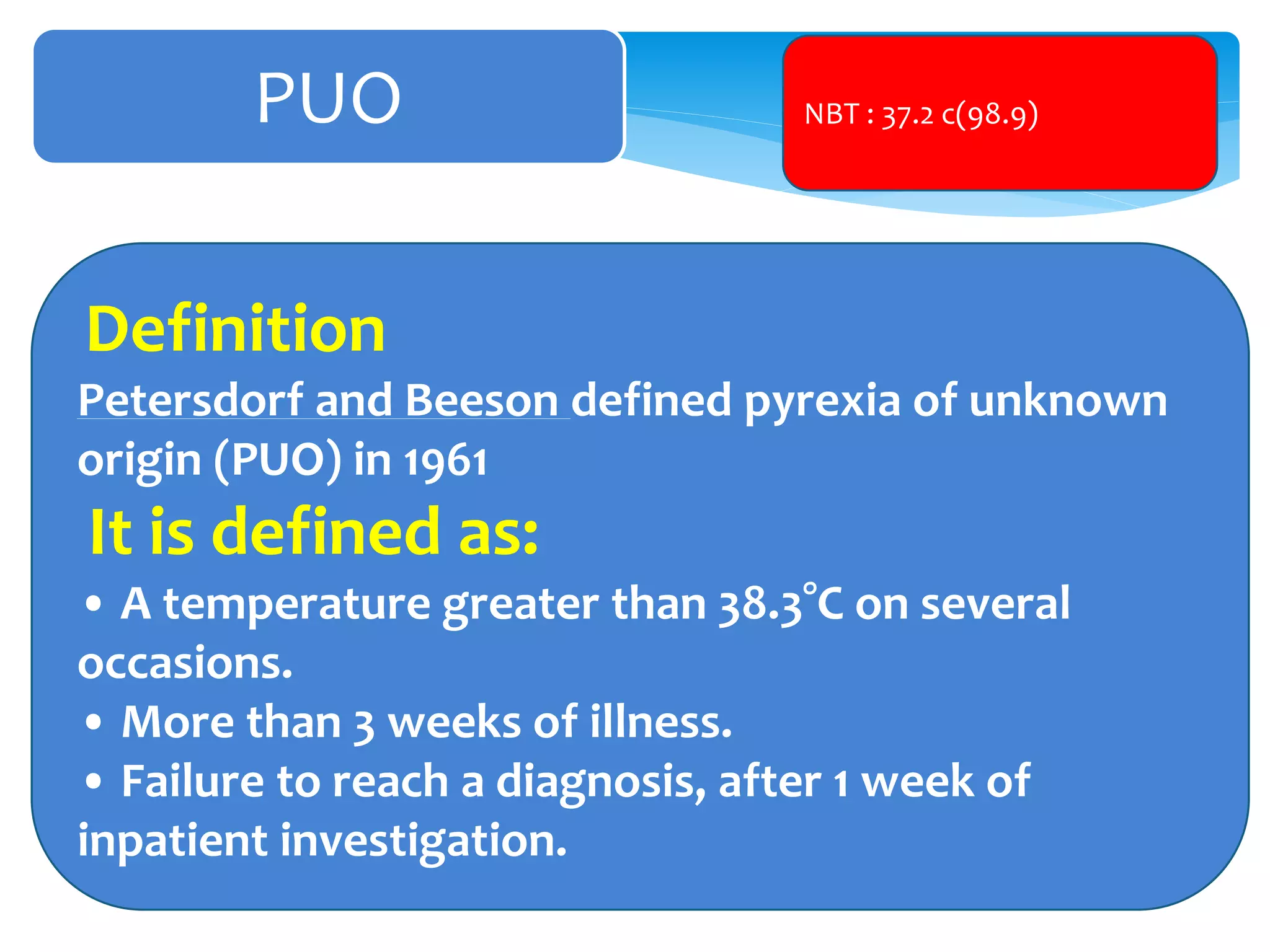
PUO
Definition
Petersdorf and Beeson defined pyrexia of unknown
origin (PUO) in 1961
It is defined as:
• A temperature greater than 38.3°C on several
occasions.
• More than 3 weeks of illness.
• Failure to reach a diagnosis, after 1 week of
inpatient investigation.
NBT : 37.2 c(98.9)
S
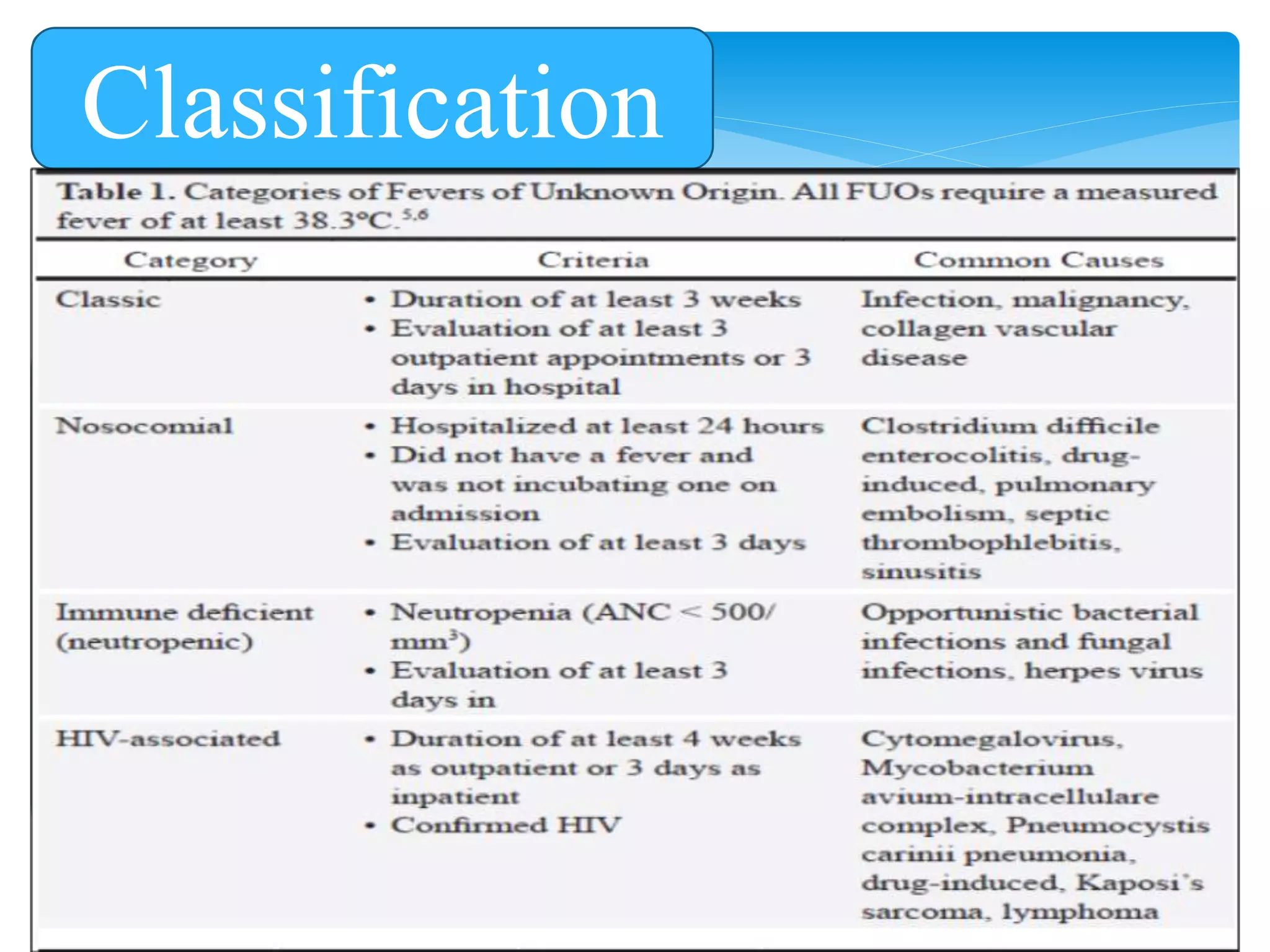
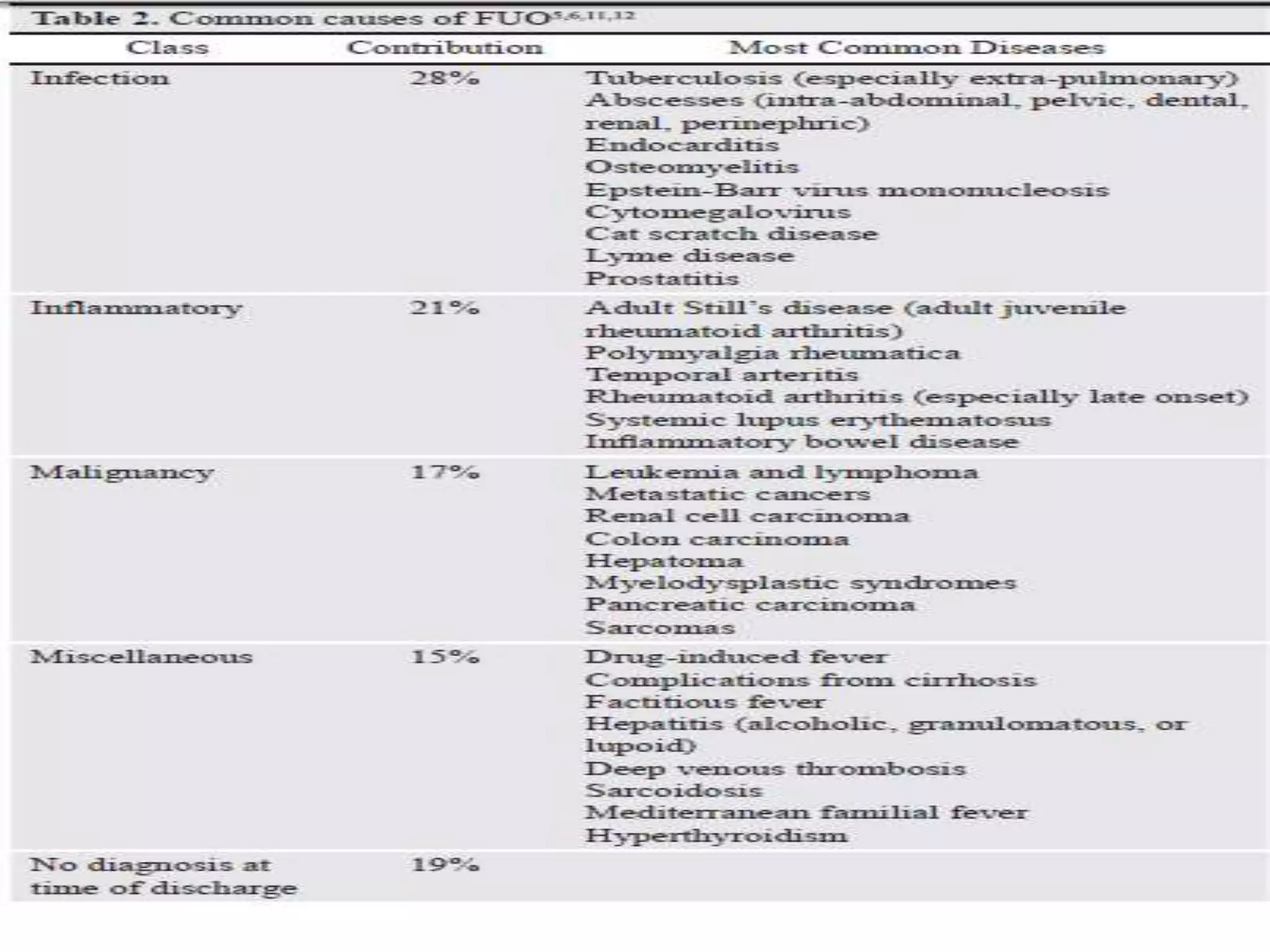
Classification
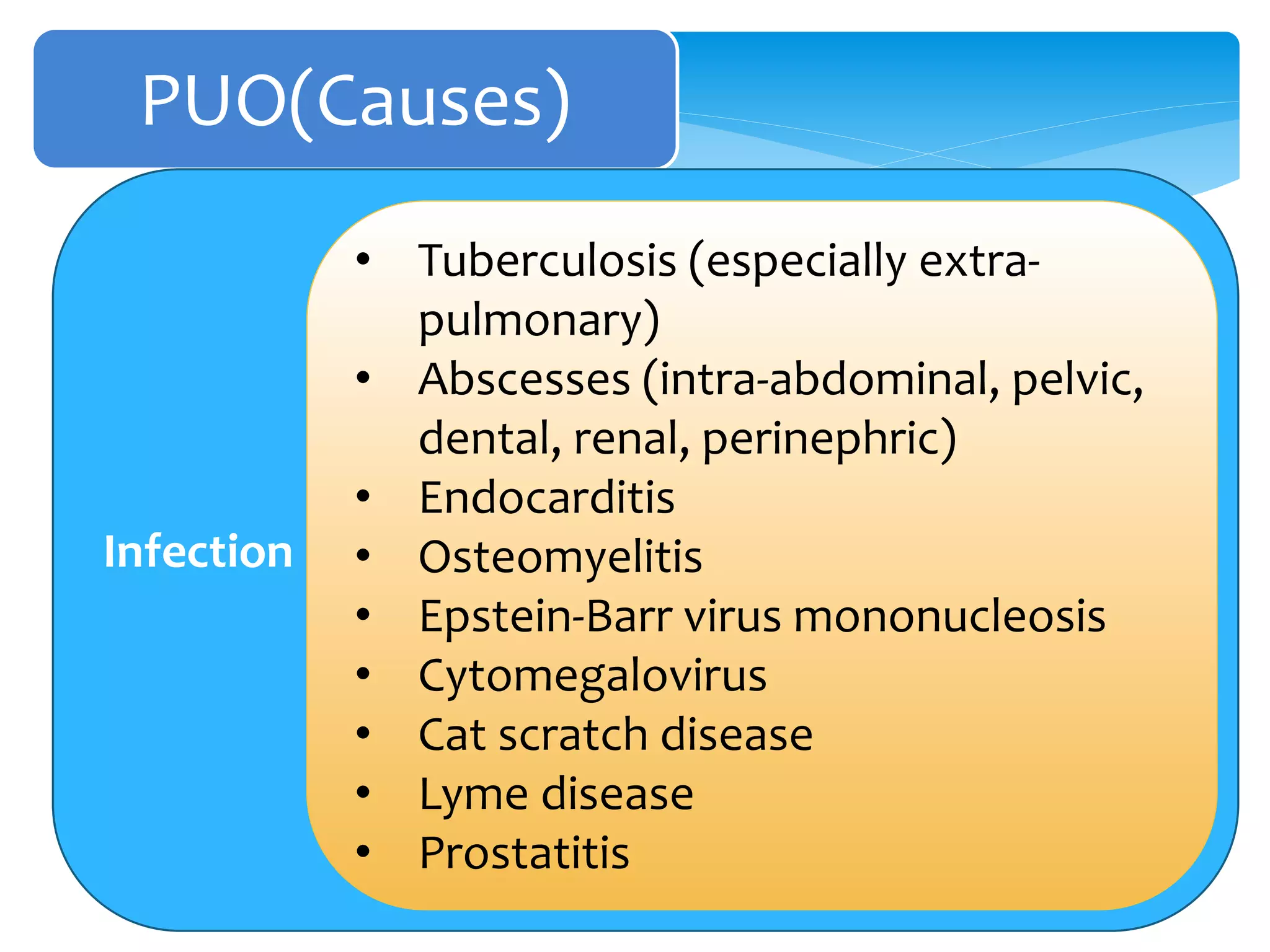
PUO(Causes)
Infection
• Tuberculosis (especially extra-
pulmonary)
• Abscesses (intra-abdominal, pelvic,
dental, renal, perinephric)
• Endocarditis
• Osteomyelitis
• Epstein-Barr virus mononucleosis
• Cytomegalovirus
• Cat scratch disease
• Lyme disease
• Prostatitis
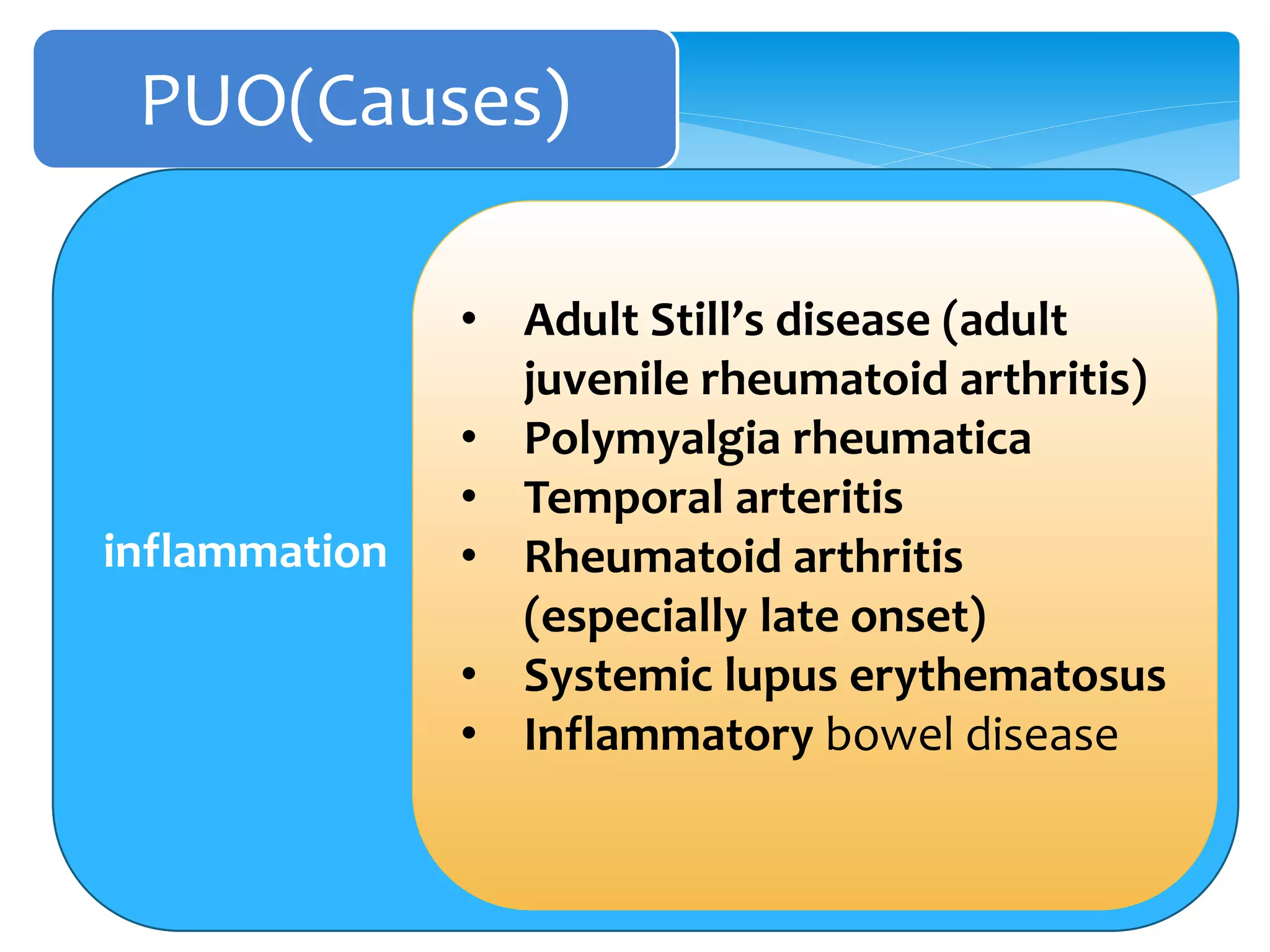
PUO(Causes)
inflammation
• Adult Still’s disease (adult
juvenile rheumatoid arthritis)
• Polymyalgia rheumatica
• Temporal arteritis
• Rheumatoid arthritis
(especially late onset)
• Systemic lupus erythematosus
• Inflammatory bowel disease
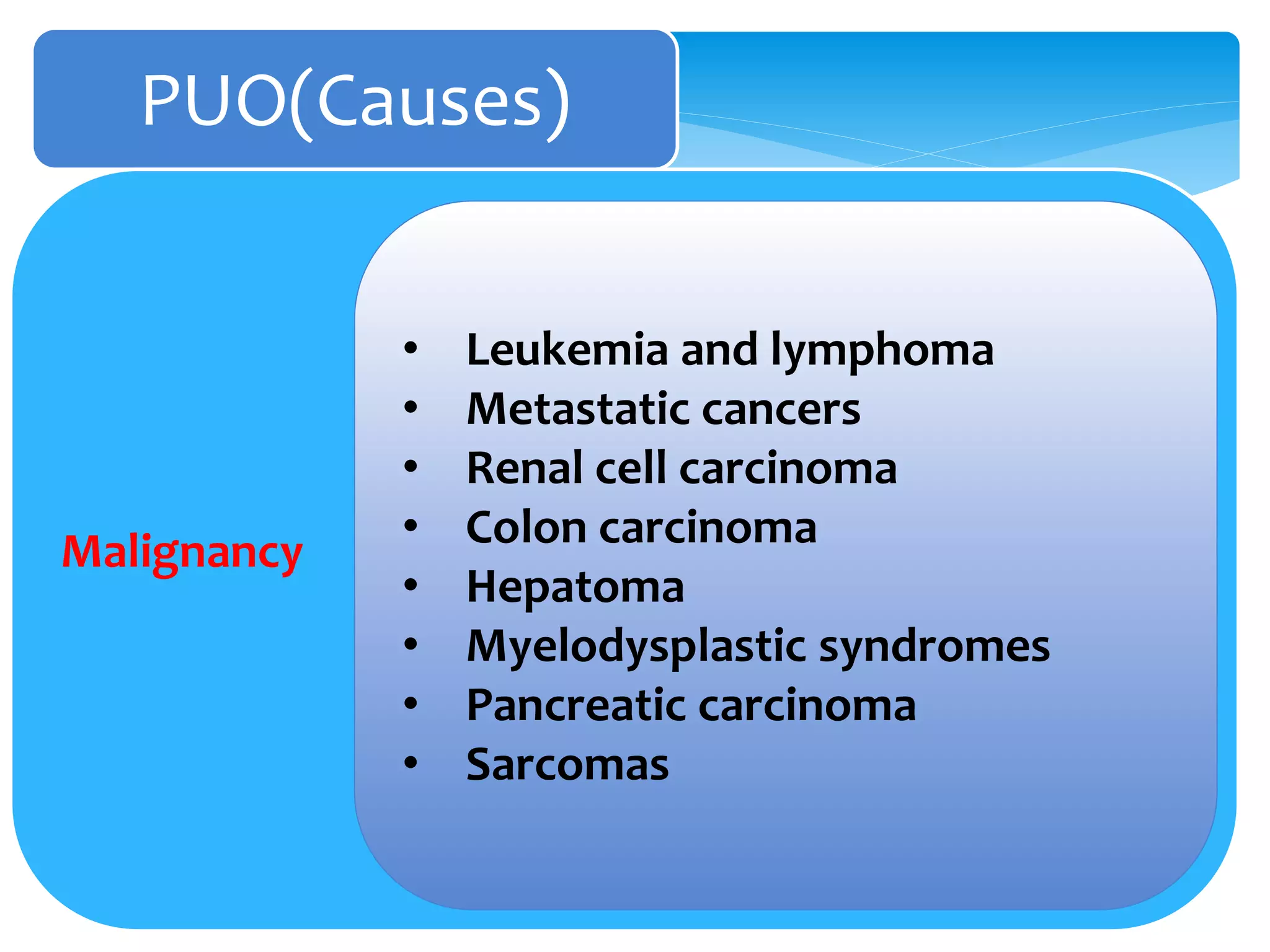
PUO(Causes)
Malignancy
• Leukemia and lymphoma
• Metastatic cancers
• Renal cell carcinoma
• Colon carcinoma
• Hepatoma
• Myelodysplastic syndromes
• Pancreatic carcinoma
• Sarcomas
PUO(Causes)
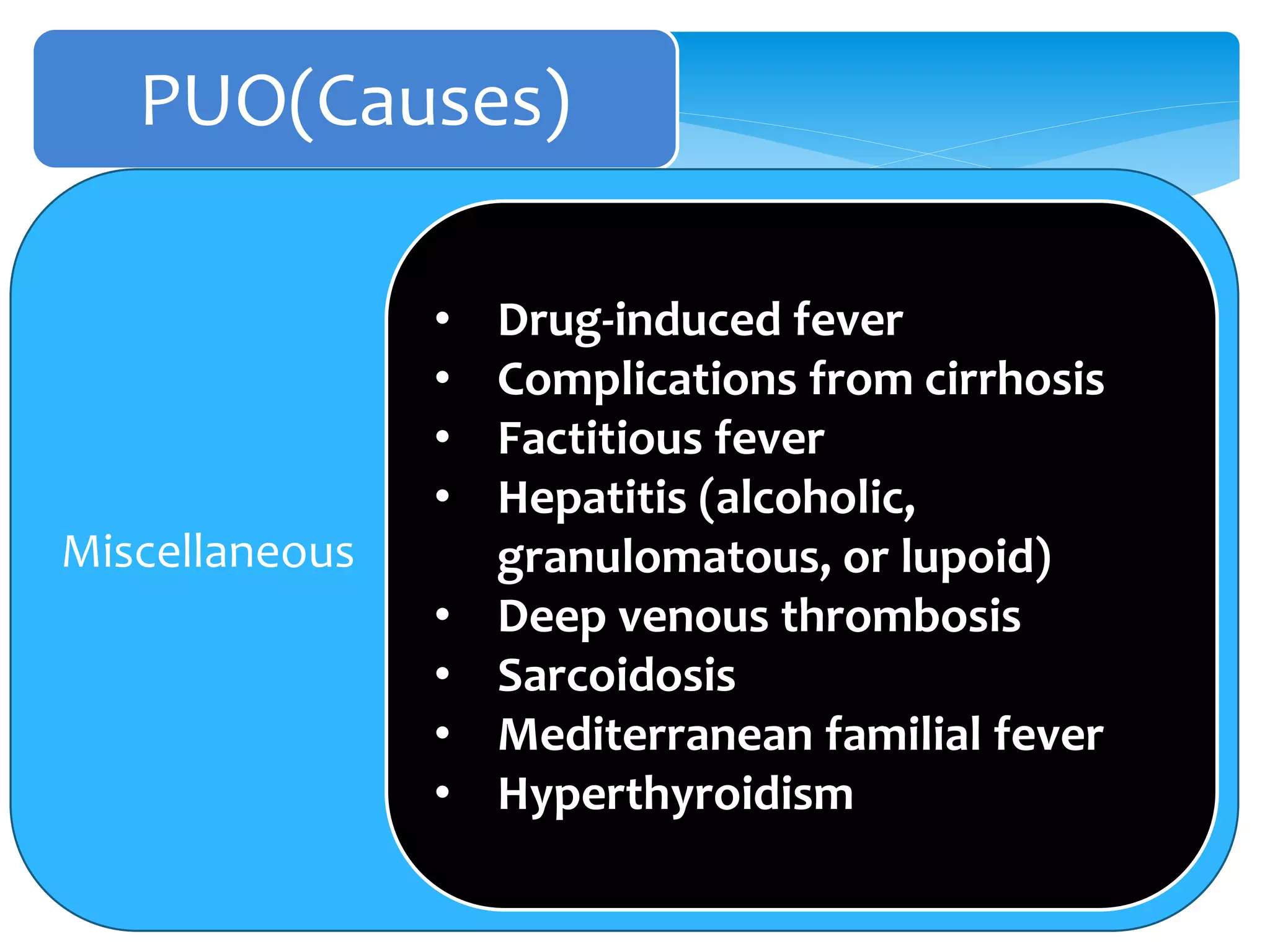
Miscellaneous
• Drug-induced fever
• Complications from cirrhosis
• Factitious fever
• Hepatitis (alcoholic,
granulomatous, or lupoid)
• Deep venous thrombosis
• Sarcoidosis
• Mediterranean familial fever
• Hyperthyroidism
Approach of Patient with PUO
The first and foremost step is to establish that
fever really exists. Strict oral temperature
record must be kept. Detailed history and
physical examination has probably not more
significance in any other category of patients
than PUO. Clinical evaluation should be
repeated frequently and a thorough review
of patients with already done investigations
should be taken.
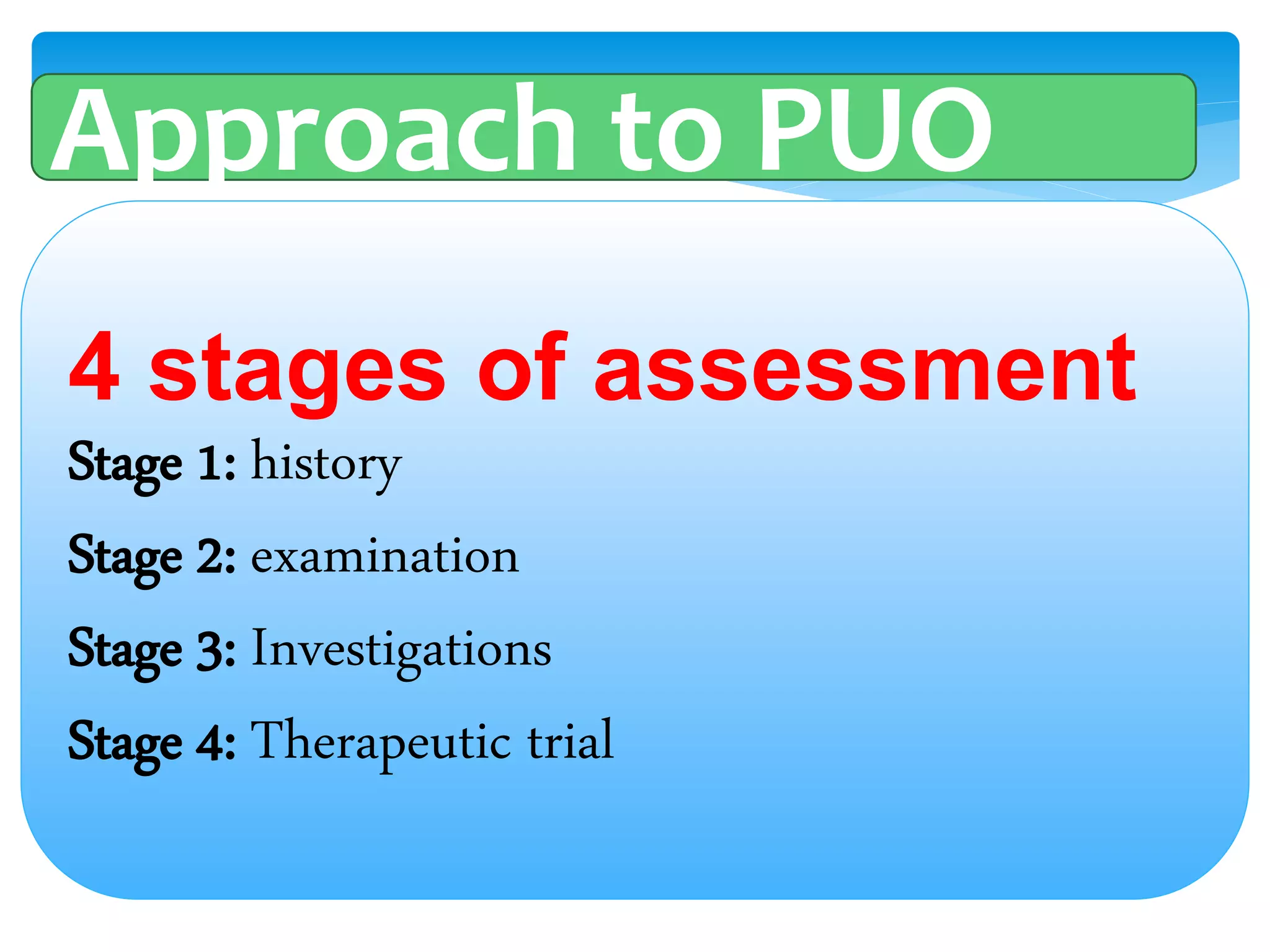
Approach to PUO
4 stages of assessment
Stage 1: history
Stage 2: examination
Stage 3: Investigations
Stage 4: Therapeutic trial
Approach to PUO
History
A detailed, careful, day by day history of symptoms,
signs previous treatment given, response to
treatment, all investigations and patient’s general
condition
Some guiding points for history of fever could be :
1. Since when
2. Onset - acute or gradual
3. Rigors, is it daily or on alternative days
4. Diurnal variation
5. Response to previous treatment
6. Associated symptoms(wt. loss, headache. Myalgia.
History of associated symptoms should be
taken in same details for each symptom.
Weakness, myalgia, headache, vague
abdominal discomfort, burning of
micturition (during fever) can be due to
fever itself.
Interpretation of symptoms is very
important and sometimes very difficult.
Existing data shows that only about half
patients with abdominal complaints and one
fourth with CNS (central nervous system)
symptoms had disease at the corresponding
site.
Highest yield questions include asking about
past medical history (e.g. recurrent TB,
metastatic cancer, Crohn’s disease),
medications, family history (e.g.
Mediterranean familial disease), animal
contact (e.g. psittacosis from parakeet
contact), sexual history (e.g. rectal
abscesses from anal penetration), and
travel history (e.g. amoebiasis)
social practices including drug use,
unusual diet (e.g. unpasteurised
products), and environmental
exposures may also be helpful
Physical Examination
 Documentation of fever and exclusion
of factitious fever (may be up to 10% of
cases)
 An adequate physical exam is one that
looks at every system for subtle clues,
including full neurological, head and
neck, musculoskeletal, dermatological,
and fundoscopic exams.
Investigations
 baseline investigations i.e. CBC, ESR,
LFT, RFT, CXR (chest X-ray), ECG, urine
stool, sputum for AFB (acid fast
bacillus) and blood cultures.
Repetition of some of these basic
investigations like CXR and blood
culture give positive result in
significant number of patients.
Investigations
 Non invasive : USG abdomen, USG neck for lymph node, CT scan of
chest and abdomen or other specific areas, 2D echo (two dimensional
echocardiography), trans-esophageal echo, infectious disease serology
like brucella, rickettsia, ANA (antinuclear antibodies) ds-DNA (double
stranded deoxyribo nucleic acid), C-ANCA, P-ANCA (P - Antineutrophilic
cytoplasmic antibodies), C3 (complement 3), C4 (complement 4) levels,
ACE (angiotensin converting enzyme) levels, ferritin, thyroid function
tests and tumor markers [like PSA (prostate specific antigen), CEA
(carcino embryonic antigen)].
Specific investigations
Investigations
Invasive : Lymph node excision biopsy,
lumbar puncture, aspiration of pleural / ascitic
/ synovial fluid, skin biopsy, liver biopsy, bone
marrow biopsy and biopsy of a lesion shown
on radiological investigation.
Specific investigations
Empirical therapy
Treat. Of infective endocarditis and sepsis
anti tuberculosis therapy
anti malarial
anti rheumatic
metronidazol
Usually not advisable.
only if fever cause is not oblivious after several days and patient is
deteriorates
Summary
Thank you

Pyrexia of unknown origin

  • 1.
    Pyrexia of UnknownOrigin(PUO) ASCITES AND HEPATORENAL SYNDROME BY Dr/ Mahmoud S. Desoky
  • 2.
    Importance  One ofthe most challenging problems a physician faces in practice  A truly significant test of his clinical skills  A thorough and detailed history with a good clinical examination and relevant investigations are necessary in every patient of prolonged pyrexia.
  • 3.
    “Humanity has threegreat enemies : Fever, famine and wars. Of these by far the greatest, the most terrible is fever” - Sir William Osler (1849-1919). In the 19th century, febrile illness caused more than 2/3rd of total deaths.
  • 7.
    PUO Definition Petersdorf and Beesondefined pyrexia of unknown origin (PUO) in 1961 It is defined as: • A temperature greater than 38.3°C on several occasions. • More than 3 weeks of illness. • Failure to reach a diagnosis, after 1 week of inpatient investigation. NBT : 37.2 c(98.9)
  • 8.
  • 10.
    PUO(Causes) Infection • Tuberculosis (especiallyextra- pulmonary) • Abscesses (intra-abdominal, pelvic, dental, renal, perinephric) • Endocarditis • Osteomyelitis • Epstein-Barr virus mononucleosis • Cytomegalovirus • Cat scratch disease • Lyme disease • Prostatitis
  • 11.
    PUO(Causes) inflammation • Adult Still’sdisease (adult juvenile rheumatoid arthritis) • Polymyalgia rheumatica • Temporal arteritis • Rheumatoid arthritis (especially late onset) • Systemic lupus erythematosus • Inflammatory bowel disease
  • 12.
    PUO(Causes) Malignancy • Leukemia andlymphoma • Metastatic cancers • Renal cell carcinoma • Colon carcinoma • Hepatoma • Myelodysplastic syndromes • Pancreatic carcinoma • Sarcomas
  • 13.
    PUO(Causes) Miscellaneous • Drug-induced fever •Complications from cirrhosis • Factitious fever • Hepatitis (alcoholic, granulomatous, or lupoid) • Deep venous thrombosis • Sarcoidosis • Mediterranean familial fever • Hyperthyroidism
  • 14.
    Approach of Patientwith PUO The first and foremost step is to establish that fever really exists. Strict oral temperature record must be kept. Detailed history and physical examination has probably not more significance in any other category of patients than PUO. Clinical evaluation should be repeated frequently and a thorough review of patients with already done investigations should be taken. Approach to PUO
  • 15.
    4 stages ofassessment Stage 1: history Stage 2: examination Stage 3: Investigations Stage 4: Therapeutic trial Approach to PUO
  • 16.
    History A detailed, careful,day by day history of symptoms, signs previous treatment given, response to treatment, all investigations and patient’s general condition Some guiding points for history of fever could be : 1. Since when 2. Onset - acute or gradual 3. Rigors, is it daily or on alternative days 4. Diurnal variation 5. Response to previous treatment 6. Associated symptoms(wt. loss, headache. Myalgia.
  • 17.
    History of associatedsymptoms should be taken in same details for each symptom. Weakness, myalgia, headache, vague abdominal discomfort, burning of micturition (during fever) can be due to fever itself. Interpretation of symptoms is very important and sometimes very difficult. Existing data shows that only about half patients with abdominal complaints and one fourth with CNS (central nervous system) symptoms had disease at the corresponding site.
  • 18.
    Highest yield questionsinclude asking about past medical history (e.g. recurrent TB, metastatic cancer, Crohn’s disease), medications, family history (e.g. Mediterranean familial disease), animal contact (e.g. psittacosis from parakeet contact), sexual history (e.g. rectal abscesses from anal penetration), and travel history (e.g. amoebiasis)
  • 19.
    social practices includingdrug use, unusual diet (e.g. unpasteurised products), and environmental exposures may also be helpful
  • 20.
    Physical Examination  Documentationof fever and exclusion of factitious fever (may be up to 10% of cases)  An adequate physical exam is one that looks at every system for subtle clues, including full neurological, head and neck, musculoskeletal, dermatological, and fundoscopic exams.
  • 21.
    Investigations  baseline investigationsi.e. CBC, ESR, LFT, RFT, CXR (chest X-ray), ECG, urine stool, sputum for AFB (acid fast bacillus) and blood cultures. Repetition of some of these basic investigations like CXR and blood culture give positive result in significant number of patients.
  • 22.
    Investigations  Non invasive: USG abdomen, USG neck for lymph node, CT scan of chest and abdomen or other specific areas, 2D echo (two dimensional echocardiography), trans-esophageal echo, infectious disease serology like brucella, rickettsia, ANA (antinuclear antibodies) ds-DNA (double stranded deoxyribo nucleic acid), C-ANCA, P-ANCA (P - Antineutrophilic cytoplasmic antibodies), C3 (complement 3), C4 (complement 4) levels, ACE (angiotensin converting enzyme) levels, ferritin, thyroid function tests and tumor markers [like PSA (prostate specific antigen), CEA (carcino embryonic antigen)]. Specific investigations
  • 23.
    Investigations Invasive : Lymphnode excision biopsy, lumbar puncture, aspiration of pleural / ascitic / synovial fluid, skin biopsy, liver biopsy, bone marrow biopsy and biopsy of a lesion shown on radiological investigation. Specific investigations
  • 24.
    Empirical therapy Treat. Ofinfective endocarditis and sepsis anti tuberculosis therapy anti malarial anti rheumatic metronidazol Usually not advisable. only if fever cause is not oblivious after several days and patient is deteriorates
  • 25.
  • 26.