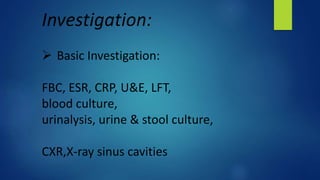
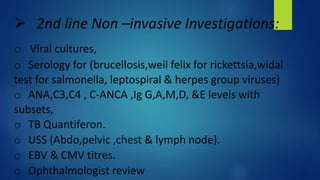
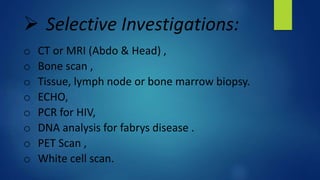
This document defines fever of unknown origin and outlines the process for evaluating a patient with prolonged or recurrent fever when the cause is not readily apparent. It discusses taking a thorough history including fever characteristics, travel, exposures, medications and symptoms. A full examination focuses on potential infectious sources or underlying conditions. Initial tests include blood counts, inflammation markers and cultures, with further imaging and specialty-guided biopsies as needed to identify treatable causes. Empiric antibiotics may be used selectively while avoiding overuse before a pathogen is identified. Referrals to specialists can help determine causes like inflammatory diseases or infections requiring their management.


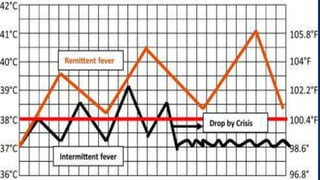

![Skin
o Rash only during fever (JIA)
o No sweat (familial dysautonomia)
o Petechiae (endocarditis, rickettsia)
o Papules (cat scratch)
o Eschar (tularaemia)
o Erythema migrans (Lyme)
o Malar (SLE)
o Palpable purpura [polyarteritis nodosa (PAN)]
o Erythema nodosum (JIA, SLE, streptococcal, infection, malignancy, IBD, TB)
o Seborrheic dermatitis(histiocytosis)
o Sparse hair (ectodermal dysplasia)](https://image.slidesharecdn.com/puobydraabdurrazaqalt-190924173452/85/PUO-18-320.jpg)