Fever with Rash


                             Fever With Rash
    Chooi Yuo Hao (Eugene)


                               1
•Varicella Zoster Virus (VZV)
  • Perinatally acquired varicella
•Kawasaki Disease


                                     Fever With Rash
                                       2
History Taking
• Introduction
• Chief complaints
• HOPI
• Past history (Medical and Surgical)
• Birth history


                                        Fever With Rash
• Feeding history
• Developmental history
• Immunization history
• Drug history
• Family history                          3

• Social and environmental history
Physical examination
• General examination
• Systemic examination


                         Fever With Rash
                           4
Varicella Zoster Virus (VZV)
• 1 of the known human herpes viruses
  • Varicella Zoster Virus (VZV) – Chicken Pox
  • Herpes Zoster – Shingles
• Neurotropic human herpes virus with similarities to


                                                        Fever With Rash
  herpes simplex virus
• Air-borne and highly contagious disease
• Causes primary, latent and recurrent infections
• Increased    morbidity      and     mortality    in
  adolescent, adults, and immunocompromised
  persons                                                 5
• Predisposed to severe group A streptococcus and
  Staphylococcus aureus infection
Clinical Manifestation
• Prodromal symptoms
  • Nausea, loss of appetite, aching muscle and headache
• Fever (mostly low grade), malaise, 24-48hrs later
  associated with vesicular rash (successive crops of
  pruritic vesicles that evolve to pustules, crusts and


                                                           Fever With Rash
  at times scar4)
• Rashes starts from the scalp, face or trunk, upper
  extremities and lower extremities
• Some children might not have prodromal
  symptoms, they begins with vesicular rash and fever
                                                             6
Fever With Rash
                     7
Varicella lesion
Fever With Rash
                                  8
Vesicular rash of chicken pox
Fever With Rash
                            9
Haemorrhagic chickenpox
Complications
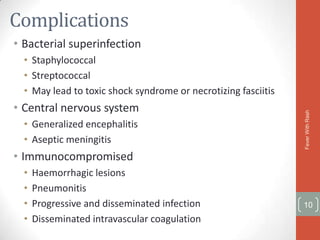
• Bacterial superinfection
  • Staphylococcal
  • Streptococcal
  • May lead to toxic shock syndrome or necrotizing fasciitis
• Central nervous system


                                                                Fever With Rash
  • Generalized encephalitis
  • Aseptic meningitis
• Immunocompromised
  •   Haemorrhagic lesions
  •   Pneumonitis
  •   Progressive and disseminated infection                    10
  •   Disseminated intravascular coagulation
Treatment
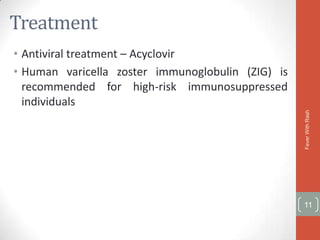
• Antiviral treatment – Acyclovir
• Human varicella zoster immunoglobulin (ZIG) is
  recommended for high-risk immunosuppressed
  individuals


                                                   Fever With Rash
                                                   11
Prognosis
• Quite good excluded immunosuppressed patients
• Resolves spontaneously – self limited
• Mortality rate 2-3 per 100,000 cases


                                                  Fever With Rash
                                                  12
Prevention
• Difficult to prevent as the infection is highly
  contagious for 24-48 hour before the rash appears.
• Live attenuated VZV vaccine can be administer
• Postexposure prophylaxis – VZV vaccine or oral


                                                       Fever With Rash
  acyclovir


  Beware of admitting a chickenpox
    contact to a clinical area with
   immunocompromised children                          13
Perinatally Acquired Varicella
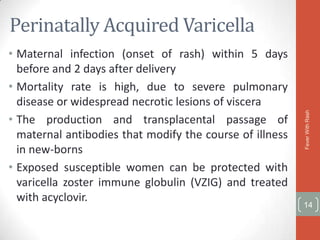
• Maternal infection (onset of rash) within 5 days
  before and 2 days after delivery
• Mortality rate is high, due to severe pulmonary
  disease or widespread necrotic lesions of viscera


                                                          Fever With Rash
• The production and transplacental passage of
  maternal antibodies that modify the course of illness
  in new-borns
• Exposed susceptible women can be protected with
  varicella zoster immune globulin (VZIG) and treated
  with acyclovir.
                                                          14
• Women with varicella lesions should be isolated
  from their newborns, breast feeding is
  contraindicated; when all the lesions have crusted,
  breast feeding should be commence
• Neonates with varicella lesions should be isolated


                                                        Fever With Rash
  from other infants but not from their mothers.
• Infants born in the high-risk period should also
  receive zoster immune globulin and are often also
  given acyclovir prophylactically

                                                        15
Summary
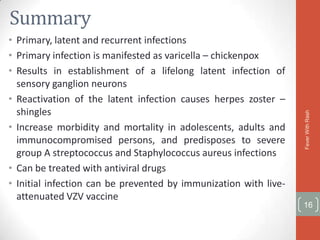
• Primary, latent and recurrent infections
• Primary infection is manifested as varicella – chickenpox
• Results in establishment of a lifelong latent infection of
  sensory ganglion neurons
• Reactivation of the latent infection causes herpes zoster –
  shingles


                                                                  Fever With Rash
• Increase morbidity and mortality in adolescents, adults and
  immunocompromised persons, and predisposes to severe
  group A streptococcus and Staphylococcus aureus infections
• Can be treated with antiviral drugs
• Initial infection can be prevented by immunization with live-
  attenuated VZV vaccine
                                                                  16
Kawasaki Disease
• Also known as acute febrile mucocutaneous
  syndrome
• A systemic febrile condition affecting children
  usually <5 years old
• Aetiology remains unknown, possible bacterial


                                                         Fever With Rash
  toxins or viral agents with genetic predisposition
• Aneurysms of the coronary arteries are an
  important complication
• Affects children 6 months – 4 years old, with a peak
  at the end of the first year
                                                         17
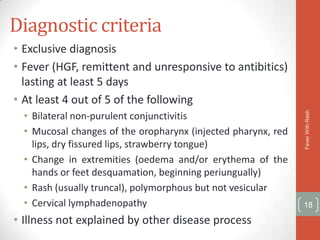
Diagnostic criteria
• Exclusive diagnosis
• Fever (HGF, remittent and unresponsive to antibitics)
  lasting at least 5 days
• At least 4 out of 5 of the following
  • Bilateral non-purulent conjunctivitis


                                                               Fever With Rash
  • Mucosal changes of the oropharynx (injected pharynx, red
    lips, dry fissured lips, strawberry tongue)
  • Change in extremities (oedema and/or erythema of the
    hands or feet desquamation, beginning periungually)
  • Rash (usually truncal), polymorphous but not vesicular
  • Cervical lymphadenopathy                                   18

• Illness not explained by other disease process
Fever With Rash
                                                 19
Red, cracked lips and conjunctiva inflammation
Fever With Rash
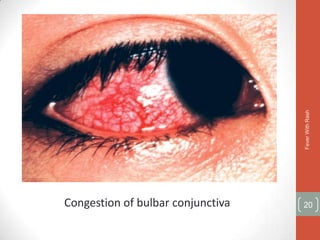
Congestion of bulbar conjunctiva   20
Fever With Rash
                    21
Strawberry tongue
Fever With Rash
                     22
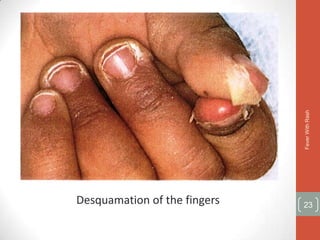
Peeling of fingers
Fever With Rash
Desquamation of the fingers   23
Fever With Rash
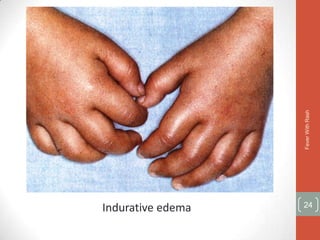
Indurative edema   24
Other helpful signs
 • Indurated BCG scar
 • Perianal excoriation, irritability
 • Altered mental state
 • Aseptic meningitis


                                         Fever With Rash
 • Transient arthritis
 • Diarrhoea, vomiting, abdominal pain
 • Hepatoslenomegaly
 • Hydrops of gallbladder
 • Sterile pyuria
                                         25
Investigation
• Full blood count
  • Anaemia, leukocytosis, thrombocytosis
• ESR and CRP elevated
• Serum albumin <3gdl; Raised alanine


                                                    Fever With Rash
  aminotrasaminase (ALT)
• Urine > 10 wbc/hpf
• Chest x-ray, ECG
• Echocardiogram in the acute phase and repeat at
  6-8 weeks or earlier if indicated
                                                    26
Fever With Rash
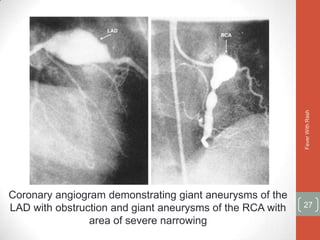
Coronary angiogram demonstrating giant aneurysms of the
LAD with obstruction and giant aneurysms of the RCA with   27

                area of severe narrowing
Complication
• Coronary vasculitis, usually within 2 weeks of
  illness
• Asymptomatic
 •   Myocardial infection
 •


                                                   Fever With Rash
     Myocardial infarction
 •   Pericarditis
 •   Myocarditis
 •   Endocarditis
 •   Heart failure
 •   Arrhythmias
                                                   28
• Incomplete Kawasaki Disease (kindly refer to the 2nd
  edition of paeds protocol pg 115)

• Atypical Kawasaki Disease (kindly refer to the 2nd


                                                         Fever With Rash
  edition of paeds protocol pg 115)


                                                         29
Fever With Rash
                                                      30


Evaluation of Suspected Incomplete Kawasaki Disease
Treatment
• Primary treatment
  • IV Immunoglobulins 2 Gm/kg infusion over 10-12
    hours
    Therapy <10 days of onset effective in preventing


                                                        Fever With Rash
    coronary vascular damage
  • Oral Aspirin 30 mg/kg/day for 2 weeks or until
    patient is afebrile for 2-3 days


                                                        31
Maintenance
• Oral Aspirin 3-5 mg/kg daily (anti-platelet dose) for
  6-8 weeks or until ESR and platelet count normal

 If coronary aneurysm present, then continue aspirin


                                                          Fever With Rash
 until resolves

 Alternative: Oral Dipyridamole 3-5mg/kg daily


                                                          32
Prognosis
• Complete recovery in children without coronary
  artery involvement
• Most (80%) 3-5mm aneurysm resolve
  • 30% of 5-8mm aneurysm resolve
• Prognosis worst for aneurysms > 8mm; mortality


                                                   Fever With Rash
  1~2%
• Good prognosis for aneurysms <4mm


                                                   33
Summary
• Mainly affects infants and young children
• The diagnosis is made on clinical features such as
• Fever lasting at least 5 days
• At least 4 out of 5 of the following
  • Bilateral non-purulent conjunctivitis


                                                                         Fever With Rash
  • Mucosal changes of the oropharynx (injected pharynx, red lips, dry
    fissured lips, strawberry tongue)
  • Change in extremities (oedema and/or erythema of the hands or feet
    desquamation, beginning periungually)
  • Rash (usually truncal), polymorphous but not vesicular
  • Cervical lymphadenopathy
• Complications – Coronary artery aneurysms and
                                                                         34
  sudden death
• Treatment – Intravenous immunoglobulin and aspirin
References
• Hussein Imam, Ng H.P., Thomas T. (2008). Paediatrics
  Protocols for Malaysian Hospitals (2nd edition): pg 6,78,115-
  116
• Lissauer T., Clayden G. (2007). Illustrated textbook of
  Paediatrics (3rd edition): pg 230-232, 237-238


                                                                    Fever With Rash
• Kliegman R.M., Beherman R.E., Jenson H.B., Stanton B.F.
  (2007). Nelson textbook of Paediatrics (18th edition)
• Klaus W., Richard A.J. (2009). Fitzpatrick’s Color Atlas &
  Synopsis of Clinical Dermatology (6th edition): pg 833
• Kliegman R.M., Marcdante K.J., Beherman R.E., Jenson H.B.
  (2007). Nelson Essentials of Paediatrics (5th edition): pg 470-
  472
                                                                    35
Fever With Rash
36

Fever with rash by Dr.Eugene

  • 1.
    Fever with Rash Fever With Rash Chooi Yuo Hao (Eugene) 1
  • 2.
    •Varicella Zoster Virus(VZV) • Perinatally acquired varicella •Kawasaki Disease Fever With Rash 2
  • 3.
    History Taking • Introduction •Chief complaints • HOPI • Past history (Medical and Surgical) • Birth history Fever With Rash • Feeding history • Developmental history • Immunization history • Drug history • Family history 3 • Social and environmental history
  • 4.
    Physical examination • Generalexamination • Systemic examination Fever With Rash 4
  • 5.
    Varicella Zoster Virus(VZV) • 1 of the known human herpes viruses • Varicella Zoster Virus (VZV) – Chicken Pox • Herpes Zoster – Shingles • Neurotropic human herpes virus with similarities to Fever With Rash herpes simplex virus • Air-borne and highly contagious disease • Causes primary, latent and recurrent infections • Increased morbidity and mortality in adolescent, adults, and immunocompromised persons 5 • Predisposed to severe group A streptococcus and Staphylococcus aureus infection
  • 6.
    Clinical Manifestation • Prodromalsymptoms • Nausea, loss of appetite, aching muscle and headache • Fever (mostly low grade), malaise, 24-48hrs later associated with vesicular rash (successive crops of pruritic vesicles that evolve to pustules, crusts and Fever With Rash at times scar4) • Rashes starts from the scalp, face or trunk, upper extremities and lower extremities • Some children might not have prodromal symptoms, they begins with vesicular rash and fever 6
  • 7.
    Fever With Rash 7 Varicella lesion
  • 8.
    Fever With Rash 8 Vesicular rash of chicken pox
  • 9.
    Fever With Rash 9 Haemorrhagic chickenpox
  • 10.
    Complications • Bacterial superinfection • Staphylococcal • Streptococcal • May lead to toxic shock syndrome or necrotizing fasciitis • Central nervous system Fever With Rash • Generalized encephalitis • Aseptic meningitis • Immunocompromised • Haemorrhagic lesions • Pneumonitis • Progressive and disseminated infection 10 • Disseminated intravascular coagulation
  • 11.
    Treatment • Antiviral treatment– Acyclovir • Human varicella zoster immunoglobulin (ZIG) is recommended for high-risk immunosuppressed individuals Fever With Rash 11
  • 12.
    Prognosis • Quite goodexcluded immunosuppressed patients • Resolves spontaneously – self limited • Mortality rate 2-3 per 100,000 cases Fever With Rash 12
  • 13.
    Prevention • Difficult toprevent as the infection is highly contagious for 24-48 hour before the rash appears. • Live attenuated VZV vaccine can be administer • Postexposure prophylaxis – VZV vaccine or oral Fever With Rash acyclovir Beware of admitting a chickenpox contact to a clinical area with immunocompromised children 13
  • 14.
    Perinatally Acquired Varicella •Maternal infection (onset of rash) within 5 days before and 2 days after delivery • Mortality rate is high, due to severe pulmonary disease or widespread necrotic lesions of viscera Fever With Rash • The production and transplacental passage of maternal antibodies that modify the course of illness in new-borns • Exposed susceptible women can be protected with varicella zoster immune globulin (VZIG) and treated with acyclovir. 14
  • 15.
    • Women withvaricella lesions should be isolated from their newborns, breast feeding is contraindicated; when all the lesions have crusted, breast feeding should be commence • Neonates with varicella lesions should be isolated Fever With Rash from other infants but not from their mothers. • Infants born in the high-risk period should also receive zoster immune globulin and are often also given acyclovir prophylactically 15
  • 16.
    Summary • Primary, latentand recurrent infections • Primary infection is manifested as varicella – chickenpox • Results in establishment of a lifelong latent infection of sensory ganglion neurons • Reactivation of the latent infection causes herpes zoster – shingles Fever With Rash • Increase morbidity and mortality in adolescents, adults and immunocompromised persons, and predisposes to severe group A streptococcus and Staphylococcus aureus infections • Can be treated with antiviral drugs • Initial infection can be prevented by immunization with live- attenuated VZV vaccine 16
  • 17.
    Kawasaki Disease • Alsoknown as acute febrile mucocutaneous syndrome • A systemic febrile condition affecting children usually <5 years old • Aetiology remains unknown, possible bacterial Fever With Rash toxins or viral agents with genetic predisposition • Aneurysms of the coronary arteries are an important complication • Affects children 6 months – 4 years old, with a peak at the end of the first year 17
  • 18.
    Diagnostic criteria • Exclusivediagnosis • Fever (HGF, remittent and unresponsive to antibitics) lasting at least 5 days • At least 4 out of 5 of the following • Bilateral non-purulent conjunctivitis Fever With Rash • Mucosal changes of the oropharynx (injected pharynx, red lips, dry fissured lips, strawberry tongue) • Change in extremities (oedema and/or erythema of the hands or feet desquamation, beginning periungually) • Rash (usually truncal), polymorphous but not vesicular • Cervical lymphadenopathy 18 • Illness not explained by other disease process
  • 19.
    Fever With Rash 19 Red, cracked lips and conjunctiva inflammation
  • 20.
    Fever With Rash Congestionof bulbar conjunctiva 20
  • 21.
    Fever With Rash 21 Strawberry tongue
  • 22.
    Fever With Rash 22 Peeling of fingers
  • 23.
  • 24.
  • 25.
    Other helpful signs • Indurated BCG scar • Perianal excoriation, irritability • Altered mental state • Aseptic meningitis Fever With Rash • Transient arthritis • Diarrhoea, vomiting, abdominal pain • Hepatoslenomegaly • Hydrops of gallbladder • Sterile pyuria 25
  • 26.
    Investigation • Full bloodcount • Anaemia, leukocytosis, thrombocytosis • ESR and CRP elevated • Serum albumin <3gdl; Raised alanine Fever With Rash aminotrasaminase (ALT) • Urine > 10 wbc/hpf • Chest x-ray, ECG • Echocardiogram in the acute phase and repeat at 6-8 weeks or earlier if indicated 26
  • 27.
    Fever With Rash Coronaryangiogram demonstrating giant aneurysms of the LAD with obstruction and giant aneurysms of the RCA with 27 area of severe narrowing
  • 28.
    Complication • Coronary vasculitis,usually within 2 weeks of illness • Asymptomatic • Myocardial infection • Fever With Rash Myocardial infarction • Pericarditis • Myocarditis • Endocarditis • Heart failure • Arrhythmias 28
  • 29.
    • Incomplete KawasakiDisease (kindly refer to the 2nd edition of paeds protocol pg 115) • Atypical Kawasaki Disease (kindly refer to the 2nd Fever With Rash edition of paeds protocol pg 115) 29
  • 30.
    Fever With Rash 30 Evaluation of Suspected Incomplete Kawasaki Disease
  • 31.
    Treatment • Primary treatment • IV Immunoglobulins 2 Gm/kg infusion over 10-12 hours Therapy <10 days of onset effective in preventing Fever With Rash coronary vascular damage • Oral Aspirin 30 mg/kg/day for 2 weeks or until patient is afebrile for 2-3 days 31
  • 32.
    Maintenance • Oral Aspirin3-5 mg/kg daily (anti-platelet dose) for 6-8 weeks or until ESR and platelet count normal If coronary aneurysm present, then continue aspirin Fever With Rash until resolves Alternative: Oral Dipyridamole 3-5mg/kg daily 32
  • 33.
    Prognosis • Complete recoveryin children without coronary artery involvement • Most (80%) 3-5mm aneurysm resolve • 30% of 5-8mm aneurysm resolve • Prognosis worst for aneurysms > 8mm; mortality Fever With Rash 1~2% • Good prognosis for aneurysms <4mm 33
  • 34.
    Summary • Mainly affectsinfants and young children • The diagnosis is made on clinical features such as • Fever lasting at least 5 days • At least 4 out of 5 of the following • Bilateral non-purulent conjunctivitis Fever With Rash • Mucosal changes of the oropharynx (injected pharynx, red lips, dry fissured lips, strawberry tongue) • Change in extremities (oedema and/or erythema of the hands or feet desquamation, beginning periungually) • Rash (usually truncal), polymorphous but not vesicular • Cervical lymphadenopathy • Complications – Coronary artery aneurysms and 34 sudden death • Treatment – Intravenous immunoglobulin and aspirin
  • 35.
    References • Hussein Imam,Ng H.P., Thomas T. (2008). Paediatrics Protocols for Malaysian Hospitals (2nd edition): pg 6,78,115- 116 • Lissauer T., Clayden G. (2007). Illustrated textbook of Paediatrics (3rd edition): pg 230-232, 237-238 Fever With Rash • Kliegman R.M., Beherman R.E., Jenson H.B., Stanton B.F. (2007). Nelson textbook of Paediatrics (18th edition) • Klaus W., Richard A.J. (2009). Fitzpatrick’s Color Atlas & Synopsis of Clinical Dermatology (6th edition): pg 833 • Kliegman R.M., Marcdante K.J., Beherman R.E., Jenson H.B. (2007). Nelson Essentials of Paediatrics (5th edition): pg 470- 472 35
  • 36.