Common dermatology terms
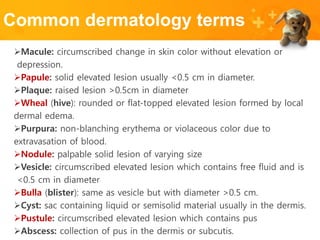
Macule: circumscribed change in skin color without elevation or
depression.
Papule: solid elevated lesion usually <0.5 cm in diameter.
Plaque: raised lesion >0.5cm in diameter
Wheal (hive): rounded or flat-topped elevated lesion formed by local
dermal edema.
Purpura: non-blanching erythema or violaceous color due to
extravasation of blood.
Nodule: palpable solid lesion of varying size
Vesicle: circumscribed elevated lesion which contains free fluid and is
<0.5 cm in diameter
Bulla (blister): same as vesicle but with diameter >0.5 cm.
Cyst: sac containing liquid or semisolid material usually in the dermis.
Pustule: circumscribed elevated lesion which contains pus
Abscess: collection of pus in the dermis or subcutis.
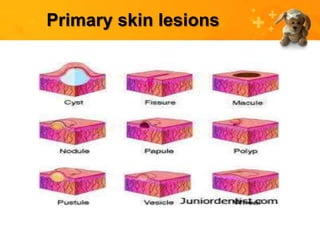
Primary skin lesions
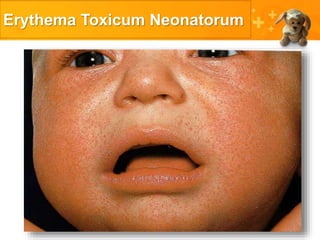
Erythema Toxicum Neonatorum
Huge title - harmless skin condition
Erythematous macule with a central tiny papule,
seen anywhere - except the palms and soles.
The lesions are packed with eosinophils, and
there may be accompanying eosinophilia in the
blood count.
The cause is unknown, and no treatment is
required as the rash disappears after 1-2 weeks.
.
Erythema Toxicum Neonatorum
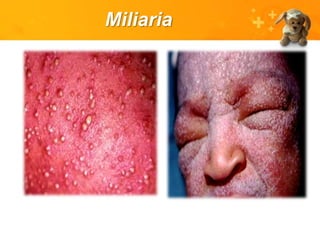
Prickly heat, sweat rash.
Many red macules with central papules, vesicl
es or pustules are present.
These may be on the trunk, diaper area, head
or neck.
Miliaria
Miliaria
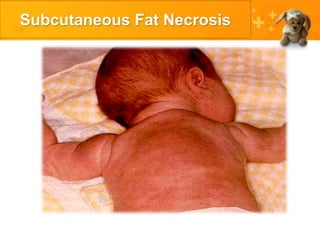
Self limited, benign condition.
Sharply demarcated reddish to violaceous plaques
or nodules.
Etiology uncertain.
Onset first few days- weeks of life.
Cheeks, back, buttocks, arms, and thighs.
Subcutaneous Fat Necrosis
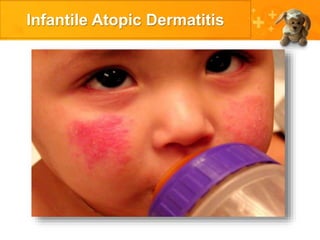
Cause is unknown
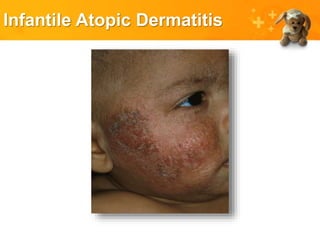
Red, itchy papules and plaques that ooze and
crust
Sites of Predilection
Face in the young
Extensor surfaces of the arms and legs 8-10 mo.
Antecubital and popliteal fossa, neck, face in older
Infantile Atopic Dermatitis
Avoidance or elimination of predisposing
factors.
Hydration and lubrication of dry skin.
Anti-pruritic agents.
Topical steroids.
Eczema- Treatment
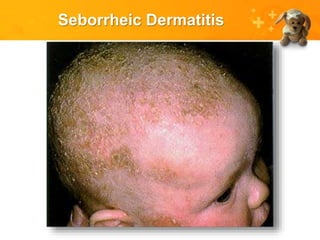
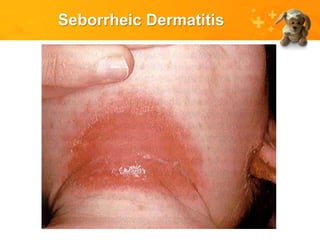
Common, generally self-limiting.
Its cause remains ill-understood.
There is a genetic predisposition.
Most frequent between the ages of 1:6 mo.
Greasy, salmon-colored scaling eruption.
Hair-bearing and intertriginous areas.
The rash causes no discomfort or itching.
Seborrheic Dermatitis
Anti-seborrheic shampoo
Topical steroids
Seborrheic Dermatitis-
Treatment
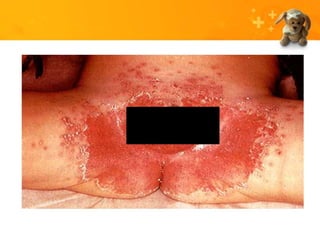
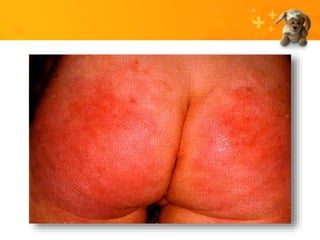
Starts off in the deep flexures which show wide
spread erythema on the buttocks-beefy red color.
There are also raised edge, sharp marginization
and white scale at the border of lesions, with pin
point pustulo-vesicular satellite lesions
Candidal Dermatitis
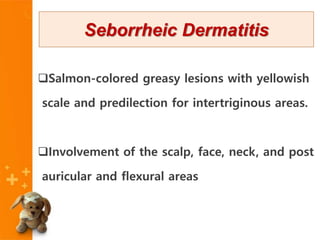
Salmon-colored greasy lesions with yellowish
scale and predilection for intertriginous areas.
Involvement of the scalp, face, neck, and post
auricular and flexural areas
Seborrheic Dermatitis
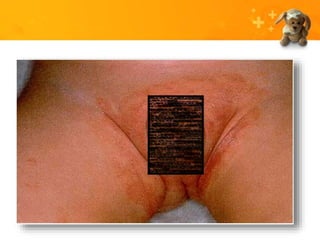
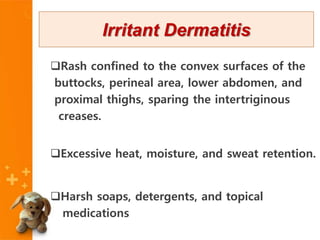
Rash confined to the convex surfaces of the
buttocks, perineal area, lower abdomen, and
proximal thighs, sparing the intertriginous
creases.
Excessive heat, moisture, and sweat retention.
Harsh soaps, detergents, and topical
medications
Irritant Dermatitis
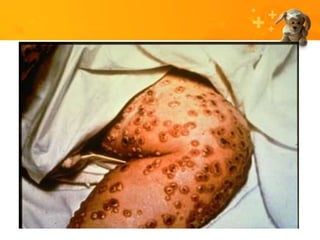
 Variola viruses ,Fatality 40 %.
First invades upper respiratory tract.
From lymph nodes it spreads via hematogenous
spread.
Chills, fever, headache, delirium, SZ.
 Face to upper arms and trunk, and finally to
lower legs
Smallpox- Variola
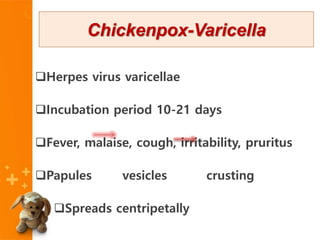
Herpes virus varicellae
Incubation period 10-21 days
Fever, malaise, cough, irritability, pruritus
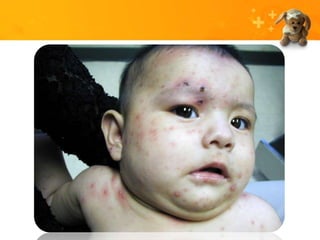
Papules vesicles crusting
Spreads centripetally
Chickenpox-Varicella
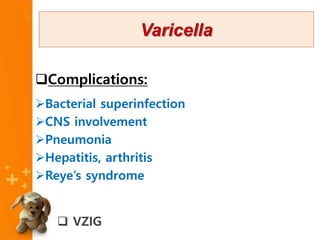
Complications:
Bacterial superinfection
CNS involvement
Pneumonia
Hepatitis, arthritis
Reye’s syndrome
 VZIG
Varicella
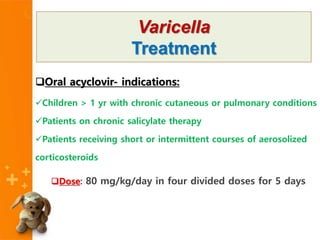
Oral acyclovir- indications:
Children > 1 yr with chronic cutaneous or pulmonary conditions
Patients on chronic salicylate therapy
Patients receiving short or intermittent courses of aerosolized
corticosteroids
Dose: 80 mg/kg/day in four divided doses for 5 days
Varicella
Treatment
VZIG (1 vial/5 kg IM) :
Pts on high dose steroids
Immunocompromised
Pregnant women
Newborns exposed 5 days prior to birth and 2 days
after delivery
Neonates born to nonimmune mothers
Varicella
Post exposure
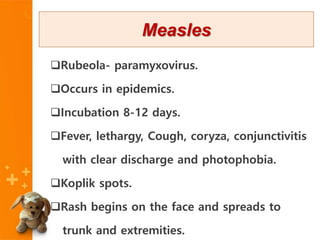
Rubeola- paramyxovirus.
Occurs in epidemics.
Incubation 8-12 days.
Fever, lethargy, Cough, coryza, conjunctivitis
with clear discharge and photophobia.
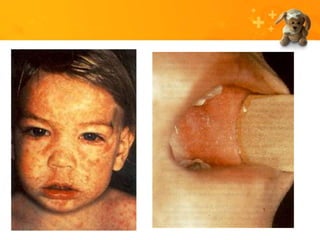
Koplik spots.
Rash begins on the face and spreads to
trunk and extremities.
Measles
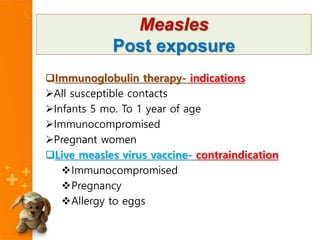
Immunoglobulin therapy- indications
All susceptible contacts
Infants 5 mo. To 1 year of age
Immunocompromised
Pregnant women
Live measles virus vaccine- contraindication
Immunocompromised
Pregnancy
Allergy to eggs
Measles
Post exposure
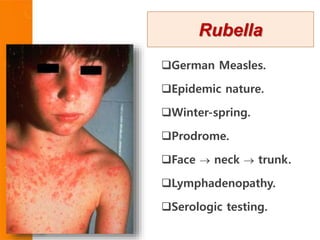
German Measles.
Epidemic nature.
Winter-spring.
Prodrome.
Face  neck  trunk.
Lymphadenopathy.
Serologic testing.
Rubella
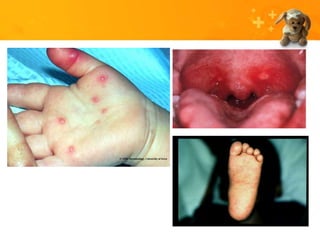
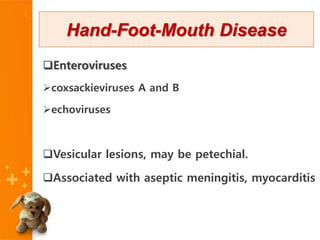
Enteroviruses
coxsackieviruses A and B
echoviruses
Vesicular lesions, may be petechial.
Associated with aseptic meningitis, myocarditis
Hand-Foot-Mouth Disease
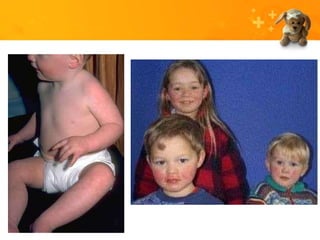
Fifth disease
Mildly contagious, parvovirus B-19
Pre-school and young school-age children
Prodrome: mild malaise
Rash: “slapped cheek”, circumoral pallor,
peripheral mild macular distribution
Erythema Infectiosum
Roseola Infantum(HHV-6B)
Children 6-19 months
Abrupt onset of high fever
Febrile seizures
Rash develops after fever dissipates
Mainly on trunk
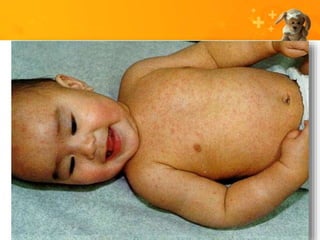
Exanthem Subitum
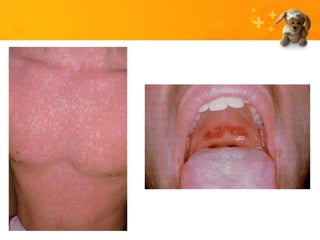
Acute, self limited illness
Epstein-Barr virus
Oral transmission – incubation 30-50 days
Fever, fatigue, pharyngitis, LA, splenomegaly,
atypical lymphocytosis
Exanthem is seen in 10-15%
Erythematous, maculopapular, morbilliform,
scarlatiniform, urticarial, hemorrhagic, or even
nodular
Infectious Mononucleosis
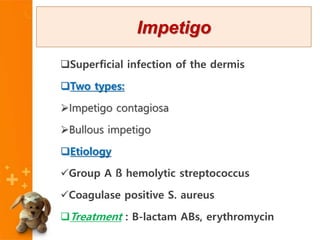
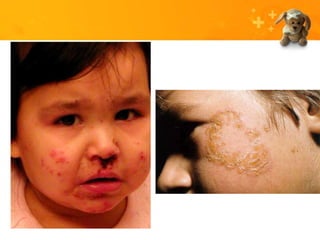
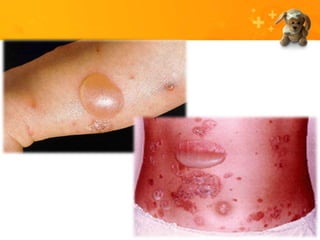
Superficial infection of the dermis
Two types:
Impetigo contagiosa
Bullous impetigo
Etiology
Group A ß hemolytic streptococcus
Coagulase positive S. aureus
Treatment : B-lactam ABs, erythromycin
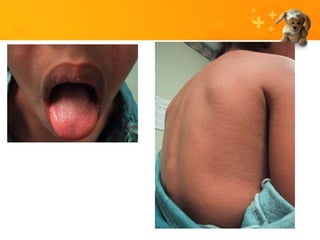
Impetigo
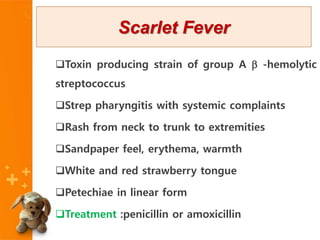
Toxin producing strain of group A  -hemolytic
streptococcus
Strep pharyngitis with systemic complaints
Rash from neck to trunk to extremities
Sandpaper feel, erythema, warmth
White and red strawberry tongue
Petechiae in linear form
Treatment :penicillin or amoxicillin
Scarlet Fever
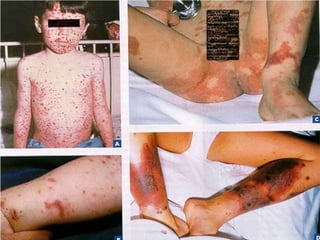
Usually sudden onset of fever,chills, myalgia,and
arthralgia
Rash is macular, nonpruritic, erythematous
lesions
Petechial rash develops in 75% of cases
Neisseria meningitides
Fever, rash, hypotension, shock, DIC
Treatment: PCN G
Meningococcemia
Most common rickettsial infection in US
Abrupt fever, headache, and myalgia
Rash from extremities towards trunk
Macules  petechiae
Treatment
Tetracycline
Doxycycline
Chloramphenicol
Rocky Mountain Spotted Fever
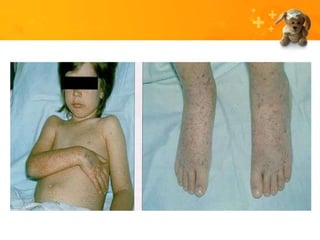
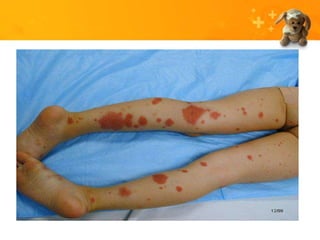
No clear etiologic agent, often post viral
2-10 years of age
Palpable purpura over the buttocks and LE
Transient migratory arthritis
Renal and GI involvement
Henoch-Schnlein Purpura
Unknown etiology
Peak incidence 18-24 months
Clinical findings:
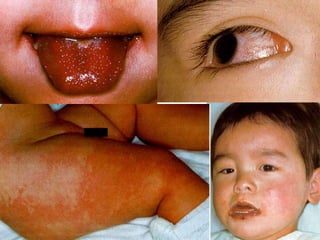
Fever for at least five days
Conjunctivitis
Polymorphous rash
Oral cavity changes
Cervical adenopathy
Kawasaki Syndrome
Common pediatric skin rash

Common pediatric skin rash

  • 3.
    Common dermatology terms Macule:circumscribed change in skin color without elevation or depression. Papule: solid elevated lesion usually <0.5 cm in diameter. Plaque: raised lesion >0.5cm in diameter Wheal (hive): rounded or flat-topped elevated lesion formed by local dermal edema. Purpura: non-blanching erythema or violaceous color due to extravasation of blood. Nodule: palpable solid lesion of varying size Vesicle: circumscribed elevated lesion which contains free fluid and is <0.5 cm in diameter Bulla (blister): same as vesicle but with diameter >0.5 cm. Cyst: sac containing liquid or semisolid material usually in the dermis. Pustule: circumscribed elevated lesion which contains pus Abscess: collection of pus in the dermis or subcutis.
  • 4.
  • 6.
    Erythema Toxicum Neonatorum Hugetitle - harmless skin condition Erythematous macule with a central tiny papule, seen anywhere - except the palms and soles. The lesions are packed with eosinophils, and there may be accompanying eosinophilia in the blood count. The cause is unknown, and no treatment is required as the rash disappears after 1-2 weeks. .
  • 7.
  • 8.
    Prickly heat, sweatrash. Many red macules with central papules, vesicl es or pustules are present. These may be on the trunk, diaper area, head or neck. Miliaria
  • 9.
  • 10.
    Self limited, benigncondition. Sharply demarcated reddish to violaceous plaques or nodules. Etiology uncertain. Onset first few days- weeks of life. Cheeks, back, buttocks, arms, and thighs. Subcutaneous Fat Necrosis
  • 11.
  • 12.
    Cause is unknown Red,itchy papules and plaques that ooze and crust Sites of Predilection Face in the young Extensor surfaces of the arms and legs 8-10 mo. Antecubital and popliteal fossa, neck, face in older Infantile Atopic Dermatitis
  • 13.
  • 14.
  • 15.
    Avoidance or eliminationof predisposing factors. Hydration and lubrication of dry skin. Anti-pruritic agents. Topical steroids. Eczema- Treatment
  • 16.
    Common, generally self-limiting. Itscause remains ill-understood. There is a genetic predisposition. Most frequent between the ages of 1:6 mo. Greasy, salmon-colored scaling eruption. Hair-bearing and intertriginous areas. The rash causes no discomfort or itching. Seborrheic Dermatitis
  • 17.
  • 18.
  • 19.
  • 21.
    Starts off inthe deep flexures which show wide spread erythema on the buttocks-beefy red color. There are also raised edge, sharp marginization and white scale at the border of lesions, with pin point pustulo-vesicular satellite lesions Candidal Dermatitis
  • 23.
    Salmon-colored greasy lesionswith yellowish scale and predilection for intertriginous areas. Involvement of the scalp, face, neck, and post auricular and flexural areas Seborrheic Dermatitis
  • 25.
    Rash confined tothe convex surfaces of the buttocks, perineal area, lower abdomen, and proximal thighs, sparing the intertriginous creases. Excessive heat, moisture, and sweat retention. Harsh soaps, detergents, and topical medications Irritant Dermatitis
  • 28.
     Variola viruses,Fatality 40 %. First invades upper respiratory tract. From lymph nodes it spreads via hematogenous spread. Chills, fever, headache, delirium, SZ.  Face to upper arms and trunk, and finally to lower legs Smallpox- Variola
  • 30.
    Herpes virus varicellae Incubationperiod 10-21 days Fever, malaise, cough, irritability, pruritus Papules vesicles crusting Spreads centripetally Chickenpox-Varicella
  • 32.
  • 33.
    Oral acyclovir- indications: Children> 1 yr with chronic cutaneous or pulmonary conditions Patients on chronic salicylate therapy Patients receiving short or intermittent courses of aerosolized corticosteroids Dose: 80 mg/kg/day in four divided doses for 5 days Varicella Treatment
  • 34.
    VZIG (1 vial/5kg IM) : Pts on high dose steroids Immunocompromised Pregnant women Newborns exposed 5 days prior to birth and 2 days after delivery Neonates born to nonimmune mothers Varicella Post exposure
  • 35.
    Rubeola- paramyxovirus. Occurs inepidemics. Incubation 8-12 days. Fever, lethargy, Cough, coryza, conjunctivitis with clear discharge and photophobia. Koplik spots. Rash begins on the face and spreads to trunk and extremities. Measles
  • 37.
    Immunoglobulin therapy- indications Allsusceptible contacts Infants 5 mo. To 1 year of age Immunocompromised Pregnant women Live measles virus vaccine- contraindication Immunocompromised Pregnancy Allergy to eggs Measles Post exposure
  • 38.
    German Measles. Epidemic nature. Winter-spring. Prodrome. Face neck  trunk. Lymphadenopathy. Serologic testing. Rubella
  • 39.
    Enteroviruses coxsackieviruses A andB echoviruses Vesicular lesions, may be petechial. Associated with aseptic meningitis, myocarditis Hand-Foot-Mouth Disease
  • 41.
    Fifth disease Mildly contagious,parvovirus B-19 Pre-school and young school-age children Prodrome: mild malaise Rash: “slapped cheek”, circumoral pallor, peripheral mild macular distribution Erythema Infectiosum
  • 43.
    Roseola Infantum(HHV-6B) Children 6-19months Abrupt onset of high fever Febrile seizures Rash develops after fever dissipates Mainly on trunk Exanthem Subitum
  • 45.
    Acute, self limitedillness Epstein-Barr virus Oral transmission – incubation 30-50 days Fever, fatigue, pharyngitis, LA, splenomegaly, atypical lymphocytosis Exanthem is seen in 10-15% Erythematous, maculopapular, morbilliform, scarlatiniform, urticarial, hemorrhagic, or even nodular Infectious Mononucleosis
  • 48.
    Superficial infection ofthe dermis Two types: Impetigo contagiosa Bullous impetigo Etiology Group A ß hemolytic streptococcus Coagulase positive S. aureus Treatment : B-lactam ABs, erythromycin Impetigo
  • 51.
    Toxin producing strainof group A  -hemolytic streptococcus Strep pharyngitis with systemic complaints Rash from neck to trunk to extremities Sandpaper feel, erythema, warmth White and red strawberry tongue Petechiae in linear form Treatment :penicillin or amoxicillin Scarlet Fever
  • 53.
    Usually sudden onsetof fever,chills, myalgia,and arthralgia Rash is macular, nonpruritic, erythematous lesions Petechial rash develops in 75% of cases Neisseria meningitides Fever, rash, hypotension, shock, DIC Treatment: PCN G Meningococcemia
  • 55.
    Most common rickettsialinfection in US Abrupt fever, headache, and myalgia Rash from extremities towards trunk Macules  petechiae Treatment Tetracycline Doxycycline Chloramphenicol Rocky Mountain Spotted Fever
  • 57.
    No clear etiologicagent, often post viral 2-10 years of age Palpable purpura over the buttocks and LE Transient migratory arthritis Renal and GI involvement Henoch-Schnlein Purpura
  • 59.
    Unknown etiology Peak incidence18-24 months Clinical findings: Fever for at least five days Conjunctivitis Polymorphous rash Oral cavity changes Cervical adenopathy Kawasaki Syndrome