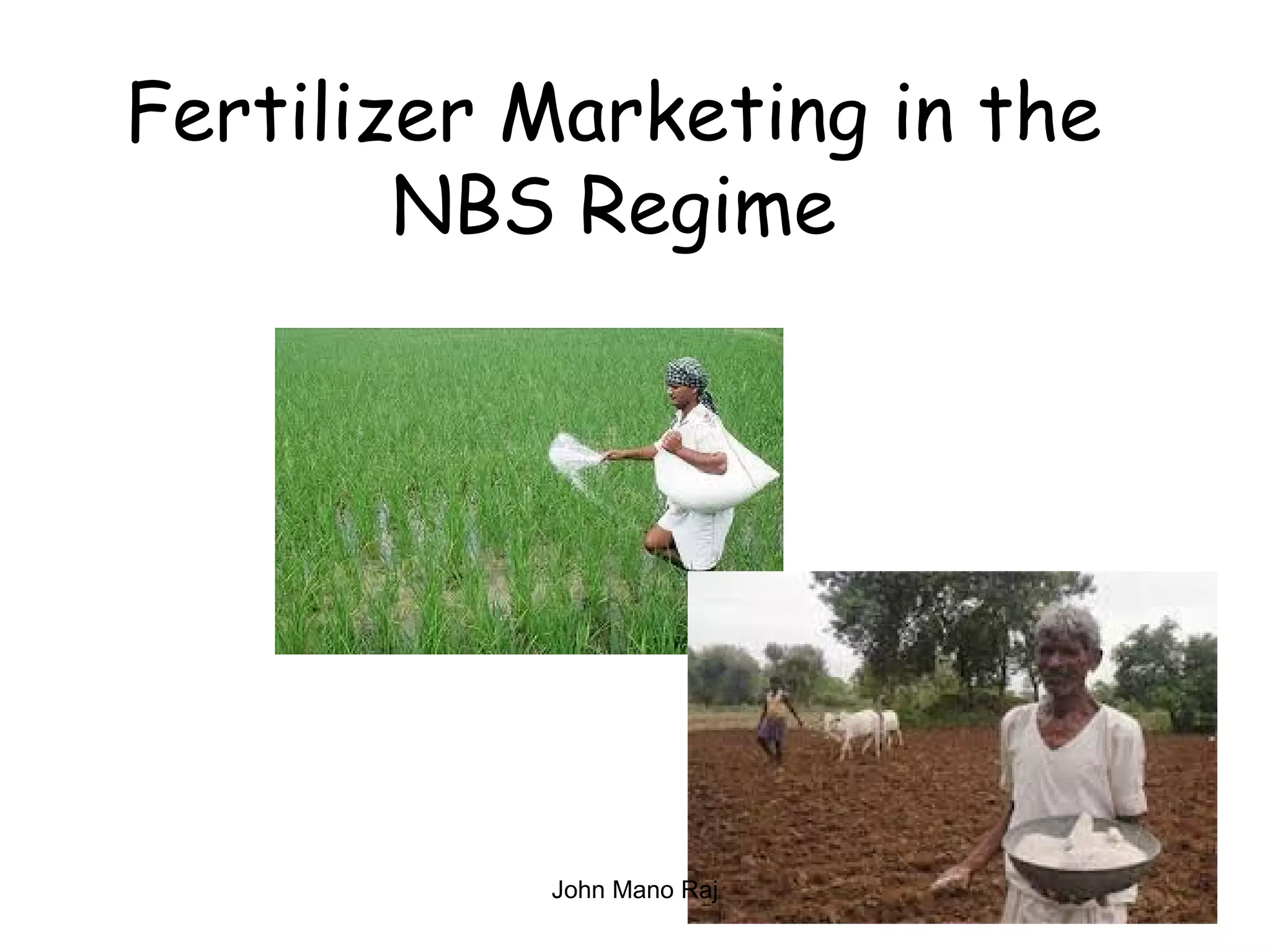
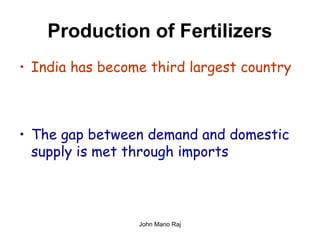
Fertilizer Marketing in the
NBS Regime
John Mano Raj
Production of Fertilizers
• India has become third largest country
• The gap between demand and domestic
supply is met through imports
John Mano Raj
Paradigm shift in Fertilizer
Sector in India
• Fertilizer consumption and food grain
production is closely correlated.
• Food grain production increasing
steadily, but de-growth during 2012 - 13
• At the present level of nutrition,
additional 150 million tons of food grain
production has to be achieved to feed
almost 1.5 billion people by 2040.
John Mano Raj
Fertilizer Consumption
• Urea and DAP are the most popular
fertilizers, accounting for 53 and 18 per cent
respectively, of the total fertilizer material
consumed in the country.
• Consumption of fertilizer nutrients per
hectare of gross cropped area in India is low
almost 1/4 - 1/3 to that of Netherlands,
Korea, Japan and Belgium.
• Even, within the country, there is large
variation in fertilizer use amongst different
States John Mano Raj
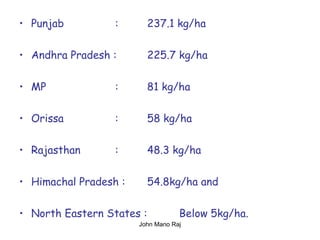
• Punjab : 237.1 kg/ha
• Andhra Pradesh : 225.7 kg/ha
• MP : 81 kg/ha
• Orissa : 58 kg/ha
• Rajasthan : 48.3 kg/ha
• Himachal Pradesh : 54.8kg/ha and
• North Eastern States : Below 5kg/ha.
John Mano Raj
John Mano Raj
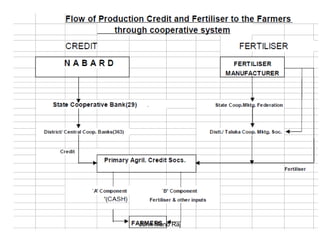
Fertilizer Distribution Channel
Fertilizers are produced at about 200
locations in the country and distributed
among the farmers scattered through
the length and breadth of the country
in about 6,27,000 villages through a
network comprising of private and
institutional channels.
John Mano Raj
Fertilizer Promotion
• Fertilizer promotion programmes lay
emphasizes on efficient and balanced use of
fertilizer application.
• Farmers Meetings, Crop Seminars, Field Days,
Farmers Training/ Visits, Farmers Camps,
Crop Demonstration/ Trials, Campaigns are
some of the activities carried out to educate
farmers about fertilizer use and crop
production technology
John Mano Raj
Policy Measures
• Department of Agriculture and
Cooperation (DAC) makes an assessment
of the requirement for major
fertilizers
• Fertilizer (Control) Order (FCO) under
ECA in 1957 to regulate the price,
quality and distribution of fertilizers in
the country
John Mano Raj
FCO provides
• Compulsory registration of fertilizer manufacturers,
importers and dealers
• The specification of all fertilizers manufactured or
imported and sold in the country
• Regulation of the manufacture of fertilizer mixtures;
packing and marking on the fertilizer bags
• Appointment of enforcement agencies
• Setting up of quality control laboratories and
• Prohibition on the manufacture and import and sale of
non-standard or spurious or adulterated fertilizers.John Mano Raj
The Central Fertilizer Committee meet
time to time to make necessary
amendment on FCO
Comprehensive and revised version of
FCO enacted in 1985
John Mano Raj
Fertilizer Movement Control Order 1973
• Movement between states under the
control of Government
• Prohibited export of fertilizer
• Farm gate price fixed by government
John Mano Raj
• Fertilizer Prices Committee 1976
• Recommended RPS
The Retention Price Scheme (RPS) for fertilizer Industry
introduced from 1.11.1977 and remained in force till
31.3.2003. Under the RPS Retention Price was fixed for each
unit by the Govt. The difference between the Retention Price
of Urea and the maximum retail price of urea was paid as
subsidy.
• Fertilizer Industry Coordination
Committee, 1977 administered theJohn Mano Raj
• Block Delivery Scheme 1980 – 81
• To ensure the availability of fertilizer
in the remote place
• Govt. allowed reimbursement of
secondary freight from railheads to
retail outlet
John Mano Raj
• In recent years, measures have been taken to render FCO into a more
dynamic instrument of nutrient management policy.
• Clause 20B has been added to allow for customized fertilizers in the
interest of site-specific nutrient management.
• Customized fertilizers of 36 grades have been included in FCO.
• To promote secondary and micro nutrients on a large scale, 9 fortified
fertilizers have been included in the FCO and the procedure for their
inclusion simplified.
• Procedure for inclusion of new fertilizers in the FCO has also been
simplified by dispensing with the requirement of multi-location trials if
the product is one of the variants of the products already included in
FCO.
• Five bio-fertilizers (rhizobium, azotobacter, azospirillum, phosphate
solubilizing bacteria and mycorrhizae) and three organic fertilizers
(city waste compost, vermi-compost and castor de-oiled cake) have
John Mano Raj
The recent policy changes
• nutrient-based pricing and subsidy (NBS)
• allowing additional cost of fortification and coating on
approved subsidized fertilizers to manufacturers (5-
10 per cent above the MRP)
• paying freight subsidy for all subsidized fertilizers
on an actual basis instead of uniform basis, and
• allowing higher rate of concession to single super
phosphate (SSP) fertilizer to revive the SSP industry
John Mano Raj
Policy Reforms in Fertilizer
• NBS since April 1, 2010
Reasons for NBS
• Imbalanced use of fertilizer
• Increasing micronutrient deficiency
• Skewed use of fertilizers in crops and areas
• Over dependence on limited fertilizer products
• Increase in fertilizer subsidy bill
• Stagnation in capacity
John Mano Raj
NBS
• Subsidy based on nutrient and not on
product
• Fixed subsidy and the farm gate price
decided by the co.
• Secondary and micronutrients attract
additional subsidy to encourage their
application alongwith primary nutrients.
John Mano Raj
NBS aims at….
• Increase in crop productivity
• Uniformity in pricing
• Balanced nutrition
• Correction in soil health
• Encouraging investment in fertilizer sector
• Innovation in new products (customized
fertilizer)
• Moving from commodity marketing to creating
brands.
• Increasing operational efficiencies to become
competitive in market
• Transformation in channels from sale counter to
agri service centre
John Mano Raj
John Mano Raj
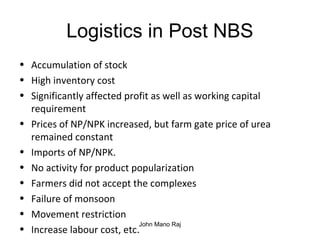
Logistics in Post NBS
• Accumulation of stock
• High inventory cost
• Significantly affected profit as well as working capital
requirement
• Prices of NP/NPK increased, but farm gate price of urea
remained constant
• Imports of NP/NPK.
• No activity for product popularization
• Farmers did not accept the complexes
• Failure of monsoon
• Movement restriction
• Increase labour cost, etc.
John Mano Raj
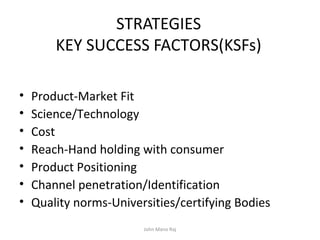
STRATEGIES
KEY SUCCESS FACTORS(KSFs)
• Product-Market Fit
• Science/Technology
• Cost
• Reach-Hand holding with consumer
• Product Positioning
• Channel penetration/Identification
• Quality norms-Universities/certifying Bodies
John Mano Raj
The Way Forward
• Soil test-based site-specific nutrient
management
• Initiatives on the setting up of
adequate capacity for soil testing and
for the adoption of information
technology based systems to generate
and communicate suitable advisories
based on soil test crop response data to
farmers in the country.
John Mano Raj
The Way Forward……
• An increase in consumption of
fertilizers would be combined with the
integrated nutrient management
approach.
• An emphasis on a balanced use of
fertilizers for optimum results would
simultaneously be promoted.
John Mano Raj
• Measures to increase the domestic
production of fertilizers as well as
secure imports at stable prices are
important
John Mano Raj
Marketing Implication
• 4Ps
John Mano Raj
John Mano Raj
John Mano Raj
Logistics Management
John Mano Raj
John Mano Raj
Challenges and Implications….
• Reducing the lead time
• Reducing the transit time
John Mano Raj
Logistics Performance Index
 Efficiency of the clearance process.
 Quality of transport and IT infrastructure for
logistics
 Ease and affordability of arranging international
and local shipments
 Competency of the logistics functions
 Ability to track and trace shipments
 Domestic logistics costs
 Timeliness of shipment in reaching the destination
John Mano Raj
Challenges and Implications
 Effective transportation and logistics
supported by excellent logistics information
system.
 Scheduling in accordance with demand and
supply.
 Tracing and tracking the vehicles. Use of
Radio Frequency Identification (RFID), Radio
Frequency Tags (RFT).
John Mano Raj
Challenges and Implications….
Environmental Issues
 Eco friendly packing
 Reusing of packing material
 Aesthetic value of packing
 Brand ambassador (silent sales man)
 Brand pull strategy
John Mano Raj
John Mano Raj
Brand promoter
 Farmers trust dealers far more than any
other source
 Dealers shape farmers’ opinion
 Multi-brand dealership
 Brand most pushed is most used by farmers
Innovative ideas to maintain dealer loyalty
John Mano Raj
Communicator
 Dealer plays the role of information
channel in addition to distribution
channel
Keep the dealer constantly informed
John Mano Raj
Market intelligence
 Proximity to the farmer
Formal and informal methods of getting market
related information
John Mano Raj
Advisor
Keep dealers informed about the latest
developments in farm practices
Training programmes, literature, help desks, etc.

Fertilizer Marketing in NBS Regime

  • 1.
    Fertilizer Marketing inthe NBS Regime John Mano Raj
  • 2.
    Production of Fertilizers •India has become third largest country • The gap between demand and domestic supply is met through imports John Mano Raj
  • 3.
    Paradigm shift inFertilizer Sector in India • Fertilizer consumption and food grain production is closely correlated. • Food grain production increasing steadily, but de-growth during 2012 - 13 • At the present level of nutrition, additional 150 million tons of food grain production has to be achieved to feed almost 1.5 billion people by 2040. John Mano Raj
  • 4.
    Fertilizer Consumption • Ureaand DAP are the most popular fertilizers, accounting for 53 and 18 per cent respectively, of the total fertilizer material consumed in the country. • Consumption of fertilizer nutrients per hectare of gross cropped area in India is low almost 1/4 - 1/3 to that of Netherlands, Korea, Japan and Belgium. • Even, within the country, there is large variation in fertilizer use amongst different States John Mano Raj
  • 5.
    • Punjab :237.1 kg/ha • Andhra Pradesh : 225.7 kg/ha • MP : 81 kg/ha • Orissa : 58 kg/ha • Rajasthan : 48.3 kg/ha • Himachal Pradesh : 54.8kg/ha and • North Eastern States : Below 5kg/ha. John Mano Raj
  • 6.
  • 7.
    Fertilizer Distribution Channel Fertilizersare produced at about 200 locations in the country and distributed among the farmers scattered through the length and breadth of the country in about 6,27,000 villages through a network comprising of private and institutional channels. John Mano Raj
  • 8.
    Fertilizer Promotion • Fertilizerpromotion programmes lay emphasizes on efficient and balanced use of fertilizer application. • Farmers Meetings, Crop Seminars, Field Days, Farmers Training/ Visits, Farmers Camps, Crop Demonstration/ Trials, Campaigns are some of the activities carried out to educate farmers about fertilizer use and crop production technology John Mano Raj
  • 9.
    Policy Measures • Departmentof Agriculture and Cooperation (DAC) makes an assessment of the requirement for major fertilizers • Fertilizer (Control) Order (FCO) under ECA in 1957 to regulate the price, quality and distribution of fertilizers in the country John Mano Raj
  • 10.
    FCO provides • Compulsoryregistration of fertilizer manufacturers, importers and dealers • The specification of all fertilizers manufactured or imported and sold in the country • Regulation of the manufacture of fertilizer mixtures; packing and marking on the fertilizer bags • Appointment of enforcement agencies • Setting up of quality control laboratories and • Prohibition on the manufacture and import and sale of non-standard or spurious or adulterated fertilizers.John Mano Raj
  • 11.
    The Central FertilizerCommittee meet time to time to make necessary amendment on FCO Comprehensive and revised version of FCO enacted in 1985 John Mano Raj
  • 12.
    Fertilizer Movement ControlOrder 1973 • Movement between states under the control of Government • Prohibited export of fertilizer • Farm gate price fixed by government John Mano Raj
  • 13.
    • Fertilizer PricesCommittee 1976 • Recommended RPS The Retention Price Scheme (RPS) for fertilizer Industry introduced from 1.11.1977 and remained in force till 31.3.2003. Under the RPS Retention Price was fixed for each unit by the Govt. The difference between the Retention Price of Urea and the maximum retail price of urea was paid as subsidy. • Fertilizer Industry Coordination Committee, 1977 administered theJohn Mano Raj
  • 14.
    • Block DeliveryScheme 1980 – 81 • To ensure the availability of fertilizer in the remote place • Govt. allowed reimbursement of secondary freight from railheads to retail outlet John Mano Raj
  • 15.
    • In recentyears, measures have been taken to render FCO into a more dynamic instrument of nutrient management policy. • Clause 20B has been added to allow for customized fertilizers in the interest of site-specific nutrient management. • Customized fertilizers of 36 grades have been included in FCO. • To promote secondary and micro nutrients on a large scale, 9 fortified fertilizers have been included in the FCO and the procedure for their inclusion simplified. • Procedure for inclusion of new fertilizers in the FCO has also been simplified by dispensing with the requirement of multi-location trials if the product is one of the variants of the products already included in FCO. • Five bio-fertilizers (rhizobium, azotobacter, azospirillum, phosphate solubilizing bacteria and mycorrhizae) and three organic fertilizers (city waste compost, vermi-compost and castor de-oiled cake) have John Mano Raj
  • 16.
    The recent policychanges • nutrient-based pricing and subsidy (NBS) • allowing additional cost of fortification and coating on approved subsidized fertilizers to manufacturers (5- 10 per cent above the MRP) • paying freight subsidy for all subsidized fertilizers on an actual basis instead of uniform basis, and • allowing higher rate of concession to single super phosphate (SSP) fertilizer to revive the SSP industry John Mano Raj
  • 17.
    Policy Reforms inFertilizer • NBS since April 1, 2010 Reasons for NBS • Imbalanced use of fertilizer • Increasing micronutrient deficiency • Skewed use of fertilizers in crops and areas • Over dependence on limited fertilizer products • Increase in fertilizer subsidy bill • Stagnation in capacity John Mano Raj
  • 18.
    NBS • Subsidy basedon nutrient and not on product • Fixed subsidy and the farm gate price decided by the co. • Secondary and micronutrients attract additional subsidy to encourage their application alongwith primary nutrients. John Mano Raj
  • 19.
    NBS aims at…. •Increase in crop productivity • Uniformity in pricing • Balanced nutrition • Correction in soil health • Encouraging investment in fertilizer sector • Innovation in new products (customized fertilizer) • Moving from commodity marketing to creating brands. • Increasing operational efficiencies to become competitive in market • Transformation in channels from sale counter to agri service centre John Mano Raj
  • 20.
  • 21.
    Logistics in PostNBS • Accumulation of stock • High inventory cost • Significantly affected profit as well as working capital requirement • Prices of NP/NPK increased, but farm gate price of urea remained constant • Imports of NP/NPK. • No activity for product popularization • Farmers did not accept the complexes • Failure of monsoon • Movement restriction • Increase labour cost, etc. John Mano Raj
  • 22.
    STRATEGIES KEY SUCCESS FACTORS(KSFs) •Product-Market Fit • Science/Technology • Cost • Reach-Hand holding with consumer • Product Positioning • Channel penetration/Identification • Quality norms-Universities/certifying Bodies John Mano Raj
  • 23.
    The Way Forward •Soil test-based site-specific nutrient management • Initiatives on the setting up of adequate capacity for soil testing and for the adoption of information technology based systems to generate and communicate suitable advisories based on soil test crop response data to farmers in the country. John Mano Raj
  • 24.
    The Way Forward…… •An increase in consumption of fertilizers would be combined with the integrated nutrient management approach. • An emphasis on a balanced use of fertilizers for optimum results would simultaneously be promoted. John Mano Raj
  • 25.
    • Measures toincrease the domestic production of fertilizers as well as secure imports at stable prices are important John Mano Raj
  • 26.
  • 27.
  • 28.
  • 29.
  • 30.
    John Mano Raj Challengesand Implications…. • Reducing the lead time • Reducing the transit time
  • 31.
    John Mano Raj LogisticsPerformance Index  Efficiency of the clearance process.  Quality of transport and IT infrastructure for logistics  Ease and affordability of arranging international and local shipments  Competency of the logistics functions  Ability to track and trace shipments  Domestic logistics costs  Timeliness of shipment in reaching the destination
  • 32.
    John Mano Raj Challengesand Implications  Effective transportation and logistics supported by excellent logistics information system.  Scheduling in accordance with demand and supply.  Tracing and tracking the vehicles. Use of Radio Frequency Identification (RFID), Radio Frequency Tags (RFT).
  • 33.
    John Mano Raj Challengesand Implications…. Environmental Issues  Eco friendly packing  Reusing of packing material  Aesthetic value of packing  Brand ambassador (silent sales man)
  • 34.
     Brand pullstrategy John Mano Raj
  • 35.
    John Mano Raj Brandpromoter  Farmers trust dealers far more than any other source  Dealers shape farmers’ opinion  Multi-brand dealership  Brand most pushed is most used by farmers Innovative ideas to maintain dealer loyalty
  • 36.
    John Mano Raj Communicator Dealer plays the role of information channel in addition to distribution channel Keep the dealer constantly informed
  • 37.
    John Mano Raj Marketintelligence  Proximity to the farmer Formal and informal methods of getting market related information
  • 38.
    John Mano Raj Advisor Keepdealers informed about the latest developments in farm practices Training programmes, literature, help desks, etc.