Industry Analysis
on
Industrial Fertilisers
INTRODUCTION
Fertilizers are substances that supply one or more of the
chemicals required for plant growth. Fertilizers can be both
organic and inorganic. As per industry experts it is said that
there are sixteen elements that are absolutely necessary for
plant growth. Out of these sixteen 9 elements are required in
large quantities while the other seven are needed in smaller
amounts.
The different types of chemical fertilizers are usually classified
according to the three principal elements, namely
• Nitrogen (N),
•Phosphorous (P) and
• Potassium (K),
and may, therefore, be included in more than
one group.
1. EVOLUTION AND GROWTH
 Evolution
• The fertilizer industry in India is extremely vital as it manufactures
some of the most important raw materials required for crop
production. The primary objective of this industry is to ensure the
inflow of both primary and secondary elements required for crop
production in the desirable quantities.
• The success of the agricultural sector in India is largely dependent on
the fertilizer industry. The benchmark that the food industry in India
has set is mainly due to the many technically competent fertilizer
producing companies in the country.
• India is home to numerous top class private and government
fertilizer companies. Ranging from fertilizers to seeds to fungicides
the many fertilizer companies in India are the major reason behind
the success story of the sector in India.
 Growth - at National Level
• A modest beginning with respect to manufacturing of chemical fertilizers was
made in 1906 when the first super-phosphate factory was set up at Ranipet in
Tamil Nadu.
• The setting up of the Sindri plant by the Fertilizer Corporation of India Ltd.
(FCI) in 1951 was a turning point.
• It is now one of the fastest growing basic industries which have taken rapid
strides in recent years. It produces a wide range of fertilizers to suit different
soil and crop requirements in different parts of the country. India is now the
third largest producer of nitrogenous fertilizers in the world.
• There are 57 fertilizer units manufacturing a wide range of nitrogenous and
complex fertilizers, including 29 units producing urea and 9 units producing
ammonia sulphate as a by-product.
A new impetus to the growth of Indian fertilizer Industry was provided
by the set up the two fertilizer plants Fertilizer and
i. Chemicals Travancore of Indian Limited (FACT) in Kerala
ii. the Fertilizer Corporation of India (FCI) in Bihar.
Indian fertilizer has reached international levels of capacity utilization
by adopting various strategies for increasing the productions of
fertilizers. These includes as under:
• Expansion and increase in efficiency through modernization and
revamping of existing fertilizer units.
• Using alternative source such as coal or liquefied natural gas for the
production of fertilizer especially urea.
• Reviving some of the closed fertilizers plants.
• Establishing joint venture projects with companies in countries.
Factors Influencing Growth
• Revenue and expense drive earnings
• Fertilizer Prices
• Fertilizers demand and purchase
• The cost of raw material input
• The impact of crop price on fertilizer stock
• Retail price
Industry Evolutionary Pattern
Distribution – (State wise)
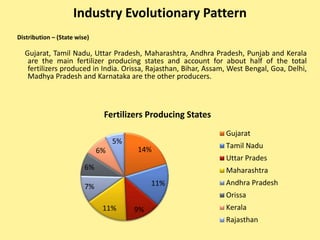
Gujarat, Tamil Nadu, Uttar Pradesh, Maharashtra, Andhra Pradesh, Punjab and Kerala
are the main fertilizer producing states and account for about half of the total
fertilizers produced in India. Orissa, Rajasthan, Bihar, Assam, West Bengal, Goa, Delhi,
Madhya Pradesh and Karnataka are the other producers.
14%
11%
9%11%
7%
6%
6%
5%
Fertilizers Producing States
Gujarat
Tamil Nadu
Uttar Prades
Maharashtra
Andhra Pradesh
Orissa
Kerala
Rajasthan
Existing Structure of the Fertilizer Industry
The fertilizer industry in India consists of three major
players:-
• Public Sector undertakings,
• Cooperative Societies like KRIBHCO, IFFCO
• Private sector.
The fertilizer industry has organized itself through Fertilizer
Association of India to coordinate with the Government of
India to achieve the macro-economic objectives related to
agricultural sector and to provide other services. Indian
fertilizer industry has succeeded in meeting almost fully the
demand of all chemical fertilizers .
Public Sector Undertakings
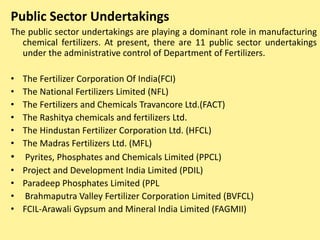
The public sector undertakings are playing a dominant role in manufacturing
chemical fertilizers. At present, there are 11 public sector undertakings
under the administrative control of Department of Fertilizers.
• The Fertilizer Corporation Of India(FCI)
• The National Fertilizers Limited (NFL)
• The Fertilizers and Chemicals Travancore Ltd.(FACT)
• The Rashitya chemicals and fertilizers Ltd.
• The Hindustan Fertilizer Corporation Ltd. (HFCL)
• The Madras Fertilizers Ltd. (MFL)
• Pyrites, Phosphates and Chemicals Limited (PPCL)
• Project and Development India Limited (PDIL)
• Paradeep Phosphates Limited (PPL
• Brahmaputra Valley Fertilizer Corporation Limited (BVFCL)
• FCIL-Arawali Gypsum and Mineral India Limited (FAGMII)
Cooperative Sector:
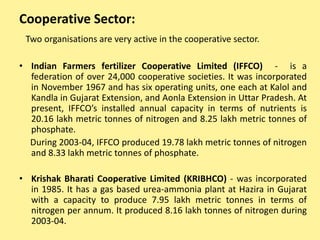
Two organisations are very active in the cooperative sector.
• Indian Farmers fertilizer Cooperative Limited (IFFCO) - is a
federation of over 24,000 cooperative societies. It was incorporated
in November 1967 and has six operating units, one each at Kalol and
Kandla in Gujarat Extension, and Aonla Extension in Uttar Pradesh. At
present, IFFCO’s installed annual capacity in terms of nutrients is
20.16 lakh metric tonnes of nitrogen and 8.25 lakh metric tonnes of
phosphate.
During 2003-04, IFFCO produced 19.78 lakh metric tonnes of nitrogen
and 8.33 lakh metric tonnes of phosphate.
• Krishak Bharati Cooperative Limited (KRIBHCO) - was incorporated
in 1985. It has a gas based urea-ammonia plant at Hazira in Gujarat
with a capacity to produce 7.95 lakh metric tonnes in terms of
nitrogen per annum. It produced 8.16 lakh tonnes of nitrogen during
2003-04.
Private Sector:
• A number of private companies are also engaged in
manufacturing fertilizers. Some of the important companies are
IEL (Kanpur), SRC (Kota), D.C.M. (Delhi), GNFC (Bharuch),
Coromandel, (Vishakhapatnam), ZACL (Goa), ЕГО Pary (Ennore),
GSFC (Vadodara), SPIC (Tuticorin) and MFC (Mangalore). Their
combined installed capacity is about 20 lakh tonnes per annum.
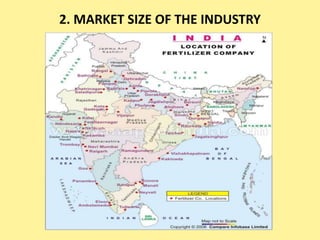
2. MARKET SIZE OF THE INDUSTRY
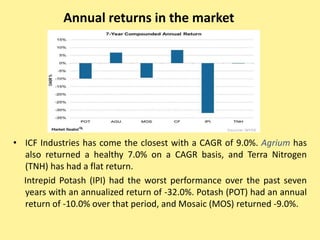
Annual returns in the market
• ICF Industries has come the closest with a CAGR of 9.0%. Agrium has
also returned a healthy 7.0% on a CAGR basis, and Terra Nitrogen
(TNH) has had a flat return.
Intrepid Potash (IPI) had the worst performance over the past seven
years with an annualized return of -32.0%. Potash (POT) had an annual
return of -10.0% over that period, and Mosaic (MOS) returned -9.0%.
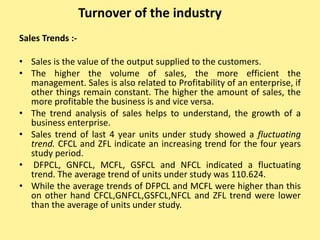
Turnover of the industry
Sales Trends :-
• Sales is the value of the output supplied to the customers.
• The higher the volume of sales, the more efficient the
management. Sales is also related to Profitability of an enterprise, if
other things remain constant. The higher the amount of sales, the
more profitable the business is and vice versa.
• The trend analysis of sales helps to understand, the growth of a
business enterprise.
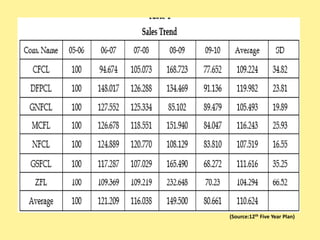
• Sales trend of last 4 year units under study showed a fluctuating
trend. CFCL and ZFL indicate an increasing trend for the four years
study period.
• DFPCL, GNFCL, MCFL, GSFCL and NFCL indicated a fluctuating
trend. The average trend of units under study was 110.624.
• While the average trends of DFPCL and MCFL were higher than this
on other hand CFCL,GNFCL,GSFCL,NFCL and ZFL trend were lower
than the average of units under study.
(Source:12th Five Year Plan)
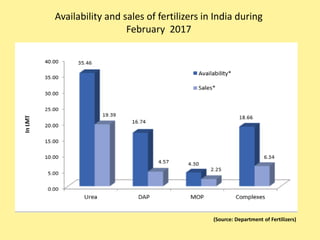
Availability and sales of fertilizers in India during
February 2017
(Source: Department of Fertilizers)
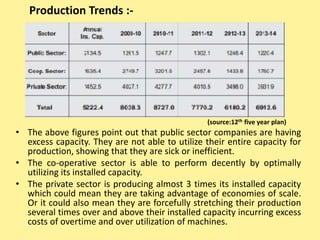
Production Trends :-
(source:12th five year plan)
• The above figures point out that public sector companies are having
excess capacity. They are not able to utilize their entire capacity for
production, showing that they are sick or inefficient.
• The co-operative sector is able to perform decently by optimally
utilizing its installed capacity.
• The private sector is producing almost 3 times its installed capacity
which could mean they are taking advantage of economies of scale.
Or it could also mean they are forcefully stretching their production
several times over and above their installed capacity incurring excess
costs of overtime and over utilization of machines.
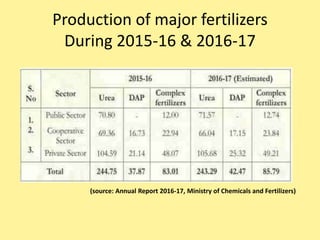
Production of major fertilizers
During 2015-16 & 2016-17
(source: Annual Report 2016-17, Ministry of Chemicals and Fertilizers)
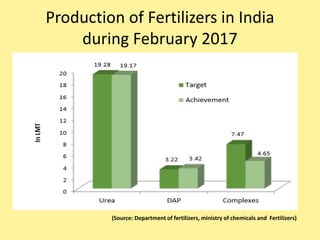
Production of Fertilizers in India
during February 2017
(Source: Department of fertilizers, ministry of chemicals and Fertilizers)
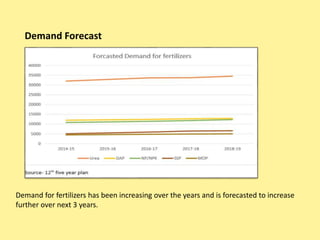
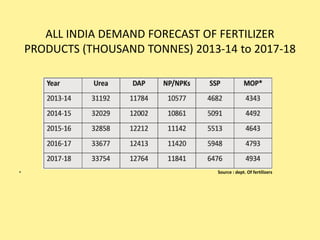
Demand Forecast
Demand for fertilizers has been increasing over the years and is forecasted to increase
further over next 3 years.
ALL INDIA DEMAND FORECAST OF FERTILIZER
PRODUCTS (THOUSAND TONNES) 2013-14 to 2017-18
• Source : dept. Of fertilizers
3. Composition and Product Mix
RAW MATERIALS:
• The fertilizers outlined here are compound fertilizers composed of primary
fertilizers and secondary nutrients.
• Primary fertilizers include substances derived from nitrogen, phosphorus,
and potassium.
• Secondary nutrients are added to some fertilizers to help make them more
effective.
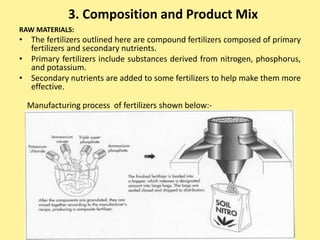
Manufacturing process of fertilizers shown below:-
Technology
TVA Development - Tennessee Valley Authority (TVA) developed
high-analysis fertilizers with high nutrient content as well as more
efficient manufacturing processes. The fertilizers include urea,
diammonium phosphate (DAP), triple superphosphate (TSP), sulfur-
coated urea, and liquid fertilizers. TVA improved the manufacturing
processes for ammonium nitrate and other products that help
commercial producers provide efficient fertilizers to farmers
worldwide. TVA's ammonium-granulation and bulk-blending
technologies improve the efficiency of the manufacture of many
mixed fertilizer grades. TVA generated most of the fluid fertilizer and
dry bulk-blending technology
• Innovative technology converts by-products into valuable fertilizers
The new patented ThyssenKrupp process combines the advantages
of high-value granular fertilizer with cost-efficient production.
4.Competitive Analysis
• The fertilizer industry is a global market with
high and increasing levels of concentration
and trade. - The top five countries control 50-
80 percent of the world’s production capacity
for the major nitrogen, phosphate and potash
fertilizer (IFDC, 2009). - Among the major
producing countries, the top four firms
generally control more than half of each
country’s production capacity
RESEARCH AND DEVELOPMENT
Current Status of R&D in Fertilizer Industry
• The number of fertilizer producers have full-fledged R&D centers like
GSFC Baroda, FEDO Cochin, SPIC Tuticorin, RCF Trombay, GNFC
Bharuch, DMCC Ambernath etc.
• Over the years a vast infrastructure has been created in the country,
which include a chain of national laboratories, universities and
specialized institutions.
• Number of major R&D programme appeared to have been taken up by
the public funded institutions, in the country.
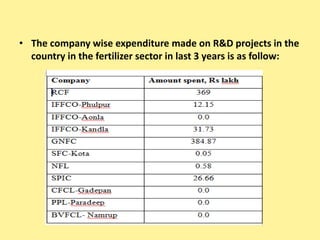
• The company wise expenditure made on R&D projects in the
country in the fertilizer sector in last 3 years is as follow:
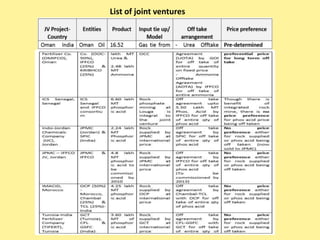
India and Global Players
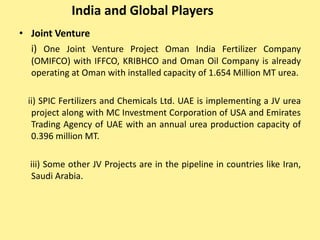
• Joint Venture
i) One Joint Venture Project Oman India Fertilizer Company
(OMIFCO) with IFFCO, KRIBHCO and Oman Oil Company is already
operating at Oman with installed capacity of 1.654 Million MT urea.
ii) SPIC Fertilizers and Chemicals Ltd. UAE is implementing a JV urea
project along with MC Investment Corporation of USA and Emirates
Trading Agency of UAE with an annual urea production capacity of
0.396 million MT.
iii) Some other JV Projects are in the pipeline in countries like Iran,
Saudi Arabia.
List of joint ventures
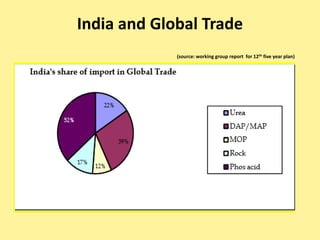
India and Global Trade
(source: working group report for 12th five year plan)
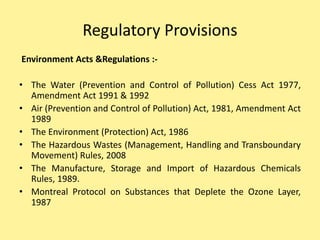
Regulatory Provisions
Environment Acts &Regulations :-
• The Water (Prevention and Control of Pollution) Cess Act 1977,
Amendment Act 1991 & 1992
• Air (Prevention and Control of Pollution) Act, 1981, Amendment Act
1989
• The Environment (Protection) Act, 1986
• The Hazardous Wastes (Management, Handling and Transboundary
Movement) Rules, 2008
• The Manufacture, Storage and Import of Hazardous Chemicals
Rules, 1989.
• Montreal Protocol on Substances that Deplete the Ozone Layer,
1987
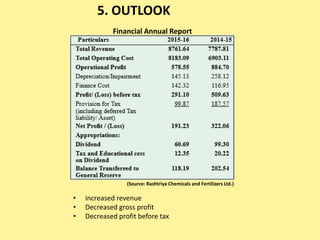
5. OUTLOOK
(Source: Rashtriya Chemicals and Fertilizers Ltd.)
• increased revenue
• Decreased gross profit
• Decreased profit before tax
Financial Annual Report
OPPORTUNITIES FOR NEW BUSINESS
OPERATIONS
Long Term R&D Proposals
- Development of Membrane based CO2 removal system in Ammonia
plant.
- Running of front end ammonia plant at high pressure and study of
performance of catalyst at higher pressure in PR, HT, and LT reactors
- Development of Synthesis catalyst for operating at lower pressure
- Incorporation of idea of Fuel Cell based power generation in
fertilizer plants
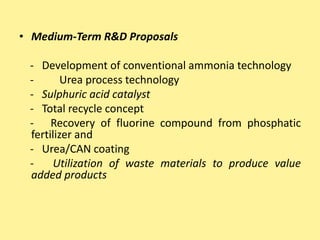
• Medium-Term R&D Proposals
- Development of conventional ammonia technology
- Urea process technology
- Sulphuric acid catalyst
- Total recycle concept
- Recovery of fluorine compound from phosphatic
fertilizer and
- Urea/CAN coating
- Utilization of waste materials to produce value
added products
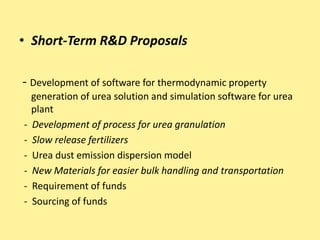
• Short-Term R&D Proposals
- Development of software for thermodynamic property
generation of urea solution and simulation software for urea
plant
- Development of process for urea granulation
- Slow release fertilizers
- Urea dust emission dispersion model
- New Materials for easier bulk handling and transportation
- Requirement of funds
- Sourcing of funds
INTRODUCTION OF NEW PRODUCTS
India: IFFCO produced water soluble fertilizers
• Now it has been announced that the giant fertilizer maker
Indian Farmers Fertiliser Cooperative Limited (IFFCO) is setting
up a 50 million tpa manufacturing plant at its Kandla unit in
the Kutch district (Gujarat). The output will be urea phosphate
It is usually applied through drip irrigation that cannot run on
partially soluble fertilizers.
• IFFCO produced in 2009-10 over 8 million tonnes fertilizers
and accounted for about 22% of the Indian nitrogen fertilizer
output and about 27% of the phosphate production.
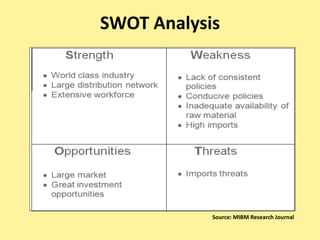
SWOT Analysis
Source: MIBM Research Journal
References:-
• FAI (2010-11), “Indian Fertilizer Industry Annual Report”,
Fertilizer Association of India.
• Foulke A. Roy (1968), Practical financial Statement Analysis,
Tata McGraw Hill, New Delhi.
• “ Indian fertiliser sector updates ” 2016, ICRA Limited.
• Government of India Ministry of Chemicals & Fertilizers ,
Department of Fertilizers
Industrial fertilizerrs ppt

Industrial fertilizerrs ppt

  • 1.
  • 2.
    INTRODUCTION Fertilizers are substancesthat supply one or more of the chemicals required for plant growth. Fertilizers can be both organic and inorganic. As per industry experts it is said that there are sixteen elements that are absolutely necessary for plant growth. Out of these sixteen 9 elements are required in large quantities while the other seven are needed in smaller amounts. The different types of chemical fertilizers are usually classified according to the three principal elements, namely • Nitrogen (N), •Phosphorous (P) and • Potassium (K), and may, therefore, be included in more than one group.
  • 3.
    1. EVOLUTION ANDGROWTH  Evolution • The fertilizer industry in India is extremely vital as it manufactures some of the most important raw materials required for crop production. The primary objective of this industry is to ensure the inflow of both primary and secondary elements required for crop production in the desirable quantities. • The success of the agricultural sector in India is largely dependent on the fertilizer industry. The benchmark that the food industry in India has set is mainly due to the many technically competent fertilizer producing companies in the country. • India is home to numerous top class private and government fertilizer companies. Ranging from fertilizers to seeds to fungicides the many fertilizer companies in India are the major reason behind the success story of the sector in India.
  • 4.
     Growth -at National Level • A modest beginning with respect to manufacturing of chemical fertilizers was made in 1906 when the first super-phosphate factory was set up at Ranipet in Tamil Nadu. • The setting up of the Sindri plant by the Fertilizer Corporation of India Ltd. (FCI) in 1951 was a turning point. • It is now one of the fastest growing basic industries which have taken rapid strides in recent years. It produces a wide range of fertilizers to suit different soil and crop requirements in different parts of the country. India is now the third largest producer of nitrogenous fertilizers in the world. • There are 57 fertilizer units manufacturing a wide range of nitrogenous and complex fertilizers, including 29 units producing urea and 9 units producing ammonia sulphate as a by-product.
  • 5.
    A new impetusto the growth of Indian fertilizer Industry was provided by the set up the two fertilizer plants Fertilizer and i. Chemicals Travancore of Indian Limited (FACT) in Kerala ii. the Fertilizer Corporation of India (FCI) in Bihar. Indian fertilizer has reached international levels of capacity utilization by adopting various strategies for increasing the productions of fertilizers. These includes as under: • Expansion and increase in efficiency through modernization and revamping of existing fertilizer units. • Using alternative source such as coal or liquefied natural gas for the production of fertilizer especially urea. • Reviving some of the closed fertilizers plants. • Establishing joint venture projects with companies in countries.
  • 6.
    Factors Influencing Growth •Revenue and expense drive earnings • Fertilizer Prices • Fertilizers demand and purchase • The cost of raw material input • The impact of crop price on fertilizer stock • Retail price
  • 7.
    Industry Evolutionary Pattern Distribution– (State wise) Gujarat, Tamil Nadu, Uttar Pradesh, Maharashtra, Andhra Pradesh, Punjab and Kerala are the main fertilizer producing states and account for about half of the total fertilizers produced in India. Orissa, Rajasthan, Bihar, Assam, West Bengal, Goa, Delhi, Madhya Pradesh and Karnataka are the other producers. 14% 11% 9%11% 7% 6% 6% 5% Fertilizers Producing States Gujarat Tamil Nadu Uttar Prades Maharashtra Andhra Pradesh Orissa Kerala Rajasthan
  • 8.
    Existing Structure ofthe Fertilizer Industry The fertilizer industry in India consists of three major players:- • Public Sector undertakings, • Cooperative Societies like KRIBHCO, IFFCO • Private sector. The fertilizer industry has organized itself through Fertilizer Association of India to coordinate with the Government of India to achieve the macro-economic objectives related to agricultural sector and to provide other services. Indian fertilizer industry has succeeded in meeting almost fully the demand of all chemical fertilizers .
  • 9.
    Public Sector Undertakings Thepublic sector undertakings are playing a dominant role in manufacturing chemical fertilizers. At present, there are 11 public sector undertakings under the administrative control of Department of Fertilizers. • The Fertilizer Corporation Of India(FCI) • The National Fertilizers Limited (NFL) • The Fertilizers and Chemicals Travancore Ltd.(FACT) • The Rashitya chemicals and fertilizers Ltd. • The Hindustan Fertilizer Corporation Ltd. (HFCL) • The Madras Fertilizers Ltd. (MFL) • Pyrites, Phosphates and Chemicals Limited (PPCL) • Project and Development India Limited (PDIL) • Paradeep Phosphates Limited (PPL • Brahmaputra Valley Fertilizer Corporation Limited (BVFCL) • FCIL-Arawali Gypsum and Mineral India Limited (FAGMII)
  • 10.
    Cooperative Sector: Two organisationsare very active in the cooperative sector. • Indian Farmers fertilizer Cooperative Limited (IFFCO) - is a federation of over 24,000 cooperative societies. It was incorporated in November 1967 and has six operating units, one each at Kalol and Kandla in Gujarat Extension, and Aonla Extension in Uttar Pradesh. At present, IFFCO’s installed annual capacity in terms of nutrients is 20.16 lakh metric tonnes of nitrogen and 8.25 lakh metric tonnes of phosphate. During 2003-04, IFFCO produced 19.78 lakh metric tonnes of nitrogen and 8.33 lakh metric tonnes of phosphate. • Krishak Bharati Cooperative Limited (KRIBHCO) - was incorporated in 1985. It has a gas based urea-ammonia plant at Hazira in Gujarat with a capacity to produce 7.95 lakh metric tonnes in terms of nitrogen per annum. It produced 8.16 lakh tonnes of nitrogen during 2003-04.
  • 11.
    Private Sector: • Anumber of private companies are also engaged in manufacturing fertilizers. Some of the important companies are IEL (Kanpur), SRC (Kota), D.C.M. (Delhi), GNFC (Bharuch), Coromandel, (Vishakhapatnam), ZACL (Goa), ЕГО Pary (Ennore), GSFC (Vadodara), SPIC (Tuticorin) and MFC (Mangalore). Their combined installed capacity is about 20 lakh tonnes per annum.
  • 12.
    2. MARKET SIZEOF THE INDUSTRY
  • 13.
    Annual returns inthe market • ICF Industries has come the closest with a CAGR of 9.0%. Agrium has also returned a healthy 7.0% on a CAGR basis, and Terra Nitrogen (TNH) has had a flat return. Intrepid Potash (IPI) had the worst performance over the past seven years with an annualized return of -32.0%. Potash (POT) had an annual return of -10.0% over that period, and Mosaic (MOS) returned -9.0%.
  • 14.
    Turnover of theindustry Sales Trends :- • Sales is the value of the output supplied to the customers. • The higher the volume of sales, the more efficient the management. Sales is also related to Profitability of an enterprise, if other things remain constant. The higher the amount of sales, the more profitable the business is and vice versa. • The trend analysis of sales helps to understand, the growth of a business enterprise. • Sales trend of last 4 year units under study showed a fluctuating trend. CFCL and ZFL indicate an increasing trend for the four years study period. • DFPCL, GNFCL, MCFL, GSFCL and NFCL indicated a fluctuating trend. The average trend of units under study was 110.624. • While the average trends of DFPCL and MCFL were higher than this on other hand CFCL,GNFCL,GSFCL,NFCL and ZFL trend were lower than the average of units under study.
  • 15.
  • 16.
    Availability and salesof fertilizers in India during February 2017 (Source: Department of Fertilizers)
  • 17.
    Production Trends :- (source:12thfive year plan) • The above figures point out that public sector companies are having excess capacity. They are not able to utilize their entire capacity for production, showing that they are sick or inefficient. • The co-operative sector is able to perform decently by optimally utilizing its installed capacity. • The private sector is producing almost 3 times its installed capacity which could mean they are taking advantage of economies of scale. Or it could also mean they are forcefully stretching their production several times over and above their installed capacity incurring excess costs of overtime and over utilization of machines.
  • 18.
    Production of majorfertilizers During 2015-16 & 2016-17 (source: Annual Report 2016-17, Ministry of Chemicals and Fertilizers)
  • 19.
    Production of Fertilizersin India during February 2017 (Source: Department of fertilizers, ministry of chemicals and Fertilizers)
  • 20.
    Demand Forecast Demand forfertilizers has been increasing over the years and is forecasted to increase further over next 3 years.
  • 21.
    ALL INDIA DEMANDFORECAST OF FERTILIZER PRODUCTS (THOUSAND TONNES) 2013-14 to 2017-18 • Source : dept. Of fertilizers
  • 22.
    3. Composition andProduct Mix RAW MATERIALS: • The fertilizers outlined here are compound fertilizers composed of primary fertilizers and secondary nutrients. • Primary fertilizers include substances derived from nitrogen, phosphorus, and potassium. • Secondary nutrients are added to some fertilizers to help make them more effective. Manufacturing process of fertilizers shown below:-
  • 23.
    Technology TVA Development -Tennessee Valley Authority (TVA) developed high-analysis fertilizers with high nutrient content as well as more efficient manufacturing processes. The fertilizers include urea, diammonium phosphate (DAP), triple superphosphate (TSP), sulfur- coated urea, and liquid fertilizers. TVA improved the manufacturing processes for ammonium nitrate and other products that help commercial producers provide efficient fertilizers to farmers worldwide. TVA's ammonium-granulation and bulk-blending technologies improve the efficiency of the manufacture of many mixed fertilizer grades. TVA generated most of the fluid fertilizer and dry bulk-blending technology • Innovative technology converts by-products into valuable fertilizers The new patented ThyssenKrupp process combines the advantages of high-value granular fertilizer with cost-efficient production.
  • 24.
    4.Competitive Analysis • Thefertilizer industry is a global market with high and increasing levels of concentration and trade. - The top five countries control 50- 80 percent of the world’s production capacity for the major nitrogen, phosphate and potash fertilizer (IFDC, 2009). - Among the major producing countries, the top four firms generally control more than half of each country’s production capacity
  • 25.
    RESEARCH AND DEVELOPMENT CurrentStatus of R&D in Fertilizer Industry • The number of fertilizer producers have full-fledged R&D centers like GSFC Baroda, FEDO Cochin, SPIC Tuticorin, RCF Trombay, GNFC Bharuch, DMCC Ambernath etc. • Over the years a vast infrastructure has been created in the country, which include a chain of national laboratories, universities and specialized institutions. • Number of major R&D programme appeared to have been taken up by the public funded institutions, in the country.
  • 26.
    • The companywise expenditure made on R&D projects in the country in the fertilizer sector in last 3 years is as follow:
  • 27.
    India and GlobalPlayers • Joint Venture i) One Joint Venture Project Oman India Fertilizer Company (OMIFCO) with IFFCO, KRIBHCO and Oman Oil Company is already operating at Oman with installed capacity of 1.654 Million MT urea. ii) SPIC Fertilizers and Chemicals Ltd. UAE is implementing a JV urea project along with MC Investment Corporation of USA and Emirates Trading Agency of UAE with an annual urea production capacity of 0.396 million MT. iii) Some other JV Projects are in the pipeline in countries like Iran, Saudi Arabia.
  • 28.
    List of jointventures
  • 29.
    India and GlobalTrade (source: working group report for 12th five year plan)
  • 30.
    Regulatory Provisions Environment Acts&Regulations :- • The Water (Prevention and Control of Pollution) Cess Act 1977, Amendment Act 1991 & 1992 • Air (Prevention and Control of Pollution) Act, 1981, Amendment Act 1989 • The Environment (Protection) Act, 1986 • The Hazardous Wastes (Management, Handling and Transboundary Movement) Rules, 2008 • The Manufacture, Storage and Import of Hazardous Chemicals Rules, 1989. • Montreal Protocol on Substances that Deplete the Ozone Layer, 1987
  • 31.
    5. OUTLOOK (Source: RashtriyaChemicals and Fertilizers Ltd.) • increased revenue • Decreased gross profit • Decreased profit before tax Financial Annual Report
  • 32.
    OPPORTUNITIES FOR NEWBUSINESS OPERATIONS Long Term R&D Proposals - Development of Membrane based CO2 removal system in Ammonia plant. - Running of front end ammonia plant at high pressure and study of performance of catalyst at higher pressure in PR, HT, and LT reactors - Development of Synthesis catalyst for operating at lower pressure - Incorporation of idea of Fuel Cell based power generation in fertilizer plants
  • 33.
    • Medium-Term R&DProposals - Development of conventional ammonia technology - Urea process technology - Sulphuric acid catalyst - Total recycle concept - Recovery of fluorine compound from phosphatic fertilizer and - Urea/CAN coating - Utilization of waste materials to produce value added products
  • 34.
    • Short-Term R&DProposals - Development of software for thermodynamic property generation of urea solution and simulation software for urea plant - Development of process for urea granulation - Slow release fertilizers - Urea dust emission dispersion model - New Materials for easier bulk handling and transportation - Requirement of funds - Sourcing of funds
  • 35.
    INTRODUCTION OF NEWPRODUCTS India: IFFCO produced water soluble fertilizers • Now it has been announced that the giant fertilizer maker Indian Farmers Fertiliser Cooperative Limited (IFFCO) is setting up a 50 million tpa manufacturing plant at its Kandla unit in the Kutch district (Gujarat). The output will be urea phosphate It is usually applied through drip irrigation that cannot run on partially soluble fertilizers. • IFFCO produced in 2009-10 over 8 million tonnes fertilizers and accounted for about 22% of the Indian nitrogen fertilizer output and about 27% of the phosphate production.
  • 36.

  • 37.
    References:- • FAI (2010-11),“Indian Fertilizer Industry Annual Report”, Fertilizer Association of India. • Foulke A. Roy (1968), Practical financial Statement Analysis, Tata McGraw Hill, New Delhi. • “ Indian fertiliser sector updates ” 2016, ICRA Limited. • Government of India Ministry of Chemicals & Fertilizers , Department of Fertilizers