SAC 602 – Advances in Soil Fertility (2+0)
INNOVATION IN FERTILIZER
APPLICATION
S. ASHOKH ARAVIND
2020602004
AGRONOMY
INTRODUCTION
• Technical and scientific advances have made the application of
fertilizers more efficient in recent years, and have helped farmers
maximize fertilizers' benefits while reducing risks of their over, under,
or misuse.
• Higher fertilizer consumption with lower fertilizer efficiency demands
for improved fertilizer application efficiency and uptake.
• However, not all farmers have access to cutting-edge technology,
which is why innovation should not only be seen in terms of
technological advances, but also include agricultural practices that
allow for a more precise application of inputs based on experience.
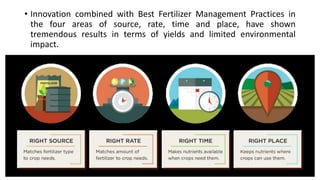
• Innovation combined with Best Fertilizer Management Practices in
the four areas of source, rate, time and place, have shown
tremendous results in terms of yields and limited environmental
impact.
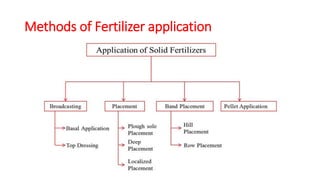
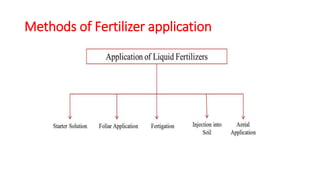
Methods of Fertilizer application
Emerging techniques
• Digital tools: Examples include “IPNI’s Nutrient Expert”, a software
introduced in several Asian countries to help crop advisors develop
site-specific nutrient management based on the 4R principles.
• Deep banding of fertilizer: i.e. applying fertilizers a few centimeters
below the surface, closer to the plants’ roots;
• Broadcasting & Split-applications: i.e. postponing the application of a
portion of the fertilizer to a later time to ensure a longer fertilization
period;
• Micro dosing techniques: This technique consists in applying small
quantities of fertilizers, by using bottle caps, either during planting or
3 – 4 weeks after plant emergence.
• Liquid applications
Nutrient Expert - International Plant
Nutrition Institute (IPNI) - Canada
• Nutrient Expert® is an easy-to-use, interactive, and computer-based decision
support tool that can rapidly provide nutrient recommendations for an individual
farmer field in the presence or absence of soil testing data.
• Uses the principles of SSNM and enables farm advisors to develop fertilizer
recommendations tailored to a specific field or growing environment.
• As a computer-based decision support tool, NE combines all the steps and
guidelines in SSNM into a simple software tailored for farm advisors
• Allows users to draw required information from their own experience, farmers’
knowledge of the local region and farmers’ practices. NE can use experimental
data but it can also estimate the required SSNM parameters using existing site
information.
• The parameters needed in SSNM are usually measured in nutrient omission trials
conducted in farmers’ fields, which require at least one crop season. With NE,
parameters can be estimated using proxy information, which allows farm advisors
to develop fertilizer guidelines for a location without data from field trials.
Smart Fertilizer Software
• Create your fertilization plan with our software. We offer solutions for both
farmers and large companies. Optimize your inputs, using just the right
amount of fertilizers that your crops need.
• Finds the ideal combination of fertilizers and their application rates
• All growing methods — open field, fertigation, greenhouses, hydroponics
• Provides complete fertilizer schedules, according to crop growth stages
• Integrates crop characteristics, field data and yield goals
• Balances nutrients in soil as well as in hydroponic nutrient solutions
• The unique algorithms make sure that you always reach a precise nutrient
balance
• Create your field, choose your crop and get your fertilization report
Fertilizer placement
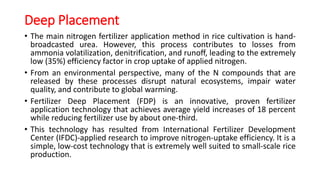
• Fertilizer placement is an integral part of efficient crop management.
Correct placement often improves the efficiency by which plants take up
nutrients and consequently encourages maximum yields of intensively
managed agronomic crops.
• Correct fertilizer placement is especially critical for maximum crop yields
under reduced tillage operations.
• Correct fertilizer placement can protect both surface and groundwater
quality. Subsurface banding of nitrogen (N) and phosphorus (P) fertilizers is
a best management practice (BMP) designed to protect surface water
quality by reducing potential erosional losses.
• Subsurface banding in many cases would also be a BMP for protecting
groundwater quality because plant N and P use efficiency increases. High
crop-use efficiency leaves less N in the soil to leach into groundwater.
Deep Placement
• The main nitrogen fertilizer application method in rice cultivation is hand-
broadcasted urea. However, this process contributes to losses from
ammonia volatilization, denitrification, and runoff, leading to the extremely
low (35%) efficiency factor in crop uptake of applied nitrogen.
• From an environmental perspective, many of the N compounds that are
released by these processes disrupt natural ecosystems, impair water
quality, and contribute to global warming.
• Fertilizer Deep Placement (FDP) is an innovative, proven fertilizer
application technology that achieves average yield increases of 18 percent
while reducing fertilizer use by about one-third.
• This technology has resulted from International Fertilizer Development
Center (IFDC)-applied research to improve nitrogen-uptake efficiency. It is a
simple, low-cost technology that is extremely well suited to small-scale rice
production.
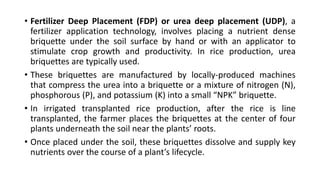
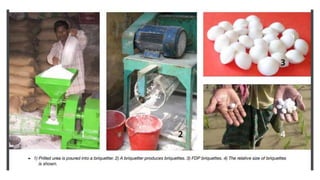
• Fertilizer Deep Placement (FDP) or urea deep placement (UDP), a
fertilizer application technology, involves placing a nutrient dense
briquette under the soil surface by hand or with an applicator to
stimulate crop growth and productivity. In rice production, urea
briquettes are typically used.
• These briquettes are manufactured by locally-produced machines
that compress the urea into a briquette or a mixture of nitrogen (N),
phosphorous (P), and potassium (K) into a small “NPK” briquette.
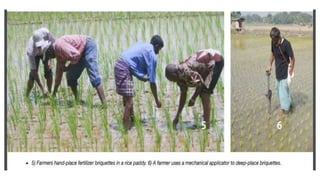
• In irrigated transplanted rice production, after the rice is line
transplanted, the farmer places the briquettes at the center of four
plants underneath the soil near the plants’ roots.
• Once placed under the soil, these briquettes dissolve and supply key
nutrients over the course of a plant’s lifecycle.
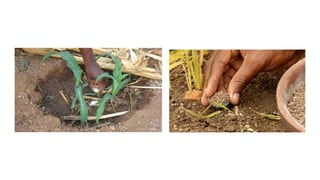
Microdosing - ICRISAT
• Microdosing, a strategic fertilizer placement technique developed by
CGIAR researchers at the ICRISAT and partners to increase fertilizer
use efficiency, reduce investment costs for resource-poor small-scale
farmers, and increase crop growth and productivity.
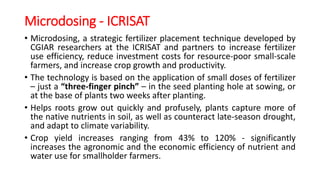
• The technology is based on the application of small doses of fertilizer
– just a “three-finger pinch” – in the seed planting hole at sowing, or
at the base of plants two weeks after planting.
• Helps roots grow out quickly and profusely, plants capture more of
the native nutrients in soil, as well as counteract late-season drought,
and adapt to climate variability.
• Crop yield increases ranging from 43% to 120% - significantly
increases the agronomic and the economic efficiency of nutrient and
water use for smallholder farmers.
• The evidence that micro-dosing could be a breakthrough method in
increasing fertilizer use in Africa is demonstrated by Mr. Tshuma, who
is one of the 170,000 households in Zimbabwe giving it a try.
• In Zimbabwe, ICRISAT used crop models to study the cost of micro-
dosing and how the practice works. The study found that, contrary to
conventional wisdom, even small amounts of fertilizer can increase
yields significantly.
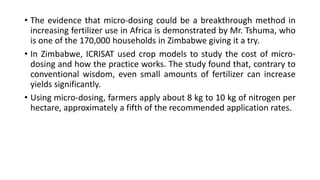
• Using micro-dosing, farmers apply about 8 kg to 10 kg of nitrogen per
hectare, approximately a fifth of the recommended application rates.
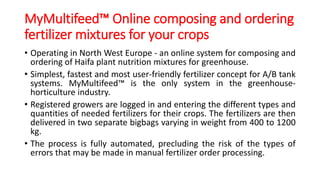
MyMultifeed™ Online composing and ordering
fertilizer mixtures for your crops
• Operating in North West Europe - an online system for composing and
ordering of Haifa plant nutrition mixtures for greenhouse.
• Simplest, fastest and most user-friendly fertilizer concept for A/B tank
systems. MyMultifeed™ is the only system in the greenhouse-
horticulture industry.
• Registered growers are logged in and entering the different types and
quantities of needed fertilizers for their crops. The fertilizers are then
delivered in two separate bigbags varying in weight from 400 to 1200
kg.
• The process is fully automated, precluding the risk of the types of
errors that may be made in manual fertilizer order processing.
Precision broadcaster - Cereal Systems
Initiative for South Asia (CSISA)
• Simply, a broadcasting equipment used in small scale areas.
• The zipper on top of the bag does not let the fertilizer spill out, or let water
in.
• Urea is evenly spread in the fields and crop establishment is even. The
spreader applies urea 4 meters on both sides covering the end of the field
boundary.
• 1 hour to fertilize 0.33 hectares of wheat - fertilized a total of 8.67 hectares
in 26 hours (a week) working around 3.5 hours per day.
• In contrast to hand broadcasting - 66 hours to fertilize the same field
(during a different season) at the rate of 2.5 hours for 0.33 hectares.
(Earthway Spreader 2750)
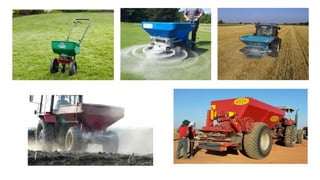
Fertilizer spreader
• A broadcast seeder, alternately called a broadcaster, broadcast
spreader or centrifugal fertilizer spreader (Europe), is a farm
implement commonly used for spreading seed, lime, fertilizer, sand,
ice melt, etc., and is an alternative to drop spreaders/seeders.
• There are 3 different types of machines, the use of one or the other
will mark the type of exploitation.
Fertilizer spreaders
Centrifugal spreaders
Pneumatic fertilizer spreaders
Fertigation
• Fertigation - benefits to users like high crop productivity and quality,
resource use efficiency, environmental safety, flexibility in
operations, effective weed management and successful crop
cultivation on fields with undulating topography.
• It is considered eco-friendly as it avoids leaching of nutrients
especially N-NO3.
• Water soluble fertilizers or liquid fertilizers are most suitable for
fertigation. Compatibility chart should be referred before mixing of
the two or more fertilizers.
• The initial cost is higher but in long term basis it is economical as
compared to conventional methods of fertilization as it brings down
the cost of cultivation by decreasing fertilizer requirement and
increasing the farm income by enhanced production.
Site-Specific Fertigation With Crop Monitoring
Different methods of fertigation for different situation - various types for
fertigation equipment’s - according to the crop type and irrigation systems.
Generally, fertilizer rates depend on multiple factors:
• Type of crop,
• Growth stage,
• Soil type,
• Fertilizer grade,
• Solution concentration,
• Soil moisture,
• Soil temperature,
• Osmotic potential,
• Fertigation effect on soil microbial biomass (microbial action).
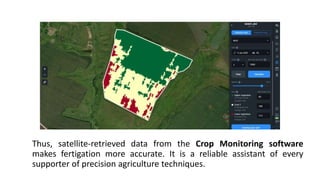
Thus, satellite-retrieved data from the Crop Monitoring software
makes fertigation more accurate. It is a reliable assistant of every
supporter of precision agriculture techniques.
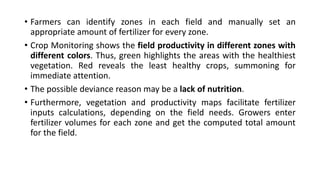
• Farmers can identify zones in each field and manually set an
appropriate amount of fertilizer for every zone.
• Crop Monitoring shows the field productivity in different zones with
different colors. Thus, green highlights the areas with the healthiest
vegetation. Red reveals the least healthy crops, summoning for
immediate attention.
• The possible deviance reason may be a lack of nutrition.
• Furthermore, vegetation and productivity maps facilitate fertilizer
inputs calculations, depending on the field needs. Growers enter
fertilizer volumes for each zone and get the computed total amount
for the field.
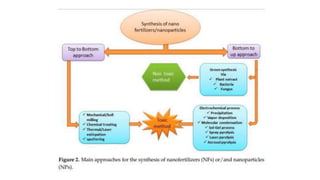
Nanofertilizer technology
• The term nanofertilizer indicates that the nanomaterial, which is either a
plant nutrient itself or the carrier of a plant nutrient, is termed a
nanofertilizer.
• Nutrients encapsulated or covered by nanomaterials are also called NFs.
• Increase soil fertility, the bioavailability of plant nutrients, and product
quality. Categorized into macro NFs, micro NFs, and nanoparticulate
fertilizers.
• NFs have large surface areas and a characteristic slow and steady release of
nutrients, both of which make them highly suitable for use in modern
agriculture.
• NFs developed from synthetic substances (i.e., modified forms of synthetic
fertilizers) or green synthesized from different parts of plants through
various chemical, mechanical, or biological methods using nanotechnology.
Conclusion
• Essential nutrients are required for growing healthy, productive and
nutritious crops.
• Fertilizers applied without consideration of the appropriate rate, timing,
source, and method, can have harmful effects on the environment and
human health.
• Agricultural nutrient cycles are open system with unavoidable loss –
objective to reduce losses.
• Integrated soil fertility management’ approach.
• “Enhanced Efficiency Fertilizer” (EEF) is a term for new formulations that
control fertilizer release or alter reactions that reduce nutrient losses to the
environment.
• EEFs and other next generation product technology innovations may be an
important addition to a system of conservation practices that help reduce
the impacts from row crop agriculture on the environment, while
maintaining or increasing agricultural productivity and profitability.
References
• https://agrilinks.org/events/fertilizer-deep-placement-technology-useful-tool-
food-security-improvement
• https://www.cgiar.org/innovations/fertilizer-microdosing/
• https://www.haifa-group.com/success-stories/multifeed-bigbag-%E2%80%93-
innovative-fertilizer-application-method
• https://csisa.org/precision-broadcasters-innovations-in-fertilizer-application/
• http://ecoursesonline.iasri.res.in/mod/page/view.php?id=219
• https://farmingfirst.org/2009/06/new-fertilizer-method/
• https://ingenaes.illinois.edu/wp-content/uploads/ING-Tech-Profile-2016-
Fertilizer-Deep-Placement-Bangladesh.pdf
• https://agricolacurtis.com/en/agricultural-fertilizer-spreaders-different-types-
and-operation/
• https://www.ctcn.org/sites/www.ctcn.org/files/resources/2013ifdcreport_vol
38no2_final_web.pdf

INNOVATIONS IN FERTILIZER APPLICATION.pptx

  • 1.
    SAC 602 –Advances in Soil Fertility (2+0) INNOVATION IN FERTILIZER APPLICATION S. ASHOKH ARAVIND 2020602004 AGRONOMY
  • 2.
    INTRODUCTION • Technical andscientific advances have made the application of fertilizers more efficient in recent years, and have helped farmers maximize fertilizers' benefits while reducing risks of their over, under, or misuse. • Higher fertilizer consumption with lower fertilizer efficiency demands for improved fertilizer application efficiency and uptake. • However, not all farmers have access to cutting-edge technology, which is why innovation should not only be seen in terms of technological advances, but also include agricultural practices that allow for a more precise application of inputs based on experience.
  • 3.
    • Innovation combinedwith Best Fertilizer Management Practices in the four areas of source, rate, time and place, have shown tremendous results in terms of yields and limited environmental impact.
  • 4.
  • 5.
  • 6.
    Emerging techniques • Digitaltools: Examples include “IPNI’s Nutrient Expert”, a software introduced in several Asian countries to help crop advisors develop site-specific nutrient management based on the 4R principles. • Deep banding of fertilizer: i.e. applying fertilizers a few centimeters below the surface, closer to the plants’ roots; • Broadcasting & Split-applications: i.e. postponing the application of a portion of the fertilizer to a later time to ensure a longer fertilization period; • Micro dosing techniques: This technique consists in applying small quantities of fertilizers, by using bottle caps, either during planting or 3 – 4 weeks after plant emergence. • Liquid applications
  • 7.
    Nutrient Expert -International Plant Nutrition Institute (IPNI) - Canada • Nutrient Expert® is an easy-to-use, interactive, and computer-based decision support tool that can rapidly provide nutrient recommendations for an individual farmer field in the presence or absence of soil testing data. • Uses the principles of SSNM and enables farm advisors to develop fertilizer recommendations tailored to a specific field or growing environment. • As a computer-based decision support tool, NE combines all the steps and guidelines in SSNM into a simple software tailored for farm advisors • Allows users to draw required information from their own experience, farmers’ knowledge of the local region and farmers’ practices. NE can use experimental data but it can also estimate the required SSNM parameters using existing site information. • The parameters needed in SSNM are usually measured in nutrient omission trials conducted in farmers’ fields, which require at least one crop season. With NE, parameters can be estimated using proxy information, which allows farm advisors to develop fertilizer guidelines for a location without data from field trials.
  • 8.
    Smart Fertilizer Software •Create your fertilization plan with our software. We offer solutions for both farmers and large companies. Optimize your inputs, using just the right amount of fertilizers that your crops need. • Finds the ideal combination of fertilizers and their application rates • All growing methods — open field, fertigation, greenhouses, hydroponics • Provides complete fertilizer schedules, according to crop growth stages • Integrates crop characteristics, field data and yield goals • Balances nutrients in soil as well as in hydroponic nutrient solutions • The unique algorithms make sure that you always reach a precise nutrient balance • Create your field, choose your crop and get your fertilization report
  • 9.
    Fertilizer placement • Fertilizerplacement is an integral part of efficient crop management. Correct placement often improves the efficiency by which plants take up nutrients and consequently encourages maximum yields of intensively managed agronomic crops. • Correct fertilizer placement is especially critical for maximum crop yields under reduced tillage operations. • Correct fertilizer placement can protect both surface and groundwater quality. Subsurface banding of nitrogen (N) and phosphorus (P) fertilizers is a best management practice (BMP) designed to protect surface water quality by reducing potential erosional losses. • Subsurface banding in many cases would also be a BMP for protecting groundwater quality because plant N and P use efficiency increases. High crop-use efficiency leaves less N in the soil to leach into groundwater.
  • 11.
    Deep Placement • Themain nitrogen fertilizer application method in rice cultivation is hand- broadcasted urea. However, this process contributes to losses from ammonia volatilization, denitrification, and runoff, leading to the extremely low (35%) efficiency factor in crop uptake of applied nitrogen. • From an environmental perspective, many of the N compounds that are released by these processes disrupt natural ecosystems, impair water quality, and contribute to global warming. • Fertilizer Deep Placement (FDP) is an innovative, proven fertilizer application technology that achieves average yield increases of 18 percent while reducing fertilizer use by about one-third. • This technology has resulted from International Fertilizer Development Center (IFDC)-applied research to improve nitrogen-uptake efficiency. It is a simple, low-cost technology that is extremely well suited to small-scale rice production.
  • 12.
    • Fertilizer DeepPlacement (FDP) or urea deep placement (UDP), a fertilizer application technology, involves placing a nutrient dense briquette under the soil surface by hand or with an applicator to stimulate crop growth and productivity. In rice production, urea briquettes are typically used. • These briquettes are manufactured by locally-produced machines that compress the urea into a briquette or a mixture of nitrogen (N), phosphorous (P), and potassium (K) into a small “NPK” briquette. • In irrigated transplanted rice production, after the rice is line transplanted, the farmer places the briquettes at the center of four plants underneath the soil near the plants’ roots. • Once placed under the soil, these briquettes dissolve and supply key nutrients over the course of a plant’s lifecycle.
  • 15.
    Microdosing - ICRISAT •Microdosing, a strategic fertilizer placement technique developed by CGIAR researchers at the ICRISAT and partners to increase fertilizer use efficiency, reduce investment costs for resource-poor small-scale farmers, and increase crop growth and productivity. • The technology is based on the application of small doses of fertilizer – just a “three-finger pinch” – in the seed planting hole at sowing, or at the base of plants two weeks after planting. • Helps roots grow out quickly and profusely, plants capture more of the native nutrients in soil, as well as counteract late-season drought, and adapt to climate variability. • Crop yield increases ranging from 43% to 120% - significantly increases the agronomic and the economic efficiency of nutrient and water use for smallholder farmers.
  • 16.
    • The evidencethat micro-dosing could be a breakthrough method in increasing fertilizer use in Africa is demonstrated by Mr. Tshuma, who is one of the 170,000 households in Zimbabwe giving it a try. • In Zimbabwe, ICRISAT used crop models to study the cost of micro- dosing and how the practice works. The study found that, contrary to conventional wisdom, even small amounts of fertilizer can increase yields significantly. • Using micro-dosing, farmers apply about 8 kg to 10 kg of nitrogen per hectare, approximately a fifth of the recommended application rates.
  • 18.
    MyMultifeed™ Online composingand ordering fertilizer mixtures for your crops • Operating in North West Europe - an online system for composing and ordering of Haifa plant nutrition mixtures for greenhouse. • Simplest, fastest and most user-friendly fertilizer concept for A/B tank systems. MyMultifeed™ is the only system in the greenhouse- horticulture industry. • Registered growers are logged in and entering the different types and quantities of needed fertilizers for their crops. The fertilizers are then delivered in two separate bigbags varying in weight from 400 to 1200 kg. • The process is fully automated, precluding the risk of the types of errors that may be made in manual fertilizer order processing.
  • 20.
    Precision broadcaster -Cereal Systems Initiative for South Asia (CSISA) • Simply, a broadcasting equipment used in small scale areas. • The zipper on top of the bag does not let the fertilizer spill out, or let water in. • Urea is evenly spread in the fields and crop establishment is even. The spreader applies urea 4 meters on both sides covering the end of the field boundary. • 1 hour to fertilize 0.33 hectares of wheat - fertilized a total of 8.67 hectares in 26 hours (a week) working around 3.5 hours per day. • In contrast to hand broadcasting - 66 hours to fertilize the same field (during a different season) at the rate of 2.5 hours for 0.33 hectares. (Earthway Spreader 2750)
  • 22.
    Fertilizer spreader • Abroadcast seeder, alternately called a broadcaster, broadcast spreader or centrifugal fertilizer spreader (Europe), is a farm implement commonly used for spreading seed, lime, fertilizer, sand, ice melt, etc., and is an alternative to drop spreaders/seeders. • There are 3 different types of machines, the use of one or the other will mark the type of exploitation. Fertilizer spreaders Centrifugal spreaders Pneumatic fertilizer spreaders
  • 24.
    Fertigation • Fertigation -benefits to users like high crop productivity and quality, resource use efficiency, environmental safety, flexibility in operations, effective weed management and successful crop cultivation on fields with undulating topography. • It is considered eco-friendly as it avoids leaching of nutrients especially N-NO3. • Water soluble fertilizers or liquid fertilizers are most suitable for fertigation. Compatibility chart should be referred before mixing of the two or more fertilizers. • The initial cost is higher but in long term basis it is economical as compared to conventional methods of fertilization as it brings down the cost of cultivation by decreasing fertilizer requirement and increasing the farm income by enhanced production.
  • 25.
    Site-Specific Fertigation WithCrop Monitoring Different methods of fertigation for different situation - various types for fertigation equipment’s - according to the crop type and irrigation systems. Generally, fertilizer rates depend on multiple factors: • Type of crop, • Growth stage, • Soil type, • Fertilizer grade, • Solution concentration, • Soil moisture, • Soil temperature, • Osmotic potential, • Fertigation effect on soil microbial biomass (microbial action).
  • 26.
    Thus, satellite-retrieved datafrom the Crop Monitoring software makes fertigation more accurate. It is a reliable assistant of every supporter of precision agriculture techniques.
  • 27.
    • Farmers canidentify zones in each field and manually set an appropriate amount of fertilizer for every zone. • Crop Monitoring shows the field productivity in different zones with different colors. Thus, green highlights the areas with the healthiest vegetation. Red reveals the least healthy crops, summoning for immediate attention. • The possible deviance reason may be a lack of nutrition. • Furthermore, vegetation and productivity maps facilitate fertilizer inputs calculations, depending on the field needs. Growers enter fertilizer volumes for each zone and get the computed total amount for the field.
  • 28.
    Nanofertilizer technology • Theterm nanofertilizer indicates that the nanomaterial, which is either a plant nutrient itself or the carrier of a plant nutrient, is termed a nanofertilizer. • Nutrients encapsulated or covered by nanomaterials are also called NFs. • Increase soil fertility, the bioavailability of plant nutrients, and product quality. Categorized into macro NFs, micro NFs, and nanoparticulate fertilizers. • NFs have large surface areas and a characteristic slow and steady release of nutrients, both of which make them highly suitable for use in modern agriculture. • NFs developed from synthetic substances (i.e., modified forms of synthetic fertilizers) or green synthesized from different parts of plants through various chemical, mechanical, or biological methods using nanotechnology.
  • 30.
    Conclusion • Essential nutrientsare required for growing healthy, productive and nutritious crops. • Fertilizers applied without consideration of the appropriate rate, timing, source, and method, can have harmful effects on the environment and human health. • Agricultural nutrient cycles are open system with unavoidable loss – objective to reduce losses. • Integrated soil fertility management’ approach. • “Enhanced Efficiency Fertilizer” (EEF) is a term for new formulations that control fertilizer release or alter reactions that reduce nutrient losses to the environment. • EEFs and other next generation product technology innovations may be an important addition to a system of conservation practices that help reduce the impacts from row crop agriculture on the environment, while maintaining or increasing agricultural productivity and profitability.
  • 31.
    References • https://agrilinks.org/events/fertilizer-deep-placement-technology-useful-tool- food-security-improvement • https://www.cgiar.org/innovations/fertilizer-microdosing/ •https://www.haifa-group.com/success-stories/multifeed-bigbag-%E2%80%93- innovative-fertilizer-application-method • https://csisa.org/precision-broadcasters-innovations-in-fertilizer-application/ • http://ecoursesonline.iasri.res.in/mod/page/view.php?id=219 • https://farmingfirst.org/2009/06/new-fertilizer-method/ • https://ingenaes.illinois.edu/wp-content/uploads/ING-Tech-Profile-2016- Fertilizer-Deep-Placement-Bangladesh.pdf • https://agricolacurtis.com/en/agricultural-fertilizer-spreaders-different-types- and-operation/ • https://www.ctcn.org/sites/www.ctcn.org/files/resources/2013ifdcreport_vol 38no2_final_web.pdf