



















FERTILIZER
LABORATORY
Baja- bahan yang ditambah pada
tanah untuk menjadikan tumbuhan
lebih subur.
Membekalkan nutrien seperti
N,K,P,Mg,B dan unsur kimia yang
berkaitan dengan proses
pembesaran tumbuhan.
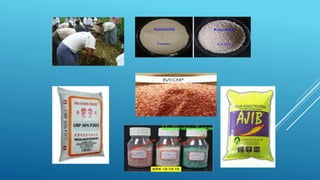
Jenis
baja
Baja tunggal
* 1 unsur nutrisi dan
kadangkala mempunyai
½ unsur kecil lain.
Baja sebatian
* Campuran beberapa
baja tunggal yang
dicampurkan secara
kimia.
Baja campuran
* Campuran beberapa
jenis baja tunggal secara
fizikal mengunakan
mesin.
 Memeriksa unsur-unsur seperti N,P,K,Mg dan B.
 Menjaga kualiti produk.
 Kawalan mutu.
 Memastikan kandungan nutrisi baja mencukupi untuk
dibekalkan kepada tumbuhan
 Memeriksa kelembapan baja.
 Memastikan spesifikasi nutrisi yang dilakukan oleh
pihak kilang dibenarkan oleh RISDA.
BAJA
Nitrogen (N)
*EA
*Buchi Distillation
Potassium (K)
*Spectrophoto
meter
*ICP
Magnesium (Mg)
*ICP
*ASS
Phosporus (P)
*Spectrophoto
meter
*ICP
Boron (B)
*Spectrophoto
meter
*ICP
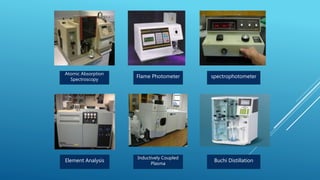
Atomic Absorption
Spectroscopy
Flame Photometer spectrophotometer
Element Analysis
Inductively Coupled
Plasma
Buchi Distillation
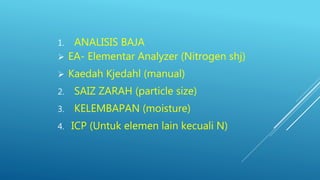
1. ANALISIS BAJA
 EA- Elementar Analyzer (Nitrogen shj)
 Kaedah Kjedahl (manual)
2. SAIZ ZARAH (particle size)
3. KELEMBAPAN (moisture)
4. ICP (Untuk elemen lain kecuali N)
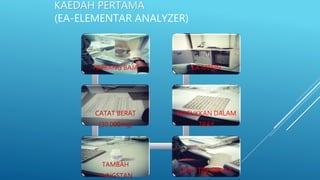
KAEDAH PERTAMA
(EA-ELEMENTAR ANALYZER)
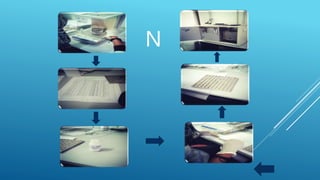
TIMBANG BAJA
CATAT BERAT
(30.000mg)
TAMBAH
TUNGSTAN
LIPAT TIN KAPSUL
MASUKKAN DALAM
TRAY
EA MESIN
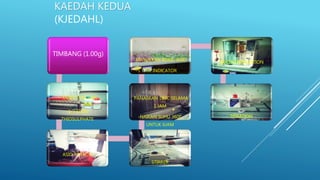
KAEDAH KEDUA
(KJEDAHL)
TIMBANG (1.00g)
- TABLET KJEDAHL
-1/2 SUDU
THIOSULPHATE
ASID TOTAL N
STIRRER
-PANASKAN 180C SELAMA
1 JAM
-NAIKAN SUHU 360C
UNTUK 6JAM
-MASUKKAN BORIC ASID
-5 TITIK INDICATOR (N)
BUCHI DISTILLATION
TITRATION
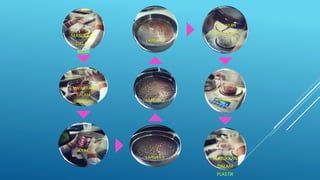
SAIZ ZARAH
(PARTICLE SIZE)
MASUKKAN
DALAM
BIKAR
MASUKKAN
DALAM
SARINGAN
AYAK
LAPISAN 1
LAPISAN 2
LAPISAN 3
MASUKKAN
DALAM BIKAR
TIMBANG
MASUKKAN
DALAM
PLASTIK
KELEMBAPAN
(MOISTURE)
TIMBANG BERAT PETRI DISH
TIMBANG BERAT BAJA
(10.00g)
MASUKKAN DALAM
DESSICATOR
MASUKKAN DALAM
KETUHAR (150℃)
MASUKKAN KE DALAM CATAT BERAT BARU BAGI
ICP
(UNTUK ELEMEN
LAIN KECUALI N)
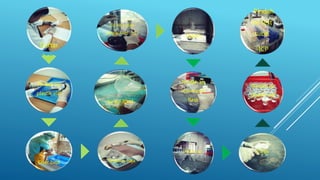
Daftar
baja
Pindah ke
plastik vial
Kisar baja Timbang baja
Isi air 70ml
Isi HCL dan
Nitrik Asid (2:1)
Digest
Pindah ke
volumetric
flask
Mark up Turas
Pindah ke
plastik vial
-Pindah
ke test
tube.
-ICP
RUMUSAN
NUTRIEN SUMBER KANDUNGAN
NUTRIEN (%)
FUNGSI
Nitrogen Urea (46% N) 1. Penting dalam pembentukan klorofil dan kehijauan daun
pokok untuk proses fotosintisis.
2. Membantu didalam pembentukan asid amino (protein)
dan enzim-enzim yang diperlukan oleh pokok.
3. Membantu pertumbuhan pokok.
4. Meningkatkan berat tandan.
Phosphorus Rock Phosphate (32% P2O5) 1. Membantu proses fotosintisis dan proses pemindahan
tenaga.
2. Merangsang pertumbuhan akar pokok.
3. Penting untuk proses pembiakan.
4. Meningkatkan berat tandan.
Potassium Muriate Of Potash
(MOP)
(60% K2O) 1. Membantu didalam proses kimia dalaman pokok seperti
pengeluaran enzim-enzim yang diperlukan oleh
pokok.
2. Mengawal keperluan air dan pengangkutan makanan
pokok.
3. Menguatkan ketahanan pokok dari penyakit.
Magnesium Oxide Magnesite
Kiesrite
(90% MgO)
(27% MgO)
1. Penting dalam proses pembentukan klorofil.
2. Komponen penting didalam ribosom dan pembuatan
protin.
Boron Borate (46% B2O5) 1. Komponen penting didalam proses penguraian
kabohidrat untuk keperluan pokok.
2. Penting untuk pengembangan sel dan tisu pokok.
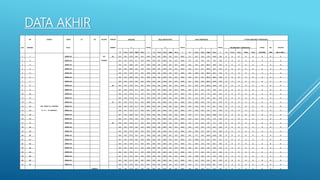
DATA AKHIR
NO. LOKASI JENIS LO DO KILANG JUMLAH ANALISIS NILAI SEPATUTNYA NILAI PERBEZAAN 1=TIDAK MENGIKUT SPESIFIKASI
QTT MAKMAL BAJA KAMPIT % TOTAL % TOTAL % TOTAL MS-MENGIKUT SPESIFIKASI TOTAL BIL STATUS
^N ^P2O5 ^K2O ^MgO ^B2O3 # ^N ^P2O5 ^K2O ^MgO ^B2O3 # ^N ^P2O5 ^K2O ^MgO ^B2O3 # ^N ^P2O5 ^K2O ^MgO ^B2O3 NUTRIEN TMS MS=0,TMS=1
1 1 RISDA 3Z ALL 30 8.9 5.6 17.6 2.0 0.4 34.5 9.0 6.0 18.0 2.0 0.5 35.5 -1.1 -6.7 -2.2 -2.5 -18.0 -2.9 0 0 0 0 0 0 0 0
2 2 RISDA 3Z COSMOS 8.3 5.9 17.2 2.1 0.5 34.0 9.0 6.0 18.0 2.0 0.5 35.5 -7.3 -1.8 -4.4 2.5 -4.0 -4.3 0 0 0 0 0 0 0 0
3 3 RISDA 3Z 8.4 5.7 16.8 2.5 0.5 33.9 9.0 6.0 18.0 2.0 0.5 35.5 -6.2 -5.8 -6.4 25.0 -10.0 -4.6 0 0 0 0 0 0 0 0
4 4 RISDA 3Z 8.5 5.8 16.9 2.6 0.5 34.2 9.0 6.0 18.0 2.0 0.5 35.5 -5.6 -3.7 -6.1 30.0 -8.0 -3.5 0 0 0 0 0 0 0 0
5 5 RISDA 3Z 8.5 5.4 17.2 2.4 0.5 34.0 9.0 6.0 18.0 2.0 0.5 35.5 -5.6 -10.2 -4.4 20.0 -8.0 -4.4 0 0 0 0 0 0 0 0
6 6 RISDA 3Z 8.6 5.5 16.8 2.5 0.4 33.8 9.0 6.0 18.0 2.0 0.5 35.5 -4.4 -8.7 -6.7 25.0 -16.6 -4.8 0 0 0 0 0 0 0 0
7 7 RISDA 3Z 8.5 5.5 17.5 2.6 0.4 34.5 9.0 6.0 18.0 2.0 0.5 35.5 -6.1 -8.0 -2.8 30.0 -12.0 -2.8 0 0 0 0 0 0 0 0
8 8 RISDA 3Z 28 8.4 5.5 17.6 2.4 0.4 34.3 9.0 6.0 18.0 2.0 0.5 35.5 -6.7 -8.8 -2.2 20.0 -12.0 -3.4 0 0 0 0 0 0 0 0
9 9 RISDA 3Z 8.7 5.6 17.2 2.1 0.5 34.1 9.0 6.0 18.0 2.0 0.5 35.5 -3.9 -6.7 -4.4 7.0 -6.0 -4.1 0 0 0 0 0 0 0 0
10 10 RISDA 3Z 8.6 5.6 17.5 2.1 0.5 34.3 9.0 6.0 18.0 2.0 0.5 35.5 -4.4 -6.8 -2.7 7.0 -8.0 -3.4 0 0 0 0 0 0 0 0
11 11 RISDA 3Z 8.4 5.8 17.2 2.1 0.5 34.0 9.0 6.0 18.0 2.0 0.5 35.5 -6.7 -3.3 -4.2 3.0 0.0 -4.2 0 0 0 0 0 0 0 0
12 12 RISDA 3Z 27 8.7 5.4 17.1 2.1 0.5 33.9 9.0 6.0 18.0 2.0 0.5 35.5 -2.9 -10.0 -4.8 7.0 2.0 -4.4 0 0 0 0 0 0 0 0
13 13 LDG. RISDA TG. GENTING RISDA 3Z 8.6 5.5 17.2 2.1 0.5 34.0 9.0 6.0 18.0 2.0 0.5 35.5 -4.4 -9.0 -4.4 7.0 8.0 -4.4 0 0 0 0 0 0 0 0
14 14 E 1 C 1 - 27 ABDFG(7) RISDA 3Z 8.6 5.7 17.3 2.1 0.5 34.1 9.0 6.0 18.0 2.0 0.5 35.5 -4.4 -5.5 -4.2 3.0 -2.2 -4.0 0 0 0 0 0 0 0 0
15 15 RISDA 3Z 8.7 5.5 16.9 2.2 0.4 33.8 9.0 6.0 18.0 2.0 0.5 35.5 -2.9 -7.7 -6.1 12.0 -16.0 -4.7 0 0 0 0 0 0 0 0
16 16 RISDA 3Z 8.6 5.7 17.2 2.0 0.5 34.1 9.0 6.0 18.0 2.0 0.5 35.5 -4.0 -5.3 -4.2 2.0 -1.0 -4.0 0 0 0 0 0 0 0 0
17 17 RISDA 3Z 25 8.6 5.5 17.6 2.1 0.5 34.3 9.0 6.0 18.0 2.0 0.5 35.5 -4.4 -7.9 -2.5 3.0 7.2 -3.5 0 0 0 0 0 0 0 0
18 18 RISDA 3Z 8.5 5.5 17.4 2.0 0.5 33.9 9.0 6.0 18.0 2.0 0.5 35.5 -5.6 -7.8 -3.3 -1.5 -6.6 -4.6 0 0 0 0 0 0 0 0
19 19 RISDA 3Z 8.4 5.5 17.3 2.0 0.5 33.7 9.0 6.0 18.0 2.0 0.5 35.5 -6.2 -9.0 -3.7 0.0 -2.0 -5.0 0 0 0 0 0 0 0 0
20 20 RISDA 3Z 8.6 5.5 17.2 2.2 0.4 34.0 9.0 6.0 18.0 2.0 0.5 35.5 -4.4 -7.7 -4.2 10.0 -12.0 -4.2 0 0 0 0 0 0 0 0
21 21 RISDA 3Z 8.7 5.4 17.4 2.0 0.5 34.0 9.0 6.0 18.0 2.0 0.5 35.5 -3.3 -10.0 -3.1 0.5 -4.0 -4.1 0 0 0 0 0 0 0 0
22 22 RISDA 3Z 8.5 5.5 17.4 2.1 0.5 34.1 9.0 6.0 18.0 2.0 0.5 35.5 -5.1 -8.0 -3.3 4.5 6.0 -4.0 0 0 0 0 0 0 0 0
23 23 RISDA 3S 8.5 5.5 17.5 2.1 0.5 34.0 9.0 6.0 18.0 2.0 0.5 35.5 -5.9 -8.7 -2.8 4.0 -2.0 -4.2 0 0 0 0 0 0 0 0
24 24 RISDA 3S 8.6 5.5 17.0 2.1 0.5 33.8 9.0 6.0 18.0 2.0 0.5 35.5 -4.4 -7.7 -5.3 4.5 5.4 -4.8 0 0 0 0 0 0 0 0
25 25 RISDA 3Z 8.7 5.4 17.1 2.2 0.5 33.9 9.0 6.0 18.0 2.0 0.5 35.5 -3.3 -10.0 -4.8 7.5 -4.0 -4.6 0 0 0 0 0 0 0 0
26 26 RISDA 3Z 8.5 5.8 17.1 2.0 0.5 33.9 9.0 6.0 18.0 2.0 0.5 35.5 -5.6 -3.3 -5.3 2.0 0.0 -4.5 0 0 0 0 0 0 0 0
27 27 RISDA 3Z 8.6 5.5 17.2 2.2 0.5 34.1 9.0 6.0 18.0 2.0 0.5 35.5 -4.0 -7.7 -4.4 12.0 0.0 -3.9 0 0 0 0 0 0 0 0
PURATA 8.6 5.6 17.2 2.2 0.5 34.1 9.0 6.0 18.0 2.0 0.5 35.5 -4.8 -6.9 -4.2 11.1 -6.2 -4.0 0 0 0 0 0 0 0 0
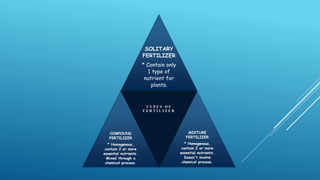
SOLITARY
FERTILIZER
* Contain only
1 type of
nutrient for
plants.
COMPOUND
FERTILIZER
* Homogenous,
contain 2 or more
essential nutrients.
Mixed through a
chemical process.
T Y P E S O F
F E R T I L I Z E R
MIXTURE
FERTILIZER
* Homogenous,
contain 2 or more
essential nutrients.
Doesn't involve
chemical process.
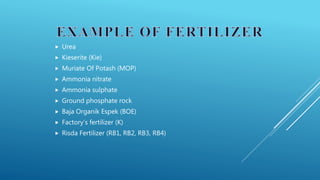
 Urea
 Kieserite (Kie)
 Muriate Of Potash (MOP)
 Ammonia nitrate
 Ammonia sulphate
 Ground phosphate rock
 Baja Organik Espek (BOE)
 Factory’s fertilizer (K)
 Risda Fertilizer (RB1, RB2, RB3, RB4)
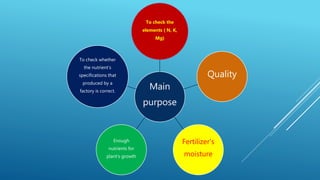
Main
purpose
To check the
elements ( N, K,
Mg)
Quality
Fertilizer’s
moisture
Enough
nutrients for
plant’s growth
To check whether
the nutrient’s
specifications that
produced by a
factory is correct.
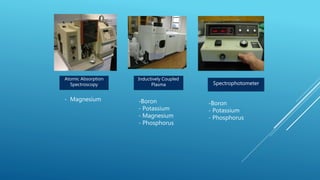
Atomic Absorption
Spectroscopy Spectrophotometer
Inductively Coupled
Plasma
- Magnesium -Boron
- Potassium
- Magnesium
- Phosphorus
-Boron
- Potassium
- Phosphorus
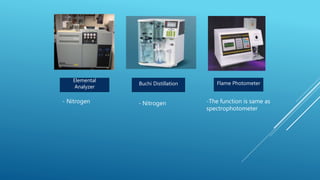
Buchi Distillation
Elemental
Analyzer
- Nitrogen
Flame Photometer
- Nitrogen -The function is same as
spectrophotometer
Back
N
Back
N
Back
MOISTUR
E
CONTENT
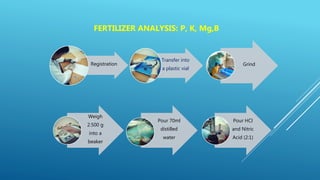
Registration
Transfer into
a plastic vial
Grind
Weigh
2.500 g
into a
beaker
Pour 70ml
distilled
waterIsi air 70ml
Pour HCl
and Nitric
Acid (2:1)
FERTILIZER ANALYSIS: P, K, Mg,B
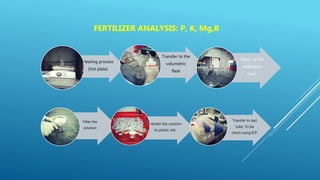
Heating process
(hot plate)
Transfer to the
volumetric
flask
Mark up the
calibration
mark.
Filter the
solution
Transfer the solution
to plastic vial
Transfer to test
tube. To be
check using ICP.
FERTILIZER ANALYSIS: P, K, Mg,B
FERTILIZER
Aim : to determine the contain of element e.g. K, Mg, P, Ca in
the fertilizer followed by the specification.
Instrument used:
Inductively Coupled Plasma(ICP)- determine all
element at one time include heavy metal if
necessary.
Atomic Absorption Spectrophotometer(AAS) &
UV Spectrophotometer - one element at a time.
Determination
of pH value
Determination
of moisture
content
Determination
of potassium
Determination
of magnesium
Determination
of phosphorus
Trace element
FERTILIZER
ANALYSIS
DETERMINATION OF POTASSIUM AND MAGNESIUM
Why we need potassium and magnesium?
POTASSIUM - provide the ionic environment for metabolic
process in cytosol.(growth regulation)
- potassium ions (K+) for protein synthesis and
opening and closing of stomata.
MAGNESIUM - part of chlorophyll in plant for photosynthesis
METHOD
 Method for the determination of magnesium
Determination of water-soluble magnesium content (MgO)
 Principle
Magnesium in magnesium sulphate fertilizers is extracted in
boiling water and the magnesium content determined by atomic
absorption spectrophotometer.
 Reference: MS 417: Part 6: 1994
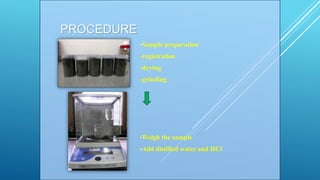
PROCEDURE
•Sample preparation
-registration
-drying
-grinding
•Weigh the sample
•Add distilled water and HCl
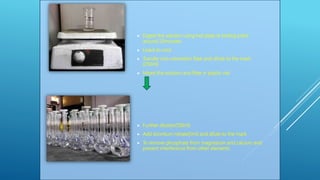
 Digest the solution using hot plate at boiling point
around 20minutes
 Leave to cool
 Transfer into volumetric flask and dilute to the mark
(250ml)
 Mixed the solution and filter in plastic vial
 Further dilution(100ml)
 Add strontium nitrate(5ml) and dilute to the mark
 To remove phosphate from magnesium and calcium and
prevent interference from other elements
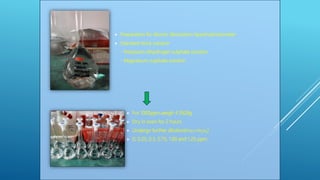
 Preparation for Atomic Absorption Spectrophotometer
 Standard stock solution
- Potassium dihydrogen sulphate solution
- Magnesium sulphate solution
 For 1000ppm,weigh 4.3928g.
 Dry in oven for 2 hours
 Undergo further dilution(m1v1=m2v2)
 0, 0.25, 0.5, 0.75, 1.00 and 1.25 ppm
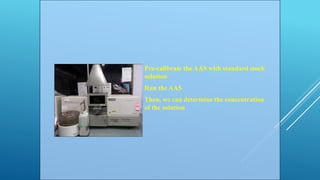
 Pre-calibrate the AAS with standard stock
solution
 Run the AAS
 Then, we can determine the concentration
of the solution
DETERMINATION OF PHOSPHORUS
Why phosphorus important to plant?
• Essential to stimulate early plant growth and hastens the maturity.
• Development of root health.
• Classified as macronutrient.
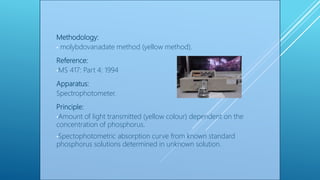
Methodology:
• molybdovanadate method (yellow method).
Reference:
•MS 417: Part 4: 1994
Apparatus:
Spectrophotometer.
Principle:
•Amount of light transmitted (yellow colour) dependent on the
concentration of phosphorus.
•Spectophotometric absorption curve from known standard
phosphorus solutions determined in unknown solution.
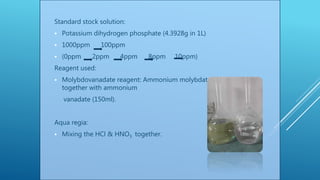
Standard stock solution:
 Potassium dihydrogen phosphate (4.3928g in 1L)
 1000ppm 100ppm
 (0ppm 2ppm 4ppm 8ppm 10ppm)
Reagent used:
 Molybdovanadate reagent: Ammonium molybdate (100ml) mixed
together with ammonium
vanadate (150ml).
Aqua regia:
 Mixing the HCl & HNO3 together.
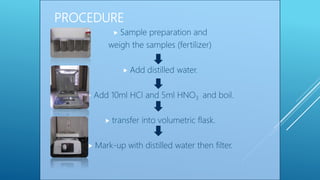
PROCEDURE
 Sample preparation and
weigh the samples (fertilizer)
 Add distilled water.
 Add 10ml HCl and 5ml HNO3 and boil.
 transfer into volumetric flask.
 Mark-up with distilled water then filter.
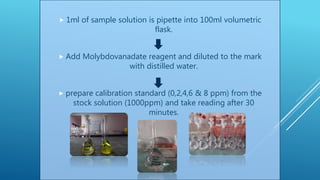
 1ml of sample solution is pipette into 100ml volumetric
flask.
 Add Molybdovanadate reagent and diluted to the mark
with distilled water.
 prepare calibration standard (0,2,4,6 & 8 ppm) from the
stock solution (1000ppm) and take reading after 30
minutes.
 Determine phosphate at acidic colour at pH ± 2.6
 Double acid method is used.
 We put HCl and HNO3 to convert all polyphosphate (P2O7) to
orthophosphate (PO4
3-).
 phosphate + metavanadate = phosphomolybdate acid + water.
(yellow colour)
INSTRUMENT:
INDUCTIVELY
COUPLED PLASMA
(ICP)
INTRODUCTION
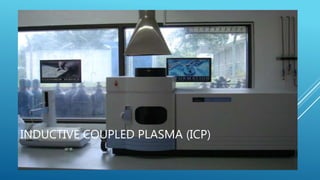
INDUCTIVE COUPLED PLASMA (ICP)
 measures the light emitted at element-specific characteristic
wavelengths from thermally excited analyte ions .
 light emitted is separated and measured in a spectrometer, yielding
an intensity measurement that can be converted to an elemental
concentration by comparison with calibration standards.
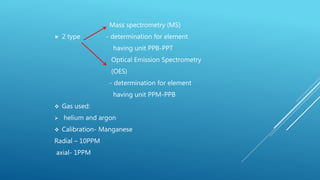
Mass spectrometry (MS)
 2 type - determination for element
having unit PPB-PPT
Optical Emission Spectrometry
(OES)
- determination for element
having unit PPM-PPB
 Gas used:
 helium and argon
 Calibration- Manganese
Radial – 10PPM
axial- 1PPM
PART OF MACHINE
AND
HOW IT WORK
1. COMPUTER
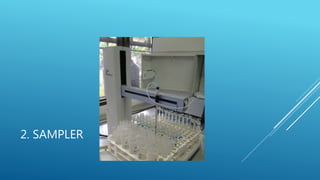
2. SAMPLER
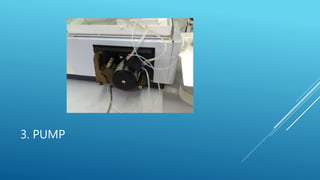
3. PUMP
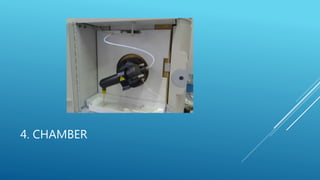
4. CHAMBER
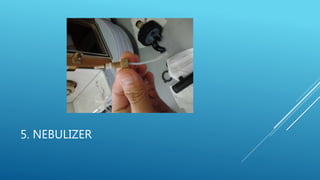
5. NEBULIZER
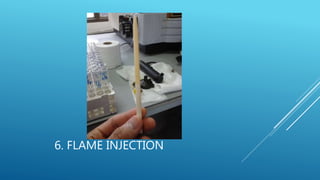
6. FLAME INJECTION
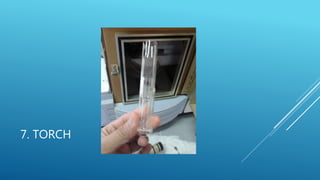
7. TORCH
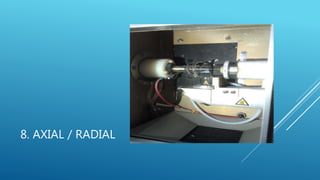
8. AXIAL / RADIAL
9. SPECTRUM
 Selection of colour for each element.
 Convert into energy Eo
 Transfer into computer- calculate intensity, log10 = 1/Eo
 Can analyze 43 element in the periodic table except for nitrogen and
oxygen
 Eg: Phosphorus P, Potassium K, Sodium Na,
Boron B, Calcium Ca, and etc.
 Error of ICP : 0.05%
CALCULATION
 Run standard
P, K, Mg, B
 Plot graph.
 From graph, calculate slope, m
 Formula, y=mx + c
 Calculate intensity
 Calculate ppm, formula
PPM= (intensity-intercept)/slope

Fertilizer analysis presentation

  • 1.
  • 2.
    Baja- bahan yangditambah pada tanah untuk menjadikan tumbuhan lebih subur. Membekalkan nutrien seperti N,K,P,Mg,B dan unsur kimia yang berkaitan dengan proses pembesaran tumbuhan.
  • 3.
    Jenis baja Baja tunggal * 1unsur nutrisi dan kadangkala mempunyai ½ unsur kecil lain. Baja sebatian * Campuran beberapa baja tunggal yang dicampurkan secara kimia. Baja campuran * Campuran beberapa jenis baja tunggal secara fizikal mengunakan mesin.
  • 5.
     Memeriksa unsur-unsurseperti N,P,K,Mg dan B.  Menjaga kualiti produk.  Kawalan mutu.  Memastikan kandungan nutrisi baja mencukupi untuk dibekalkan kepada tumbuhan  Memeriksa kelembapan baja.  Memastikan spesifikasi nutrisi yang dilakukan oleh pihak kilang dibenarkan oleh RISDA.
  • 6.
    BAJA Nitrogen (N) *EA *Buchi Distillation Potassium(K) *Spectrophoto meter *ICP Magnesium (Mg) *ICP *ASS Phosporus (P) *Spectrophoto meter *ICP Boron (B) *Spectrophoto meter *ICP
  • 7.
    Atomic Absorption Spectroscopy Flame Photometerspectrophotometer Element Analysis Inductively Coupled Plasma Buchi Distillation
  • 9.
    1. ANALISIS BAJA EA- Elementar Analyzer (Nitrogen shj)  Kaedah Kjedahl (manual) 2. SAIZ ZARAH (particle size) 3. KELEMBAPAN (moisture) 4. ICP (Untuk elemen lain kecuali N)
  • 11.
    KAEDAH PERTAMA (EA-ELEMENTAR ANALYZER) TIMBANGBAJA CATAT BERAT (30.000mg) TAMBAH TUNGSTAN LIPAT TIN KAPSUL MASUKKAN DALAM TRAY EA MESIN
  • 12.
    KAEDAH KEDUA (KJEDAHL) TIMBANG (1.00g) -TABLET KJEDAHL -1/2 SUDU THIOSULPHATE ASID TOTAL N STIRRER -PANASKAN 180C SELAMA 1 JAM -NAIKAN SUHU 360C UNTUK 6JAM -MASUKKAN BORIC ASID -5 TITIK INDICATOR (N) BUCHI DISTILLATION TITRATION
  • 13.
  • 14.
    MASUKKAN DALAM BIKAR MASUKKAN DALAM SARINGAN AYAK LAPISAN 1 LAPISAN 2 LAPISAN3 MASUKKAN DALAM BIKAR TIMBANG MASUKKAN DALAM PLASTIK
  • 15.
  • 16.
    TIMBANG BERAT PETRIDISH TIMBANG BERAT BAJA (10.00g) MASUKKAN DALAM DESSICATOR MASUKKAN DALAM KETUHAR (150℃) MASUKKAN KE DALAM CATAT BERAT BARU BAGI
  • 17.
  • 18.
    Daftar baja Pindah ke plastik vial Kisarbaja Timbang baja Isi air 70ml Isi HCL dan Nitrik Asid (2:1) Digest Pindah ke volumetric flask Mark up Turas Pindah ke plastik vial -Pindah ke test tube. -ICP
  • 19.
  • 20.
    NUTRIEN SUMBER KANDUNGAN NUTRIEN(%) FUNGSI Nitrogen Urea (46% N) 1. Penting dalam pembentukan klorofil dan kehijauan daun pokok untuk proses fotosintisis. 2. Membantu didalam pembentukan asid amino (protein) dan enzim-enzim yang diperlukan oleh pokok. 3. Membantu pertumbuhan pokok. 4. Meningkatkan berat tandan. Phosphorus Rock Phosphate (32% P2O5) 1. Membantu proses fotosintisis dan proses pemindahan tenaga. 2. Merangsang pertumbuhan akar pokok. 3. Penting untuk proses pembiakan. 4. Meningkatkan berat tandan. Potassium Muriate Of Potash (MOP) (60% K2O) 1. Membantu didalam proses kimia dalaman pokok seperti pengeluaran enzim-enzim yang diperlukan oleh pokok. 2. Mengawal keperluan air dan pengangkutan makanan pokok. 3. Menguatkan ketahanan pokok dari penyakit. Magnesium Oxide Magnesite Kiesrite (90% MgO) (27% MgO) 1. Penting dalam proses pembentukan klorofil. 2. Komponen penting didalam ribosom dan pembuatan protin. Boron Borate (46% B2O5) 1. Komponen penting didalam proses penguraian kabohidrat untuk keperluan pokok. 2. Penting untuk pengembangan sel dan tisu pokok.
  • 21.
    DATA AKHIR NO. LOKASIJENIS LO DO KILANG JUMLAH ANALISIS NILAI SEPATUTNYA NILAI PERBEZAAN 1=TIDAK MENGIKUT SPESIFIKASI QTT MAKMAL BAJA KAMPIT % TOTAL % TOTAL % TOTAL MS-MENGIKUT SPESIFIKASI TOTAL BIL STATUS ^N ^P2O5 ^K2O ^MgO ^B2O3 # ^N ^P2O5 ^K2O ^MgO ^B2O3 # ^N ^P2O5 ^K2O ^MgO ^B2O3 # ^N ^P2O5 ^K2O ^MgO ^B2O3 NUTRIEN TMS MS=0,TMS=1 1 1 RISDA 3Z ALL 30 8.9 5.6 17.6 2.0 0.4 34.5 9.0 6.0 18.0 2.0 0.5 35.5 -1.1 -6.7 -2.2 -2.5 -18.0 -2.9 0 0 0 0 0 0 0 0 2 2 RISDA 3Z COSMOS 8.3 5.9 17.2 2.1 0.5 34.0 9.0 6.0 18.0 2.0 0.5 35.5 -7.3 -1.8 -4.4 2.5 -4.0 -4.3 0 0 0 0 0 0 0 0 3 3 RISDA 3Z 8.4 5.7 16.8 2.5 0.5 33.9 9.0 6.0 18.0 2.0 0.5 35.5 -6.2 -5.8 -6.4 25.0 -10.0 -4.6 0 0 0 0 0 0 0 0 4 4 RISDA 3Z 8.5 5.8 16.9 2.6 0.5 34.2 9.0 6.0 18.0 2.0 0.5 35.5 -5.6 -3.7 -6.1 30.0 -8.0 -3.5 0 0 0 0 0 0 0 0 5 5 RISDA 3Z 8.5 5.4 17.2 2.4 0.5 34.0 9.0 6.0 18.0 2.0 0.5 35.5 -5.6 -10.2 -4.4 20.0 -8.0 -4.4 0 0 0 0 0 0 0 0 6 6 RISDA 3Z 8.6 5.5 16.8 2.5 0.4 33.8 9.0 6.0 18.0 2.0 0.5 35.5 -4.4 -8.7 -6.7 25.0 -16.6 -4.8 0 0 0 0 0 0 0 0 7 7 RISDA 3Z 8.5 5.5 17.5 2.6 0.4 34.5 9.0 6.0 18.0 2.0 0.5 35.5 -6.1 -8.0 -2.8 30.0 -12.0 -2.8 0 0 0 0 0 0 0 0 8 8 RISDA 3Z 28 8.4 5.5 17.6 2.4 0.4 34.3 9.0 6.0 18.0 2.0 0.5 35.5 -6.7 -8.8 -2.2 20.0 -12.0 -3.4 0 0 0 0 0 0 0 0 9 9 RISDA 3Z 8.7 5.6 17.2 2.1 0.5 34.1 9.0 6.0 18.0 2.0 0.5 35.5 -3.9 -6.7 -4.4 7.0 -6.0 -4.1 0 0 0 0 0 0 0 0 10 10 RISDA 3Z 8.6 5.6 17.5 2.1 0.5 34.3 9.0 6.0 18.0 2.0 0.5 35.5 -4.4 -6.8 -2.7 7.0 -8.0 -3.4 0 0 0 0 0 0 0 0 11 11 RISDA 3Z 8.4 5.8 17.2 2.1 0.5 34.0 9.0 6.0 18.0 2.0 0.5 35.5 -6.7 -3.3 -4.2 3.0 0.0 -4.2 0 0 0 0 0 0 0 0 12 12 RISDA 3Z 27 8.7 5.4 17.1 2.1 0.5 33.9 9.0 6.0 18.0 2.0 0.5 35.5 -2.9 -10.0 -4.8 7.0 2.0 -4.4 0 0 0 0 0 0 0 0 13 13 LDG. RISDA TG. GENTING RISDA 3Z 8.6 5.5 17.2 2.1 0.5 34.0 9.0 6.0 18.0 2.0 0.5 35.5 -4.4 -9.0 -4.4 7.0 8.0 -4.4 0 0 0 0 0 0 0 0 14 14 E 1 C 1 - 27 ABDFG(7) RISDA 3Z 8.6 5.7 17.3 2.1 0.5 34.1 9.0 6.0 18.0 2.0 0.5 35.5 -4.4 -5.5 -4.2 3.0 -2.2 -4.0 0 0 0 0 0 0 0 0 15 15 RISDA 3Z 8.7 5.5 16.9 2.2 0.4 33.8 9.0 6.0 18.0 2.0 0.5 35.5 -2.9 -7.7 -6.1 12.0 -16.0 -4.7 0 0 0 0 0 0 0 0 16 16 RISDA 3Z 8.6 5.7 17.2 2.0 0.5 34.1 9.0 6.0 18.0 2.0 0.5 35.5 -4.0 -5.3 -4.2 2.0 -1.0 -4.0 0 0 0 0 0 0 0 0 17 17 RISDA 3Z 25 8.6 5.5 17.6 2.1 0.5 34.3 9.0 6.0 18.0 2.0 0.5 35.5 -4.4 -7.9 -2.5 3.0 7.2 -3.5 0 0 0 0 0 0 0 0 18 18 RISDA 3Z 8.5 5.5 17.4 2.0 0.5 33.9 9.0 6.0 18.0 2.0 0.5 35.5 -5.6 -7.8 -3.3 -1.5 -6.6 -4.6 0 0 0 0 0 0 0 0 19 19 RISDA 3Z 8.4 5.5 17.3 2.0 0.5 33.7 9.0 6.0 18.0 2.0 0.5 35.5 -6.2 -9.0 -3.7 0.0 -2.0 -5.0 0 0 0 0 0 0 0 0 20 20 RISDA 3Z 8.6 5.5 17.2 2.2 0.4 34.0 9.0 6.0 18.0 2.0 0.5 35.5 -4.4 -7.7 -4.2 10.0 -12.0 -4.2 0 0 0 0 0 0 0 0 21 21 RISDA 3Z 8.7 5.4 17.4 2.0 0.5 34.0 9.0 6.0 18.0 2.0 0.5 35.5 -3.3 -10.0 -3.1 0.5 -4.0 -4.1 0 0 0 0 0 0 0 0 22 22 RISDA 3Z 8.5 5.5 17.4 2.1 0.5 34.1 9.0 6.0 18.0 2.0 0.5 35.5 -5.1 -8.0 -3.3 4.5 6.0 -4.0 0 0 0 0 0 0 0 0 23 23 RISDA 3S 8.5 5.5 17.5 2.1 0.5 34.0 9.0 6.0 18.0 2.0 0.5 35.5 -5.9 -8.7 -2.8 4.0 -2.0 -4.2 0 0 0 0 0 0 0 0 24 24 RISDA 3S 8.6 5.5 17.0 2.1 0.5 33.8 9.0 6.0 18.0 2.0 0.5 35.5 -4.4 -7.7 -5.3 4.5 5.4 -4.8 0 0 0 0 0 0 0 0 25 25 RISDA 3Z 8.7 5.4 17.1 2.2 0.5 33.9 9.0 6.0 18.0 2.0 0.5 35.5 -3.3 -10.0 -4.8 7.5 -4.0 -4.6 0 0 0 0 0 0 0 0 26 26 RISDA 3Z 8.5 5.8 17.1 2.0 0.5 33.9 9.0 6.0 18.0 2.0 0.5 35.5 -5.6 -3.3 -5.3 2.0 0.0 -4.5 0 0 0 0 0 0 0 0 27 27 RISDA 3Z 8.6 5.5 17.2 2.2 0.5 34.1 9.0 6.0 18.0 2.0 0.5 35.5 -4.0 -7.7 -4.4 12.0 0.0 -3.9 0 0 0 0 0 0 0 0 PURATA 8.6 5.6 17.2 2.2 0.5 34.1 9.0 6.0 18.0 2.0 0.5 35.5 -4.8 -6.9 -4.2 11.1 -6.2 -4.0 0 0 0 0 0 0 0 0
  • 22.
    SOLITARY FERTILIZER * Contain only 1type of nutrient for plants. COMPOUND FERTILIZER * Homogenous, contain 2 or more essential nutrients. Mixed through a chemical process. T Y P E S O F F E R T I L I Z E R MIXTURE FERTILIZER * Homogenous, contain 2 or more essential nutrients. Doesn't involve chemical process.
  • 23.
     Urea  Kieserite(Kie)  Muriate Of Potash (MOP)  Ammonia nitrate  Ammonia sulphate  Ground phosphate rock  Baja Organik Espek (BOE)  Factory’s fertilizer (K)  Risda Fertilizer (RB1, RB2, RB3, RB4)
  • 24.
    Main purpose To check the elements( N, K, Mg) Quality Fertilizer’s moisture Enough nutrients for plant’s growth To check whether the nutrient’s specifications that produced by a factory is correct.
  • 26.
    Atomic Absorption Spectroscopy Spectrophotometer InductivelyCoupled Plasma - Magnesium -Boron - Potassium - Magnesium - Phosphorus -Boron - Potassium - Phosphorus
  • 27.
    Buchi Distillation Elemental Analyzer - Nitrogen FlamePhotometer - Nitrogen -The function is same as spectrophotometer
  • 30.
  • 31.
  • 32.
  • 33.
    Registration Transfer into a plasticvial Grind Weigh 2.500 g into a beaker Pour 70ml distilled waterIsi air 70ml Pour HCl and Nitric Acid (2:1) FERTILIZER ANALYSIS: P, K, Mg,B
  • 34.
    Heating process (hot plate) Transferto the volumetric flask Mark up the calibration mark. Filter the solution Transfer the solution to plastic vial Transfer to test tube. To be check using ICP. FERTILIZER ANALYSIS: P, K, Mg,B
  • 35.
    FERTILIZER Aim : todetermine the contain of element e.g. K, Mg, P, Ca in the fertilizer followed by the specification. Instrument used: Inductively Coupled Plasma(ICP)- determine all element at one time include heavy metal if necessary. Atomic Absorption Spectrophotometer(AAS) & UV Spectrophotometer - one element at a time.
  • 36.
    Determination of pH value Determination ofmoisture content Determination of potassium Determination of magnesium Determination of phosphorus Trace element FERTILIZER ANALYSIS
  • 37.
    DETERMINATION OF POTASSIUMAND MAGNESIUM Why we need potassium and magnesium? POTASSIUM - provide the ionic environment for metabolic process in cytosol.(growth regulation) - potassium ions (K+) for protein synthesis and opening and closing of stomata. MAGNESIUM - part of chlorophyll in plant for photosynthesis
  • 38.
    METHOD  Method forthe determination of magnesium Determination of water-soluble magnesium content (MgO)  Principle Magnesium in magnesium sulphate fertilizers is extracted in boiling water and the magnesium content determined by atomic absorption spectrophotometer.  Reference: MS 417: Part 6: 1994
  • 39.
  • 40.
     Digest thesolution using hot plate at boiling point around 20minutes  Leave to cool  Transfer into volumetric flask and dilute to the mark (250ml)  Mixed the solution and filter in plastic vial  Further dilution(100ml)  Add strontium nitrate(5ml) and dilute to the mark  To remove phosphate from magnesium and calcium and prevent interference from other elements
  • 41.
     Preparation forAtomic Absorption Spectrophotometer  Standard stock solution - Potassium dihydrogen sulphate solution - Magnesium sulphate solution  For 1000ppm,weigh 4.3928g.  Dry in oven for 2 hours  Undergo further dilution(m1v1=m2v2)  0, 0.25, 0.5, 0.75, 1.00 and 1.25 ppm
  • 42.
     Pre-calibrate theAAS with standard stock solution  Run the AAS  Then, we can determine the concentration of the solution
  • 43.
    DETERMINATION OF PHOSPHORUS Whyphosphorus important to plant? • Essential to stimulate early plant growth and hastens the maturity. • Development of root health. • Classified as macronutrient.
  • 44.
    Methodology: • molybdovanadate method(yellow method). Reference: •MS 417: Part 4: 1994 Apparatus: Spectrophotometer. Principle: •Amount of light transmitted (yellow colour) dependent on the concentration of phosphorus. •Spectophotometric absorption curve from known standard phosphorus solutions determined in unknown solution.
  • 45.
    Standard stock solution: Potassium dihydrogen phosphate (4.3928g in 1L)  1000ppm 100ppm  (0ppm 2ppm 4ppm 8ppm 10ppm) Reagent used:  Molybdovanadate reagent: Ammonium molybdate (100ml) mixed together with ammonium vanadate (150ml). Aqua regia:  Mixing the HCl & HNO3 together.
  • 46.
    PROCEDURE  Sample preparationand weigh the samples (fertilizer)  Add distilled water.  Add 10ml HCl and 5ml HNO3 and boil.  transfer into volumetric flask.  Mark-up with distilled water then filter.
  • 47.
     1ml ofsample solution is pipette into 100ml volumetric flask.  Add Molybdovanadate reagent and diluted to the mark with distilled water.  prepare calibration standard (0,2,4,6 & 8 ppm) from the stock solution (1000ppm) and take reading after 30 minutes.
  • 48.
     Determine phosphateat acidic colour at pH ± 2.6  Double acid method is used.  We put HCl and HNO3 to convert all polyphosphate (P2O7) to orthophosphate (PO4 3-).  phosphate + metavanadate = phosphomolybdate acid + water. (yellow colour)
  • 49.
  • 50.
  • 51.
  • 52.
     measures thelight emitted at element-specific characteristic wavelengths from thermally excited analyte ions .  light emitted is separated and measured in a spectrometer, yielding an intensity measurement that can be converted to an elemental concentration by comparison with calibration standards.
  • 53.
    Mass spectrometry (MS) 2 type - determination for element having unit PPB-PPT Optical Emission Spectrometry (OES) - determination for element having unit PPM-PPB  Gas used:  helium and argon  Calibration- Manganese Radial – 10PPM axial- 1PPM
  • 54.
  • 55.
  • 56.
  • 57.
  • 58.
  • 59.
  • 60.
  • 61.
  • 62.
    8. AXIAL /RADIAL
  • 63.
    9. SPECTRUM  Selectionof colour for each element.  Convert into energy Eo  Transfer into computer- calculate intensity, log10 = 1/Eo
  • 64.
     Can analyze43 element in the periodic table except for nitrogen and oxygen  Eg: Phosphorus P, Potassium K, Sodium Na, Boron B, Calcium Ca, and etc.  Error of ICP : 0.05%
  • 65.
    CALCULATION  Run standard P,K, Mg, B  Plot graph.  From graph, calculate slope, m  Formula, y=mx + c  Calculate intensity  Calculate ppm, formula PPM= (intensity-intercept)/slope