BIOCHAR AS SOIL CONDITIONER
HAJIRA YOUNAS
• Biochar
• Background of Biochar
• Biochar products
• Thermal decomposition of biochar
• Biochar production method
• Biochar production units
• Rate of application
• Method of application
• Biochar benefits to soil
• Soil moisture retention
• Biochar as liming agent
• Nutrient availability to plants
• Reduce nutrient leaching
• Microbial activity
• Crop yield
• Conclusion
• References
Contents
2
3
BACKGROUND OF BIOCHAR
Rich, highly fertile, dark soil was discovered by the explorer Herbert
Smith in 1879, and rediscovered by a German soil scientist Wim
Sombroek in the 1950s in the Amazon rain forest.
Analyses of the Terra Preta found a high concentration of charcoal and
activated carbon to be the major ingredients together with organic
matter, such as plant and animal remains (manure, blood and bones).
4
5
BIOCHAR PRODUCTION METHOD
Methods
Pyrolysis
Fast pyrolysis
Slow pyrolysis
Gasification
6
PYROLYSIS
Pyrolysis is a thermochemical decomposition of organic
material at temperatures between 400 °C to 900 °C in the
absence of oxygen.
7
Burning of wood, InnoFireWood's website. Accessed on 2010-02-06.
THERMAL DECOMPOSITION OF BIOCHAR8
PRODUCTS
Bio-oil
Syngas
Biochar
9
SLOW PYROLYSIS
 Biomass
Biochar
Syngas+Bio-oil vapour
>400 oC
Absence of Oxygen
Liquid (Bio-Oil)
 Low temperature
 Very long residence time
10
Cool and condense
FAST PYROLYSIS
11
 Moderate temperature
 Short residence time
GASIFICATION
Biomass
Biochar
Syngas+Bio-oil vapour
<700 oC
Limited Oxygen
Liquid (Bio-Oil)
 High temperature
 Long residence time
12
Cool and condense
PRODUCT PERCENTAGE
(Biederman, L.A. & Harpole, W.S., 2013)
13
NATURE OF FEEDSTOCK
Wood chip
Wood pellet
Crop residue
Switch grass
Tree cuttings Distiller grains Juice industry residue
14
Chicken litter Dairy manure Sewage sludge
Paper sludge Munciple waste Tree parts
15
16
17
FEEDSTOCK COMPONENTS
Lehmann, J, and S. Joseph. 2009
Inorganic contents
18
DEGRADATION TEMPERATURE OF
COMPONENT
US Biochar Initiative. 2013. Available online: http://www.biochar-us.org/ (accessed on 5 June 2013).
19
BIOCHAR PRODUCTION UNITS
A basic Biochar unit Vertical Biochar unit
Commercial Biochar unit
Moveable Biochar unit
20
BIOCHAR PROPERTIES: PROCESS
CONDITION
 As temperature increase
 Biochar yield decrease
 Fixed carbon increase
 Surface area increase
 Ash content increase
(Day et al., 2005, Sohi et al., 2010 & (Purakayastha et al., 2012)
21
BIOCHAR PORES
22
Biochar pore size
Micropores (<2 nm) Mesopores (2-50 nm) Macropores (>200nm)
(Lehmann et al., 2009)
Scanning electron microscopic structure of biochar contains pores of different size
https://www.google.com.pk/search?biw=1366&bih=662&tbm=isch&sa=1&q=micropore+biochar&oq=micropore+biochar&gs_l=img.3...44852.51008.0.51750.6.6.0.0.0.0.982.2278.22j1j0j1j1.5.0....
0...1c.1.64.img..1.0.0.UynT9r4rhr0#imgdii=n8Rp2MXFRzV17M%3A%3Bn8Rp2MXFRzV17M%3A%3BxjaVYlQLnFmaBM%3A&img rc=n8R 2MXFRzV17M%3A
23
24
(Kurt Spokas, 2013)
25
Enhanced
biochar
yield
Low
temperature
(>400 oC)
Higher
pressure
Larger vapor
residence time
Slower heat
rate
Large particle
size
HIGH
BIOCHAR
YIELD
26
BIOCHAR COST
The cost of biochar is directly related to the cost of the
feedstock, collection and transportation cost, the processing
method.
Green waste and waste wood biochars were found to cost
between $150 to $260/ton.
27
BIOCHAR STABILITY IN SOIL
It has been predicted that the stable portion of biochar
has a mean residence time of greater than 100 years
(Spokas et al., 2014).
(Spokas, 2014)
28
Hand application Tractor propelled spreader
Deep banding
Trench and fill
APPLICATION STARATIGIES
29
RATE OF APPLICATION
Depends on many factors including the type of biomass used, the degree of metal
contamination in the biomass, the types and proportions of various nutrients (N, P, etc.),
and also on edaphic, climatic and topographic factors of the land where the biochar is to be
applied.
Experiments have found that rates between 5-50 t/ha (0.5-5 kg/m2) have often been used
successfully (Major, 2013).
Research suggests that even low rates of biochar application can significantly increase crop
productivity (Winsley, 2007).
30
BIOCHAR BENEFITS TO PLANTS
Modification
of Soil
Microbial
activity
Soil
moisture
retention
Nutrient
availability
to plants
Reduce
nutrient
leaching
Carbon
sequestration
Crop yield
31
NUTRIENT AVAILABILITY TO
PLANTS
Progressive elimination of carbon, oxygen and
hydrogen during pyrolysis therefore increases
the total concentration of minerals in the biochar
residue.
Biochar addition to soil increase exchangeable
Ca, Mg, K, Na, and P in the soil by increasing
CEC.
Biochar has a great ability to absorb and retain
cations in an exchangeable form than the other
form of soil organic matter due to greater surface
area and negative surface charge (Liang et al.,
2006).
32
33
Through the addition of biochar, the cations are held closer to the roots and available to plants
Herbert et al., 2012
MICROBIAL ACTIVITY
 Biochar pores and its high internal
surface area and increased ability to
absorb OM act as refuge for soil
microbiota from predators and
desiccation.
 Bacteria, actinomycetes and
arbuscular mycorrhizal fungi.
 These microbiota reduce N loss and
increase nutrient availability for plants
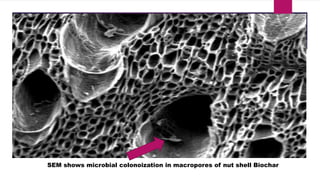
(Winsely, 2007). The porous structure of biochar invites microbial
colonization
34
35
SEM shows microbial colonoization in macropores of nut shell Biochar
CROP PRODUCTION
Biochar improves soil quality and crop productivity in a variety of soil
(Blackwell et al., 2009).
The improvements in crop productivity were related to increased nutrient
retention ,alleviation of Al toxicity in highly acidic soils, increased soil
water permeability and plant water availability, increased soil cation
exchange capacity, enhanced cycling of P and S and neutralization of
phytotoxic compounds in the soil (Steiner et al., 2008a).
36
189 percent increase in aboveground biomass measured 5
months after application of 23 Ton per acre biochar (Major et.
Al.,2010).
Biochar support plant health by improving their
establishment and provide resistance to disease.
The improved nutrient retention and enhanced soil fertility
results in the production of high crop yield relative to
adjacent soil (Lehmann et al., 2009).
37
Effect on banana tree with and without
biochar
Effect of biochar on tree seedling
http://www.terra-char.com/crop-response.html
38
39
SOIL MOISTURE RETENTION
Adding biochar to soil can have direct and indirect effects on soil water
retention.
• The direct effect of biochar application is related to the high surface area of biochar.
• The indirect effects of biochar application on soil water retention related to improve
aggregation or structure.
For soils where biochar was added at rates up to 22 t per ha, water
retention capacity that was 18% higher than in adjacent soils in which
biochar was low or absent (Sohi et al., 2010)
40
Typical representation of the soil water retention curve and the hypothesized effect of the addition of biochar to this soil
41
SOIL NUTIENT LEACHING PREVENTION
 Biochar may have the potential to reduce leaching of nutrients from agricultural
soils (Lehmann et al., 2007).
 This possibility is suggested by the strong adsorption affinity of biochar for soluble
nutrients such as ammonium, nitrate, phosphate and other ionic solutes (Radovic et
al., 2001).
 Lehmann et al (2003b) found that “cumulative leaching of mineral N, K and Mg in
the Amazonian Dark Earth was only 24, 45 and 7%, respectively, of that found in a
Ferralsol”.
42
ControlBiochar
https://www.google.com.pk/search?q=nutrient%20leaching%20prevention%20pic&tbm=isch&tbs=rimg%3ACRU_1jI-xXzPIIjh2CygIfe80XQrssAzzNCX6ZqJyRzdZoZEPb7s6yRLh19Zfh WVBobWjnvI1Ga5lnSqiJMm4jbHCoSCXYLKAh97zRdEcuRoMdXMJvGKhIJCuywDPM0JfoRHO8ZFTfnVo8qEglmonJHN1mhkRHWcqHwboa9kSoSCQ9vuzrJEuHXESZE_1BPxJJ0uKhIJ1l
H59ZUGhsR8Map0NxZD58qEglaOe8jUZrmWRGNAAHhTNO8xSoSCdKqIkybiNscEfOvP6Tudo4u&tbo=u&bih=662&biw=1366&ved=0ahUKEwiB76Xwx9_PAhVJtBQKHY3gDRYQ9C8ICQ& dpr=1#imgrc=FT-Mj7FfM8gaJM%3A
43
MODIFICATION OF SOIL
Biochar is commonly alkaline. The pH values of biochar at
different pyrolysis temperature ranged from slightly alkaline
(≈8.2) to highly alkaline (≈11.5) across a wide variety of
feedstocks (Yuan et al. 2011).
Biochars shows positive effect in the case of acidic soils
compared to alkaline soils (Biederman and Harpole 2013).
Biochar addition can reduce the bioavailability of toxic forms of
Al, Cu, and Mn and increase the availability of essential nutrients
such as Na, K, Ca, Mg, and Mo, thereby rendering a favorable
environment for plant growth (Atkinson et al. 2010).
44
CARBON SEQUESTRATION
45
CONCLUSION
 Efficient use of biomass by converting it as a useful source of soil amendment
is one way to manage soil health and fertility. One of the approaches for
efficient utilization of biomass involves carbonization of biomass to highly
stable carbon compound-biochar. Use of biochar in agricultural systems is one
viable option that enhance nutrient availability, moisture retention, CEC,
improve soil quality and natural rate of carbon sequestration in the soil. Further,
inter-disciplinary research has to be taken up for studying the long term impact
of biochar application on soil physical properties, nutrient availability, soil
microbial activities, carbon sequestration potential, crop productivity and green
house gas mitigation.
46
REFERENCES
 Atkinson, C. J., Fitzgerald, J. D., and Hipps, N. A. (2010). “Potential mechanisms for achieving agricultural benefits
from biochar application to temperate soils: A review.” Plant Soil, 337(1–2), 1–18.
 Biederman, L. A., and Harpole, W. S. (2013). “Biochar and its effects on plant productivity and nutrient cycling: A
meta-analysis.” GCB Bioenergy, 5(2), 202–214.
 Chan, K.Y. and Xu, Z. 2009. Biochar: nutrient properties and their enhancement. In: Biochar for environmental
management (J. Lehmann and S. Joseph eds.), Science and Technology, Earthscan, London. pp 67-84.
 Laird, D. A. & Kosikinen, W. C. (2008). Triazine soil interactions. In: The triazine herbicides: 50 years
revolutionizing agriculture, LeBaron, H. M.; McFarland, J. E. & Burnside, O. (Eds.), page numbers (275-299),
Elsevier, ISBN 978-0-444-51167-6, San Diego, CA.
 Lehmann, J, and S. Joseph. 2009. Biochar for environmental management: An Introduction. pp. 1-12. In J.
Lehmann and S. Joseph (eds.) Biochar for environmental management: Science and technology. Earthscan,
London.
 Major, J. 2010. Practical aspects of biochar application to tree crops. IBI Technical Bulletin #102, International
Biochar Initiative. (Accessed online at http://www.biocharinternational.
org/sites/default/files/Technical%20Bulletin%20Biochar%20Tree%20 Planting.pdf).
47
 Mullen, C.A., A.A. Boateng, N. Goldberg, I.M. Lima, D.A. Laird, and K.B. Hicks. 2010. Bio-oil and biochar
production from corn cobs and stover by fast pyrolysis. Biomass Bioenergy, 34:67-74.
 Sohi, S.P.; Krull, E.; Lopez-Capel, E. & Bol, R. (2010). A review of biochar and its use and function in soil.
In: Advances in Agronomy, page numbers (47-82), Publisher Elsevier Academic Press Inc., ISSN 0065-
2213, San Diego, CA-92101-4495, USA .
 Spokas, K. A. (2010). Review of the stability of biochar in soils: Predictability of O:C molar ratios. Carbon
Management. accepted (October 2010) In Press.
 Spokas, K. A. (2014). “Review of the stability of biochar in soils predictability of O C molar ratios.”
Carbon Manage., 1(2), 289–303.
 Steiner, C., Glaser, B., Teixeira, W. G., Lehmann, J., Blum, W. E. H., and Zech, W. (2008a). Nitrogen
retention and plant uptake on a highly weathered central Amazonian ferralsol amended with compost
and charcoal. J. Plant Nutr. Soil Sci. 171, 893–899.
 US Biochar Initiative. 2013. Available online: http://www.biochar-us.org/ (accessed on 5 June 2013).
48
 Van Zwieten, L.; Meszaros, I.; Downie, A.; Chan, Y.K.; Joseph, S. Soil health: Can the cane industry use a bit
of “black magic”? Aust. Canegrow. 2008, 17, 10–11.
 Yuan, J. H., Xu, R. K., and Zhang, H. (2011). “The forms of alkalis in the biochar produced from crop
residues at different temperatures.” Bioresour. Technol., 102(3), 3488–3497.
49
50

Biochar as Soil Conditioner

  • 1.
    BIOCHAR AS SOILCONDITIONER HAJIRA YOUNAS
  • 2.
    • Biochar • Backgroundof Biochar • Biochar products • Thermal decomposition of biochar • Biochar production method • Biochar production units • Rate of application • Method of application • Biochar benefits to soil • Soil moisture retention • Biochar as liming agent • Nutrient availability to plants • Reduce nutrient leaching • Microbial activity • Crop yield • Conclusion • References Contents 2
  • 3.
  • 4.
    BACKGROUND OF BIOCHAR Rich,highly fertile, dark soil was discovered by the explorer Herbert Smith in 1879, and rediscovered by a German soil scientist Wim Sombroek in the 1950s in the Amazon rain forest. Analyses of the Terra Preta found a high concentration of charcoal and activated carbon to be the major ingredients together with organic matter, such as plant and animal remains (manure, blood and bones). 4
  • 5.
  • 6.
    BIOCHAR PRODUCTION METHOD Methods Pyrolysis Fastpyrolysis Slow pyrolysis Gasification 6
  • 7.
    PYROLYSIS Pyrolysis is athermochemical decomposition of organic material at temperatures between 400 °C to 900 °C in the absence of oxygen. 7 Burning of wood, InnoFireWood's website. Accessed on 2010-02-06.
  • 8.
  • 9.
  • 10.
    SLOW PYROLYSIS  Biomass Biochar Syngas+Bio-oilvapour >400 oC Absence of Oxygen Liquid (Bio-Oil)  Low temperature  Very long residence time 10 Cool and condense
  • 11.
    FAST PYROLYSIS 11  Moderatetemperature  Short residence time
  • 12.
    GASIFICATION Biomass Biochar Syngas+Bio-oil vapour <700 oC LimitedOxygen Liquid (Bio-Oil)  High temperature  Long residence time 12 Cool and condense
  • 13.
    PRODUCT PERCENTAGE (Biederman, L.A.& Harpole, W.S., 2013) 13
  • 14.
    NATURE OF FEEDSTOCK Woodchip Wood pellet Crop residue Switch grass Tree cuttings Distiller grains Juice industry residue 14
  • 15.
    Chicken litter Dairymanure Sewage sludge Paper sludge Munciple waste Tree parts 15
  • 16.
  • 17.
  • 18.
    FEEDSTOCK COMPONENTS Lehmann, J,and S. Joseph. 2009 Inorganic contents 18
  • 19.
    DEGRADATION TEMPERATURE OF COMPONENT USBiochar Initiative. 2013. Available online: http://www.biochar-us.org/ (accessed on 5 June 2013). 19
  • 20.
    BIOCHAR PRODUCTION UNITS Abasic Biochar unit Vertical Biochar unit Commercial Biochar unit Moveable Biochar unit 20
  • 21.
    BIOCHAR PROPERTIES: PROCESS CONDITION As temperature increase  Biochar yield decrease  Fixed carbon increase  Surface area increase  Ash content increase (Day et al., 2005, Sohi et al., 2010 & (Purakayastha et al., 2012) 21
  • 22.
    BIOCHAR PORES 22 Biochar poresize Micropores (<2 nm) Mesopores (2-50 nm) Macropores (>200nm) (Lehmann et al., 2009)
  • 23.
    Scanning electron microscopicstructure of biochar contains pores of different size https://www.google.com.pk/search?biw=1366&bih=662&tbm=isch&sa=1&q=micropore+biochar&oq=micropore+biochar&gs_l=img.3...44852.51008.0.51750.6.6.0.0.0.0.982.2278.22j1j0j1j1.5.0.... 0...1c.1.64.img..1.0.0.UynT9r4rhr0#imgdii=n8Rp2MXFRzV17M%3A%3Bn8Rp2MXFRzV17M%3A%3BxjaVYlQLnFmaBM%3A&img rc=n8R 2MXFRzV17M%3A 23
  • 24.
  • 25.
  • 26.
    Enhanced biochar yield Low temperature (>400 oC) Higher pressure Larger vapor residencetime Slower heat rate Large particle size HIGH BIOCHAR YIELD 26
  • 27.
    BIOCHAR COST The costof biochar is directly related to the cost of the feedstock, collection and transportation cost, the processing method. Green waste and waste wood biochars were found to cost between $150 to $260/ton. 27
  • 28.
    BIOCHAR STABILITY INSOIL It has been predicted that the stable portion of biochar has a mean residence time of greater than 100 years (Spokas et al., 2014). (Spokas, 2014) 28
  • 29.
    Hand application Tractorpropelled spreader Deep banding Trench and fill APPLICATION STARATIGIES 29
  • 30.
    RATE OF APPLICATION Dependson many factors including the type of biomass used, the degree of metal contamination in the biomass, the types and proportions of various nutrients (N, P, etc.), and also on edaphic, climatic and topographic factors of the land where the biochar is to be applied. Experiments have found that rates between 5-50 t/ha (0.5-5 kg/m2) have often been used successfully (Major, 2013). Research suggests that even low rates of biochar application can significantly increase crop productivity (Winsley, 2007). 30
  • 31.
    BIOCHAR BENEFITS TOPLANTS Modification of Soil Microbial activity Soil moisture retention Nutrient availability to plants Reduce nutrient leaching Carbon sequestration Crop yield 31
  • 32.
    NUTRIENT AVAILABILITY TO PLANTS Progressiveelimination of carbon, oxygen and hydrogen during pyrolysis therefore increases the total concentration of minerals in the biochar residue. Biochar addition to soil increase exchangeable Ca, Mg, K, Na, and P in the soil by increasing CEC. Biochar has a great ability to absorb and retain cations in an exchangeable form than the other form of soil organic matter due to greater surface area and negative surface charge (Liang et al., 2006). 32
  • 33.
    33 Through the additionof biochar, the cations are held closer to the roots and available to plants Herbert et al., 2012
  • 34.
    MICROBIAL ACTIVITY  Biocharpores and its high internal surface area and increased ability to absorb OM act as refuge for soil microbiota from predators and desiccation.  Bacteria, actinomycetes and arbuscular mycorrhizal fungi.  These microbiota reduce N loss and increase nutrient availability for plants (Winsely, 2007). The porous structure of biochar invites microbial colonization 34
  • 35.
    35 SEM shows microbialcolonoization in macropores of nut shell Biochar
  • 36.
    CROP PRODUCTION Biochar improvessoil quality and crop productivity in a variety of soil (Blackwell et al., 2009). The improvements in crop productivity were related to increased nutrient retention ,alleviation of Al toxicity in highly acidic soils, increased soil water permeability and plant water availability, increased soil cation exchange capacity, enhanced cycling of P and S and neutralization of phytotoxic compounds in the soil (Steiner et al., 2008a). 36
  • 37.
    189 percent increasein aboveground biomass measured 5 months after application of 23 Ton per acre biochar (Major et. Al.,2010). Biochar support plant health by improving their establishment and provide resistance to disease. The improved nutrient retention and enhanced soil fertility results in the production of high crop yield relative to adjacent soil (Lehmann et al., 2009). 37
  • 38.
    Effect on bananatree with and without biochar Effect of biochar on tree seedling http://www.terra-char.com/crop-response.html 38
  • 39.
  • 40.
    SOIL MOISTURE RETENTION Addingbiochar to soil can have direct and indirect effects on soil water retention. • The direct effect of biochar application is related to the high surface area of biochar. • The indirect effects of biochar application on soil water retention related to improve aggregation or structure. For soils where biochar was added at rates up to 22 t per ha, water retention capacity that was 18% higher than in adjacent soils in which biochar was low or absent (Sohi et al., 2010) 40
  • 41.
    Typical representation ofthe soil water retention curve and the hypothesized effect of the addition of biochar to this soil 41
  • 42.
    SOIL NUTIENT LEACHINGPREVENTION  Biochar may have the potential to reduce leaching of nutrients from agricultural soils (Lehmann et al., 2007).  This possibility is suggested by the strong adsorption affinity of biochar for soluble nutrients such as ammonium, nitrate, phosphate and other ionic solutes (Radovic et al., 2001).  Lehmann et al (2003b) found that “cumulative leaching of mineral N, K and Mg in the Amazonian Dark Earth was only 24, 45 and 7%, respectively, of that found in a Ferralsol”. 42
  • 43.
  • 44.
    MODIFICATION OF SOIL Biocharis commonly alkaline. The pH values of biochar at different pyrolysis temperature ranged from slightly alkaline (≈8.2) to highly alkaline (≈11.5) across a wide variety of feedstocks (Yuan et al. 2011). Biochars shows positive effect in the case of acidic soils compared to alkaline soils (Biederman and Harpole 2013). Biochar addition can reduce the bioavailability of toxic forms of Al, Cu, and Mn and increase the availability of essential nutrients such as Na, K, Ca, Mg, and Mo, thereby rendering a favorable environment for plant growth (Atkinson et al. 2010). 44
  • 45.
  • 46.
    CONCLUSION  Efficient useof biomass by converting it as a useful source of soil amendment is one way to manage soil health and fertility. One of the approaches for efficient utilization of biomass involves carbonization of biomass to highly stable carbon compound-biochar. Use of biochar in agricultural systems is one viable option that enhance nutrient availability, moisture retention, CEC, improve soil quality and natural rate of carbon sequestration in the soil. Further, inter-disciplinary research has to be taken up for studying the long term impact of biochar application on soil physical properties, nutrient availability, soil microbial activities, carbon sequestration potential, crop productivity and green house gas mitigation. 46
  • 47.
    REFERENCES  Atkinson, C.J., Fitzgerald, J. D., and Hipps, N. A. (2010). “Potential mechanisms for achieving agricultural benefits from biochar application to temperate soils: A review.” Plant Soil, 337(1–2), 1–18.  Biederman, L. A., and Harpole, W. S. (2013). “Biochar and its effects on plant productivity and nutrient cycling: A meta-analysis.” GCB Bioenergy, 5(2), 202–214.  Chan, K.Y. and Xu, Z. 2009. Biochar: nutrient properties and their enhancement. In: Biochar for environmental management (J. Lehmann and S. Joseph eds.), Science and Technology, Earthscan, London. pp 67-84.  Laird, D. A. & Kosikinen, W. C. (2008). Triazine soil interactions. In: The triazine herbicides: 50 years revolutionizing agriculture, LeBaron, H. M.; McFarland, J. E. & Burnside, O. (Eds.), page numbers (275-299), Elsevier, ISBN 978-0-444-51167-6, San Diego, CA.  Lehmann, J, and S. Joseph. 2009. Biochar for environmental management: An Introduction. pp. 1-12. In J. Lehmann and S. Joseph (eds.) Biochar for environmental management: Science and technology. Earthscan, London.  Major, J. 2010. Practical aspects of biochar application to tree crops. IBI Technical Bulletin #102, International Biochar Initiative. (Accessed online at http://www.biocharinternational. org/sites/default/files/Technical%20Bulletin%20Biochar%20Tree%20 Planting.pdf). 47
  • 48.
     Mullen, C.A.,A.A. Boateng, N. Goldberg, I.M. Lima, D.A. Laird, and K.B. Hicks. 2010. Bio-oil and biochar production from corn cobs and stover by fast pyrolysis. Biomass Bioenergy, 34:67-74.  Sohi, S.P.; Krull, E.; Lopez-Capel, E. & Bol, R. (2010). A review of biochar and its use and function in soil. In: Advances in Agronomy, page numbers (47-82), Publisher Elsevier Academic Press Inc., ISSN 0065- 2213, San Diego, CA-92101-4495, USA .  Spokas, K. A. (2010). Review of the stability of biochar in soils: Predictability of O:C molar ratios. Carbon Management. accepted (October 2010) In Press.  Spokas, K. A. (2014). “Review of the stability of biochar in soils predictability of O C molar ratios.” Carbon Manage., 1(2), 289–303.  Steiner, C., Glaser, B., Teixeira, W. G., Lehmann, J., Blum, W. E. H., and Zech, W. (2008a). Nitrogen retention and plant uptake on a highly weathered central Amazonian ferralsol amended with compost and charcoal. J. Plant Nutr. Soil Sci. 171, 893–899.  US Biochar Initiative. 2013. Available online: http://www.biochar-us.org/ (accessed on 5 June 2013). 48
  • 49.
     Van Zwieten,L.; Meszaros, I.; Downie, A.; Chan, Y.K.; Joseph, S. Soil health: Can the cane industry use a bit of “black magic”? Aust. Canegrow. 2008, 17, 10–11.  Yuan, J. H., Xu, R. K., and Zhang, H. (2011). “The forms of alkalis in the biochar produced from crop residues at different temperatures.” Bioresour. Technol., 102(3), 3488–3497. 49
  • 50.

Editor's Notes

  • #5 Biochar has been used in agriculture for thousands of years. These dark soils known as Terra Preta.
  • #7 Pyrolysis is the chemical decomposition of an organic substance by heating in the absence or limited supply of oxygen. Pyrolysis occurs spontaneously at high temperatures Greek word ‘pyro’ meaning fire and “lysis” meaning decomposition or breaking down into constituent parts.
  • #9 About 50 % of the pyrolysis biomass is converted into biochar and can be returned to the soil
  • #10 The process of pyrolysis transforms organic materials into three different components, Gases which are produced are flammable, including methane and other hydrocarbons which can be cooled whereby they condense and form an oil/tar residue which generally contains small amounts of water. The gasses (either condenses or in gaseous form) and liquids can be upgraded and used as a fuel for combustion. The remaining solid component after pyrolysis is charcoal, referred to as biochar when it is produced with the intention of adding it to soil to improve it.
  • #15 Processed and unprocessed biomass
  • #22 Pyrolysis temperature is the main regulating factor which governs surface area of biochar. (400 to 900oC increased surface area of biochar from 120 to 460 m2/g. The importance of temperature leads to the suggestion that biochar created at low temperature may be suitable for controlling release of nutrients (Day et al., 2005), while high temperatures would lead to a material analogous to activated carbon (Ogawa et al., 2006). It is also noted that the surfaces of low temperature biochar can be hydrophobic, and this may limit the capacity to store water in soil. However, although low temperature biochar is stronger than high temperature products, it is brittle and prone to abrade into fine fractions once incorporated into the mineral soil. Carbon contents 33.0 to 82.4%.
  • #24 Macropores in biochar affect the soil’s hydrology and microbial environment. The larger the pores, the easier water, plant roots and fungal hyphae can penetrate the particle.
  • #28 Biochars created from agricultural and green waste, poultry litter and wastewater sewage differs in cost to produce.
  • #31 While no recommended application rates for biochar can be given, biochar should be applied in moderate amounts to soil. Rates around 1% by weight or less have been used successfully so far in field crops
  • #33 The negatively charged reactive surface of biochar allows for cations to be electro-statically bounded (adsorbed) and available for exchange with the plant roots. Most of the potential nutrients in pyrolysis feedstock are largely conserved during pyrolysis.
  • #37 Much of the initial information concerning Al toxicity in highly acidic soils due to presence of Ca and Mg oxides, hydroxides and carbonates (ash) mixed with the biochar increased soil water permeability and plant water availability due to porous structure of biochar. Effects on soil parameters and crop yield has come from Amazon Dark Earth anthrosols to surrounding oxisols (Laird et al., 2009).
  • #40 Impact of biochar on crop yields
  • #41 Water is held more tightly in small pores, so clayey soils retain more water. Indirect effect: Biochar can affect soil aggregation due to interactions with SOM, minerals and microorganisms. Soil organic matter increases soil water holding capacity and in the biochar-enriched terra preta with their associated higher levels of soil organic matter
  • #42 Figure 3.1 shows a typical representation of the soil water retention curve (van Genuchten, 1980) and the hypothesised effect of the addition of biochar to this soil. Notice that in this conceptual example most of the water that is stored additionally in the soil will not be available for plant water uptake since it occurs at tensions superior to the range wherein plant roots are able to take up water. In this hypothetical representation this is mainly due to the pore size distribution of the biochar which largely consists of very small pores and only very little pores in the range relevant for plant water uptake. Although this is a hypothetical consideration; it highlights the need for a further understanding of the direct and indirect effects of biochar addition on soil water retention, and its longevity.
  • #43 If this affinity of biochar for ionic solutes can in fact be utilised to reduce run-off in agricultural watersheds, then it will have important benefits in terms of reducing hypoxia of inland and coastal waterways caused by eutrophication.
  • #46 Green plants remove CO2 from the atmosphere via photosynthesis and convert it into biomass. Virtually all of that carbon is returned to the atmosphere when plants die and decay, or immediately if the biomass is burned as fossil fuel.