INTRODUCTION
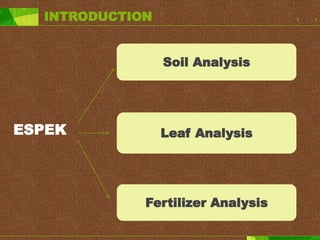
ESPEK
Soil Analysis
Leaf Analysis
Fertilizer Analysis
INTRODUCTION
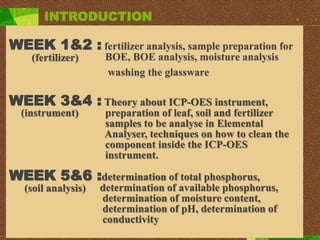
WEEK 1&2 : fertilizer analysis, sample preparation for
BOE, BOE analysis, moisture analysis
washing the glassware
WEEK 3&4 : Theory about ICP-OES instrument,
preparation of leaf, soil and fertilizer
samples to be analyse in Elemental
Analyser, techniques on how to clean the
component inside the ICP-OES
instrument.
WEEK 5&6 :determination of total phosphorus,
determination of available phosphorus,
determination of moisture content,
determination of pH, determination of
conductivity
(fertilizer)
(instrument)
(soil analysis)
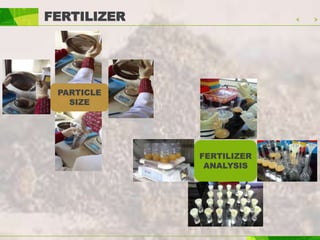
FERTILIZER
PARTICLE
SIZE
FERTILIZER
ANALYSIS
SOIL
DETERMINATION
OF PH
DETERMINATION
OF CONDUCTIVITY
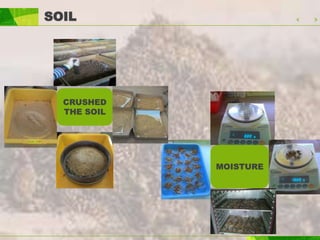
SOIL
CRUSHED
THE SOIL
MOISTURE
BOE Analysis
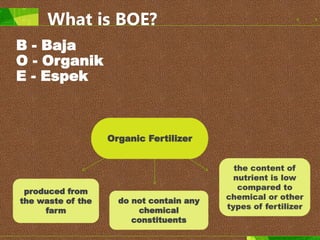
What is BOE?
B - Baja
O - Organik
E - Espek
Organic Fertilizer
produced from
the waste of the
farm
do not contain any
chemical
constituents
the content of
nutrient is low
compared to
chemical or other
types of fertilizer
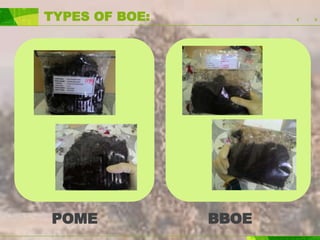
TYPES OF BOE:
POME BBOE
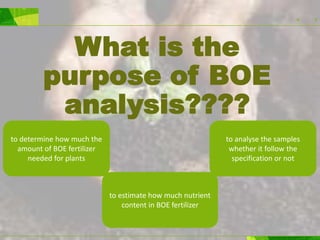
What is the
purpose of BOE
analysis????
to determine how much the
amount of BOE fertilizer
needed for plants
to estimate how much nutrient
content in BOE fertilizer
to analyse the samples
whether it follow the
specification or not
METHODOLOGY
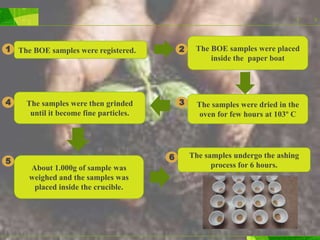
The BOE samples were registered. The BOE samples were placed
inside the paper boat
The samples were dried in the
oven for few hours at 103Âş C
The samples were then grinded
until it become fine particles.
About 1.000g of sample was
weighed and the samples was
placed inside the crucible.
The samples undergo the ashing
process for 6 hours.
1 2
65
4 3
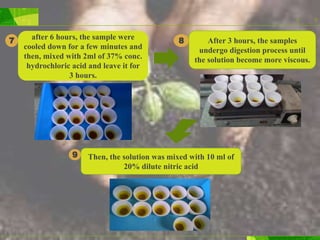
After 3 hours, the samples
undergo digestion process until
the solution become more viscous.
after 6 hours, the sample were
cooled down for a few minutes and
then, mixed with 2ml of 37% conc.
hydrochloric acid and leave it for
3 hours.
Then, the solution was mixed with 10 ml of
20% dilute nitric acid
7 8
9
The solution was then transfered
into the 100ml of volumetric
flask by using boiling water.
The sample solution inside
volumetric flask were then mark
up by using distilled water.
The samples were then palced in
water bath for few minutes until
the volume of sample become half
from its original volume.
10 11
12Lastly, the sample solution
were filtered into vial and
transfered into test tubes to be
analyse in ICP-OES.
13
RESULTS
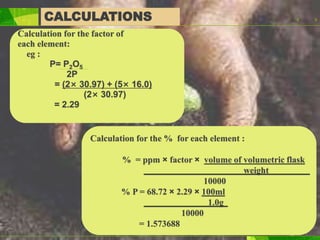
CALCULATIONS
Calculation for the factor of
each element:
eg :
P= P2O5
2P
= (2× 30.97) + (5× 16.0)
(2× 30.97)
= 2.29
Calculation for the % for each element :
% = ppm × factor × volume of volumetric flask
weight
10000
% P = 68.72 × 2.29 × 100ml
1.0g
10000
= 1.573688
CONCLUSION
each element contribute different nutrients for plants and soil.
Organic fertilizer have extra elements which contribute more nutrients for
plant instead of the common fertilizer which have the nutrients of nitrogen,
potassium and phosphorus.
organic fertilizer have the elements of Iron(Fe), Manganase(Mn) and
Copper (Cu) .
Element Description
Nitrogen(N) Required for growth vegetative part.
Phosphorus(P) Required for healthy and strong roots.
Good for flower and fruits.
Potassium(K) Make the plants healthy by facilitating the circulation
within the plants.
Magnesium(Mg)
Calcium(Ca)
Iron(Fe)
Copper(Cu)
Provide minerals for roots and plants.
What is the
advantages of
organic
fertilizer????
Reduce the
pollution
improve the
structure of soil
increase the ability
to hold water and
nutrients
increase
the fertility
of the soil

Presentation boe analysis

  • 2.
  • 3.
    INTRODUCTION WEEK 1&2 :fertilizer analysis, sample preparation for BOE, BOE analysis, moisture analysis washing the glassware WEEK 3&4 : Theory about ICP-OES instrument, preparation of leaf, soil and fertilizer samples to be analyse in Elemental Analyser, techniques on how to clean the component inside the ICP-OES instrument. WEEK 5&6 :determination of total phosphorus, determination of available phosphorus, determination of moisture content, determination of pH, determination of conductivity (fertilizer) (instrument) (soil analysis)
  • 4.
  • 5.
  • 6.
  • 7.
  • 8.
    What is BOE? B- Baja O - Organik E - Espek Organic Fertilizer produced from the waste of the farm do not contain any chemical constituents the content of nutrient is low compared to chemical or other types of fertilizer
  • 9.
  • 10.
    What is the purposeof BOE analysis???? to determine how much the amount of BOE fertilizer needed for plants to estimate how much nutrient content in BOE fertilizer to analyse the samples whether it follow the specification or not
  • 11.
  • 12.
    The BOE sampleswere registered. The BOE samples were placed inside the paper boat The samples were dried in the oven for few hours at 103Âş C The samples were then grinded until it become fine particles. About 1.000g of sample was weighed and the samples was placed inside the crucible. The samples undergo the ashing process for 6 hours. 1 2 65 4 3
  • 13.
    After 3 hours,the samples undergo digestion process until the solution become more viscous. after 6 hours, the sample were cooled down for a few minutes and then, mixed with 2ml of 37% conc. hydrochloric acid and leave it for 3 hours. Then, the solution was mixed with 10 ml of 20% dilute nitric acid 7 8 9
  • 14.
    The solution wasthen transfered into the 100ml of volumetric flask by using boiling water. The sample solution inside volumetric flask were then mark up by using distilled water. The samples were then palced in water bath for few minutes until the volume of sample become half from its original volume. 10 11 12Lastly, the sample solution were filtered into vial and transfered into test tubes to be analyse in ICP-OES. 13
  • 15.
  • 16.
    CALCULATIONS Calculation for thefactor of each element: eg : P= P2O5 2P = (2× 30.97) + (5× 16.0) (2× 30.97) = 2.29 Calculation for the % for each element : % = ppm × factor × volume of volumetric flask weight 10000 % P = 68.72 × 2.29 × 100ml 1.0g 10000 = 1.573688
  • 17.
    CONCLUSION each element contributedifferent nutrients for plants and soil. Organic fertilizer have extra elements which contribute more nutrients for plant instead of the common fertilizer which have the nutrients of nitrogen, potassium and phosphorus. organic fertilizer have the elements of Iron(Fe), Manganase(Mn) and Copper (Cu) . Element Description Nitrogen(N) Required for growth vegetative part. Phosphorus(P) Required for healthy and strong roots. Good for flower and fruits. Potassium(K) Make the plants healthy by facilitating the circulation within the plants. Magnesium(Mg) Calcium(Ca) Iron(Fe) Copper(Cu) Provide minerals for roots and plants.
  • 18.
    What is the advantagesof organic fertilizer???? Reduce the pollution improve the structure of soil increase the ability to hold water and nutrients increase the fertility of the soil