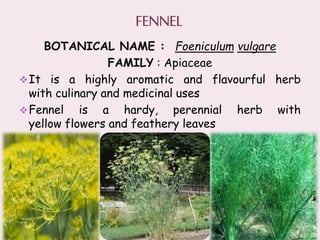
BOTANICAL NAME : Foeniculum vulgare
FAMILY : Apiaceae
It is a highly aromatic and flavourful herb
with culinary and medicinal uses
Fennel is a hardy, perennial herb with
yellow flowers and feathery leaves
The major constituent of fennel oil is anethole
(80%)
It contains not more than 10% estragole and not
more than 7.5% fenchone
Other constituents include alpha pinene, beta
myrcene, beta pinene, bitter fenchone, camphene,
estragole (methyl-chavicol), fenchone, limonene,
p-cymen, and safrole.
Furthermore, sweet fennel contains other
nonvolatile constituents such as flavonoids and
coumarins
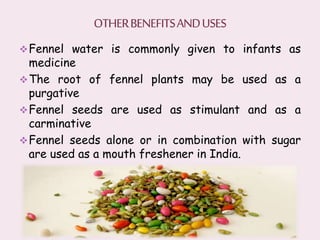
Fennel water is commonly given to infants as
medicine
The root of fennel plants may be used as a
purgative
Fennel seeds are used as stimulant and as a
carminative
Fennel seeds alone or in combination with sugar
are used as a mouth freshener in India.
It is indigenous to the shores of
the Mediterranean but has become widely
naturalized in many parts of the world, especially
on dry soils near the sea-coast and on riverbanks
India is top producer of fennel seeds in the
world
Fennel is known in various names in different
parts of the country. In Hindi, fennel is known as
‘saunf’
Major production centers of fennel in India are
Rajasthan, Andhra Pradesh, Punjab, Madhya
Pradesh, Uttar Pradesh, Gujarat, Karnataka, and
Haryana
ORIGIN AND DISTRIBUTION
Cool and dry climate is best for the cultivation of
fennel crop
Dry and cool weather during the seed set
increases seed yield and quality of the produce
Fennel can be cultivated in all types of soils that
are rich in organic matter
Best soils for fennel cultivation are black cotton
soil and loamy soil containing lime
Proper drainage is also an important requisite for
commercial cultivation of fennel crop
 RF 101 :Tall, erect with stout stem; long,bold grains;
matures in 150–160 days; average yield is 15.5 q/ha
 RF 125 : Short plants with compact umbels; long, bold grains;
matures in 110–130 days; yield is 17.3 q/ha of seed
 RF 35 : Tall, spreading plats with medium-sized, hairless and
green seeds; tolerant to sugary disease, leaf-spot and leaf-
blight; matures in 225 days; average yield of 12.8 q/ha.
 Gujarat Fennel 1 : Tall and bushy plants with oblong,
medium-bold and dark green seeds; tolerant to sugary disease
and leaf-spot; matures in 225 days; average yield is 16.5
q/ha; suitable for early-sowing; tolerant to drought.
 Co 1 : Medium tall plants with diffused branching; matures in
220 days with an average yield of 5.67q/ha; suitable for
drought-prone, waterlogged, saline and alkaline conditions;
suitable for hilly areas.
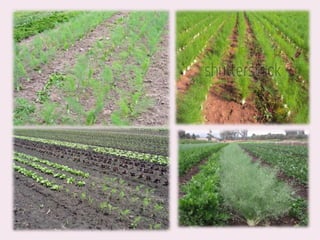
Fennel seeds can be directly sown in the main
field or seedlings can be raised in nursery beds
and later transplanted in the main field
DIRECT SOWING
Sowing time : Mid-September to mid-October
Seed rate : 10–12 kg/ha (Direct sowing)
Spacing : 45–60cm (row-row)
TRANSPLANTING
Seedlings are raised during June or July on well-
prepared nursery beds. Afterwards, 7–8 weeks
old seedlings are transplanted in the field in
August
FERTILIZATION : At the time of field preparation FYM
(farmyard manure) is added @ 10–15 tons/ha.
Afterwards, apply 90kg N/ha in three equal splits–
first as basal dose along with 40kg/ha P2O5, second
and third applications at 30 and 60 days after sowing.
WEED CONTROL : Weed infestation is a serious
problem. First hoeing and weeding at 30 days after
sowing by mechanical and chemical means.
IRRIGATION : First irrigation done after seed sowing and
thereafter one or two light irrigations are required
until seed germination. Afterwards, the crop is
irrigated at an interval of 15–25 days. Water stress
must be avoided during flowering and seed formation
to improve yield.
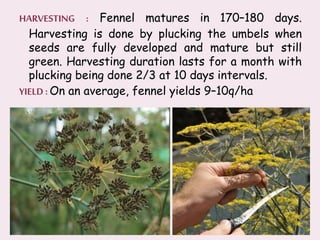
HARVESTING : Fennel matures in 170–180 days.
Harvesting is done by plucking the umbels when
seeds are fully developed and mature but still
green. Harvesting duration lasts for a month with
plucking being done 2/3 at 10 days intervals.
YIELD : On an average, fennel yields 9–10q/ha
 Drying of Fennel Seeds
Harvested umbels are dried in sun for 1–2 days and then
in shade for 8–10 days. Care must be taken not to sun-
dry the umbels too long as long exposure of seeds to
the sun reduces the quality of the produce.
 Cleaning and Grading
After drying, fennel seeds are cleaned with the help of
vacuum gravity separator or spiral gravity separator.
Cleaned seeds are then graded based on its quality
and then packed in jute bags for marketing.
 Storage
Dried and clean seeds are stored in jute bags in damp-
free aerated store
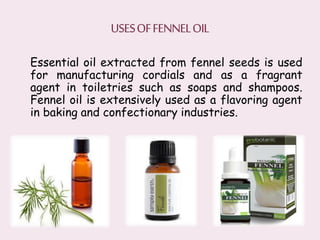
Essential oil extracted from fennel seeds is used
for manufacturing cordials and as a fragrant
agent in toiletries such as soaps and shampoos.
Fennel oil is extensively used as a flavoring agent
in baking and confectionary industries.
THANK YOU

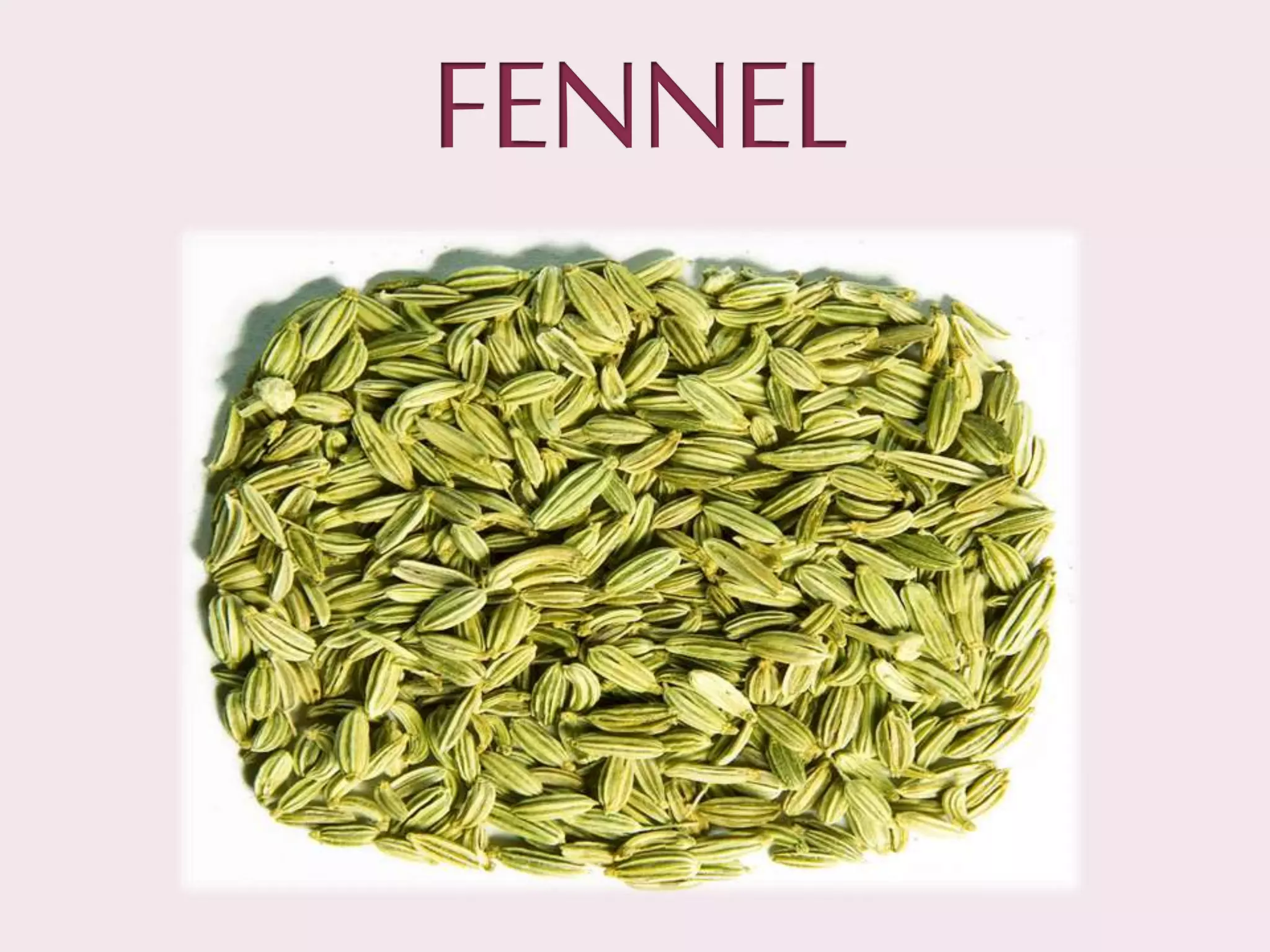
Fennel Cultivation

  • 2.
    BOTANICAL NAME :Foeniculum vulgare FAMILY : Apiaceae It is a highly aromatic and flavourful herb with culinary and medicinal uses Fennel is a hardy, perennial herb with yellow flowers and feathery leaves
  • 3.
    The major constituentof fennel oil is anethole (80%) It contains not more than 10% estragole and not more than 7.5% fenchone Other constituents include alpha pinene, beta myrcene, beta pinene, bitter fenchone, camphene, estragole (methyl-chavicol), fenchone, limonene, p-cymen, and safrole. Furthermore, sweet fennel contains other nonvolatile constituents such as flavonoids and coumarins
  • 5.
    Fennel water iscommonly given to infants as medicine The root of fennel plants may be used as a purgative Fennel seeds are used as stimulant and as a carminative Fennel seeds alone or in combination with sugar are used as a mouth freshener in India.
  • 6.
    It is indigenousto the shores of the Mediterranean but has become widely naturalized in many parts of the world, especially on dry soils near the sea-coast and on riverbanks India is top producer of fennel seeds in the world Fennel is known in various names in different parts of the country. In Hindi, fennel is known as ‘saunf’ Major production centers of fennel in India are Rajasthan, Andhra Pradesh, Punjab, Madhya Pradesh, Uttar Pradesh, Gujarat, Karnataka, and Haryana ORIGIN AND DISTRIBUTION
  • 7.
    Cool and dryclimate is best for the cultivation of fennel crop Dry and cool weather during the seed set increases seed yield and quality of the produce Fennel can be cultivated in all types of soils that are rich in organic matter Best soils for fennel cultivation are black cotton soil and loamy soil containing lime Proper drainage is also an important requisite for commercial cultivation of fennel crop
  • 8.
     RF 101:Tall, erect with stout stem; long,bold grains; matures in 150–160 days; average yield is 15.5 q/ha  RF 125 : Short plants with compact umbels; long, bold grains; matures in 110–130 days; yield is 17.3 q/ha of seed  RF 35 : Tall, spreading plats with medium-sized, hairless and green seeds; tolerant to sugary disease, leaf-spot and leaf- blight; matures in 225 days; average yield of 12.8 q/ha.  Gujarat Fennel 1 : Tall and bushy plants with oblong, medium-bold and dark green seeds; tolerant to sugary disease and leaf-spot; matures in 225 days; average yield is 16.5 q/ha; suitable for early-sowing; tolerant to drought.  Co 1 : Medium tall plants with diffused branching; matures in 220 days with an average yield of 5.67q/ha; suitable for drought-prone, waterlogged, saline and alkaline conditions; suitable for hilly areas.
  • 9.
    Fennel seeds canbe directly sown in the main field or seedlings can be raised in nursery beds and later transplanted in the main field DIRECT SOWING Sowing time : Mid-September to mid-October Seed rate : 10–12 kg/ha (Direct sowing) Spacing : 45–60cm (row-row) TRANSPLANTING Seedlings are raised during June or July on well- prepared nursery beds. Afterwards, 7–8 weeks old seedlings are transplanted in the field in August
  • 11.
    FERTILIZATION : Atthe time of field preparation FYM (farmyard manure) is added @ 10–15 tons/ha. Afterwards, apply 90kg N/ha in three equal splits– first as basal dose along with 40kg/ha P2O5, second and third applications at 30 and 60 days after sowing. WEED CONTROL : Weed infestation is a serious problem. First hoeing and weeding at 30 days after sowing by mechanical and chemical means. IRRIGATION : First irrigation done after seed sowing and thereafter one or two light irrigations are required until seed germination. Afterwards, the crop is irrigated at an interval of 15–25 days. Water stress must be avoided during flowering and seed formation to improve yield.
  • 12.
    HARVESTING : Fennelmatures in 170–180 days. Harvesting is done by plucking the umbels when seeds are fully developed and mature but still green. Harvesting duration lasts for a month with plucking being done 2/3 at 10 days intervals. YIELD : On an average, fennel yields 9–10q/ha
  • 13.
     Drying ofFennel Seeds Harvested umbels are dried in sun for 1–2 days and then in shade for 8–10 days. Care must be taken not to sun- dry the umbels too long as long exposure of seeds to the sun reduces the quality of the produce.  Cleaning and Grading After drying, fennel seeds are cleaned with the help of vacuum gravity separator or spiral gravity separator. Cleaned seeds are then graded based on its quality and then packed in jute bags for marketing.  Storage Dried and clean seeds are stored in jute bags in damp- free aerated store
  • 14.
    Essential oil extractedfrom fennel seeds is used for manufacturing cordials and as a fragrant agent in toiletries such as soaps and shampoos. Fennel oil is extensively used as a flavoring agent in baking and confectionary industries.
  • 15.