Black Pepper
Ms. V. V. Uttarwar
Introduction
• SCIENTIFIC NAME : Piper nigrum
Family : Piperaceae
English name : Black Pepper
Indian names: Kali Mirch (Hindi), Kare Menasu (Kannada), Kurumaluku, Nallamulaku
Malayalam), Maricha Ushana, Hopusha (Sanskrit), Milagu (Tamil), Miriyalu (Telugu).
Species : Piper nigrum L
Distribution : Western Ghats of India, North Myanmar, Indonesia, Malaysia, Brazil,
Madagascar, Sri Lanka, Vietnam, Thailand, China.
Uses : Spice and condiment.
Origin and Area of Production
• It is called as king of Spices as volume of international trade of it is the
highest among all spices.
• According to year 2020 stat. Karnataka ias leading producer of black
pepper. (Approx. 50 % Production)
• Pepper has its origin in the Western Ghats of India.
• It occurs wild in the hills of Assam and North Burma. It is a perennial
climbing plant, mostly cultivated as a mixed crop in coffee, citrus and
arecanut plantations in Kerala and Karnataka.
• Besides India, pepper is now grown in Indonesia, Malaysia, Brazil,
Madagascar, Sri Lanka, Vietnam, Thailand, China and the Federated State
of Micronesia.
Conti…
• Pepper is also grown in Pondicherry, Maharashtra, Goa, Andhra Pradesh,
Orissa, West Bengal, some Northeastern states and the Andaman and
Nicobar Islands. Nearly 80% of the pepper produced in the country is
exported, contributing to about 37% of the total export earnings from
spices.
• The main buyers of Indian pepper are the US, China, Vietnam, Hong Kong,
Bangladesh, Thailand, UK, UAE, Malaysia and Sri Lanka.
Plant Description
• Pepper is a large genus, with over 1,000
species, in the family Piperaceae. They are
mostly herbaceous or woody climbers or
shrubs distributed in the tropics of
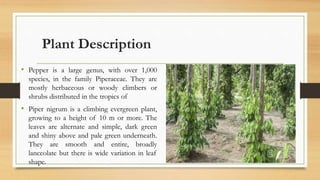
• Piper nigrum is a climbing evergreen plant,
growing to a height of 10 m or more. The
leaves are alternate and simple, dark green
and shiny above and pale green underneath.
They are smooth and entire, broadly
lanceolate but there is wide variation in leaf
shape.
Conti…..
• The spike is a catkin type of inflorescence,
which emerges opposite the upper leaves, on the
plagiotropic branches. It is 3-15 cm long with
50-150 minute white to pale yellow flowers.
• The fruit is a one-seeded green berry, sessile
usually globose and sometimes elongated or
oval. The seed is surrounded by a thin, soft
pericap. During ripening, it becomes yellow and
turns light red afterwards. The period taken
from flowering to maturity is about 6 months.
Varieties
• In India, out of about 100 varieties which are under cultivation, only ten have assumed
commercial importance. The distinguishing characters of some of the
important varieties are as follows.
• Kottanadan Tellicherry
• Kuthiravally Malabar pepper
• Kartmunda Cheriakodi
• Karimcotta Daddagya
• Balan cotta
• Panniyur-1, Panniyur-3 and Panniyur-8
Uses of Pepper
• As a Flavor-ant in culinary seasoning
• As preservatives
• As medicinal use
• Use of oil of Pepper
• Use of Piperin Use of Pepper Olearesin
Harvesting
• The spikes are ready for harvest when they start yellowing and in a spike 1 or 2 berries become red. At this stage, the
spikes are removed from the vines.
• The spikes are kept as such for a day or so, thereafter the berries are removed by rubbing or scrubbing, and then dried
in the sun. The spikes are sometimes dried directly in the sun for a few days on mats or on clean concrete floors.
• These are turned over, and later are removed when completely dry. The outer skin of the berries becomes dark brown
to black and shrivels.
• In Kerala, where 90-95% of pepper is grown, the plants flower in May-June.
• The crop takes 6-8 months from flowering to harvest.
• The harvest season extends from November to January in the plains and January to March in the hills.
Curing
• Harvesting of pepper is carried out according to the King of
Pepper that is white or black.
• For preparation of black pepper, the berries are harvested slightly
early white for white pepper.
• It is harvested at a slightly advanced stage of ripeness, that is when
the berries turn red.
Black Pepper
• The spikes are heaped for 1-2 days then the berries are separated by rubbing
of trampling and dried in sum.
• The spike are also directly dried in the sun for 5-7 days on mats or clean
concrte floor, until the outer skin become dark brown to black and shrivel
generally 100 kg of fresh berries yield about 26-30 Kg of black pepper for
commerce.
White Pepper
• White pepper is prepared by removing the outer skin of the harvested
berries either before or after drying by any one of the following technique:
• Using Ripe Fresh Berries
• Using Dried Berries
Using Ripe Fresh Berries
• The harvested ripe spikes or berries are packed in gunny bags are stepped in
water tank or under running water for 7-10 days.
• The pinhead and light berries floated are separated are dried and sold as
pinhead and light pepper.
• The remaining sound berries are stirred 2-3 times daily while drying.
Using Dried Berries
• The dried black pepper berries are striped in water for 10-15 days after which
they are removed rubbed, washed thoroughly.
• Stepped again in bleaching solution for 2-3 days , drained and dried in the
sun and sold as white pepper.
Processed Products of Black Pepper
• White Pepper
• Canned tender Green pepper
• Bottled green pepper in Brine/ Acetic acid
• Cured green Pepper
• Dehydrated green paper
• Freezed dried Green pepper
• Frozen green pepper
• Pepper Powder
• Pepper oil
• Pepper oleoresin
White Pepper
• It is liked for its flavor, mild pungency low fibric and high starch content and
white color and absence of black particle.
• White pepper is made either by removal of skin of ripened berries or by
abrasion peeling of black pepper berries.
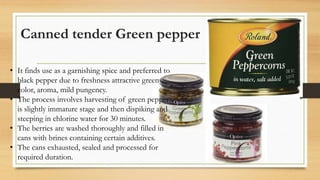
Canned tender Green pepper
• It finds use as a garnishing spice and preferred to
black pepper due to freshness attractive green
color, aroma, mild pungency.
• The process involves harvesting of green pepper
is slightly immature stage and then dispiking and
steeping in chlorine water for 30 minutes.
• The berries are washed thoroughly and filled in
cans with brines containing certain additives.
• The cans exhausted, sealed and processed for
required duration.
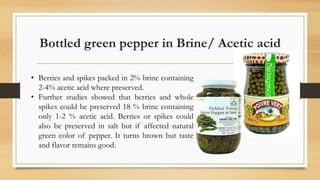
Bottled green pepper in Brine/ Acetic acid
• Berries and spikes packed in 2% brine containing
2-4% acetic acid where preserved.
• Further studies showed that berries and whole
spikes could be preserved 18 % brine containing
only 1-2 % acetic acid. Berries or spikes could
also be preserved in salt but if affected natural
green color of pepper. It turns brown but taste
and flavor remains good.
Freezed dried Green pepper
• The cleaned washed green berries are water blanched cooled, deep frozen to
-40 C and while in that frozen state, they are subjected to vaccum drying
under an ultra low pressure of 5 micron.
• It has superior attractive green colour , better aroma and color.
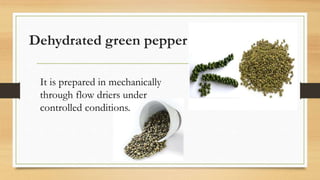
Dehydrated green pepper
It is prepared in mechanically
through flow driers under
controlled conditions.
Frozen green pepper
• This is another recently developed product
the cleaned, blanched cooked in brine are
frozen in 2 % brine containing 0.25% citric
acid.
• Ascorbic acid is added to covering brine
before freezing, canning or bottling to serve
as an anti-oxidant for prevention of
browning in green pepper or brine.
Pepper Powder
• Fully Matured black peppers
are used for preparation of
powder.
• India is exporting increased
quantity of black pepper
powder.
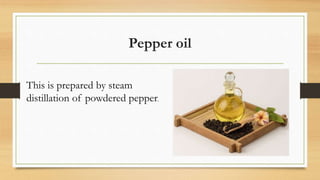
Pepper oil
This is prepared by steam
distillation of powdered pepper.
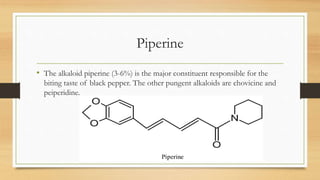
Piperine
• The alkaloid piperine (3-6%) is the major constituent responsible for the
biting taste of black pepper. The other pungent alkaloids are chovicine and
peiperidine.
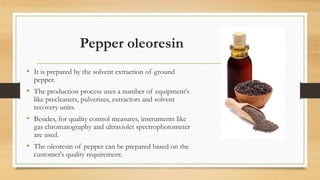
Pepper oleoresin
• It is prepared by the solvent extraction of ground
pepper.
• The production process uses a number of equipment's
like precleaners, pulverizes, extractors and solvent
recovery units.
• Besides, for quality control measures, instruments like
gas chromatography and ultraviolet spectrophotometer
are used.
• The oleoresin of pepper can be prepared based on the
customer's quality requirement.
Thank you

Black pepper

  • 1.
  • 2.
    Introduction • SCIENTIFIC NAME: Piper nigrum Family : Piperaceae English name : Black Pepper Indian names: Kali Mirch (Hindi), Kare Menasu (Kannada), Kurumaluku, Nallamulaku Malayalam), Maricha Ushana, Hopusha (Sanskrit), Milagu (Tamil), Miriyalu (Telugu). Species : Piper nigrum L Distribution : Western Ghats of India, North Myanmar, Indonesia, Malaysia, Brazil, Madagascar, Sri Lanka, Vietnam, Thailand, China. Uses : Spice and condiment.
  • 3.
    Origin and Areaof Production • It is called as king of Spices as volume of international trade of it is the highest among all spices. • According to year 2020 stat. Karnataka ias leading producer of black pepper. (Approx. 50 % Production) • Pepper has its origin in the Western Ghats of India. • It occurs wild in the hills of Assam and North Burma. It is a perennial climbing plant, mostly cultivated as a mixed crop in coffee, citrus and arecanut plantations in Kerala and Karnataka. • Besides India, pepper is now grown in Indonesia, Malaysia, Brazil, Madagascar, Sri Lanka, Vietnam, Thailand, China and the Federated State of Micronesia.
  • 4.
    Conti… • Pepper isalso grown in Pondicherry, Maharashtra, Goa, Andhra Pradesh, Orissa, West Bengal, some Northeastern states and the Andaman and Nicobar Islands. Nearly 80% of the pepper produced in the country is exported, contributing to about 37% of the total export earnings from spices. • The main buyers of Indian pepper are the US, China, Vietnam, Hong Kong, Bangladesh, Thailand, UK, UAE, Malaysia and Sri Lanka.
  • 5.
    Plant Description • Pepperis a large genus, with over 1,000 species, in the family Piperaceae. They are mostly herbaceous or woody climbers or shrubs distributed in the tropics of • Piper nigrum is a climbing evergreen plant, growing to a height of 10 m or more. The leaves are alternate and simple, dark green and shiny above and pale green underneath. They are smooth and entire, broadly lanceolate but there is wide variation in leaf shape.
  • 6.
    Conti….. • The spikeis a catkin type of inflorescence, which emerges opposite the upper leaves, on the plagiotropic branches. It is 3-15 cm long with 50-150 minute white to pale yellow flowers. • The fruit is a one-seeded green berry, sessile usually globose and sometimes elongated or oval. The seed is surrounded by a thin, soft pericap. During ripening, it becomes yellow and turns light red afterwards. The period taken from flowering to maturity is about 6 months.
  • 7.
    Varieties • In India,out of about 100 varieties which are under cultivation, only ten have assumed commercial importance. The distinguishing characters of some of the important varieties are as follows. • Kottanadan Tellicherry • Kuthiravally Malabar pepper • Kartmunda Cheriakodi • Karimcotta Daddagya • Balan cotta • Panniyur-1, Panniyur-3 and Panniyur-8
  • 8.
    Uses of Pepper •As a Flavor-ant in culinary seasoning • As preservatives • As medicinal use • Use of oil of Pepper • Use of Piperin Use of Pepper Olearesin
  • 9.
    Harvesting • The spikesare ready for harvest when they start yellowing and in a spike 1 or 2 berries become red. At this stage, the spikes are removed from the vines. • The spikes are kept as such for a day or so, thereafter the berries are removed by rubbing or scrubbing, and then dried in the sun. The spikes are sometimes dried directly in the sun for a few days on mats or on clean concrete floors. • These are turned over, and later are removed when completely dry. The outer skin of the berries becomes dark brown to black and shrivels. • In Kerala, where 90-95% of pepper is grown, the plants flower in May-June. • The crop takes 6-8 months from flowering to harvest. • The harvest season extends from November to January in the plains and January to March in the hills.
  • 10.
    Curing • Harvesting ofpepper is carried out according to the King of Pepper that is white or black. • For preparation of black pepper, the berries are harvested slightly early white for white pepper. • It is harvested at a slightly advanced stage of ripeness, that is when the berries turn red.
  • 11.
    Black Pepper • Thespikes are heaped for 1-2 days then the berries are separated by rubbing of trampling and dried in sum. • The spike are also directly dried in the sun for 5-7 days on mats or clean concrte floor, until the outer skin become dark brown to black and shrivel generally 100 kg of fresh berries yield about 26-30 Kg of black pepper for commerce.
  • 12.
    White Pepper • Whitepepper is prepared by removing the outer skin of the harvested berries either before or after drying by any one of the following technique: • Using Ripe Fresh Berries • Using Dried Berries
  • 13.
    Using Ripe FreshBerries • The harvested ripe spikes or berries are packed in gunny bags are stepped in water tank or under running water for 7-10 days. • The pinhead and light berries floated are separated are dried and sold as pinhead and light pepper. • The remaining sound berries are stirred 2-3 times daily while drying.
  • 14.
    Using Dried Berries •The dried black pepper berries are striped in water for 10-15 days after which they are removed rubbed, washed thoroughly. • Stepped again in bleaching solution for 2-3 days , drained and dried in the sun and sold as white pepper.
  • 15.
    Processed Products ofBlack Pepper • White Pepper • Canned tender Green pepper • Bottled green pepper in Brine/ Acetic acid • Cured green Pepper • Dehydrated green paper • Freezed dried Green pepper • Frozen green pepper • Pepper Powder • Pepper oil • Pepper oleoresin
  • 16.
    White Pepper • Itis liked for its flavor, mild pungency low fibric and high starch content and white color and absence of black particle. • White pepper is made either by removal of skin of ripened berries or by abrasion peeling of black pepper berries.
  • 17.
    Canned tender Greenpepper • It finds use as a garnishing spice and preferred to black pepper due to freshness attractive green color, aroma, mild pungency. • The process involves harvesting of green pepper is slightly immature stage and then dispiking and steeping in chlorine water for 30 minutes. • The berries are washed thoroughly and filled in cans with brines containing certain additives. • The cans exhausted, sealed and processed for required duration.
  • 18.
    Bottled green pepperin Brine/ Acetic acid • Berries and spikes packed in 2% brine containing 2-4% acetic acid where preserved. • Further studies showed that berries and whole spikes could be preserved 18 % brine containing only 1-2 % acetic acid. Berries or spikes could also be preserved in salt but if affected natural green color of pepper. It turns brown but taste and flavor remains good.
  • 19.
    Freezed dried Greenpepper • The cleaned washed green berries are water blanched cooled, deep frozen to -40 C and while in that frozen state, they are subjected to vaccum drying under an ultra low pressure of 5 micron. • It has superior attractive green colour , better aroma and color.
  • 20.
    Dehydrated green pepper Itis prepared in mechanically through flow driers under controlled conditions.
  • 21.
    Frozen green pepper •This is another recently developed product the cleaned, blanched cooked in brine are frozen in 2 % brine containing 0.25% citric acid. • Ascorbic acid is added to covering brine before freezing, canning or bottling to serve as an anti-oxidant for prevention of browning in green pepper or brine.
  • 22.
    Pepper Powder • FullyMatured black peppers are used for preparation of powder. • India is exporting increased quantity of black pepper powder.
  • 23.
    Pepper oil This isprepared by steam distillation of powdered pepper.
  • 24.
    Piperine • The alkaloidpiperine (3-6%) is the major constituent responsible for the biting taste of black pepper. The other pungent alkaloids are chovicine and peiperidine.
  • 25.
    Pepper oleoresin • Itis prepared by the solvent extraction of ground pepper. • The production process uses a number of equipment's like precleaners, pulverizes, extractors and solvent recovery units. • Besides, for quality control measures, instruments like gas chromatography and ultraviolet spectrophotometer are used. • The oleoresin of pepper can be prepared based on the customer's quality requirement.
  • 26.