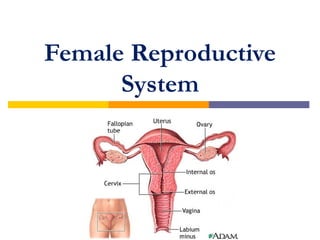
Female Reproductive
System
Female Reproductive System
 Produce sex hormones
 Estrogen, Progesterone
 Produce egg (ova)
 Support & protect developing embryo
 Give birth to new baby
Major Organs
 Cervix
 Vagina
 Ovaries [gonads]
 Uterine tubes [fallopian tubes]
 Uterus
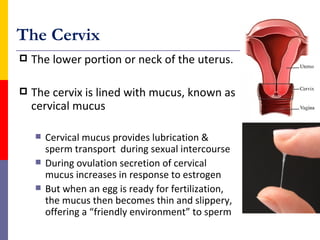
The Cervix
 The lower portion or neck of the uterus.
 The cervix is lined with mucus, known as
cervical mucus
 Cervical mucus provides lubrication &
sperm transport during sexual intercourse
 During ovulation secretion of cervical
mucus increases in response to estrogen
 But when an egg is ready for fertilization,
the mucus then becomes thin and slippery,
offering a “friendly environment” to sperm
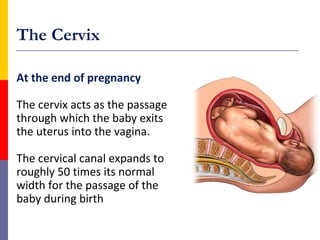
At the end of pregnancy
The cervix acts as the passage
through which the baby exits
the uterus into the vagina.
The cervical canal expands to
roughly 50 times its normal
width for the passage of the
baby during birth
The Cervix
The Vagina
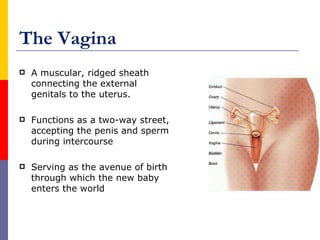
 A muscular, ridged sheath
connecting the external
genitals to the uterus.
 Functions as a two-way street,
accepting the penis and sperm
during intercourse
 Serving as the avenue of birth
through which the new baby
enters the world
External genetalia
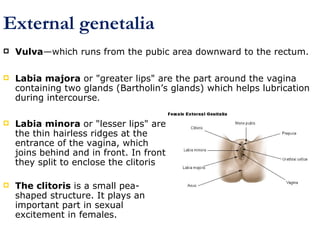
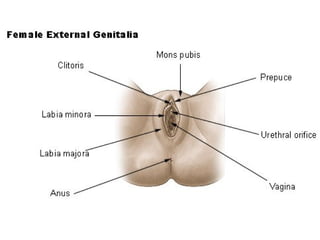
 Vulva—which runs from the pubic area downward to the rectum.
 Labia minora or "lesser lips" are
the thin hairless ridges at the
entrance of the vagina, which
joins behind and in front. In front
they split to enclose the clitoris
 The clitoris is a small pea-
shaped structure. It plays an
important part in sexual
excitement in females.
 Labia majora or "greater lips" are the part around the vagina
containing two glands (Bartholin’s glands) which helps lubrication
during intercourse.
External genetalia
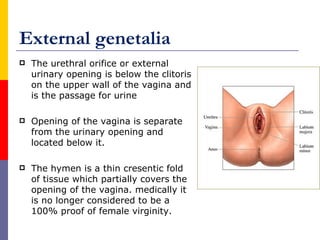
 The urethral orifice or external
urinary opening is below the clitoris
on the upper wall of the vagina and
is the passage for urine
 Opening of the vagina is separate
from the urinary opening and
located below it.
 The hymen is a thin cresentic fold
of tissue which partially covers the
opening of the vagina. medically it
is no longer considered to be a
100% proof of female virginity.
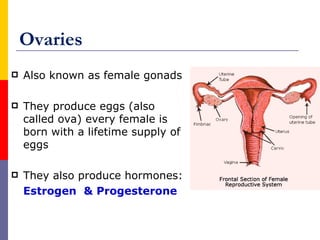
Ovaries
 Also known as female gonads
 They produce eggs (also
called ova) every female is
born with a lifetime supply of
eggs
 They also produce hormones:
Estrogen & Progesterone
Fallopian tubes [uterine tubes]
 Stretch from the uterus to the ovaries and measure about 8
to 13 cm in length.
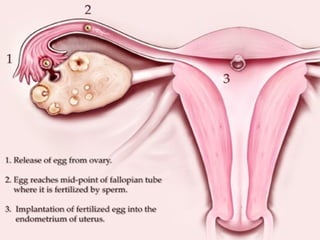
 The ends of the fallopian tubes lying next to the ovaries
feather into ends called fimbria
 Millions of tiny hair-like cilia line the fimbria and interior of
the fallopian tubes.
 The cilia beat in waves hundreds of times a second catching
the egg at ovulation and moving it through the tube to the
uterine cavity.
 Fertilization typically occurs in the fallopian tube
Uterus
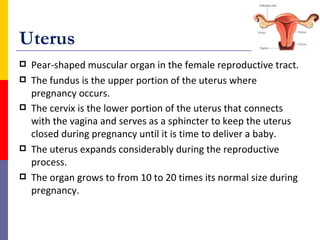
 Pear-shaped muscular organ in the female reproductive tract.
 The fundus is the upper portion of the uterus where
pregnancy occurs.
 The cervix is the lower portion of the uterus that connects
with the vagina and serves as a sphincter to keep the uterus
closed during pregnancy until it is time to deliver a baby.
 The uterus expands considerably during the reproductive
process.
 The organ grows to from 10 to 20 times its normal size during
pregnancy.
Uterus
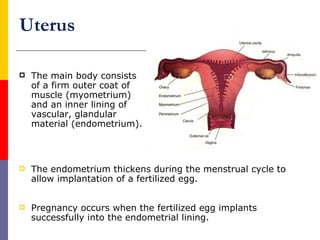
 The main body consists
of a firm outer coat of
muscle (myometrium)
and an inner lining of
vascular, glandular
material (endometrium).
 Pregnancy occurs when the fertilized egg implants
successfully into the endometrial lining.
 The endometrium thickens during the menstrual cycle to
allow implantation of a fertilized egg.
Endometrium
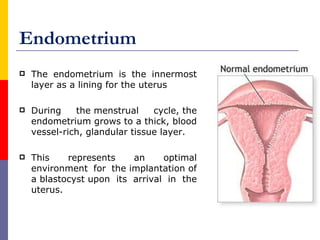
 The endometrium is the innermost
layer as a lining for the uterus
 During the menstrual cycle, the
endometrium grows to a thick, blood
vessel-rich, glandular tissue layer.
 This represents an optimal
environment for the implantation of
a blastocyst upon its arrival in the
uterus.
Endometrium
 The endometrium is central,
echogenic (detectable using
ultrasound scanners), and has
an average thickness of 6.7
mm.
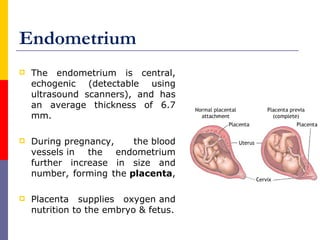
 During pregnancy, the blood
vessels in the endometrium
further increase in size and
number, forming the placenta,
 Placenta supplies oxygen and
nutrition to the embryo & fetus.
femalereproductivesystem-120329125448-phpapp02.pdf

femalereproductivesystem-120329125448-phpapp02.pdf

  • 1.
  • 2.
    Female Reproductive System Produce sex hormones  Estrogen, Progesterone  Produce egg (ova)  Support & protect developing embryo  Give birth to new baby
  • 3.
    Major Organs  Cervix Vagina  Ovaries [gonads]  Uterine tubes [fallopian tubes]  Uterus
  • 4.
    The Cervix  Thelower portion or neck of the uterus.  The cervix is lined with mucus, known as cervical mucus  Cervical mucus provides lubrication & sperm transport during sexual intercourse  During ovulation secretion of cervical mucus increases in response to estrogen  But when an egg is ready for fertilization, the mucus then becomes thin and slippery, offering a “friendly environment” to sperm
  • 5.
    At the endof pregnancy The cervix acts as the passage through which the baby exits the uterus into the vagina. The cervical canal expands to roughly 50 times its normal width for the passage of the baby during birth The Cervix
  • 6.
    The Vagina  Amuscular, ridged sheath connecting the external genitals to the uterus.  Functions as a two-way street, accepting the penis and sperm during intercourse  Serving as the avenue of birth through which the new baby enters the world
  • 7.
    External genetalia  Vulva—whichruns from the pubic area downward to the rectum.  Labia minora or "lesser lips" are the thin hairless ridges at the entrance of the vagina, which joins behind and in front. In front they split to enclose the clitoris  The clitoris is a small pea- shaped structure. It plays an important part in sexual excitement in females.  Labia majora or "greater lips" are the part around the vagina containing two glands (Bartholin’s glands) which helps lubrication during intercourse.
  • 9.
    External genetalia  Theurethral orifice or external urinary opening is below the clitoris on the upper wall of the vagina and is the passage for urine  Opening of the vagina is separate from the urinary opening and located below it.  The hymen is a thin cresentic fold of tissue which partially covers the opening of the vagina. medically it is no longer considered to be a 100% proof of female virginity.
  • 10.
    Ovaries  Also knownas female gonads  They produce eggs (also called ova) every female is born with a lifetime supply of eggs  They also produce hormones: Estrogen & Progesterone
  • 12.
    Fallopian tubes [uterinetubes]  Stretch from the uterus to the ovaries and measure about 8 to 13 cm in length.  The ends of the fallopian tubes lying next to the ovaries feather into ends called fimbria  Millions of tiny hair-like cilia line the fimbria and interior of the fallopian tubes.  The cilia beat in waves hundreds of times a second catching the egg at ovulation and moving it through the tube to the uterine cavity.  Fertilization typically occurs in the fallopian tube
  • 14.
    Uterus  Pear-shaped muscularorgan in the female reproductive tract.  The fundus is the upper portion of the uterus where pregnancy occurs.  The cervix is the lower portion of the uterus that connects with the vagina and serves as a sphincter to keep the uterus closed during pregnancy until it is time to deliver a baby.  The uterus expands considerably during the reproductive process.  The organ grows to from 10 to 20 times its normal size during pregnancy.
  • 15.
    Uterus  The mainbody consists of a firm outer coat of muscle (myometrium) and an inner lining of vascular, glandular material (endometrium).  Pregnancy occurs when the fertilized egg implants successfully into the endometrial lining.  The endometrium thickens during the menstrual cycle to allow implantation of a fertilized egg.
  • 16.
    Endometrium  The endometriumis the innermost layer as a lining for the uterus  During the menstrual cycle, the endometrium grows to a thick, blood vessel-rich, glandular tissue layer.  This represents an optimal environment for the implantation of a blastocyst upon its arrival in the uterus.
  • 17.
    Endometrium  The endometriumis central, echogenic (detectable using ultrasound scanners), and has an average thickness of 6.7 mm.  During pregnancy, the blood vessels in the endometrium further increase in size and number, forming the placenta,  Placenta supplies oxygen and nutrition to the embryo & fetus.