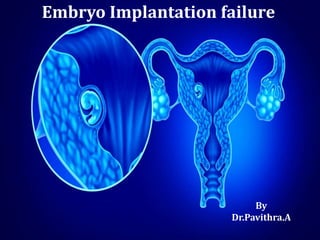
Embryo Implantation failure
By
Dr.Pavithra.A
Fertilization
 Fertilization involves fusion of the female (oocyte) and male gametes (sperm).
 The sperm fertilizes the oocyte creating a single diploid cell, the zygote.
 After successful fertilization in the ampulla of the fallopian tube, the zygote
migrates towards the uterine cavity with the assistance of the ciliary motility of
fallopian tube epithelium .
 During this time, the zygote undergoes a sequence of cell divisions resulting in a
multicellular structure termed the blastocyst.
 The blastocyst possesses an inner cell mass, which will form the embryo and an
outer layer of cells called trophoblasts, which will develop into the placenta
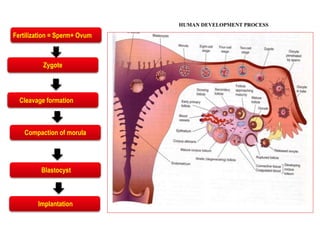
Fertilization = Sperm+ Ovum
Zygote
Compaction of morula
Cleavage formation
Blastocyst
Implantation
HUMAN DEVELOPMENT PROCESS
CLEAVAGE
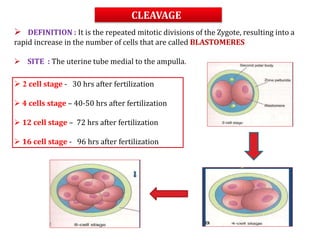
 DEFINITION : It is the repeated mitotic divisions of the Zygote, resulting into a
rapid increase in the number of cells that are called BLASTOMERES
 SITE : The uterine tube medial to the ampulla.
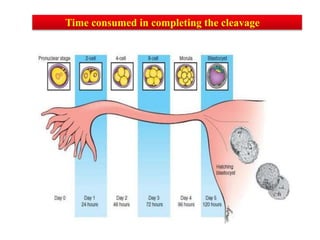
 2 cell stage - 30 hrs after fertilization
 4 cells stage – 40-50 hrs after fertilization
 12 cell stage – 72 hrs after fertilization
 16 cell stage - 96 hrs after fertilization
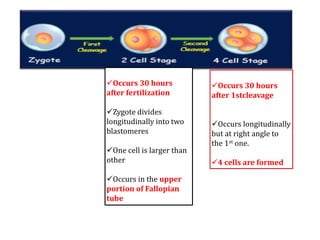
Occurs 30 hours
after fertilization
Zygote divides
longitudinally into two
blastomeres
One cell is larger than
other
Occurs in the upper
portion of Fallopian
tube
Occurs 30 hours
after 1stcleavage
Occurs longitudinally
but at right angle to
the 1st one.
4 cells are formed
Name 6
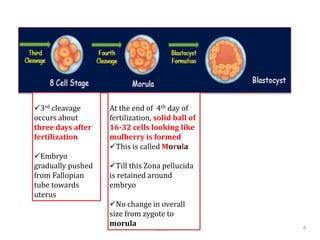
3rd cleavage
occurs about
three days after
fertilization
Embryo
gradually pushed
from Fallopian
tube towards
uterus
At the end of 4th day of
fertilization, solid ball of
16-32 cells looking like
mulberry is formed
This is called Morula
Till this Zona pellucida
is retained around
embryo
No change in overall
size from zygote to
morula
Time consumed in completing the cleavage
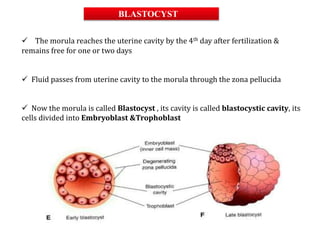
BLASTOCYST
 The morula reaches the uterine cavity by the 4th day after fertilization &
remains free for one or two days
 Fluid passes from uterine cavity to the morula through the zona pellucida
 Now the morula is called Blastocyst , its cavity is called blastocystic cavity, its
cells divided into Embryoblast &Trophoblast
 The Embryoblast projects into the blastocystic cavity ,while the trophoblast forms
the wall of the blastocyst .
 Zona pellucida degenerates &disappears by the 5th day to allows the blastocyst to
increase in size and penetrates the endometrium
 BY 6th day the blastocyst adheres to the endometrium
 By 7th day, Trophoblast differentiated into 2 layers
 CYTOTROPHBLAST ,inner layer ,mitotically active
 SYNCYTIOTROPHOBLAST (outer multinucleated mass, with indistinct cell
boundary
 By 8th day the blastocyst is superficially embedded in the compact layer of
endometrium
Difficulties in studying the process of
Implantation
Successful Implantation Requires
“Two way Interaction “
Blastocyst-Endometrium
DEFINTION :
 Penetration of the blastocyst into the superficial (compact)layer of the
endometrium.
 The endometrium after implantation is called Deciduas
SITE OF IMPLANTATION :
 Posterior wall of the uterine body in the functional layer of the
endometrium during the secretory phase of the cycle
TIME:
 Implantation occurs at the 6th day after fertilization and is completed
about the 11th day
IMPLANTATION
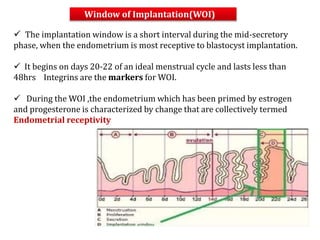
Window of Implantation(WOI)
 The implantation window is a short interval during the mid-secretory
phase, when the endometrium is most receptive to blastocyst implantation.
 It begins on days 20-22 of an ideal menstrual cycle and lasts less than
48hrs Integrins are the markers for WOI.
 During the WOI ,the endometrium which has been primed by estrogen
and progesterone is characterized by change that are collectively termed
Endometrial receptivity
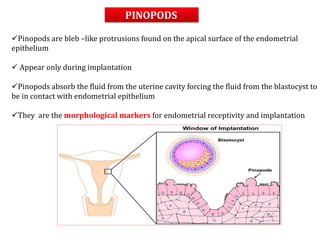
Pinopods are bleb –like protrusions found on the apical surface of the endometrial
epithelium
 Appear only during implantation
Pinopods absorb the fluid from the uterine cavity forcing the fluid from the blastocyst to
be in contact with endometrial epithelium
They are the morphological markers for endometrial receptivity and implantation
PINOPODS
Decidualization
 Decidualization is a biological transformation by which the endometrial
stromal cells ( fibroblast –like ) differentiate into a highly specialized secretory
epithelioid cell type ,termed decidual cells
 Decidualization occurs during the last secretory phase (day 23-28) and is a
pre-requisite for successful blastocyst implantation
 FUNCTION OF DECIDUAL CELLS
Controlled Trophoblast Invasion : Deciduas forms a local micro
environment to promote trophoblast attachment &invasion as well as limit the
extent of aggressive invasion
Protection of concepts from maternal immune rejection :
Act as gate keeper that controls immune tolerance during pregnancy by
blocking T cells that would otherwise attack the developing conceptus
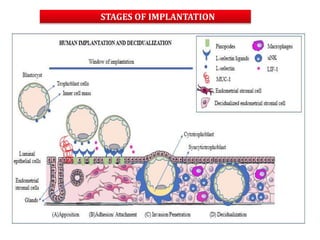
STAGES OF IMPLANTATION
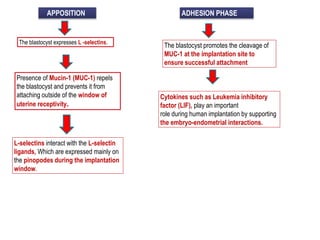
APPOSITION
The blastocyst expresses L -selectins.
Presence of Mucin-1 (MUC-1) repels
the blastocyst and prevents it from
attaching outside of the window of
uterine receptivity.
L-selectins interact with the L-selectin
ligands, Which are expressed mainly on
the pinopodes during the implantation
window.
ADHESION PHASE
The blastocyst promotes the cleavage of
MUC-1 at the implantation site to
ensure successful attachment
Cytokines such as Leukemia inhibitory
factor (LIF), play an important
role during human implantation by supporting
the embryo-endometrial interactions.
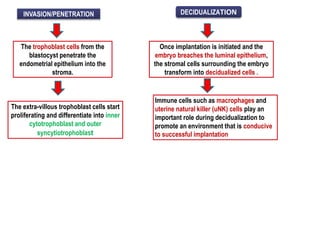
INVASION/PENETRATION
The trophoblast cells from the
blastocyst penetrate the
endometrial epithelium into the
stroma.
The extra-villous trophoblast cells start
proliferating and differentiate into inner
cytotrophoblast and outer
syncytiotrophoblast
DECIDUALIZATION
Once implantation is initiated and the
embryo breaches the luminal epithelium,
the stromal cells surrounding the embryo
transform into decidualized cells .
Immune cells such as macrophages and
uterine natural killer (uNK) cells play an
important role during decidualization to
promote an environment that is conducive
to successful implantation
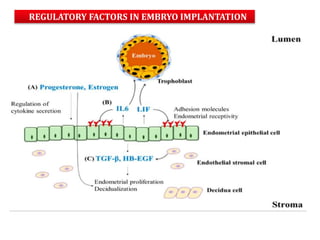
REGULATORY FACTORS IN EMBRYO IMPLANTATION
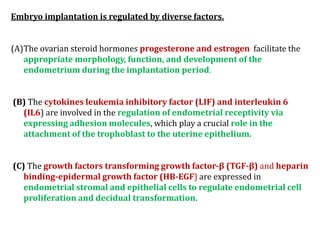
Embryo implantation is regulated by diverse factors.
(A)The ovarian steroid hormones progesterone and estrogen facilitate the
appropriate morphology, function, and development of the
endometrium during the implantation period.
(B) The cytokines leukemia inhibitory factor (LIF) and interleukin 6
(IL6) are involved in the regulation of endometrial receptivity via
expressing adhesion molecules, which play a crucial role in the
attachment of the trophoblast to the uterine epithelium.
(C) The growth factors transforming growth factor-β (TGF-β) and heparin
binding-epidermal growth factor (HB-EGF) are expressed in
endometrial stromal and epithelial cells to regulate endometrial cell
proliferation and decidual transformation.
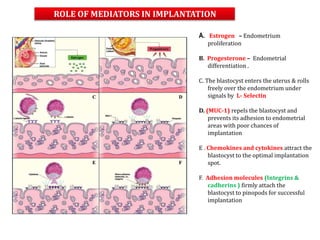
A. Estrogen – Endometrium
proliferation
B. Progesterone – Endometrial
differentiation .
C. The blastocyst enters the uterus & rolls
freely over the endometrium under
signals by L- Selectin
D. (MUC-1) repels the blastocyst and
prevents its adhesion to endometrial
areas with poor chances of
implantation
E . Chemokines and cytokines attract the
blastocyst to the optimal implantation
spot.
F. Adhesion molecules (Integrins &
cadherins ) firmly attach the
blastocyst to pinopods for successful
implantation
ROLE OF MEDIATORS IN IMPLANTATION
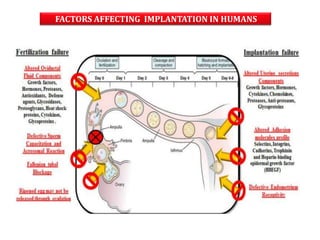
FACTORS AFFECTING IMPLANTATION IN HUMANS
embryo implantation failure.pptx

embryo implantation failure.pptx

  • 1.
  • 2.
    Fertilization  Fertilization involvesfusion of the female (oocyte) and male gametes (sperm).  The sperm fertilizes the oocyte creating a single diploid cell, the zygote.  After successful fertilization in the ampulla of the fallopian tube, the zygote migrates towards the uterine cavity with the assistance of the ciliary motility of fallopian tube epithelium .  During this time, the zygote undergoes a sequence of cell divisions resulting in a multicellular structure termed the blastocyst.  The blastocyst possesses an inner cell mass, which will form the embryo and an outer layer of cells called trophoblasts, which will develop into the placenta
  • 3.
    Fertilization = Sperm+Ovum Zygote Compaction of morula Cleavage formation Blastocyst Implantation HUMAN DEVELOPMENT PROCESS
  • 4.
    CLEAVAGE  DEFINITION :It is the repeated mitotic divisions of the Zygote, resulting into a rapid increase in the number of cells that are called BLASTOMERES  SITE : The uterine tube medial to the ampulla.  2 cell stage - 30 hrs after fertilization  4 cells stage – 40-50 hrs after fertilization  12 cell stage – 72 hrs after fertilization  16 cell stage - 96 hrs after fertilization
  • 5.
    Occurs 30 hours afterfertilization Zygote divides longitudinally into two blastomeres One cell is larger than other Occurs in the upper portion of Fallopian tube Occurs 30 hours after 1stcleavage Occurs longitudinally but at right angle to the 1st one. 4 cells are formed
  • 6.
    Name 6 3rd cleavage occursabout three days after fertilization Embryo gradually pushed from Fallopian tube towards uterus At the end of 4th day of fertilization, solid ball of 16-32 cells looking like mulberry is formed This is called Morula Till this Zona pellucida is retained around embryo No change in overall size from zygote to morula
  • 7.
    Time consumed incompleting the cleavage
  • 8.
    BLASTOCYST  The morulareaches the uterine cavity by the 4th day after fertilization & remains free for one or two days  Fluid passes from uterine cavity to the morula through the zona pellucida  Now the morula is called Blastocyst , its cavity is called blastocystic cavity, its cells divided into Embryoblast &Trophoblast
  • 9.
     The Embryoblastprojects into the blastocystic cavity ,while the trophoblast forms the wall of the blastocyst .  Zona pellucida degenerates &disappears by the 5th day to allows the blastocyst to increase in size and penetrates the endometrium  BY 6th day the blastocyst adheres to the endometrium  By 7th day, Trophoblast differentiated into 2 layers  CYTOTROPHBLAST ,inner layer ,mitotically active  SYNCYTIOTROPHOBLAST (outer multinucleated mass, with indistinct cell boundary  By 8th day the blastocyst is superficially embedded in the compact layer of endometrium
  • 10.
    Difficulties in studyingthe process of Implantation Successful Implantation Requires “Two way Interaction “ Blastocyst-Endometrium
  • 11.
    DEFINTION :  Penetrationof the blastocyst into the superficial (compact)layer of the endometrium.  The endometrium after implantation is called Deciduas SITE OF IMPLANTATION :  Posterior wall of the uterine body in the functional layer of the endometrium during the secretory phase of the cycle TIME:  Implantation occurs at the 6th day after fertilization and is completed about the 11th day IMPLANTATION
  • 12.
    Window of Implantation(WOI) The implantation window is a short interval during the mid-secretory phase, when the endometrium is most receptive to blastocyst implantation.  It begins on days 20-22 of an ideal menstrual cycle and lasts less than 48hrs Integrins are the markers for WOI.  During the WOI ,the endometrium which has been primed by estrogen and progesterone is characterized by change that are collectively termed Endometrial receptivity
  • 13.
    Pinopods are bleb–like protrusions found on the apical surface of the endometrial epithelium  Appear only during implantation Pinopods absorb the fluid from the uterine cavity forcing the fluid from the blastocyst to be in contact with endometrial epithelium They are the morphological markers for endometrial receptivity and implantation PINOPODS
  • 14.
    Decidualization  Decidualization isa biological transformation by which the endometrial stromal cells ( fibroblast –like ) differentiate into a highly specialized secretory epithelioid cell type ,termed decidual cells  Decidualization occurs during the last secretory phase (day 23-28) and is a pre-requisite for successful blastocyst implantation  FUNCTION OF DECIDUAL CELLS Controlled Trophoblast Invasion : Deciduas forms a local micro environment to promote trophoblast attachment &invasion as well as limit the extent of aggressive invasion Protection of concepts from maternal immune rejection : Act as gate keeper that controls immune tolerance during pregnancy by blocking T cells that would otherwise attack the developing conceptus
  • 15.
  • 16.
    APPOSITION The blastocyst expressesL -selectins. Presence of Mucin-1 (MUC-1) repels the blastocyst and prevents it from attaching outside of the window of uterine receptivity. L-selectins interact with the L-selectin ligands, Which are expressed mainly on the pinopodes during the implantation window. ADHESION PHASE The blastocyst promotes the cleavage of MUC-1 at the implantation site to ensure successful attachment Cytokines such as Leukemia inhibitory factor (LIF), play an important role during human implantation by supporting the embryo-endometrial interactions.
  • 17.
    INVASION/PENETRATION The trophoblast cellsfrom the blastocyst penetrate the endometrial epithelium into the stroma. The extra-villous trophoblast cells start proliferating and differentiate into inner cytotrophoblast and outer syncytiotrophoblast DECIDUALIZATION Once implantation is initiated and the embryo breaches the luminal epithelium, the stromal cells surrounding the embryo transform into decidualized cells . Immune cells such as macrophages and uterine natural killer (uNK) cells play an important role during decidualization to promote an environment that is conducive to successful implantation
  • 18.
    REGULATORY FACTORS INEMBRYO IMPLANTATION
  • 19.
    Embryo implantation isregulated by diverse factors. (A)The ovarian steroid hormones progesterone and estrogen facilitate the appropriate morphology, function, and development of the endometrium during the implantation period. (B) The cytokines leukemia inhibitory factor (LIF) and interleukin 6 (IL6) are involved in the regulation of endometrial receptivity via expressing adhesion molecules, which play a crucial role in the attachment of the trophoblast to the uterine epithelium. (C) The growth factors transforming growth factor-β (TGF-β) and heparin binding-epidermal growth factor (HB-EGF) are expressed in endometrial stromal and epithelial cells to regulate endometrial cell proliferation and decidual transformation.
  • 20.
    A. Estrogen –Endometrium proliferation B. Progesterone – Endometrial differentiation . C. The blastocyst enters the uterus & rolls freely over the endometrium under signals by L- Selectin D. (MUC-1) repels the blastocyst and prevents its adhesion to endometrial areas with poor chances of implantation E . Chemokines and cytokines attract the blastocyst to the optimal implantation spot. F. Adhesion molecules (Integrins & cadherins ) firmly attach the blastocyst to pinopods for successful implantation ROLE OF MEDIATORS IN IMPLANTATION
  • 21.