MATERNAL AND CHILD HEALTH:
Female Reproductive Organ
• The vagina is an elastic, muscular canal with a
soft, flexible lining that provides lubrication
and sensation. The vagina connects the uterus
to the outside world. The vulva and labia form
the entrance, and the cervix of the uterus
protrudes into the vagina, forming the interior
end.
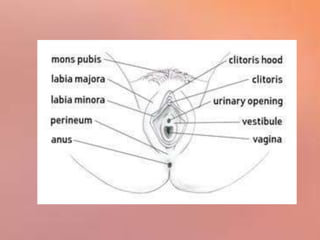
• Labia majora: The labia majora (“large lips”)
enclose and protect the other external
reproductive organs. During puberty, hair
growth occurs on the skin of the labia majora,
which also contain sweat and oil-secreting
glands.
• Labia minora: The labia minora (“small lips”)
can have a variety of sizes and shapes. They lie
just inside the labia majora, and surround the
openings to the vagina
• Bartholin’s glands: These glands are located
next to the vaginal opening on each side and
produce a fluid (mucus) secretion.
• Clitoris: The two labia minora meet at the
clitoris, a small, sensitive protrusion that is
comparable to the penis in males. The clitoris
is covered by a fold of skin, called the prepuce,
which is similar to the foreskin at the end of
the penis. Like the penis, the clitoris is very
sensitive to stimulation and can become erect.
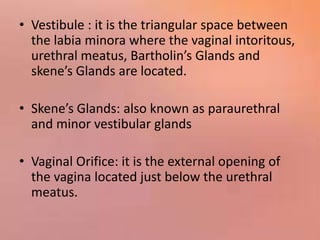
• Vestibule : it is the triangular space between
the labia minora where the vaginal intoritous,
urethral meatus, Bartholin’s Glands and
skene’s Glands are located.
• Skene’s Glands: also known as paraurethral
and minor vestibular glands
• Vaginal Orifice: it is the external opening of
the vagina located just below the urethral
meatus.
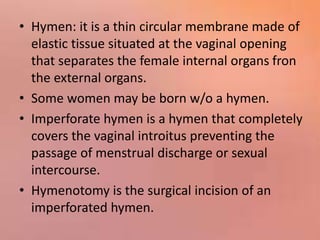
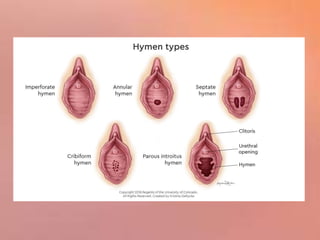
• Hymen: it is a thin circular membrane made of
elastic tissue situated at the vaginal opening
that separates the female internal organs fron
the external organs.
• Some women may be born w/o a hymen.
• Imperforate hymen is a hymen that completely
covers the vaginal introitus preventing the
passage of menstrual discharge or sexual
intercourse.
• Hymenotomy is the surgical incision of an
imperforated hymen.
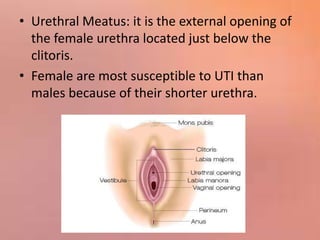
• Urethral Meatus: it is the external opening of
the female urethra located just below the
clitoris.
• Female are most susceptible to UTI than
males because of their shorter urethra.
Female internal organs
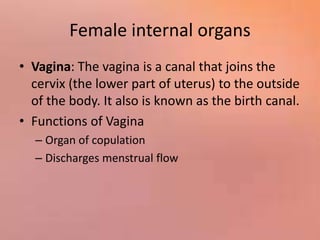
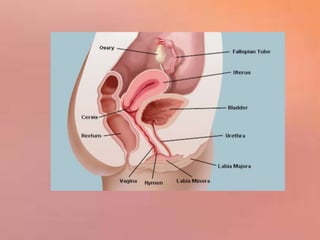
• Vagina: The vagina is a canal that joins the
cervix (the lower part of uterus) to the outside
of the body. It also is known as the birth canal.
• Functions of Vagina
– Organ of copulation
– Discharges menstrual flow
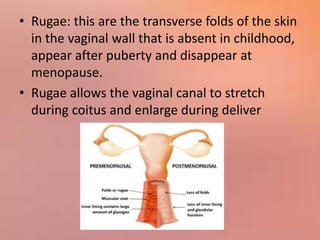
• Rugae: this are the transverse folds of the skin
in the vaginal wall that is absent in childhood,
appear after puberty and disappear at
menopause.
• Rugae allows the vaginal canal to stretch
during coitus and enlarge during deliver
• Vaginl pH
• Before puberty- alkaline in nature (6.8 to 7.2)
• After puberty becomes acidic (4 to 5)
• Doderlein Bacilli (bacteria normally present in
the vagina) conver the glycogen content of
vaginaal mucus to lactic acid making the
vaginal environment acidic. This acidity helps
control the growth to pathogenic
microorganism that may cause vaginal
infections.
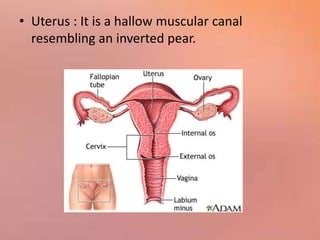
• Uterus : It is a hallow muscular canal
resembling an inverted pear.
• Functon of the Uterus
• It is an organ of reproduction
• Organ of Menstruation
• Receive the fertilized ovum
• Implantation site
• Protects the growing fetus
• Expel the fetus at maturity through uterine
contraction.
• Parts of the Uterus
• A. Fundus
• The uppermost convex portion located
between the inserions of the fallopian tube
• This is the most muscular are of the uterus
thisckest and most contractile portion
• During pregnancy, palpation of its height is
used to assess uterine growth and during the
postpartum period, to assess for uterine
involution. It is the ideal site for implantation
of the zygote.
• Corpus: the corpus is the main body of the
uterus. It’s very muscular and can stretch to
accommodate a developing fetus. During labor,
the muscular walls of the corpus contract to help
push the baby through the cervix and vagina.
• Isthmus: the portion of the uterus between the
corpus and the cervix is called the isthmus. This is
where the walls of the uterus begin to narrow
toward the cervix.
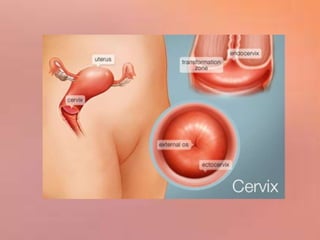
• Cervix
• The cervix is the lowest part of the uterus. It’s lined with
a smooth mucous membrane and connects the uterus
to the vagina. Glands in the cervical lining usually
produce a thick mucus. However, during ovulation, this
becomes thinner to allow sperm to easily pass into the
uterus.
• The cervix has three main parts:
• Endocervix. This is the inner part of the cervix that leads
to the uterus.
• Cervical canal. The cervical canal links the uterus to the
vagina.
• Exocervix. The exocervix is the outer part of the cervix
that protrudes into the vagina.
• During childbirth, the cervix dilates (widens) to allow
the baby to pass through the birth canal.
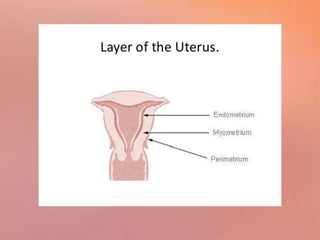
• Perimetrium – outermost layer attached to
the broad ligaments
• Myometrium- middle muscular layer
responsible for uterine contractions during
labor
• Endometrium- innermost layer, mucosal lining
of the uterine cavity changes in thickens
during menstrual cycle
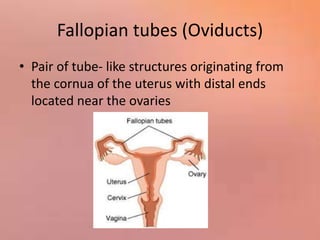
Fallopian tubes (Oviducts)
• Pair of tube- like structures originating from
the cornua of the uterus with distal ends
located near the ovaries
Functions
• Transport ovum from ovary to the uterus
• The site of fertilization
• Provides nourishment to the ovum during its
journey.
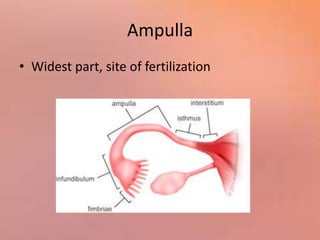
Ampulla
• Widest part, site of fertilization
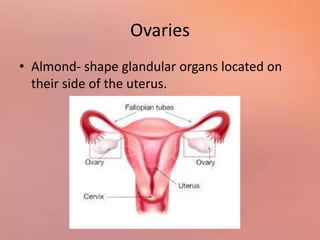
Ovaries
• Almond- shape glandular organs located on
their side of the uterus.
Functions
• Oogenesis- development and maturation of
ovum.
• Ovulation- release ovum from the ovary
• Hormone production – main source of estrogen
and progesterone
• Estrogen- hormone of women, promotes female
secondary sex characteristics.
• Progesterone - hormone of pregnancy, prevents
sloughing off of endometrium, prevents
premature uterine contruction.
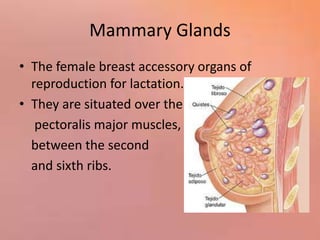
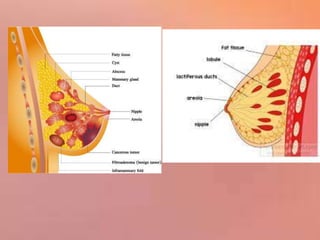
Mammary Glands
• The female breast accessory organs of
reproduction for lactation.
• They are situated over the
pectoralis major muscles,
between the second
and sixth ribs.
External Structures
• 1. Nipple or Mammary Papillae – located at
the center of the anterior surface of each
breast. It has 15 – 20 opening connected to
lactiferous ducts and in which milk flows out.
• 2. Areola – the pigmented skin that surrounds
the nipple.
• 3. Montgomery Tubercles- glands in the areola
that secrete an oily substance that keeps the
areola and nipple lactated.
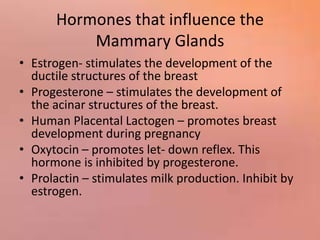
Hormones that influence the
Mammary Glands
• Estrogen- stimulates the development of the
ductile structures of the breast
• Progesterone – stimulates the development of
the acinar structures of the breast.
• Human Placental Lactogen – promotes breast
development during pregnancy
• Oxytocin – promotes let- down reflex. This
hormone is inhibited by progesterone.
• Prolactin – stimulates milk production. Inhibit by
estrogen.

MCN

  • 1.
  • 2.
    Female Reproductive Organ •The vagina is an elastic, muscular canal with a soft, flexible lining that provides lubrication and sensation. The vagina connects the uterus to the outside world. The vulva and labia form the entrance, and the cervix of the uterus protrudes into the vagina, forming the interior end.
  • 3.
    • Labia majora:The labia majora (“large lips”) enclose and protect the other external reproductive organs. During puberty, hair growth occurs on the skin of the labia majora, which also contain sweat and oil-secreting glands. • Labia minora: The labia minora (“small lips”) can have a variety of sizes and shapes. They lie just inside the labia majora, and surround the openings to the vagina
  • 4.
    • Bartholin’s glands:These glands are located next to the vaginal opening on each side and produce a fluid (mucus) secretion. • Clitoris: The two labia minora meet at the clitoris, a small, sensitive protrusion that is comparable to the penis in males. The clitoris is covered by a fold of skin, called the prepuce, which is similar to the foreskin at the end of the penis. Like the penis, the clitoris is very sensitive to stimulation and can become erect.
  • 6.
    • Vestibule :it is the triangular space between the labia minora where the vaginal intoritous, urethral meatus, Bartholin’s Glands and skene’s Glands are located. • Skene’s Glands: also known as paraurethral and minor vestibular glands • Vaginal Orifice: it is the external opening of the vagina located just below the urethral meatus.
  • 7.
    • Hymen: itis a thin circular membrane made of elastic tissue situated at the vaginal opening that separates the female internal organs fron the external organs. • Some women may be born w/o a hymen. • Imperforate hymen is a hymen that completely covers the vaginal introitus preventing the passage of menstrual discharge or sexual intercourse. • Hymenotomy is the surgical incision of an imperforated hymen.
  • 9.
    • Urethral Meatus:it is the external opening of the female urethra located just below the clitoris. • Female are most susceptible to UTI than males because of their shorter urethra.
  • 10.
    Female internal organs •Vagina: The vagina is a canal that joins the cervix (the lower part of uterus) to the outside of the body. It also is known as the birth canal. • Functions of Vagina – Organ of copulation – Discharges menstrual flow
  • 12.
    • Rugae: thisare the transverse folds of the skin in the vaginal wall that is absent in childhood, appear after puberty and disappear at menopause. • Rugae allows the vaginal canal to stretch during coitus and enlarge during deliver
  • 13.
    • Vaginl pH •Before puberty- alkaline in nature (6.8 to 7.2) • After puberty becomes acidic (4 to 5) • Doderlein Bacilli (bacteria normally present in the vagina) conver the glycogen content of vaginaal mucus to lactic acid making the vaginal environment acidic. This acidity helps control the growth to pathogenic microorganism that may cause vaginal infections.
  • 14.
    • Uterus :It is a hallow muscular canal resembling an inverted pear.
  • 16.
    • Functon ofthe Uterus • It is an organ of reproduction • Organ of Menstruation • Receive the fertilized ovum • Implantation site • Protects the growing fetus • Expel the fetus at maturity through uterine contraction.
  • 17.
    • Parts ofthe Uterus • A. Fundus • The uppermost convex portion located between the inserions of the fallopian tube • This is the most muscular are of the uterus thisckest and most contractile portion • During pregnancy, palpation of its height is used to assess uterine growth and during the postpartum period, to assess for uterine involution. It is the ideal site for implantation of the zygote.
  • 18.
    • Corpus: thecorpus is the main body of the uterus. It’s very muscular and can stretch to accommodate a developing fetus. During labor, the muscular walls of the corpus contract to help push the baby through the cervix and vagina. • Isthmus: the portion of the uterus between the corpus and the cervix is called the isthmus. This is where the walls of the uterus begin to narrow toward the cervix.
  • 19.
    • Cervix • Thecervix is the lowest part of the uterus. It’s lined with a smooth mucous membrane and connects the uterus to the vagina. Glands in the cervical lining usually produce a thick mucus. However, during ovulation, this becomes thinner to allow sperm to easily pass into the uterus. • The cervix has three main parts: • Endocervix. This is the inner part of the cervix that leads to the uterus. • Cervical canal. The cervical canal links the uterus to the vagina. • Exocervix. The exocervix is the outer part of the cervix that protrudes into the vagina. • During childbirth, the cervix dilates (widens) to allow the baby to pass through the birth canal.
  • 22.
    • Perimetrium –outermost layer attached to the broad ligaments • Myometrium- middle muscular layer responsible for uterine contractions during labor • Endometrium- innermost layer, mucosal lining of the uterine cavity changes in thickens during menstrual cycle
  • 23.
    Fallopian tubes (Oviducts) •Pair of tube- like structures originating from the cornua of the uterus with distal ends located near the ovaries
  • 24.
    Functions • Transport ovumfrom ovary to the uterus • The site of fertilization • Provides nourishment to the ovum during its journey.
  • 25.
    Ampulla • Widest part,site of fertilization
  • 26.
    Ovaries • Almond- shapeglandular organs located on their side of the uterus.
  • 27.
    Functions • Oogenesis- developmentand maturation of ovum. • Ovulation- release ovum from the ovary • Hormone production – main source of estrogen and progesterone • Estrogen- hormone of women, promotes female secondary sex characteristics. • Progesterone - hormone of pregnancy, prevents sloughing off of endometrium, prevents premature uterine contruction.
  • 28.
    Mammary Glands • Thefemale breast accessory organs of reproduction for lactation. • They are situated over the pectoralis major muscles, between the second and sixth ribs.
  • 29.
    External Structures • 1.Nipple or Mammary Papillae – located at the center of the anterior surface of each breast. It has 15 – 20 opening connected to lactiferous ducts and in which milk flows out. • 2. Areola – the pigmented skin that surrounds the nipple. • 3. Montgomery Tubercles- glands in the areola that secrete an oily substance that keeps the areola and nipple lactated.
  • 31.
    Hormones that influencethe Mammary Glands • Estrogen- stimulates the development of the ductile structures of the breast • Progesterone – stimulates the development of the acinar structures of the breast. • Human Placental Lactogen – promotes breast development during pregnancy • Oxytocin – promotes let- down reflex. This hormone is inhibited by progesterone. • Prolactin – stimulates milk production. Inhibit by estrogen.