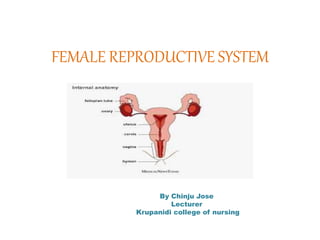
FEMALE REPRODUCTIVE SYSTEM
By Chinju Jose
Lecturer
Krupanidi college of nursing
FUNCTIONS OF FEMALE REPRODUCTIVE
SYSTEM
Functions include
Producing gametes called eggs,
Secreting sex hormones (such as estrogen),
Providing a site for fertilization,
Gestating a fetus if fertilization occurs,
 Giving birth to a baby,
Breastfeeding baby after birth
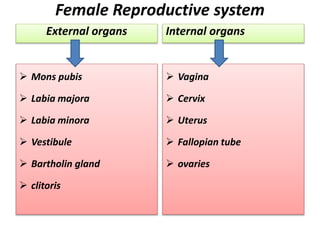
Female Reproductive system
External organs
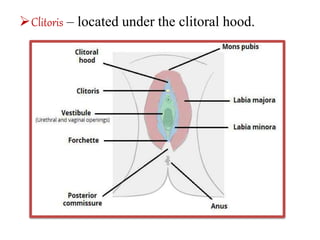
 Mons pubis
 Labia majora
 Labia minora
 Vestibule
 Bartholin gland
 clitoris
Internal organs
 Vagina
 Cervix
 Uterus
 Fallopian tube
 ovaries
EXTERNAL GENITALIA
The function of the external female
reproductive structures are
• To enable sperm to enter the body and
• to protect the internal genital organs
from infectious organisms.
The vulva
FUNCTIONS ARE
Acts as sensory tissue during sexual intercourse
Assists in micturition by directing the flow of
urine
 Protects the internal female reproductive tract
from infection
STRUCTURE OF VULVA
The vulva is a collective term for several anatomical
structures.
 Mons pubis – a subcutaneous fat pad located anterior to the
pubic symphysis. It formed by the fusion of the labia
majora.
 Labiamajora– two hair-bearing external skin folds.
They extend from the monspubis posteriorly to the
posterior commissure (a depression overlying the
perineal body)
Labia minora – two hairless folds of skin, which
lie within the labia majora.
• They fuse anteriorly to form the hood of the
clitoris and extend posteriorly either side of
the vaginal opening.
• They merge posteriorly, creating a fold of
skin known as the fourchette.
Vestibule – the area enclosed by the labia minora.
It contains the openings of the vagina (external
vaginal orifice, vaginal introitus) and urethra.
Bartholin’s glands – secrete lubricating mucus from
small ducts during sexual arousal. They are
located either side of the vaginal orifice.
Clitoris – located under the clitoral hood.
blood SUPPLY AND
LYMPHATICS
• The arterial supply to the vulva is from the
paired internal and external pudendal arteries
• Venous drainage is achieved via the
pudendal veins.
• Lymph drains to the nearby superficial
inguinal lymph nodes.
Internal organs
• Vagina = “birth canal”
• • A tube like, muscular but elastic organ
• • About 4 to 5 inches long in an adult woman.
• • PH- 4 acidic
• • It is the passageway for sperm to the egg and
for menstrual
• bleeding
• • Organ of copulation and forms the birth canal
of parturition
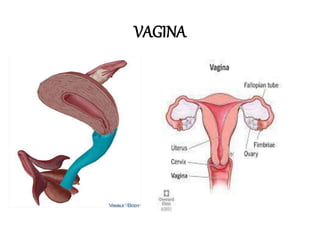
VAGINA
• Posterior wall of vagina is 10 c m long
• Anterior wall is only 7.5 cm length
• The upper end of the vagina is known as the
vault Pink in appearance
• It connects the external genital organs to the
uterus.the organ of sexual intercourse in
women.
• There are Four fornics of the vagina
• One anterior – front of cervix
• One posterior – behind
• Two lateral – either side of cervix
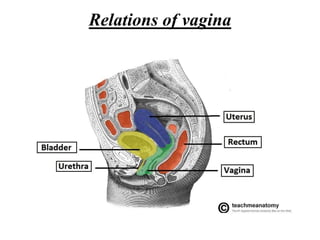
Relations of vagina
• Anterior to the vagina – lie the bladder and
the urethra which are closely connected to the
anterior vaginal wall
• Posterior to the vagina – lie the pouch of
douglas, the rectum and the perineal body;
each occupying one third of the posterior
vaginal wall
• Laterally – on the upper two third are the
pelvic fascia and the ureters, which pass beside
the cervix
• Superior to the vagina – lies the utreus
• Inferior to the vagina – lies the external
genitalia
Relations of vagina
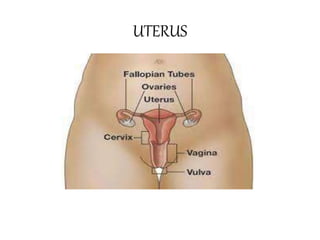
UTERUS
UTERUS
• The uterus is a hollow muscular pear-shaped
organ, that is located anteroposteriorly in the
pelvic cavity.
• It lies in the pelvic cavity between the urinary
bladder and the rectum
• It is about 7.5 cm long, 5 cm wide and its walls
are about 2.5 cm thick.
• It weighs between 30 and 40 grams
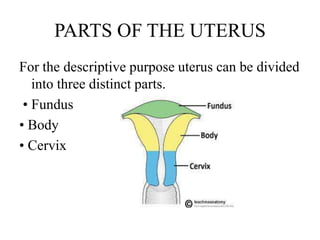
PARTS OF THE UTERUS
For the descriptive purpose uterus can be divided
into three distinct parts.
• Fundus
• Body
• Cervix
• Fundus- This is the dome-shaped part of the
uterus above the openings of the uterine tubes.
• Body- This is the main part. It is narrowest
inferiorly at the internal os where it is continuous
with the cervix.
• Cervix (‘neck’ of the uterus) - This protrudes
through the anterior wall of the vagina, opening
into it at the external os.
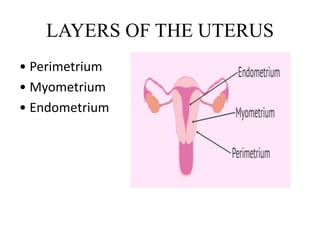
LAYERS OF THE UTERUS
• Perimetrium
• Myometrium
• Endometrium
PERIMETRIUM.
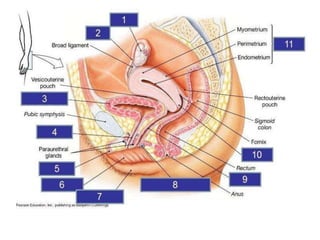
• This is peritoneum, which is distributed differently on
the various surfaces of the uterus.
• • Anteriorly it lies over the fundus and the body where
it is folded on to the upper surface of the urinary
bladder. This fold of peritoneum forms the
vesicouterine pouch.
• Posteriorly the peritoneum covers the fundus, the body
and the cervix, then it folds back on to the rectum to
form the rectouterine (pouch of Douglas).
MYOMETRIUM.
• This is the thickest layer of tissue in the
uterine wall.
• It is a mass of smooth muscle fibres interlaced
with areolar tissue, blood vessels and nerves.
ENDOMETRIUM
 Made up of the Columnar epithelial cells
 Consist mucous secreting tubular glands
BLOOD SUPPLY, LYMPH DRAINAGE
AND NERVE SUPPLY
• Arterial supply. This is by the uterine arteries,
branches of the internal iliac arteries.
• Venous drainage internal illiac vein
• Lymph drainage. Deep and superficial lymph
vessels drain lymph from the uterus and the
uterine tubes to the aortic lymph nodes and
groups of nodes associated with the iliac blood
vessels
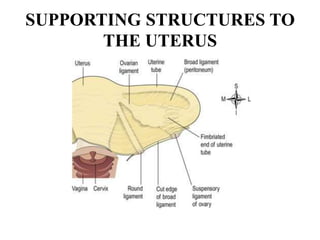
SUPPORTING STRUCTURES TO
THE UTERUS
• The uterus is supported in the pelvic cavity by
surrounding organs, muscles of the pelvic floor and
ligaments that suspend it from the walls of the pelvis
• • Broad ligaments- These are formed by a double fold of
peritoneum, one on each side of the uterus.
• • Round ligaments-These are bands of fibrous tissue
between the two layers of broad ligament.
• Uterosacral ligaments- These originate from
the posterior walls of the cervix and vagina
and extend backwards, one on each side of the
rectum, to the sacrum.
• Transverse cervical (cardinal) ligaments-
These extend one from each side of the cervix
and vagina to the side walls of the pelvis.
SUPPORTING STRUCTURES TO
THE UTERUS
THE CERVIX
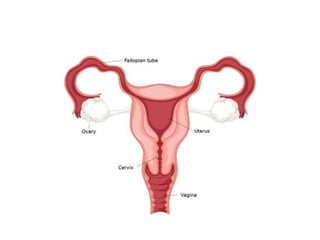
• The cervix is the lower portion of the uterus, an
organ of the female reproductive tract. It connects
the vagina with the main body of the
uterus,acting as a gateway between them.
• Anatomically and histologically, the cervix is
distinct from the uterus, and hence we consider it
as a separate anatomical structure.
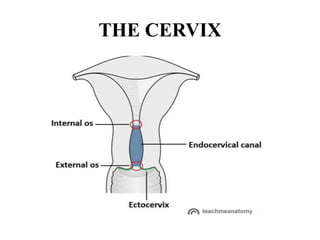
• The cervix is composed of two regions; the
ectocervix and the endocervical canal.
• The ectocervix is the portion of the cervix
that projects into the vagina. It is lined by stratified
squamous non-keratinized epithelium.
• The opening in the ectocervix, the external os,
marks the transition from the ectocervix to the
endocervical canal
• The endocervical canal (or endocervix) is
the more proximal, and ‘inner’ part of the
cervix. It is lined by a mucus-secreting simple
columnar epithelium. The endocervical canal
ends, and the uterine cavity begins, at a
narrowing called the internal os.
THE CERVIX
Functions of cervix
• It facilitates the passage of sperm into the uterine cavity.
This is achieved via dilation of the external and internal os.
• Maintains sterility of the upper female reproductive tract.
The cervix, and all structures superior to it, are sterile. This
ultimately protects the uterine cavity and the upper genital
tract by preventing bacterial invasion. This environment is
maintained by the frequent shedding of the endometrium,
thick cervical mucus and a narrow external os.
UTERINE TUBES
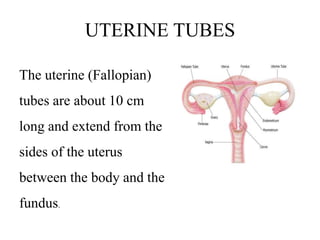
The uterine (Fallopian)
tubes are about 10 cm
long and extend from the
sides of the uterus
between the body and the
fundus.
UTERINE TUBES
• They lie in the upper free border of the broad
ligament and their trumpet-shaped lateral ends,
penetrate the posterior wall, opening into the
peritoneal cavity close to the ovaries.
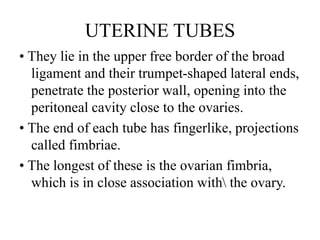
• The end of each tube has fingerlike, projections
called fimbriae.
• The longest of these is the ovarian fimbria,
which is in close association with the ovary.
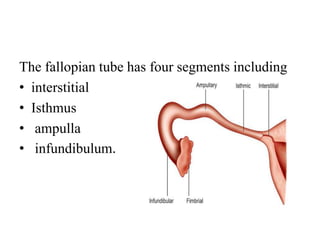
The fallopian tube has four segments including
• interstitial
• Isthmus
• ampulla
• infundibulum.
FUNCTIONS
• The uterine tubes propel the ovum from the ovary
to the uterus by peristalsis and ciliary movement.
• The secretions of the uterine tube nourish both
ovum and spermatozoa.
• Fertilisation of the ovum usually takes place in the
uterine tube, and the zygote is propelled into the
uterus for implantation.
OVARY
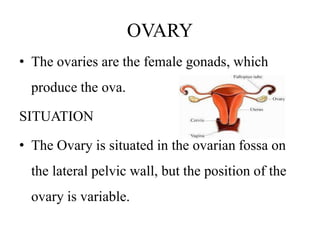
• The ovaries are the female gonads, which
produce the ova.
SITUATION
• The Ovary is situated in the ovarian fossa on
the lateral pelvic wall, but the position of the
ovary is variable.
• They are 2.5–3.5 cm long, 2 cm wide and 1 cm
thick.
• Each is attached to the upper part of the uterus
by the ovarian ligament and to the back of the
broad ligament.
• STRUCTURE
• The ovaries have two layers of tissue. •
• Medulla-This lies in the centre and consists of
fibrous tissue, blood vessels and nerves.
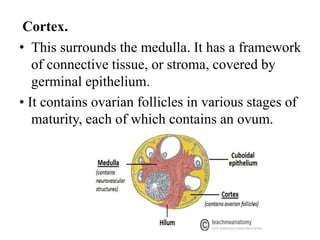
Cortex.
• This surrounds the medulla. It has a framework
of connective tissue, or stroma, covered by
germinal epithelium.
• It contains ovarian follicles in various stages of
maturity, each of which contains an ovum.
FUNCTIONS
• The ovary is the organ in which the female
gametes are stored and develop prior to
ovulation.
• Their maturation is controlled by the
hypothalamus and the anterior pituitary
gland,
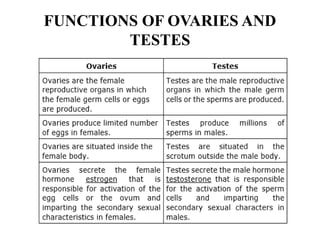
FUNCTIONS OF OVARIES AND
TESTES

FEMALE REPRODUCTIVE SYSTEM.pptx

  • 1.
    FEMALE REPRODUCTIVE SYSTEM ByChinju Jose Lecturer Krupanidi college of nursing
  • 2.
    FUNCTIONS OF FEMALEREPRODUCTIVE SYSTEM Functions include Producing gametes called eggs, Secreting sex hormones (such as estrogen), Providing a site for fertilization, Gestating a fetus if fertilization occurs,  Giving birth to a baby, Breastfeeding baby after birth
  • 3.
    Female Reproductive system Externalorgans  Mons pubis  Labia majora  Labia minora  Vestibule  Bartholin gland  clitoris Internal organs  Vagina  Cervix  Uterus  Fallopian tube  ovaries
  • 4.
    EXTERNAL GENITALIA The functionof the external female reproductive structures are • To enable sperm to enter the body and • to protect the internal genital organs from infectious organisms.
  • 5.
    The vulva FUNCTIONS ARE Actsas sensory tissue during sexual intercourse Assists in micturition by directing the flow of urine  Protects the internal female reproductive tract from infection
  • 6.
    STRUCTURE OF VULVA Thevulva is a collective term for several anatomical structures.  Mons pubis – a subcutaneous fat pad located anterior to the pubic symphysis. It formed by the fusion of the labia majora.  Labiamajora– two hair-bearing external skin folds. They extend from the monspubis posteriorly to the posterior commissure (a depression overlying the perineal body)
  • 7.
    Labia minora –two hairless folds of skin, which lie within the labia majora. • They fuse anteriorly to form the hood of the clitoris and extend posteriorly either side of the vaginal opening. • They merge posteriorly, creating a fold of skin known as the fourchette.
  • 8.
    Vestibule – thearea enclosed by the labia minora. It contains the openings of the vagina (external vaginal orifice, vaginal introitus) and urethra. Bartholin’s glands – secrete lubricating mucus from small ducts during sexual arousal. They are located either side of the vaginal orifice.
  • 9.
    Clitoris – locatedunder the clitoral hood.
  • 10.
    blood SUPPLY AND LYMPHATICS •The arterial supply to the vulva is from the paired internal and external pudendal arteries • Venous drainage is achieved via the pudendal veins. • Lymph drains to the nearby superficial inguinal lymph nodes.
  • 11.
    Internal organs • Vagina= “birth canal” • • A tube like, muscular but elastic organ • • About 4 to 5 inches long in an adult woman. • • PH- 4 acidic • • It is the passageway for sperm to the egg and for menstrual • bleeding • • Organ of copulation and forms the birth canal of parturition
  • 12.
  • 13.
    • Posterior wallof vagina is 10 c m long • Anterior wall is only 7.5 cm length • The upper end of the vagina is known as the vault Pink in appearance • It connects the external genital organs to the uterus.the organ of sexual intercourse in women.
  • 14.
    • There areFour fornics of the vagina • One anterior – front of cervix • One posterior – behind • Two lateral – either side of cervix
  • 15.
    Relations of vagina •Anterior to the vagina – lie the bladder and the urethra which are closely connected to the anterior vaginal wall • Posterior to the vagina – lie the pouch of douglas, the rectum and the perineal body; each occupying one third of the posterior vaginal wall
  • 16.
    • Laterally –on the upper two third are the pelvic fascia and the ureters, which pass beside the cervix • Superior to the vagina – lies the utreus • Inferior to the vagina – lies the external genitalia
  • 17.
  • 18.
  • 19.
    UTERUS • The uterusis a hollow muscular pear-shaped organ, that is located anteroposteriorly in the pelvic cavity. • It lies in the pelvic cavity between the urinary bladder and the rectum • It is about 7.5 cm long, 5 cm wide and its walls are about 2.5 cm thick. • It weighs between 30 and 40 grams
  • 20.
    PARTS OF THEUTERUS For the descriptive purpose uterus can be divided into three distinct parts. • Fundus • Body • Cervix
  • 21.
    • Fundus- Thisis the dome-shaped part of the uterus above the openings of the uterine tubes. • Body- This is the main part. It is narrowest inferiorly at the internal os where it is continuous with the cervix. • Cervix (‘neck’ of the uterus) - This protrudes through the anterior wall of the vagina, opening into it at the external os.
  • 22.
    LAYERS OF THEUTERUS • Perimetrium • Myometrium • Endometrium
  • 23.
    PERIMETRIUM. • This isperitoneum, which is distributed differently on the various surfaces of the uterus. • • Anteriorly it lies over the fundus and the body where it is folded on to the upper surface of the urinary bladder. This fold of peritoneum forms the vesicouterine pouch. • Posteriorly the peritoneum covers the fundus, the body and the cervix, then it folds back on to the rectum to form the rectouterine (pouch of Douglas).
  • 25.
    MYOMETRIUM. • This isthe thickest layer of tissue in the uterine wall. • It is a mass of smooth muscle fibres interlaced with areolar tissue, blood vessels and nerves. ENDOMETRIUM  Made up of the Columnar epithelial cells  Consist mucous secreting tubular glands
  • 26.
    BLOOD SUPPLY, LYMPHDRAINAGE AND NERVE SUPPLY • Arterial supply. This is by the uterine arteries, branches of the internal iliac arteries. • Venous drainage internal illiac vein • Lymph drainage. Deep and superficial lymph vessels drain lymph from the uterus and the uterine tubes to the aortic lymph nodes and groups of nodes associated with the iliac blood vessels
  • 27.
    SUPPORTING STRUCTURES TO THEUTERUS • The uterus is supported in the pelvic cavity by surrounding organs, muscles of the pelvic floor and ligaments that suspend it from the walls of the pelvis • • Broad ligaments- These are formed by a double fold of peritoneum, one on each side of the uterus. • • Round ligaments-These are bands of fibrous tissue between the two layers of broad ligament.
  • 28.
    • Uterosacral ligaments-These originate from the posterior walls of the cervix and vagina and extend backwards, one on each side of the rectum, to the sacrum. • Transverse cervical (cardinal) ligaments- These extend one from each side of the cervix and vagina to the side walls of the pelvis.
  • 29.
  • 30.
    THE CERVIX • Thecervix is the lower portion of the uterus, an organ of the female reproductive tract. It connects the vagina with the main body of the uterus,acting as a gateway between them. • Anatomically and histologically, the cervix is distinct from the uterus, and hence we consider it as a separate anatomical structure.
  • 32.
    • The cervixis composed of two regions; the ectocervix and the endocervical canal. • The ectocervix is the portion of the cervix that projects into the vagina. It is lined by stratified squamous non-keratinized epithelium. • The opening in the ectocervix, the external os, marks the transition from the ectocervix to the endocervical canal
  • 33.
    • The endocervicalcanal (or endocervix) is the more proximal, and ‘inner’ part of the cervix. It is lined by a mucus-secreting simple columnar epithelium. The endocervical canal ends, and the uterine cavity begins, at a narrowing called the internal os.
  • 34.
  • 35.
    Functions of cervix •It facilitates the passage of sperm into the uterine cavity. This is achieved via dilation of the external and internal os. • Maintains sterility of the upper female reproductive tract. The cervix, and all structures superior to it, are sterile. This ultimately protects the uterine cavity and the upper genital tract by preventing bacterial invasion. This environment is maintained by the frequent shedding of the endometrium, thick cervical mucus and a narrow external os.
  • 36.
    UTERINE TUBES The uterine(Fallopian) tubes are about 10 cm long and extend from the sides of the uterus between the body and the fundus.
  • 37.
    UTERINE TUBES • Theylie in the upper free border of the broad ligament and their trumpet-shaped lateral ends, penetrate the posterior wall, opening into the peritoneal cavity close to the ovaries. • The end of each tube has fingerlike, projections called fimbriae. • The longest of these is the ovarian fimbria, which is in close association with the ovary.
  • 38.
    The fallopian tubehas four segments including • interstitial • Isthmus • ampulla • infundibulum.
  • 39.
    FUNCTIONS • The uterinetubes propel the ovum from the ovary to the uterus by peristalsis and ciliary movement. • The secretions of the uterine tube nourish both ovum and spermatozoa. • Fertilisation of the ovum usually takes place in the uterine tube, and the zygote is propelled into the uterus for implantation.
  • 40.
    OVARY • The ovariesare the female gonads, which produce the ova. SITUATION • The Ovary is situated in the ovarian fossa on the lateral pelvic wall, but the position of the ovary is variable.
  • 41.
    • They are2.5–3.5 cm long, 2 cm wide and 1 cm thick. • Each is attached to the upper part of the uterus by the ovarian ligament and to the back of the broad ligament. • STRUCTURE • The ovaries have two layers of tissue. • • Medulla-This lies in the centre and consists of fibrous tissue, blood vessels and nerves.
  • 42.
    Cortex. • This surroundsthe medulla. It has a framework of connective tissue, or stroma, covered by germinal epithelium. • It contains ovarian follicles in various stages of maturity, each of which contains an ovum.
  • 43.
    FUNCTIONS • The ovaryis the organ in which the female gametes are stored and develop prior to ovulation. • Their maturation is controlled by the hypothalamus and the anterior pituitary gland,
  • 44.