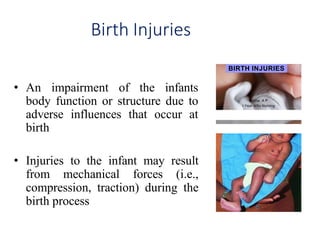
• An impairment of the infants
body function or structure due to
adverse influences that occur at
birth
• Injuries to the infant may result
from mechanical forces (i.e.,
compression, traction) during the
birth process
Birth Injuries
BIRTH INJURIES
Aruna. A P
I Year MSc Nursing
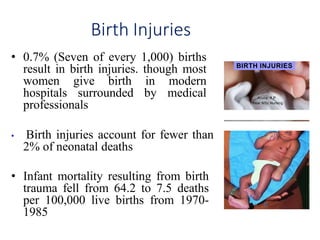
• 0.7% (Seven of every 1,000) births
result in birth injuries. though most
women give birth in modern
hospitals surrounded by medical
professionals
• Birth injuries account for fewer than
2% of neonatal deaths
• Infant mortality resulting from birth
trauma fell from 64.2 to 7.5 deaths
per 100,000 live births from 1970-
1985
Birth Injuries
BIRTH INJURIES
Aruna. A P
I Year MSc Nursing
DEFINITION
• An impairment of the infants body function or
structure due to adverse influences that occur at birth
• (National vital statistics report)
• Primiparity
• Small maternal stature
• Maternal pelvic anomalies
• Prolonged or unusually rapid labor
• Oligohydramnios
• Malpresentation of the fetus (breech)
• Cephalopelvic disproportion
• Deep transverse arrest of presenting part of
the fetus
Factors predisposing to injury include the
following
• Use of mid forceps or vaccum
extraction
• Versions and extractions
• Very low birth weight or extreme
prematurity
• Fetal macrosomia birth weight over
about 4,000 grams
• Fetal macrocephali (Large head)
• Fetus anomalies
Factors predisposing to injury include the
following
RISK FACTORS
• Primiparity
• Small maternal stature
• Maternal pelvic anomalies
• Prolonged or unusually rapid labor
• Oligohydramnios
• Malpresentation of the fetus
• Use of mid forceps or vaccum extraction
• Versions and extractions
• Very low birth weight or extreme
prematurity
• Fetal macrosomia or large fetal head
• Fetal anomalies
TYPES
• Head and neck injuries
• Nerve injury
• Facial injuries
• Fractures
• Intra-abdominal injury
• Soft tissue injuries
HEAD AND NECK INJURIES
EXTRACRANIAL INJURIES
• CAPUT SUCCEDANEUM
• CEPHALHEMATOMA
• SUBGALEAL HEMORRHAGE
CAPUT SUCCEDANEUM
• A caput succedaneum is a serosanguinous fluid
collection above the periosteum. It presents as a soft
tissue swelling with purpura and ecchymosis over
the presenting portion of the scalp. It may extend
across the midline and across suture lines.
• The edema disappears within the 1st few days of
life.
• Molding of the head and overriding of the parietal
bones disappear during the 1st weeks of life.
• Rarely, a hemorrhagic caput may result in shock
and require blood transfusion.
MANAGEMENT
• No specific treatment is needed
• But if extensive ecchymoses are present,
hyperbilirubinemia may develop
• Shock – Blood transfusion
CEPHALHEMATOMA
• A cephalhematoma is a subperiosteal blood
collection caused by rupture of vessels beneath
the periosteum.
Clinical features
• Swelling, usually over a parietal or
occipital bone
• Swelling does not cross a suture line and is often
not associated with discoloration of the overlying
scalp.
• Limited to the surface of one cranial bone.
Diagnosis
• Physical examination
• Skull radiograph
• cranial computed tomography
• If infection is suspected, aspiration of the mass
• If sepsis, antibiotics
• hyperbilirubinemia – photo therapy
SUBGALEAL HEMORRHAGE
• A subgaleal hemorrhage is bleeding between
the galea aponeurosis of the scalp and the
periosteum.
FEATURES
• A subgaleal hemorrhage presents as a firm-to-
fluctuant mass that crosses suture lines.
• The mass is typically noted within 4 hours of birth.
LABORATORY FINDINGS
• Serial hemoglobin and hematocrit
monitoring,
• coagulation profile to investigate for the
presence of a coagulopathy.
• Bilirubin levels also need to be monitored
TREATMENT
• Supportive
• Transfusions may be required if blood loss is
significant.
• In severe cases, surgery may be required to
cauterize the bleeding vessels.
• These lesions typically resolve over a 2–3 week
period
CRANIAL INJURIES
• LINEAR SKULL FRACTURES
• DEPRESSED SKULL FRACTURES
LINEAR SKULL FRACTURES
• Usually affect the parietal bones.
• The pathogenesis is related to compression from the
application of forceps, or from the skull pushing
against the maternal symphysis or ischeal spines.
• Rarely, a linear fracture may be
associated with a dural tear, with
subsequent development of a
leptomeningeal cyst.
DEPRESSED SKULL FRACTURES
• Indications for surgery include
• radiographic evidence of bone
fragments in the cerebrum
• presence of neurologic deficits
• signs of increased intracranial pressure
• signs of cerebrospinal fluid beneath the galea
• failure to respond to closed manipulation.
• Indications for nonsurgical management include
• Depressions less than 2 cm in width and
depressions over a major venous sinus
• Without neurologic symptoms
INTRACRANIAL INJURY
• Intracranial haemorrhage
• Epidural hemorrhage
• Subdural hemorrhage
• Subarachnoid hemorrhage
• Intraparenchymal haemorrhage
• Germinal matrix hemorrhage /
intraventricular haemorrhage
INTRACRANIAL HAEMORRHAGE
• Bleeding can occur
– External to the brain into the
epidural, subdural or subarachnoid space
– In to the parenchyma of the cerebrum or
cerebellum
– Into the ventricles from the subependymal
germinal matrix or choroid plexus
RISK FACTORS
• forceps delivery
• vacuum extraction
• precipitous deliver
• prolonged second stage of labor
• macrosomia
SYMPTOMS
• apnea
• seizures
EPIDURAL HEMORRHAGE
• Epidural hemorrhage primarily arises from injury to
the middle meningeal artery, and is frequently
associated with a cephalhematoma or skull fracture.
CLINICAL MANIFESTATIONS
• Diffuse neurologic symptoms
• Increased intracranial pressure
• Bulging fontanels
• Localized symptoms,
• Lateralizing seizures
• Eye deviation.
• cranial computed tomography showing a high-
density lentiform lesion in the temporoparietal
region
• Skull radiographs
SUBDURAL HEMORRHAGE
• most frequent intracranial hemorrhage related
to birth trauma
• Laceration of the tentorium, with rupture of the
straight sinus, vein of Galen transverse sinus, or
infratentorial veins causing a posterior fossa clot and
brainstem compression
• Laceration of the falx, with rupture of the inferior
sagittal sinus resulting in a clot in the longitudinal
cerebral fissure
• Laceration of the superficial cerebral vein,
causing bleeding over the cerebral convexity
• Occipital osteodiastasis, with rupture of the
occipital sinus, resulting in a posterior fossa clot
CLINICAL FEATURES
• Respiratory symptoms such as apnea
• Seizures
• Focal neurologic deficits
• Lethargy
• Hypotonia
• Other neurologic symptoms
• Cranial computed tomography
• Cranial ultrasonography
• MRI.
• Coagulation profile
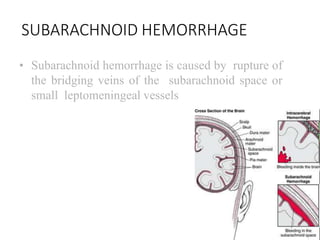
SUBARACHNOID HEMORRHAGE
• Subarachnoid hemorrhage is caused by rupture of
the bridging veins of the subarachnoid space or
small leptomeningeal vessels
MANIFESTATIONS
• Seizures, often occurring on the second day of
life
• Irritability
• Depressed level of consciousness
• Focal neurologic signs.
DIAGNOSIS
• Cranial computed tomography.
• Cranial ultrasonography
• Lumbar puncture shows an increased number
of red blood cells
MANAGEMENT
• Resolves without intervention
• Monitoring head growth
INTRAPARENCHYMAL HAEMORRHAGE
• TYPES
• Intra cerebral
Causes:
• rupture of an av malformation or aneurysm
• coagulation disturbances
• extracorporeal membrane oxygenation therapy
• secondary to a large ICH in any other
compartment
• Intracerebellar :
more common in preterm than the term
babies. May be a primary haemorrhage or may
result from venous hemorrhagic infarction or from
extension of GMH/ IVH
CLINICAL FEATURES
• In the preterm infant
– IPH is often clinically silent in either
intracranial fossa , unless the hemorrhage is
quite large
• In the term infant, manifestations are
– Seizures
– Hemiparesis
– Gaze preference
– Irritability
– Depressed level of consciousness
DIAGNOSIS
• CT Scans
• MRI
• Cranial ultrasonography
MANAGEMENT
• Symptomatic treatment and support
• Neurosurgical intervention
GERMINAL MATRIX
HEMORRHAGE
(INTRAVENTRICULAR HAEMORRHAGE)
• Causes:
• Trauma,
• Perinatal asphyxia
• Secondary to venous hemorrhagic
infarction in the thalamus
FACTORS IN THE PATHOGENESIS
• Intra vascular factors
– Ischemia / reperfusion
– Fluctuating cerebral blood flow
– Increase in CBF
– Increase in cerebral venous pressure
– Platelet dysfunction
– Coagulation disturbances
• Vascular factors
– Tenuous involuting capillaries with large
diameter lumen
• Extra vascular factors
– Deficient vascular support
– Excessive fibrinolytic activity
CLINICAL FEATURES
In the preterm newborn
• Usually clinically silent
• Decreased levels of consciousness and
spontaneous movement
• Hypotonia
• Abnormal eye movement
• Skew deviation
In term newborns
• Seizures
• Irritability
• Apnea
• Lethargy
• Vomiting with dehydration
• Full fontanels
DIAGNOSIS
• Cranial ultra sonography
• CT or MRI
MANAGEMENT
• Prevention
• Supportive care
• Careful monitoring
• Surgical intervention
NERVE INJURY
BRACHIAL PLEXUS INJURY
• Erb’s palsy
• Klumpke’spalsy
• Injury to the upper plexus,
• Erb-Duchenne paralysis
BRACHIAL PLEXUS INJURY
• Risk factors
• Macrosomia
• shoulder dystocia
• instrumented deliveries
• malpresentation
ERB-DUCHENNE PARALYSIS
• 5th and 6th cervical nerves injury
• The infant loses the power to abduct the arm from
the shoulder, rotate the arm externally, and
supinate the forearm
• Erb’s palsy may also be associated with injury to
the phrenic nerve,
which is innervated with
fibers from C3–C5
• Adduction and internal rotation of the arm with
pronation of the forearm.
• Biceps reflex is absent
• Moro reflex is absent on the affected side.
• The involved arm is held in the ‘‘waiter’s tip’’
position, with adduction and internal rotation of
the shoulder, extension of the elbow, pronation of
the forearm, and flexion of the wrist and fingers.
KLUMPKE’SPALSY
• Involves the C8 and T1 nerves, resulting in weakness
of the intrinsic hand muscles and long flexors of the
wrist and fingers
• The grasp reflex is absent but the biceps reflex is
present.
• Flaccid extremity with absent reflexes.
ASSOCIATED LESIONS
• Hematomas of the sternocleidomastoid muscle,
and fractures of the clavicle and humerus.
• Ipsilateral Horner’s syndrome
(ptosis, miosis, and anhydrosis) when there is
accompanying injury to the sympathetic fibers
of T1.
TYPES
• Neuropraxia with temporary conduction block
• Axonotmesis with a severed axon, but with intact
surrounding neuronal elements
• Neurotmesis with complete postganglionic
disruption of the nerve
• Avulsion with preganglionic disconnection from the
spinal cord
DIAGNOSIS
• Physical examination.
• Radiographs of the shoulder and upper arm
MANAGEMENT
• Initial treatment is conservative.
• The arm is immobilized across the upper
abdomen during the first week
• Physical therapy with passive range-of-
motion exercises at the shoulder, elbow and
wrist should begin after the first week.
• Infants without recovery by 3 to 6 months of
age may be considered for surgical
exploration
FACIAL NERVE PALSY
(BELL’S PALSY)
• Risk factors
– forceps delivery
– prolonged second stage of labor
Clinical manifestations
• weakness of both upper and lower facial muscles.
• At rest, the nasolabial fold is flattened and the eye
remains persistently open on the affected side.
• During crying, there is inability to wrinkle the
forehead or close the eye on the ipsilateral side,
and the mouth is drawn awayfrom the affected
side.
• lacerations and bruising
• neurologic findings
TREATMENT
• protection of the involved eye by application of
artificial tears and taping to prevent corneal injury.
• neurosurgical repair of the nerve should be
considered only after lack of resolution during 1
year of observation
PHRENIC NERVE INJURY
• The phrenic nerve arises from the third through
fifth cervical nerve roots.
• Injury to the phrenic nerve leads to paralysis
of the ipsilateral diaphragm.
CLINICAL MANIFESTATIONS
• respiratory distress, with diminished breath sounds
on the affected side.
• Chest radiographs show elevation of the affected
diaphragm, with mediastinal shift to the
contralateral side.
• Ultrasonography or fluoroscopy can confirm
the diagnosis by showing paradoxical
diaphragmatic movement during inspiration
TREATMENT
• Initial treatment is supportive
• Oxygen
• Respiratory failure may be treated with
continuous positive airway pressure or
mechanical ventilation.
• Gavage feedings.
• Plication of the diaphragm
LARYNGEAL NERVE INJURY
• Symptoms
• Stridor
• respiratory distress
• hoarse cry
• dysphagia,
• Aspiration
• Diagnosis is made by direct
laryngoscopy
Treatment
• Small frequent feedings may be required to
decrease the risk of aspiration.
• Intubation
• Tracheostomy
• Bilateral paralysis tends to produce more severe
distress, and therefore requires intubation and
tracheostomy placement more frequently
SPINAL CORD INJURY
• Clinical findings
• decreased or absent spontaneous
movement
• absent deep tendon reflexes
• absent or periodic breathing
• lack of response to painful stimuli below the
level of the lesion.
• Lesions above C4 are almost always
associated with apnea
• Lesions between C4 and T4 may have respiratory
distress secondary to varying degrees of
involvement of the phrenic nerve and innervation
to the intercostal muscles
MANAGEMENT
• If cord injury is suspected in the delivery room, the
head, neck, and spine should be immobilized.
• Therapy is supportive.
FACIAL INJURIES
NASAL SEPTAL
DISLOCATION
• Nasal septal dislocation involves dislocation of
the triangular cartilaginous portion of the septum
from the vomerine groove
CLINICAL FEATURES
• airway obstruction.
• deviation of the nose to one side
• The nares are asymmetric, with flattening of the side
of the dislocation (Metzenbaum sign).
• Application of pressure on the tip of the nose
(Jeppesen and Windfeld test) causes collapse of the
nostrils, and the deviated septum becomes more
apparent.
MANAGEMENT
• Definitive diagnosis can be made by
rhinoscopy
• manual reduction performed by an
otolaryngologist using a nasal elevator.
• Reduction should be performed by 3 days of age
OCULAR INJURIES
• Rupture of Descemet’s membrane of the cornea
• lid lacerations
• hyphema (blood in anterior chamber)
• vitreous hemorrhage
• Purtscher’s retinopathy
• corneal edema,
• corneal abrasion
CONGENITAL MUSCULAR
TORTICOLLIS
• atrophic muscle fibers surrounded by collagen
and fibroblasts.
• tearing of the muscle fibers or fascial sheath
with hematoma formation and subsequent
fibrosis.
CLINICAL FEATURES
• The head is tilted toward the side of the lesion and
rotated to the contralateral side,
• chin is slightly elevated.
• If a mass is present, it is firm, spindle- shaped,
immobile, and located in the midportion of the
sternocleidomastoid muscle, without
accompanying discoloration or inflammation.
DIAGNOSIS
• physical examination
• Radiographs should be obtained to rule out
abnormalities of the cervical spine.
• Ultrasonography may be useful both
diagnostically and prognostically.
TREATMENT
• active and passive stretching
• surgery
FRACTURES
CLAVICULAR FRACTURE
• clavicle is the most frequently fractured bone
during birth
Risk factors
• higher birth weight
• prolonged second stage of labor
• shoulder dystocia
• instrumented deliveries
MANAGEMENT
• Asymptomatic incomplete fractures require no
treatment.
• Complete fractures are treated with
immobilization of the arm for 7 to 10 days
LONG BONE FRACTURES
Risk factors
• breech presentation
• cesarean delivery
• low birthweight
CLINICAL FEATURES
• decreased movement of the affected
extremity,
• swelling,
• pain with passive movement
• , and crepitus
DIAGNOSIS
• Diagnosis is made radiographically
• Ultrasonography
TREATMENT
• immobilization and splinting
• Closed reduction and casting are required only
when the bones are displaced.
• Proximal femoral fractures may require a spica
cast or use of a Pavlik harness
INTRA-ABDOMINAL INJURY
Liver injury is the most common
• Three potential mechanisms lead to intra-
abdominal injury:
• (1) direct trauma,
• (2) compression of the chest against the surface of
the spleen or liver
• (3) chest compression leading to tearing of the
ligamentaous insertions of the liver or spleen
CLINICAL MANIFESTATIONS
• With hepatic or splenic rupture,
• patients develop sudden pallor, hemorrhagic
shock,
• abdominal distention, and abdominal
discoloration.
• Presentation of a liver rupture with scrotal
swelling and discoloration has been described.
• Subcapsular hematomas may present more
insidiously, with anemia, poor feeding,
tachypnea, and tachycardia.
• Adrenal hemorrhage may present as a flank
mass
DIAGNOSIS
• Abdominal ultrasound
• Computed tomography
• Abdominal radiographs may show
nonspecific intraperitoneal fluid or
hepatomegaly.
• Abdominal paracentesis is diagnostic if a
hemoperitoneum is present
TREATMENT
• volume replacement and correction of any
coagulopathy.
• If the infant is hemodynamically
stable, conservative management is
indicated.
• With rupture or hemodynamic instability, a
laparotomy is required to control the
bleeding.
• Patients with adrenal hemorrhage may
require hormone replacement therapy.
NURSE’S ROLE…
THANK YOU….

BIRTH INJURIES.pptx

  • 1.
    • An impairmentof the infants body function or structure due to adverse influences that occur at birth • Injuries to the infant may result from mechanical forces (i.e., compression, traction) during the birth process Birth Injuries BIRTH INJURIES Aruna. A P I Year MSc Nursing
  • 2.
    • 0.7% (Sevenof every 1,000) births result in birth injuries. though most women give birth in modern hospitals surrounded by medical professionals • Birth injuries account for fewer than 2% of neonatal deaths • Infant mortality resulting from birth trauma fell from 64.2 to 7.5 deaths per 100,000 live births from 1970- 1985 Birth Injuries BIRTH INJURIES Aruna. A P I Year MSc Nursing
  • 3.
    DEFINITION • An impairmentof the infants body function or structure due to adverse influences that occur at birth • (National vital statistics report)
  • 4.
    • Primiparity • Smallmaternal stature • Maternal pelvic anomalies • Prolonged or unusually rapid labor • Oligohydramnios • Malpresentation of the fetus (breech) • Cephalopelvic disproportion • Deep transverse arrest of presenting part of the fetus Factors predisposing to injury include the following
  • 5.
    • Use ofmid forceps or vaccum extraction • Versions and extractions • Very low birth weight or extreme prematurity • Fetal macrosomia birth weight over about 4,000 grams • Fetal macrocephali (Large head) • Fetus anomalies Factors predisposing to injury include the following
  • 6.
    RISK FACTORS • Primiparity •Small maternal stature • Maternal pelvic anomalies • Prolonged or unusually rapid labor • Oligohydramnios • Malpresentation of the fetus
  • 7.
    • Use ofmid forceps or vaccum extraction • Versions and extractions • Very low birth weight or extreme prematurity • Fetal macrosomia or large fetal head • Fetal anomalies
  • 8.
    TYPES • Head andneck injuries • Nerve injury • Facial injuries • Fractures • Intra-abdominal injury • Soft tissue injuries
  • 9.
    HEAD AND NECKINJURIES
  • 10.
    EXTRACRANIAL INJURIES • CAPUTSUCCEDANEUM • CEPHALHEMATOMA • SUBGALEAL HEMORRHAGE
  • 12.
    CAPUT SUCCEDANEUM • Acaput succedaneum is a serosanguinous fluid collection above the periosteum. It presents as a soft tissue swelling with purpura and ecchymosis over the presenting portion of the scalp. It may extend across the midline and across suture lines.
  • 13.
    • The edemadisappears within the 1st few days of life. • Molding of the head and overriding of the parietal bones disappear during the 1st weeks of life. • Rarely, a hemorrhagic caput may result in shock and require blood transfusion.
  • 14.
    MANAGEMENT • No specifictreatment is needed • But if extensive ecchymoses are present, hyperbilirubinemia may develop • Shock – Blood transfusion
  • 15.
    CEPHALHEMATOMA • A cephalhematomais a subperiosteal blood collection caused by rupture of vessels beneath the periosteum.
  • 16.
    Clinical features • Swelling,usually over a parietal or occipital bone • Swelling does not cross a suture line and is often not associated with discoloration of the overlying scalp. • Limited to the surface of one cranial bone.
  • 17.
    Diagnosis • Physical examination •Skull radiograph • cranial computed tomography
  • 18.
    • If infectionis suspected, aspiration of the mass • If sepsis, antibiotics • hyperbilirubinemia – photo therapy
  • 20.
    SUBGALEAL HEMORRHAGE • Asubgaleal hemorrhage is bleeding between the galea aponeurosis of the scalp and the periosteum.
  • 21.
    FEATURES • A subgalealhemorrhage presents as a firm-to- fluctuant mass that crosses suture lines. • The mass is typically noted within 4 hours of birth.
  • 22.
    LABORATORY FINDINGS • Serialhemoglobin and hematocrit monitoring, • coagulation profile to investigate for the presence of a coagulopathy. • Bilirubin levels also need to be monitored
  • 23.
    TREATMENT • Supportive • Transfusionsmay be required if blood loss is significant. • In severe cases, surgery may be required to cauterize the bleeding vessels. • These lesions typically resolve over a 2–3 week period
  • 24.
    CRANIAL INJURIES • LINEARSKULL FRACTURES • DEPRESSED SKULL FRACTURES
  • 25.
    LINEAR SKULL FRACTURES •Usually affect the parietal bones. • The pathogenesis is related to compression from the application of forceps, or from the skull pushing against the maternal symphysis or ischeal spines. • Rarely, a linear fracture may be associated with a dural tear, with subsequent development of a leptomeningeal cyst.
  • 26.
    DEPRESSED SKULL FRACTURES •Indications for surgery include • radiographic evidence of bone fragments in the cerebrum • presence of neurologic deficits • signs of increased intracranial pressure • signs of cerebrospinal fluid beneath the galea • failure to respond to closed manipulation.
  • 27.
    • Indications fornonsurgical management include • Depressions less than 2 cm in width and depressions over a major venous sinus • Without neurologic symptoms
  • 28.
    INTRACRANIAL INJURY • Intracranialhaemorrhage • Epidural hemorrhage • Subdural hemorrhage • Subarachnoid hemorrhage • Intraparenchymal haemorrhage • Germinal matrix hemorrhage / intraventricular haemorrhage
  • 30.
    INTRACRANIAL HAEMORRHAGE • Bleedingcan occur – External to the brain into the epidural, subdural or subarachnoid space – In to the parenchyma of the cerebrum or cerebellum – Into the ventricles from the subependymal germinal matrix or choroid plexus
  • 31.
    RISK FACTORS • forcepsdelivery • vacuum extraction • precipitous deliver • prolonged second stage of labor • macrosomia
  • 32.
  • 33.
    EPIDURAL HEMORRHAGE • Epiduralhemorrhage primarily arises from injury to the middle meningeal artery, and is frequently associated with a cephalhematoma or skull fracture.
  • 34.
    CLINICAL MANIFESTATIONS • Diffuseneurologic symptoms • Increased intracranial pressure • Bulging fontanels • Localized symptoms, • Lateralizing seizures • Eye deviation.
  • 35.
    • cranial computedtomography showing a high- density lentiform lesion in the temporoparietal region • Skull radiographs
  • 36.
    SUBDURAL HEMORRHAGE • mostfrequent intracranial hemorrhage related to birth trauma
  • 37.
    • Laceration ofthe tentorium, with rupture of the straight sinus, vein of Galen transverse sinus, or infratentorial veins causing a posterior fossa clot and brainstem compression • Laceration of the falx, with rupture of the inferior sagittal sinus resulting in a clot in the longitudinal cerebral fissure
  • 38.
    • Laceration ofthe superficial cerebral vein, causing bleeding over the cerebral convexity • Occipital osteodiastasis, with rupture of the occipital sinus, resulting in a posterior fossa clot
  • 39.
    CLINICAL FEATURES • Respiratorysymptoms such as apnea • Seizures • Focal neurologic deficits • Lethargy • Hypotonia • Other neurologic symptoms
  • 40.
    • Cranial computedtomography • Cranial ultrasonography • MRI. • Coagulation profile
  • 41.
    SUBARACHNOID HEMORRHAGE • Subarachnoidhemorrhage is caused by rupture of the bridging veins of the subarachnoid space or small leptomeningeal vessels
  • 42.
    MANIFESTATIONS • Seizures, oftenoccurring on the second day of life • Irritability • Depressed level of consciousness • Focal neurologic signs.
  • 43.
    DIAGNOSIS • Cranial computedtomography. • Cranial ultrasonography • Lumbar puncture shows an increased number of red blood cells
  • 44.
    MANAGEMENT • Resolves withoutintervention • Monitoring head growth
  • 45.
    INTRAPARENCHYMAL HAEMORRHAGE • TYPES •Intra cerebral Causes: • rupture of an av malformation or aneurysm • coagulation disturbances • extracorporeal membrane oxygenation therapy • secondary to a large ICH in any other compartment
  • 46.
    • Intracerebellar : morecommon in preterm than the term babies. May be a primary haemorrhage or may result from venous hemorrhagic infarction or from extension of GMH/ IVH
  • 47.
    CLINICAL FEATURES • Inthe preterm infant – IPH is often clinically silent in either intracranial fossa , unless the hemorrhage is quite large • In the term infant, manifestations are – Seizures – Hemiparesis – Gaze preference – Irritability – Depressed level of consciousness
  • 48.
    DIAGNOSIS • CT Scans •MRI • Cranial ultrasonography
  • 49.
    MANAGEMENT • Symptomatic treatmentand support • Neurosurgical intervention
  • 50.
    GERMINAL MATRIX HEMORRHAGE (INTRAVENTRICULAR HAEMORRHAGE) •Causes: • Trauma, • Perinatal asphyxia • Secondary to venous hemorrhagic infarction in the thalamus
  • 51.
    FACTORS IN THEPATHOGENESIS • Intra vascular factors – Ischemia / reperfusion – Fluctuating cerebral blood flow – Increase in CBF – Increase in cerebral venous pressure – Platelet dysfunction – Coagulation disturbances
  • 52.
    • Vascular factors –Tenuous involuting capillaries with large diameter lumen • Extra vascular factors – Deficient vascular support – Excessive fibrinolytic activity
  • 53.
    CLINICAL FEATURES In thepreterm newborn • Usually clinically silent • Decreased levels of consciousness and spontaneous movement • Hypotonia • Abnormal eye movement • Skew deviation
  • 54.
    In term newborns •Seizures • Irritability • Apnea • Lethargy • Vomiting with dehydration • Full fontanels
  • 55.
    DIAGNOSIS • Cranial ultrasonography • CT or MRI
  • 56.
    MANAGEMENT • Prevention • Supportivecare • Careful monitoring • Surgical intervention
  • 57.
  • 58.
    BRACHIAL PLEXUS INJURY •Erb’s palsy • Klumpke’spalsy • Injury to the upper plexus, • Erb-Duchenne paralysis
  • 59.
    BRACHIAL PLEXUS INJURY •Risk factors • Macrosomia • shoulder dystocia • instrumented deliveries • malpresentation
  • 60.
    ERB-DUCHENNE PARALYSIS • 5thand 6th cervical nerves injury • The infant loses the power to abduct the arm from the shoulder, rotate the arm externally, and supinate the forearm • Erb’s palsy may also be associated with injury to the phrenic nerve, which is innervated with fibers from C3–C5
  • 61.
    • Adduction andinternal rotation of the arm with pronation of the forearm. • Biceps reflex is absent • Moro reflex is absent on the affected side. • The involved arm is held in the ‘‘waiter’s tip’’ position, with adduction and internal rotation of the shoulder, extension of the elbow, pronation of the forearm, and flexion of the wrist and fingers.
  • 62.
    KLUMPKE’SPALSY • Involves theC8 and T1 nerves, resulting in weakness of the intrinsic hand muscles and long flexors of the wrist and fingers
  • 63.
    • The graspreflex is absent but the biceps reflex is present. • Flaccid extremity with absent reflexes.
  • 64.
    ASSOCIATED LESIONS • Hematomasof the sternocleidomastoid muscle, and fractures of the clavicle and humerus. • Ipsilateral Horner’s syndrome (ptosis, miosis, and anhydrosis) when there is accompanying injury to the sympathetic fibers of T1.
  • 65.
    TYPES • Neuropraxia withtemporary conduction block • Axonotmesis with a severed axon, but with intact surrounding neuronal elements • Neurotmesis with complete postganglionic disruption of the nerve • Avulsion with preganglionic disconnection from the spinal cord
  • 66.
    DIAGNOSIS • Physical examination. •Radiographs of the shoulder and upper arm
  • 67.
    MANAGEMENT • Initial treatmentis conservative. • The arm is immobilized across the upper abdomen during the first week • Physical therapy with passive range-of- motion exercises at the shoulder, elbow and wrist should begin after the first week. • Infants without recovery by 3 to 6 months of age may be considered for surgical exploration
  • 68.
    FACIAL NERVE PALSY (BELL’SPALSY) • Risk factors – forceps delivery – prolonged second stage of labor
  • 69.
    Clinical manifestations • weaknessof both upper and lower facial muscles. • At rest, the nasolabial fold is flattened and the eye remains persistently open on the affected side. • During crying, there is inability to wrinkle the forehead or close the eye on the ipsilateral side, and the mouth is drawn awayfrom the affected side.
  • 70.
    • lacerations andbruising • neurologic findings
  • 71.
    TREATMENT • protection ofthe involved eye by application of artificial tears and taping to prevent corneal injury. • neurosurgical repair of the nerve should be considered only after lack of resolution during 1 year of observation
  • 72.
    PHRENIC NERVE INJURY •The phrenic nerve arises from the third through fifth cervical nerve roots. • Injury to the phrenic nerve leads to paralysis of the ipsilateral diaphragm.
  • 73.
    CLINICAL MANIFESTATIONS • respiratorydistress, with diminished breath sounds on the affected side. • Chest radiographs show elevation of the affected diaphragm, with mediastinal shift to the contralateral side. • Ultrasonography or fluoroscopy can confirm the diagnosis by showing paradoxical diaphragmatic movement during inspiration
  • 74.
    TREATMENT • Initial treatmentis supportive • Oxygen • Respiratory failure may be treated with continuous positive airway pressure or mechanical ventilation. • Gavage feedings. • Plication of the diaphragm
  • 75.
    LARYNGEAL NERVE INJURY •Symptoms • Stridor • respiratory distress • hoarse cry • dysphagia, • Aspiration
  • 76.
    • Diagnosis ismade by direct laryngoscopy
  • 77.
    Treatment • Small frequentfeedings may be required to decrease the risk of aspiration. • Intubation • Tracheostomy • Bilateral paralysis tends to produce more severe distress, and therefore requires intubation and tracheostomy placement more frequently
  • 78.
    SPINAL CORD INJURY •Clinical findings • decreased or absent spontaneous movement • absent deep tendon reflexes • absent or periodic breathing • lack of response to painful stimuli below the level of the lesion.
  • 79.
    • Lesions aboveC4 are almost always associated with apnea • Lesions between C4 and T4 may have respiratory distress secondary to varying degrees of involvement of the phrenic nerve and innervation to the intercostal muscles
  • 80.
    MANAGEMENT • If cordinjury is suspected in the delivery room, the head, neck, and spine should be immobilized. • Therapy is supportive.
  • 81.
  • 82.
    NASAL SEPTAL DISLOCATION • Nasalseptal dislocation involves dislocation of the triangular cartilaginous portion of the septum from the vomerine groove
  • 83.
    CLINICAL FEATURES • airwayobstruction. • deviation of the nose to one side • The nares are asymmetric, with flattening of the side of the dislocation (Metzenbaum sign). • Application of pressure on the tip of the nose (Jeppesen and Windfeld test) causes collapse of the nostrils, and the deviated septum becomes more apparent.
  • 84.
    MANAGEMENT • Definitive diagnosiscan be made by rhinoscopy • manual reduction performed by an otolaryngologist using a nasal elevator. • Reduction should be performed by 3 days of age
  • 85.
    OCULAR INJURIES • Ruptureof Descemet’s membrane of the cornea • lid lacerations • hyphema (blood in anterior chamber) • vitreous hemorrhage • Purtscher’s retinopathy • corneal edema, • corneal abrasion
  • 86.
    CONGENITAL MUSCULAR TORTICOLLIS • atrophicmuscle fibers surrounded by collagen and fibroblasts. • tearing of the muscle fibers or fascial sheath with hematoma formation and subsequent fibrosis.
  • 87.
    CLINICAL FEATURES • Thehead is tilted toward the side of the lesion and rotated to the contralateral side, • chin is slightly elevated. • If a mass is present, it is firm, spindle- shaped, immobile, and located in the midportion of the sternocleidomastoid muscle, without accompanying discoloration or inflammation.
  • 88.
    DIAGNOSIS • physical examination •Radiographs should be obtained to rule out abnormalities of the cervical spine. • Ultrasonography may be useful both diagnostically and prognostically.
  • 89.
    TREATMENT • active andpassive stretching • surgery
  • 90.
  • 91.
    CLAVICULAR FRACTURE • clavicleis the most frequently fractured bone during birth
  • 92.
    Risk factors • higherbirth weight • prolonged second stage of labor • shoulder dystocia • instrumented deliveries
  • 93.
    MANAGEMENT • Asymptomatic incompletefractures require no treatment. • Complete fractures are treated with immobilization of the arm for 7 to 10 days
  • 94.
    LONG BONE FRACTURES Riskfactors • breech presentation • cesarean delivery • low birthweight
  • 95.
    CLINICAL FEATURES • decreasedmovement of the affected extremity, • swelling, • pain with passive movement • , and crepitus
  • 96.
    DIAGNOSIS • Diagnosis ismade radiographically • Ultrasonography
  • 97.
    TREATMENT • immobilization andsplinting • Closed reduction and casting are required only when the bones are displaced. • Proximal femoral fractures may require a spica cast or use of a Pavlik harness
  • 98.
    INTRA-ABDOMINAL INJURY Liver injuryis the most common • Three potential mechanisms lead to intra- abdominal injury: • (1) direct trauma, • (2) compression of the chest against the surface of the spleen or liver • (3) chest compression leading to tearing of the ligamentaous insertions of the liver or spleen
  • 99.
    CLINICAL MANIFESTATIONS • Withhepatic or splenic rupture, • patients develop sudden pallor, hemorrhagic shock, • abdominal distention, and abdominal discoloration. • Presentation of a liver rupture with scrotal swelling and discoloration has been described.
  • 100.
    • Subcapsular hematomasmay present more insidiously, with anemia, poor feeding, tachypnea, and tachycardia. • Adrenal hemorrhage may present as a flank mass
  • 101.
    DIAGNOSIS • Abdominal ultrasound •Computed tomography • Abdominal radiographs may show nonspecific intraperitoneal fluid or hepatomegaly. • Abdominal paracentesis is diagnostic if a hemoperitoneum is present
  • 102.
    TREATMENT • volume replacementand correction of any coagulopathy. • If the infant is hemodynamically stable, conservative management is indicated. • With rupture or hemodynamic instability, a laparotomy is required to control the bleeding. • Patients with adrenal hemorrhage may require hormone replacement therapy.
  • 103.
  • 104.