PES Institute of Medical Sciences & Research
NEONATAL APNEA
PES Institute of Medical Sciences & Research
INTRODUCTION
• Apnea is more common in preterm infants.
Apnea of prematurity requires a specific
assessment and treatment.
• It is rare among full-term healthy infants and, if
present, usually indicates an underlying pathology
• Idiopathic apnea of prematurity occurs in the
absence of identifiable predisposing diseases.
• Apnea is a disorder of respiratory control and may
be: obstructive, central, or mixed.
PES Institute of Medical Sciences & Research
APNEA
• In infants Apnea is defined as Cessation of
breathing for longer than 20sec, or any
duration if accompanied by cyanosis and sinus
bradycardia
PES Institute of Medical Sciences & Research
Obstructive Apnea
• Characterized by absence of airflow but
persistent chest wall motion.
• Pharyngeal collapse may follow the negative
airway pressures generated during inspiration or it
may result from in coordination of the tongue and
other upper airway muscles involved in
maintaining airway patency.
• Pharyngeal instability, neck flexion
PES Institute of Medical Sciences & Research
Central Apnea
• Caused by decreased central nervous system
(CNS) stimuli to respiratory muscles.
• Both airflow and chest wall motion are absent.
• Gestational age is the most important determinant
of respiratory control, with the frequency of apnea
being inversely related to gestational age.
• The immaturity of the brainstem respiratory centers
is manifested by an attenuated response to carbon
dioxide and a paradoxical response to hypoxia that
results in apnea rather than the hyperventilation
observed after the 1st few mo of life.
PES Institute of Medical Sciences & Research
Mixed Apnea
• The most common pattern of idiopathic apnea in
preterm neonates (50-75%) of the cases
• Usually Obstructive apnea precedes Central apnea
• Short episodes of apnea are usually central,
whereas prolonged ones are often mixed.
• Apnea depends on the sleep state; its frequency
increases during active (rapid eye movement)
sleep.
PES Institute of Medical Sciences & Research
Potential Causes of Neonatal
Apnea and Bradycardia
Central nervous system Intraventricular haemorrhage,
drugs, seizures, hypoxic injury,
herniation, neuromuscular
disorders, Leigh syndrome,
brainstem infarction or anomalies
(e.g., olivopontocerebellar
atrophy), spinal cord injury after
general anaesthesia
Respiratory
Infectious
Pneumonia, obstructive airway
lesions, upper airway collapse,
atelectasis, extreme prematurity,
laryngeal reflex, phrenic nerve
paralysis, pneumothorax, hypoxia
Sepsis, meningitis (bacterial, fungal,
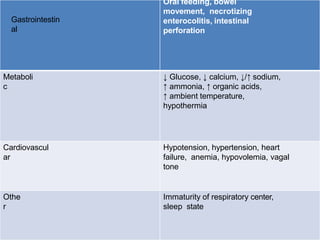
Oral feeding, bowel
movement, necrotizing
enterocolitis, intestinal
perforation
Metaboli
c
↓ Glucose, ↓ calcium, ↓/↑ sodium,
↑ ammonia, ↑ organic acids,
↑ ambient temperature,
hypothermia
Cardiovascul
ar
Hypotension, hypertension, heart
failure, anemia, hypovolemia, vagal
tone
Othe
r
Immaturity of respiratory center,
sleep state
Gastrointestin
al
PES Institute of Medical Sciences & Research
Clinical Manifestation
• The incidence of idiopathic apnea of prematurity
varies inversely with gestational age.
• The onset of idiopathic apnea can be during the 1st 1-
2 wk after birth but is often delayed if there is RDS
or other causes of respiratory distress.
• Apneic episodes have been noted to be as frequent on
day 1 as throughout the 1st wk in premature infants
without respiratory disease.
• The incidence of associated bradycardia increases
with the length of the preceding apnea and
correlates with the severity of hypoxia.
PES Institute of Medical Sciences & Research
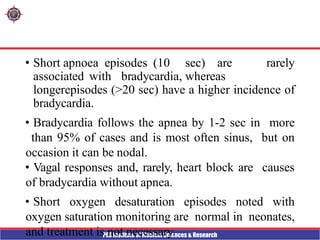
• Short apnoea episodes (10 sec) are rarely
associated with bradycardia, whereas
longerepisodes (>20 sec) have a higher incidence of
bradycardia.
• Bradycardia follows the apnea by 1-2 sec in more
than 95% of cases and is most often sinus, but on
occasion it can be nodal.
• Vagal responses and, rarely, heart block are causes
of bradycardia without apnea.
• Short oxygen desaturation episodes noted with
oxygen saturation monitoring are normal in neonates,
and treatment is not necessary.
PES Institute of Medical Sciences & Research
CHEYNE-STOKES
BREATHING
 Also calledas“periodicbreathing”.
 This condition was named after “John Cheyne & William
Stokes”,thephysicianswho first described itin19th century.
 Characterized by alternate periods of tachypnea
andapnea.
 Occurs as acompensationforchanging serum pO2 &
pCO2, and classically seen in damage to pons where
resp.centersare located.
PES Institute of Medical Sciences & Research
TREATMENT
• Infants at risk for apnea should get cardio
respiratory monitoring.
• Gentle tactile stimulation is often adequate therapy
for mild and intermittent episodes.
• The onset of apnea in a previously well preterm
neonate after the 2nd wk of life or in a term
infant at any time is a critical event that warrants
prompt investigation.
• Recurrent apnea of prematurity may be treated
with caffeine or theophylline.
• Methylxanthines increase central respiratory drive
by lowering the threshold of response to
hypercapnia as well as enhancing contractility of
the diaphragm and preventing diaphragmatic
PES Institute of Medical Sciences & Research
• Caffeine and theophylline are as effective, but
caffeine has fewer side effects (less tachycardia
and feeding intolerance).
• Loading doses of 5-7 mg/kg of theophylline
(orally) or aminophylline (intravenously) should
be followed by doses of 1-2 mg/kg given every 6-
12 hr by the oral or intravenous route.
• Loading doses of 20 mg/kg of caffeine citrate are
followed 24 hr later by maintenance doses of 5
mg/kg/24 hr qd, either orally or intravenously.
PES Institute of Medical Sciences & Research
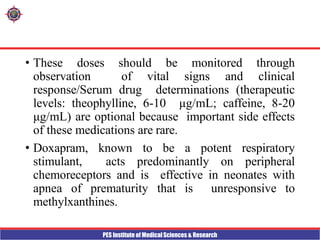
• These doses should be monitored through
observation of vital signs and clinical
response/Serum drug determinations (therapeutic
levels: theophylline, 6-10 μg/mL; caffeine, 8-20
μg/mL) are optional because important side effects
of these medications are rare.
• Doxapram, known to be a potent respiratory
stimulant, acts predominantly on peripheral
chemoreceptors and is effective in neonates with
apnea of prematurity that is unresponsive to
methylxanthines.
PES Institute of Medical Sciences & Research
• Transfusion of packed red blood cells to reduce
the incidence of idiopathic apnea is reserved for
severely anemic infants.
• Nasal continuous positive airway pressure
(continuous positive airway pressure [CPAP], 3-5 cm
H2O) and high- flow humidification using nasal
cannula (1-2.5 L/min) are therapies for mixed or
obstructive apnea, but
CPAP is preferred because of its proven efficacy and
safety. The efficacy of CPAP is related to its ability to
splint the upper airway and prevent airway
obstruction.
PES Institute of Medical Sciences & Research
PROGNOSIS
• Apnea of prematurity does not alter an infant’s
prognosis unless it is severe, recurrent, and
refractory to therapy.
• The associated problems of intraventricular
hemorrhage (IVH), BPD, and retinopathy of
prematurity are critical in determining the
prognosis for Apneic infants.
• Apnea of prematurity usually resolves by 37 wk of
post conceptional age, although it may persist
beyond term gestation, particularly in extremely
preterm infants born at <28 wk of gestation, and
does not predict future episodes of sudden infant
death syndrome (SIDS).
PES Institute of Medical Sciences & Research
APNEAAND SUDDEN INFANT
DEATH SYNDROME
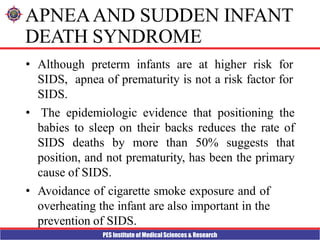
• Although preterm infants are at higher risk for
SIDS, apnea of prematurity is not a risk factor for
SIDS.
• The epidemiologic evidence that positioning the
babies to sleep on their backs reduces the rate of
SIDS deaths by more than 50% suggests that
position, and not prematurity, has been the primary
cause of SIDS.
• Avoidance of cigarette smoke exposure and of
overheating the infant are also important in the
prevention of SIDS.
PES Institute of Medical Sciences & Research
• There is significant new information in recent
decades on sudden infant death syndrome (SIDS)
and apnea during early infancy
• The hypothesis that apnea is the pathophysiologic
precursor to SIDS was first proposed in 1972.
• The apnea theory has never been proven despite
extensive independent research in the several
decades after that report.and SIDS has not been
established
PES Institute of Medical Sciences & Research
A Task Force on Prolonged Infantile Apnea formed (
in 1980) to evaluate the evidence for the theory that
apnea is a precursor to SIDS, concluded in 1985 that
“a causal relationship between prolonged apnea and
SIDS has not been established
PES Institute of Medical Sciences & Research
SUDDEN INFANT DEATH
SYNDROME (SIDS)
• Sudden infant death syndrome (SIDS)is the sudden,
unexplained death of an infantyounger than one year
old.
• Some people call SIDS"crib death" because many
babieswho die of SIDSarefound in their
cribs.
• SIDS is defined as the sudden, unexpected death of
an infant less than 1 year of age that cannot be
explained despite a thorough investigation,
including a complete autopsy, examination of the
death scene, and review of the clinical and social
history.
PES Institute of Medical Sciences & Research
Epidemiology
• Incidence
• Despite a recent decline in incidence, SIDS
continues to be the leading cause of post neonatal
mortality in developed countries after excluding
perinatal event-related deaths
• Age-related demographics
• About two-thirds of SIDS deaths occur in infants
aged 2-4 months. Ninety percent of deaths occur
in children younger than 6 months, and 95% of
deaths occur in children younger than 8 months;
few occur in children younger than 1 month or
older than 8 months.
PES Institute of Medical Sciences & Research
• Sex-related demographics
• Approximately 60-70% of SIDS deaths occur in
males. Despite other notable changes in SIDS
epidemiology, the male-to-female ratio has
remained relatively unchanged in most population
studies.
Risk
Factors;
Risk factors for SIDS (Derived from Malloy and Mac Dorman
(2005).
Maternal Factors Infantile Factors
Young age Male gender
Multiparity Low birth
weight Smoking during pregnancy Low birth length
Drug abuse during pregnancy Premature birth
Previous fetal death Blood type B
Anemia in pregnancy Low Apgar score
Placenta previa Low hematocrit at 48h
Premature rapture of membrane Not using a pacifier
Low social status Prone or side sleeping
Maternal
Factors
Infantile
Factors
Social
class
Bed
sharing
Low family
income
Not
breastfed
Short
interpregnancy
Sibling in own
room
Late attendance of antenatal
clinic
Previous SIDS in
family
Postnatal
depression
Previous cyanotic
episode
Urinary tract
infection
overheatin
g
Attendance to
psychiatrist
Unmarried mother
PES Institute of Medical Sciences & Research
Pathophysiology
• Although multiple hypotheses have been proposed
as the pathophysiologic mechanisms responsible
for SIDS, none have been proven. The triple-risk
model, proposed by Filiano and Kinney, suggests
that SIDS represents an intersection of factors,
including the following :
-A vulnerable infant possessing intrinsic
abnormalities in cardio respiratory
control
-A critical period in the development of
homeostatic control mechanisms
PES Institute of Medical Sciences & Research
Prevention
• Primary Prevention
• Dissemination of advice on safe sleeping has
been one of the most effective health
interventions ever performed.
• According to the American Academy of
Pediatrics(AAP, 2011), the following were
given as preventive measures ofAOP:-
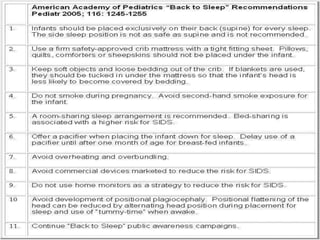
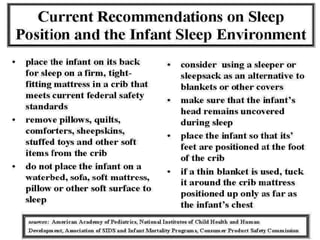
• Infants should be placed for sleep in a supine
position for every sleep.
• – Use a firm sleep surface. Pillows or sheepskin
should not be placed under a sleeping infant.
PES Institute of Medical Sciences & Research
•Room-sharing without bed-sharing is recommended.
•Keep soft objects and loose bedding out of the crib.
• Pregnant women should receive regular
prenatal care.
• Avoid smoke exposure during pregnancy and
after birth.
• Avoid alcohol and illicit drug use during
pregnancy and after birth.
•Breastfeeding.
PES Institute of Medical Sciences & Research
• Consider offering a pacifier at nap time and
bed time. Avoid overheating. Bedroom
temperature should be comfortable for a lightly
closed adult.
• Do not use home cardiorespiratory monitors as
a strategy for reducing the risk of SIDS.
• Infants should be immunized in
accordance with recommendations of
the AAP and CDC.
• Avoid commercial devices marketed to reduce
the risk of SIDS.
PES Institute of Medical Sciences & Research
B). Secondary Prevention
• Monitoring, although recently discouraged has been
the only secondary mechanism of preventing SIDS.
• The first indication comprises infants after an
apparent life- threatening event (ALTE) and infants
from families who had two or more sudden
unexpected infant deaths.
PES Institute of Medical Sciences & Research
•THANK YOU

NEONATAL APNEA.pptx

  • 1.
    PES Institute ofMedical Sciences & Research NEONATAL APNEA
  • 2.
    PES Institute ofMedical Sciences & Research INTRODUCTION • Apnea is more common in preterm infants. Apnea of prematurity requires a specific assessment and treatment. • It is rare among full-term healthy infants and, if present, usually indicates an underlying pathology • Idiopathic apnea of prematurity occurs in the absence of identifiable predisposing diseases. • Apnea is a disorder of respiratory control and may be: obstructive, central, or mixed.
  • 3.
    PES Institute ofMedical Sciences & Research APNEA • In infants Apnea is defined as Cessation of breathing for longer than 20sec, or any duration if accompanied by cyanosis and sinus bradycardia
  • 4.
    PES Institute ofMedical Sciences & Research Obstructive Apnea • Characterized by absence of airflow but persistent chest wall motion. • Pharyngeal collapse may follow the negative airway pressures generated during inspiration or it may result from in coordination of the tongue and other upper airway muscles involved in maintaining airway patency. • Pharyngeal instability, neck flexion
  • 5.
    PES Institute ofMedical Sciences & Research Central Apnea • Caused by decreased central nervous system (CNS) stimuli to respiratory muscles. • Both airflow and chest wall motion are absent. • Gestational age is the most important determinant of respiratory control, with the frequency of apnea being inversely related to gestational age. • The immaturity of the brainstem respiratory centers is manifested by an attenuated response to carbon dioxide and a paradoxical response to hypoxia that results in apnea rather than the hyperventilation observed after the 1st few mo of life.
  • 6.
    PES Institute ofMedical Sciences & Research Mixed Apnea • The most common pattern of idiopathic apnea in preterm neonates (50-75%) of the cases • Usually Obstructive apnea precedes Central apnea • Short episodes of apnea are usually central, whereas prolonged ones are often mixed. • Apnea depends on the sleep state; its frequency increases during active (rapid eye movement) sleep.
  • 7.
    PES Institute ofMedical Sciences & Research Potential Causes of Neonatal Apnea and Bradycardia Central nervous system Intraventricular haemorrhage, drugs, seizures, hypoxic injury, herniation, neuromuscular disorders, Leigh syndrome, brainstem infarction or anomalies (e.g., olivopontocerebellar atrophy), spinal cord injury after general anaesthesia Respiratory Infectious Pneumonia, obstructive airway lesions, upper airway collapse, atelectasis, extreme prematurity, laryngeal reflex, phrenic nerve paralysis, pneumothorax, hypoxia Sepsis, meningitis (bacterial, fungal,
  • 8.
    Oral feeding, bowel movement,necrotizing enterocolitis, intestinal perforation Metaboli c ↓ Glucose, ↓ calcium, ↓/↑ sodium, ↑ ammonia, ↑ organic acids, ↑ ambient temperature, hypothermia Cardiovascul ar Hypotension, hypertension, heart failure, anemia, hypovolemia, vagal tone Othe r Immaturity of respiratory center, sleep state Gastrointestin al
  • 9.
    PES Institute ofMedical Sciences & Research Clinical Manifestation • The incidence of idiopathic apnea of prematurity varies inversely with gestational age. • The onset of idiopathic apnea can be during the 1st 1- 2 wk after birth but is often delayed if there is RDS or other causes of respiratory distress. • Apneic episodes have been noted to be as frequent on day 1 as throughout the 1st wk in premature infants without respiratory disease. • The incidence of associated bradycardia increases with the length of the preceding apnea and correlates with the severity of hypoxia.
  • 10.
    PES Institute ofMedical Sciences & Research • Short apnoea episodes (10 sec) are rarely associated with bradycardia, whereas longerepisodes (>20 sec) have a higher incidence of bradycardia. • Bradycardia follows the apnea by 1-2 sec in more than 95% of cases and is most often sinus, but on occasion it can be nodal. • Vagal responses and, rarely, heart block are causes of bradycardia without apnea. • Short oxygen desaturation episodes noted with oxygen saturation monitoring are normal in neonates, and treatment is not necessary.
  • 11.
    PES Institute ofMedical Sciences & Research CHEYNE-STOKES BREATHING  Also calledas“periodicbreathing”.  This condition was named after “John Cheyne & William Stokes”,thephysicianswho first described itin19th century.  Characterized by alternate periods of tachypnea andapnea.  Occurs as acompensationforchanging serum pO2 & pCO2, and classically seen in damage to pons where resp.centersare located.
  • 12.
    PES Institute ofMedical Sciences & Research TREATMENT • Infants at risk for apnea should get cardio respiratory monitoring. • Gentle tactile stimulation is often adequate therapy for mild and intermittent episodes. • The onset of apnea in a previously well preterm neonate after the 2nd wk of life or in a term infant at any time is a critical event that warrants prompt investigation. • Recurrent apnea of prematurity may be treated with caffeine or theophylline. • Methylxanthines increase central respiratory drive by lowering the threshold of response to hypercapnia as well as enhancing contractility of the diaphragm and preventing diaphragmatic
  • 13.
    PES Institute ofMedical Sciences & Research • Caffeine and theophylline are as effective, but caffeine has fewer side effects (less tachycardia and feeding intolerance). • Loading doses of 5-7 mg/kg of theophylline (orally) or aminophylline (intravenously) should be followed by doses of 1-2 mg/kg given every 6- 12 hr by the oral or intravenous route. • Loading doses of 20 mg/kg of caffeine citrate are followed 24 hr later by maintenance doses of 5 mg/kg/24 hr qd, either orally or intravenously.
  • 14.
    PES Institute ofMedical Sciences & Research • These doses should be monitored through observation of vital signs and clinical response/Serum drug determinations (therapeutic levels: theophylline, 6-10 μg/mL; caffeine, 8-20 μg/mL) are optional because important side effects of these medications are rare. • Doxapram, known to be a potent respiratory stimulant, acts predominantly on peripheral chemoreceptors and is effective in neonates with apnea of prematurity that is unresponsive to methylxanthines.
  • 15.
    PES Institute ofMedical Sciences & Research • Transfusion of packed red blood cells to reduce the incidence of idiopathic apnea is reserved for severely anemic infants. • Nasal continuous positive airway pressure (continuous positive airway pressure [CPAP], 3-5 cm H2O) and high- flow humidification using nasal cannula (1-2.5 L/min) are therapies for mixed or obstructive apnea, but CPAP is preferred because of its proven efficacy and safety. The efficacy of CPAP is related to its ability to splint the upper airway and prevent airway obstruction.
  • 16.
    PES Institute ofMedical Sciences & Research PROGNOSIS • Apnea of prematurity does not alter an infant’s prognosis unless it is severe, recurrent, and refractory to therapy. • The associated problems of intraventricular hemorrhage (IVH), BPD, and retinopathy of prematurity are critical in determining the prognosis for Apneic infants. • Apnea of prematurity usually resolves by 37 wk of post conceptional age, although it may persist beyond term gestation, particularly in extremely preterm infants born at <28 wk of gestation, and does not predict future episodes of sudden infant death syndrome (SIDS).
  • 17.
    PES Institute ofMedical Sciences & Research APNEAAND SUDDEN INFANT DEATH SYNDROME • Although preterm infants are at higher risk for SIDS, apnea of prematurity is not a risk factor for SIDS. • The epidemiologic evidence that positioning the babies to sleep on their backs reduces the rate of SIDS deaths by more than 50% suggests that position, and not prematurity, has been the primary cause of SIDS. • Avoidance of cigarette smoke exposure and of overheating the infant are also important in the prevention of SIDS.
  • 18.
    PES Institute ofMedical Sciences & Research • There is significant new information in recent decades on sudden infant death syndrome (SIDS) and apnea during early infancy • The hypothesis that apnea is the pathophysiologic precursor to SIDS was first proposed in 1972. • The apnea theory has never been proven despite extensive independent research in the several decades after that report.and SIDS has not been established
  • 19.
    PES Institute ofMedical Sciences & Research A Task Force on Prolonged Infantile Apnea formed ( in 1980) to evaluate the evidence for the theory that apnea is a precursor to SIDS, concluded in 1985 that “a causal relationship between prolonged apnea and SIDS has not been established
  • 20.
    PES Institute ofMedical Sciences & Research SUDDEN INFANT DEATH SYNDROME (SIDS) • Sudden infant death syndrome (SIDS)is the sudden, unexplained death of an infantyounger than one year old. • Some people call SIDS"crib death" because many babieswho die of SIDSarefound in their cribs. • SIDS is defined as the sudden, unexpected death of an infant less than 1 year of age that cannot be explained despite a thorough investigation, including a complete autopsy, examination of the death scene, and review of the clinical and social history.
  • 21.
    PES Institute ofMedical Sciences & Research Epidemiology • Incidence • Despite a recent decline in incidence, SIDS continues to be the leading cause of post neonatal mortality in developed countries after excluding perinatal event-related deaths • Age-related demographics • About two-thirds of SIDS deaths occur in infants aged 2-4 months. Ninety percent of deaths occur in children younger than 6 months, and 95% of deaths occur in children younger than 8 months; few occur in children younger than 1 month or older than 8 months.
  • 22.
    PES Institute ofMedical Sciences & Research • Sex-related demographics • Approximately 60-70% of SIDS deaths occur in males. Despite other notable changes in SIDS epidemiology, the male-to-female ratio has remained relatively unchanged in most population studies.
  • 26.
    Risk Factors; Risk factors forSIDS (Derived from Malloy and Mac Dorman (2005). Maternal Factors Infantile Factors Young age Male gender Multiparity Low birth weight Smoking during pregnancy Low birth length Drug abuse during pregnancy Premature birth Previous fetal death Blood type B Anemia in pregnancy Low Apgar score Placenta previa Low hematocrit at 48h Premature rapture of membrane Not using a pacifier Low social status Prone or side sleeping
  • 27.
    Maternal Factors Infantile Factors Social class Bed sharing Low family income Not breastfed Short interpregnancy Sibling inown room Late attendance of antenatal clinic Previous SIDS in family Postnatal depression Previous cyanotic episode Urinary tract infection overheatin g Attendance to psychiatrist Unmarried mother
  • 28.
    PES Institute ofMedical Sciences & Research Pathophysiology • Although multiple hypotheses have been proposed as the pathophysiologic mechanisms responsible for SIDS, none have been proven. The triple-risk model, proposed by Filiano and Kinney, suggests that SIDS represents an intersection of factors, including the following : -A vulnerable infant possessing intrinsic abnormalities in cardio respiratory control -A critical period in the development of homeostatic control mechanisms
  • 29.
    PES Institute ofMedical Sciences & Research Prevention • Primary Prevention • Dissemination of advice on safe sleeping has been one of the most effective health interventions ever performed. • According to the American Academy of Pediatrics(AAP, 2011), the following were given as preventive measures ofAOP:- • Infants should be placed for sleep in a supine position for every sleep. • – Use a firm sleep surface. Pillows or sheepskin should not be placed under a sleeping infant.
  • 30.
    PES Institute ofMedical Sciences & Research •Room-sharing without bed-sharing is recommended. •Keep soft objects and loose bedding out of the crib. • Pregnant women should receive regular prenatal care. • Avoid smoke exposure during pregnancy and after birth. • Avoid alcohol and illicit drug use during pregnancy and after birth. •Breastfeeding.
  • 31.
    PES Institute ofMedical Sciences & Research • Consider offering a pacifier at nap time and bed time. Avoid overheating. Bedroom temperature should be comfortable for a lightly closed adult. • Do not use home cardiorespiratory monitors as a strategy for reducing the risk of SIDS. • Infants should be immunized in accordance with recommendations of the AAP and CDC. • Avoid commercial devices marketed to reduce the risk of SIDS.
  • 32.
    PES Institute ofMedical Sciences & Research B). Secondary Prevention • Monitoring, although recently discouraged has been the only secondary mechanism of preventing SIDS. • The first indication comprises infants after an apparent life- threatening event (ALTE) and infants from families who had two or more sudden unexpected infant deaths.
  • 33.
    PES Institute ofMedical Sciences & Research •THANK YOU