Warning
Please be aware that this
resource may contain
references to and images of
Aboriginal and Torres Strait
Islander people who may
have passed away.
If someone you didn’t know
came to your house and
took you, or one of your
brothers or sisters away......
Imagine ....
How would you feel if this
happened to your family?
None of you had done
anything wrong, you didn’t
know why this was
happening...
Imagine...
 From 1909 to 1969 Governments, churches and
welfare bodies were able to take Aboriginal
children away from their families without
consent. This practice continued into the 1970s.
 These children were then brought up in
institutions or fostered out to white families.
 These children are known as...
THE STOLEN GENERATION
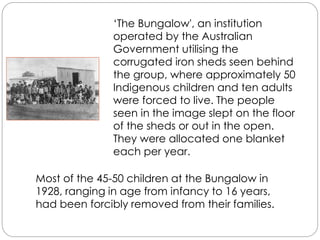
‘The Bungalow’ N.T. 1928
One of many places children from the Stolen Generation
were forced to live, in very poor conditions.
‘The Bungalow', an institution
operated by the Australian
Government utilising the
corrugated iron sheds seen behind
the group, where approximately 50
Indigenous children and ten adults
were forced to live. The people
seen in the image slept on the floor
of the sheds or out in the open.
They were allocated one blanket
each per year.
Most of the 45-50 children at the Bungalow in
1928, ranging in age from infancy to 16 years,
had been forcibly removed from their families.
FACTS
 Aboriginal children were taken from
their families all over Australia.
 The first 'native institution' at
Parramatta, N.S.W. in 1814 was set up
to 'civilise' Aboriginal children.
 The lack of understanding and respect
for Aboriginal people also meant that
many people who supported the child
removals believed that they were
doing the ‘right thing’.
FACTS cont.
 In the early 20th century white Australians
thought Aboriginal people would die out. In
three generations, they thought, Aboriginal
genes would have been 'bred out' when
Aboriginal people had children with white
people.
 It is not known precisely how many Aboriginal
children were taken away between 1909 and
1969, when the Aborigines Welfare Board
(formerly the Aborigines Protection Board) was
abolished. Poor record keeping, the loss of
records and changes to departmental structures
have made it almost impossible to trace many
connections.
Reasons why Aboriginal girls were taken away (in %).
This statistic considers why Aboriginal girls were
removed from their families. "Other" reasons include
"being female on an Aboriginal reserve" and simply
because of being "Aboriginal“.
Rabbit Proof Fence
Rabbit-Proof Fence is a 2002 Australian drama
film based on the book Follow the Rabbit-Proof
Fence by Doris Pilkington Garimara. It is based
on a true story concerning the author's mother, as
well as two other mixed-race Aboriginal girls, who
ran away from the Moore River Native
Settlement, north of Perth, to return to their
Aboriginal families, after having been placed
there in 1931. The film follows the girls as they
trek/walk for nine weeks along 1,500 miles
(2,400 km) of the Australian rabbit-proof fence to
return to their community at Jigalong, while being
tracked by a white authority figure and an
Watch images from the movie ‘Rabbit Proof Fence’ tell the
story of 3 young children taken away from their family and
how they tried to get home.
•They are more likely to come to the attention of
the police as they grow into adolescence
•They are more likely to suffer low self-esteem,
depression and mental illness
•They are more vulnerable to physical,
emotional and sexual abuse
•They had been almost always taught to reject
their Aboriginality and Aboriginal culture
•They are unable to retain links with their land
•They cannot take a role in the cultural and
spiritual life of their former communities
•They are unlikely to be able to establish their
right to native title.
The effects of removal on The Stolen
Generation today
The National Sorry Day is held on the 26th
May each year since 1988, in
commemoration of the Bringing Them Home
report being handed to the federal
government on 26 May 1997.
Sorry Day 2007. Someone had planted an Aboriginal flag on the
ground expressing his sorrow for what had happened to Indigenous
people
On the 13th February, 2008 The Prime
Minister, Kevin Rudd offered a broad
apology to all Aborigines and the
Stolen Generations for their "profound
grief, suffering and loss“.
The Australian Government says SORRY
Reflections
 Think about how you might feel if you had been
one of the Stolen Generation children. In groups,
write down how you think families would have
been affected, at the time of separation, as they
were growing up and once they were adults.
 Imagine you knew what you know now but could
go back in time. Write a letter to the authorities
and give them some reasons why they should
stop separating Aboriginal children from their
families. You can look on the internet or at the
library for more information on the Stolen
Generation to help you. Include your references
at the end of your letter.
References
 http://www.racismnoway.com.au/classroom/fac
tsheets/52.html
 http://learningplace.eq.edu.au/cx/resources
 http://www.creativespirits.info/aboriginalculture/
politics/stolen-generations.html
 http://en.wikipedia.org/wiki/Rabbit-
Proof_Fence_%28film%29
 http://en.wikipedia.org/wiki/National_Sorry_Day
 http://www.youtube.com/watch?v=rF5y5nP8Pps

Stolen Introduction

  • 1.
    Warning Please be awarethat this resource may contain references to and images of Aboriginal and Torres Strait Islander people who may have passed away.
  • 2.
    If someone youdidn’t know came to your house and took you, or one of your brothers or sisters away...... Imagine ....
  • 3.
    How would youfeel if this happened to your family? None of you had done anything wrong, you didn’t know why this was happening... Imagine...
  • 4.
     From 1909to 1969 Governments, churches and welfare bodies were able to take Aboriginal children away from their families without consent. This practice continued into the 1970s.  These children were then brought up in institutions or fostered out to white families.  These children are known as... THE STOLEN GENERATION
  • 5.
    ‘The Bungalow’ N.T.1928 One of many places children from the Stolen Generation were forced to live, in very poor conditions.
  • 6.
    ‘The Bungalow', aninstitution operated by the Australian Government utilising the corrugated iron sheds seen behind the group, where approximately 50 Indigenous children and ten adults were forced to live. The people seen in the image slept on the floor of the sheds or out in the open. They were allocated one blanket each per year. Most of the 45-50 children at the Bungalow in 1928, ranging in age from infancy to 16 years, had been forcibly removed from their families.
  • 7.
    FACTS  Aboriginal childrenwere taken from their families all over Australia.  The first 'native institution' at Parramatta, N.S.W. in 1814 was set up to 'civilise' Aboriginal children.  The lack of understanding and respect for Aboriginal people also meant that many people who supported the child removals believed that they were doing the ‘right thing’.
  • 8.
    FACTS cont.  Inthe early 20th century white Australians thought Aboriginal people would die out. In three generations, they thought, Aboriginal genes would have been 'bred out' when Aboriginal people had children with white people.  It is not known precisely how many Aboriginal children were taken away between 1909 and 1969, when the Aborigines Welfare Board (formerly the Aborigines Protection Board) was abolished. Poor record keeping, the loss of records and changes to departmental structures have made it almost impossible to trace many connections.
  • 9.
    Reasons why Aboriginalgirls were taken away (in %). This statistic considers why Aboriginal girls were removed from their families. "Other" reasons include "being female on an Aboriginal reserve" and simply because of being "Aboriginal“.
  • 10.
    Rabbit Proof Fence Rabbit-ProofFence is a 2002 Australian drama film based on the book Follow the Rabbit-Proof Fence by Doris Pilkington Garimara. It is based on a true story concerning the author's mother, as well as two other mixed-race Aboriginal girls, who ran away from the Moore River Native Settlement, north of Perth, to return to their Aboriginal families, after having been placed there in 1931. The film follows the girls as they trek/walk for nine weeks along 1,500 miles (2,400 km) of the Australian rabbit-proof fence to return to their community at Jigalong, while being tracked by a white authority figure and an
  • 11.
    Watch images fromthe movie ‘Rabbit Proof Fence’ tell the story of 3 young children taken away from their family and how they tried to get home.
  • 12.
    •They are morelikely to come to the attention of the police as they grow into adolescence •They are more likely to suffer low self-esteem, depression and mental illness •They are more vulnerable to physical, emotional and sexual abuse •They had been almost always taught to reject their Aboriginality and Aboriginal culture •They are unable to retain links with their land •They cannot take a role in the cultural and spiritual life of their former communities •They are unlikely to be able to establish their right to native title. The effects of removal on The Stolen Generation today
  • 13.
    The National SorryDay is held on the 26th May each year since 1988, in commemoration of the Bringing Them Home report being handed to the federal government on 26 May 1997. Sorry Day 2007. Someone had planted an Aboriginal flag on the ground expressing his sorrow for what had happened to Indigenous people
  • 14.
    On the 13thFebruary, 2008 The Prime Minister, Kevin Rudd offered a broad apology to all Aborigines and the Stolen Generations for their "profound grief, suffering and loss“. The Australian Government says SORRY
  • 15.
    Reflections  Think abouthow you might feel if you had been one of the Stolen Generation children. In groups, write down how you think families would have been affected, at the time of separation, as they were growing up and once they were adults.  Imagine you knew what you know now but could go back in time. Write a letter to the authorities and give them some reasons why they should stop separating Aboriginal children from their families. You can look on the internet or at the library for more information on the Stolen Generation to help you. Include your references at the end of your letter.
  • 16.
    References  http://www.racismnoway.com.au/classroom/fac tsheets/52.html  http://learningplace.eq.edu.au/cx/resources http://www.creativespirits.info/aboriginalculture/ politics/stolen-generations.html  http://en.wikipedia.org/wiki/Rabbit- Proof_Fence_%28film%29  http://en.wikipedia.org/wiki/National_Sorry_Day  http://www.youtube.com/watch?v=rF5y5nP8Pps