Feedback to students Rosalind Duhs Centre for the Advancement of Learning and Teaching (CALT) This document is licensed under the Attribution-NonCommercial-ShareAlike 2.0 UK: England & Wales license, available at http://creativecommons.org/licenses/by-nc-sa/2.0/uk/.
Seminar intended learning outcomes After the seminar, participants are expected to be able to: Formulate broad definitions of feedback to promote student learning Facilitate and encourage student use of feedback Provide students with useful feedback in diverse ways.
Definitions of feedback 1 Written comments on written work
Definitions of feedback 2 A dialogue (written and/or spoken) with a learner which provides information on the quality of work with advice on how to develop and improve
A dialogic feedback system
Broadening conceptions of feedback Every opportunity a student has to find out about their level of knowledge, understanding, qualities, skills and other attributes can be seen as feedback. Useful feedback does not always have to come from tutors.
Transparent definitions of feedback Ensure that students: work with broader definitions of feedback know how they will get feedback integrate processes for acting on feedback into their study patterns
Facilitate and encourage student use of feedback
The traditional pattern of feedback Traditional pattern: tutor   student Student does work. Tutor comments. Student looks at mark. Student does not always study comments.  Student may not understand comments.
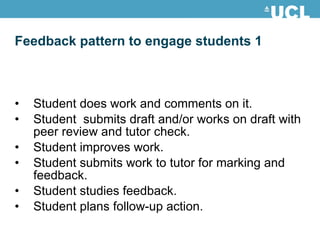
Feedback pattern to engage students 1 Student does work and comments on it. Student  submits draft and/or works on draft with peer review and  tutor check . Student improves work. Student submits work to tutor for marking and feedback. Student studies feedback. Student plans follow-up action.
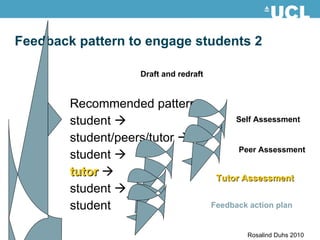
Feedback pattern to engage students 2 Recommended pattern:  student   student/peers/ tutor   student   tutor   student   student  Self Assessment Peer Assessment Draft and redraft Tutor Assessment Feedback action plan Rosalind Duhs 2010
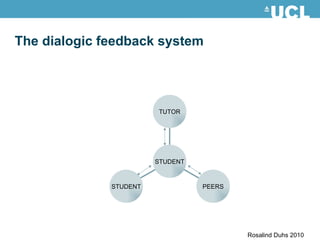
The dialogic feedback system Rosalind Duhs 2010 TUTOR PEERS STUDENT STUDENT
Why a dialogue? To engage students To encourage awareness of learning To promote  ’ time on task’ To help students develop insight into what is required of them
To work as we do when we disseminate our research  Why can’t students work in this way? We check the criteria for submissions to journals We ensure that we are meeting criteria (self-assessment) We ask colleagues to read our draft papers OR we work in research teams (peer assessment) We get feedback from journals and revise our work  (similar to feedback on drafts from tutors)
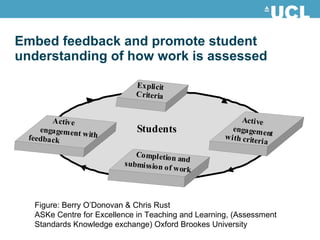
Embed feedback and promote student understanding of how work is assessed  Figure:  Berry O’Donovan & Chris Rust ASKe Centre for Excellence in Teaching and Learning, (Assessment Standards Knowledge exchange) Oxford Brookes University
Use assessment criteria and related exemplars to promote understanding of feedback
Provide students with useful feedback in diverse ways Main conditions for useful feedback (Sadler 1989) Knowledge of what constitutes a good performance Knowledge of how the current performance relates to a good performance Skills to act to close the gap between the current and a good performance And timely
Useful feedback: the student perspective  Students often find it difficult to understand feedback (Lea and Street, 1998) Feedback appears vague (Higgins, 2000) Language is impenetrable (Lea and Street, 1998; Ridsdale 2000)
Difficulty understanding comments ‘… phrases such as ‘deeper analysis required’ often mean very little to students and are, in fact, open to misinterpretation.’ http://www.heacademy.ac.uk/resources/detail/should_we_be_giving_less?i =academyYork
Write a brief summary of your view of the assignment Balance negative with positive comments Use constructive criticism to provide positive suggestions for improvement Ask questions which encourage reflection about the work Explain all your comments Tutor feedback for learning 1
Tutor feedback for learning 2 (‘feedforward’) Suggest follow-up work and references Suggest specific ways to improve the assignment Explain the mark or the grade and why it is not better or worse Offer help with specific problems Offer the opportunity to discuss the assignment and your comments. Gibbs, G, and Habeshaw, T,  Preparing to Teach: An introduction to effective teaching in higher education
Focus on what is most likely to have greatest benefit Give students something digestible (right for their level) to work on
Draft and redraft using Turnitin Use a Turnitin (plagiarism detection tool)  co-ordinator and advisers Aim – promote student understanding of how to write  without  unintentional plagiarism Students are free to submit and resubmit to Turnitin ‘ Patch writing’ is a stage of development as students learn academic writing. Norms regarding referencing can vary internationally
Use IT (eg Moodle) for feedback and questionnaires and quizzes for learning Use a virtual learning environment for embedded video and follow-up quizzes for feedback to prepare students for lab work. Upload general feedback about a piece of work. Refer to paragraphs for individual feedback on texts.
Feedback short cuts 1 Work electronically and ’paste’ in comments from a separate file Use a handout with numbered comments. Write the number where you want to comment.
Feedback shortcuts 2 Differentiate between style- or method-related and content comments, eg use letters for style and re-use, including examples. Use numbers for comments on content. Sound-record comments. Audio feedback is well-received by students. See this JISC-funded project http://sites.google.com/site/soundsgooduk/Home
1. Facilitates the development of  self assessment  (reflection) in learning. 2. Encourages  teacher and peer dialogue  around learning. 3. Helps  clarify  what good performance is (goals,  criteria , expected standards). 4. Provides opportunities to  close the gap  between current and desired performance. 5. Delivers  high quality information to students  about their learning. 6. Encourages  positive motivational beliefs and self-esteem. 7. Provides  information to teachers  that can be used to help shape teaching. (SENLEF) Conclusion The seven principles of good feedback
References Higgins, R. (2000).  “Be more critical”: Rethinking assessment feedback . Paper presented at the British Educational Research Association Conference, Cardiff University, September 7-10. http://www.leeds.ac.uk/educol/documents/00001548.htm  Lea, M. & Street, B. (1998) Student Writing in Higher Education: an academic literacies approach.  Studies in Higher Education , 23 (2), pp. 157-172  Ridsdale, M.L.“I’ve read his comments but I don’t know how to do”:International postgraduate student perceptions of written supervisor feedback. In ‘ Sources of confusion : refereed proceedings of the national language and academic skills conference held at La Trobe University, November 27-28,2000’ edited by \k \charnock, pp272-282.  Rust, C, Price, M. & O’Donovan, B. (2003) Improving students’ learning by developing their understanding of assessment criteria and processes,  Assessment and Evaluation . 28, 147-164.   Sadler, D. R. (1989). Formative assessment and the design of instructional systems.  Instructional Science ,  18 , 119-144.   SENLEF  http:// www.heacademy.ac.uk/ourwork/learning/assessment/senlef
Please also see the assessment and feedback short course Moodle page. UCLMoodle/all courses/Social and Historical Sciences/CALT/ Assessment and Feedback These pages are open to guest users. Additional resources

Feedback to Students

  • 1.
    Feedback to studentsRosalind Duhs Centre for the Advancement of Learning and Teaching (CALT) This document is licensed under the Attribution-NonCommercial-ShareAlike 2.0 UK: England & Wales license, available at http://creativecommons.org/licenses/by-nc-sa/2.0/uk/.
  • 2.
    Seminar intended learningoutcomes After the seminar, participants are expected to be able to: Formulate broad definitions of feedback to promote student learning Facilitate and encourage student use of feedback Provide students with useful feedback in diverse ways.
  • 3.
    Definitions of feedback1 Written comments on written work
  • 4.
    Definitions of feedback2 A dialogue (written and/or spoken) with a learner which provides information on the quality of work with advice on how to develop and improve
  • 5.
  • 6.
    Broadening conceptions offeedback Every opportunity a student has to find out about their level of knowledge, understanding, qualities, skills and other attributes can be seen as feedback. Useful feedback does not always have to come from tutors.
  • 7.
    Transparent definitions offeedback Ensure that students: work with broader definitions of feedback know how they will get feedback integrate processes for acting on feedback into their study patterns
  • 8.
    Facilitate and encouragestudent use of feedback
  • 9.
    The traditional patternof feedback Traditional pattern: tutor  student Student does work. Tutor comments. Student looks at mark. Student does not always study comments. Student may not understand comments.
  • 10.
    Feedback pattern toengage students 1 Student does work and comments on it. Student submits draft and/or works on draft with peer review and tutor check . Student improves work. Student submits work to tutor for marking and feedback. Student studies feedback. Student plans follow-up action.
  • 11.
    Feedback pattern toengage students 2 Recommended pattern: student  student/peers/ tutor  student  tutor  student  student Self Assessment Peer Assessment Draft and redraft Tutor Assessment Feedback action plan Rosalind Duhs 2010
  • 12.
    The dialogic feedbacksystem Rosalind Duhs 2010 TUTOR PEERS STUDENT STUDENT
  • 13.
    Why a dialogue?To engage students To encourage awareness of learning To promote ’ time on task’ To help students develop insight into what is required of them
  • 14.
    To work aswe do when we disseminate our research Why can’t students work in this way? We check the criteria for submissions to journals We ensure that we are meeting criteria (self-assessment) We ask colleagues to read our draft papers OR we work in research teams (peer assessment) We get feedback from journals and revise our work (similar to feedback on drafts from tutors)
  • 15.
    Embed feedback andpromote student understanding of how work is assessed Figure: Berry O’Donovan & Chris Rust ASKe Centre for Excellence in Teaching and Learning, (Assessment Standards Knowledge exchange) Oxford Brookes University
  • 16.
    Use assessment criteriaand related exemplars to promote understanding of feedback
  • 17.
    Provide students withuseful feedback in diverse ways Main conditions for useful feedback (Sadler 1989) Knowledge of what constitutes a good performance Knowledge of how the current performance relates to a good performance Skills to act to close the gap between the current and a good performance And timely
  • 18.
    Useful feedback: thestudent perspective Students often find it difficult to understand feedback (Lea and Street, 1998) Feedback appears vague (Higgins, 2000) Language is impenetrable (Lea and Street, 1998; Ridsdale 2000)
  • 19.
    Difficulty understanding comments‘… phrases such as ‘deeper analysis required’ often mean very little to students and are, in fact, open to misinterpretation.’ http://www.heacademy.ac.uk/resources/detail/should_we_be_giving_less?i =academyYork
  • 20.
    Write a briefsummary of your view of the assignment Balance negative with positive comments Use constructive criticism to provide positive suggestions for improvement Ask questions which encourage reflection about the work Explain all your comments Tutor feedback for learning 1
  • 21.
    Tutor feedback forlearning 2 (‘feedforward’) Suggest follow-up work and references Suggest specific ways to improve the assignment Explain the mark or the grade and why it is not better or worse Offer help with specific problems Offer the opportunity to discuss the assignment and your comments. Gibbs, G, and Habeshaw, T, Preparing to Teach: An introduction to effective teaching in higher education
  • 22.
    Focus on whatis most likely to have greatest benefit Give students something digestible (right for their level) to work on
  • 23.
    Draft and redraftusing Turnitin Use a Turnitin (plagiarism detection tool) co-ordinator and advisers Aim – promote student understanding of how to write without unintentional plagiarism Students are free to submit and resubmit to Turnitin ‘ Patch writing’ is a stage of development as students learn academic writing. Norms regarding referencing can vary internationally
  • 24.
    Use IT (egMoodle) for feedback and questionnaires and quizzes for learning Use a virtual learning environment for embedded video and follow-up quizzes for feedback to prepare students for lab work. Upload general feedback about a piece of work. Refer to paragraphs for individual feedback on texts.
  • 25.
    Feedback short cuts1 Work electronically and ’paste’ in comments from a separate file Use a handout with numbered comments. Write the number where you want to comment.
  • 26.
    Feedback shortcuts 2Differentiate between style- or method-related and content comments, eg use letters for style and re-use, including examples. Use numbers for comments on content. Sound-record comments. Audio feedback is well-received by students. See this JISC-funded project http://sites.google.com/site/soundsgooduk/Home
  • 27.
    1. Facilitates thedevelopment of self assessment (reflection) in learning. 2. Encourages teacher and peer dialogue around learning. 3. Helps clarify what good performance is (goals, criteria , expected standards). 4. Provides opportunities to close the gap between current and desired performance. 5. Delivers high quality information to students about their learning. 6. Encourages positive motivational beliefs and self-esteem. 7. Provides information to teachers that can be used to help shape teaching. (SENLEF) Conclusion The seven principles of good feedback
  • 28.
    References Higgins, R.(2000). “Be more critical”: Rethinking assessment feedback . Paper presented at the British Educational Research Association Conference, Cardiff University, September 7-10. http://www.leeds.ac.uk/educol/documents/00001548.htm Lea, M. & Street, B. (1998) Student Writing in Higher Education: an academic literacies approach. Studies in Higher Education , 23 (2), pp. 157-172 Ridsdale, M.L.“I’ve read his comments but I don’t know how to do”:International postgraduate student perceptions of written supervisor feedback. In ‘ Sources of confusion : refereed proceedings of the national language and academic skills conference held at La Trobe University, November 27-28,2000’ edited by \k \charnock, pp272-282. Rust, C, Price, M. & O’Donovan, B. (2003) Improving students’ learning by developing their understanding of assessment criteria and processes, Assessment and Evaluation . 28, 147-164. Sadler, D. R. (1989). Formative assessment and the design of instructional systems. Instructional Science , 18 , 119-144. SENLEF http:// www.heacademy.ac.uk/ourwork/learning/assessment/senlef
  • 29.
    Please also seethe assessment and feedback short course Moodle page. UCLMoodle/all courses/Social and Historical Sciences/CALT/ Assessment and Feedback These pages are open to guest users. Additional resources

Editor's Notes

  • #2 This short session provides staff with ways of helping students to learn from feedback and recognise the many forms feedback can take.
  • #3 These session learning outcomes also serve as an outline for the session.
  • #4 We normally consider feedback in narrow terms. It is a one-way process – from tutor to student - and it happens once in the form of written comments on written work. Feedback is usually provided on finished work when it is too late to improve. Sometimes feedback is provided so late that it cannot be used to enhance the standard of the next piece of work.
  • #5 A feedback dialogue provides multiple opportunities for learning and the chance for learners to develop a clearer picture of what they need to do to improve and produce better work.
  • #7 This slide shows how the definition of feedback can be broadened. The tutor or lecturer does not need to be the only source of feedback.
  • #8 Students often have no idea how they will get feedback and how they can use it to learn. Awareness of what to expect is helpful.
  • #10 This is standard practice. The tutor writes feedback for the students. Students often just look at their mark and if it’s ok they may not even read the feedback comments. Instead, they need to study feedback and consider how to learn from it and act on it to improve the standard of their work.
  • #11 This feedback pattern offers multiple opportunities for learning and gets students to engage with work early on in advance of deadlines. The virtual learning environment can be used for feedback on early drafts. Students can be put into small feedback groups, as diverse as possible. They benefit greatly from collaborative learning.
  • #12 This animated slide illustrates multiple iterations of feedback and reflection on feedback. The most important arrow is probably the thick one on the left which goes from the student to the student and underlines the centrality of considering feedback and making an effort to learn from it.
  • #13 The dialogic feedback system puts the student at the centre, not the teacher. Students consider their own work, the work of peers, and engage in a feedback dialogue with tutors.
  • #14 All these benefits accrue from working with a dialogic feedback system.
  • #15 This slide shows how the dialogic feedback system mirrors the way academic staff work in many disciplines when they submit an article to a journal. They would never dream of starting the article a few days before submission and they would seldom expect to get it published at once.
  • #16 With thanks to Berry O’Donovan and Chris Rust for permission to use their figure. They have provided students with assessment criteria and given them the opportunity to mark each others’ work applying the criteria. Students’ performance has improved as a result. They understand what is required and engage actively with feedback before the next iteration begins.
  • #17 This slide concludes the section on assessment criteria and related exemplars. The use of exemplars is helpful because when students are required to critique or analyse, they may not know what that entails. Asking them to draw on texts and identify the characteristics of a critique or an analysis will help them to develop the abilities they need to master.
  • #18 It is vital to explain that timely means in time to use the feedback to learn and produce better work next time.
  • #19 It is not enough to write comments. They need to be useful to students so they need to be comprehensible.
  • #21 This practical advice centres on providing feedback which leaves students with a sense of empowerment. In this context, empowerment comes from the perception that it is possible to do better. Even if student work is of a high standard, students need to know why they did well so they can continue to work in ways which reflect their profound insights. If work is of a low standard, students need to know that they can do better if they adopt a deep approach to learning and focus on developing specific areas, a few at a time.
  • #22 These pieces of advice also build on the notion of ‘feedforward’ or comments on work which can be used for future development.
  • #24 Referencing can be difficult. Students may not understand that they are plagiarising and may need support in this area.
  • #25 Time can often be saved by using quizzes with embedded feedback. These work well. Often students find the same areas challenging so some explanations do not have to be individual, but can be shared by the whole group.