MPA 203 – LOCAL
GOVERNANCE AND
ADMINISTRATION
REPORTED BY:
Engr. FELICIANO T. GARROTE
PROFESSOR:
Dr. JOSEFINA B. BITONIO
FEDERALISM
FEDERALISMFEDERALISM
HISTORY OF FEDERALISM
- The term FEDERALISM have root in the latin word “foedus”, meaning
treaty, pact or covenant. Their common meaning until the late eighteenth century
was a simple league or inter-governmental relationship among sovereign states
based upon treaty.
- Federalism was introduced in the United States of America under the
constitution of 1787 and federalism is defined by them that – is the mixed or
compound mode of government, combining a general government (the central or
“federal” government) with regional governments (provincial, state, territorial or sub-
unit government) in a single political system.
- In 1869, federalism in the United States means – is a system of
government in which the same territory is controlled by two levels of government.
Generally, an overarching national government is responsible for the federal
governance, governing issues that affect the entire country, while the smaller
subdivisions, states, and cities, govern the issues of local concern. Both the
national government and the smaller political subdivisions have the power to make
laws and both have a certain level of autonomy for each other. The United States
has a federal system of governance consisting of the national or federal
government, and the government of the individual states. This system is called
‘dual sovereignty”.
- A distribution of power allows all the entities of the system to work
separately while still working together as a nation.
- Federalism is a system government in which the same territory is
controlled by two levels of government. Generally, an overarching national
government is responsible for the federal governance, governing the issues that
affect the entire country, while the smaller subdivisions, states, and cities, govern
the issues of local concern. Both the national government and the smaller political
subdivisions have the power to make laws and both have a certain level of
autonomy from each other.
FEDERALISM
- Federal government with power over issues of national concern, while
the state governments, generally, have jurisdiction over issues of domestic
concern.
- For example, the federal government can regulate interstate commerce
pursuant to the Commence Clause of the Constitution but has no power to regulate
commerce that occurs only within a single state.
- Likewise, although the Constitution grants the federal government the
power to tax, state governments are also able to levy taxes to support themselves,
because that power is not forbidden to them by the Constitution. State governments
manage matters of local concern, such as child protective services, public schools,
and road maintenance and repair.
- Another key element of federalism is the principle of Separation of
Powers. Three branches of federal government, each with its Executive branch,
which includes the president, has Veto power; the Senate and Congress make up
the legislative branch and have the power of advice and consent over the
appointment of executive and judicial officers; and the courts make up the judicial
branch and have the power of judicial review.
FEDERALISM IN THE
PHILIPPINES
FEDERALISM IN THE
PHILIPPINES
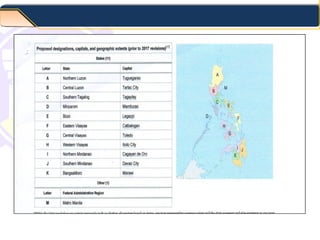
- The concept of federal government for the Philippines was proposed as
early as the Philippine Revolution with Filipino revolutionaries Emilio Aguinaldo and
Apolinario Mabini suggesting dividing the islands into three federal states, Luzon,
Visayas and Mindanao.
- One of the first proponents of federalism in the Philippines in the 21st
century is University of the Philippines professor Jose Abueva who argued that a
federal form of government is necessary to more efficiently cater to the needs of
the country despite its diversity. The primary goals of a constitutional amendment
is to increase decentralization, greater local power and access to resources most
especially among regions outside Metro Manila which has long been dubbed as
rather imperial. Also former senator Aquilino Pimentel, Jr. is a prominent supporter
of federalism who, since 2001, has advocated for federalism. He sees the proposed
system as a key component in alleviating the Mindanao crisis and appeasing Moro
insurgents. Even though the purpose of Federalism was never intended to appease
any followers of any specific ideology of religion. Federalism will also hasten
economic development since resource and financial mobilization is upon each
states’ or provinces’ discretion without significant constraint from the central
government.
HISTORY
Arguments of these pushing federalism in the Philippines
Jan Robert Go, Assistant Professor of Political Science of U.P.
- Budget and fiscal autonomy have been a long standing issue among
local government units (LGU’s) in the country. And most of the time, programs of
the national government are “downloaded” to lower – income municipalities without
the benefit of evaluating whether they are applicable and sustainable.
IS FEDERALISM GOOD IN THE PHILIPPINES?
- One contention of federalism advocates is that major tax revenues are
turned over to the national government.
- Federal system of government will not solve Philippine woes but should
be seen as a path to finding solutions.
- Federalism is a means towards greater development it is not the solution
to all of our problems.
Former Speaker Pantaleon Alvares
- Filipinos can have better access to basic services such as more schools
and hospitals because of the greater resources and political power.
3 ADVANTAGES OF FEDERALISM IN THE PHILIPPINES
1. DECENTRALIZATION
- In Duterte’s federalism, local governments can decide for themselves. Regions
or states area allowed by federalism to create solutions to their own problems,
implement policies for their improvement, and make decisions for their own
good without having to ask Malacañang for their decision.
- For example, the United States have some states like Washington and
Colorado that allow citizens to use recreational cannabis while other states do not.
The local government units will also have no more excuses for delayed and low-
quality projects and programs because they will not be able to blame the national
government anymore.
- One of the advantages of decentralization is that local government units
will also have no more excuse for delayed and low-quality projects and programs
because they will not be able to blame the national government.
2. ECONOMIC EFFECT
What about the economic effects of a federal government?
- Improvement of local economy is considered as one of the pros of
federal government
- The federal system allows local governments have more power over
their resources. In the Philippines’ current form of government, local government
units have to turn a big bulk of their funds to the national government.
- A federal constitutional system will allow the autonomous regions or
states to use the majority of their funds for their own development and without
needing a go signal from Malacañang.
3. LESS DEPENDENCE ON METRO MANILA
- One of the most common federalist arguments is that a federal
constitution would lead to less dependence on Metro Manila when it comes to
finding jobs and establishing businesses.
- The positive side of this particular aspect is that the country’s wealth will
be more evenly distributed among the state governments. Lots of people also go to
Metro Manila to find stable jobs and establish businesses. Federalism, if it leads to
economic improvement for the autonomous regions, might lead to more job
opportunities and business investments outside Metro Manila.
- A whopping 35 percent of the country’s budget was given to Metro
Manila even if it represents only 14 percent of the total population.
- One importance of federalism is that it allows fiscal autonomy for local
governments.
FEDERALISM PROS AND CONS LIST
- Federalism, like anything else, can be good for your country or state, but
it can also be harmful in many ways as well. For those who are unfamiliar with the
laws of federalism, it basically means that states will have say so in most minor
issues and can dictate to a degree what residents are allowed and not allowed to
do. Basically meaning that not all the governmental power is in one place, but
instead dispersed through regions.
LIST OF PROS OF FEDERALISM
1. State Control
- States are allowed to put into motion certain policies that affect only them. For
example the death penalty. Most of the southern state such as Texas have the
death penalty for criminals, but most of your northern states like the Michigan
and lowa have not adopted this policy.
2. Focus on Larger Issues
- With responsibilities being dispersed into their branches your
government who holds higher ranking can focus more on the larger issues.
Including foreign policy, terrorism and epidemics. While your local government can
focus on their own local region. Land owning is an example of this, outlawing a type
of fertilizer or crop dusting can affect the farming states such as Ohio, but this
policy won’t do any good to people in New York.
3. Dispersed Power
- One of the biggest advantages of federalism is the power that one group
can hold. Americans are constantly saying that the government has too much
power over what we do, however think what it would be like if there were no state
leaders and legislatures. You never want to put all your eggs in one basket, as this
could very easily lead the country into a dictatorship type state.
1. Wealth Factor
- Probably one of the biggest cons to federalism is the wealth factor. For
example, states with national monuments such as the Grand Canyon in Arizona
draw in a lot of tourist, which draws in more money than other states. Federalism
keeps money within the states, so basically wealthy states get richer, and poorer
states may end up in [poverty one day. The gap between rich and poor grows more
and more every year as well.
2. Confusion with Governmental Rule
- Federalism also causes confusion between the local governments and
the national government as well. If an epidemic of aids broke out in one quadrant of
the US, the National government may not know when to step in and take
responsibility as they would think the locals are taking care of it. however., the
locals may think the national government will help out. In history, this has happened
with hurricane Katrina as well as 911; no one quite sure who would step in first.
LIST OF CONS OF FEDERALISM
3. Potential for Corruption
- Corruption can also occur at the local level and
national level due to the power of authority. Let’s say a
certain congressman wants same sex marriages
legalized, and the locals state does not. A local power
can put the plan in motion for same sex marriage in
order to get something in return such as money, goods
or other valuable assets.
Former Chief Justice Hilario Davide and NEDA Director General Ernesto
Pernia and prominent economist Bernardo Villegas have all expressed strong
reservations about our nations’ march toward federalism.
Based from recent surveys show that only 36% of our people support the
shift to federalism, while 64% are against, charter change.
The most glaring weakness I see is that it will strengthen and perpetuate
political dynasties. With significant political powers and resources devolved to
regions and local government units, reigning political kingpins and warlords will be
further empowered and become increasingly invulnerable , and the system of
political dynasties perpetually entrenched.
- Former Chief Justice Hilario Davide -
Major concern is that, under the envisioned federal system, our already
inefficient and bloated government bureaucracy will further grow, leading to
heightened inefficiency and immense additional cost.
- Economist Bernardo Villegas -
- The cost of this additional layer of government is estimated to be about
50 – 70 billion a year. NEDA Secretary Pernia correctly observes that this will₱
wreak havoc on our fiscal situation.
“One morning many of us still remember, we woke up to realize that our
cherished democracy had been stolen. To prevent another such nightmare, we
must unite against federalism now.”
- Federal charter would lead to inevitable disruptions to the economy’s
growth momentum and progress in infrastructure improvement efforts.
The projected added expenses arising from the shift to federalism would
bring about fiscal pressures and pressure on the budget deficit cap. Under two
scenarios using draft federal charter, the incremental cost of federalism would be a
minimum of 156.6 billion and a maximum of 243.5 billion on average.₱ ₱
- Finance Secretary Carlos Dominguez
III -
Ramon Del Rosario, Jr. , President of Makati Business Club.
Federalism

Federalism

  • 1.
    MPA 203 –LOCAL GOVERNANCE AND ADMINISTRATION REPORTED BY: Engr. FELICIANO T. GARROTE PROFESSOR: Dr. JOSEFINA B. BITONIO FEDERALISM
  • 2.
    FEDERALISMFEDERALISM HISTORY OF FEDERALISM -The term FEDERALISM have root in the latin word “foedus”, meaning treaty, pact or covenant. Their common meaning until the late eighteenth century was a simple league or inter-governmental relationship among sovereign states based upon treaty. - Federalism was introduced in the United States of America under the constitution of 1787 and federalism is defined by them that – is the mixed or compound mode of government, combining a general government (the central or “federal” government) with regional governments (provincial, state, territorial or sub- unit government) in a single political system.
  • 3.
    - In 1869,federalism in the United States means – is a system of government in which the same territory is controlled by two levels of government. Generally, an overarching national government is responsible for the federal governance, governing issues that affect the entire country, while the smaller subdivisions, states, and cities, govern the issues of local concern. Both the national government and the smaller political subdivisions have the power to make laws and both have a certain level of autonomy for each other. The United States has a federal system of governance consisting of the national or federal government, and the government of the individual states. This system is called ‘dual sovereignty”. - A distribution of power allows all the entities of the system to work separately while still working together as a nation.
  • 4.
    - Federalism isa system government in which the same territory is controlled by two levels of government. Generally, an overarching national government is responsible for the federal governance, governing the issues that affect the entire country, while the smaller subdivisions, states, and cities, govern the issues of local concern. Both the national government and the smaller political subdivisions have the power to make laws and both have a certain level of autonomy from each other. FEDERALISM - Federal government with power over issues of national concern, while the state governments, generally, have jurisdiction over issues of domestic concern. - For example, the federal government can regulate interstate commerce pursuant to the Commence Clause of the Constitution but has no power to regulate commerce that occurs only within a single state.
  • 5.
    - Likewise, althoughthe Constitution grants the federal government the power to tax, state governments are also able to levy taxes to support themselves, because that power is not forbidden to them by the Constitution. State governments manage matters of local concern, such as child protective services, public schools, and road maintenance and repair. - Another key element of federalism is the principle of Separation of Powers. Three branches of federal government, each with its Executive branch, which includes the president, has Veto power; the Senate and Congress make up the legislative branch and have the power of advice and consent over the appointment of executive and judicial officers; and the courts make up the judicial branch and have the power of judicial review.
  • 6.
    FEDERALISM IN THE PHILIPPINES FEDERALISMIN THE PHILIPPINES - The concept of federal government for the Philippines was proposed as early as the Philippine Revolution with Filipino revolutionaries Emilio Aguinaldo and Apolinario Mabini suggesting dividing the islands into three federal states, Luzon, Visayas and Mindanao. - One of the first proponents of federalism in the Philippines in the 21st century is University of the Philippines professor Jose Abueva who argued that a federal form of government is necessary to more efficiently cater to the needs of the country despite its diversity. The primary goals of a constitutional amendment is to increase decentralization, greater local power and access to resources most especially among regions outside Metro Manila which has long been dubbed as rather imperial. Also former senator Aquilino Pimentel, Jr. is a prominent supporter of federalism who, since 2001, has advocated for federalism. He sees the proposed system as a key component in alleviating the Mindanao crisis and appeasing Moro insurgents. Even though the purpose of Federalism was never intended to appease any followers of any specific ideology of religion. Federalism will also hasten economic development since resource and financial mobilization is upon each states’ or provinces’ discretion without significant constraint from the central government. HISTORY
  • 9.
    Arguments of thesepushing federalism in the Philippines Jan Robert Go, Assistant Professor of Political Science of U.P. - Budget and fiscal autonomy have been a long standing issue among local government units (LGU’s) in the country. And most of the time, programs of the national government are “downloaded” to lower – income municipalities without the benefit of evaluating whether they are applicable and sustainable. IS FEDERALISM GOOD IN THE PHILIPPINES? - One contention of federalism advocates is that major tax revenues are turned over to the national government. - Federal system of government will not solve Philippine woes but should be seen as a path to finding solutions. - Federalism is a means towards greater development it is not the solution to all of our problems.
  • 10.
    Former Speaker PantaleonAlvares - Filipinos can have better access to basic services such as more schools and hospitals because of the greater resources and political power. 3 ADVANTAGES OF FEDERALISM IN THE PHILIPPINES 1. DECENTRALIZATION - In Duterte’s federalism, local governments can decide for themselves. Regions or states area allowed by federalism to create solutions to their own problems, implement policies for their improvement, and make decisions for their own good without having to ask Malacañang for their decision. - For example, the United States have some states like Washington and Colorado that allow citizens to use recreational cannabis while other states do not. The local government units will also have no more excuses for delayed and low- quality projects and programs because they will not be able to blame the national government anymore.
  • 11.
    - One ofthe advantages of decentralization is that local government units will also have no more excuse for delayed and low-quality projects and programs because they will not be able to blame the national government. 2. ECONOMIC EFFECT What about the economic effects of a federal government? - Improvement of local economy is considered as one of the pros of federal government - The federal system allows local governments have more power over their resources. In the Philippines’ current form of government, local government units have to turn a big bulk of their funds to the national government. - A federal constitutional system will allow the autonomous regions or states to use the majority of their funds for their own development and without needing a go signal from Malacañang.
  • 12.
    3. LESS DEPENDENCEON METRO MANILA - One of the most common federalist arguments is that a federal constitution would lead to less dependence on Metro Manila when it comes to finding jobs and establishing businesses. - The positive side of this particular aspect is that the country’s wealth will be more evenly distributed among the state governments. Lots of people also go to Metro Manila to find stable jobs and establish businesses. Federalism, if it leads to economic improvement for the autonomous regions, might lead to more job opportunities and business investments outside Metro Manila. - A whopping 35 percent of the country’s budget was given to Metro Manila even if it represents only 14 percent of the total population. - One importance of federalism is that it allows fiscal autonomy for local governments.
  • 13.
    FEDERALISM PROS ANDCONS LIST - Federalism, like anything else, can be good for your country or state, but it can also be harmful in many ways as well. For those who are unfamiliar with the laws of federalism, it basically means that states will have say so in most minor issues and can dictate to a degree what residents are allowed and not allowed to do. Basically meaning that not all the governmental power is in one place, but instead dispersed through regions. LIST OF PROS OF FEDERALISM 1. State Control - States are allowed to put into motion certain policies that affect only them. For example the death penalty. Most of the southern state such as Texas have the death penalty for criminals, but most of your northern states like the Michigan and lowa have not adopted this policy.
  • 14.
    2. Focus onLarger Issues - With responsibilities being dispersed into their branches your government who holds higher ranking can focus more on the larger issues. Including foreign policy, terrorism and epidemics. While your local government can focus on their own local region. Land owning is an example of this, outlawing a type of fertilizer or crop dusting can affect the farming states such as Ohio, but this policy won’t do any good to people in New York. 3. Dispersed Power - One of the biggest advantages of federalism is the power that one group can hold. Americans are constantly saying that the government has too much power over what we do, however think what it would be like if there were no state leaders and legislatures. You never want to put all your eggs in one basket, as this could very easily lead the country into a dictatorship type state.
  • 15.
    1. Wealth Factor -Probably one of the biggest cons to federalism is the wealth factor. For example, states with national monuments such as the Grand Canyon in Arizona draw in a lot of tourist, which draws in more money than other states. Federalism keeps money within the states, so basically wealthy states get richer, and poorer states may end up in [poverty one day. The gap between rich and poor grows more and more every year as well. 2. Confusion with Governmental Rule - Federalism also causes confusion between the local governments and the national government as well. If an epidemic of aids broke out in one quadrant of the US, the National government may not know when to step in and take responsibility as they would think the locals are taking care of it. however., the locals may think the national government will help out. In history, this has happened with hurricane Katrina as well as 911; no one quite sure who would step in first. LIST OF CONS OF FEDERALISM
  • 16.
    3. Potential forCorruption - Corruption can also occur at the local level and national level due to the power of authority. Let’s say a certain congressman wants same sex marriages legalized, and the locals state does not. A local power can put the plan in motion for same sex marriage in order to get something in return such as money, goods or other valuable assets.
  • 17.
    Former Chief JusticeHilario Davide and NEDA Director General Ernesto Pernia and prominent economist Bernardo Villegas have all expressed strong reservations about our nations’ march toward federalism. Based from recent surveys show that only 36% of our people support the shift to federalism, while 64% are against, charter change. The most glaring weakness I see is that it will strengthen and perpetuate political dynasties. With significant political powers and resources devolved to regions and local government units, reigning political kingpins and warlords will be further empowered and become increasingly invulnerable , and the system of political dynasties perpetually entrenched. - Former Chief Justice Hilario Davide - Major concern is that, under the envisioned federal system, our already inefficient and bloated government bureaucracy will further grow, leading to heightened inefficiency and immense additional cost. - Economist Bernardo Villegas -
  • 18.
    - The costof this additional layer of government is estimated to be about 50 – 70 billion a year. NEDA Secretary Pernia correctly observes that this will₱ wreak havoc on our fiscal situation. “One morning many of us still remember, we woke up to realize that our cherished democracy had been stolen. To prevent another such nightmare, we must unite against federalism now.” - Federal charter would lead to inevitable disruptions to the economy’s growth momentum and progress in infrastructure improvement efforts. The projected added expenses arising from the shift to federalism would bring about fiscal pressures and pressure on the budget deficit cap. Under two scenarios using draft federal charter, the incremental cost of federalism would be a minimum of 156.6 billion and a maximum of 243.5 billion on average.₱ ₱ - Finance Secretary Carlos Dominguez III - Ramon Del Rosario, Jr. , President of Makati Business Club.