Understanding Federalism:
Diffenent models-
Different Challenges
Advantages-Disadvantages
By Dr. Erato Kozakou-Marcoullis
Former Minister of Foreign Affairs
At the roundtable discussion organized by the European
Parliament Office in Cyprus:
“Federal States in the EU: Challenges and Opportunities”
21 December 2015
1
Systems of government
Unitary-federal-confederation: definitions
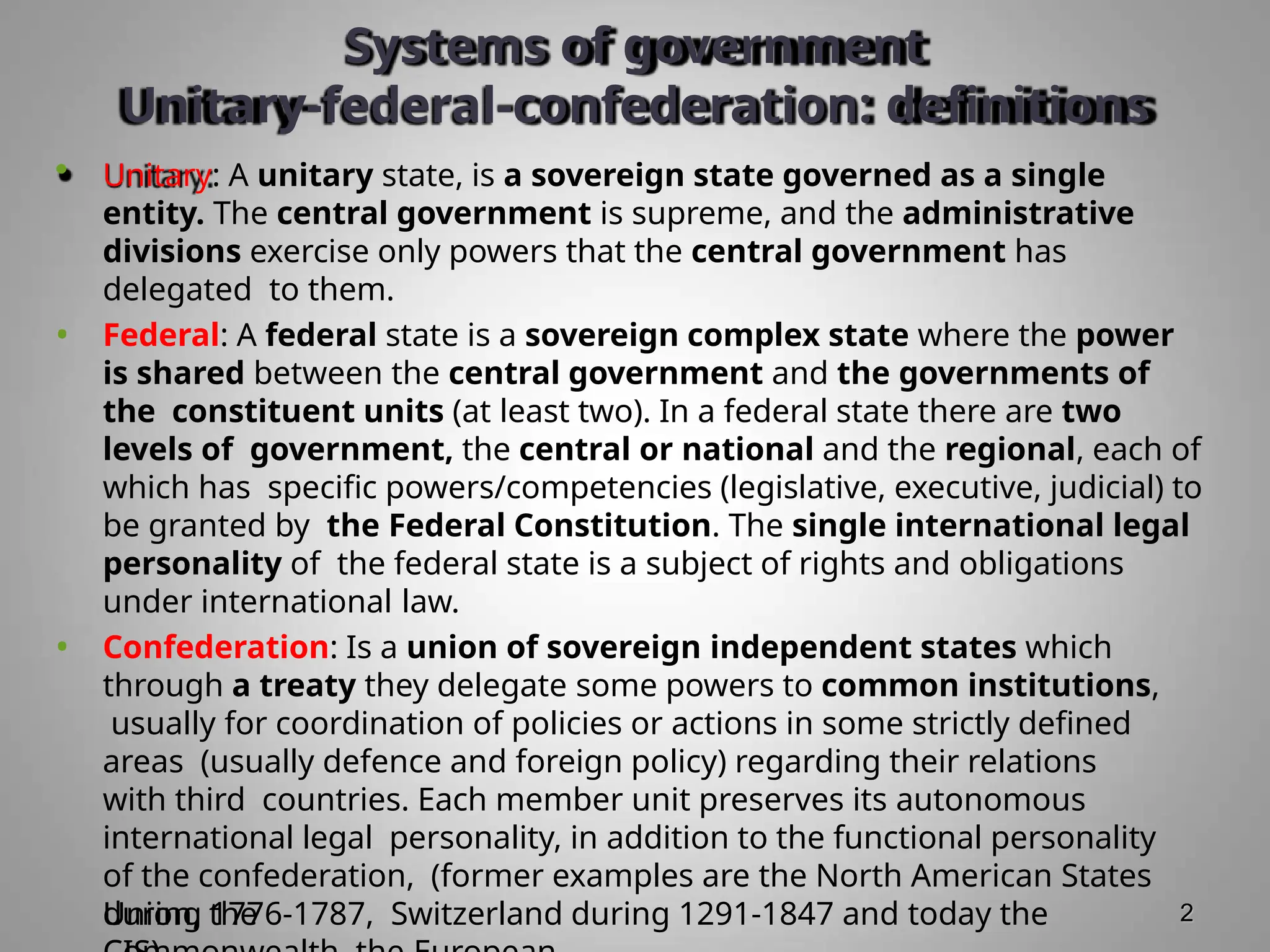
• Unitary: A unitary state, is a sovereign state governed as a single
entity. The central government is supreme, and the administrative
divisions exercise only powers that the central government has
delegated to them.
• Federal: A federal state is a sovereign complex state where the power
is shared between the central government and the governments of
the constituent units (at least two). In a federal state there are two
levels of government, the central or national and the regional, each of
which has specific powers/competencies (legislative, executive, judicial) to
be granted by the Federal Constitution. The single international legal
personality of the federal state is a subject of rights and obligations
under international law.
• Confederation: Is a union of sovereign independent states which
through a treaty they delegate some powers to common institutions,
usually for coordination of policies or actions in some strictly defined
areas (usually defence and foreign policy) regarding their relations
with third countries. Each member unit preserves its autonomous
international legal personality, in addition to the functional personality
of the confederation, (former examples are the North American States
during 1776-1787, Switzerland during 1291-1847 and today the
Union, the 2
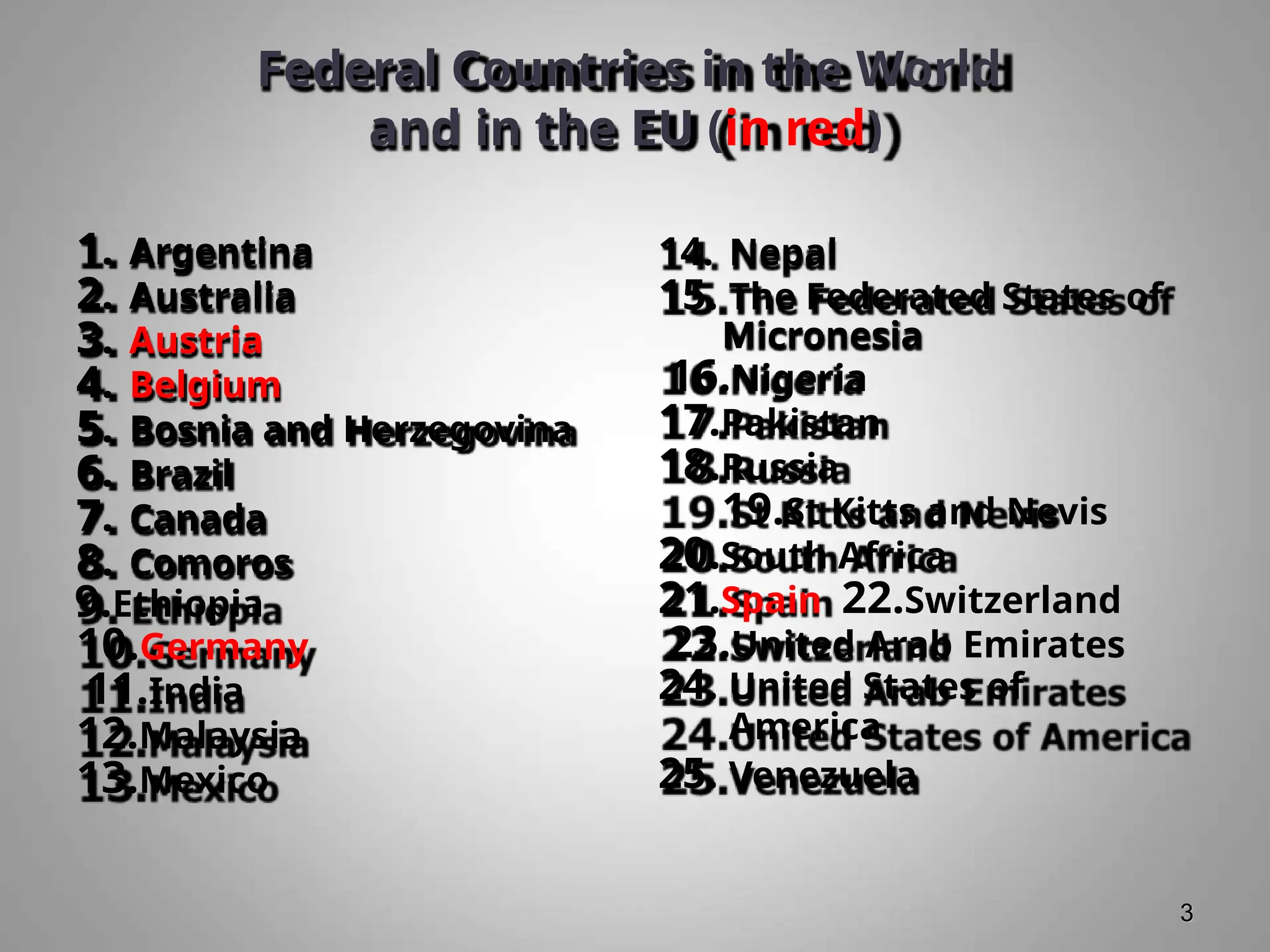
Federal Countries in the World
and in the EU (in red)
1. Argentina
2. Australia
3. Austria
4. Belgium
5. Bosnia and Herzegovina
6. Brazil
7. Canada
8. Comoros
9.Ethiopia
10.Germany
11.India
12.Malaysia
13.Mexico
14. Nepal
15. The Federated States of
Micronesia
16.Nigeria
17.Pakistan
18.Russia
19.St Kitts and Nevis
20.South Africa
21.Spain 22.Switzerland
23.United Arab Emirates
24. United States of
America
25. Venezuela
3
Advantages of Federal states
1. Distribution of power: The classical horizontal
division of the powers of state (legislative -
executive
- judicial) is complemented by a vertical division of
power between the state as a whole and the
individual CUs. This ensures that there are checks
and balances, helping to prevent abuse of power.
2. Competition: The CUs are always competing.
This competition fosters progress and helps to
avoid undesirable developments at the national
level.
3. Balance: Through aiming at mutual control,
reciprocal consideration and the need to seek
compromises, extreme positions are curtailed.
Federalism has a balancing and thus a stabilizing
effect.
4. Diversity: The division of the country in CUs
guarantees that many economic, political and
cultural centers develop. This provides a more
favorable environment to preserve and develop
specific regional, historical, economic and cultural
4
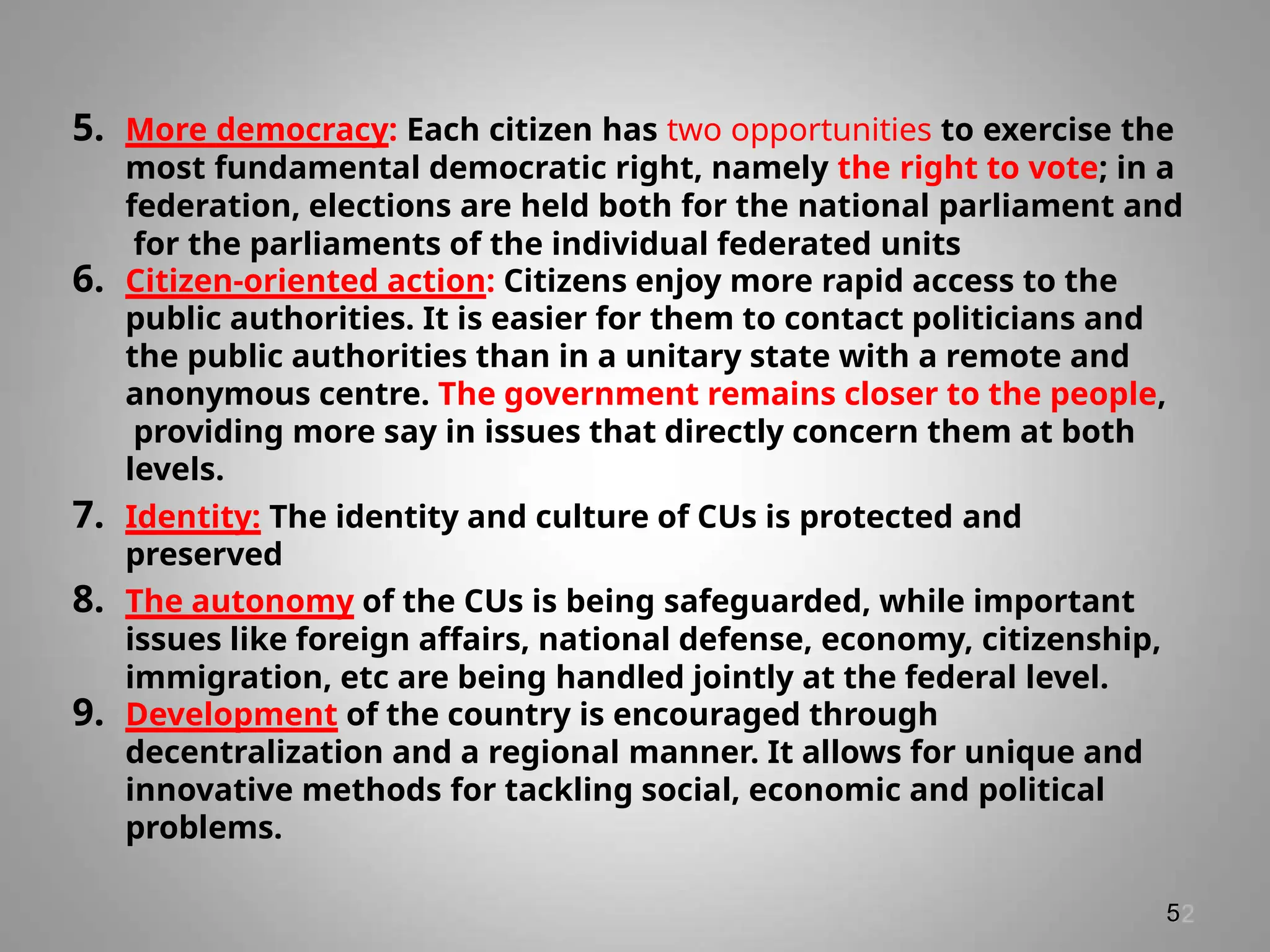
5. More democracy: Each citizen has two opportunities to exercise the
most fundamental democratic right, namely the right to vote; in a
federation, elections are held both for the national parliament and
for the parliaments of the individual federated units
6. Citizen-oriented action: Citizens enjoy more rapid access to the
public authorities. It is easier for them to contact politicians and
the public authorities than in a unitary state with a remote and
anonymous centre. The government remains closer to the people,
providing more say in issues that directly concern them at both
levels.
7. Identity: The identity and culture of CUs is protected and
preserved
8. The autonomy of the CUs is being safeguarded, while important
issues like foreign affairs, national defense, economy, citizenship,
immigration, etc are being handled jointly at the federal level.
9. Development of the country is encouraged through
decentralization and a regional manner. It allows for unique and
innovative methods for tackling social, economic and political
problems.
5
Disadvantages of federal states
1. Lack of uniformity: The CUs’ autonomy necessarily means
there are differences between the units. Citizens living in
different parts of the country may be treated differently, not
only in
spending programs, such as welfare, but in legal systems
that assign in different places different penalties to similar
offenses or that differentially enforce civil rights laws
2. Complicated: As decisions are taken in many different centers
in the Federal Government and power is shared between the
Federation and the CUs, it is essential that the various levels
of government co-operate and show consideration for each
other. This interweaving of responsibility is complex and
sometimes hard for citizens to understand
3. Time-consuming: The parliaments, governments and
administrations of the Federation and the federated units have
to wait for initiatives, decisions or consent from each other and
engage in lengthy negotiations in order to arrive at joint
solutions. This can be a time-consuming process. 6
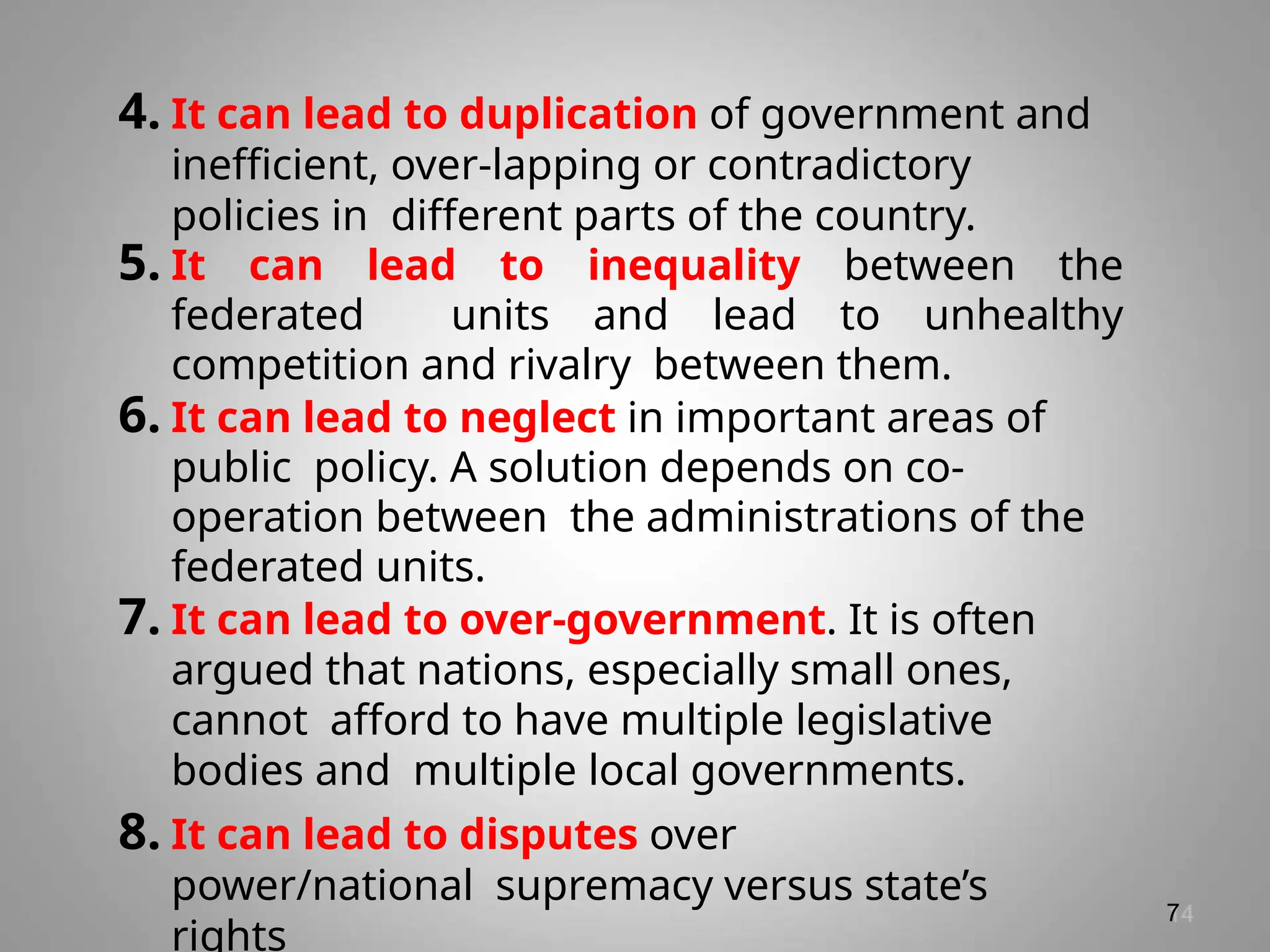
4. It can lead to duplication of government and
inefficient, over-lapping or contradictory
policies in different parts of the country.
5. It can lead to inequality between the
federated units and lead to unhealthy
competition and rivalry between them.
6. It can lead to neglect in important areas of
public policy. A solution depends on co-
operation between the administrations of the
federated units.
7. It can lead to over-government. It is often
argued that nations, especially small ones,
cannot afford to have multiple legislative
bodies and multiple local governments.
8. It can lead to disputes over
power/national supremacy versus state’s
rights
7
Conclusions
• Federalism is not a panacea and it does not solve
all problems
• It is important to create a federalist culture, as well as a
culture of consensus-building, cooperation, tolerance,
mutual understanding and respect of differences, diversity
and multiculturalism, devotion to the common institutions
and creation of a shared identity
• There is no specific model of federation which could be
copied from one and implemented in another country
• Every federation has its own special characteristics and it
adapts to the needs of a specific country and a specific
people
• In the 21st century it is expected that more countries
will move towards federalism, especially federations
emerging from post conflict situations (both
international and ethnic)
8
Thank you!
9

understanding federalism-Power point.pptx

  • 1.
    Understanding Federalism: Diffenent models- DifferentChallenges Advantages-Disadvantages By Dr. Erato Kozakou-Marcoullis Former Minister of Foreign Affairs At the roundtable discussion organized by the European Parliament Office in Cyprus: “Federal States in the EU: Challenges and Opportunities” 21 December 2015 1
  • 2.
    Systems of government Unitary-federal-confederation:definitions • Unitary: A unitary state, is a sovereign state governed as a single entity. The central government is supreme, and the administrative divisions exercise only powers that the central government has delegated to them. • Federal: A federal state is a sovereign complex state where the power is shared between the central government and the governments of the constituent units (at least two). In a federal state there are two levels of government, the central or national and the regional, each of which has specific powers/competencies (legislative, executive, judicial) to be granted by the Federal Constitution. The single international legal personality of the federal state is a subject of rights and obligations under international law. • Confederation: Is a union of sovereign independent states which through a treaty they delegate some powers to common institutions, usually for coordination of policies or actions in some strictly defined areas (usually defence and foreign policy) regarding their relations with third countries. Each member unit preserves its autonomous international legal personality, in addition to the functional personality of the confederation, (former examples are the North American States during 1776-1787, Switzerland during 1291-1847 and today the Union, the 2
  • 3.
    Federal Countries inthe World and in the EU (in red) 1. Argentina 2. Australia 3. Austria 4. Belgium 5. Bosnia and Herzegovina 6. Brazil 7. Canada 8. Comoros 9.Ethiopia 10.Germany 11.India 12.Malaysia 13.Mexico 14. Nepal 15. The Federated States of Micronesia 16.Nigeria 17.Pakistan 18.Russia 19.St Kitts and Nevis 20.South Africa 21.Spain 22.Switzerland 23.United Arab Emirates 24. United States of America 25. Venezuela 3
  • 4.
    Advantages of Federalstates 1. Distribution of power: The classical horizontal division of the powers of state (legislative - executive - judicial) is complemented by a vertical division of power between the state as a whole and the individual CUs. This ensures that there are checks and balances, helping to prevent abuse of power. 2. Competition: The CUs are always competing. This competition fosters progress and helps to avoid undesirable developments at the national level. 3. Balance: Through aiming at mutual control, reciprocal consideration and the need to seek compromises, extreme positions are curtailed. Federalism has a balancing and thus a stabilizing effect. 4. Diversity: The division of the country in CUs guarantees that many economic, political and cultural centers develop. This provides a more favorable environment to preserve and develop specific regional, historical, economic and cultural 4
  • 5.
    5. More democracy:Each citizen has two opportunities to exercise the most fundamental democratic right, namely the right to vote; in a federation, elections are held both for the national parliament and for the parliaments of the individual federated units 6. Citizen-oriented action: Citizens enjoy more rapid access to the public authorities. It is easier for them to contact politicians and the public authorities than in a unitary state with a remote and anonymous centre. The government remains closer to the people, providing more say in issues that directly concern them at both levels. 7. Identity: The identity and culture of CUs is protected and preserved 8. The autonomy of the CUs is being safeguarded, while important issues like foreign affairs, national defense, economy, citizenship, immigration, etc are being handled jointly at the federal level. 9. Development of the country is encouraged through decentralization and a regional manner. It allows for unique and innovative methods for tackling social, economic and political problems. 5
  • 6.
    Disadvantages of federalstates 1. Lack of uniformity: The CUs’ autonomy necessarily means there are differences between the units. Citizens living in different parts of the country may be treated differently, not only in spending programs, such as welfare, but in legal systems that assign in different places different penalties to similar offenses or that differentially enforce civil rights laws 2. Complicated: As decisions are taken in many different centers in the Federal Government and power is shared between the Federation and the CUs, it is essential that the various levels of government co-operate and show consideration for each other. This interweaving of responsibility is complex and sometimes hard for citizens to understand 3. Time-consuming: The parliaments, governments and administrations of the Federation and the federated units have to wait for initiatives, decisions or consent from each other and engage in lengthy negotiations in order to arrive at joint solutions. This can be a time-consuming process. 6
  • 7.
    4. It canlead to duplication of government and inefficient, over-lapping or contradictory policies in different parts of the country. 5. It can lead to inequality between the federated units and lead to unhealthy competition and rivalry between them. 6. It can lead to neglect in important areas of public policy. A solution depends on co- operation between the administrations of the federated units. 7. It can lead to over-government. It is often argued that nations, especially small ones, cannot afford to have multiple legislative bodies and multiple local governments. 8. It can lead to disputes over power/national supremacy versus state’s rights 7
  • 8.
    Conclusions • Federalism isnot a panacea and it does not solve all problems • It is important to create a federalist culture, as well as a culture of consensus-building, cooperation, tolerance, mutual understanding and respect of differences, diversity and multiculturalism, devotion to the common institutions and creation of a shared identity • There is no specific model of federation which could be copied from one and implemented in another country • Every federation has its own special characteristics and it adapts to the needs of a specific country and a specific people • In the 21st century it is expected that more countries will move towards federalism, especially federations emerging from post conflict situations (both international and ethnic) 8
  • 9.