FEDERALISM
WHAT IS FEDERALISM
 Federalism is a mixed or compound mode of government that
combines a general government (the central or federal government)
with regional government (provincial, state, territorial, or other sub-
unit government) in a single political system, dividing the power
between the two.
Copyright 2011 Cengage Learning 2
ORIGIN OF FEDERALISM
 The term federalism shares its root in the Latin word ‘Foedus’ meaning
treat or pact. Their common early meaning until the late 18th century was a
simple league or inter governmental relations among sovereign states
based upon a treaty.
 The first form of federalism took place in ancient times, in the form
of alliances between different states. Some examples from the 7th to 2nd
century B.C were the Archaic league and Peloponnesian league .
Copyright 2011 Cengage Learning 3
KEY FEATURES OF
FEDERALISM
 Division of power, it is an essential feature of federal constitution and
division of power is done by constitution itself, e.g. Part V (Article 141-
159) of 1973 constitution of Pakistan.
 Supremacy of the constitution
 Written Constitution
 Rigid Constitution
 Bicameral Legislature
Copyright 2011 Cengage Learning 4
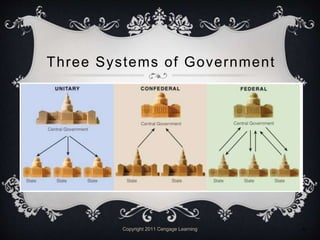
A UNITARY SYSTEM
 Central government gives power to sub-national
governments (counties, provinces, etc.).
 Local governments typically have only those powers
granted to them by the central government, rather than any
reserved powers.
 Especially important is the central government’s role as
provider of funds.
Copyright 2011 Cengage Learning 5
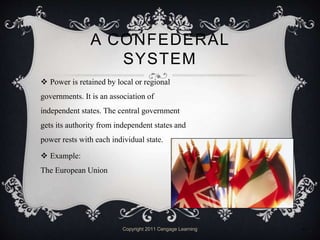
A CONFEDERAL
SYSTEM
 Power is retained by local or regional
governments. It is an association of
independent states. The central government
gets its authority from independent states and
power rests with each individual state.
 Example:
The European Union
Copyright 2011 Cengage Learning 6
A FEDERAL SYSTEM
 Divides power between the national and lower level governments
 Each government has distinct powers that the other governments cannot
override.
 Examples of federal systems: Australia, Brazil, Canada, Germany, India,
Mexico, and the United States
Copyright 2011 Cengage Learning 7
Three Systems of Government
Copyright 2011 Cengage Learning 8
WHY FEDERALISM?
 The authors of the Constitution wanted to combine a central
government strong enough to maintain order with strong provinces.
 The large geographical size of a country.
 Provincial governments serve as training grounds for national
politicians and as laboratories in which new ideas can be tested.
 Federalism allows for many political subcultures.
Copyright 2011 Cengage Learning 9
ARGUMENTS AGAINST
FEDERALISM
A way for powerful states/provinces to block
plans
Inequalities across states/provinces.
Some see expansion of national powers as a
danger
Example of Prussian Empire.
Copyright 2011 Cengage Learning 10
James Madison
©The Granger Collection, New York
THE FEDERAL SYSTEM
 Scholars and political leaders alike have debated the relative merits and
drawbacks of federalism since the founding of the republic.
 Federal System
• Authority Divided
• Written Constitution
• Central Government and Constituent Governments
Copyright 2011 Cengage Learning 11
Permits diversity, diffusion of power
Local governments can handle local problems
More access points for political participation
Protects individual rights
Fosters experimentation and innovation
Suits large country with diverse population
The Federal System
Advantages
Copyright 2011 Cengage Learning 12
F e d e r a l g o v e r n m e n t i s r o o t e d i n c o n s t i t u t i o n a l i s m
a n d p l u r a l i s m
Federalism requires power-sharing between federal institutions and
those at the subnational level, such that neither level of government
has absolute power. A well-functioning federal system is by
definition constitutional and pluralist, since it is based on discussion
and negotiation between balanced centers of power and the
recognition of minorities under a broad framework of agreed
constitutional rules.
Copyright 2011 Cengage Learning 13
T h e p o w e r - s h a r i n g b a s e i s b r o a d e n e d
 Federalism allows political groups that are minorities on the
federal or national level to hold office at the state or provincial
level. This can have a beneficial effect in promoting political
inclusion and a balance of power in countries with a dominant
party at the national level.
 Example of Democratic Alliance in South Africa
Copyright 2011 Cengage Learning 14
I N N OVA T I V E A N D P R A G M A T I C
A P P ROA C H E S TO P O L I C Y D E V E L O P M E N T
A R E E N C O U R A G E D
 By allowing subnational units to develop their own policies to
meet their own needs, federalism can promote innovation and
experimentation in policymaking, enabling states or provinces to
pioneer innovative policies that would not be politically viable at
the national level.
 Example of the US state of Massachusetts
Copyright 2011 Cengage Learning 15
T h e b u r d e n o n c e n t r a l a u t h o r i t i e s i s r e d u c e d
 Federalism frees the central government from
having to handle much of domestic
administration and service delivery, enabling it to
focus on strategic challenges and national
priorities.
Copyright 2011 Cengage Learning 16
R e s o u r c e s a r e s h a r e d a c r o s s g e o g r a p h i c a l s p a c e
 Federalism is a way of ensuring the wider distribution of
public resources through revenue sharing and other forms of
fiscal arrangements that guarantee an agreed share of resources to
all areas of a country.
Copyright 2011 Cengage Learning 17
C A PA C I T I E S A N D D E M O C R A T I C
R E S P O N S I B I L I T I E S A R E D E V E L O P E D
 State, provincial or regional institutions provide a useful
training ground for citizens, representatives and public officials.
 In a centralized country, politics takes places in the capital, and
those who are far removed from the capital have few
opportunities to participate in holding office and making
decisions; in a federal country, many more people have the
opportunity to participate in public life.
Copyright 2011 Cengage Learning 18
Distribution of legislative
powers
 In most federal systems, the federal constitution divides powers between the
federal institutions, on the one hand, and the constituent units of the federation,
on the other, according to one or more lists of legislative competences that are
specified in the constitution
 One list of legislative competences in Argentina, Australia, Pakistan (since the
18th amendment) and the United states.
 Two lists of legislative competences in Canada
Copyright 2011 Cengage Learning 19
Distribution of executive
powers
 Federal executive is responsible for administering programs and
enforcing laws that are enacted by the federal legislature, while subnational
executives are responsible for administering and enforcing laws enacted by
subnational legislatures.
 Responsibility of federal authorities___defence, foreign policy,
citizenship and immigration, and macro-economics (such as currency and
foreign trade). Beyond this, powers are distributed between different levels
of government varies considerably
Copyright 2011 Cengage Learning 20
DISTRIBUTION OF
EXECUTIVE POWERS
 Constitutional designers cannot always successfully
prescribe or predict how the distribution of powers will
develop over time.
 Canada and United States are classical examples of it.
Copyright 2011 Cengage Learning 21

wilson_chapter_3.ppt

  • 1.
  • 2.
    WHAT IS FEDERALISM Federalism is a mixed or compound mode of government that combines a general government (the central or federal government) with regional government (provincial, state, territorial, or other sub- unit government) in a single political system, dividing the power between the two. Copyright 2011 Cengage Learning 2
  • 3.
    ORIGIN OF FEDERALISM The term federalism shares its root in the Latin word ‘Foedus’ meaning treat or pact. Their common early meaning until the late 18th century was a simple league or inter governmental relations among sovereign states based upon a treaty.  The first form of federalism took place in ancient times, in the form of alliances between different states. Some examples from the 7th to 2nd century B.C were the Archaic league and Peloponnesian league . Copyright 2011 Cengage Learning 3
  • 4.
    KEY FEATURES OF FEDERALISM Division of power, it is an essential feature of federal constitution and division of power is done by constitution itself, e.g. Part V (Article 141- 159) of 1973 constitution of Pakistan.  Supremacy of the constitution  Written Constitution  Rigid Constitution  Bicameral Legislature Copyright 2011 Cengage Learning 4
  • 5.
    A UNITARY SYSTEM Central government gives power to sub-national governments (counties, provinces, etc.).  Local governments typically have only those powers granted to them by the central government, rather than any reserved powers.  Especially important is the central government’s role as provider of funds. Copyright 2011 Cengage Learning 5
  • 6.
    A CONFEDERAL SYSTEM  Poweris retained by local or regional governments. It is an association of independent states. The central government gets its authority from independent states and power rests with each individual state.  Example: The European Union Copyright 2011 Cengage Learning 6
  • 7.
    A FEDERAL SYSTEM Divides power between the national and lower level governments  Each government has distinct powers that the other governments cannot override.  Examples of federal systems: Australia, Brazil, Canada, Germany, India, Mexico, and the United States Copyright 2011 Cengage Learning 7
  • 8.
    Three Systems ofGovernment Copyright 2011 Cengage Learning 8
  • 9.
    WHY FEDERALISM?  Theauthors of the Constitution wanted to combine a central government strong enough to maintain order with strong provinces.  The large geographical size of a country.  Provincial governments serve as training grounds for national politicians and as laboratories in which new ideas can be tested.  Federalism allows for many political subcultures. Copyright 2011 Cengage Learning 9
  • 10.
    ARGUMENTS AGAINST FEDERALISM A wayfor powerful states/provinces to block plans Inequalities across states/provinces. Some see expansion of national powers as a danger Example of Prussian Empire. Copyright 2011 Cengage Learning 10 James Madison ©The Granger Collection, New York
  • 11.
    THE FEDERAL SYSTEM Scholars and political leaders alike have debated the relative merits and drawbacks of federalism since the founding of the republic.  Federal System • Authority Divided • Written Constitution • Central Government and Constituent Governments Copyright 2011 Cengage Learning 11
  • 12.
    Permits diversity, diffusionof power Local governments can handle local problems More access points for political participation Protects individual rights Fosters experimentation and innovation Suits large country with diverse population The Federal System Advantages Copyright 2011 Cengage Learning 12
  • 13.
    F e de r a l g o v e r n m e n t i s r o o t e d i n c o n s t i t u t i o n a l i s m a n d p l u r a l i s m Federalism requires power-sharing between federal institutions and those at the subnational level, such that neither level of government has absolute power. A well-functioning federal system is by definition constitutional and pluralist, since it is based on discussion and negotiation between balanced centers of power and the recognition of minorities under a broad framework of agreed constitutional rules. Copyright 2011 Cengage Learning 13
  • 14.
    T h ep o w e r - s h a r i n g b a s e i s b r o a d e n e d  Federalism allows political groups that are minorities on the federal or national level to hold office at the state or provincial level. This can have a beneficial effect in promoting political inclusion and a balance of power in countries with a dominant party at the national level.  Example of Democratic Alliance in South Africa Copyright 2011 Cengage Learning 14
  • 15.
    I N NOVA T I V E A N D P R A G M A T I C A P P ROA C H E S TO P O L I C Y D E V E L O P M E N T A R E E N C O U R A G E D  By allowing subnational units to develop their own policies to meet their own needs, federalism can promote innovation and experimentation in policymaking, enabling states or provinces to pioneer innovative policies that would not be politically viable at the national level.  Example of the US state of Massachusetts Copyright 2011 Cengage Learning 15
  • 16.
    T h eb u r d e n o n c e n t r a l a u t h o r i t i e s i s r e d u c e d  Federalism frees the central government from having to handle much of domestic administration and service delivery, enabling it to focus on strategic challenges and national priorities. Copyright 2011 Cengage Learning 16
  • 17.
    R e so u r c e s a r e s h a r e d a c r o s s g e o g r a p h i c a l s p a c e  Federalism is a way of ensuring the wider distribution of public resources through revenue sharing and other forms of fiscal arrangements that guarantee an agreed share of resources to all areas of a country. Copyright 2011 Cengage Learning 17
  • 18.
    C A PAC I T I E S A N D D E M O C R A T I C R E S P O N S I B I L I T I E S A R E D E V E L O P E D  State, provincial or regional institutions provide a useful training ground for citizens, representatives and public officials.  In a centralized country, politics takes places in the capital, and those who are far removed from the capital have few opportunities to participate in holding office and making decisions; in a federal country, many more people have the opportunity to participate in public life. Copyright 2011 Cengage Learning 18
  • 19.
    Distribution of legislative powers In most federal systems, the federal constitution divides powers between the federal institutions, on the one hand, and the constituent units of the federation, on the other, according to one or more lists of legislative competences that are specified in the constitution  One list of legislative competences in Argentina, Australia, Pakistan (since the 18th amendment) and the United states.  Two lists of legislative competences in Canada  Two lists of legislative competences in Canada Copyright 2011 Cengage Learning 19
  • 20.
    Distribution of executive powers Federal executive is responsible for administering programs and enforcing laws that are enacted by the federal legislature, while subnational executives are responsible for administering and enforcing laws enacted by subnational legislatures.  Responsibility of federal authorities___defence, foreign policy, citizenship and immigration, and macro-economics (such as currency and foreign trade). Beyond this, powers are distributed between different levels of government varies considerably Copyright 2011 Cengage Learning 20
  • 21.
    DISTRIBUTION OF EXECUTIVE POWERS Constitutional designers cannot always successfully prescribe or predict how the distribution of powers will develop over time.  Canada and United States are classical examples of it. Copyright 2011 Cengage Learning 21