CURRENT ISSUES
IN PUBLIC
PERSONNEL
ADMINISTRATION
MONDIDO, JUSTINE LYKA
FATALLA, KENNETH
SISION, KIERBE
LAGUITAN, LALA
MENDOZA, MA. MAICA
HOLGANZA, MAOI
DUMRANG, JAMAIL
GAGATE, JHERALD
• In a dynamic and turbulent environment where social,
economic and political problems mount and the demands of
society increase faster than the capacity of available resources
to provide for, government, especially the administrative
organization for carrying out policies and implement projects
and programs, is called upon to adopt appropriate
mechanisms to cope with this concerns.
• The bureaucracy is faced with crucial issues and challenges
• Should public administration be ethnocentric or universal?
Should public administration be guided primarily by theories
and principles, for whatever these are worth, or should it
adapt itself to environmental pressures and consequently seek
new approaches for responding to the challenges of the
environment?
Source:https://www.slideshare.net/J2Gonzales/final-
presentation-project-alugtu-jr
• Principles of administration are universal but their
applicability and relevance may yet be conditioned by the
physical and social environment.
• Technology aims at making life more convenient and
improving the quality of life by introducing new methods
and approaches to service delivery.
• The management of the economy, for example, may require
new perspectives especially with the advent of the debt
problem, borrowing and repayment schemes. A
development-oriented public administration has to
consider as major concerns, productivity, efficiency,
effectiveness, accountability, budgetary deficits and
unstable economy, among others. It must address the
problems of poverty, ecology, social justice, inequality, and
disproportionate distribution of the goods of society.
Source:https://www.slideshare.net/J2Gonzales/final-
presentation-project-alugtu-jr
• Energy Crisis (lack of foresight and failure)
• Depletion of Forest Resources (maintaining
the ecological balance and instilling
environmental consciousness)
• Unregulated Population Growth (lack of
appreciation for quality life more than a
religious inspired and ethical social
phenomenon) Source:https://www.slideshare.net/J2Gonzales/final-
presentation-project-alugtu-jr
• Moral, Mental and Environmental Pollution
(enforce ethical standards for social and
ecosystems maintenance)
• Cleaning and Greening (exemplified by the City of
Manila and hoped that this will have a spillover
effect throughout Metro Manila and the rest of
the country)
• Peace and Order Situation (lack of individual and
social discipline)
Source:https://www.slideshare.net/J2Gonzales/final-
presentation-project-alugtu-jr
• It has an imitative rather than a indigenous pattern
characterized by some version of modern western
bureaucratic administration.
• It is deficient in skilled manpower necessary for
developmental programs; there is shortage of trained
administrators with management capability, development
skills and technical competence.
• There is emphasis on orientation other than production-
directed and program oriented goals. It uses the public
service as substitute for a social security program and a
means to help solve the unemployment problem.
ADMINISTRATION IN DEVELOPING COUNTRIES IS
CHARACTERIZEDBYTHEFOLLOWING;{by:FERRELHEADY}
Source:https://www.slideshare.net/J2Gonzales/final-
presentation-project-alugtu-jr
• There is wide discrepancy between format and
reality as demonstrated by the urge to make
things seem more than what they actually are,
resulting in a gap between expectations and
realities.
• It has a generous measure of operational
autonomy as several groups converge in the
bureaucracy. There are technical experts,
professional experts or technocrats and the
military, each desirous to formulate and
implement policy decisions on their own
respective turfs.
Source:https://www.slideshare.net/J2Gonzales/final-
presentation-project-alugtu-jr
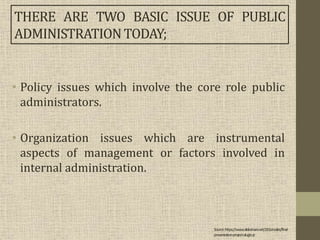
• Policy issues which involve the core role public
administrators.
• Organization issues which are instrumental
aspects of management or factors involved in
internal administration.
THERE ARE TWO BASIC ISSUE OF PUBLIC
ADMINISTRATIONTODAY;
Source:https://www.slideshare.net/J2Gonzales/final-
presentation-project-alugtu-jr
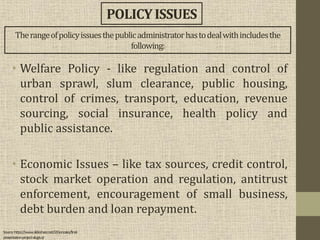
• Welfare Policy - like regulation and control of
urban sprawl, slum clearance, public housing,
control of crimes, transport, education, revenue
sourcing, social insurance, health policy and
public assistance.
• Economic Issues – like tax sources, credit control,
stock market operation and regulation, antitrust
enforcement, encouragement of small business,
debt burden and loan repayment.
POLICYISSUES
Therangeofpolicyissuesthepublicadministratorhastodealwithincludesthe
following:
Source:https://www.slideshare.net/J2Gonzales/final-
presentation-project-alugtu-jr
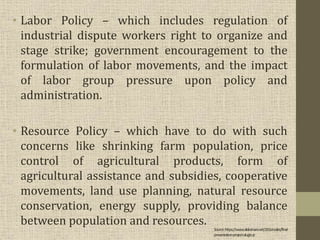
• Labor Policy – which includes regulation of
industrial dispute workers right to organize and
stage strike; government encouragement to the
formulation of labor movements, and the impact
of labor group pressure upon policy and
administration.
• Resource Policy – which have to do with such
concerns like shrinking farm population, price
control of agricultural products, form of
agricultural assistance and subsidies, cooperative
movements, land use planning, natural resource
conservation, energy supply, providing balance
between population and resources.
Source:https://www.slideshare.net/J2Gonzales/final-
presentation-project-alugtu-jr
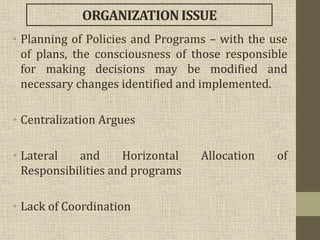
• Planning of Policies and Programs – with the use
of plans, the consciousness of those responsible
for making decisions may be modified and
necessary changes identified and implemented.
• Centralization Argues
• Lateral and Horizontal Allocation of
Responsibilities and programs
• Lack of Coordination
ORGANIZATIONISSUE
• Decision Making and Program Management ,
(controlling and evaluating performance) –
policies, developing strategies, assigning roles,
elicit participation, and cooperation)
• Confronting public management is how to deal
with negative bureaucratic behavior, abuse of
discretion and over indulgence, red tape, graft
and corruption.
• Influence upon political and administrative decision
making is significantly powerful.
• More public interest groups will pursue collective and
community oriented goals demanding environmental
conservation, clean air, eradication of poverty,
equitable allocation of goods and services and this
groups completed by citizen awareness of the
responsibilities of government and will be more critical
of government policies.
• The environment of society is fast changing; the
challenges are continuous; there are no permanent
solutions.
OTHERSIGNIFICANT ISSUES
Source:https://www.slideshare.net/J2Gonzales/final-
presentation-project-alugtu-jr
ISSUES AND CHALLENGES IN PUBLIC
ADMINISTRATION
By A. Lugtu Jr.
Published on May 24, 2014
SOURCE: https://www.slideshare.net/J2Gonzales/final-
presentation-project-alugtu-jr
THANKYOOUUUU!!

Current Issues in Public Personnel Administration

  • 1.
    CURRENT ISSUES IN PUBLIC PERSONNEL ADMINISTRATION MONDIDO,JUSTINE LYKA FATALLA, KENNETH SISION, KIERBE LAGUITAN, LALA MENDOZA, MA. MAICA HOLGANZA, MAOI DUMRANG, JAMAIL GAGATE, JHERALD
  • 2.
    • In adynamic and turbulent environment where social, economic and political problems mount and the demands of society increase faster than the capacity of available resources to provide for, government, especially the administrative organization for carrying out policies and implement projects and programs, is called upon to adopt appropriate mechanisms to cope with this concerns. • The bureaucracy is faced with crucial issues and challenges • Should public administration be ethnocentric or universal? Should public administration be guided primarily by theories and principles, for whatever these are worth, or should it adapt itself to environmental pressures and consequently seek new approaches for responding to the challenges of the environment? Source:https://www.slideshare.net/J2Gonzales/final- presentation-project-alugtu-jr
  • 3.
    • Principles ofadministration are universal but their applicability and relevance may yet be conditioned by the physical and social environment. • Technology aims at making life more convenient and improving the quality of life by introducing new methods and approaches to service delivery. • The management of the economy, for example, may require new perspectives especially with the advent of the debt problem, borrowing and repayment schemes. A development-oriented public administration has to consider as major concerns, productivity, efficiency, effectiveness, accountability, budgetary deficits and unstable economy, among others. It must address the problems of poverty, ecology, social justice, inequality, and disproportionate distribution of the goods of society. Source:https://www.slideshare.net/J2Gonzales/final- presentation-project-alugtu-jr
  • 4.
    • Energy Crisis(lack of foresight and failure) • Depletion of Forest Resources (maintaining the ecological balance and instilling environmental consciousness) • Unregulated Population Growth (lack of appreciation for quality life more than a religious inspired and ethical social phenomenon) Source:https://www.slideshare.net/J2Gonzales/final- presentation-project-alugtu-jr
  • 5.
    • Moral, Mentaland Environmental Pollution (enforce ethical standards for social and ecosystems maintenance) • Cleaning and Greening (exemplified by the City of Manila and hoped that this will have a spillover effect throughout Metro Manila and the rest of the country) • Peace and Order Situation (lack of individual and social discipline) Source:https://www.slideshare.net/J2Gonzales/final- presentation-project-alugtu-jr
  • 6.
    • It hasan imitative rather than a indigenous pattern characterized by some version of modern western bureaucratic administration. • It is deficient in skilled manpower necessary for developmental programs; there is shortage of trained administrators with management capability, development skills and technical competence. • There is emphasis on orientation other than production- directed and program oriented goals. It uses the public service as substitute for a social security program and a means to help solve the unemployment problem. ADMINISTRATION IN DEVELOPING COUNTRIES IS CHARACTERIZEDBYTHEFOLLOWING;{by:FERRELHEADY} Source:https://www.slideshare.net/J2Gonzales/final- presentation-project-alugtu-jr
  • 7.
    • There iswide discrepancy between format and reality as demonstrated by the urge to make things seem more than what they actually are, resulting in a gap between expectations and realities. • It has a generous measure of operational autonomy as several groups converge in the bureaucracy. There are technical experts, professional experts or technocrats and the military, each desirous to formulate and implement policy decisions on their own respective turfs. Source:https://www.slideshare.net/J2Gonzales/final- presentation-project-alugtu-jr
  • 8.
    • Policy issueswhich involve the core role public administrators. • Organization issues which are instrumental aspects of management or factors involved in internal administration. THERE ARE TWO BASIC ISSUE OF PUBLIC ADMINISTRATIONTODAY; Source:https://www.slideshare.net/J2Gonzales/final- presentation-project-alugtu-jr
  • 9.
    • Welfare Policy- like regulation and control of urban sprawl, slum clearance, public housing, control of crimes, transport, education, revenue sourcing, social insurance, health policy and public assistance. • Economic Issues – like tax sources, credit control, stock market operation and regulation, antitrust enforcement, encouragement of small business, debt burden and loan repayment. POLICYISSUES Therangeofpolicyissuesthepublicadministratorhastodealwithincludesthe following: Source:https://www.slideshare.net/J2Gonzales/final- presentation-project-alugtu-jr
  • 10.
    • Labor Policy– which includes regulation of industrial dispute workers right to organize and stage strike; government encouragement to the formulation of labor movements, and the impact of labor group pressure upon policy and administration. • Resource Policy – which have to do with such concerns like shrinking farm population, price control of agricultural products, form of agricultural assistance and subsidies, cooperative movements, land use planning, natural resource conservation, energy supply, providing balance between population and resources. Source:https://www.slideshare.net/J2Gonzales/final- presentation-project-alugtu-jr
  • 11.
    • Planning ofPolicies and Programs – with the use of plans, the consciousness of those responsible for making decisions may be modified and necessary changes identified and implemented. • Centralization Argues • Lateral and Horizontal Allocation of Responsibilities and programs • Lack of Coordination ORGANIZATIONISSUE
  • 12.
    • Decision Makingand Program Management , (controlling and evaluating performance) – policies, developing strategies, assigning roles, elicit participation, and cooperation) • Confronting public management is how to deal with negative bureaucratic behavior, abuse of discretion and over indulgence, red tape, graft and corruption.
  • 13.
    • Influence uponpolitical and administrative decision making is significantly powerful. • More public interest groups will pursue collective and community oriented goals demanding environmental conservation, clean air, eradication of poverty, equitable allocation of goods and services and this groups completed by citizen awareness of the responsibilities of government and will be more critical of government policies. • The environment of society is fast changing; the challenges are continuous; there are no permanent solutions. OTHERSIGNIFICANT ISSUES Source:https://www.slideshare.net/J2Gonzales/final- presentation-project-alugtu-jr
  • 14.
    ISSUES AND CHALLENGESIN PUBLIC ADMINISTRATION By A. Lugtu Jr. Published on May 24, 2014 SOURCE: https://www.slideshare.net/J2Gonzales/final- presentation-project-alugtu-jr
  • 15.