LOCAL
GOVERNMENT AND
REGIONAL
ADMINISTRATION
Local Autonomy
Ilagan,Creselda M.
Local
Autonomy
• Autonomy comes from Greek word autonomia which
means “self” and nomos which means “law”. When
combined, it means “live under one’s own laws”.
• Local autonomy is a highly valued feature of good
governance. The continuous efforts of many European
countries to strengthen the autonomy of local
government show the importance given to
decentralization and the transfer of far-reaching
competences to the lowest units.
Layers of
Local
Authority
• Within subordinate local governments exists hierarchy
of authority. Except in Switzerland and very few
countries, there are at least two layers of local
government (Humes and Martin, 1969):
* intermediate units of local government which
coordinate services in a larger area and supervise lower
levels of local authorities (e.g., provinces, counties,
prefectures or special structures such as regional or
metropolitan governments)
* basic units of local government, those performing
services for people who live together in a community
(cities, municipalities, districts)
• In a few countries, a lower and smaller form of local
government constitutes the sub-municipal level,
characterized by the barangays in the Philippines, the
parishes in the UK, and the mahalle inTurkey.
Layers of
Local
Authority
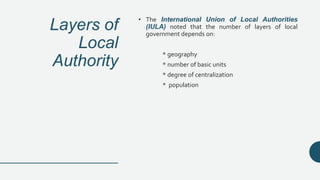
• The International Union of Local Authorities
(IULA) noted that the number of layers of local
government depends on:
* geography
* number of basic units
* degree of centralization
* population
Local
Autonomy
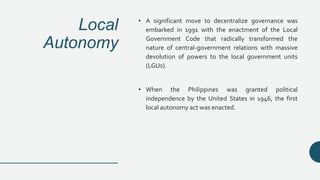
• A significant move to decentralize governance was
embarked in 1991 with the enactment of the Local
Government Code that radically transformed the
nature of central-government relations with massive
devolution of powers to the local government units
(LGUs).
• When the Philippines was granted political
independence by the United States in 1946, the first
local autonomy act was enacted.
Local
Autonomy
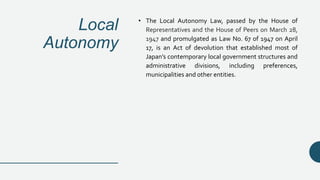
• The Local Autonomy Law, passed by the House of
Representatives and the House of Peers on March 28,
1947 and promulgated as Law No. 67 of 1947 on April
17, is an Act of devolution that established most of
Japan’s contemporary local government structures and
administrative divisions, including preferences,
municipalities and other entities.
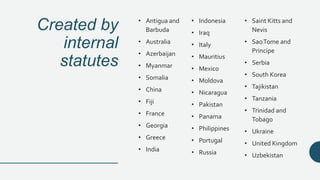
Created by
internal
statutes
• Antigua and
Barbuda
• Australia
• Azerbaijan
• Myanmar
• Somalia
• China
• Fiji
• France
• Georgia
• Greece
• India
• Indonesia
• Iraq
• Italy
• Mauritius
• Mexico
• Moldova
• Nicaragua
• Pakistan
• Panama
• Philippines
• Portugal
• Russia
• Saint Kitts and
Nevis
• SaoTome and
Principe
• Serbia
• South Korea
• Tajikistan
• Tanzania
• Trinidad and
Tobago
• Ukraine
• United Kingdom
• Uzbekistan
What is a
Local
Government?
• As defined by the Code, the Local Government refers
to the political subdivision of a nation which is
constituted by law and has substantial control of local
affairs with officials elected as otherwise locally
selected.
Legal Basis • In 1991, Republic Act No. 7160, otherwise known as the
Local Government Code was enacted into law,
transferring control and responsibility of delivering
basic services to the hands of local government units
(LGU). It aimed to enhance provision of services in the
grass roots level as well as improve the efficiency in
resource allocation. It categorically specifies that the
state shall provide for a system of decentralization
whereby LGUs shall be given more powers, authority,
responsibility and resource. It is meant to transform
Local Government Units as self-reliant communities
and active partners in nation building by giving them
more powers, authority, responsibilities and resources.
Provinces • The provincial government takes care of the function
so which affect the people of a certain province. The
province is the largest political unit in the Philippines. It
possess the following powers --- 1) to acquire and
transfer real and personal properties, 2) to enter into
contracts, including those incurring obligations, which
are expressly provided by law; and 3) to exercise such
other rights and incur such other obligations as are
expressly authorized by law. A province elects its
executives -- the governor, vice governor, and the
members of the provincial board.
Municipalities • Each province is composed of municipalities commonly
called towns. The municipality is a public corporation
created by an act of congress and is governed by the
Municipality Law, which defines its duties and powers.
Being public corporations, municipalities can sue or be
sued in court; enter into contracts; acquire and hold
real and personal properties for municipal purposes;
and exercise such other powers as are granted by law.
The elective officials are the municipal mayor, vice
mayor, and councilors.
Cities • The chartered city is also a unit of local administration.
It is created by a special law which serves as its charter.
The charter is the constitution of the city. The charter
creates the city, defines its boundaries, provides its
system of government, and defines the powers and
duties of its officials. A city or any of its officials cannot
perform any official act which is not permitted by its
charter. The city elective officials are the mayor, vice
mayor, and the members of the board of councilors.
Barangays • Each municipality or city is composed of a number of
villages or barangays. The barangays are the smallest
units of local government in the Philippines. They are
governed by the Barrio Charter. The elective officials of
the barangays are the Barangay Captain and the
BarangayCouncilors.

Local autonomy, decentralization and related concepts

  • 1.
  • 2.
    Local Autonomy • Autonomy comesfrom Greek word autonomia which means “self” and nomos which means “law”. When combined, it means “live under one’s own laws”. • Local autonomy is a highly valued feature of good governance. The continuous efforts of many European countries to strengthen the autonomy of local government show the importance given to decentralization and the transfer of far-reaching competences to the lowest units.
  • 3.
    Layers of Local Authority • Withinsubordinate local governments exists hierarchy of authority. Except in Switzerland and very few countries, there are at least two layers of local government (Humes and Martin, 1969): * intermediate units of local government which coordinate services in a larger area and supervise lower levels of local authorities (e.g., provinces, counties, prefectures or special structures such as regional or metropolitan governments) * basic units of local government, those performing services for people who live together in a community (cities, municipalities, districts) • In a few countries, a lower and smaller form of local government constitutes the sub-municipal level, characterized by the barangays in the Philippines, the parishes in the UK, and the mahalle inTurkey.
  • 4.
    Layers of Local Authority • TheInternational Union of Local Authorities (IULA) noted that the number of layers of local government depends on: * geography * number of basic units * degree of centralization * population
  • 5.
    Local Autonomy • A significantmove to decentralize governance was embarked in 1991 with the enactment of the Local Government Code that radically transformed the nature of central-government relations with massive devolution of powers to the local government units (LGUs). • When the Philippines was granted political independence by the United States in 1946, the first local autonomy act was enacted.
  • 6.
    Local Autonomy • The LocalAutonomy Law, passed by the House of Representatives and the House of Peers on March 28, 1947 and promulgated as Law No. 67 of 1947 on April 17, is an Act of devolution that established most of Japan’s contemporary local government structures and administrative divisions, including preferences, municipalities and other entities.
  • 7.
    Created by internal statutes • Antiguaand Barbuda • Australia • Azerbaijan • Myanmar • Somalia • China • Fiji • France • Georgia • Greece • India • Indonesia • Iraq • Italy • Mauritius • Mexico • Moldova • Nicaragua • Pakistan • Panama • Philippines • Portugal • Russia • Saint Kitts and Nevis • SaoTome and Principe • Serbia • South Korea • Tajikistan • Tanzania • Trinidad and Tobago • Ukraine • United Kingdom • Uzbekistan
  • 8.
    What is a Local Government? •As defined by the Code, the Local Government refers to the political subdivision of a nation which is constituted by law and has substantial control of local affairs with officials elected as otherwise locally selected.
  • 9.
    Legal Basis •In 1991, Republic Act No. 7160, otherwise known as the Local Government Code was enacted into law, transferring control and responsibility of delivering basic services to the hands of local government units (LGU). It aimed to enhance provision of services in the grass roots level as well as improve the efficiency in resource allocation. It categorically specifies that the state shall provide for a system of decentralization whereby LGUs shall be given more powers, authority, responsibility and resource. It is meant to transform Local Government Units as self-reliant communities and active partners in nation building by giving them more powers, authority, responsibilities and resources.
  • 10.
    Provinces • Theprovincial government takes care of the function so which affect the people of a certain province. The province is the largest political unit in the Philippines. It possess the following powers --- 1) to acquire and transfer real and personal properties, 2) to enter into contracts, including those incurring obligations, which are expressly provided by law; and 3) to exercise such other rights and incur such other obligations as are expressly authorized by law. A province elects its executives -- the governor, vice governor, and the members of the provincial board.
  • 11.
    Municipalities • Eachprovince is composed of municipalities commonly called towns. The municipality is a public corporation created by an act of congress and is governed by the Municipality Law, which defines its duties and powers. Being public corporations, municipalities can sue or be sued in court; enter into contracts; acquire and hold real and personal properties for municipal purposes; and exercise such other powers as are granted by law. The elective officials are the municipal mayor, vice mayor, and councilors.
  • 12.
    Cities • Thechartered city is also a unit of local administration. It is created by a special law which serves as its charter. The charter is the constitution of the city. The charter creates the city, defines its boundaries, provides its system of government, and defines the powers and duties of its officials. A city or any of its officials cannot perform any official act which is not permitted by its charter. The city elective officials are the mayor, vice mayor, and the members of the board of councilors.
  • 13.
    Barangays • Eachmunicipality or city is composed of a number of villages or barangays. The barangays are the smallest units of local government in the Philippines. They are governed by the Barrio Charter. The elective officials of the barangays are the Barangay Captain and the BarangayCouncilors.