The Judiciary


       Prof. Lourdes Veneracion-Rallonza, PhD
       Department of Political Science
       Ateneo de Manila University
The Judiciary has the
constitutional jurisdiction to…
   Resolve conflicts arising between the state
    & citizens over basic liberties;
   Ruling whether specific laws are
    constitutional; and
   Resolving conflicts between different
    institutions or levels of government
Given the constitutional jurisdiction, the
judiciary has the societal function of…

   Maintaining social control;
   Legitimizing the regime; and
   Indirectly involving itself in public policy
    (as judicial decisions may influence public
    opinion)
In the 1987 Philippine Constitution,
   judicial power was vested to one
 Supreme Court; the Supreme Court
   was the only court created by the
  Constitution and thereby CANNOT
be abolished by any law/legislation. It
is the highest Court in the Philippines
   and thus called the ‘Court of Last
                Resort’.
Structure of Supreme Court
   15 appointed justices (with 1 Chief Justice and
    14 Associate Justices)
   No fix term of office (Art. VIII, Sec. 11); stay in
    office based on good conduct and behavior &
    until they reach the age of 70
   Appointed by the President from a list 3
    nominees prepared by the Judicial & Bar
    Council
   Appointment NOT subject to confirmation by the
    Commission on Appointments (Art. VIII, Sec. 9)
   SC members can only be removed by
    impeachment (Art. XI, Sec. 2)
Cases filed/appealed to/in the
                     Supreme Court
   The Supreme Court “has the power to review,
    revise, reverse, modify, or affirm on
    appeal…final judgments and orders of lower
    courts in:
    - all cases in which constitutionality or validity of
    any treaty, international or executive agreement,
    law, presidential decree, proclamation, order,
    instruction, ordinance, or regulation is in
    question;
Cases filed/appealed to/in the
                Supreme Court
- all cases involving the legality of any tax,
impose, assessment, or toll or any penalty
imposed in relation thereto;
- all cases in which the jurisdiction of any lower
court is in issue;
- all criminal cases in which the penalty imposed
is reclusion perpetua or higher; and
- all cases in which only an error or question of
law is involved
The Lower Courts…
   Court of Appeals: composed of 1 Presiding Justice and
    68 Associate Justices is vested with jurisdiction over
    appeals from the decisions of the Regional Trial Courts
    and certain quasi-judicial agencies, boards or
    commissions
   Sandiganbayan: composed of a Presiding Justice and 8
    Associate Justices, has exclusive jurisdiction over
    violations of the Anti-Graft and Corrupt Practices Act (RA
    3019), the Unexplained Wealth Act (RA 1379), and or
    other crimes or felonies committed by public officials and
    employees in relation to their office, including those
    employees in government-owned or controlled
    companies
The Lower Courts…
   Court of Tax Appeals: composed of 1 Presiding Judge
    and 2 Associate Justices is vested with exclusive
    appellate jurisdiction over appeals from the decisions of
    the Commissioner of Internal Revenue and the
    Commissioner of Customs
   Regional Trial Courts: The law provides for 720 RTCs.
    The Philippines is divided into 13 regions – the National
    Capital Region (NCR) and Regions I to XII. In these
    regions are found many RTCs to which decided cases
    coming from the MTC, MCTC, MTCC and MetroTC are
    appealed.
The Lower Courts…
   Shari’a Courts and Shari’a Circuit Courts: in some
    provinces in Mindanao where the Muslim Code on
    Personal Laws is enforced, the law provides for 5 Shari'a
    District Courts which are equivalent to the Regional Trial
    Courts in rank and for 51 Shari'a Circuit Courts in the
    municipalities therein which gave the rank and level of
    Municipal Circuit Trial Courts.
   Municipal Trial Courts and Municipal Circuit Trial
    Courts: every municipality has its own Municipal Trial
    Court. It is referred to as such if it covers only 1
    municipality; it is called Municipal Circuit Trial Court if it
    covers 2 or more municipalities.
The Lower Courts…
   Metropolitan Trial Courts and Municipal Trial Courts
    in Cities: Municipal Trial Courts in towns and cities in
    the Metropolitan Manila area, as distinguished from
    other political subdivisions in the Philippines, are
    referred to as Metropolitan Trial Courts. In cities outside
    of the Metropolitan Area, the equivalent of the Municipal
    Trial Courts are referred to as Municipal Trial Courts in
    Cities.
   NOTE: The Supreme Court can decide on cases that
    have not been tried in the lower courts (see Art. VIII,
    Sec. 5 of 1987 Constitution)
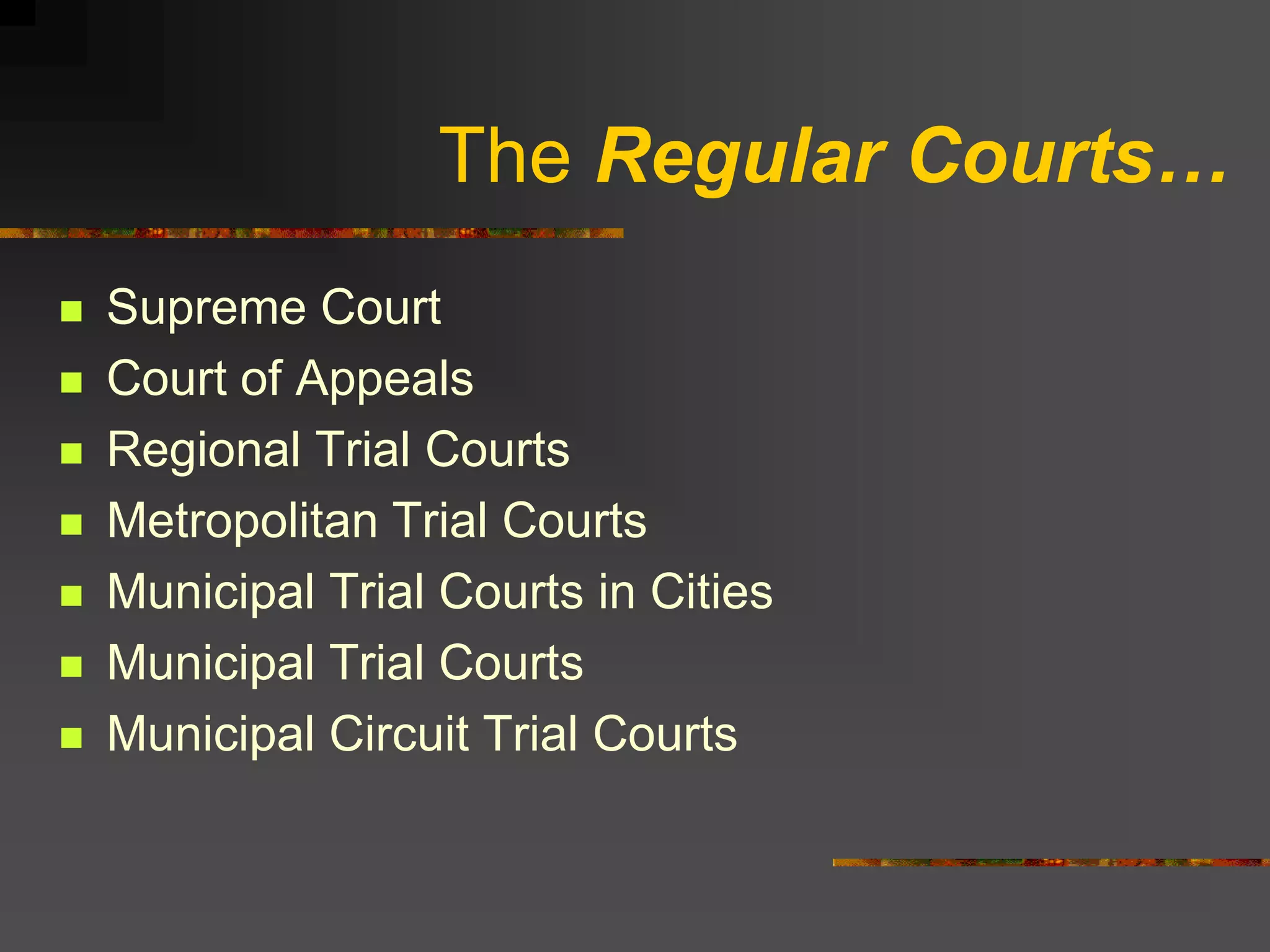
The Regular Courts…
   Supreme Court
   Court of Appeals
   Regional Trial Courts
   Metropolitan Trial Courts
   Municipal Trial Courts in Cities
   Municipal Trial Courts
   Municipal Circuit Trial Courts
The Special Courts…
   Sandiganbayan
   Court of Tax Appeals
   Shari’a District Courts
   Shari’a Circuit
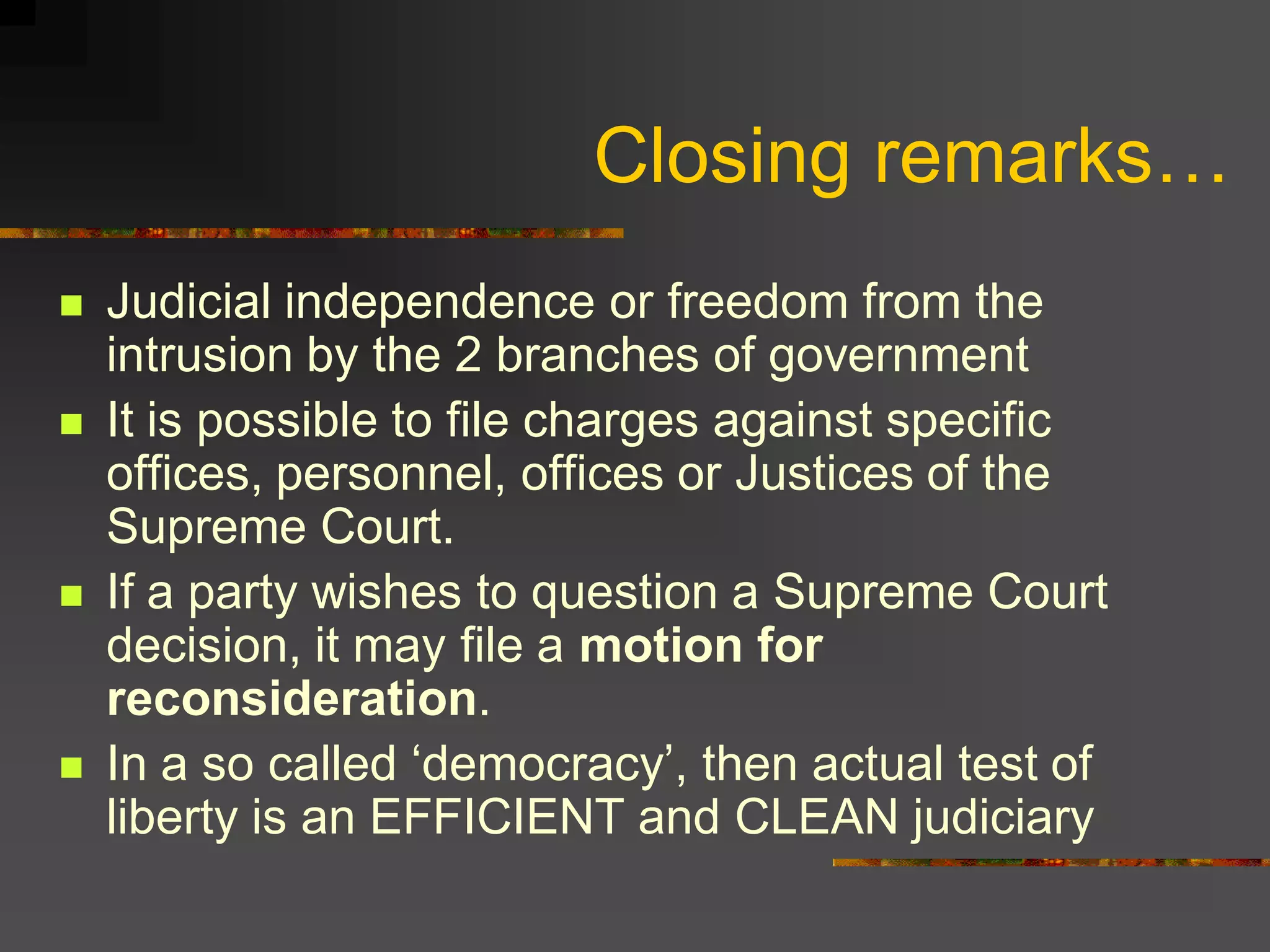
Closing remarks…
   Judicial independence or freedom from the
    intrusion by the 2 branches of government
   It is possible to file charges against specific
    offices, personnel, offices or Justices of the
    Supreme Court.
   If a party wishes to question a Supreme Court
    decision, it may file a motion for
    reconsideration.
   In a so called ‘democracy’, then actual test of
    liberty is an EFFICIENT and CLEAN judiciary

The Judiciary

  • 1.
    The Judiciary Prof. Lourdes Veneracion-Rallonza, PhD Department of Political Science Ateneo de Manila University
  • 2.
    The Judiciary hasthe constitutional jurisdiction to…  Resolve conflicts arising between the state & citizens over basic liberties;  Ruling whether specific laws are constitutional; and  Resolving conflicts between different institutions or levels of government
  • 3.
    Given the constitutionaljurisdiction, the judiciary has the societal function of…  Maintaining social control;  Legitimizing the regime; and  Indirectly involving itself in public policy (as judicial decisions may influence public opinion)
  • 4.
    In the 1987Philippine Constitution, judicial power was vested to one Supreme Court; the Supreme Court was the only court created by the Constitution and thereby CANNOT be abolished by any law/legislation. It is the highest Court in the Philippines and thus called the ‘Court of Last Resort’.
  • 5.
    Structure of SupremeCourt  15 appointed justices (with 1 Chief Justice and 14 Associate Justices)  No fix term of office (Art. VIII, Sec. 11); stay in office based on good conduct and behavior & until they reach the age of 70  Appointed by the President from a list 3 nominees prepared by the Judicial & Bar Council  Appointment NOT subject to confirmation by the Commission on Appointments (Art. VIII, Sec. 9)  SC members can only be removed by impeachment (Art. XI, Sec. 2)
  • 6.
    Cases filed/appealed to/inthe Supreme Court  The Supreme Court “has the power to review, revise, reverse, modify, or affirm on appeal…final judgments and orders of lower courts in: - all cases in which constitutionality or validity of any treaty, international or executive agreement, law, presidential decree, proclamation, order, instruction, ordinance, or regulation is in question;
  • 7.
    Cases filed/appealed to/inthe Supreme Court - all cases involving the legality of any tax, impose, assessment, or toll or any penalty imposed in relation thereto; - all cases in which the jurisdiction of any lower court is in issue; - all criminal cases in which the penalty imposed is reclusion perpetua or higher; and - all cases in which only an error or question of law is involved
  • 8.
    The Lower Courts…  Court of Appeals: composed of 1 Presiding Justice and 68 Associate Justices is vested with jurisdiction over appeals from the decisions of the Regional Trial Courts and certain quasi-judicial agencies, boards or commissions  Sandiganbayan: composed of a Presiding Justice and 8 Associate Justices, has exclusive jurisdiction over violations of the Anti-Graft and Corrupt Practices Act (RA 3019), the Unexplained Wealth Act (RA 1379), and or other crimes or felonies committed by public officials and employees in relation to their office, including those employees in government-owned or controlled companies
  • 9.
    The Lower Courts…  Court of Tax Appeals: composed of 1 Presiding Judge and 2 Associate Justices is vested with exclusive appellate jurisdiction over appeals from the decisions of the Commissioner of Internal Revenue and the Commissioner of Customs  Regional Trial Courts: The law provides for 720 RTCs. The Philippines is divided into 13 regions – the National Capital Region (NCR) and Regions I to XII. In these regions are found many RTCs to which decided cases coming from the MTC, MCTC, MTCC and MetroTC are appealed.
  • 10.
    The Lower Courts…  Shari’a Courts and Shari’a Circuit Courts: in some provinces in Mindanao where the Muslim Code on Personal Laws is enforced, the law provides for 5 Shari'a District Courts which are equivalent to the Regional Trial Courts in rank and for 51 Shari'a Circuit Courts in the municipalities therein which gave the rank and level of Municipal Circuit Trial Courts.  Municipal Trial Courts and Municipal Circuit Trial Courts: every municipality has its own Municipal Trial Court. It is referred to as such if it covers only 1 municipality; it is called Municipal Circuit Trial Court if it covers 2 or more municipalities.
  • 11.
    The Lower Courts…  Metropolitan Trial Courts and Municipal Trial Courts in Cities: Municipal Trial Courts in towns and cities in the Metropolitan Manila area, as distinguished from other political subdivisions in the Philippines, are referred to as Metropolitan Trial Courts. In cities outside of the Metropolitan Area, the equivalent of the Municipal Trial Courts are referred to as Municipal Trial Courts in Cities.  NOTE: The Supreme Court can decide on cases that have not been tried in the lower courts (see Art. VIII, Sec. 5 of 1987 Constitution)
  • 12.
    The Regular Courts…  Supreme Court  Court of Appeals  Regional Trial Courts  Metropolitan Trial Courts  Municipal Trial Courts in Cities  Municipal Trial Courts  Municipal Circuit Trial Courts
  • 13.
    The Special Courts…  Sandiganbayan  Court of Tax Appeals  Shari’a District Courts  Shari’a Circuit
  • 14.
    Closing remarks…  Judicial independence or freedom from the intrusion by the 2 branches of government  It is possible to file charges against specific offices, personnel, offices or Justices of the Supreme Court.  If a party wishes to question a Supreme Court decision, it may file a motion for reconsideration.  In a so called ‘democracy’, then actual test of liberty is an EFFICIENT and CLEAN judiciary