Government in America: People, Politics, and Policy
             Thirteenth AP* Edition
        Edwards/Wattenberg/Lineberry


                               Chapter 3
                           Federalism


                                     Pearson Education, Inc., Longman © 2008
Defining Federalism
 What   is Federalism?
  – Federalism: a way of organizing a nation so that two or
    more levels of government have formal authority over
    the land and people
  – Unitary governments: a way of organizing a nation so
    that all power resides in the central government
  – Confederation: The United Nations is a modern
    example.
  – Intergovernmental Relations: the workings of the
    federal system- the entire set of interactions among
    national, state and local governments
                    Pearson Education,
                   Inc., Longman ©
Defining Federalism


     Pearson Education,
    Inc., Longman ©
Defining Federalism
 Why    Is Federalism So Important?
  – Decentralizes our politics
      More opportunities to participate

  – Decentralizes our policies
        Federal and state governments handle different
         problems.
          – States regulate drinking ages, marriage, and speed limits.
        States can solve the same problem in different ways
         and tend to be policy innovators.
                     Pearson Education,
                    Inc., Longman ©
The Constitutional Basis of
        Federalism
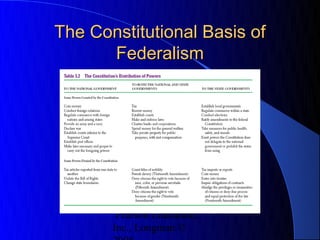
 The   Division of Power
  – Supremacy Clause, Article VI of the
   Constitution states the following are supreme:
      The U.S. Constitution
      Laws of Congress

      Treaties

  – Yet, national government cannot usurp state
   powers.
        Tenth Amendment
                  Pearson Education,
                 Inc., Longman ©
The Constitutional Basis of
      Federalism


        Pearson Education,
       Inc., Longman ©
The Constitutional Basis of
        Federalism
 Establishing    National Supremacy
  – Implied and enumerated powers
      McCulloch v. Maryland (1819)

  – Commerce Powers
        Gibbons v. Ogden (1824)
  – The Civil War (1861-1865)
  – The Struggle for Racial Equality
        Brown v. Board of Education (1954)
                    Pearson Education,
                   Inc., Longman ©
The Constitutional Basis of
         Federalism
 States’   Obligations to Each Other
   – Full Faith and Credit: Each state must recognize official
     documents and judgments rendered by other states.
         Article IV, Section I of Constitution
   – Privileges and Immunities: Citizens of each state have
     privileges of citizens of other states.
         Article IV, Section 2 of Constitution
   – Extradition: States must return a person charged with a
     crime in another state to that state for punishment.

                        Pearson Education,
                       Inc., Longman ©
Intergovernmental Relations
            Today
 Dual   Federalism
  – Definition: a system of government in which
    both the states and the national government
    remain supreme within their own spheres, each
    responsible for some policies
  – Like a layer cake
  – Narrowly interpreted powers of federal
    government
  – Ended in the 1930’s
                Pearson Education,
               Inc., Longman ©
Intergovernmental Relations
            Today
 Cooperative   Federalism
  – Definition: a system of government in which
    powers and policy assignments are shared
    between states and the national government
  – Like a marble cake
  – Shared costs and administration
  – States follow federal guidelines

                 Pearson Education,
                Inc., Longman ©
Intergovernmental Relations
             Today
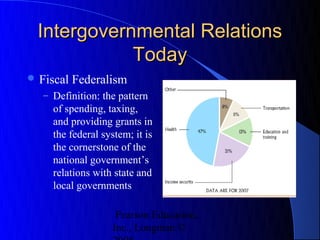
 Fiscal   Federalism
   – Definition: the pattern
     of spending, taxing,
     and providing grants in
     the federal system; it is
     the cornerstone of the
     national government’s
     relations with state and
     local governments

                    Pearson Education,
                   Inc., Longman ©
Intergovernmental Relations
           Today


        Pearson Education,
       Inc., Longman ©
Intergovernmental Relations
            Today
 Fiscal   Federalism (continued)
  – The Grant System: Distributing the Federal Pie
      Categorical Grants: federal grants that can be used

       for specific purposes; grants with strings attached
           – Project Grants: based on merit
           – Formula Grants: amount varies based on formulas
      Block Grants: federal grants given more or less
       automatically to support broad programs
      Grants are given to states & local governments.

                     Pearson Education,
                    Inc., Longman ©
Intergovernmental Relations
            Today
 Fiscal   Federalism (continued)
  – The Scramble for Federal Dollars
      $460 billion in grants every year

      Grant distribution follows universalism—a little

       something for everybody.
  – The Mandate Blues
      Mandates direct states or local governments to

       comply with federal rules under threat of penalties
       or as a condition of receipt of a federal grant.
      Unfunded mandates
                   Pearson Education,
                  Inc., Longman ©
Understanding Federalism
 Advantages   for            Disadvantages     for
  Democracy                     Democracy
  – Increases access to          – States have different
    government                      levels of service
  – Local problems can be         – Local interest can
    solved locally                  counteract national
  – Hard for political              interests
    parties or interest           – Too many levels of
    groups to dominate all          government and too
    politics                        much money
                    Pearson Education,
                   Inc., Longman ©
Understanding Federalism


        Pearson Education,
       Inc., Longman ©
Understanding Federalism


        Pearson Education,
       Inc., Longman ©
Understanding Federalism


        Pearson Education,
       Inc., Longman ©
Understanding Federalism
 Federalism    and the Scope of Government
  – What should the scope of national government
    be relative to the states?
      National power increased with industrialization,
       expansion of individual rights, and social services.
      Most problems require resources afforded to the

       national, not state governments.


                  Pearson Education,
                 Inc., Longman ©
Understanding Federalism


        Pearson Education,
       Inc., Longman ©
Summary
 American  federalism is a governmental
  system in which power is shared between a
  central government and the 50 state
  governments.
 The United States has moved from dual to
  cooperative federalism; fiscal federalism.
 Federalism leads to both advantages and
  disadvantages to democracy.
               Pearson Education,
              Inc., Longman ©

Chapter 03

  • 1.
    Government in America:People, Politics, and Policy Thirteenth AP* Edition Edwards/Wattenberg/Lineberry Chapter 3 Federalism Pearson Education, Inc., Longman © 2008
  • 2.
    Defining Federalism  What is Federalism? – Federalism: a way of organizing a nation so that two or more levels of government have formal authority over the land and people – Unitary governments: a way of organizing a nation so that all power resides in the central government – Confederation: The United Nations is a modern example. – Intergovernmental Relations: the workings of the federal system- the entire set of interactions among national, state and local governments Pearson Education, Inc., Longman ©
  • 3.
    Defining Federalism Pearson Education, Inc., Longman ©
  • 4.
    Defining Federalism  Why Is Federalism So Important? – Decentralizes our politics  More opportunities to participate – Decentralizes our policies  Federal and state governments handle different problems. – States regulate drinking ages, marriage, and speed limits.  States can solve the same problem in different ways and tend to be policy innovators. Pearson Education, Inc., Longman ©
  • 5.
    The Constitutional Basisof Federalism  The Division of Power – Supremacy Clause, Article VI of the Constitution states the following are supreme:  The U.S. Constitution  Laws of Congress  Treaties – Yet, national government cannot usurp state powers.  Tenth Amendment Pearson Education, Inc., Longman ©
  • 6.
    The Constitutional Basisof Federalism Pearson Education, Inc., Longman ©
  • 7.
    The Constitutional Basisof Federalism  Establishing National Supremacy – Implied and enumerated powers  McCulloch v. Maryland (1819) – Commerce Powers  Gibbons v. Ogden (1824) – The Civil War (1861-1865) – The Struggle for Racial Equality  Brown v. Board of Education (1954) Pearson Education, Inc., Longman ©
  • 8.
    The Constitutional Basisof Federalism  States’ Obligations to Each Other – Full Faith and Credit: Each state must recognize official documents and judgments rendered by other states.  Article IV, Section I of Constitution – Privileges and Immunities: Citizens of each state have privileges of citizens of other states.  Article IV, Section 2 of Constitution – Extradition: States must return a person charged with a crime in another state to that state for punishment. Pearson Education, Inc., Longman ©
  • 9.
    Intergovernmental Relations Today  Dual Federalism – Definition: a system of government in which both the states and the national government remain supreme within their own spheres, each responsible for some policies – Like a layer cake – Narrowly interpreted powers of federal government – Ended in the 1930’s Pearson Education, Inc., Longman ©
  • 10.
    Intergovernmental Relations Today  Cooperative Federalism – Definition: a system of government in which powers and policy assignments are shared between states and the national government – Like a marble cake – Shared costs and administration – States follow federal guidelines Pearson Education, Inc., Longman ©
  • 11.
    Intergovernmental Relations Today  Fiscal Federalism – Definition: the pattern of spending, taxing, and providing grants in the federal system; it is the cornerstone of the national government’s relations with state and local governments Pearson Education, Inc., Longman ©
  • 12.
    Intergovernmental Relations Today Pearson Education, Inc., Longman ©
  • 13.
    Intergovernmental Relations Today  Fiscal Federalism (continued) – The Grant System: Distributing the Federal Pie  Categorical Grants: federal grants that can be used for specific purposes; grants with strings attached – Project Grants: based on merit – Formula Grants: amount varies based on formulas  Block Grants: federal grants given more or less automatically to support broad programs  Grants are given to states & local governments. Pearson Education, Inc., Longman ©
  • 14.
    Intergovernmental Relations Today  Fiscal Federalism (continued) – The Scramble for Federal Dollars  $460 billion in grants every year  Grant distribution follows universalism—a little something for everybody. – The Mandate Blues  Mandates direct states or local governments to comply with federal rules under threat of penalties or as a condition of receipt of a federal grant.  Unfunded mandates Pearson Education, Inc., Longman ©
  • 15.
    Understanding Federalism  Advantages for  Disadvantages for Democracy Democracy – Increases access to – States have different government levels of service – Local problems can be – Local interest can solved locally counteract national – Hard for political interests parties or interest – Too many levels of groups to dominate all government and too politics much money Pearson Education, Inc., Longman ©
  • 16.
    Understanding Federalism Pearson Education, Inc., Longman ©
  • 17.
    Understanding Federalism Pearson Education, Inc., Longman ©
  • 18.
    Understanding Federalism Pearson Education, Inc., Longman ©
  • 19.
    Understanding Federalism  Federalism and the Scope of Government – What should the scope of national government be relative to the states?  National power increased with industrialization, expansion of individual rights, and social services.  Most problems require resources afforded to the national, not state governments. Pearson Education, Inc., Longman ©
  • 20.
    Understanding Federalism Pearson Education, Inc., Longman ©
  • 21.
    Summary  American federalism is a governmental system in which power is shared between a central government and the 50 state governments.  The United States has moved from dual to cooperative federalism; fiscal federalism.  Federalism leads to both advantages and disadvantages to democracy. Pearson Education, Inc., Longman ©