By –
NEELMA NAYB
MPHIL. Biotech II sem
Department of Biotechnology
AGROBACTERIUM
• INTRODUCTION
– Agrobacterium tumefaciens
– Ti Plasmid
• Ti Plasmid stucture
– Vir (virulent) Gene
• Structure of T-DNA
• Infection Process
• Ti Plasmid-Derived Vector Systems
– Agrobacterium mediated transformation
• Process of Transformation
INTRODUCTION
• WHAT ARE PLASMIDS ?
PLASMIDS are double stranded, closed circular DNA
molecules, which exist in the cell as extra
chromosomal units.
Transmitted from one bacterium to another (even of
another species) via horizontal gene transfer.
Engineered plasmids are widely used as vectors in
DNA cloning .
AGROBACTERIUM TUMEFACIENS
• A. tumefaciens is a gram-negative soil
bacterium which naturally transforms plant
cells, resulting in crown gall (cancer) tumors.
• Infects plants through breaks or wounds.
• Tumor formation is the result of integration
of T-DNA (Transfer DNA) in plant genome.
TI PLASMID
• Ti plasmid is a tumor-inducing plasmid or
tumor induction plasmid.
• Found in Agrobacterium tumefaciens
bacteria .
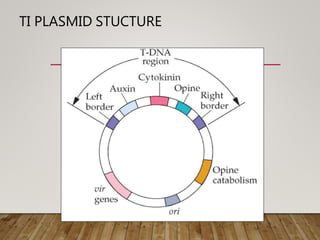
TI PLASMID STUCTURE
VIR (VIRULENT) GENE
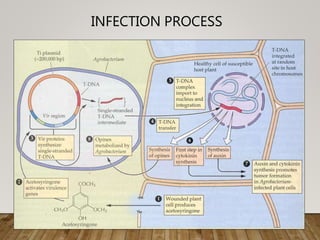
1. Transfer the T-DNA to plant cell
2. Acetosyringone (AS) (a flavonoid) released
by wounded plant cells activates vir genes.
3. virA,B,C,D,E,F,G (7 complementation
groups, but some have multiple ORFs),
span about 30 kb of Ti plasmid.
FUNCTION OF VIR GENES
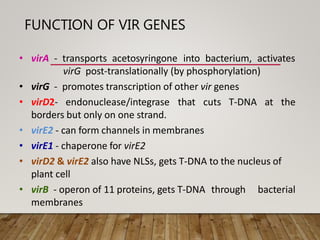
• virA - transports acetosyringone into bacterium, activates
virG post-translationally (by phosphorylation)
• virG - promotes transcription of other vir genes
• virD2- endonuclease/integrase that cuts T-DNA at the
borders but only on one strand.
• virE2 - can form channels in membranes
• virE1 - chaperone for virE2
• virD2 & virE2 also have NLSs, gets T-DNA to the nucleus of
plant cell
• virB - operon of 11 proteins, gets T-DNA through bacterial
membranes
OPINES
• Derivatives of amino acids synthesized by T-DNA
• Ti plasmids can be classified according to the
opines produced :
1. Nopaline plasmids
2. Octopine plasmids
3. Agropine plasmids
Nopaline plasmids : carry gene for synthesizing
nopaline in the plant and for utilization (catabolism) in
the bacteria.
Octopine plasmids : carry genes to synthesize
octopine in the plant and catabolism in the bacteria.
Agropine plasmids : carry genes for agropine
synthesis and catabolism.
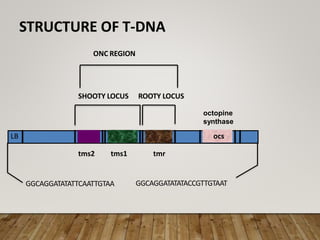
STRUCTURE OF T-DNA
LB
SHOOTY LOCUS ROOTY LOCUS
ONC REGION
tms2 tms1 tmr
ocs
GGCAGGATATATTCAATTGTAA GGCAGGATATATACCGTTGTAAT
octopine
synthase
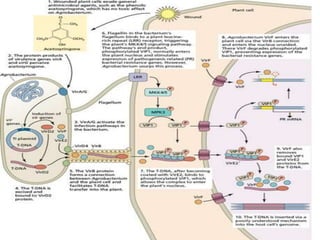
INFECTION PROCESS
TI PLASMID-DERIVED VECTOR SYSTEMS
 Using Ti plasmid as a vector it is possible to insert a desired
DNA sequence (gene) into the T DNA region of Ti plasmid.
 There are several limitations to use Ti plasmids directly as
cloning vectors :-
 LARGE SIZE.
 TUMOR INDUCTION PROPERTY.
 ABSENCE OF UNIQUE RESTRICTION SITES.
• Agrobacterium plasmids are disarmed by deleting
naturally occurring T-DNA encoded oncogenes
and replacing them with foreign genes of interest.
The right and left border sequences of T-DNA
which is required for T-DNA integration.
 A multiple cloning site.
 An origin of replication
 A selectable marker gene
AGROBACTERIUM MEDIATED
TRANSFORMATION
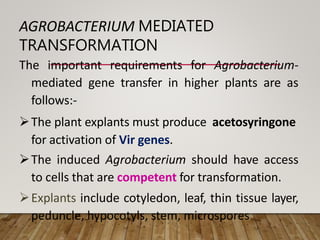
The important requirements for Agrobacterium-
mediated gene transfer in higher plants are as
follows:-
The plant explants must produce acetosyringone
for activation of Vir genes.
The induced Agrobacterium should have access
to cells that are competent for transformation.
Explants include cotyledon, leaf, thin tissue layer,
peduncle, hypocotyls, stem, microspores
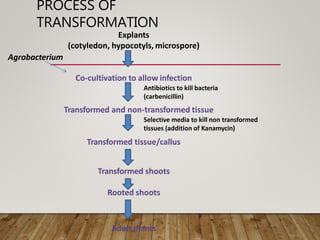
PROCESS OF
TRANSFORMATION
Explants
(cotyledon, hypocotyls, microspore)
Agrobacterium
Co-cultivation to allow infection
Antibiotics to kill bacteria
(carbenicillin)
Transformed and non-transformed tissue
Selective media to kill non transformed
tissues (addition of Kanamycin)
Transformed tissue/callus
Transformed shoots
Rooted shoots
Adult plants
THANK YOU

agrobacterium

  • 1.
    By – NEELMA NAYB MPHIL.Biotech II sem Department of Biotechnology AGROBACTERIUM
  • 2.
    • INTRODUCTION – Agrobacteriumtumefaciens – Ti Plasmid • Ti Plasmid stucture – Vir (virulent) Gene • Structure of T-DNA • Infection Process • Ti Plasmid-Derived Vector Systems – Agrobacterium mediated transformation • Process of Transformation
  • 3.
    INTRODUCTION • WHAT AREPLASMIDS ? PLASMIDS are double stranded, closed circular DNA molecules, which exist in the cell as extra chromosomal units. Transmitted from one bacterium to another (even of another species) via horizontal gene transfer. Engineered plasmids are widely used as vectors in DNA cloning .
  • 4.
    AGROBACTERIUM TUMEFACIENS • A.tumefaciens is a gram-negative soil bacterium which naturally transforms plant cells, resulting in crown gall (cancer) tumors. • Infects plants through breaks or wounds. • Tumor formation is the result of integration of T-DNA (Transfer DNA) in plant genome.
  • 5.
    TI PLASMID • Tiplasmid is a tumor-inducing plasmid or tumor induction plasmid. • Found in Agrobacterium tumefaciens bacteria .
  • 6.
  • 7.
    VIR (VIRULENT) GENE 1.Transfer the T-DNA to plant cell 2. Acetosyringone (AS) (a flavonoid) released by wounded plant cells activates vir genes. 3. virA,B,C,D,E,F,G (7 complementation groups, but some have multiple ORFs), span about 30 kb of Ti plasmid.
  • 8.
    FUNCTION OF VIRGENES • virA - transports acetosyringone into bacterium, activates virG post-translationally (by phosphorylation) • virG - promotes transcription of other vir genes • virD2- endonuclease/integrase that cuts T-DNA at the borders but only on one strand. • virE2 - can form channels in membranes • virE1 - chaperone for virE2 • virD2 & virE2 also have NLSs, gets T-DNA to the nucleus of plant cell • virB - operon of 11 proteins, gets T-DNA through bacterial membranes
  • 9.
    OPINES • Derivatives ofamino acids synthesized by T-DNA • Ti plasmids can be classified according to the opines produced : 1. Nopaline plasmids 2. Octopine plasmids 3. Agropine plasmids
  • 10.
    Nopaline plasmids :carry gene for synthesizing nopaline in the plant and for utilization (catabolism) in the bacteria. Octopine plasmids : carry genes to synthesize octopine in the plant and catabolism in the bacteria. Agropine plasmids : carry genes for agropine synthesis and catabolism.
  • 11.
    STRUCTURE OF T-DNA LB SHOOTYLOCUS ROOTY LOCUS ONC REGION tms2 tms1 tmr ocs GGCAGGATATATTCAATTGTAA GGCAGGATATATACCGTTGTAAT octopine synthase
  • 12.
  • 14.
    TI PLASMID-DERIVED VECTORSYSTEMS  Using Ti plasmid as a vector it is possible to insert a desired DNA sequence (gene) into the T DNA region of Ti plasmid.  There are several limitations to use Ti plasmids directly as cloning vectors :-  LARGE SIZE.  TUMOR INDUCTION PROPERTY.  ABSENCE OF UNIQUE RESTRICTION SITES.
  • 15.
    • Agrobacterium plasmidsare disarmed by deleting naturally occurring T-DNA encoded oncogenes and replacing them with foreign genes of interest. The right and left border sequences of T-DNA which is required for T-DNA integration.  A multiple cloning site.  An origin of replication  A selectable marker gene
  • 16.
    AGROBACTERIUM MEDIATED TRANSFORMATION The importantrequirements for Agrobacterium- mediated gene transfer in higher plants are as follows:- The plant explants must produce acetosyringone for activation of Vir genes. The induced Agrobacterium should have access to cells that are competent for transformation. Explants include cotyledon, leaf, thin tissue layer, peduncle, hypocotyls, stem, microspores
  • 17.
    PROCESS OF TRANSFORMATION Explants (cotyledon, hypocotyls,microspore) Agrobacterium Co-cultivation to allow infection Antibiotics to kill bacteria (carbenicillin) Transformed and non-transformed tissue Selective media to kill non transformed tissues (addition of Kanamycin) Transformed tissue/callus Transformed shoots Rooted shoots Adult plants
  • 18.