FEASIBILITY ANALYSIS
PROF. CHRISTINE JOYCE B. MENDOZA
20 January 2017
Calapan City
Short Course on Environmental Planning
DCERP & HUMEIN Phils. Inc.
LECTURE OBJECTIVES
Short Course on Environmental Planning
DCERP & HUMEIN Phils. Inc.
By the end of the lecture, participants are
expected to:
 Explain the seven aspects of feasibility study
 Decide on the overall feasibility of project
based on specific criteria
2
• Included in the project preparation stage
• Determine whether the project can and should
be undertaken and if so, how and when
• Costly and naturally requires funding, so a
technical assistance grant is normally sought
• Involves functional areas of analysis which are
closely interrelated
Short Course on Environmental Planning
DCERP & HUMEIN Phils. Inc.
FEASIBILITY STUDIES
Short Course on Environmental Planning
DCERP & HUMEIN Phils. Inc.
PRE-FEASIBILITY STUDIES
• Narrow down the range of possible alternatives
• Ascertain whether on the basis of results obtained,
the allocation of scarce resources for the
preparation of a more detailed FS is warranted
• Establish the work program for further
development of the project
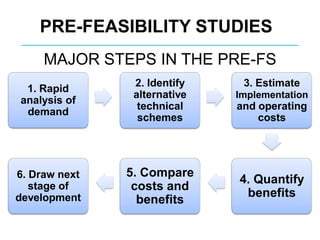
MAJOR STEPS IN THE PRE-FS
1. Rapid
analysis of
demand
2. Identify
alternative
technical
schemes
3. Estimate
Implementation
and operating
costs
4. Quantify
benefits
5. Compare
costs and
benefits
6. Draw next
stage of
development
PRE-FEASIBILITY STUDIES
Short Course on Environmental Planning
DCERP & HUMEIN Phils. Inc.
POSSIBLE DECISIONS
AFTER THE PRE-FS [1]
Reject the
project
Defer conduct
of detailed FS
Proceed to detailed
design and
implementation
Conduct a
detailed FS
Short Course on Environmental Planning
DCERP & HUMEIN Phils. Inc.
POSSIBLE DECISIONS
AFTER THE PRE-FS [2]
Rejection Analysis should conclusively reveal that none of the
possible project alternatives is feasible, even in the
remote future
Deferment Project can be feasible only if implemented in a
relatively distant future
Detailed
design and
implementatio
n
Economic and technical soundness of the project may
turn out to be highly evident during the Pre-FS, thus, No
need to have detailed FS
Need for a FS If results of the Pre-FS indicate: (1) more detailed
information to produce more conclusive results; (2)
alternative schemes of the project are nearly the same
degree of feasibility and/or show marginal feasibility; (3)
new alternative solutions have emerged and has to be
ascertained through detailed FS
Shortcourse on Environmental Planning
DCERP & HUMEIN Phils. Inc.
CONCEPT STATEMENT
A one-page description of a project, that is
distributed by the proponent to other planners
and stakeholders who are asked to provide
feedback on the potential of the idea
Feedback will provide proponent:
• a sense of the viability of the project idea; and
• suggestions for how the idea can be
strengthened or “tweaked” before proceeding
further
Shortcourse on Environmental Planning
DCERP & HUMEIN Phils. Inc.
ASPECTS OF
FEASIBILITY STUDY
MARKET
FINANCIAL
ECONOMIC
INSTITUTIONAL
TECHNICAL
ENVIRONMENTAL
SOCIAL
MARKET ASPECT
Aims to determine the extent to which products,
goods, and services to be generated by the project
are needed or demanded by its target beneficiaries
Helps design the appropriate marketing strategies
and plans that will help ensure that a project’s
target beneficiaries / users are reached and will
accept the project outputs at given prices
Extent of marketability of goods/services include:
• Magnitude of existing and projected demand for the
product/service not covered by current or forecast
supply
• Competitiveness of product/service wrt quality and
price
• Effectiveness of marketing program and
organization
Includes definition of market, conduct of current and
projected demand and supply, other major market
considerations and marketing programming and
planning (product, place, promotion and price)
MARKET ASPECT
Shortcourse on Environmental Planning
DCERP & HUMEIN Phils. Inc.
MEASURES OF
PROJECT WORTH
Net present value (NPV)
Internal rate of return (IRR)
Benefit-cost ration (BCR)
Payback period
DISCOUNTING
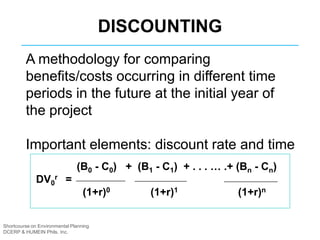
A methodology for comparing
benefits/costs occurring in different time
periods in the future at the initial year of
the project
Important elements: discount rate and time
(B0 - C0) + (B1 - C1) + . . . … .+ (Bn - Cn)
DV0
r =
(1+r)0 (1+r)1 (1+r)n
Shortcourse on Environmental Planning
DCERP & HUMEIN Phils. Inc.
Shortcourse on Environmental Planning
DCERP & HUMEIN Phils. Inc.
MEASURES OF
PROJECT WORTH
Net present value (NPV) compares cost
and benefit streams discounted to the
present year
(Bi - Ci)
NPV0
r =
(1+r)i
Σ
i = 0
i = n
Where:
1/ (1+r)i = discounting factor
(Bi - Ci) = net benefit or net cost
n = life of project
Shortcourse on Environmental Planning
DCERP & HUMEIN Phils. Inc.
MEASURES OF
PROJECT WORTH
Net present value (NPV) Decision Rules
1. Accepting/ rejecting project
Do not accept a project unless it generates a
positive NPV when discounted by the
opportunity cost of funds
Example
Project A : PV Costs = P50M ; NPV = - P 0.7M
Project B : PV Costs = P30M ; NPV = +P 1.5M
Project C : PV Costs = P20M ; NPV = - P 0.5M
Shortcourse on Environmental Planning
DCERP & HUMEIN Phils. Inc.
MEASURES OF
PROJECT WORTH
Net present value (NPV) Decision Rules
2. Budget constraint
Within the limit of a fixed budget, choose
that subset of available projects which
maximizes NPV
Example
Project D : PV Costs = P10M ; NPV = + P 0.6M
Project E : PV Costs = P30M ; NPV = + P4.0M
Project F : PV Costs = P20M ; NPV = + P 1.5M
Project G : PV Costs = P20M ; NPV = + P 2.25M
Budget constraint: P 40 M
Shortcourse on Environmental Planning
DCERP & HUMEIN Phils. Inc.
MEASURES OF
PROJECT WORTH
Net present value (NPV) Decision Rules
3. Mutually exclusive projects
Where there is no budget constraint but a project
must be chosen from mutually exclusive
alternatives, always choose the one that
generates the highest NPV.
Example
Project H : PV CapCosts = P40M ; NPV = + P 7.0M
Project I : PV CapCosts = P20M ; NPV = + P 6.0M
Shortcourse on Environmental Planning
DCERP & HUMEIN Phils. Inc.
MEASURES OF
PROJECT WORTH
Net present value (NPV) Decision Rules
4. Different Project Lives
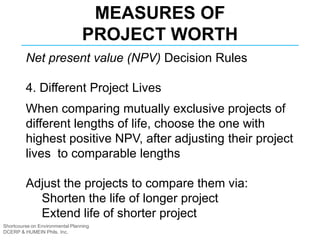
When comparing mutually exclusive projects of
different lengths of life, choose the one with
highest positive NPV, after adjusting their project
lives to comparable lengths
Adjust the projects to compare them via:
Shorten the life of longer project
Extend life of shorter project
MEASURES OF
PROJECT WORTH
Internal rate of return (IRR)
Discount rate at which the present value of
benefits equals the present value of costs, i.e.,
NPV = 0 and BCR = 1
This is effective annual Return on Investment
(ROI) over the entire life of a project (versus
accounting ROI which is not time-discounted)
It is the measure of the earning power of money
to be invested in a project from the perspective
of owner, investor, borrower or lender.
Shortcourse on Environmental Planning
DCERP & HUMEIN Phils. Inc.
Shortcourse on Environmental Planning
DCERP & HUMEIN Phils. Inc.
MEASURES OF
PROJECT WORTH
IRR Decision Rules
1. Accepting/ rejecting project
If IRR > cost of funds, implement the project
Cost of fund or the opportunity cost of capital
Example
Project A : Cost of Fund = 10% ; IRR = 12%
Project B : Cost of Fund = 12% ; IRR = 11%
Project C : Cost of Fund = 12% ; IRR = 12%
Shortcourse on Environmental Planning
DCERP & HUMEIN Phils. Inc.
MEASURES OF
PROJECT WORTH
IRR Decision Rules
2. Mutually Exclusive Projects
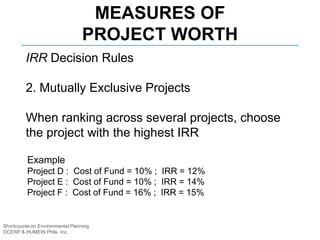
When ranking across several projects, choose
the project with the highest IRR
Example
Project D : Cost of Fund = 10% ; IRR = 12%
Project E : Cost of Fund = 10% ; IRR = 14%
Project F : Cost of Fund = 16% ; IRR = 15%
Shortcourse on Environmental Planning
DCERP & HUMEIN Phils. Inc.
MEASURES OF
PROJECT WORTH
Benefit-cost ratio (BCR) is the ratio of the
present value of benefits to the present value of
costs
Bi / (1+r)i
BCR =
Ci / (1+r)i
Σ
i = 0
i = n
Σ
i = 0
i = n
Shortcourse on Environmental Planning
DCERP & HUMEIN Phils. Inc.
MEASURES OF
PROJECT WORTH
Benefit-cost ratio (BCR) Decision Rules
1. Accepting/Rejecting a Project
Accept the project if BCR > 1. Otherwise, reject.
2. Mutually exclusive projects
Between two or more mutually exclusive
projects, select the project with the highest BCR.
Shortcourse on Environmental Planning
DCERP & HUMEIN Phils. Inc.
MEASURES OF
PROJECT WORTH
Payback period is measured in the number of
years before the discounted cumulative benefits
are sufficient to repay the discounted cumulative
costs. The lesser number of years, the better
Payback period
= Original Investment/Gross Annual Profit
Gross annual profit is the simple average of
gross profits for each year of the project life
Shortcourse on Environmental Planning
DCERP & HUMEIN Phils. Inc.
MEASURES OF
PROJECT WORTH
Payback period is useful for firms that face many
investment opportunities but have limited
financial resources, thus, they are compelled to
reject projects with long payback periods
Also for assessing profitability of high-risk
projects (i.e. involving changes in technology)
Shortcourse on Environmental Planning
DCERP & HUMEIN Phils. Inc.
CHOICE OF
DISCOUNT RATES
1. Project’s View: weighted average cost of
capital (WACC)
2. Owner’s View: opportunity cost of equity; may
vary depending on risk. Include market
interest rate (e.g., average lending rate,
average deposit rate, T-Bill rate)
3. Government/Budget’s View: opportunity cost
of funds (e.g., T-Bill rates or interest rates on
mandated deposits in GFIs)
4. Economy’s View: economic opportunity cost
of capital (i.e., 15%)
Shortcourse on Environmental Planning
DCERP & HUMEIN Phils. Inc.
CHOICE OF
DISCOUNT RATES
Choose the highest rate to ensure project
yield net returns over and above the
returns of the next best alternative
Shortcourse on Environmental Planning
DCERP & HUMEIN Phils. Inc.
FINANCIAL ASPECT
Used to assess the project’s financial
viability and its ability to meet its
operational costs and debt-service
obligations
Compares financial cost with expected
incomes over the project’s lifetime
Shortcourse on Environmental Planning
DCERP & HUMEIN Phils. Inc.
Accept project if:
NPV >0
FIRR >opportunity cost of capital
For mutually exclusive projects that pass the
aforementioned criteria, choose the project with
the highest NPV, FIRR.
FINANCIAL EVALUATION
Shortcourse on Environmental Planning
DCERP & HUMEIN Phils. Inc.
Used to assess project desirability in terms of its
net contribution to the economic and social
welfare of the country
Compares economic and social benefits
expected to be generated from the project and
economic and social costs of implementation
and operation
ECONOMIC ASPECT
Shortcourse on Environmental Planning
DCERP & HUMEIN Phils. Inc.
Financial prices are adjusted to economic prices
to account for market distortions (taxes, tariffs,
subsidies, market power) and externalities that are
not valued in the market
ECONOMIC ASPECT
Shortcourse on Environmental Planning
DCERP & HUMEIN Phils. Inc.
Externalities are costs or benefits that are felt by
entities other than the agency implementing or
operating the project.
Project effects – positive or negative – go beyond
the limits of the program/project and are usually
not reflected in the financial accounts of the
program/project
Involve a significant economic cost or confer a
significant economic benefit and should be taken
into account in estimating the overall economic
impact of the program/project
ECONOMIC ASPECT
Shortcourse on Environmental Planning
DCERP & HUMEIN Phils. Inc.
Examples of externalities
Environmental externality: pollution and congestion
Tax and subsidy for non-tradable goods: transfer
prices
Import and export tax for tradable goods: transfer
prices
Foreign exchange externality: market distortions
underlying the demand-and-supply of foreign exchange
Labor externality: divergence between the market
wage rate and the cost of employment
ECONOMIC ASPECT
Shortcourse on Environmental Planning
DCERP & HUMEIN Phils. Inc.
ECONOMIC ASPECT
Economic benefits Economic costs
• increase in quantity of
output or service
• improvement in quality of
outputs or service
• incremental savings in
resource use
• increase or occurrence
of positive externalities
• decrease or elimination
of negative externalities
• incremental use of
inputs or resources
(either for capital or
operation and
maintenance)
• decrease in positive
externalities
• increase in negative
externalities
Taxes, subsidies, financial
charges, amortization, and
depreciation costs not included
Shortcourse on Environmental Planning
DCERP & HUMEIN Phils. Inc.
Steps in conducting economic analysis
1. Financial prices are adjusted to economic
prices to account for market distortions (taxes,
tariffs, subsidies, market pIdentify costs and
benefits
2. Quantify/convert cost and benefit to economic
price
3. Determine economic viability
4. Conduct sensitivity analysis
ECONOMIC ASPECT
Shortcourse on Environmental Planning
DCERP & HUMEIN Phils. Inc.
Accept project if:
ENPV > 0
EIRR > Social Discount Rate
For mutually exclusive projects that pass the
aforementioned criteria, choose the project with
the highest ENPV and EIRR.
ECONOMIC ASPECT
Shortcourse on Environmental Planning
DCERP & HUMEIN Phils. Inc.
FINANCE vs ECONOMICS
Finance covers decisions
and transactions internal
to an economic unit–
whether household,
project, enterprise, or
agency – regarding the
allocation of resources
over time and the
handling of risk, which
decisions are focused on
the survival, maintenance,
or growth of that particular
unit.
Economics covers
processes and decisions
both internal as well as
external to the economic
unit, including those that
impact on the whole
community, territory or
society
Shortcourse on Environmental Planning
DCERP & HUMEIN Phils. Inc.
INSTITUTIONAL ASPECT
Involves the assessment of the adequacy of the
proponent’s project implementation capability
considering political, legal, organizational,
managerial, operational and other administrative
constraints which might hinder
implementation/operation process
Shortcourse on Environmental Planning
DCERP & HUMEIN Phils. Inc.
INSTITUTIONAL ASPECT
Criteria for institutional capability include project’s:
• Political acceptability and legality
• Organizational adequacy to organize and
implement
• Resources availability and adequacy
Shortcourse on Environmental Planning
DCERP & HUMEIN Phils. Inc.
TECHNICAL ASPECT
Aims to identify and analyze alternative ways of
carrying out the project in terms of its size,
location, basic technical features, resource
requirements, phasing of implementation
Shortcourse on Environmental Planning
DCERP & HUMEIN Phils. Inc.
TECHNICAL ASPECT
Involves the assessment of the project in terms of:
• Alternative ways of carrying out the project
• Engineering characteristics of alternatives
• Physical resource requirements of alternatives
• Construction and operating plans project design
Value for Money (VfM) as an instrument to
assess technical soundness of the project design
and cost efficiency, among others.
Shortcourse on Environmental Planning
DCERP & HUMEIN Phils. Inc.
Involves the assessment of potentially
beneficial/harmful impacts of:
• Environmentally critical projects; and
• Projects on environmentally critical areas
ENVIRONMENTAL ASPECT
Shortcourse on Environmental Planning
DCERP & HUMEIN Phils. Inc.
Environmentally critical projects (ECP) are those
that have significant environmental
consequences. Such adverse impact(s) may be
sensitive, irreversible and diverse. ECPs needs
an EIS document to be submitted to EMB-
Central Office.
Examples: heavy industries like petroleum and petro-
chemical industries, iron and steel mills, etc; forestry,
fishery, infrastructure projects and golf courses
ENVIRONMENTAL ASPECT
Shortcourse on Environmental Planning
DCERP & HUMEIN Phils. Inc.
Projects on environmentally critical areas (ECA)
may have adverse environmental impacts that
are less sensitive, major or diverse as the ECP
impacts. Remedial measures can be more easily
designed. ECA projects need to submit Initial
Environmental Examination (IEE) to EMB
Regional Offices
Examples: areas declared by law as national parks, watershed
reserves, wildlife preserves, aesthetic potential tourist spots, areas
with unique historic, archaeological or scientific interest, areas
frequented by natural calamities, areas traditionally occupied by
ICCs, prime agricultural lands, water bodies/mangrove areas, coral
reefs
ENVIRONMENTAL ASPECT
Shortcourse on Environmental Planning
DCERP & HUMEIN Phils. Inc.
SOCIAL ANALYSIS
Involves the assessment of project benefits and
costs beyond those which are financial such as:
• Income distribution effects
• Employment linkages
• Health and nutrition impact, and
• Links to other quality of life indicators
Shortcourse on Environmental Planning
DCERP & HUMEIN Phils. Inc.
SOCIAL ANALYSIS
Social dimensions are included to:
• Assist in the design of socially responsive
projects
• Facilitate more effective project implementation
• Identify some of project’s potential risks
• Enable a more equitable distribution of project
benefits
• Build upon the desirable socio-cultural
characteristics of communities
Shortcourse on Environmental Planning
DCERP & HUMEIN Phils. Inc.
Among the social dimensions considered in the
analysis are:
• Affected groups
• Demands/Needs of the affected groups
• Gender issues involved
• Potential adverse impacts
SOCIAL ANALYSIS
Shortcourse on Environmental Planning
DCERP & HUMEIN Phils. Inc.
Projects can be classified as:
• Projects with direct positive social impact
(poverty alleviation)
• Projects with direct positive social impact but
which require active participation of target
beneficiaries
• Projects with direct/indirect negative social
impacts which require
mitigation/compensation
SOCIAL ANALYSIS
Shortcourse on Environmental Planning
DCERP & HUMEIN Phils. Inc.
SOCIAL IMPACT ANALYSIS
• Determines a project’s impact on stakeholders
• Attempts to identify project beneficiaries and losers
• Helps show if a project would create a positive or
negative social impact
• Attempts to improve project design
Shortcourse on Environmental Planning
DCERP & HUMEIN Phils. Inc.
SOCIAL IMPACT ANALYSIS
SIA can be conducted in three levels
1.Formulation of development strategies and
policies
2.Identification and selection of programs and
projects
3.Preparation, and implementation of policy,
program, and project
Shortcourse on Environmental Planning
DCERP & HUMEIN Phils. Inc.
CORE GENDER AND
DEVELOPMENT ELEMENTS
1. Participation of women and men in the
identification of the development problem
2. Collection and use of sex-disaggregated data in
the analysis of the development problem
3. Conduct of gender analysis to identify the gender
issues that the proposed project must address
4. Goals, objectives, outcomes, and outputs that
include GAD statements that will address the
gender issues in no. 3
5. Activities that respond to the identified gender
issues, including constraints to women’s
participation
Shortcourse on Environmental Planning
DCERP & HUMEIN Phils. Inc.
CORE GENDER AND
DEVELOPMENT ELEMENTS
6. Of gender analysis of the planned project to
anticipate gender-related issues arising from
the implementation of the designed project
7. Monitoring indicators and targets which include
the reduction of gender gaps or improvement of
women’s participation
8. Project monitoring and evaluation system that
includes a sex-disaggregated database
9. Resources and budgets for the activities in no.
5
10.Planned coordination with NCRFW or the
agency’s GAD plans.
Shortcourse on Environmental Planning
DCERP & HUMEIN Phils. Inc.
SENSITIVITY ANALYSIS
An investigation of what happens to NPV when
only one variable is changed e.g., sales,
variable costs, fixed costs.
A form of ‘What If’ Analysis and attempts to deal
with uncertainty
Useful in pinpointing those variables that
deserve the most attention
Shortcourse on Environmental Planning
DCERP & HUMEIN Phils. Inc.
SENSITIVITY ANALYSIS
It can involve varying discount rates, physical
inputs or outputs, or values of benefits or costs.
This will result in a variety of answers rather
than one single answer
It gives the decision-maker a range of answers
Shortcourse on Environmental Planning
DCERP & HUMEIN Phils. Inc.
SENSITIVITY ANALYSIS
Variables that are sources of risks include those
that represent
• A large share of cash receipts
(benefits/inflows) or cash disbursements
(costs/outflows)
• Highly inaccurate basis/assumptions
• A wide range of possible values
Shortcourse on Environmental Planning
DCERP & HUMEIN Phils. Inc.
SENSITIVITY ANALYSIS
General steps are as follows
Step 1 Conduct base case analysis
Step 2 While holding other values constant,
let the base case of a variable change
by a certain percentage
Step 3 Compute project indicators
Shortcourse on Environmental Planning
DCERP & HUMEIN Phils. Inc.
SENSITIVITY ANALYSIS
Example: What would be the effect on the
project’s NPV and IRR of the following changes
in variables?
10% increase in investment cost?
15% annual increase in O&M cost?
3% increase in discount rate?
Simultaneous 20% increase in investment cost and
20% decrease in revenues?
Shortcourse on Environmental Planning
DCERP & HUMEIN Phils. Inc.
BREAKEVEN ANALYSIS
Answers the questions
- What value of a parameter/variable will make
an outcome equal to a certain value?
- At what tariff rate will the NPV equal to zero?
- What decrease in investment cost will make
the IRR equal to the opportunity cost of
funds?
Shortcourse on Environmental Planning
DCERP & HUMEIN Phils. Inc.
References:
Alan Cadavos (2007). Project Development and Management
NEDA (1984). Project Development Manual.
NEDA (2010). Harmonized Gender and Development Guidelines for Project
Development, Implementation, Monitoring, and Evaluation
NEDA (2014). Project Development Training
NEDA, CIDA, UNDP (2005) ICC Project Appraisal. Reference Manual on
Project Development and Evaluation
THANK YOU!
Short Course on Environmental Planning
DCERP & HUMEIN Phils. Inc.

feasibility study

  • 1.
    FEASIBILITY ANALYSIS PROF. CHRISTINEJOYCE B. MENDOZA 20 January 2017 Calapan City Short Course on Environmental Planning DCERP & HUMEIN Phils. Inc.
  • 2.
    LECTURE OBJECTIVES Short Courseon Environmental Planning DCERP & HUMEIN Phils. Inc. By the end of the lecture, participants are expected to:  Explain the seven aspects of feasibility study  Decide on the overall feasibility of project based on specific criteria 2
  • 3.
    • Included inthe project preparation stage • Determine whether the project can and should be undertaken and if so, how and when • Costly and naturally requires funding, so a technical assistance grant is normally sought • Involves functional areas of analysis which are closely interrelated Short Course on Environmental Planning DCERP & HUMEIN Phils. Inc. FEASIBILITY STUDIES
  • 4.
    Short Course onEnvironmental Planning DCERP & HUMEIN Phils. Inc. PRE-FEASIBILITY STUDIES • Narrow down the range of possible alternatives • Ascertain whether on the basis of results obtained, the allocation of scarce resources for the preparation of a more detailed FS is warranted • Establish the work program for further development of the project
  • 5.
    MAJOR STEPS INTHE PRE-FS 1. Rapid analysis of demand 2. Identify alternative technical schemes 3. Estimate Implementation and operating costs 4. Quantify benefits 5. Compare costs and benefits 6. Draw next stage of development PRE-FEASIBILITY STUDIES
  • 6.
    Short Course onEnvironmental Planning DCERP & HUMEIN Phils. Inc. POSSIBLE DECISIONS AFTER THE PRE-FS [1] Reject the project Defer conduct of detailed FS Proceed to detailed design and implementation Conduct a detailed FS
  • 7.
    Short Course onEnvironmental Planning DCERP & HUMEIN Phils. Inc. POSSIBLE DECISIONS AFTER THE PRE-FS [2] Rejection Analysis should conclusively reveal that none of the possible project alternatives is feasible, even in the remote future Deferment Project can be feasible only if implemented in a relatively distant future Detailed design and implementatio n Economic and technical soundness of the project may turn out to be highly evident during the Pre-FS, thus, No need to have detailed FS Need for a FS If results of the Pre-FS indicate: (1) more detailed information to produce more conclusive results; (2) alternative schemes of the project are nearly the same degree of feasibility and/or show marginal feasibility; (3) new alternative solutions have emerged and has to be ascertained through detailed FS
  • 8.
    Shortcourse on EnvironmentalPlanning DCERP & HUMEIN Phils. Inc. CONCEPT STATEMENT A one-page description of a project, that is distributed by the proponent to other planners and stakeholders who are asked to provide feedback on the potential of the idea Feedback will provide proponent: • a sense of the viability of the project idea; and • suggestions for how the idea can be strengthened or “tweaked” before proceeding further
  • 9.
    Shortcourse on EnvironmentalPlanning DCERP & HUMEIN Phils. Inc. ASPECTS OF FEASIBILITY STUDY MARKET FINANCIAL ECONOMIC INSTITUTIONAL TECHNICAL ENVIRONMENTAL SOCIAL
  • 10.
    MARKET ASPECT Aims todetermine the extent to which products, goods, and services to be generated by the project are needed or demanded by its target beneficiaries Helps design the appropriate marketing strategies and plans that will help ensure that a project’s target beneficiaries / users are reached and will accept the project outputs at given prices
  • 11.
    Extent of marketabilityof goods/services include: • Magnitude of existing and projected demand for the product/service not covered by current or forecast supply • Competitiveness of product/service wrt quality and price • Effectiveness of marketing program and organization Includes definition of market, conduct of current and projected demand and supply, other major market considerations and marketing programming and planning (product, place, promotion and price) MARKET ASPECT
  • 12.
    Shortcourse on EnvironmentalPlanning DCERP & HUMEIN Phils. Inc. MEASURES OF PROJECT WORTH Net present value (NPV) Internal rate of return (IRR) Benefit-cost ration (BCR) Payback period
  • 13.
    DISCOUNTING A methodology forcomparing benefits/costs occurring in different time periods in the future at the initial year of the project Important elements: discount rate and time (B0 - C0) + (B1 - C1) + . . . … .+ (Bn - Cn) DV0 r = (1+r)0 (1+r)1 (1+r)n Shortcourse on Environmental Planning DCERP & HUMEIN Phils. Inc.
  • 14.
    Shortcourse on EnvironmentalPlanning DCERP & HUMEIN Phils. Inc. MEASURES OF PROJECT WORTH Net present value (NPV) compares cost and benefit streams discounted to the present year (Bi - Ci) NPV0 r = (1+r)i Σ i = 0 i = n Where: 1/ (1+r)i = discounting factor (Bi - Ci) = net benefit or net cost n = life of project
  • 15.
    Shortcourse on EnvironmentalPlanning DCERP & HUMEIN Phils. Inc. MEASURES OF PROJECT WORTH Net present value (NPV) Decision Rules 1. Accepting/ rejecting project Do not accept a project unless it generates a positive NPV when discounted by the opportunity cost of funds Example Project A : PV Costs = P50M ; NPV = - P 0.7M Project B : PV Costs = P30M ; NPV = +P 1.5M Project C : PV Costs = P20M ; NPV = - P 0.5M
  • 16.
    Shortcourse on EnvironmentalPlanning DCERP & HUMEIN Phils. Inc. MEASURES OF PROJECT WORTH Net present value (NPV) Decision Rules 2. Budget constraint Within the limit of a fixed budget, choose that subset of available projects which maximizes NPV Example Project D : PV Costs = P10M ; NPV = + P 0.6M Project E : PV Costs = P30M ; NPV = + P4.0M Project F : PV Costs = P20M ; NPV = + P 1.5M Project G : PV Costs = P20M ; NPV = + P 2.25M Budget constraint: P 40 M
  • 17.
    Shortcourse on EnvironmentalPlanning DCERP & HUMEIN Phils. Inc. MEASURES OF PROJECT WORTH Net present value (NPV) Decision Rules 3. Mutually exclusive projects Where there is no budget constraint but a project must be chosen from mutually exclusive alternatives, always choose the one that generates the highest NPV. Example Project H : PV CapCosts = P40M ; NPV = + P 7.0M Project I : PV CapCosts = P20M ; NPV = + P 6.0M
  • 18.
    Shortcourse on EnvironmentalPlanning DCERP & HUMEIN Phils. Inc. MEASURES OF PROJECT WORTH Net present value (NPV) Decision Rules 4. Different Project Lives When comparing mutually exclusive projects of different lengths of life, choose the one with highest positive NPV, after adjusting their project lives to comparable lengths Adjust the projects to compare them via: Shorten the life of longer project Extend life of shorter project
  • 19.
    MEASURES OF PROJECT WORTH Internalrate of return (IRR) Discount rate at which the present value of benefits equals the present value of costs, i.e., NPV = 0 and BCR = 1 This is effective annual Return on Investment (ROI) over the entire life of a project (versus accounting ROI which is not time-discounted) It is the measure of the earning power of money to be invested in a project from the perspective of owner, investor, borrower or lender. Shortcourse on Environmental Planning DCERP & HUMEIN Phils. Inc.
  • 20.
    Shortcourse on EnvironmentalPlanning DCERP & HUMEIN Phils. Inc. MEASURES OF PROJECT WORTH IRR Decision Rules 1. Accepting/ rejecting project If IRR > cost of funds, implement the project Cost of fund or the opportunity cost of capital Example Project A : Cost of Fund = 10% ; IRR = 12% Project B : Cost of Fund = 12% ; IRR = 11% Project C : Cost of Fund = 12% ; IRR = 12%
  • 21.
    Shortcourse on EnvironmentalPlanning DCERP & HUMEIN Phils. Inc. MEASURES OF PROJECT WORTH IRR Decision Rules 2. Mutually Exclusive Projects When ranking across several projects, choose the project with the highest IRR Example Project D : Cost of Fund = 10% ; IRR = 12% Project E : Cost of Fund = 10% ; IRR = 14% Project F : Cost of Fund = 16% ; IRR = 15%
  • 22.
    Shortcourse on EnvironmentalPlanning DCERP & HUMEIN Phils. Inc. MEASURES OF PROJECT WORTH Benefit-cost ratio (BCR) is the ratio of the present value of benefits to the present value of costs Bi / (1+r)i BCR = Ci / (1+r)i Σ i = 0 i = n Σ i = 0 i = n
  • 23.
    Shortcourse on EnvironmentalPlanning DCERP & HUMEIN Phils. Inc. MEASURES OF PROJECT WORTH Benefit-cost ratio (BCR) Decision Rules 1. Accepting/Rejecting a Project Accept the project if BCR > 1. Otherwise, reject. 2. Mutually exclusive projects Between two or more mutually exclusive projects, select the project with the highest BCR.
  • 24.
    Shortcourse on EnvironmentalPlanning DCERP & HUMEIN Phils. Inc. MEASURES OF PROJECT WORTH Payback period is measured in the number of years before the discounted cumulative benefits are sufficient to repay the discounted cumulative costs. The lesser number of years, the better Payback period = Original Investment/Gross Annual Profit Gross annual profit is the simple average of gross profits for each year of the project life
  • 25.
    Shortcourse on EnvironmentalPlanning DCERP & HUMEIN Phils. Inc. MEASURES OF PROJECT WORTH Payback period is useful for firms that face many investment opportunities but have limited financial resources, thus, they are compelled to reject projects with long payback periods Also for assessing profitability of high-risk projects (i.e. involving changes in technology)
  • 26.
    Shortcourse on EnvironmentalPlanning DCERP & HUMEIN Phils. Inc. CHOICE OF DISCOUNT RATES 1. Project’s View: weighted average cost of capital (WACC) 2. Owner’s View: opportunity cost of equity; may vary depending on risk. Include market interest rate (e.g., average lending rate, average deposit rate, T-Bill rate) 3. Government/Budget’s View: opportunity cost of funds (e.g., T-Bill rates or interest rates on mandated deposits in GFIs) 4. Economy’s View: economic opportunity cost of capital (i.e., 15%)
  • 27.
    Shortcourse on EnvironmentalPlanning DCERP & HUMEIN Phils. Inc. CHOICE OF DISCOUNT RATES Choose the highest rate to ensure project yield net returns over and above the returns of the next best alternative
  • 28.
    Shortcourse on EnvironmentalPlanning DCERP & HUMEIN Phils. Inc. FINANCIAL ASPECT Used to assess the project’s financial viability and its ability to meet its operational costs and debt-service obligations Compares financial cost with expected incomes over the project’s lifetime
  • 29.
    Shortcourse on EnvironmentalPlanning DCERP & HUMEIN Phils. Inc. Accept project if: NPV >0 FIRR >opportunity cost of capital For mutually exclusive projects that pass the aforementioned criteria, choose the project with the highest NPV, FIRR. FINANCIAL EVALUATION
  • 30.
    Shortcourse on EnvironmentalPlanning DCERP & HUMEIN Phils. Inc. Used to assess project desirability in terms of its net contribution to the economic and social welfare of the country Compares economic and social benefits expected to be generated from the project and economic and social costs of implementation and operation ECONOMIC ASPECT
  • 31.
    Shortcourse on EnvironmentalPlanning DCERP & HUMEIN Phils. Inc. Financial prices are adjusted to economic prices to account for market distortions (taxes, tariffs, subsidies, market power) and externalities that are not valued in the market ECONOMIC ASPECT
  • 32.
    Shortcourse on EnvironmentalPlanning DCERP & HUMEIN Phils. Inc. Externalities are costs or benefits that are felt by entities other than the agency implementing or operating the project. Project effects – positive or negative – go beyond the limits of the program/project and are usually not reflected in the financial accounts of the program/project Involve a significant economic cost or confer a significant economic benefit and should be taken into account in estimating the overall economic impact of the program/project ECONOMIC ASPECT
  • 33.
    Shortcourse on EnvironmentalPlanning DCERP & HUMEIN Phils. Inc. Examples of externalities Environmental externality: pollution and congestion Tax and subsidy for non-tradable goods: transfer prices Import and export tax for tradable goods: transfer prices Foreign exchange externality: market distortions underlying the demand-and-supply of foreign exchange Labor externality: divergence between the market wage rate and the cost of employment ECONOMIC ASPECT
  • 34.
    Shortcourse on EnvironmentalPlanning DCERP & HUMEIN Phils. Inc. ECONOMIC ASPECT Economic benefits Economic costs • increase in quantity of output or service • improvement in quality of outputs or service • incremental savings in resource use • increase or occurrence of positive externalities • decrease or elimination of negative externalities • incremental use of inputs or resources (either for capital or operation and maintenance) • decrease in positive externalities • increase in negative externalities Taxes, subsidies, financial charges, amortization, and depreciation costs not included
  • 35.
    Shortcourse on EnvironmentalPlanning DCERP & HUMEIN Phils. Inc. Steps in conducting economic analysis 1. Financial prices are adjusted to economic prices to account for market distortions (taxes, tariffs, subsidies, market pIdentify costs and benefits 2. Quantify/convert cost and benefit to economic price 3. Determine economic viability 4. Conduct sensitivity analysis ECONOMIC ASPECT
  • 36.
    Shortcourse on EnvironmentalPlanning DCERP & HUMEIN Phils. Inc. Accept project if: ENPV > 0 EIRR > Social Discount Rate For mutually exclusive projects that pass the aforementioned criteria, choose the project with the highest ENPV and EIRR. ECONOMIC ASPECT
  • 37.
    Shortcourse on EnvironmentalPlanning DCERP & HUMEIN Phils. Inc. FINANCE vs ECONOMICS Finance covers decisions and transactions internal to an economic unit– whether household, project, enterprise, or agency – regarding the allocation of resources over time and the handling of risk, which decisions are focused on the survival, maintenance, or growth of that particular unit. Economics covers processes and decisions both internal as well as external to the economic unit, including those that impact on the whole community, territory or society
  • 38.
    Shortcourse on EnvironmentalPlanning DCERP & HUMEIN Phils. Inc. INSTITUTIONAL ASPECT Involves the assessment of the adequacy of the proponent’s project implementation capability considering political, legal, organizational, managerial, operational and other administrative constraints which might hinder implementation/operation process
  • 39.
    Shortcourse on EnvironmentalPlanning DCERP & HUMEIN Phils. Inc. INSTITUTIONAL ASPECT Criteria for institutional capability include project’s: • Political acceptability and legality • Organizational adequacy to organize and implement • Resources availability and adequacy
  • 40.
    Shortcourse on EnvironmentalPlanning DCERP & HUMEIN Phils. Inc. TECHNICAL ASPECT Aims to identify and analyze alternative ways of carrying out the project in terms of its size, location, basic technical features, resource requirements, phasing of implementation
  • 41.
    Shortcourse on EnvironmentalPlanning DCERP & HUMEIN Phils. Inc. TECHNICAL ASPECT Involves the assessment of the project in terms of: • Alternative ways of carrying out the project • Engineering characteristics of alternatives • Physical resource requirements of alternatives • Construction and operating plans project design Value for Money (VfM) as an instrument to assess technical soundness of the project design and cost efficiency, among others.
  • 42.
    Shortcourse on EnvironmentalPlanning DCERP & HUMEIN Phils. Inc. Involves the assessment of potentially beneficial/harmful impacts of: • Environmentally critical projects; and • Projects on environmentally critical areas ENVIRONMENTAL ASPECT
  • 43.
    Shortcourse on EnvironmentalPlanning DCERP & HUMEIN Phils. Inc. Environmentally critical projects (ECP) are those that have significant environmental consequences. Such adverse impact(s) may be sensitive, irreversible and diverse. ECPs needs an EIS document to be submitted to EMB- Central Office. Examples: heavy industries like petroleum and petro- chemical industries, iron and steel mills, etc; forestry, fishery, infrastructure projects and golf courses ENVIRONMENTAL ASPECT
  • 44.
    Shortcourse on EnvironmentalPlanning DCERP & HUMEIN Phils. Inc. Projects on environmentally critical areas (ECA) may have adverse environmental impacts that are less sensitive, major or diverse as the ECP impacts. Remedial measures can be more easily designed. ECA projects need to submit Initial Environmental Examination (IEE) to EMB Regional Offices Examples: areas declared by law as national parks, watershed reserves, wildlife preserves, aesthetic potential tourist spots, areas with unique historic, archaeological or scientific interest, areas frequented by natural calamities, areas traditionally occupied by ICCs, prime agricultural lands, water bodies/mangrove areas, coral reefs ENVIRONMENTAL ASPECT
  • 45.
    Shortcourse on EnvironmentalPlanning DCERP & HUMEIN Phils. Inc. SOCIAL ANALYSIS Involves the assessment of project benefits and costs beyond those which are financial such as: • Income distribution effects • Employment linkages • Health and nutrition impact, and • Links to other quality of life indicators
  • 46.
    Shortcourse on EnvironmentalPlanning DCERP & HUMEIN Phils. Inc. SOCIAL ANALYSIS Social dimensions are included to: • Assist in the design of socially responsive projects • Facilitate more effective project implementation • Identify some of project’s potential risks • Enable a more equitable distribution of project benefits • Build upon the desirable socio-cultural characteristics of communities
  • 47.
    Shortcourse on EnvironmentalPlanning DCERP & HUMEIN Phils. Inc. Among the social dimensions considered in the analysis are: • Affected groups • Demands/Needs of the affected groups • Gender issues involved • Potential adverse impacts SOCIAL ANALYSIS
  • 48.
    Shortcourse on EnvironmentalPlanning DCERP & HUMEIN Phils. Inc. Projects can be classified as: • Projects with direct positive social impact (poverty alleviation) • Projects with direct positive social impact but which require active participation of target beneficiaries • Projects with direct/indirect negative social impacts which require mitigation/compensation SOCIAL ANALYSIS
  • 49.
    Shortcourse on EnvironmentalPlanning DCERP & HUMEIN Phils. Inc. SOCIAL IMPACT ANALYSIS • Determines a project’s impact on stakeholders • Attempts to identify project beneficiaries and losers • Helps show if a project would create a positive or negative social impact • Attempts to improve project design
  • 50.
    Shortcourse on EnvironmentalPlanning DCERP & HUMEIN Phils. Inc. SOCIAL IMPACT ANALYSIS SIA can be conducted in three levels 1.Formulation of development strategies and policies 2.Identification and selection of programs and projects 3.Preparation, and implementation of policy, program, and project
  • 51.
    Shortcourse on EnvironmentalPlanning DCERP & HUMEIN Phils. Inc. CORE GENDER AND DEVELOPMENT ELEMENTS 1. Participation of women and men in the identification of the development problem 2. Collection and use of sex-disaggregated data in the analysis of the development problem 3. Conduct of gender analysis to identify the gender issues that the proposed project must address 4. Goals, objectives, outcomes, and outputs that include GAD statements that will address the gender issues in no. 3 5. Activities that respond to the identified gender issues, including constraints to women’s participation
  • 52.
    Shortcourse on EnvironmentalPlanning DCERP & HUMEIN Phils. Inc. CORE GENDER AND DEVELOPMENT ELEMENTS 6. Of gender analysis of the planned project to anticipate gender-related issues arising from the implementation of the designed project 7. Monitoring indicators and targets which include the reduction of gender gaps or improvement of women’s participation 8. Project monitoring and evaluation system that includes a sex-disaggregated database 9. Resources and budgets for the activities in no. 5 10.Planned coordination with NCRFW or the agency’s GAD plans.
  • 53.
    Shortcourse on EnvironmentalPlanning DCERP & HUMEIN Phils. Inc. SENSITIVITY ANALYSIS An investigation of what happens to NPV when only one variable is changed e.g., sales, variable costs, fixed costs. A form of ‘What If’ Analysis and attempts to deal with uncertainty Useful in pinpointing those variables that deserve the most attention
  • 54.
    Shortcourse on EnvironmentalPlanning DCERP & HUMEIN Phils. Inc. SENSITIVITY ANALYSIS It can involve varying discount rates, physical inputs or outputs, or values of benefits or costs. This will result in a variety of answers rather than one single answer It gives the decision-maker a range of answers
  • 55.
    Shortcourse on EnvironmentalPlanning DCERP & HUMEIN Phils. Inc. SENSITIVITY ANALYSIS Variables that are sources of risks include those that represent • A large share of cash receipts (benefits/inflows) or cash disbursements (costs/outflows) • Highly inaccurate basis/assumptions • A wide range of possible values
  • 56.
    Shortcourse on EnvironmentalPlanning DCERP & HUMEIN Phils. Inc. SENSITIVITY ANALYSIS General steps are as follows Step 1 Conduct base case analysis Step 2 While holding other values constant, let the base case of a variable change by a certain percentage Step 3 Compute project indicators
  • 57.
    Shortcourse on EnvironmentalPlanning DCERP & HUMEIN Phils. Inc. SENSITIVITY ANALYSIS Example: What would be the effect on the project’s NPV and IRR of the following changes in variables? 10% increase in investment cost? 15% annual increase in O&M cost? 3% increase in discount rate? Simultaneous 20% increase in investment cost and 20% decrease in revenues?
  • 58.
    Shortcourse on EnvironmentalPlanning DCERP & HUMEIN Phils. Inc. BREAKEVEN ANALYSIS Answers the questions - What value of a parameter/variable will make an outcome equal to a certain value? - At what tariff rate will the NPV equal to zero? - What decrease in investment cost will make the IRR equal to the opportunity cost of funds?
  • 59.
    Shortcourse on EnvironmentalPlanning DCERP & HUMEIN Phils. Inc. References: Alan Cadavos (2007). Project Development and Management NEDA (1984). Project Development Manual. NEDA (2010). Harmonized Gender and Development Guidelines for Project Development, Implementation, Monitoring, and Evaluation NEDA (2014). Project Development Training NEDA, CIDA, UNDP (2005) ICC Project Appraisal. Reference Manual on Project Development and Evaluation
  • 60.
    THANK YOU! Short Courseon Environmental Planning DCERP & HUMEIN Phils. Inc.