PROJECT DEVELOPMENT CYCLE
Christine Joyce B. Mendoza
Assisstant Professor
DCERP, College of Human Ecology
University of the Philippines Los Baños
20 January 2017
Calapan City
Short Course on Environmental Planning
DCERP & HUMEIN Phils. Inc.
1
LECTURE OBJECTIVES
Short Course on Environmental Planning
DCERP & HUMEIN Phils. Inc.
By the end of the lecture, participants are expected to
explain each stage of the project development cycle
2
PROJECT
It is a set of planned activities designed to achieve a
certain objective with given resources and within a
specified period of time.
The following are the attributes of a project:
• Objectives
• Finite duration or time frame
• Specific physical boundary
• Beneficiaries
• Specified and quantified costs and benefits
• Organization and management structure
• Coordinated undertaking of inter-related activities
2
3Short Course on Environmental Planning
DCERP & HUMEIN Phils. Inc.
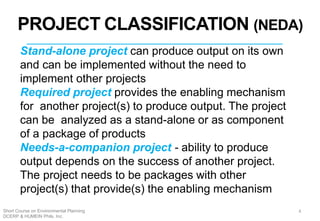
PROJECT CLASSIFICATION (NEDA)
Stand-alone project can produce output on its own
and can be implemented without the need to
implement other projects
Required project provides the enabling mechanism
for another project(s) to produce output. The project
can be analyzed as a stand-alone or as component
of a package of products
Needs-a-companion project - ability to produce
output depends on the success of another project.
The project needs to be packages with other
project(s) that provide(s) the enabling mechanism
3
4Short Course on Environmental Planning
DCERP & HUMEIN Phils. Inc.
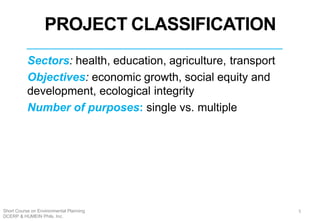
Sectors: health, education, agriculture, transport
Objectives: economic growth, social equity and
development, ecological integrity
Number of purposes: single vs. multiple
4
PROJECT CLASSIFICATION
5Short Course on Environmental Planning
DCERP & HUMEIN Phils. Inc.
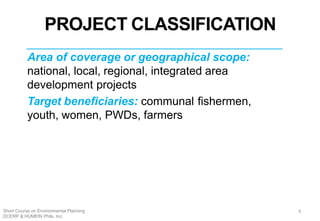
Area of coverage or geographical scope:
national, local, regional, integrated area
development projects
Target beneficiaries: communal fishermen,
youth, women, PWDs, farmers
4
PROJECT CLASSIFICATION
6Short Course on Environmental Planning
DCERP & HUMEIN Phils. Inc.
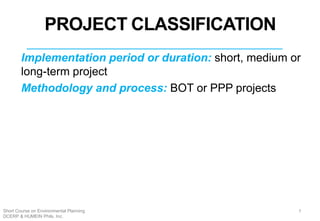
Implementation period or duration: short, medium or
long-term project
Methodology and process: BOT or PPP projects
4
PROJECT CLASSIFICATION
7Short Course on Environmental Planning
DCERP & HUMEIN Phils. Inc.
8Short Course on Environmental Planning
DCERP & HUMEIN Phils. Inc.
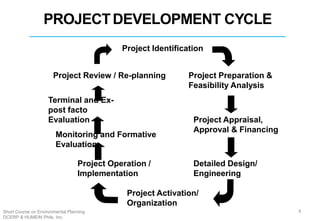
PROJECTDEVELOPMENT CYCLE
Project Identification
Project Preparation &
Feasibility Analysis
Project Appraisal,
Approval & Financing
Detailed Design/
Engineering
Project Activation/
Organization
Project Operation /
Implementation
Project Review / Re-planning
Monitoring and Formative
Evaluation
Terminal and Ex-
post facto
Evaluation
9Short Course on Environmental Planning
DCERP & HUMEIN Phils. Inc.
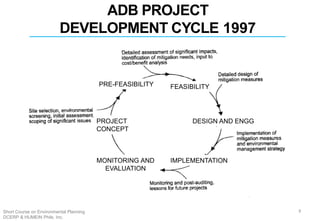
ADB PROJECT
DEVELOPMENT CYCLE 1997
FEASIBILITY
DESIGN AND ENGG
IMPLEMENTATIONMONITORING AND
EVALUATION
PROJECT
CONCEPT
PRE-FEASIBILITY
10
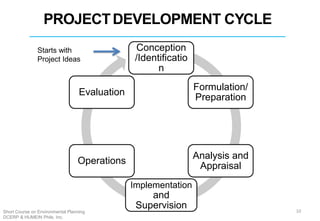
Conception
/Identificatio
n
Formulation/
Preparation
Analysis and
Appraisal
Implementation
and
Supervision
Operations
Evaluation
Short Course on Environmental Planning
DCERP & HUMEIN Phils. Inc.
PROJECTDEVELOPMENT CYCLE
Starts with
Project Ideas
SOURCES OF PROJECT IDEAS
• Development plans and strategies
• Local government units or people’s representatives
• Demand by interest groups or beneficiaries
• Unused or unutilized material or human resources and
opportunities
• Problems or constraints in the development process
• Private sponsors and enterprises
• Need to complement other investments
• Product of a dialogue between a country and international
funding agencies
11Short Course on Environmental Planning
DCERP & HUMEIN Phils. Inc.
Before project ideas can be identified
there is a need to organize and analyze. . .
• available information on the desirable
geographic project areas
• economy and the natural resources
• existing technologies, institutions,
human resources and their development potential
• experiences gained from past development projects
12Short Course on Environmental Planning
DCERP & HUMEIN Phils. Inc.
• Involves preliminary selection of the project
concept and of alternative design approaches
• Indicates the general promise of the project ideas
and the reasons for the choices made
• Might need a pre-feasibility studies or orderly
refinement up to the point where only the most
suitable are retained
13
1. CONCEPTION / IDENTIFICATION
Short Course on Environmental Planning
DCERP & HUMEIN Phils. Inc.
Selection criteria to screen and
modify project ideas
1. Technical soundness
2. Risk
3. Financing
4. Adequacy of skills and other inputs
5. Social or environmental costs
6. Commitment of the beneficiary
14Short Course on Environmental Planning
DCERP & HUMEIN Phils. Inc.
TOOLS IN PROJECT IDENTIFICATION
• Participatory problemanalysis
• Problem tree
• Objective tree
• Strategy identification and formulation
• Alternatives formulation and analysis
• Secondary data
• Direct observations
• Consultations and interviews with target groups,
stakeholders, schools, etc.
• Focus group discussions, questionnaires
11
15Short Course on Environmental Planning
DCERP & HUMEIN Phils. Inc.
2. FORMULATION / PREPARATION
Consists of bringing a project defined to the point at
which it can be appraised—whether and how it can
be carried out effectively and at a cost comparing
favorably with its expected contribution to economic
and social development at a cost suitable for
financing
Includes conduct of a detailed feasibility study:
distributional, environmental, other impacts of the
project and prerequisites for successful
implementation 16Short Course on Environmental Planning
DCERP & HUMEIN Phils. Inc.
FACTORS TO CONSIDER IN
PROJECT FORMULATION
• what items to produce and in what quantities
• where and how to sell the items
• appropriate type of design
• project location
• what methods of operation and maintenance
are the best
• type of technical and management assistance
needed
17Short Course on Environmental Planning
DCERP & HUMEIN Phils. Inc.
3. ANALYSIS AND APPRAISAL
Critical stage of the project cycle because it is the
• culmination of the preparatory work
• comprehensive review of all aspects of the
project
• lays the foundation for implementing the
project and evaluating it when completed
18Short Course on Environmental Planning
DCERP & HUMEIN Phils. Inc.
3. ANALYSIS AND APPRAISAL
Decision in this stage are based on:
• overall feasibility and soundness of the project
• priority of the project area
• cost-benefit analysis
• cost effectiveness analysis
19Short Course on Environmental Planning
DCERP & HUMEIN Phils. Inc.
4. IMPLEMENTATION / SUPERVISION
• Involves final review of the design and timetable
• Establishment of schedules and time frames,
feedback and communication systems, MIS, etc.
• Allocation of tasks to groups within the project
organization
• Decisions about procurement of equipment,
resources and manpower (mobilization, training)
• Exercise in collective problem solving, i.e., Identifying
and dealing with problems that arise during
implementation
20Short Course on Environmental Planning
DCERP & HUMEIN Phils. Inc.
A sound project identification and
preparation will pave way for smooth
implementation of projects.
Flexibility in implementation is important.
21Short Course on Environmental Planning
DCERP & HUMEIN Phils. Inc.
5. OPERATIONS
• Stage when the project is in full swing on-going
• Production and marketing activities are performed
• Takes into account the changing patterns that
occur during the project’s life (monitoring) e.g.
changing personnel and patterns of inputs
• Needs continuous monitoring and control
• Produces plans that need to be reviewed and
updated to meet the changing situation
• Reallocate resources to behind-schedule activities
22Short Course on Environmental Planning
DCERP & HUMEIN Phils. Inc.
Project execution system aims to oversee the actual
construction/installation operations carried out according to
plan, specifications, work programs and schedules
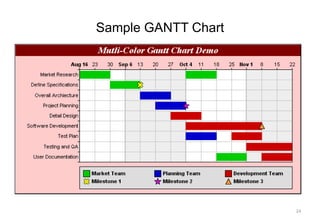
Implementation schedule can be depicted through bar or
Gantt chart indicates the project’s chronological sequence
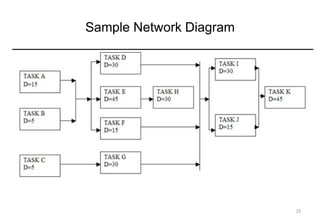
Network diagram is advised for large and complex projects
to cope with the inherent complexity of activity linkages in
the projects showing sequential interrelationship among
activities 23
5. OPERATION
Short Course on Environmental Planning
DCERP & HUMEIN Phils. Inc.
Sample GANTT Chart
24
Sample Network Diagram
25
6. EVALUATION
• To determine what went well/poorly and why
and how future efforts can be improved on the
basis of the knowledge gained
• Review or reappraisal which provides a
feedback mechanism to maintain high
standards of performance for the project itself
• Serves as a basis for improved project planning
and implementation
• Audit of project to insure resources accountability
26Short Course on Environmental Planning
DCERP & HUMEIN Phils. Inc.
6. EVALUATION
• Result in a careful documentation of experiences
• Can be done by the implementing body, other
interested group, and funding organization
• Assesses the worthwhileness of the project, i.e.,
whether it can be replicated
• Takes into account the aspects of project which
are unique, non-repeatable as well as success
and problems which have wider applicability
• Feedback from project output users and
beneficiaries are obtained
27Short Course on Environmental Planning
DCERP & HUMEIN Phils. Inc.
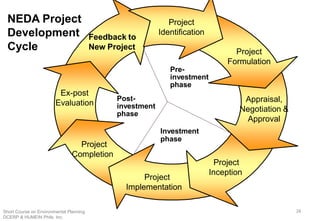
Feedback to
New Project
Ex-post
Evaluation
Project
Completion
Project
Implementation
Project
Inception
Project
Formulation
Appraisal,
Negotiation &
Approval
Project
Identification
Pre-
investment
phase
Investment
phase
Post-
investment
phase
NEDA Project
Development
Cycle
6
28Short Course on Environmental Planning
DCERP & HUMEIN Phils. Inc.
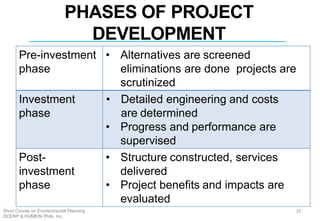
PHASES OF PROJECT
DEVELOPMENT
Pre-investment
phase
• Alternatives are screened
eliminations are done projects are
scrutinized
Investment
phase
• Detailed engineering and costs
are determined
• Progress and performance are
supervised
Post-
investment
phase
• Structure constructed, services
delivered
• Project benefits and impacts are
evaluated
29
7
Short Course on Environmental Planning
DCERP & HUMEIN Phils. Inc.
Short Course on Environmental Planning
DCERP & HUMEIN Phils. Inc.
REFERENCES
CERP 152: Environmental Project Planning and Administration Lecture
Materials
NEDA (1984). Project Development Manual.
NEDA (2014). Project Development Training
30
THANK YOU!
Short Course on Environmental Planning
DCERP & HUMEIN Phils. Inc.
31

project dev't cycle

  • 1.
    PROJECT DEVELOPMENT CYCLE ChristineJoyce B. Mendoza Assisstant Professor DCERP, College of Human Ecology University of the Philippines Los Baños 20 January 2017 Calapan City Short Course on Environmental Planning DCERP & HUMEIN Phils. Inc. 1
  • 2.
    LECTURE OBJECTIVES Short Courseon Environmental Planning DCERP & HUMEIN Phils. Inc. By the end of the lecture, participants are expected to explain each stage of the project development cycle 2
  • 3.
    PROJECT It is aset of planned activities designed to achieve a certain objective with given resources and within a specified period of time. The following are the attributes of a project: • Objectives • Finite duration or time frame • Specific physical boundary • Beneficiaries • Specified and quantified costs and benefits • Organization and management structure • Coordinated undertaking of inter-related activities 2 3Short Course on Environmental Planning DCERP & HUMEIN Phils. Inc.
  • 4.
    PROJECT CLASSIFICATION (NEDA) Stand-aloneproject can produce output on its own and can be implemented without the need to implement other projects Required project provides the enabling mechanism for another project(s) to produce output. The project can be analyzed as a stand-alone or as component of a package of products Needs-a-companion project - ability to produce output depends on the success of another project. The project needs to be packages with other project(s) that provide(s) the enabling mechanism 3 4Short Course on Environmental Planning DCERP & HUMEIN Phils. Inc.
  • 5.
    Sectors: health, education,agriculture, transport Objectives: economic growth, social equity and development, ecological integrity Number of purposes: single vs. multiple 4 PROJECT CLASSIFICATION 5Short Course on Environmental Planning DCERP & HUMEIN Phils. Inc.
  • 6.
    Area of coverageor geographical scope: national, local, regional, integrated area development projects Target beneficiaries: communal fishermen, youth, women, PWDs, farmers 4 PROJECT CLASSIFICATION 6Short Course on Environmental Planning DCERP & HUMEIN Phils. Inc.
  • 7.
    Implementation period orduration: short, medium or long-term project Methodology and process: BOT or PPP projects 4 PROJECT CLASSIFICATION 7Short Course on Environmental Planning DCERP & HUMEIN Phils. Inc.
  • 8.
    8Short Course onEnvironmental Planning DCERP & HUMEIN Phils. Inc. PROJECTDEVELOPMENT CYCLE Project Identification Project Preparation & Feasibility Analysis Project Appraisal, Approval & Financing Detailed Design/ Engineering Project Activation/ Organization Project Operation / Implementation Project Review / Re-planning Monitoring and Formative Evaluation Terminal and Ex- post facto Evaluation
  • 9.
    9Short Course onEnvironmental Planning DCERP & HUMEIN Phils. Inc. ADB PROJECT DEVELOPMENT CYCLE 1997 FEASIBILITY DESIGN AND ENGG IMPLEMENTATIONMONITORING AND EVALUATION PROJECT CONCEPT PRE-FEASIBILITY
  • 10.
    10 Conception /Identificatio n Formulation/ Preparation Analysis and Appraisal Implementation and Supervision Operations Evaluation Short Courseon Environmental Planning DCERP & HUMEIN Phils. Inc. PROJECTDEVELOPMENT CYCLE Starts with Project Ideas
  • 11.
    SOURCES OF PROJECTIDEAS • Development plans and strategies • Local government units or people’s representatives • Demand by interest groups or beneficiaries • Unused or unutilized material or human resources and opportunities • Problems or constraints in the development process • Private sponsors and enterprises • Need to complement other investments • Product of a dialogue between a country and international funding agencies 11Short Course on Environmental Planning DCERP & HUMEIN Phils. Inc.
  • 12.
    Before project ideascan be identified there is a need to organize and analyze. . . • available information on the desirable geographic project areas • economy and the natural resources • existing technologies, institutions, human resources and their development potential • experiences gained from past development projects 12Short Course on Environmental Planning DCERP & HUMEIN Phils. Inc.
  • 13.
    • Involves preliminaryselection of the project concept and of alternative design approaches • Indicates the general promise of the project ideas and the reasons for the choices made • Might need a pre-feasibility studies or orderly refinement up to the point where only the most suitable are retained 13 1. CONCEPTION / IDENTIFICATION Short Course on Environmental Planning DCERP & HUMEIN Phils. Inc.
  • 14.
    Selection criteria toscreen and modify project ideas 1. Technical soundness 2. Risk 3. Financing 4. Adequacy of skills and other inputs 5. Social or environmental costs 6. Commitment of the beneficiary 14Short Course on Environmental Planning DCERP & HUMEIN Phils. Inc.
  • 15.
    TOOLS IN PROJECTIDENTIFICATION • Participatory problemanalysis • Problem tree • Objective tree • Strategy identification and formulation • Alternatives formulation and analysis • Secondary data • Direct observations • Consultations and interviews with target groups, stakeholders, schools, etc. • Focus group discussions, questionnaires 11 15Short Course on Environmental Planning DCERP & HUMEIN Phils. Inc.
  • 16.
    2. FORMULATION /PREPARATION Consists of bringing a project defined to the point at which it can be appraised—whether and how it can be carried out effectively and at a cost comparing favorably with its expected contribution to economic and social development at a cost suitable for financing Includes conduct of a detailed feasibility study: distributional, environmental, other impacts of the project and prerequisites for successful implementation 16Short Course on Environmental Planning DCERP & HUMEIN Phils. Inc.
  • 17.
    FACTORS TO CONSIDERIN PROJECT FORMULATION • what items to produce and in what quantities • where and how to sell the items • appropriate type of design • project location • what methods of operation and maintenance are the best • type of technical and management assistance needed 17Short Course on Environmental Planning DCERP & HUMEIN Phils. Inc.
  • 18.
    3. ANALYSIS ANDAPPRAISAL Critical stage of the project cycle because it is the • culmination of the preparatory work • comprehensive review of all aspects of the project • lays the foundation for implementing the project and evaluating it when completed 18Short Course on Environmental Planning DCERP & HUMEIN Phils. Inc.
  • 19.
    3. ANALYSIS ANDAPPRAISAL Decision in this stage are based on: • overall feasibility and soundness of the project • priority of the project area • cost-benefit analysis • cost effectiveness analysis 19Short Course on Environmental Planning DCERP & HUMEIN Phils. Inc.
  • 20.
    4. IMPLEMENTATION /SUPERVISION • Involves final review of the design and timetable • Establishment of schedules and time frames, feedback and communication systems, MIS, etc. • Allocation of tasks to groups within the project organization • Decisions about procurement of equipment, resources and manpower (mobilization, training) • Exercise in collective problem solving, i.e., Identifying and dealing with problems that arise during implementation 20Short Course on Environmental Planning DCERP & HUMEIN Phils. Inc.
  • 21.
    A sound projectidentification and preparation will pave way for smooth implementation of projects. Flexibility in implementation is important. 21Short Course on Environmental Planning DCERP & HUMEIN Phils. Inc.
  • 22.
    5. OPERATIONS • Stagewhen the project is in full swing on-going • Production and marketing activities are performed • Takes into account the changing patterns that occur during the project’s life (monitoring) e.g. changing personnel and patterns of inputs • Needs continuous monitoring and control • Produces plans that need to be reviewed and updated to meet the changing situation • Reallocate resources to behind-schedule activities 22Short Course on Environmental Planning DCERP & HUMEIN Phils. Inc.
  • 23.
    Project execution systemaims to oversee the actual construction/installation operations carried out according to plan, specifications, work programs and schedules Implementation schedule can be depicted through bar or Gantt chart indicates the project’s chronological sequence Network diagram is advised for large and complex projects to cope with the inherent complexity of activity linkages in the projects showing sequential interrelationship among activities 23 5. OPERATION Short Course on Environmental Planning DCERP & HUMEIN Phils. Inc.
  • 24.
  • 25.
  • 26.
    6. EVALUATION • Todetermine what went well/poorly and why and how future efforts can be improved on the basis of the knowledge gained • Review or reappraisal which provides a feedback mechanism to maintain high standards of performance for the project itself • Serves as a basis for improved project planning and implementation • Audit of project to insure resources accountability 26Short Course on Environmental Planning DCERP & HUMEIN Phils. Inc.
  • 27.
    6. EVALUATION • Resultin a careful documentation of experiences • Can be done by the implementing body, other interested group, and funding organization • Assesses the worthwhileness of the project, i.e., whether it can be replicated • Takes into account the aspects of project which are unique, non-repeatable as well as success and problems which have wider applicability • Feedback from project output users and beneficiaries are obtained 27Short Course on Environmental Planning DCERP & HUMEIN Phils. Inc.
  • 28.
    Feedback to New Project Ex-post Evaluation Project Completion Project Implementation Project Inception Project Formulation Appraisal, Negotiation& Approval Project Identification Pre- investment phase Investment phase Post- investment phase NEDA Project Development Cycle 6 28Short Course on Environmental Planning DCERP & HUMEIN Phils. Inc.
  • 29.
    PHASES OF PROJECT DEVELOPMENT Pre-investment phase •Alternatives are screened eliminations are done projects are scrutinized Investment phase • Detailed engineering and costs are determined • Progress and performance are supervised Post- investment phase • Structure constructed, services delivered • Project benefits and impacts are evaluated 29 7 Short Course on Environmental Planning DCERP & HUMEIN Phils. Inc.
  • 30.
    Short Course onEnvironmental Planning DCERP & HUMEIN Phils. Inc. REFERENCES CERP 152: Environmental Project Planning and Administration Lecture Materials NEDA (1984). Project Development Manual. NEDA (2014). Project Development Training 30
  • 31.
    THANK YOU! Short Courseon Environmental Planning DCERP & HUMEIN Phils. Inc. 31