Click to edit Master title style
SCURP 2015: A Basic Course in Urban and Regional Planning (ABC in URP)
PLANNING PROCESS:
GOAL FORMULATION TO IMPLEMENTATION
Dr. Mark Mateo Morales, Ar., EnP.
08 March 2016
SCURP 2016
A BASIC COURSE IN URBAN AND REGIONAL PLANNING (ABC in URP)
Training and Extension Services Division
3/F Cariño Hall, School of Urban and Regional Planning
University of the Philippines - Diliman, Quezon City
7-11 March 2016
Click to edit Master title style
SCURP 2015: A Basic Course in Urban and Regional Planning (ABC in URP)
Presentation Outline
Goal Formulation
• Vision, Objectives, Strategies
Generation of Alternatives:
• Spatial Strategy
• Sectoral Strategy
Plan Implementation
• Investment Programming, Executive-
Legislative Agenda (ELA)
• Zoning, Taxes, Eminent Domain, Co-
mngt of Territorial Domain
SCURP 2016: A Basic Course in Urban and Regional Planning (ABC in URP)
Click to edit Master title style
SCURP 2015: A Basic Course in Urban and Regional Planning (ABC in URP)SCURP 2016: A Basic Course in Urban and Regional Planning (ABC in URP)
GOAL FORMULATION
Click to edit Master title style
SCURP 2015: A Basic Course in Urban and Regional Planning (ABC in URP)
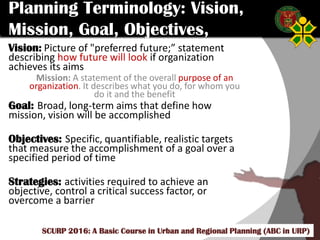
Planning Terminology: Vision,
Mission, Goal, Objectives,
StrategiesVision: Picture of "preferred future;” statement
describing how future will look if organization
achieves its aims
Mission: A statement of the overall purpose of an
organization. It describes what you do, for whom you
do it and the benefit
Goal: Broad, long-term aims that define how
mission, vision will be accomplished
Objectives: Specific, quantifiable, realistic targets
that measure the accomplishment of a goal over a
specified period of time
Strategies: activities required to achieve an
objective, control a critical success factor, or
overcome a barrier
SCURP 2016: A Basic Course in Urban and Regional Planning (ABC in URP)
Click to edit Master title style
SCURP 2015: A Basic Course in Urban and Regional Planning (ABC in URP)
Sources of Development
Goals
• Universal concept of ‘public interest’
• General welfare goals
• Provincial Physical Framework Plan
• Regional Physical Framework Plans
• National Framework for Physical Planning
• Local Communities
SCURP 2016: A Basic Course in Urban and Regional Planning (ABC in URP)
Click to edit Master title style
SCURP 2015: A Basic Course in Urban and Regional Planning (ABC in URP)
Broad concept that can be broken down
into smaller components such as:
1.Public Health and Safety - prevention of conditions
hazardous to physical well-being of community
2.Convenience – so movement of goods and people
generated, attracted in dev’t is efficient
3.Economy - least costly way of carrying out one’s
activities
4.Amenity - pleasantness of the environment as a
place to live, work and to spend one’s leisure time
Universal Concept of Public
Interest
SCURP 2016: A Basic Course in Urban and Regional Planning (ABC in URP)
Click to edit Master title style
SCURP 2015: A Basic Course in Urban and Regional Planning (ABC in URP)
• Preserve, enrich culture
• Promote health and safety
• Enhance right of people to a balanced ecology
• Encourage, support dev’t of appropriate and
self-reliant scientific and technological
capabilities
• Improve public morals
• Enhance economic prosperity and social justice
• Promote full employment
• Maintain peace and order
• Preserving comfort and convenience
General Welfare Goals: Sec. 16, LGC
(RA 7160)
SCURP 2016: A Basic Course in Urban and Regional Planning (ABC in URP)
Click to edit Master title style
SCURP 2015: A Basic Course in Urban and Regional Planning (ABC in URP)
RFPPs seek to achieve spatial
arrangement and location of land
use activities that:
a. Affect rational population distribution
b. Guarantee population access to basic
services
c. Ensure optimized, sustainable use of
resources, and
d. Protect integrity of environment
General Goals of Regional Framework
for Physical Planning (RFPP)
SCURP 2016: A Basic Course in Urban and Regional Planning (ABC in URP)
Click to edit Master title style
SCURP 2015: A Basic Course in Urban and Regional Planning (ABC in URP)
Food security: sufficient, affordable food products via local
production and/or importation
Environmental stability and ecological integrity: Appropriate
standards in natural resource mngt; balance demands of production
with ecosystem preservation
Rational urban dev’t: Sustainable city growth that complements
rural area growth
Spatial integration between consumption and production
areas: physical and economic integration via appropriate
infrastructure systems
General Goals of National Framework for
Physical Planning (NFPP 2001-2030)
SCURP 2016: A Basic Course in Urban and Regional Planning (ABC in URP)
Click to edit Master title style
SCURP 2015: A Basic Course in Urban and Regional Planning (ABC in URP)
Equitable access to physical & natural resources: just
distribution of opportunities in use, acquisition of land and other
resources
Public-private partnership: Shared responsibility bet. gov’t and
private sector in the dev’t and mngt of country’s resources.
People empowerment: Pragmatic, flexible and dynamic structures or
mechanisms that involve participation of stakeholders
Recognition of rights of indigenous people (IP): Ensuring IP’s
right to develop, control and use lands within their ancestral domain
Market orientation: Adopting interplay of market forces within the
framework of ecological and inter-generational factors in allocation, use of
land and physical resources
SCURP 2016: A Basic Course in Urban and Regional Planning (ABC in URP)
General Goals of National Framework for
Physical Planning (NFPP 2001-2030)
Click to edit Master title style
SCURP 2015: A Basic Course in Urban and Regional Planning (ABC in URP)
The ultimate source of dev’t goals for local
communities should be local residents
themselves
Although planners determine final form of these
goals, planners should be careful not to
substitute their own values & perceptions to
those articulated by the people
- Values and perceptions articulated by residents and
other stakeholders of the area
- Derived through various participatory and
consultative approaches
Local Communities
SCURP 2016: A Basic Course in Urban and Regional Planning (ABC in URP)
Click to edit Master title style
SCURP 2015: A Basic Course in Urban and Regional Planning (ABC in URP)
Example of Goals Transformed to
Vision Statement
Goal: defines “how mission, vision will be accomplished”
Vision: statement “how future will look if organization achieves its aims”
SCURP 2016: A Basic Course in Urban and Regional Planning (ABC in URP)
Example: General goals in RFPP:
a. Rational population distribution
b. Guarantee population access to basic services
c. Ensure optimized, sustainable use of resources, and
d. Protect integrity of environment
Transformed into LGU vision statement:
“a safe & secure city where empowered communities thrive
in unlimited opportunities; where natural environment is
protected amidst sustainable urban dev’t, and quality of life of
citizens are facilitated and upheld by its government.”
Click to edit Master title style
SCURP 2015: A Basic Course in Urban and Regional Planning (ABC in URP)
After vision statement is firmed up, plan
formulation process may proceed with
either CLUP or CDP dev’t, or both
simultaneously
However, it’s highly desirable to
prepare CLUP (spatial strategy) first
because it serves as framework or long-
term guide for all other plans of the
LGU
SCURP 2016: A Basic Course in Urban and Regional Planning (ABC in URP)
Click to edit Master title style
SCURP 2015: A Basic Course in Urban and Regional Planning (ABC in URP)SCURP 2016: A Basic Course in Urban and Regional Planning (ABC in URP)
GENERATION OF
ALTERNATIVES:
SPATIAL STRATEGY
Click to edit Master title style
SCURP 2015: A Basic Course in Urban and Regional Planning (ABC in URP)
To generate spatial strategies, we should have:
A. Goals and Objectives
B. Situation analysis showing strengths, weaknesses,
opportunities, and threats from:
• Ecological Profile and Field Verification (Area Familiarity)
• Sectoral Forecasting
• Disaster Risk Assessment
• Other Specialized Studies
• Accurate, Scaled Maps
Spatial Strategy Generation
SCURP 2016: A Basic Course in Urban and Regional Planning (ABC in URP)
Click to edit Master title style
SCURP 2015: A Basic Course in Urban and Regional Planning (ABC in URP)SCURP 2016: A Basic Course in Urban and Regional Planning (ABC in URP)
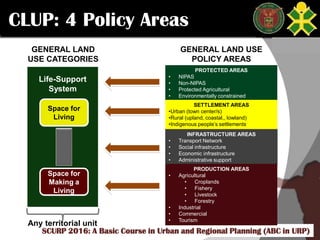
CLUP: 4 Policy Areas
Space for
Living
Space for
Making a
Living
Life-Support
System
GENERAL LAND
USE CATEGORIES
Any territorial unit
GENERAL LAND USE
POLICY AREAS
PROTECTED AREAS
• NIPAS
• Non-NIPAS
• Protected Agricultural
• Environmentally constrained
SETTLEMENT AREAS
•Urban (town center/s)
•Rural (upland, coastal,, lowland)
•Indigenous people’s settlements
INFRASTRUCTURE AREAS
• Transport Network
• Social infrastructure
• Economic infrastructure
• Administrative support
PRODUCTION AREAS
• Agricultural
• Croplands
• Fishery
• Livestock
• Forestry
• Industrial
• Commercial
• Tourism
Click to edit Master title style
SCURP 2015: A Basic Course in Urban and Regional Planning (ABC in URP)
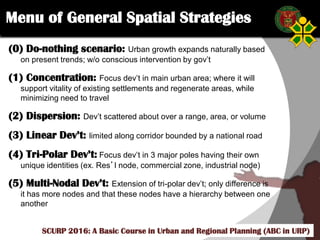
Menu of General Spatial Strategies
(0) Do-nothing scenario: Urban growth expands naturally based
on present trends; w/o conscious intervention by gov’t
(1) Concentration: Focus dev’t in main urban area; where it will
support vitality of existing settlements and regenerate areas, while
minimizing need to travel
(2) Dispersion: Dev’t scattered about over a range, area, or volume
(3) Linear Dev’t: limited along corridor bounded by a national road
(4) Tri-Polar Dev’t: Focus dev’t in 3 major poles having their own
unique identities (ex. Res’l node, commercial zone, industrial node)
(5) Multi-Nodal Dev’t: Extension of tri-polar dev’t; only difference is
it has more nodes and that these nodes have a hierarchy between one
another
SCURP 2016: A Basic Course in Urban and Regional Planning (ABC in URP)
Click to edit Master title style
SCURP 2015: A Basic Course in Urban and Regional Planning (ABC in URP)SCURP 2016: A Basic Course in Urban and Regional Planning (ABC in URP)
GENERATION OF
ALTERNATIVES:
SECTORAL STRATEGY
Click to edit Master title style
SCURP 2015: A Basic Course in Urban and Regional Planning (ABC in URP)
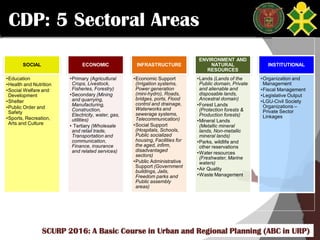
Whereas the term “comprehensive” in
the CLUP is to be understood in its
spatial or territorial sense, in the CDP
it means “multi-sectoral”
to be comprehensive the CDP must cover
5 development sectors: social, economic,
physical, environmental and institutional
Sectoral Strategy Generation
SCURP 2016: A Basic Course in Urban and Regional Planning (ABC in URP)
Click to edit Master title style
SCURP 2015: A Basic Course in Urban and Regional Planning (ABC in URP)
The Sectors & Their Concerns
Social Sector
Concerned with changes in the area or community relative to:
1. Social characteristics of area population
(demographic structure; ethno-linguistic features, e.g.
race, tribe & language, cultural norms and practices)
2. Availability of and access to social services
(education, healthcare, security, etc; affordability of such
services)
3. Social justice (distribution of income, wealth,
opportunities, level of well-being)
SCURP 2016: A Basic Course in Urban and Regional Planning (ABC in URP)
Click to edit Master title style
SCURP 2015: A Basic Course in Urban and Regional Planning (ABC in URP)
The Sectors & Their Concerns
Economic Sector
Enhancement of economic prosperity is the
principal concern of the economic sector
1. Full employment promotion (search of
possible sources and types of employment and
livelihood)
2. Food self-sufficiency or security (reduce
importation; savings invested in other
endeavors)
SCURP 2016: A Basic Course in Urban and Regional Planning (ABC in URP)
Click to edit Master title style
SCURP 2015: A Basic Course in Urban and Regional Planning (ABC in URP)
The Sectors & Their Concerns
Infrastructure Sector
Concerned with providing adequate physical base for
social and economic development
In identifying local infrastructure needs, this sector should
consider infrastructure support for, among other things:
• Preferred spatial strategy / urban form
• Projected levels of food self-sufficiency and production targets
• Eliminating backlogs in social service provision
• Upgrading quality of services and facilities to desired
standards
• Reducing vulnerability of local population to environmental
risks and disasters.
• Maintaining the integrity of the environment
SCURP 2016: A Basic Course in Urban and Regional Planning (ABC in URP)
Click to edit Master title style
SCURP 2015: A Basic Course in Urban and Regional Planning (ABC in URP)
The Sectors & Their Concerns
Environment Sector
Ensure that the proper measures to safeguard and
conserve land, minerals, marine, forest and other
resources are enacted
Programs and projects identified in the environment
sector is limited to those involving natural resource
protection and conservation.
Projects involving utilization and exploitation of natural
resources should be taken up in the economic sector.
SCURP 2016: A Basic Course in Urban and Regional Planning (ABC in URP)
Click to edit Master title style
SCURP 2015: A Basic Course in Urban and Regional Planning (ABC in URP)
The Sectors & Their Concerns
Institutional Sector
coordinates, integrates and supports the
other sectors through various mechanisms
and arrangements
Principal concern of the sector is to see that
the LGU organizational structure and
bureaucracy are properly tooled to manage
local growth and development
SCURP 2016: A Basic Course in Urban and Regional Planning (ABC in URP)
Click to edit Master title style
SCURP 2015: A Basic Course in Urban and Regional Planning (ABC in URP)
CDP: 5 Sectoral Areas
SOCIAL
•Education
•Health and Nutrition
•Social Welfare and
Development
•Shelter
•Public Order and
Safety
•Sports, Recreation,
Arts and Culture
ECONOMIC
•Primary (Agricultural
Crops, Livestock,
Fisheries, Forestry)
•Secondary (Mining
and quarrying,
Manufacturing,
Construction,
Electricity, water, gas,
utilities)
• Tertiary (Wholesale
and retail trade,
Transportation and
communication,
Finance, insurance
and related services)
INFRASTRUCTURE
•Economic Support
(Irrigation systems,
Power generation
(mini-hydro), Roads,
bridges, ports, Flood
control and drainage,
Waterworks and
sewerage systems,
Telecommunication)
•Social Support
(Hospitals, Schools,
Public socialized
housing, Facilities for
the aged, infirm,
disadvantaged
sectors)
•Public Administrative
Support (Government
buildings, Jails,
Freedom parks and
Public assembly
areas)
ENVIRONMENT AND
NATURAL
RESOURCES
•Lands (Lands of the
Public domain, Private
and alienable and
disposable lands,
Ancestral domain)
•Forest Lands
(Protection forests &
Production forests)
•Mineral Lands
(Metallic mineral
lands, Non-metallic
mineral lands)
•Parks, wildlife and
other reservations
•Water resources
(Freshwater, Marine
waters)
•Air Quality
•Waste Management
INSTITUTIONAL
•Organization and
Management
•Fiscal Management
•Legislative Output
•LGU-Civil Society
Organizations –
Private Sector
Linkages
SCURP 2016: A Basic Course in Urban and Regional Planning (ABC in URP)
Click to edit Master title style
SCURP 2015: A Basic Course in Urban and Regional Planning (ABC in URP)
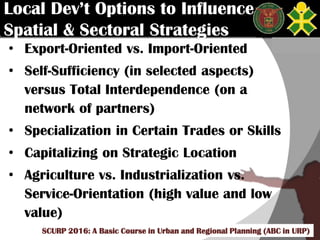
Local Dev’t Options to Influence
Spatial & Sectoral Strategies
• Export-Oriented vs. Import-Oriented
• Self-Sufficiency (in selected aspects)
versus Total Interdependence (on a
network of partners)
• Specialization in Certain Trades or Skills
• Capitalizing on Strategic Location
• Agriculture vs. Industrialization vs.
Service-Orientation (high value and low
value)
SCURP 2016: A Basic Course in Urban and Regional Planning (ABC in URP)
Click to edit Master title style
SCURP 2015: A Basic Course in Urban and Regional Planning (ABC in URP)
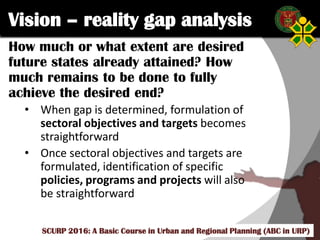
Vision – reality gap analysis
How much or what extent are desired
future states already attained? How
much remains to be done to fully
achieve the desired end?
• When gap is determined, formulation of
sectoral objectives and targets becomes
straightforward
• Once sectoral objectives and targets are
formulated, identification of specific
policies, programs and projects will also
be straightforward
SCURP 2016: A Basic Course in Urban and Regional Planning (ABC in URP)
Click to edit Master title style
SCURP 2015: A Basic Course in Urban and Regional Planning (ABC in URP)SCURP 2016: A Basic Course in Urban and Regional Planning (ABC in URP)
PLAN IMPLEMENTATION:
INVESTMENT
PROGRAMMING, ELA
Click to edit Master title style
SCURP 2015: A Basic Course in Urban and Regional Planning (ABC in URP)
Local Dev’t Investment Program
The Local Dev’t Investment Program
(LDIP) is the principal instrument for
implementing the CDP and to some
extent, certain aspects of the CLUP
• LDIP links the plan to the budget, thus
putting into effect the directive of the LGC
that “local budgets shall operationalize
approved local development plans (sec.
305, i, RA 7160)
SCURP 2016: A Basic Course in Urban and Regional Planning (ABC in URP)
Click to edit Master title style
SCURP 2015: A Basic Course in Urban and Regional Planning (ABC in URP)
Executive-Legislative Agenda (ELA)
A document mutually developed and
agreed upon by Executive and Legislative
departments of LGU
Contains major development thrusts and
priorities of the department for their 3-
year term of office consistent with the
development vision and mission of the
locality”
SCURP 2016: A Basic Course in Urban and Regional Planning (ABC in URP)
Click to edit Master title style
SCURP 2015: A Basic Course in Urban and Regional Planning (ABC in URP)
Takes off from CDP of LGU; contains
governance program of a province, city or
municipality for a given period, usually 3
years, corresponding to term of office of
elected officials
•Promotes partnership bet. local executive and
legislative, and involves multi-stakeholders in
identification & programming of 3-year LGU
development priorities
•Implementation instrument that strengthens use of
LGU information & other plans, & stakeholder
agenda; building on the resources & capacities
required to carry out LGUs dev’t priorities
Executive-Legislative Agenda (ELA)
SCURP 2016: A Basic Course in Urban and Regional Planning (ABC in URP)
Click to edit Master title style
SCURP 2015: A Basic Course in Urban and Regional Planning (ABC in URP)SCURP 2016: A Basic Course in Urban and Regional Planning (ABC in URP)
PLAN IMPLEMENTATION:
ZONING, TAXES, EMINENT
DOMAIN, CO-MNGT OF
TERRITORIAL DOMAIN
Click to edit Master title style
SCURP 2015: A Basic Course in Urban and Regional Planning (ABC in URP)
Zoning
Division of community into zones or districts
(e.g. commercial, residential, industrial,
institutional, etc.) acco. to present and
potential uses of land to maximize, regulate
and direct usage and development in
accordance with CLUP of the community
Concerned primarily with land usage and
control of population density through
imposition of building heights, bulk, open
space and density provisions in a given area
---Housing and Land Use Regulatory Board
SCURP 2016: A Basic Course in Urban and Regional Planning (ABC in URP)
Click to edit Master title style
SCURP 2015: A Basic Course in Urban and Regional Planning (ABC in URP)
Function of Zoning
Tool of public control over pattern of development
in a community; prescribe reasonable limits &
restraints over use of property; to directly
intervene in use of private property for the
common good.
“Zoning is the real power behind planning, and it
is zoning that gives teeth to planning ideals and
objectives. Planning as such cannot require that
land be used in a particular manner, but zoning
can.”
(Linowes and Allensmith)
SCURP 2016: A Basic Course in Urban and Regional Planning (ABC in URP)
Click to edit Master title style
SCURP 2015: A Basic Course in Urban and Regional Planning (ABC in URP)
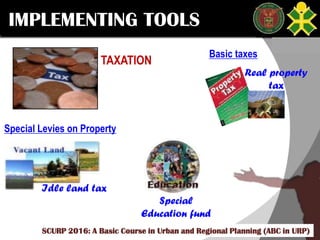
IMPLEMENTING TOOLS
TAXATION
Basic taxes
Real property
tax
Special Levies on Property
Idle land tax
Special
Education fund
SCURP 2016: A Basic Course in Urban and Regional Planning (ABC in URP)
Click to edit Master title style
SCURP 2015: A Basic Course in Urban and Regional Planning (ABC in URP)SCURP 2016: A Basic Course in Urban and Regional Planning (ABC in URP)
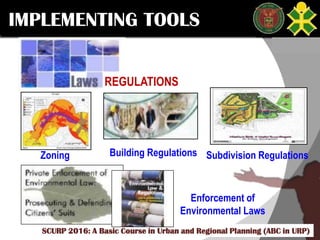
IMPLEMENTING TOOLS
REGULATIONS
Zoning Building Regulations Subdivision Regulations
Enforcement of
Environmental Laws
Click to edit Master title style
SCURP 2015: A Basic Course in Urban and Regional Planning (ABC in URP)
Eminent Domain
The taking of private property for
public purpose. This power of the
State is limited by constitutional
safeguards:
• There must be due process
• Just compensation must be paid
Acquisition of private land for benefit of the
poor & landless is now considered public
purpose (RA 7160, Sec. 19; RA 6657)
SCURP 2016: A Basic Course in Urban and Regional Planning (ABC in URP)
Click to edit Master title style
SCURP 2015: A Basic Course in Urban and Regional Planning (ABC in URP)
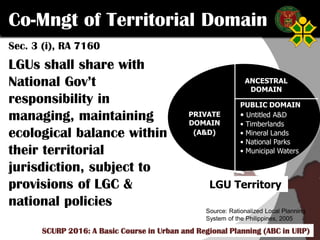
Co-Mngt of Territorial Domain
Sec. 3 (i), RA 7160
LGUs shall share with
National Gov’t
responsibility in
managing, maintaining
ecological balance within
their territorial
jurisdiction, subject to
provisions of LGC &
national policies
PRIVATE
DOMAIN
(A&D)
ANCESTRAL
DOMAIN
PUBLIC DOMAIN
• Untitled A&D
• Timberlands
• Mineral Lands
• National Parks
• Municipal Waters
LGU Territory
Source: Rationalized Local Planning
System of the Philippines, 2005
SCURP 2016: A Basic Course in Urban and Regional Planning (ABC in URP)
Click to edit Master title style
SCURP 2015: A Basic Course in Urban and Regional Planning (ABC in URP)
Thank you for your
attention!

dr. morales planning process

  • 1.
    Click to editMaster title style SCURP 2015: A Basic Course in Urban and Regional Planning (ABC in URP) PLANNING PROCESS: GOAL FORMULATION TO IMPLEMENTATION Dr. Mark Mateo Morales, Ar., EnP. 08 March 2016 SCURP 2016 A BASIC COURSE IN URBAN AND REGIONAL PLANNING (ABC in URP) Training and Extension Services Division 3/F Cariño Hall, School of Urban and Regional Planning University of the Philippines - Diliman, Quezon City 7-11 March 2016
  • 2.
    Click to editMaster title style SCURP 2015: A Basic Course in Urban and Regional Planning (ABC in URP) Presentation Outline Goal Formulation • Vision, Objectives, Strategies Generation of Alternatives: • Spatial Strategy • Sectoral Strategy Plan Implementation • Investment Programming, Executive- Legislative Agenda (ELA) • Zoning, Taxes, Eminent Domain, Co- mngt of Territorial Domain SCURP 2016: A Basic Course in Urban and Regional Planning (ABC in URP)
  • 3.
    Click to editMaster title style SCURP 2015: A Basic Course in Urban and Regional Planning (ABC in URP)SCURP 2016: A Basic Course in Urban and Regional Planning (ABC in URP) GOAL FORMULATION
  • 4.
    Click to editMaster title style SCURP 2015: A Basic Course in Urban and Regional Planning (ABC in URP) Planning Terminology: Vision, Mission, Goal, Objectives, StrategiesVision: Picture of "preferred future;” statement describing how future will look if organization achieves its aims Mission: A statement of the overall purpose of an organization. It describes what you do, for whom you do it and the benefit Goal: Broad, long-term aims that define how mission, vision will be accomplished Objectives: Specific, quantifiable, realistic targets that measure the accomplishment of a goal over a specified period of time Strategies: activities required to achieve an objective, control a critical success factor, or overcome a barrier SCURP 2016: A Basic Course in Urban and Regional Planning (ABC in URP)
  • 5.
    Click to editMaster title style SCURP 2015: A Basic Course in Urban and Regional Planning (ABC in URP) Sources of Development Goals • Universal concept of ‘public interest’ • General welfare goals • Provincial Physical Framework Plan • Regional Physical Framework Plans • National Framework for Physical Planning • Local Communities SCURP 2016: A Basic Course in Urban and Regional Planning (ABC in URP)
  • 6.
    Click to editMaster title style SCURP 2015: A Basic Course in Urban and Regional Planning (ABC in URP) Broad concept that can be broken down into smaller components such as: 1.Public Health and Safety - prevention of conditions hazardous to physical well-being of community 2.Convenience – so movement of goods and people generated, attracted in dev’t is efficient 3.Economy - least costly way of carrying out one’s activities 4.Amenity - pleasantness of the environment as a place to live, work and to spend one’s leisure time Universal Concept of Public Interest SCURP 2016: A Basic Course in Urban and Regional Planning (ABC in URP)
  • 7.
    Click to editMaster title style SCURP 2015: A Basic Course in Urban and Regional Planning (ABC in URP) • Preserve, enrich culture • Promote health and safety • Enhance right of people to a balanced ecology • Encourage, support dev’t of appropriate and self-reliant scientific and technological capabilities • Improve public morals • Enhance economic prosperity and social justice • Promote full employment • Maintain peace and order • Preserving comfort and convenience General Welfare Goals: Sec. 16, LGC (RA 7160) SCURP 2016: A Basic Course in Urban and Regional Planning (ABC in URP)
  • 8.
    Click to editMaster title style SCURP 2015: A Basic Course in Urban and Regional Planning (ABC in URP) RFPPs seek to achieve spatial arrangement and location of land use activities that: a. Affect rational population distribution b. Guarantee population access to basic services c. Ensure optimized, sustainable use of resources, and d. Protect integrity of environment General Goals of Regional Framework for Physical Planning (RFPP) SCURP 2016: A Basic Course in Urban and Regional Planning (ABC in URP)
  • 9.
    Click to editMaster title style SCURP 2015: A Basic Course in Urban and Regional Planning (ABC in URP) Food security: sufficient, affordable food products via local production and/or importation Environmental stability and ecological integrity: Appropriate standards in natural resource mngt; balance demands of production with ecosystem preservation Rational urban dev’t: Sustainable city growth that complements rural area growth Spatial integration between consumption and production areas: physical and economic integration via appropriate infrastructure systems General Goals of National Framework for Physical Planning (NFPP 2001-2030) SCURP 2016: A Basic Course in Urban and Regional Planning (ABC in URP)
  • 10.
    Click to editMaster title style SCURP 2015: A Basic Course in Urban and Regional Planning (ABC in URP) Equitable access to physical & natural resources: just distribution of opportunities in use, acquisition of land and other resources Public-private partnership: Shared responsibility bet. gov’t and private sector in the dev’t and mngt of country’s resources. People empowerment: Pragmatic, flexible and dynamic structures or mechanisms that involve participation of stakeholders Recognition of rights of indigenous people (IP): Ensuring IP’s right to develop, control and use lands within their ancestral domain Market orientation: Adopting interplay of market forces within the framework of ecological and inter-generational factors in allocation, use of land and physical resources SCURP 2016: A Basic Course in Urban and Regional Planning (ABC in URP) General Goals of National Framework for Physical Planning (NFPP 2001-2030)
  • 11.
    Click to editMaster title style SCURP 2015: A Basic Course in Urban and Regional Planning (ABC in URP) The ultimate source of dev’t goals for local communities should be local residents themselves Although planners determine final form of these goals, planners should be careful not to substitute their own values & perceptions to those articulated by the people - Values and perceptions articulated by residents and other stakeholders of the area - Derived through various participatory and consultative approaches Local Communities SCURP 2016: A Basic Course in Urban and Regional Planning (ABC in URP)
  • 12.
    Click to editMaster title style SCURP 2015: A Basic Course in Urban and Regional Planning (ABC in URP) Example of Goals Transformed to Vision Statement Goal: defines “how mission, vision will be accomplished” Vision: statement “how future will look if organization achieves its aims” SCURP 2016: A Basic Course in Urban and Regional Planning (ABC in URP) Example: General goals in RFPP: a. Rational population distribution b. Guarantee population access to basic services c. Ensure optimized, sustainable use of resources, and d. Protect integrity of environment Transformed into LGU vision statement: “a safe & secure city where empowered communities thrive in unlimited opportunities; where natural environment is protected amidst sustainable urban dev’t, and quality of life of citizens are facilitated and upheld by its government.”
  • 13.
    Click to editMaster title style SCURP 2015: A Basic Course in Urban and Regional Planning (ABC in URP) After vision statement is firmed up, plan formulation process may proceed with either CLUP or CDP dev’t, or both simultaneously However, it’s highly desirable to prepare CLUP (spatial strategy) first because it serves as framework or long- term guide for all other plans of the LGU SCURP 2016: A Basic Course in Urban and Regional Planning (ABC in URP)
  • 14.
    Click to editMaster title style SCURP 2015: A Basic Course in Urban and Regional Planning (ABC in URP)SCURP 2016: A Basic Course in Urban and Regional Planning (ABC in URP) GENERATION OF ALTERNATIVES: SPATIAL STRATEGY
  • 15.
    Click to editMaster title style SCURP 2015: A Basic Course in Urban and Regional Planning (ABC in URP) To generate spatial strategies, we should have: A. Goals and Objectives B. Situation analysis showing strengths, weaknesses, opportunities, and threats from: • Ecological Profile and Field Verification (Area Familiarity) • Sectoral Forecasting • Disaster Risk Assessment • Other Specialized Studies • Accurate, Scaled Maps Spatial Strategy Generation SCURP 2016: A Basic Course in Urban and Regional Planning (ABC in URP)
  • 16.
    Click to editMaster title style SCURP 2015: A Basic Course in Urban and Regional Planning (ABC in URP)SCURP 2016: A Basic Course in Urban and Regional Planning (ABC in URP) CLUP: 4 Policy Areas Space for Living Space for Making a Living Life-Support System GENERAL LAND USE CATEGORIES Any territorial unit GENERAL LAND USE POLICY AREAS PROTECTED AREAS • NIPAS • Non-NIPAS • Protected Agricultural • Environmentally constrained SETTLEMENT AREAS •Urban (town center/s) •Rural (upland, coastal,, lowland) •Indigenous people’s settlements INFRASTRUCTURE AREAS • Transport Network • Social infrastructure • Economic infrastructure • Administrative support PRODUCTION AREAS • Agricultural • Croplands • Fishery • Livestock • Forestry • Industrial • Commercial • Tourism
  • 17.
    Click to editMaster title style SCURP 2015: A Basic Course in Urban and Regional Planning (ABC in URP) Menu of General Spatial Strategies (0) Do-nothing scenario: Urban growth expands naturally based on present trends; w/o conscious intervention by gov’t (1) Concentration: Focus dev’t in main urban area; where it will support vitality of existing settlements and regenerate areas, while minimizing need to travel (2) Dispersion: Dev’t scattered about over a range, area, or volume (3) Linear Dev’t: limited along corridor bounded by a national road (4) Tri-Polar Dev’t: Focus dev’t in 3 major poles having their own unique identities (ex. Res’l node, commercial zone, industrial node) (5) Multi-Nodal Dev’t: Extension of tri-polar dev’t; only difference is it has more nodes and that these nodes have a hierarchy between one another SCURP 2016: A Basic Course in Urban and Regional Planning (ABC in URP)
  • 18.
    Click to editMaster title style SCURP 2015: A Basic Course in Urban and Regional Planning (ABC in URP)SCURP 2016: A Basic Course in Urban and Regional Planning (ABC in URP) GENERATION OF ALTERNATIVES: SECTORAL STRATEGY
  • 19.
    Click to editMaster title style SCURP 2015: A Basic Course in Urban and Regional Planning (ABC in URP) Whereas the term “comprehensive” in the CLUP is to be understood in its spatial or territorial sense, in the CDP it means “multi-sectoral” to be comprehensive the CDP must cover 5 development sectors: social, economic, physical, environmental and institutional Sectoral Strategy Generation SCURP 2016: A Basic Course in Urban and Regional Planning (ABC in URP)
  • 20.
    Click to editMaster title style SCURP 2015: A Basic Course in Urban and Regional Planning (ABC in URP) The Sectors & Their Concerns Social Sector Concerned with changes in the area or community relative to: 1. Social characteristics of area population (demographic structure; ethno-linguistic features, e.g. race, tribe & language, cultural norms and practices) 2. Availability of and access to social services (education, healthcare, security, etc; affordability of such services) 3. Social justice (distribution of income, wealth, opportunities, level of well-being) SCURP 2016: A Basic Course in Urban and Regional Planning (ABC in URP)
  • 21.
    Click to editMaster title style SCURP 2015: A Basic Course in Urban and Regional Planning (ABC in URP) The Sectors & Their Concerns Economic Sector Enhancement of economic prosperity is the principal concern of the economic sector 1. Full employment promotion (search of possible sources and types of employment and livelihood) 2. Food self-sufficiency or security (reduce importation; savings invested in other endeavors) SCURP 2016: A Basic Course in Urban and Regional Planning (ABC in URP)
  • 22.
    Click to editMaster title style SCURP 2015: A Basic Course in Urban and Regional Planning (ABC in URP) The Sectors & Their Concerns Infrastructure Sector Concerned with providing adequate physical base for social and economic development In identifying local infrastructure needs, this sector should consider infrastructure support for, among other things: • Preferred spatial strategy / urban form • Projected levels of food self-sufficiency and production targets • Eliminating backlogs in social service provision • Upgrading quality of services and facilities to desired standards • Reducing vulnerability of local population to environmental risks and disasters. • Maintaining the integrity of the environment SCURP 2016: A Basic Course in Urban and Regional Planning (ABC in URP)
  • 23.
    Click to editMaster title style SCURP 2015: A Basic Course in Urban and Regional Planning (ABC in URP) The Sectors & Their Concerns Environment Sector Ensure that the proper measures to safeguard and conserve land, minerals, marine, forest and other resources are enacted Programs and projects identified in the environment sector is limited to those involving natural resource protection and conservation. Projects involving utilization and exploitation of natural resources should be taken up in the economic sector. SCURP 2016: A Basic Course in Urban and Regional Planning (ABC in URP)
  • 24.
    Click to editMaster title style SCURP 2015: A Basic Course in Urban and Regional Planning (ABC in URP) The Sectors & Their Concerns Institutional Sector coordinates, integrates and supports the other sectors through various mechanisms and arrangements Principal concern of the sector is to see that the LGU organizational structure and bureaucracy are properly tooled to manage local growth and development SCURP 2016: A Basic Course in Urban and Regional Planning (ABC in URP)
  • 25.
    Click to editMaster title style SCURP 2015: A Basic Course in Urban and Regional Planning (ABC in URP) CDP: 5 Sectoral Areas SOCIAL •Education •Health and Nutrition •Social Welfare and Development •Shelter •Public Order and Safety •Sports, Recreation, Arts and Culture ECONOMIC •Primary (Agricultural Crops, Livestock, Fisheries, Forestry) •Secondary (Mining and quarrying, Manufacturing, Construction, Electricity, water, gas, utilities) • Tertiary (Wholesale and retail trade, Transportation and communication, Finance, insurance and related services) INFRASTRUCTURE •Economic Support (Irrigation systems, Power generation (mini-hydro), Roads, bridges, ports, Flood control and drainage, Waterworks and sewerage systems, Telecommunication) •Social Support (Hospitals, Schools, Public socialized housing, Facilities for the aged, infirm, disadvantaged sectors) •Public Administrative Support (Government buildings, Jails, Freedom parks and Public assembly areas) ENVIRONMENT AND NATURAL RESOURCES •Lands (Lands of the Public domain, Private and alienable and disposable lands, Ancestral domain) •Forest Lands (Protection forests & Production forests) •Mineral Lands (Metallic mineral lands, Non-metallic mineral lands) •Parks, wildlife and other reservations •Water resources (Freshwater, Marine waters) •Air Quality •Waste Management INSTITUTIONAL •Organization and Management •Fiscal Management •Legislative Output •LGU-Civil Society Organizations – Private Sector Linkages SCURP 2016: A Basic Course in Urban and Regional Planning (ABC in URP)
  • 26.
    Click to editMaster title style SCURP 2015: A Basic Course in Urban and Regional Planning (ABC in URP) Local Dev’t Options to Influence Spatial & Sectoral Strategies • Export-Oriented vs. Import-Oriented • Self-Sufficiency (in selected aspects) versus Total Interdependence (on a network of partners) • Specialization in Certain Trades or Skills • Capitalizing on Strategic Location • Agriculture vs. Industrialization vs. Service-Orientation (high value and low value) SCURP 2016: A Basic Course in Urban and Regional Planning (ABC in URP)
  • 27.
    Click to editMaster title style SCURP 2015: A Basic Course in Urban and Regional Planning (ABC in URP) Vision – reality gap analysis How much or what extent are desired future states already attained? How much remains to be done to fully achieve the desired end? • When gap is determined, formulation of sectoral objectives and targets becomes straightforward • Once sectoral objectives and targets are formulated, identification of specific policies, programs and projects will also be straightforward SCURP 2016: A Basic Course in Urban and Regional Planning (ABC in URP)
  • 28.
    Click to editMaster title style SCURP 2015: A Basic Course in Urban and Regional Planning (ABC in URP)SCURP 2016: A Basic Course in Urban and Regional Planning (ABC in URP) PLAN IMPLEMENTATION: INVESTMENT PROGRAMMING, ELA
  • 29.
    Click to editMaster title style SCURP 2015: A Basic Course in Urban and Regional Planning (ABC in URP) Local Dev’t Investment Program The Local Dev’t Investment Program (LDIP) is the principal instrument for implementing the CDP and to some extent, certain aspects of the CLUP • LDIP links the plan to the budget, thus putting into effect the directive of the LGC that “local budgets shall operationalize approved local development plans (sec. 305, i, RA 7160) SCURP 2016: A Basic Course in Urban and Regional Planning (ABC in URP)
  • 30.
    Click to editMaster title style SCURP 2015: A Basic Course in Urban and Regional Planning (ABC in URP) Executive-Legislative Agenda (ELA) A document mutually developed and agreed upon by Executive and Legislative departments of LGU Contains major development thrusts and priorities of the department for their 3- year term of office consistent with the development vision and mission of the locality” SCURP 2016: A Basic Course in Urban and Regional Planning (ABC in URP)
  • 31.
    Click to editMaster title style SCURP 2015: A Basic Course in Urban and Regional Planning (ABC in URP) Takes off from CDP of LGU; contains governance program of a province, city or municipality for a given period, usually 3 years, corresponding to term of office of elected officials •Promotes partnership bet. local executive and legislative, and involves multi-stakeholders in identification & programming of 3-year LGU development priorities •Implementation instrument that strengthens use of LGU information & other plans, & stakeholder agenda; building on the resources & capacities required to carry out LGUs dev’t priorities Executive-Legislative Agenda (ELA) SCURP 2016: A Basic Course in Urban and Regional Planning (ABC in URP)
  • 32.
    Click to editMaster title style SCURP 2015: A Basic Course in Urban and Regional Planning (ABC in URP)SCURP 2016: A Basic Course in Urban and Regional Planning (ABC in URP) PLAN IMPLEMENTATION: ZONING, TAXES, EMINENT DOMAIN, CO-MNGT OF TERRITORIAL DOMAIN
  • 33.
    Click to editMaster title style SCURP 2015: A Basic Course in Urban and Regional Planning (ABC in URP) Zoning Division of community into zones or districts (e.g. commercial, residential, industrial, institutional, etc.) acco. to present and potential uses of land to maximize, regulate and direct usage and development in accordance with CLUP of the community Concerned primarily with land usage and control of population density through imposition of building heights, bulk, open space and density provisions in a given area ---Housing and Land Use Regulatory Board SCURP 2016: A Basic Course in Urban and Regional Planning (ABC in URP)
  • 34.
    Click to editMaster title style SCURP 2015: A Basic Course in Urban and Regional Planning (ABC in URP) Function of Zoning Tool of public control over pattern of development in a community; prescribe reasonable limits & restraints over use of property; to directly intervene in use of private property for the common good. “Zoning is the real power behind planning, and it is zoning that gives teeth to planning ideals and objectives. Planning as such cannot require that land be used in a particular manner, but zoning can.” (Linowes and Allensmith) SCURP 2016: A Basic Course in Urban and Regional Planning (ABC in URP)
  • 35.
    Click to editMaster title style SCURP 2015: A Basic Course in Urban and Regional Planning (ABC in URP) IMPLEMENTING TOOLS TAXATION Basic taxes Real property tax Special Levies on Property Idle land tax Special Education fund SCURP 2016: A Basic Course in Urban and Regional Planning (ABC in URP)
  • 36.
    Click to editMaster title style SCURP 2015: A Basic Course in Urban and Regional Planning (ABC in URP)SCURP 2016: A Basic Course in Urban and Regional Planning (ABC in URP) IMPLEMENTING TOOLS REGULATIONS Zoning Building Regulations Subdivision Regulations Enforcement of Environmental Laws
  • 37.
    Click to editMaster title style SCURP 2015: A Basic Course in Urban and Regional Planning (ABC in URP) Eminent Domain The taking of private property for public purpose. This power of the State is limited by constitutional safeguards: • There must be due process • Just compensation must be paid Acquisition of private land for benefit of the poor & landless is now considered public purpose (RA 7160, Sec. 19; RA 6657) SCURP 2016: A Basic Course in Urban and Regional Planning (ABC in URP)
  • 38.
    Click to editMaster title style SCURP 2015: A Basic Course in Urban and Regional Planning (ABC in URP) Co-Mngt of Territorial Domain Sec. 3 (i), RA 7160 LGUs shall share with National Gov’t responsibility in managing, maintaining ecological balance within their territorial jurisdiction, subject to provisions of LGC & national policies PRIVATE DOMAIN (A&D) ANCESTRAL DOMAIN PUBLIC DOMAIN • Untitled A&D • Timberlands • Mineral Lands • National Parks • Municipal Waters LGU Territory Source: Rationalized Local Planning System of the Philippines, 2005 SCURP 2016: A Basic Course in Urban and Regional Planning (ABC in URP)
  • 39.
    Click to editMaster title style SCURP 2015: A Basic Course in Urban and Regional Planning (ABC in URP) Thank you for your attention!