PRESENTATION BY….

               R.RAGHAVENDRA
                I/II M.Tech, CTM
CONTENTS
          :
 1. Introduction
  2.   Earlier Studies
  3.   Transport Demand Forecast
  4.   Planning and Design Parameters
  5.   System & Engineering Works
  6.   Cost Estimates
  7.   Economics & Financial Analysis
  8.   Conclusion
INTRODUCTION
      :
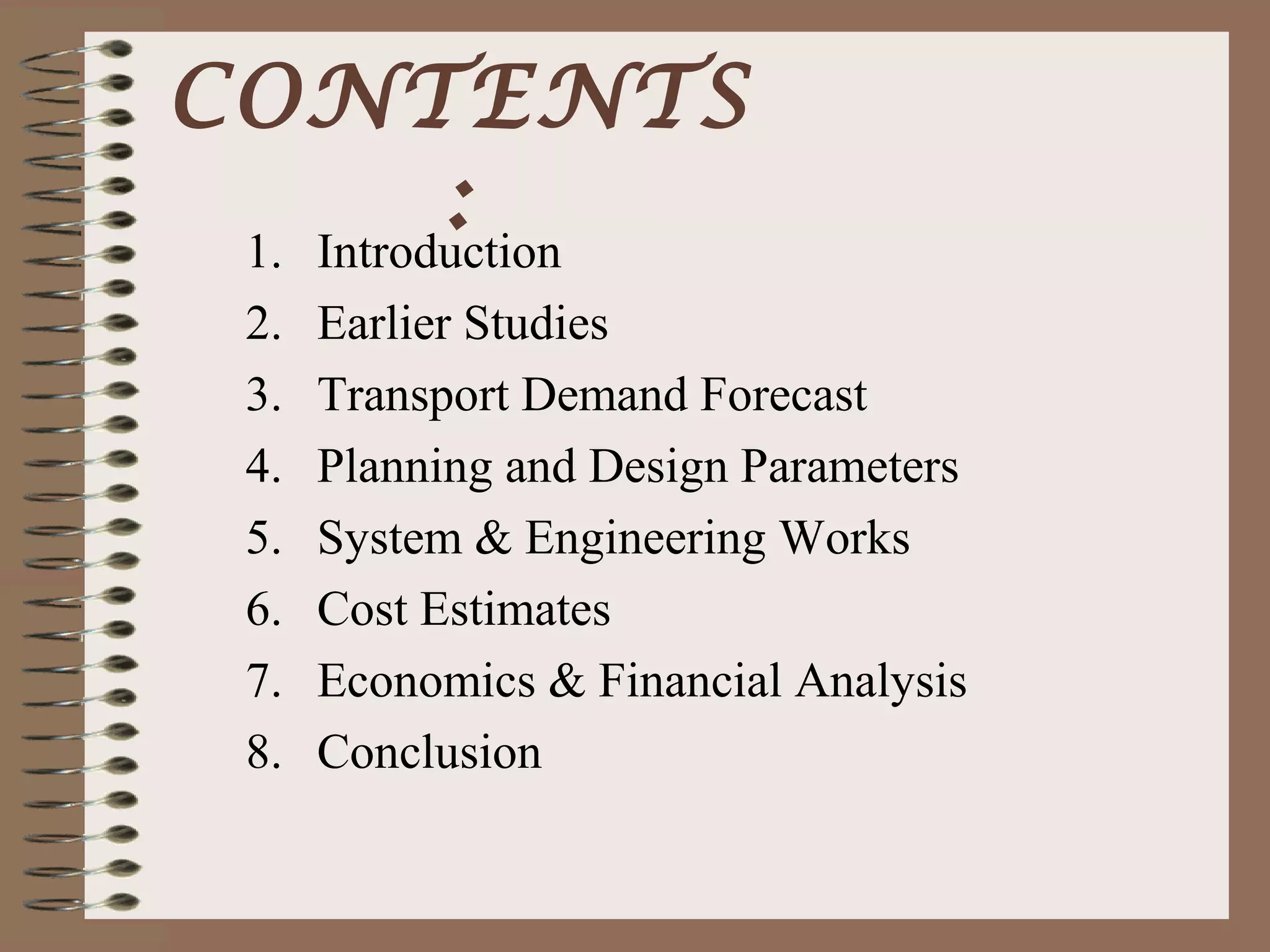
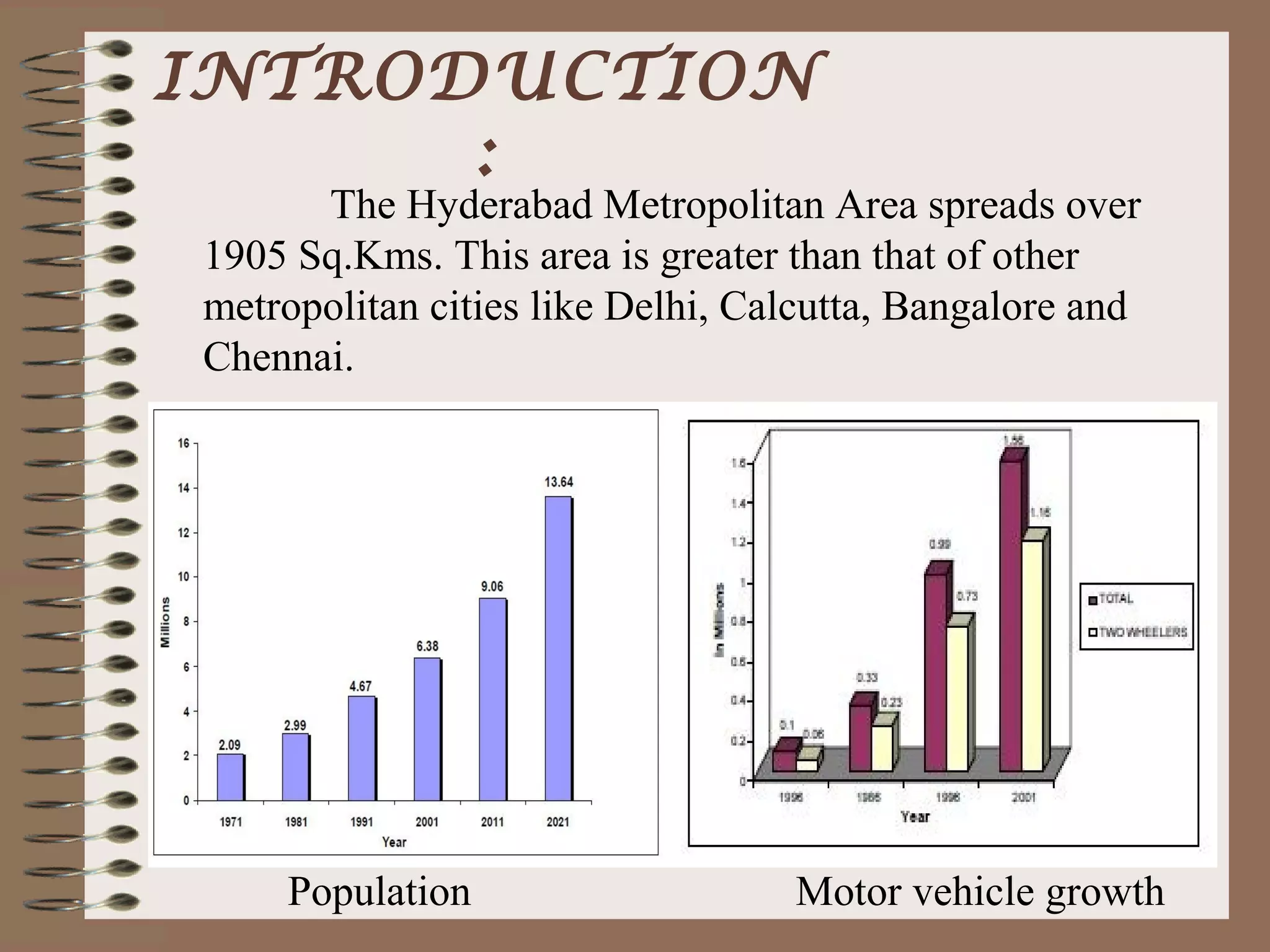
      The Hyderabad Metropolitan Area spreads over
1905 Sq.Kms. This area is greater than that of other
metropolitan cities like Delhi, Calcutta, Bangalore and
Chennai.


    Population                    Motor vehicle growth
Contd…
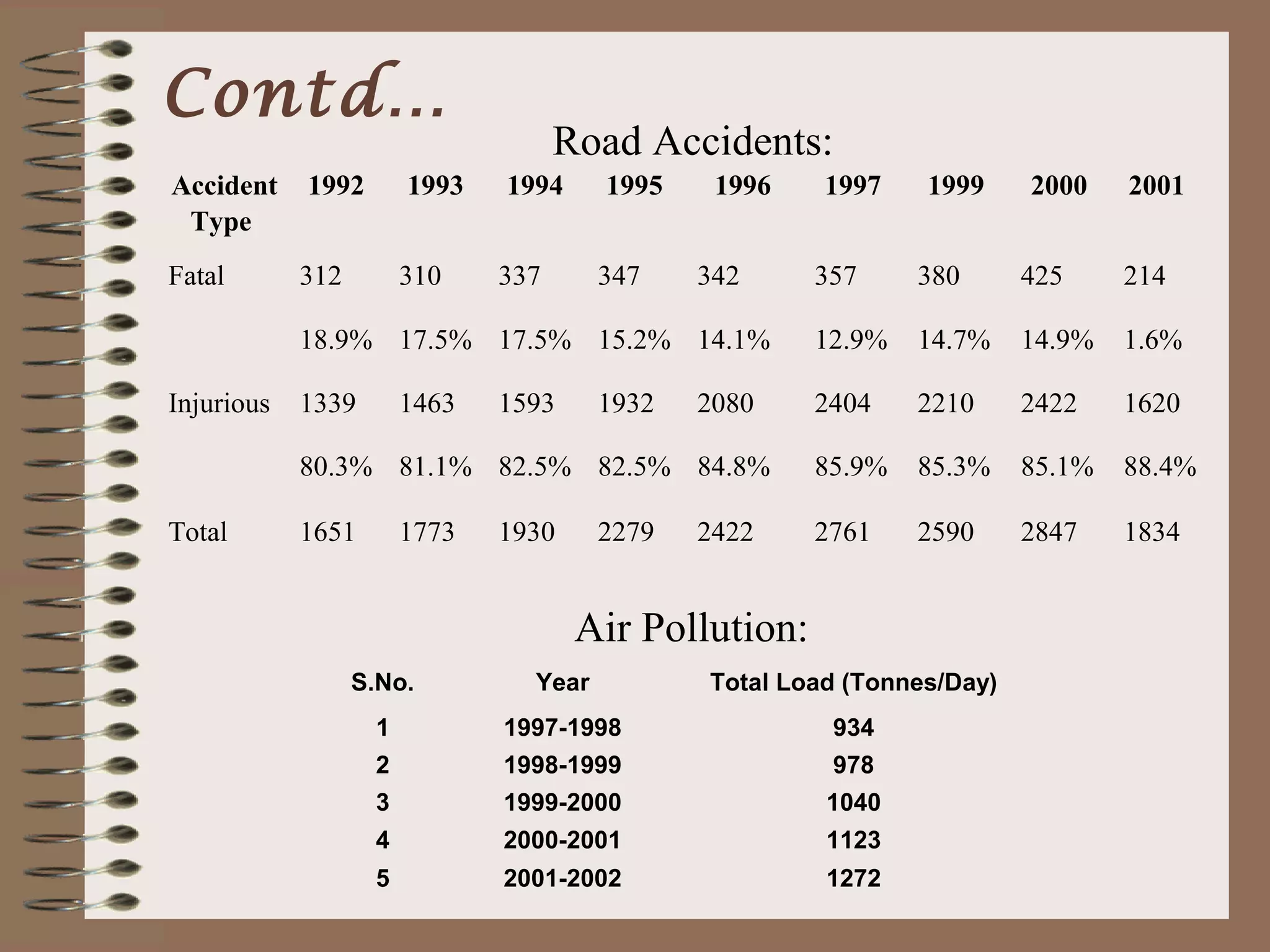
                                    Road Accidents:
Accident    1992       1993   1994     1995    1996    1997    1999     2000    2001
 Type
Fatal       312        310    337      347    342     357     380       425     214

            18.9% 17.5% 17.5% 15.2% 14.1%             12.9%   14.7%     14.9%   1.6%

Injurious   1339       1463   1593     1932   2080    2404    2210      2422    1620

            80.3% 81.1% 82.5% 82.5% 84.8%             85.9%   85.3%     85.1%   88.4%

Total       1651       1773   1930     2279   2422    2761    2590      2847    1834


                                     Air Pollution:
                  S.No.         Year          Total Load (Tonnes/Day)
                   1          1997-1998                934
                   2          1998-1999                978
                   3          1999-2000                1040
                   4          2000-2001                1123
                   5          2001-2002                1272
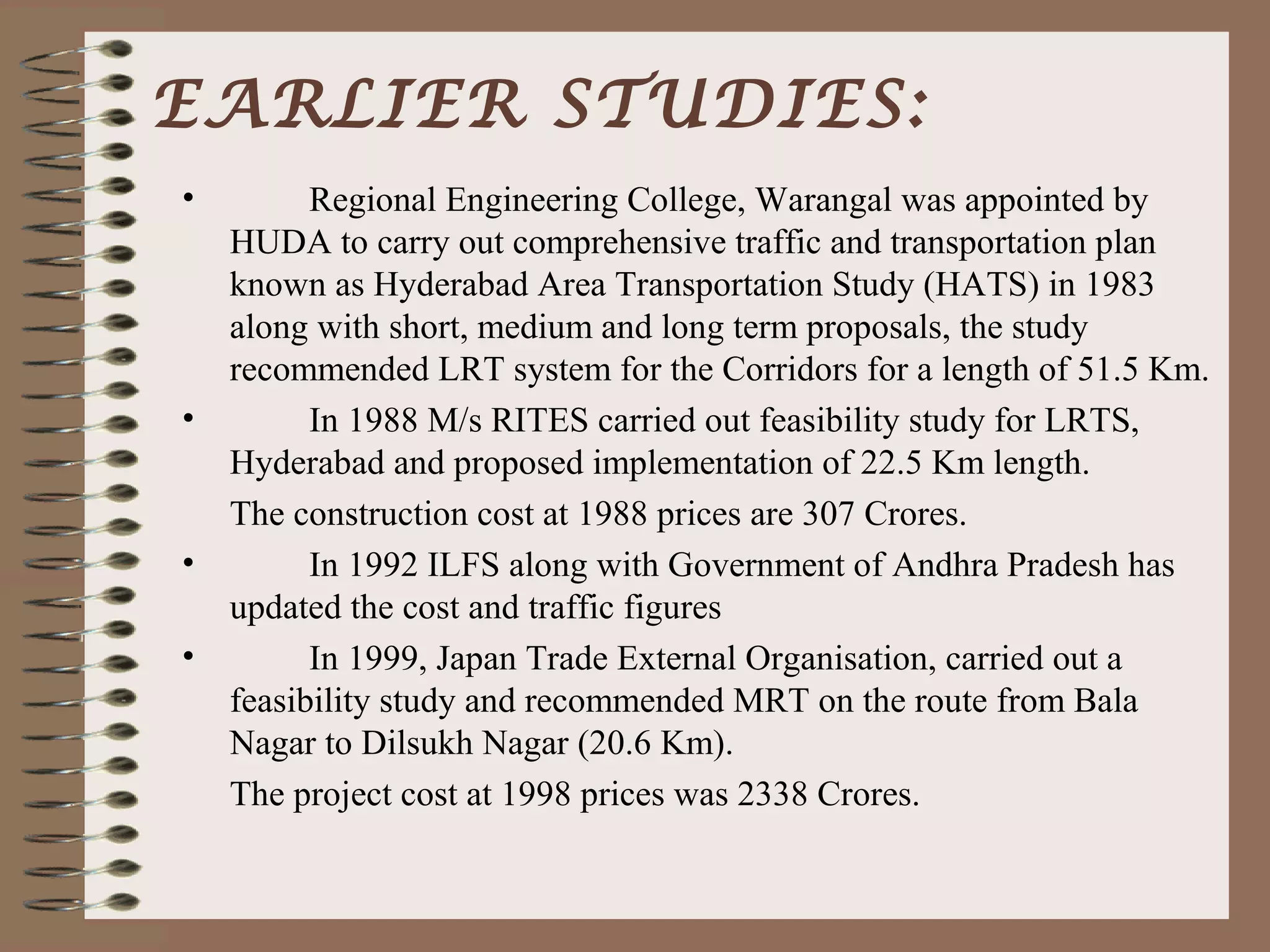
EARLIER STUDIES:
•       Regional Engineering College, Warangal was appointed by
  HUDA to carry out comprehensive traffic and transportation plan
  known as Hyderabad Area Transportation Study (HATS) in 1983
  along with short, medium and long term proposals, the study
  recommended LRT system for the Corridors for a length of 51.5 Km.
•       In 1988 M/s RITES carried out feasibility study for LRTS,
  Hyderabad and proposed implementation of 22.5 Km length.
  The construction cost at 1988 prices are 307 Crores.
•       In 1992 ILFS along with Government of Andhra Pradesh has
  updated the cost and traffic figures
•       In 1999, Japan Trade External Organisation, carried out a
  feasibility study and recommended MRT on the route from Bala
  Nagar to Dilsukh Nagar (20.6 Km).
  The project cost at 1998 prices was 2338 Crores.
Contd…
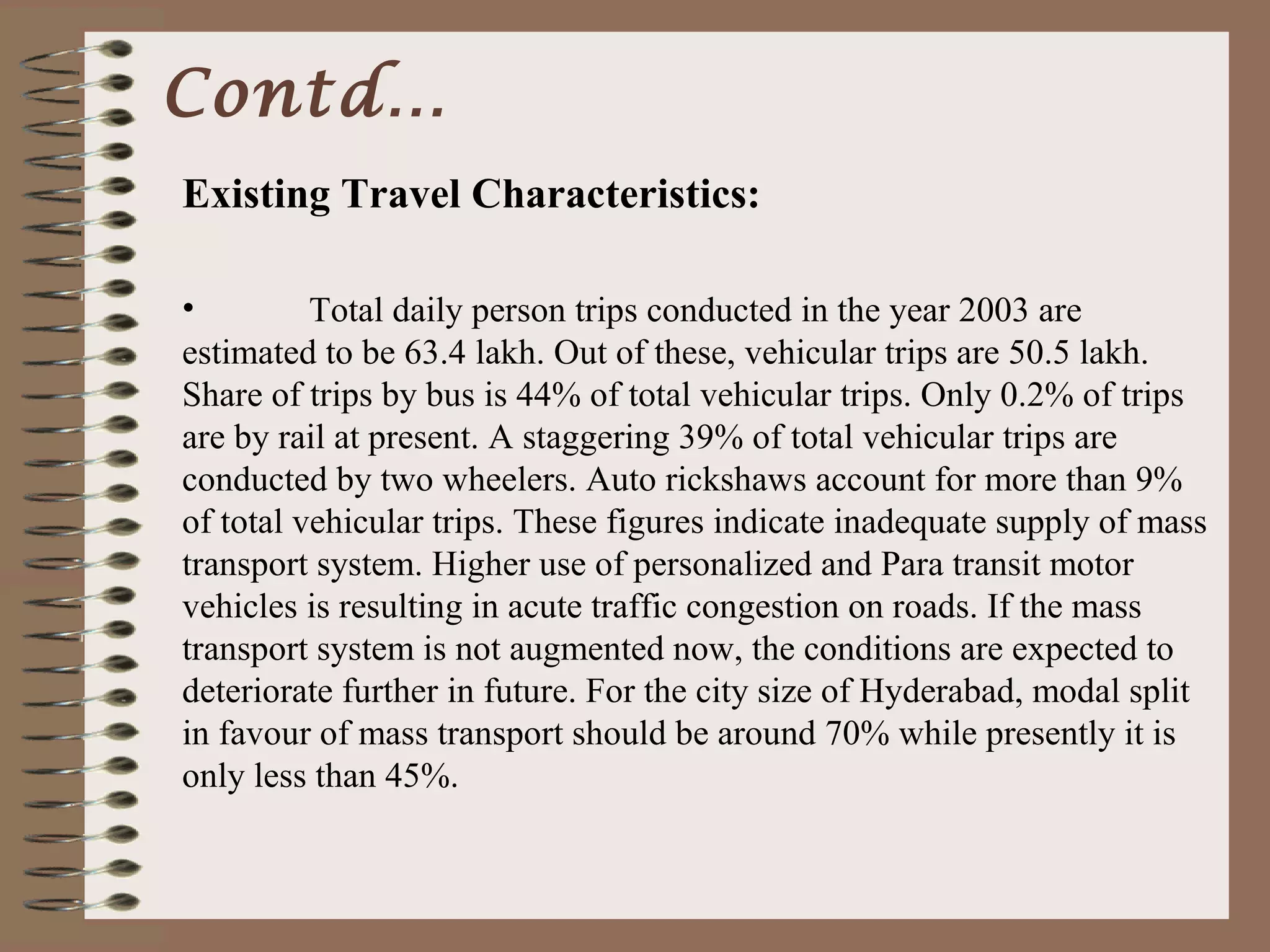
Existing Travel Characteristics:

•         Total daily person trips conducted in the year 2003 are
estimated to be 63.4 lakh. Out of these, vehicular trips are 50.5 lakh.
Share of trips by bus is 44% of total vehicular trips. Only 0.2% of trips
are by rail at present. A staggering 39% of total vehicular trips are
conducted by two wheelers. Auto rickshaws account for more than 9%
of total vehicular trips. These figures indicate inadequate supply of mass
transport system. Higher use of personalized and Para transit motor
vehicles is resulting in acute traffic congestion on roads. If the mass
transport system is not augmented now, the conditions are expected to
deteriorate further in future. For the city size of Hyderabad, modal split
in favour of mass transport should be around 70% while presently it is
only less than 45%.
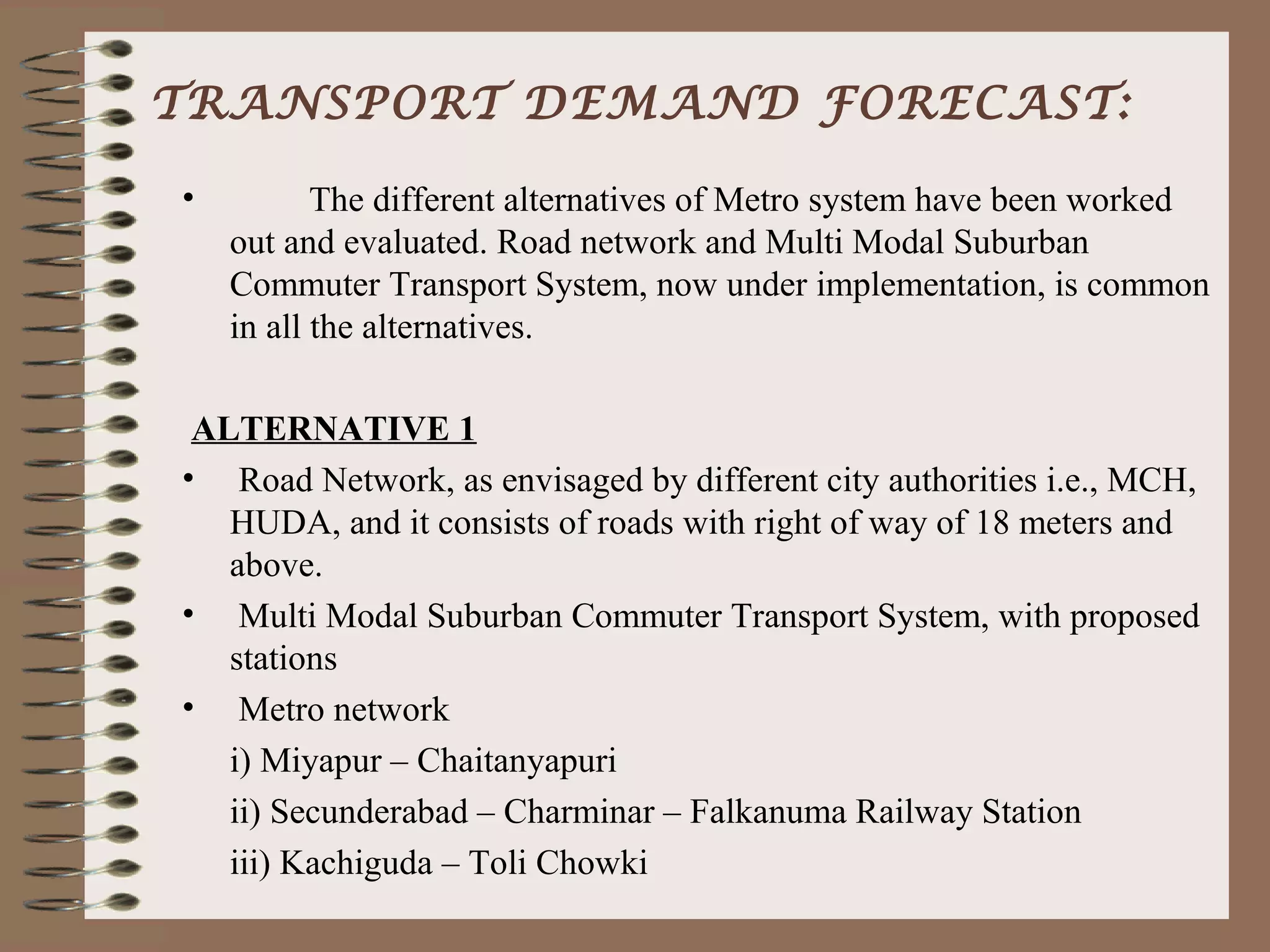
TRANSPORT DEMAND FORECAST:

•          The different alternatives of Metro system have been worked
    out and evaluated. Road network and Multi Modal Suburban
    Commuter Transport System, now under implementation, is common
    in all the alternatives.

 ALTERNATIVE 1
• Road Network, as envisaged by different city authorities i.e., MCH,
   HUDA, and it consists of roads with right of way of 18 meters and
   above.
• Multi Modal Suburban Commuter Transport System, with proposed
   stations
• Metro network
   i) Miyapur – Chaitanyapuri
   ii) Secunderabad – Charminar – Falkanuma Railway Station
   iii) Kachiguda – Toli Chowki
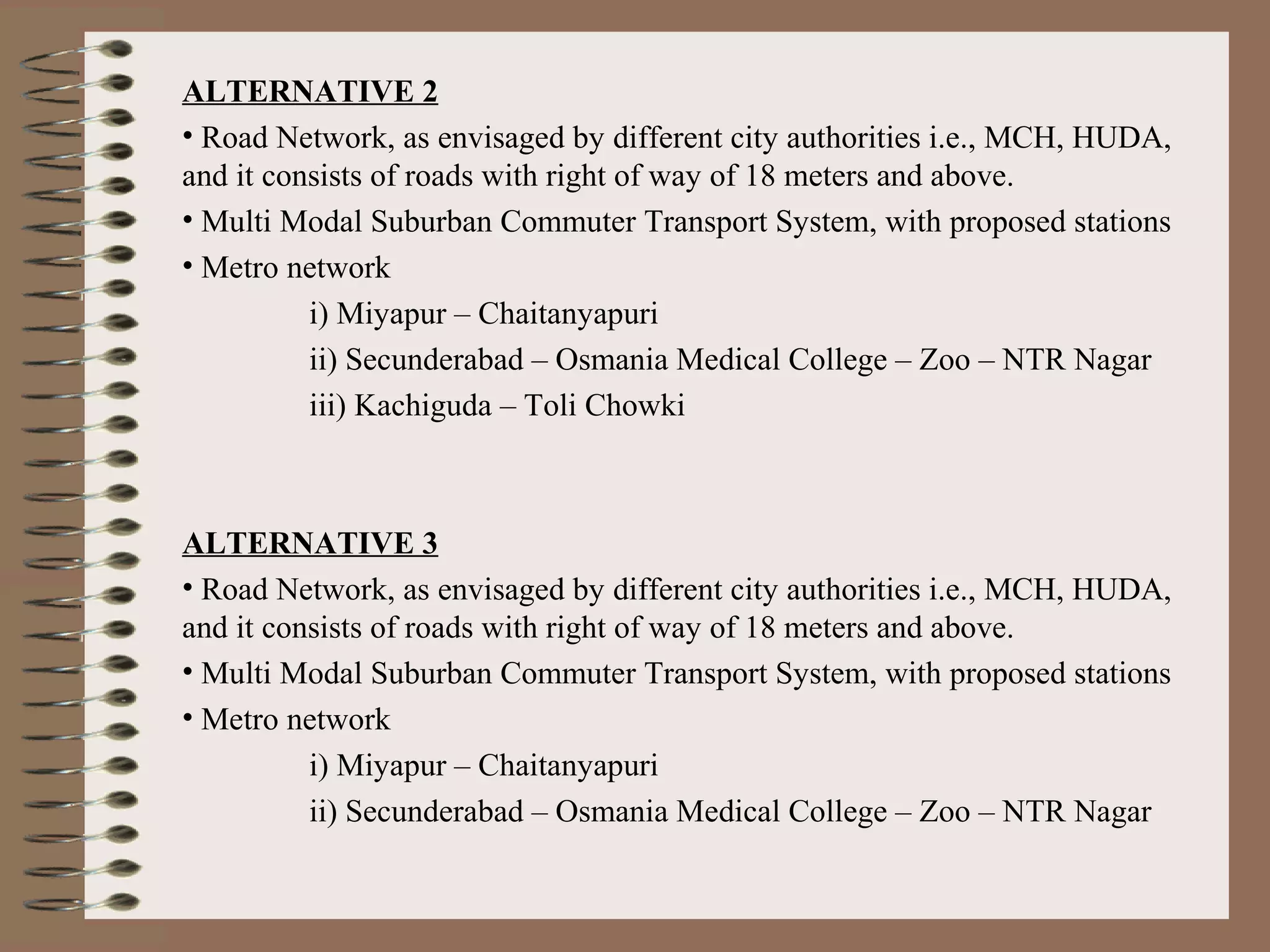
ALTERNATIVE 2
• Road Network, as envisaged by different city authorities i.e., MCH, HUDA,
and it consists of roads with right of way of 18 meters and above.
• Multi Modal Suburban Commuter Transport System, with proposed stations
• Metro network
          i) Miyapur – Chaitanyapuri
          ii) Secunderabad – Osmania Medical College – Zoo – NTR Nagar
          iii) Kachiguda – Toli Chowki


ALTERNATIVE 3
• Road Network, as envisaged by different city authorities i.e., MCH, HUDA,
and it consists of roads with right of way of 18 meters and above.
• Multi Modal Suburban Commuter Transport System, with proposed stations
• Metro network
          i) Miyapur – Chaitanyapuri
          ii) Secunderabad – Osmania Medical College – Zoo – NTR Nagar
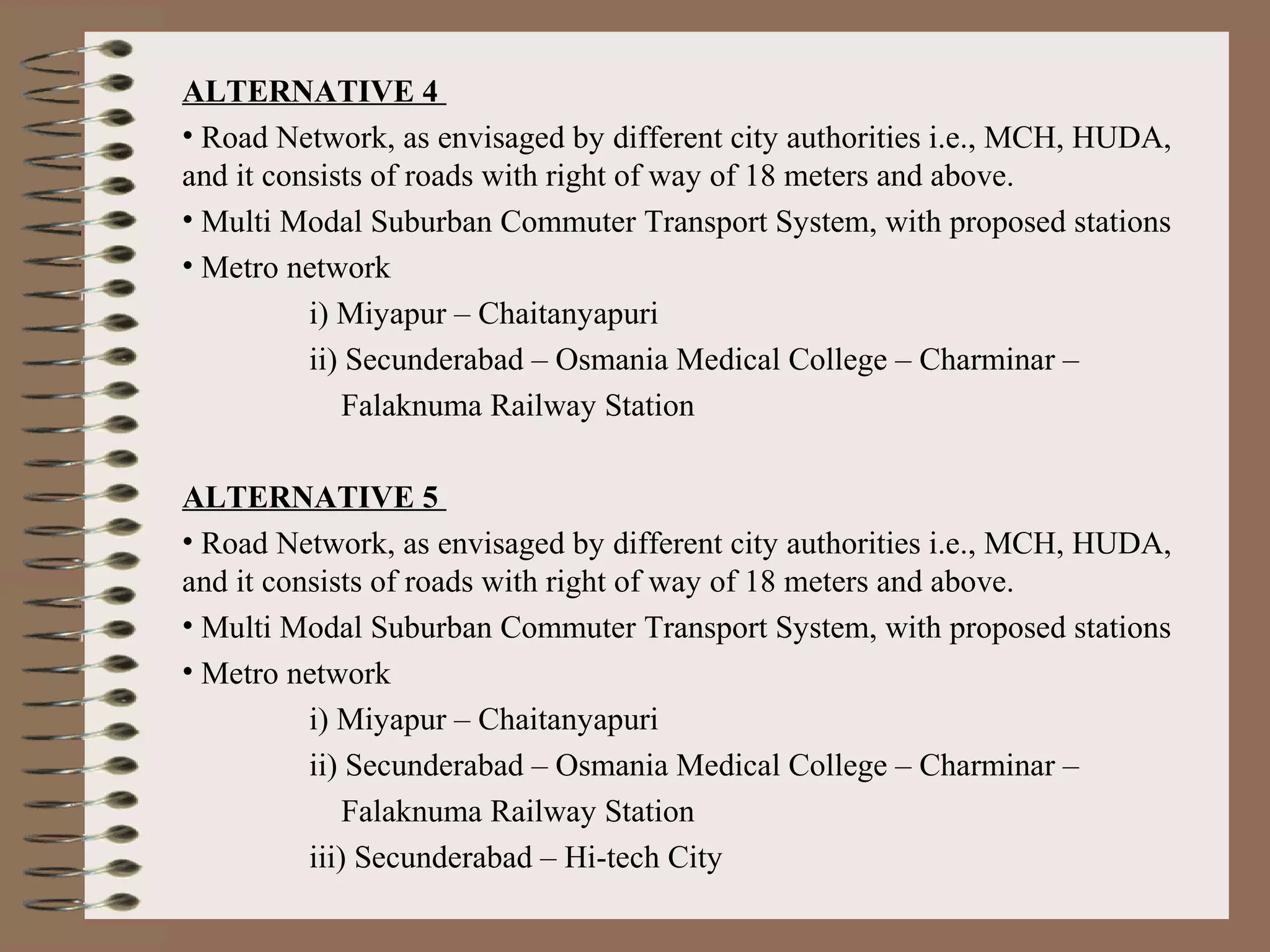
ALTERNATIVE 4
• Road Network, as envisaged by different city authorities i.e., MCH, HUDA,
and it consists of roads with right of way of 18 meters and above.
• Multi Modal Suburban Commuter Transport System, with proposed stations
• Metro network
          i) Miyapur – Chaitanyapuri
          ii) Secunderabad – Osmania Medical College – Charminar –
             Falaknuma Railway Station

ALTERNATIVE 5
• Road Network, as envisaged by different city authorities i.e., MCH, HUDA,
and it consists of roads with right of way of 18 meters and above.
• Multi Modal Suburban Commuter Transport System, with proposed stations
• Metro network
          i) Miyapur – Chaitanyapuri
          ii) Secunderabad – Osmania Medical College – Charminar –
              Falaknuma Railway Station
          iii) Secunderabad – Hi-tech City
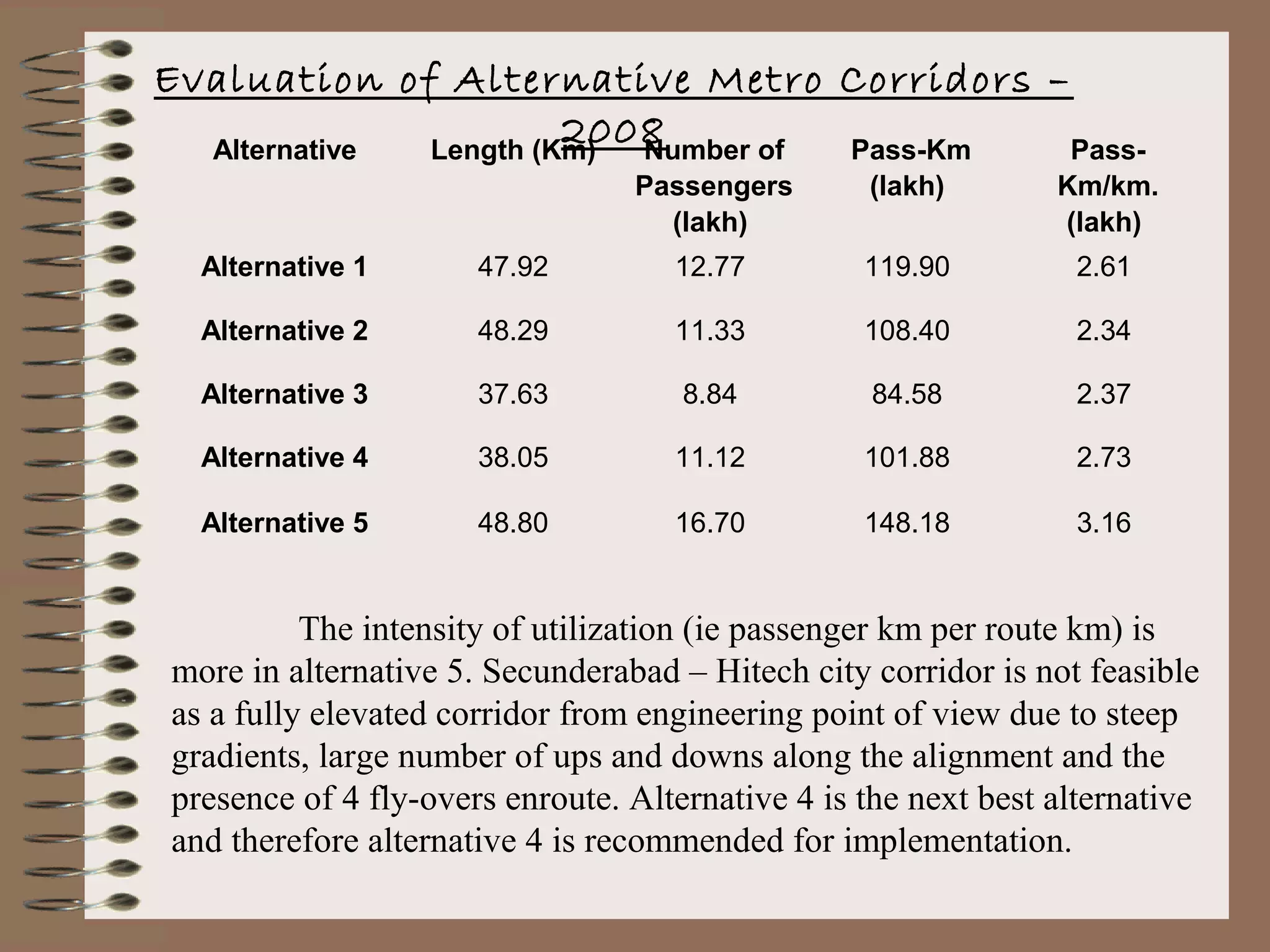
Evaluation of Alternative Metro Corridors –
  Alternative
                       2008
              Length (Km) Number of Pass-Km Pass-
                                 Passengers       (lakh)        Km/km.
                                   (lakh)                       (lakh)
  Alternative 1       47.92         12.77         119.90          2.61

  Alternative 2       48.29         11.33         108.40          2.34

  Alternative 3       37.63          8.84          84.58          2.37

  Alternative 4       38.05         11.12         101.88          2.73

  Alternative 5       48.80         16.70         148.18          3.16


          The intensity of utilization (ie passenger km per route km) is
more in alternative 5. Secunderabad – Hitech city corridor is not feasible
as a fully elevated corridor from engineering point of view due to steep
gradients, large number of ups and downs along the alignment and the
presence of 4 fly-overs enroute. Alternative 4 is the next best alternative
and therefore alternative 4 is recommended for implementation.
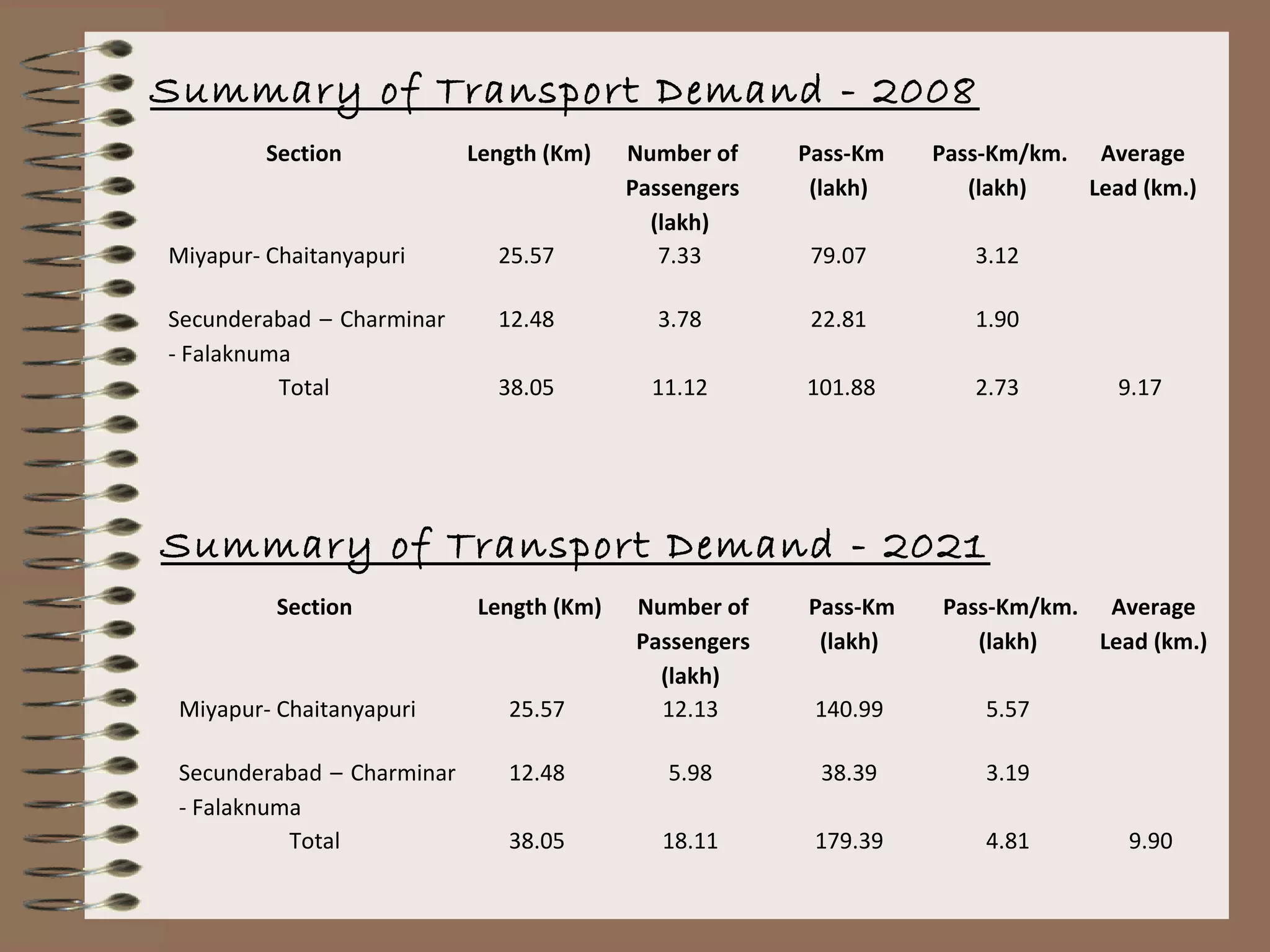
Summary of Transport Demand - 2008
         Section            Length (Km)   Number of    Pass-Km   Pass-Km/km. Average
                                          Passengers    (lakh)      (lakh)   Lead (km.)
                                            (lakh)
Miyapur- Chaitanyapuri        25.57          7.33       79.07       3.12

Secunderabad – Charminar      12.48         3.78        22.81       1.90
- Falaknuma
          Total               38.05         11.12      101.88       2.73        9.17


Summary of Transport Demand - 2021
          Section           Length (Km)   Number of    Pass-Km   Pass-Km/km. Average
                                          Passengers    (lakh)      (lakh)   Lead (km.)
                                            (lakh)
 Miyapur- Chaitanyapuri        25.57        12.13       140.99       5.57

 Secunderabad – Charminar      12.48         5.98       38.39        3.19
 - Falaknuma
           Total               38.05         18.11      179.39       4.81        9.90
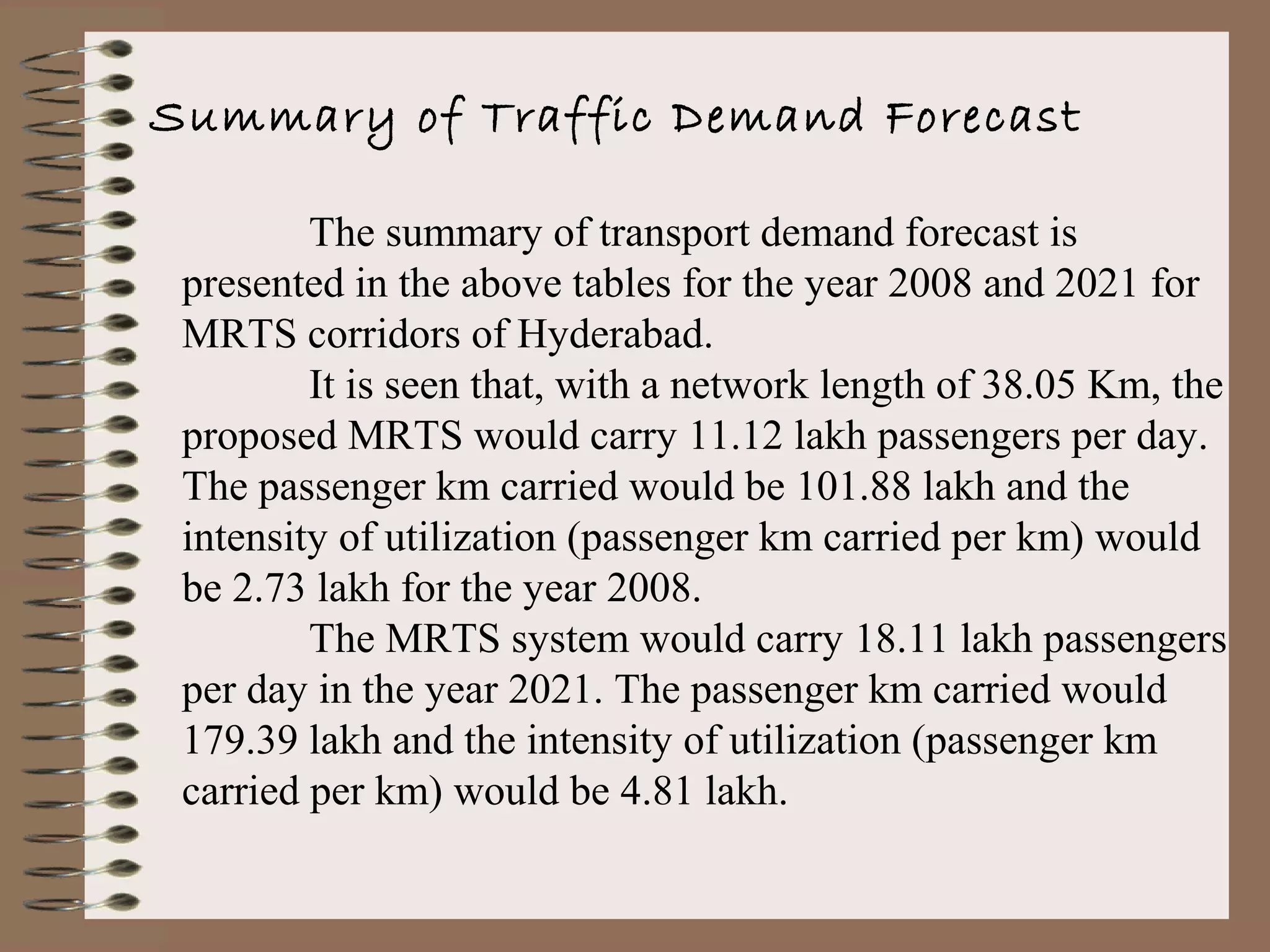
Summary of Traffic Demand Forecast

         The summary of transport demand forecast is
 presented in the above tables for the year 2008 and 2021 for
 MRTS corridors of Hyderabad.
         It is seen that, with a network length of 38.05 Km, the
 proposed MRTS would carry 11.12 lakh passengers per day.
 The passenger km carried would be 101.88 lakh and the
 intensity of utilization (passenger km carried per km) would
 be 2.73 lakh for the year 2008.
         The MRTS system would carry 18.11 lakh passengers
 per day in the year 2021. The passenger km carried would
 179.39 lakh and the intensity of utilization (passenger km
 carried per km) would be 4.81 lakh.
PLANNING AND DESIGN PARAMETERS:


 Route Alignment & Station Planning:
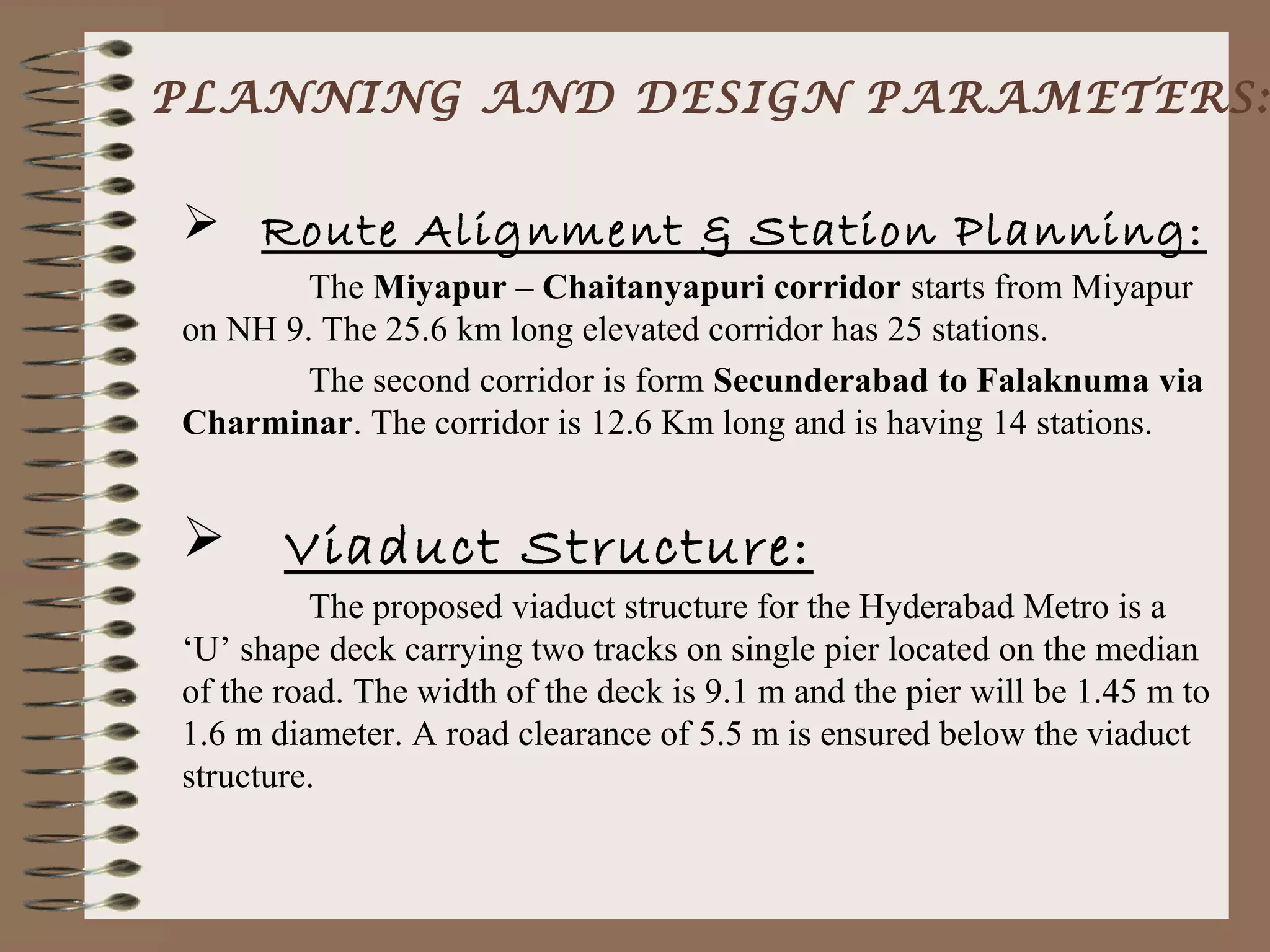
        The Miyapur – Chaitanyapuri corridor starts from Miyapur
on NH 9. The 25.6 km long elevated corridor has 25 stations.
        The second corridor is form Secunderabad to Falaknuma via
Charminar. The corridor is 12.6 Km long and is having 14 stations.


      Viaduct Structure:
         The proposed viaduct structure for the Hyderabad Metro is a
‘U’ shape deck carrying two tracks on single pier located on the median
of the road. The width of the deck is 9.1 m and the pier will be 1.45 m to
1.6 m diameter. A road clearance of 5.5 m is ensured below the viaduct
structure.
       Train Operation Plan:
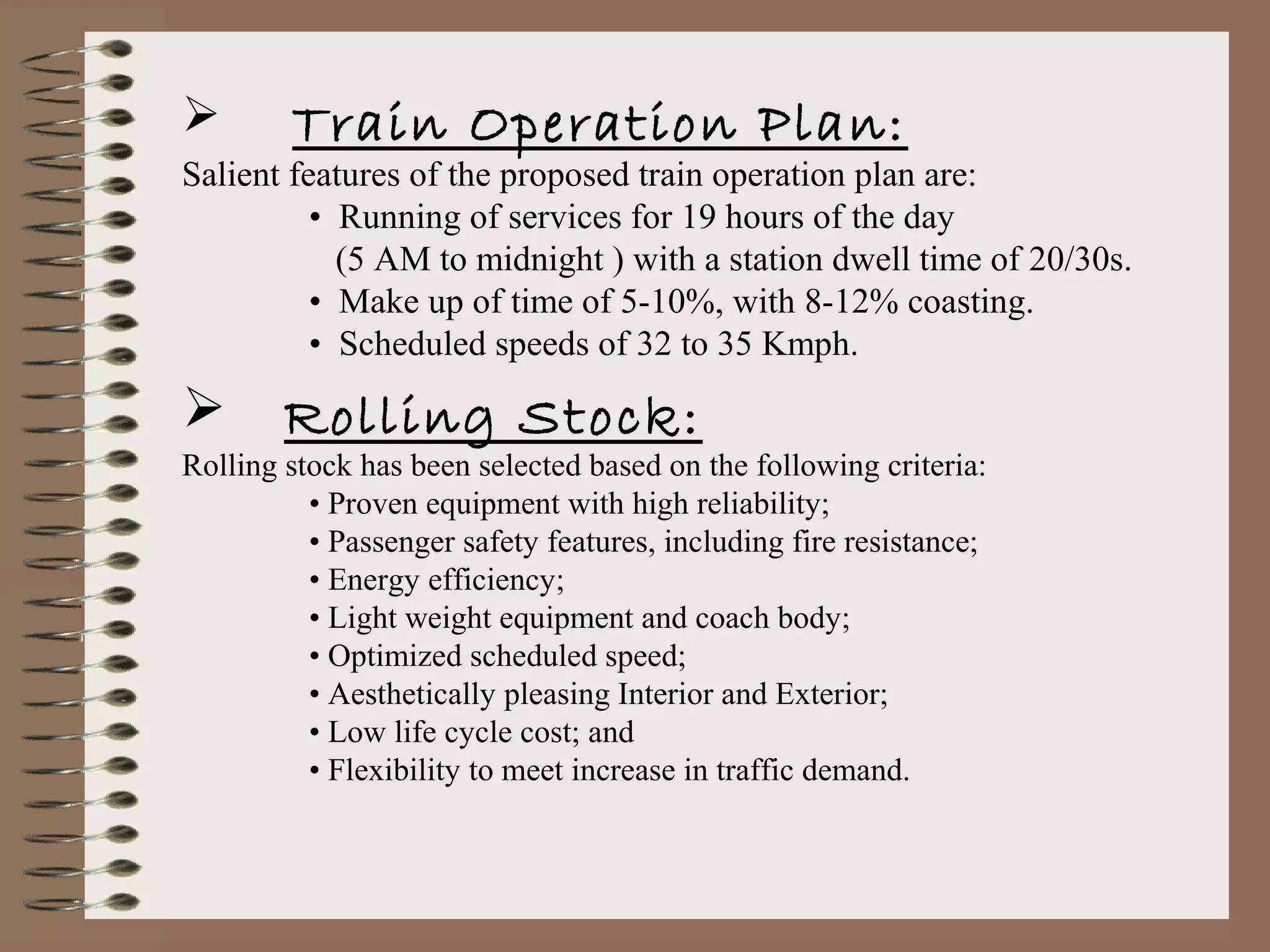
Salient features of the proposed train operation plan are:
          • Running of services for 19 hours of the day
            (5 AM to midnight ) with a station dwell time of 20/30s.
          • Make up of time of 5-10%, with 8-12% coasting.
          • Scheduled speeds of 32 to 35 Kmph.

       Rolling Stock:
Rolling stock has been selected based on the following criteria:
          • Proven equipment with high reliability;
          • Passenger safety features, including fire resistance;
          • Energy efficiency;
          • Light weight equipment and coach body;
          • Optimized scheduled speed;
          • Aesthetically pleasing Interior and Exterior;
          • Low life cycle cost; and
          • Flexibility to meet increase in traffic demand.
SYSTEM & ENGINEERING WORKS:

  Traction System:
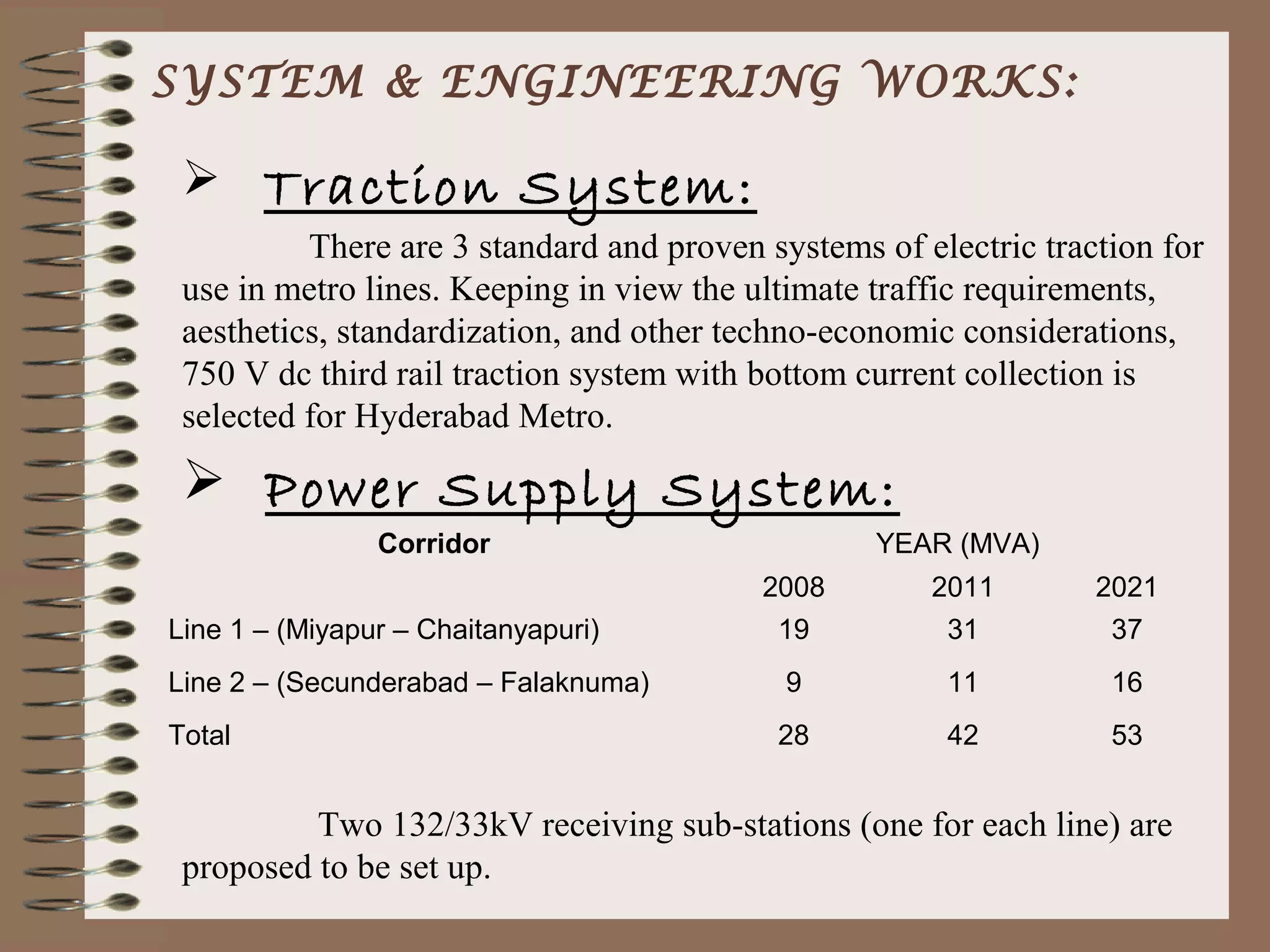
          There are 3 standard and proven systems of electric traction for
 use in metro lines. Keeping in view the ultimate traffic requirements,
 aesthetics, standardization, and other techno-economic considerations,
 750 V dc third rail traction system with bottom current collection is
 selected for Hyderabad Metro.

  Power Supply System:
                Corridor                          YEAR (MVA)
                                          2008        2011        2021
Line 1 – (Miyapur – Chaitanyapuri)         19          31          37
Line 2 – (Secunderabad – Falaknuma)         9          11          16
Total                                      28          42          53


          Two 132/33kV receiving sub-stations (one for each line) are
 proposed to be set up.
ENGINEERING WORKS:

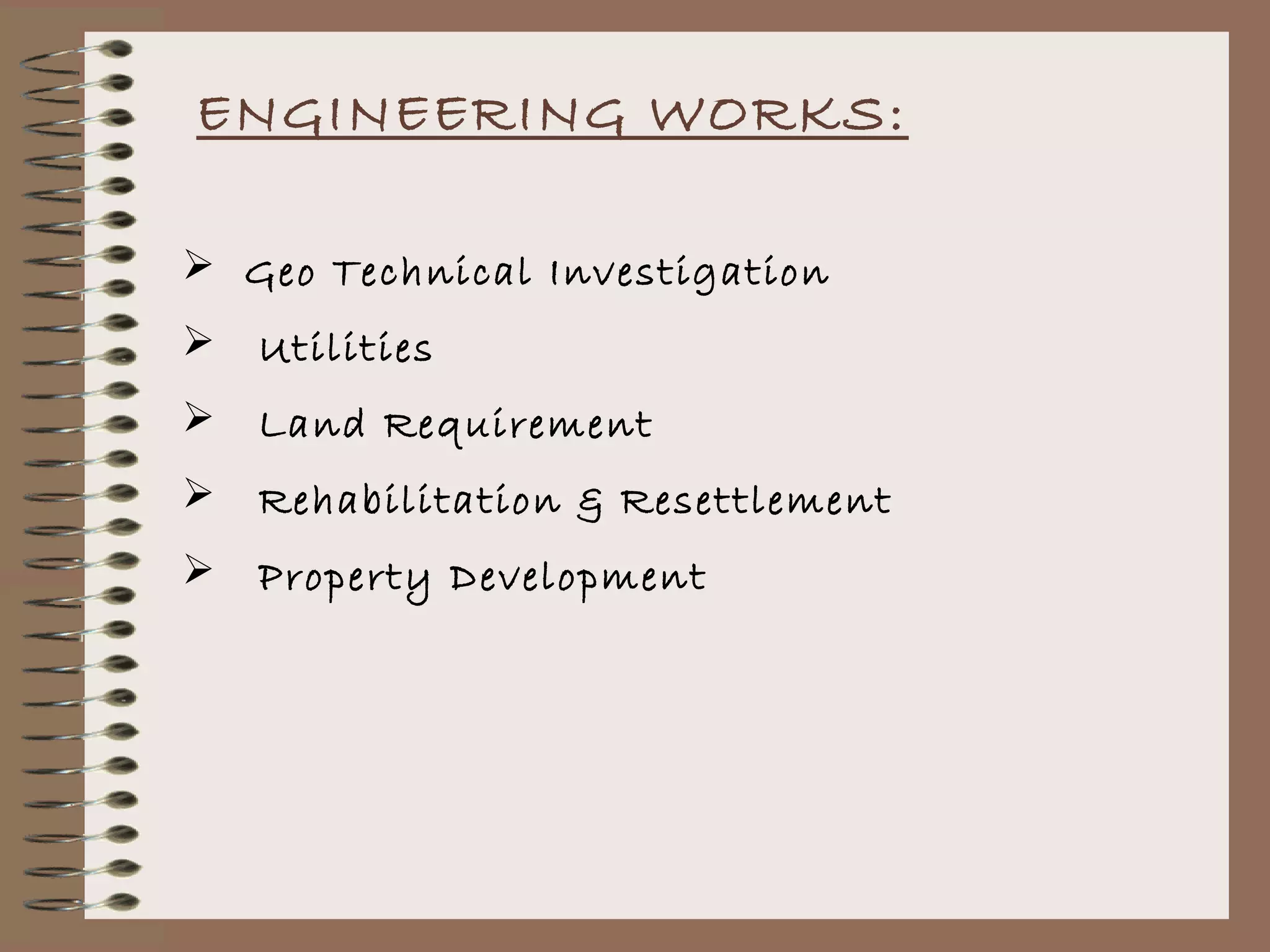
 Geo Technical Investigation
   Utilities
   Land Requirement
   Rehabilitation & Resettlement
   Property Development
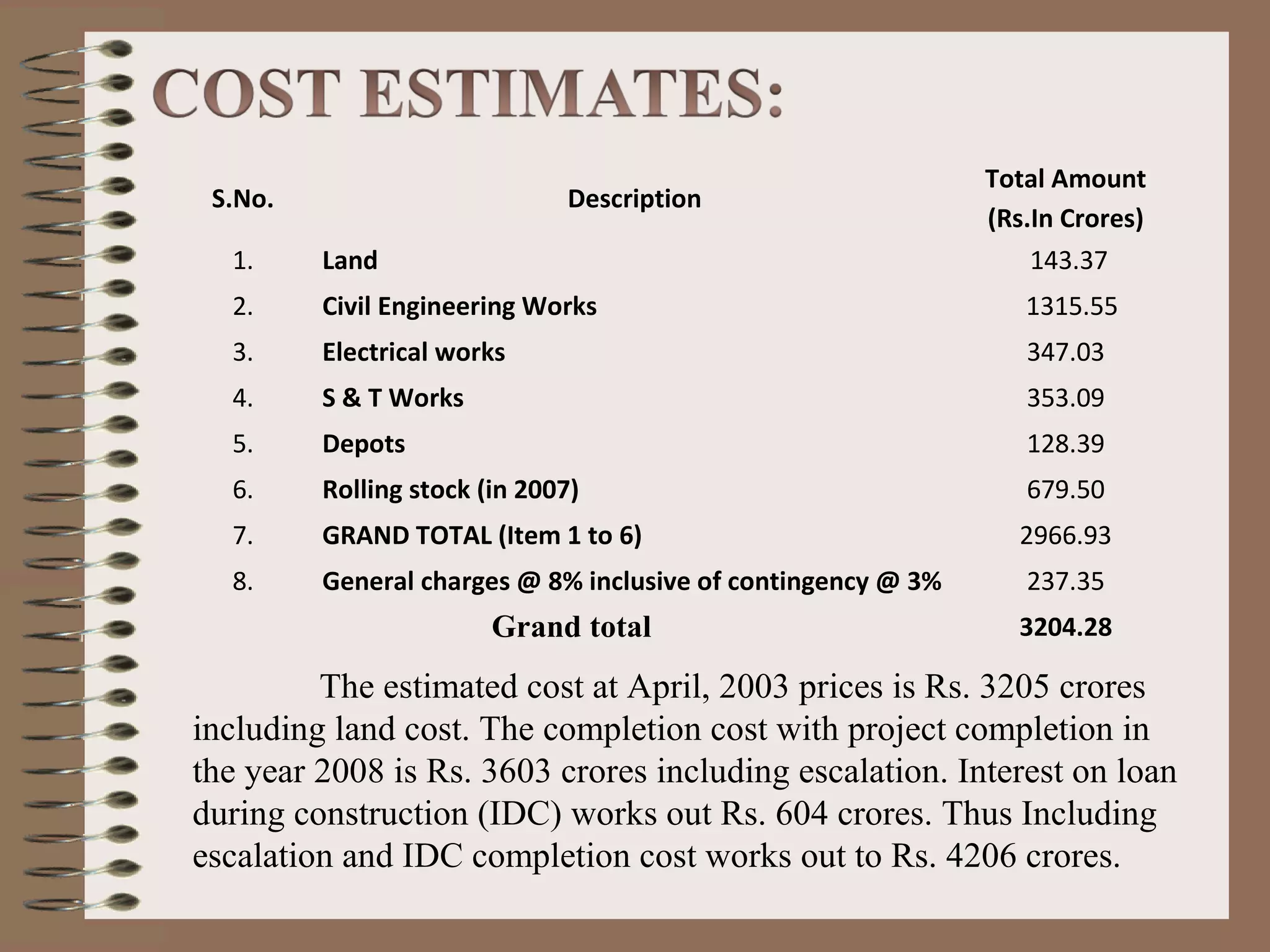
Total Amount
 S.No.                        Description
                                                              (Rs.In Crores)
  1.     Land                                                     143.37
  2.     Civil Engineering Works                                 1315.55
  3.     Electrical works                                        347.03
  4.     S & T Works                                             353.09
  5.     Depots                                                  128.39
  6.     Rolling stock (in 2007)                                 679.50
  7.     GRAND TOTAL (Item 1 to 6)                              2966.93
  8.     General charges @ 8% inclusive of contingency @ 3%      237.35
                        Grand total                             3204.28

         The estimated cost at April, 2003 prices is Rs. 3205 crores
including land cost. The completion cost with project completion in
the year 2008 is Rs. 3603 crores including escalation. Interest on loan
during construction (IDC) works out Rs. 604 crores. Thus Including
escalation and IDC completion cost works out to Rs. 4206 crores.
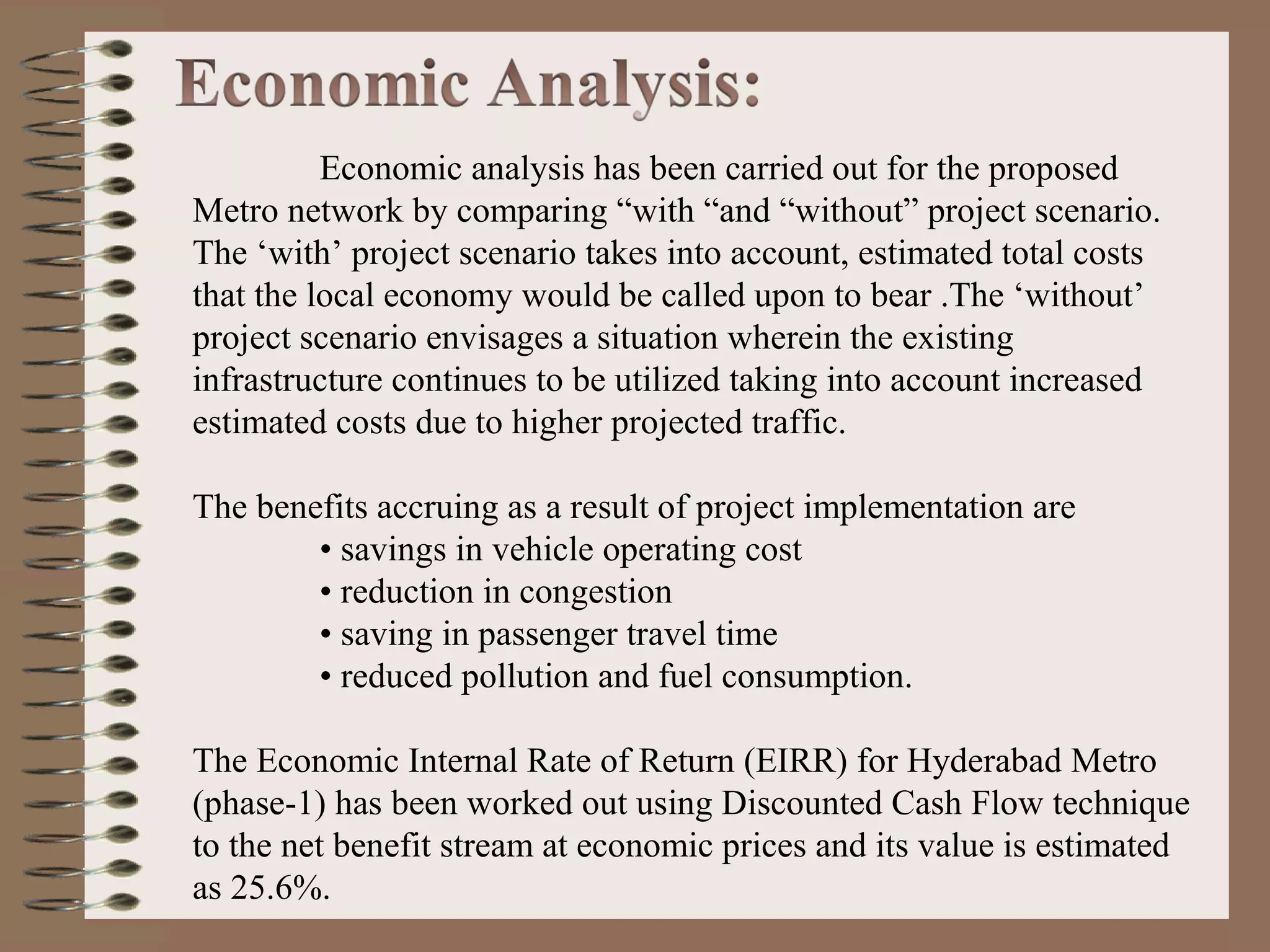
Economic analysis has been carried out for the proposed
Metro network by comparing “with “and “without” project scenario.
The ‘with’ project scenario takes into account, estimated total costs
that the local economy would be called upon to bear .The ‘without’
project scenario envisages a situation wherein the existing
infrastructure continues to be utilized taking into account increased
estimated costs due to higher projected traffic.

The benefits accruing as a result of project implementation are
        • savings in vehicle operating cost
        • reduction in congestion
        • saving in passenger travel time
        • reduced pollution and fuel consumption.

The Economic Internal Rate of Return (EIRR) for Hyderabad Metro
(phase-1) has been worked out using Discounted Cash Flow technique
to the net benefit stream at economic prices and its value is estimated
as 25.6%.
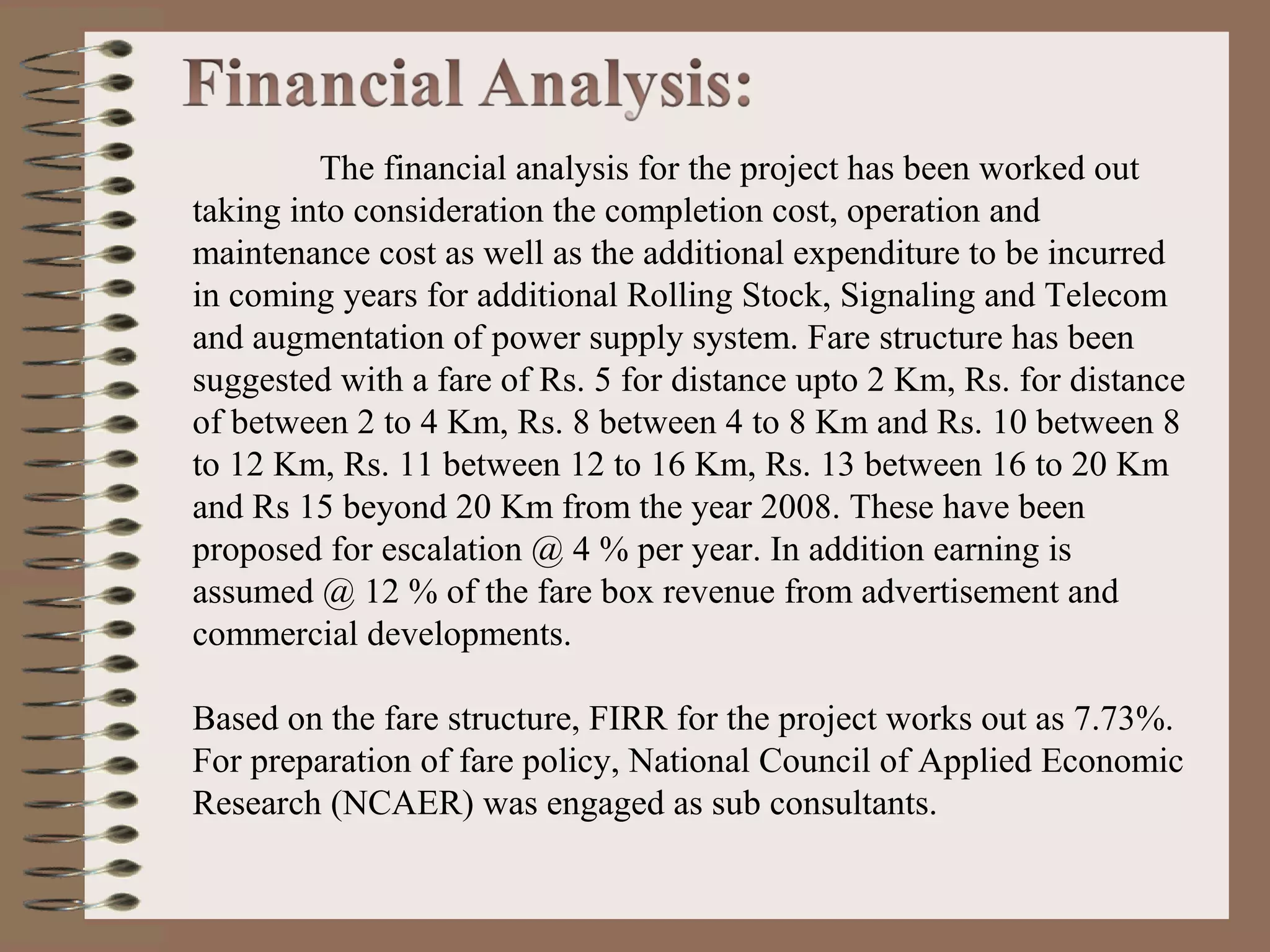
The financial analysis for the project has been worked out
taking into consideration the completion cost, operation and
maintenance cost as well as the additional expenditure to be incurred
in coming years for additional Rolling Stock, Signaling and Telecom
and augmentation of power supply system. Fare structure has been
suggested with a fare of Rs. 5 for distance upto 2 Km, Rs. for distance
of between 2 to 4 Km, Rs. 8 between 4 to 8 Km and Rs. 10 between 8
to 12 Km, Rs. 11 between 12 to 16 Km, Rs. 13 between 16 to 20 Km
and Rs 15 beyond 20 Km from the year 2008. These have been
proposed for escalation @ 4 % per year. In addition earning is
assumed @ 12 % of the fare box revenue from advertisement and
commercial developments.

Based on the fare structure, FIRR for the project works out as 7.73%.
For preparation of fare policy, National Council of Applied Economic
Research (NCAER) was engaged as sub consultants.
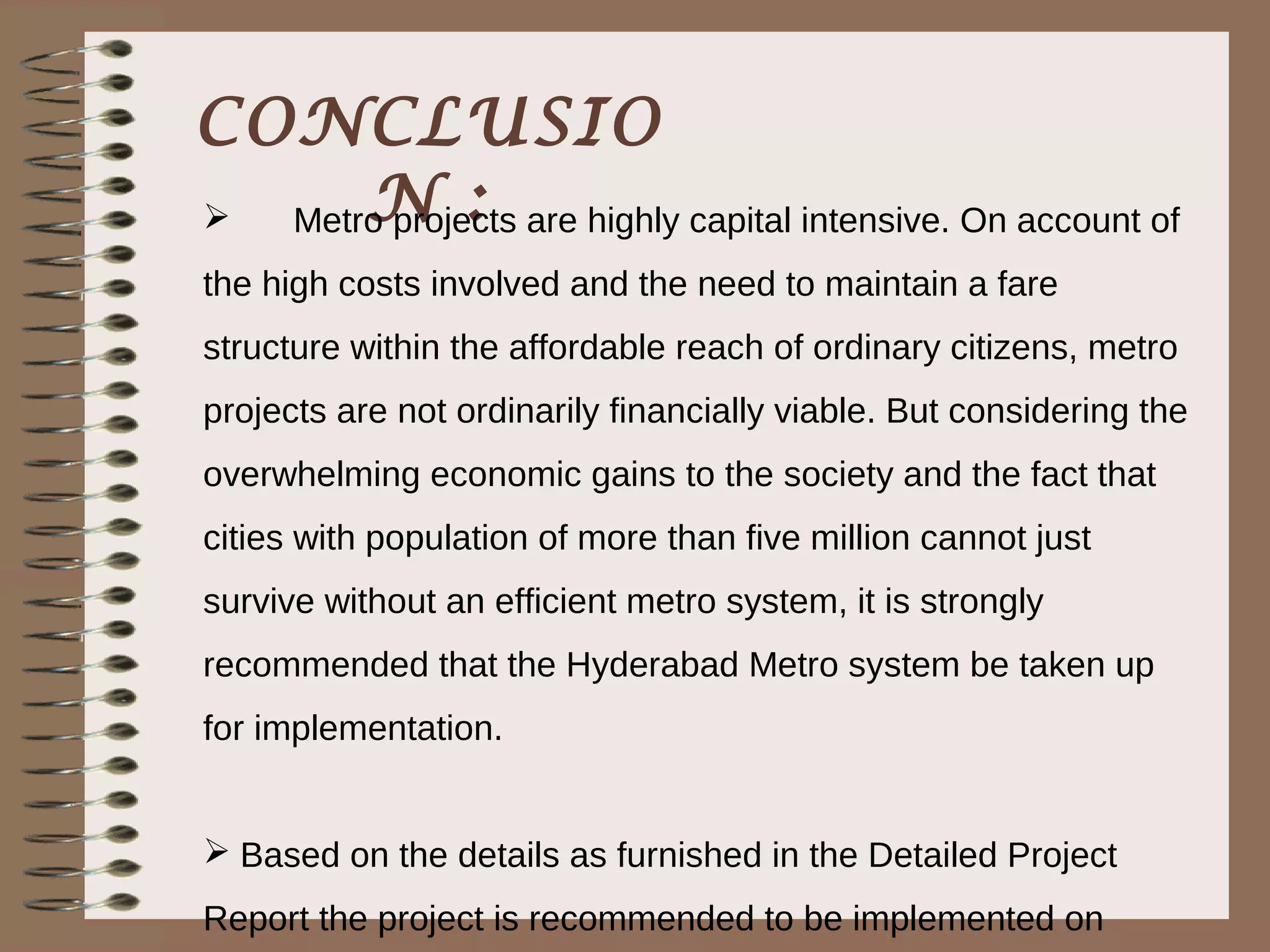
CONCLUSIO
     N :
  Metro projects are highly capital intensive. On account of
the high costs involved and the need to maintain a fare
structure within the affordable reach of ordinary citizens, metro
projects are not ordinarily financially viable. But considering the
overwhelming economic gains to the society and the fact that
cities with population of more than five million cannot just
survive without an efficient metro system, it is strongly
recommended that the Hyderabad Metro system be taken up
for implementation.


 Based on the details as furnished in the Detailed Project
Report the project is recommended to be implemented on
Feasibility Report of Hyd Metro

Feasibility Report of Hyd Metro

  • 1.
    PRESENTATION BY…. R.RAGHAVENDRA I/II M.Tech, CTM
  • 2.
    CONTENTS : 1. Introduction 2. Earlier Studies 3. Transport Demand Forecast 4. Planning and Design Parameters 5. System & Engineering Works 6. Cost Estimates 7. Economics & Financial Analysis 8. Conclusion
  • 3.
    INTRODUCTION : The Hyderabad Metropolitan Area spreads over 1905 Sq.Kms. This area is greater than that of other metropolitan cities like Delhi, Calcutta, Bangalore and Chennai. Population Motor vehicle growth
  • 4.
    Contd… Road Accidents: Accident 1992 1993 1994 1995 1996 1997 1999 2000 2001 Type Fatal 312 310 337 347 342 357 380 425 214 18.9% 17.5% 17.5% 15.2% 14.1% 12.9% 14.7% 14.9% 1.6% Injurious 1339 1463 1593 1932 2080 2404 2210 2422 1620 80.3% 81.1% 82.5% 82.5% 84.8% 85.9% 85.3% 85.1% 88.4% Total 1651 1773 1930 2279 2422 2761 2590 2847 1834 Air Pollution: S.No. Year Total Load (Tonnes/Day) 1 1997-1998 934 2 1998-1999 978 3 1999-2000 1040 4 2000-2001 1123 5 2001-2002 1272
  • 5.
    EARLIER STUDIES: • Regional Engineering College, Warangal was appointed by HUDA to carry out comprehensive traffic and transportation plan known as Hyderabad Area Transportation Study (HATS) in 1983 along with short, medium and long term proposals, the study recommended LRT system for the Corridors for a length of 51.5 Km. • In 1988 M/s RITES carried out feasibility study for LRTS, Hyderabad and proposed implementation of 22.5 Km length. The construction cost at 1988 prices are 307 Crores. • In 1992 ILFS along with Government of Andhra Pradesh has updated the cost and traffic figures • In 1999, Japan Trade External Organisation, carried out a feasibility study and recommended MRT on the route from Bala Nagar to Dilsukh Nagar (20.6 Km). The project cost at 1998 prices was 2338 Crores.
  • 6.
    Contd… Existing Travel Characteristics: • Total daily person trips conducted in the year 2003 are estimated to be 63.4 lakh. Out of these, vehicular trips are 50.5 lakh. Share of trips by bus is 44% of total vehicular trips. Only 0.2% of trips are by rail at present. A staggering 39% of total vehicular trips are conducted by two wheelers. Auto rickshaws account for more than 9% of total vehicular trips. These figures indicate inadequate supply of mass transport system. Higher use of personalized and Para transit motor vehicles is resulting in acute traffic congestion on roads. If the mass transport system is not augmented now, the conditions are expected to deteriorate further in future. For the city size of Hyderabad, modal split in favour of mass transport should be around 70% while presently it is only less than 45%.
  • 7.
    TRANSPORT DEMAND FORECAST: • The different alternatives of Metro system have been worked out and evaluated. Road network and Multi Modal Suburban Commuter Transport System, now under implementation, is common in all the alternatives. ALTERNATIVE 1 • Road Network, as envisaged by different city authorities i.e., MCH, HUDA, and it consists of roads with right of way of 18 meters and above. • Multi Modal Suburban Commuter Transport System, with proposed stations • Metro network i) Miyapur – Chaitanyapuri ii) Secunderabad – Charminar – Falkanuma Railway Station iii) Kachiguda – Toli Chowki
  • 8.
    ALTERNATIVE 2 • RoadNetwork, as envisaged by different city authorities i.e., MCH, HUDA, and it consists of roads with right of way of 18 meters and above. • Multi Modal Suburban Commuter Transport System, with proposed stations • Metro network i) Miyapur – Chaitanyapuri ii) Secunderabad – Osmania Medical College – Zoo – NTR Nagar iii) Kachiguda – Toli Chowki ALTERNATIVE 3 • Road Network, as envisaged by different city authorities i.e., MCH, HUDA, and it consists of roads with right of way of 18 meters and above. • Multi Modal Suburban Commuter Transport System, with proposed stations • Metro network i) Miyapur – Chaitanyapuri ii) Secunderabad – Osmania Medical College – Zoo – NTR Nagar
  • 9.
    ALTERNATIVE 4 • RoadNetwork, as envisaged by different city authorities i.e., MCH, HUDA, and it consists of roads with right of way of 18 meters and above. • Multi Modal Suburban Commuter Transport System, with proposed stations • Metro network i) Miyapur – Chaitanyapuri ii) Secunderabad – Osmania Medical College – Charminar – Falaknuma Railway Station ALTERNATIVE 5 • Road Network, as envisaged by different city authorities i.e., MCH, HUDA, and it consists of roads with right of way of 18 meters and above. • Multi Modal Suburban Commuter Transport System, with proposed stations • Metro network i) Miyapur – Chaitanyapuri ii) Secunderabad – Osmania Medical College – Charminar – Falaknuma Railway Station iii) Secunderabad – Hi-tech City
  • 10.
    Evaluation of AlternativeMetro Corridors – Alternative 2008 Length (Km) Number of Pass-Km Pass- Passengers (lakh) Km/km. (lakh) (lakh) Alternative 1 47.92 12.77 119.90 2.61 Alternative 2 48.29 11.33 108.40 2.34 Alternative 3 37.63 8.84 84.58 2.37 Alternative 4 38.05 11.12 101.88 2.73 Alternative 5 48.80 16.70 148.18 3.16 The intensity of utilization (ie passenger km per route km) is more in alternative 5. Secunderabad – Hitech city corridor is not feasible as a fully elevated corridor from engineering point of view due to steep gradients, large number of ups and downs along the alignment and the presence of 4 fly-overs enroute. Alternative 4 is the next best alternative and therefore alternative 4 is recommended for implementation.
  • 11.
    Summary of TransportDemand - 2008 Section Length (Km) Number of Pass-Km Pass-Km/km. Average Passengers (lakh) (lakh) Lead (km.) (lakh) Miyapur- Chaitanyapuri 25.57 7.33 79.07 3.12 Secunderabad – Charminar 12.48 3.78 22.81 1.90 - Falaknuma Total 38.05 11.12 101.88 2.73 9.17 Summary of Transport Demand - 2021 Section Length (Km) Number of Pass-Km Pass-Km/km. Average Passengers (lakh) (lakh) Lead (km.) (lakh) Miyapur- Chaitanyapuri 25.57 12.13 140.99 5.57 Secunderabad – Charminar 12.48 5.98 38.39 3.19 - Falaknuma Total 38.05 18.11 179.39 4.81 9.90
  • 12.
    Summary of TrafficDemand Forecast The summary of transport demand forecast is presented in the above tables for the year 2008 and 2021 for MRTS corridors of Hyderabad. It is seen that, with a network length of 38.05 Km, the proposed MRTS would carry 11.12 lakh passengers per day. The passenger km carried would be 101.88 lakh and the intensity of utilization (passenger km carried per km) would be 2.73 lakh for the year 2008. The MRTS system would carry 18.11 lakh passengers per day in the year 2021. The passenger km carried would 179.39 lakh and the intensity of utilization (passenger km carried per km) would be 4.81 lakh.
  • 13.
    PLANNING AND DESIGNPARAMETERS:  Route Alignment & Station Planning: The Miyapur – Chaitanyapuri corridor starts from Miyapur on NH 9. The 25.6 km long elevated corridor has 25 stations. The second corridor is form Secunderabad to Falaknuma via Charminar. The corridor is 12.6 Km long and is having 14 stations.  Viaduct Structure: The proposed viaduct structure for the Hyderabad Metro is a ‘U’ shape deck carrying two tracks on single pier located on the median of the road. The width of the deck is 9.1 m and the pier will be 1.45 m to 1.6 m diameter. A road clearance of 5.5 m is ensured below the viaduct structure.
  • 14.
    Train Operation Plan: Salient features of the proposed train operation plan are: • Running of services for 19 hours of the day (5 AM to midnight ) with a station dwell time of 20/30s. • Make up of time of 5-10%, with 8-12% coasting. • Scheduled speeds of 32 to 35 Kmph.  Rolling Stock: Rolling stock has been selected based on the following criteria: • Proven equipment with high reliability; • Passenger safety features, including fire resistance; • Energy efficiency; • Light weight equipment and coach body; • Optimized scheduled speed; • Aesthetically pleasing Interior and Exterior; • Low life cycle cost; and • Flexibility to meet increase in traffic demand.
  • 15.
    SYSTEM & ENGINEERINGWORKS:  Traction System: There are 3 standard and proven systems of electric traction for use in metro lines. Keeping in view the ultimate traffic requirements, aesthetics, standardization, and other techno-economic considerations, 750 V dc third rail traction system with bottom current collection is selected for Hyderabad Metro.  Power Supply System: Corridor YEAR (MVA) 2008 2011 2021 Line 1 – (Miyapur – Chaitanyapuri) 19 31 37 Line 2 – (Secunderabad – Falaknuma) 9 11 16 Total 28 42 53 Two 132/33kV receiving sub-stations (one for each line) are proposed to be set up.
  • 16.
    ENGINEERING WORKS:  GeoTechnical Investigation  Utilities  Land Requirement  Rehabilitation & Resettlement  Property Development
  • 17.
    Total Amount S.No. Description (Rs.In Crores) 1. Land 143.37 2. Civil Engineering Works 1315.55 3. Electrical works 347.03 4. S & T Works 353.09 5. Depots 128.39 6. Rolling stock (in 2007) 679.50 7. GRAND TOTAL (Item 1 to 6) 2966.93 8. General charges @ 8% inclusive of contingency @ 3% 237.35 Grand total 3204.28 The estimated cost at April, 2003 prices is Rs. 3205 crores including land cost. The completion cost with project completion in the year 2008 is Rs. 3603 crores including escalation. Interest on loan during construction (IDC) works out Rs. 604 crores. Thus Including escalation and IDC completion cost works out to Rs. 4206 crores.
  • 18.
    Economic analysis hasbeen carried out for the proposed Metro network by comparing “with “and “without” project scenario. The ‘with’ project scenario takes into account, estimated total costs that the local economy would be called upon to bear .The ‘without’ project scenario envisages a situation wherein the existing infrastructure continues to be utilized taking into account increased estimated costs due to higher projected traffic. The benefits accruing as a result of project implementation are • savings in vehicle operating cost • reduction in congestion • saving in passenger travel time • reduced pollution and fuel consumption. The Economic Internal Rate of Return (EIRR) for Hyderabad Metro (phase-1) has been worked out using Discounted Cash Flow technique to the net benefit stream at economic prices and its value is estimated as 25.6%.
  • 19.
    The financial analysisfor the project has been worked out taking into consideration the completion cost, operation and maintenance cost as well as the additional expenditure to be incurred in coming years for additional Rolling Stock, Signaling and Telecom and augmentation of power supply system. Fare structure has been suggested with a fare of Rs. 5 for distance upto 2 Km, Rs. for distance of between 2 to 4 Km, Rs. 8 between 4 to 8 Km and Rs. 10 between 8 to 12 Km, Rs. 11 between 12 to 16 Km, Rs. 13 between 16 to 20 Km and Rs 15 beyond 20 Km from the year 2008. These have been proposed for escalation @ 4 % per year. In addition earning is assumed @ 12 % of the fare box revenue from advertisement and commercial developments. Based on the fare structure, FIRR for the project works out as 7.73%. For preparation of fare policy, National Council of Applied Economic Research (NCAER) was engaged as sub consultants.
  • 20.
    CONCLUSIO  N : Metro projects are highly capital intensive. On account of the high costs involved and the need to maintain a fare structure within the affordable reach of ordinary citizens, metro projects are not ordinarily financially viable. But considering the overwhelming economic gains to the society and the fact that cities with population of more than five million cannot just survive without an efficient metro system, it is strongly recommended that the Hyderabad Metro system be taken up for implementation.  Based on the details as furnished in the Detailed Project Report the project is recommended to be implemented on