SEMINAR REPORT
ON
AUTOMATED HIGHWAY SYSTEM
By
Samir chauhan
(181300106003)
Guided by
Ms.Monika Makvana
Professor Civil Engineering Department
SHGEC, Amreli
An Internship Report Submitted to
Gujarat Technological University in Partial Fulfillment for the evaluation process of
B.E. (Civil Engineering)
JUNE 2021
SMT. SHANTABEN HARIBHAI GAJERA ENGINEERING COLLEGE
AMRELI-365601,GUJARAT,INDIA
II
SMT. SHANTABEN HARIBHAI GAJERA ENGINEERING COLLEGE
AMRELI-365601,GUJARAT,INDIA
DEPARTMENT OF CIVIL ENGINEERING
CERTIFICATE
This is to certify that the Seminar on Automated Highway System has been
satisfactorily carried by Samir chauhan (181300106003) under my guidance in
the fulfillment of the course Summer Internship (3170001) work during the
academic year 2021-2022.
Head of the Department
Prof. Pradeep dholariya
Internal Guide
Prof. Monika
Makvana
III
ACKNOWLEDGEMENT
I wish to express my sincere gratitude to my mentor Prof. Monika Makvana and all the faculty
members for helping me through my preparation and presentation of seminar by giving the
necessary suggestions and advices along with their valuable co-ordination in conduction of this
seminar.
I also thank my parents, for their precious support and encouragement which they had provided
in conduction of seminar.
Thus, in conclusion to the above said, I once again thank the faculties and members of SHGEC
for their valuable support in conduction of this seminar
Thank You
Samir chauhan
IV
TABLE OF CONTENTS
TITLE PAGE I
ACKNOWLEDGEMENT II
TABLE OF CONTENTS III
LIST OF FIGURES V
CHAPTER-1 INTRODUCTION
CHAPTER-2 AUTOMATED HIGHWAY SYSTEM
2.1 Automated Highway Systems
2.2 Major AHS Goals
2.3 Methodology
CHAPTER-3 THE SYSTEM CONCEPT AND TECHNOLOGIES
3.1 The Five Concept Families
3.2 Current Technologies
CHAPTER-4 CONTROL DESIGN OF AN AUTOMATED
HIGHWAY
SYSTEM
4.1 The Five Layer Theory
4.2 On-board Vehicle Control System
4.3 Roadside Control System
CHAPTER-5 POTENTIAL BENEFITS
CHAPTER-6 CONCLUSION
CHAPTER-7 REFRENCES
1
3
3
3
6
7
7
8
9
9
10
10
11
12
13
V
LIST OF FIGURES
SR.
NO.
DESCRIPTION PAGE NO.
Fig.2.1 A concept drawing of an Automated Highway System
With dedicated lanes in the centre of the highway
5
Fig.4.1 The Control Design of an Automated Highway System 9
Summer Internship Report 2021
Gujarat Technological University, Ahemedabad. Page 1
CHAPTER1. INTRODUCTION
The idea of automated driving dates back to almost 50 years ago when General Motors (GM)
presented a vision of ―driverless‖ vehicles under automated control at the 1939 World fairs in New
York. In the 1950’s research by industrial organizations conceptualized automated vehicles
controlled by mechanical systems and radio controls. After the first appearance of the computers in
the 1960’s, researchers began to consider the potential use of computers to provide lateral and
longitudinal control and traffic management. The fully automated highway concept was initially
examined by GM with sponsorship from the US department of Transportation (DOT) in the
late1970’s. During these times, focus was laid on automated vehicles on a highway as computers
were not powerful enough to consider a complete fully automated highway system.
Advances in the computing technologies, micro-electronics and sensors in the 1980’s provoked
commercial interest in the technologies that might enhance driver capability and perception and
both private and public researchers examined partially automated products and services. Among
others, the University of California Partners in Advanced Transport and Highways (PATH) has carried
out significant research and development in the field of highway automation since the 1980’s. As
various transportation technologies emerged that could assist driving on one hand and also traffic
efficiency on the other, interest in fully automated driving or integrated auto-highway technologies
grew once again.
With the passage of the 1991 Intermodal Surface Transport Efficiency Act (ISTEA), efforts were on
early prototype development and testing of fully automated vehicles and highways. This act
prompted the US DOT to develop the National Automated Highway System Research Programme
(NAHSRP), whose goal was to develop specifications for a fully automated highway system concept
that would support and stimulate the improvement of vehicle and highway technologies.
In 1994, the US Department of Transportation launched the National Highway System Consortium
(NAHSC). The consortium consisted of nine major categories of organization including academia,
federal, state, regional and local government besides representatives from vehicle, highway,
electronics and communications industries. The consortium believed in expanding the program’s
expertise and resources, and maintained that the collaborative approach among the stakeholders
would be critical in building the common interest that would be required in the early development
and deployment of fully automated highway systems. Research continues to this day though it is
largely sketchy owing to the withdrawal of the financial support for the National Automated
Highway Systems Research Programme (NAHSRP) by the US Department of Transportation in the
year 1997.
Summer Internship Report 2021
Gujarat Technological University, Ahemedabad. Page 2
Many studies conducted by the National Automated Highway Systems Consortium (NAHSC) continue
in partial way with a couple of federal programmes like the Intelligent Vehicle Initiative (IVI) with
more focus on a nearer-term horizon.
Summer Internship Report 2021
Gujarat Technological University, Ahemedabad. Page 3
CHAPTER 2. AUTOMATED HIGHWAY SYSTEMS
2.1 Automated Highway Systems
The Automated Highway System (AHS) concept defines a new relationship between vehicles and the
highway infrastructure. AHS refers to a set of designated lanes on a limited access roadway where
specially equipped vehicles are operated under completely automatic control. AHS uses vehicle and
highway control technologies that shift driving functions from the driver/operator to the vehicle.
Throttle, steering, and braking are automatically controlled to provide safer and more convenient
travel. AHS also uses communication, sensor and obstacle-detection technologies to recognize and
react to external infrastructure conditions. The vehicles and highway cooperate to coordinate
vehicle movement, avoid obstacles and improve traffic flow, improving safety and reducing
congestion. In sum, the AHS concept combines on-board vehicle intelligence with a range of
intelligent technologies installed onto existing highway infrastructure and communication
technologies that connect vehicles to highway infrastructure.
2.2 Major AHS Goals
The AHS program is designed to influence how and when vehicle-highway automation will be
introduced. AHS deployments will be tailored to meet the needs of public, commercial, transit, and
individual travellers in rural and urban communities. The major goals are to:
1. Improve safety by significantly reducing:
➢ Fatalities.
➢ Personal injury.
➢ Pain and suffering.
➢ Anxiety and stress of driving.
2. Save money and optimize investment by:
➢ Maximizing efficiency of the existing infrastructure investment.
➢ Integrating other ITS services and architecture to achieve smooth traffic flow.
Summer Internship Report 2021
Gujarat Technological University, Ahemedabad. Page 4
➢ Using available and near-term applied technology to avoid costs of conventional highway build-
out.
➢ Developing affordable equipment, vehicles, infrastructure, operations, maintenance, and user
fees.
➢ Closing the gap on predicted infrastructure needs.
➢ Using public/private partnerships for shared risk; using the National AHS Consortium as a global
focal point to influence foreign deployment efforts.
➢ Reducing fuel consumption and costs, maintenance, wear-and-tear, labor costs, insurance costs,
and property damage.
3. Improve accessibility and mobility by:
➢ Improving employee on-time performance, resulting in a more effective work force.
➢ Facilitating "just-in-time" deliveries.
➢ Improving public transportation service, increasing customer access, and expanding service
levels, resulting in increased revenue, reduced costs, and reduced accidents.
➢ Achieving a smooth traffic flow, reducing delays, travel times, travel time variability, and driver
stress.
➢ Making driving more accessible to less able drivers.
4. Improve environmental efficiencies by:
➢ Reducing emissions per vehicle-mile travelled.
➢ Providing a solid base for reliable, lower cost transit.
➢ Providing an efficient base for electric-powered vehicles and alternative fuel vehicles.
5. Create jobs by:
➢ Providing a stronger national economy and increasing global competitiveness.
➢ Increasing jobs in research and development and in early ITS deployment.
➢ Facilitating technology transfer (e.g., from military to civilian use).
Summer Internship Report 2021
Gujarat Technological University, Ahemedabad. Page 5
➢ Creating new U.S. automotive products and new technology-based industry to compete in the
international marketplace.
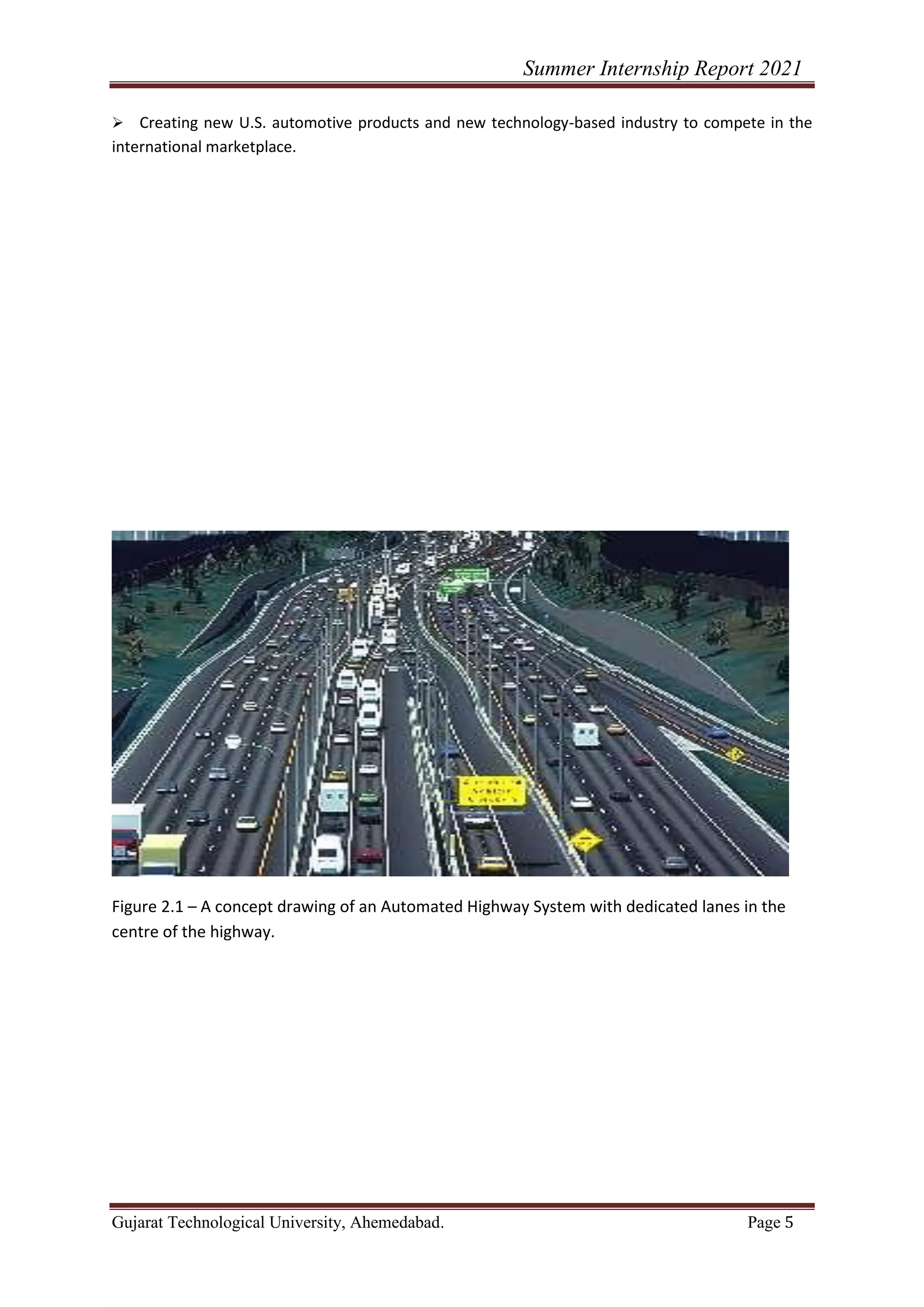
Figure 2.1 – A concept drawing of an Automated Highway System with dedicated lanes in the
centre of the highway.
Summer Internship Report 2021
Gujarat Technological University, Ahemedabad. Page 6
2.3 Methodology
As shown in figure 2.1, a driver electing to use such an automated highway might first pass through a
validation lane, similar to today's high-occupancy-vehicle (HOV) or carpooling lanes. The system
would then determine if the car will function correctly in an automated mode, establish its
destination, and deduct any tolls from the driver's credit account. Improperly operating vehicles
would be diverted to manual lanes. The driver would then steer into a merging area, and the car
would be guided through a gate onto an automated lane. An automatic control system would
coordinate the movement of newly entering and existing traffic. Once travelling in automated mode,
the driver could relax until the turnoff. The reverse process would take the vehicle off the highway.
At this point, the system would need to check whether the driver could retake control, then take
appropriate action if the driver were asleep, sick, or even dead.
The alternative to this kind of dedicated lane system is a mixed traffic system, in which automated
and non-automated vehicles would share the roadway. This approach requires more-extensive
modifications to the highway infrastructure, but would provide the biggest payoff in terms of
capacity increase.
In fact, a spectrum of approaches can be envisioned for highway automation systems in which the
degree of each vehicle's autonomy varies. On one end of the range would be fully independent or
"free-agent" vehicles with their own proximity sensors that would enable vehicles to stop safely
even if the vehicle ahead were to apply the brakes suddenly. In the middle would be vehicles that
could adapt to various levels of cooperation with other vehicles (platooning). At the other end would
be systems that rely to a lesser or greater degree on the highway infrastructure for automated
support. In general, however, most of the technology would be installed in the car.
Summer Internship Report 2021
Gujarat Technological University, Ahemedabad. Page 7
CHAPTER 3. THE SYSTEM CONCEPT AND TECHNOLOGIES
Concepts of Automated Highway System (AHS) can be classified into two groups, partially
automated systems and fully automated systems, depending on the extent of the automation.
Partially automated systems include notification and warning systems, temporary emergency
controls and continuous partial controls, which take limited control of the vehicle in emergency
situations. They automate certain routine parts of driving but rely on manual control for most
driving functions. Fully automated driving would let drivers be totally disengaged from all driving
tasks.
3.1 The Five Concept Families
Independent Vehicle Concept: This concept puts a smart vehicle in the existing infrastructure.
In-vehicle technology lets the vehicle operate automatically with on-board sensors and
computers. The vehicle can use data from roadside systems but does not depend on
infrastructure support.
Cooperative Concept: This concept lets smart vehicles communicate with each other, although
not with the infrastructure. With on-board radar, vision, and other sensors, these AHS-equipped
vehicles will be able to communicate with each other and coordinate their driving operations,
thereby achieving best throughput and safety.
Infrastructure-Supported Concept: A smart infrastructure can greatly improve the quality of
AHS services and better integrate AHS with local transportation networks. This concept
envisions automated vehicles in dedicated lanes using global information and two-way
communication with the smart infrastructure to support vehicle decision-making and operation.
Infrastructure-Assisted Concept: In this concept, the automated roadside system provides
inter-vehicle coordination during entry, exit, merging, and emergencies. This concept may
provide the greatest throughput benefit; it also may require the greatest civil infrastructure
investment.
Adaptable Concept: This concept acknowledges the fact that AHS implementation will vary by
locality. It envisions the development of a wide range of compatible standards that leave as
many of the specific architecture
decisions, solutions, and deployment progressions as possible to area stakeholders.
Summer Internship Report 2021
Gujarat Technological University, Ahemedabad. Page 8
The National Automated Highway System Consortium (NAHSC) defined several alternative AHS
concepts, from cooperative to fully automated, depending on the degree to which vehicles and
infrastructure work together as listed above.
3.2 Current Technologies
While current vehicles use new technologies mostly for safety or driver convenience, e.g., air
bags, antilock brakes, adaptive cruise control, power steering, the vehicles on an AHS system
would require much more new technology that communicates with the roadway. In the simplest
forms of AHS these would focus on the detection of other vehicles and obstacles. Technologies
that already do this to some extent are beginning to be added to luxury vehicles or are
sometimes an option that can be selected by the consumer; e.g., collision warning systems.
Other technologies that would be precursors to the communications technologies in an AHS
system are also being introduced; these include navigation assistance systems, traveler
information systems, and vehicle locator systems. Their acceptance in the market is taken as an
indicator of eventual consumer acceptance of the broader AHS concept.
Summer Internship Report 2021
Gujarat Technological University, Ahemedabad. Page 9
CHAPTER 4. CONTROL DESIGN OF AN AUTOMATED HIGHWAY SYSTEM
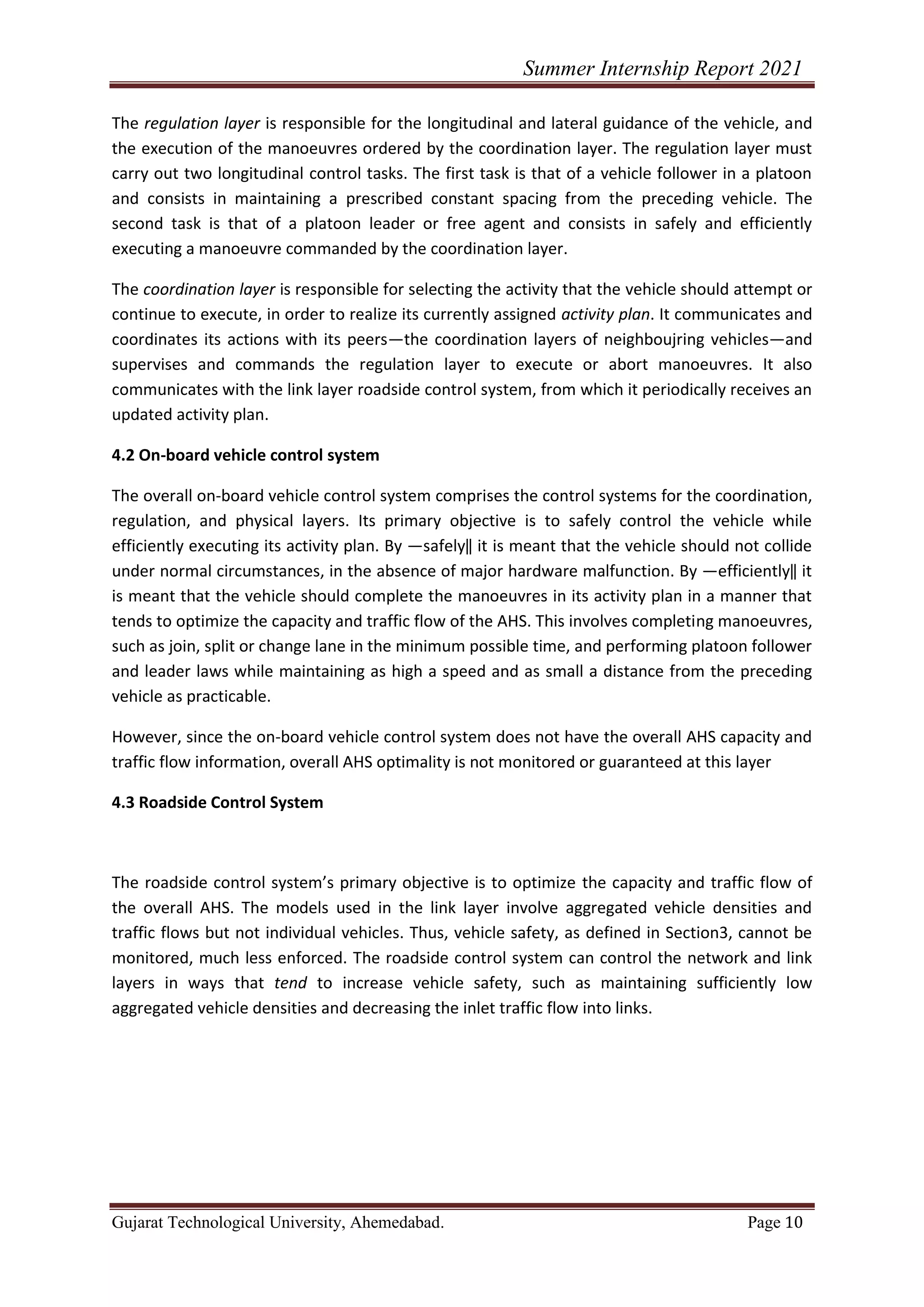
The Control design of an Automated Highway system can be looked upon the basis of a 5 layer
theory which together comprise the two systems viz. the On-board Vehicle System and the
Roadside System. The control design is explained with the aid of the figure 4.1:
Figure 4.1 – The Control Design of an Automated Highway System
4.1 The Five Layer Theory
The physical layer comprises all the on-board vehicle controllers of the physical components of a
vehicle. These include the engine and transmission, brake and steering control systems, as well
as the different lateral and longitudinal vehicle guidance and range sensors. The main function
of the physical layer is to decouple the longitudinal and lateral vehicle guidance control and to
approximately linearize the physical layer dynamics.
Summer Internship Report 2021
Gujarat Technological University, Ahemedabad. Page 10
The regulation layer is responsible for the longitudinal and lateral guidance of the vehicle, and
the execution of the manoeuvres ordered by the coordination layer. The regulation layer must
carry out two longitudinal control tasks. The first task is that of a vehicle follower in a platoon
and consists in maintaining a prescribed constant spacing from the preceding vehicle. The
second task is that of a platoon leader or free agent and consists in safely and efficiently
executing a manoeuvre commanded by the coordination layer.
The coordination layer is responsible for selecting the activity that the vehicle should attempt or
continue to execute, in order to realize its currently assigned activity plan. It communicates and
coordinates its actions with its peers—the coordination layers of neighboujring vehicles—and
supervises and commands the regulation layer to execute or abort manoeuvres. It also
communicates with the link layer roadside control system, from which it periodically receives an
updated activity plan.
4.2 On-board vehicle control system
The overall on-board vehicle control system comprises the control systems for the coordination,
regulation, and physical layers. Its primary objective is to safely control the vehicle while
efficiently executing its activity plan. By ―safely‖ it is meant that the vehicle should not collide
under normal circumstances, in the absence of major hardware malfunction. By ―efficiently‖ it
is meant that the vehicle should complete the manoeuvres in its activity plan in a manner that
tends to optimize the capacity and traffic flow of the AHS. This involves completing manoeuvres,
such as join, split or change lane in the minimum possible time, and performing platoon follower
and leader laws while maintaining as high a speed and as small a distance from the preceding
vehicle as practicable.
However, since the on-board vehicle control system does not have the overall AHS capacity and
traffic flow information, overall AHS optimality is not monitored or guaranteed at this layer
4.3 Roadside Control System
The roadside control system’s primary objective is to optimize the capacity and traffic flow of
the overall AHS. The models used in the link layer involve aggregated vehicle densities and
traffic flows but not individual vehicles. Thus, vehicle safety, as defined in Section3, cannot be
monitored, much less enforced. The roadside control system can control the network and link
layers in ways that tend to increase vehicle safety, such as maintaining sufficiently low
aggregated vehicle densities and decreasing the inlet traffic flow into links.
Summer Internship Report 2021
Gujarat Technological University, Ahemedabad. Page 11
CHAPTER 5. POTENTIAL BENEFITS
Researchers have attempted to estimate benefits that might accrue from the implementation of
automated highway systems. Table 2 summarizes potential benefits. Many of the benefits
shown in the table are fairly speculative; the systems they would depend upon are not yet in
existence and there is no clear evidence that the system can produce the following benefits in
reality.
It is anticipated that automated highway and related advanced vehicle control and safety
technologies would significantly reduce traffic congestion and enhance safety in highway
driving. This in turn would potentially cut travel time, and therefore, driving would be more
predictable and reliable. The Mobility 2000 report, sponsored by the Texas Transportation
Institute, projected that collision prevention systems could reduce accidents by 70 percent or 90
percent on fully automated highways.
Research focused on collision prevention systems has estimated possible savings in a relatively
short period of time. For example, collision avoidance systems have been estimated to have the
potential to reduce annual loss of life on U.S. roads by 50 percent by 2020. In addition,
preliminary National Highway Traffic Safety Administration estimates show that rear-ends, lane-
change, and roadway-departure crash-avoidance systems have the potential to reduce crashes
by one-sixth, or about 1.2 million crashes a year.
Summer Internship Report 2021
Gujarat Technological University, Ahemedabad. Page 12
CHAPTER 6. CONCLUSION
Automated Highway Systems brings major transportation benefits in terms of safety, efficiency,
affordability and usability, and environment in order to achieve its development goals.
A key feature of the control design architecture is the separation of the various control functions
into distinct layers with well-defined interfaces. Each layer is then designed with its own model
that is suited to the functions for which it is responsible. The models at the various layers are
different not only in terms of their formal structure (ranging from differential equations to state
machines to static graphs), but also in the entities that have a role in them.
The AHS is a complex large-scale control system, whose design required advances in sensor,
actuator, and communication technologies (not discussed here) and in techniques of control
system synthesis and analysis. It is a measure of the advanced state of the art that these
techniques have reached a stage that they could be successfully used in the AHS project.
Though it has been said so, the reasons why many federal programs like the National
Automated Highway System Research Program (NAHSRP) failed was that the program was
trapped in technology-optimism. Several U.S. DOT reports on AHS show that there are no
technical and non-technical showstoppers. However, legal, institutional, and societal challenges
just as critical as technical issues. Moreover, these institutional and societal issues cannot be
settled in one day, because they are much to do with people’s perception, behavior, consensus
and social changes based on those.
Summer Internship Report 2021
Gujarat Technological University, Ahemedabad. Page 13
CHAPTER 7. REFERERNCE(S)
1. Cheon, Sanghyun, ―An Overview of Automated Highway systems (AHS) and the social and
the institutional challenges that they face.” Link: http://www.uctc.net/papers/624.pdf
2. Horowitz, Roberto and Varaiya, Pravin, ―Control Design of an Automated Highway System” –
Proceeds of the IEEE, Volume 88, No.7, pp-913 – 925, July 2000.
3. Congress, Nita. ―Smart Road, Smart Car: The Automated Highway System‖. Public Roads
Online. Autumn 1996. Pg.4, 5 & 7. Link: http://www.tfhrc.gov/pubrds/fall96/p96au46.htm.
4. National Automated Highway System Research Program: A Review. TRB Special Report
253.Transportation Research Board, National Research Council. National Academy Press.
Washington, D.C. 1998. pg.15, 32 & 37.
5. National Automated Highway System Consortium, ―Technical Feasibility Demonstration –
Vehicle Platooning‖ 1997. Pg 1-4.
6. Lay, Rodney K., Gene M. McHale, and William B. Stevens. The U.S. DOT Status Report on the
Automated Highway Systems Program. Working Note 95W0000093. Mtretek Systems, Center
for Telecommunications and Advanced Technology. McLean, Virginia. July 1996.

Automated Highway System Report

  • 1.
    SEMINAR REPORT ON AUTOMATED HIGHWAYSYSTEM By Samir chauhan (181300106003) Guided by Ms.Monika Makvana Professor Civil Engineering Department SHGEC, Amreli An Internship Report Submitted to Gujarat Technological University in Partial Fulfillment for the evaluation process of B.E. (Civil Engineering) JUNE 2021 SMT. SHANTABEN HARIBHAI GAJERA ENGINEERING COLLEGE AMRELI-365601,GUJARAT,INDIA
  • 2.
    II SMT. SHANTABEN HARIBHAIGAJERA ENGINEERING COLLEGE AMRELI-365601,GUJARAT,INDIA DEPARTMENT OF CIVIL ENGINEERING CERTIFICATE This is to certify that the Seminar on Automated Highway System has been satisfactorily carried by Samir chauhan (181300106003) under my guidance in the fulfillment of the course Summer Internship (3170001) work during the academic year 2021-2022. Head of the Department Prof. Pradeep dholariya Internal Guide Prof. Monika Makvana
  • 3.
    III ACKNOWLEDGEMENT I wish toexpress my sincere gratitude to my mentor Prof. Monika Makvana and all the faculty members for helping me through my preparation and presentation of seminar by giving the necessary suggestions and advices along with their valuable co-ordination in conduction of this seminar. I also thank my parents, for their precious support and encouragement which they had provided in conduction of seminar. Thus, in conclusion to the above said, I once again thank the faculties and members of SHGEC for their valuable support in conduction of this seminar Thank You Samir chauhan
  • 4.
    IV TABLE OF CONTENTS TITLEPAGE I ACKNOWLEDGEMENT II TABLE OF CONTENTS III LIST OF FIGURES V CHAPTER-1 INTRODUCTION CHAPTER-2 AUTOMATED HIGHWAY SYSTEM 2.1 Automated Highway Systems 2.2 Major AHS Goals 2.3 Methodology CHAPTER-3 THE SYSTEM CONCEPT AND TECHNOLOGIES 3.1 The Five Concept Families 3.2 Current Technologies CHAPTER-4 CONTROL DESIGN OF AN AUTOMATED HIGHWAY SYSTEM 4.1 The Five Layer Theory 4.2 On-board Vehicle Control System 4.3 Roadside Control System CHAPTER-5 POTENTIAL BENEFITS CHAPTER-6 CONCLUSION CHAPTER-7 REFRENCES 1 3 3 3 6 7 7 8 9 9 10 10 11 12 13
  • 5.
    V LIST OF FIGURES SR. NO. DESCRIPTIONPAGE NO. Fig.2.1 A concept drawing of an Automated Highway System With dedicated lanes in the centre of the highway 5 Fig.4.1 The Control Design of an Automated Highway System 9
  • 6.
    Summer Internship Report2021 Gujarat Technological University, Ahemedabad. Page 1 CHAPTER1. INTRODUCTION The idea of automated driving dates back to almost 50 years ago when General Motors (GM) presented a vision of ―driverless‖ vehicles under automated control at the 1939 World fairs in New York. In the 1950’s research by industrial organizations conceptualized automated vehicles controlled by mechanical systems and radio controls. After the first appearance of the computers in the 1960’s, researchers began to consider the potential use of computers to provide lateral and longitudinal control and traffic management. The fully automated highway concept was initially examined by GM with sponsorship from the US department of Transportation (DOT) in the late1970’s. During these times, focus was laid on automated vehicles on a highway as computers were not powerful enough to consider a complete fully automated highway system. Advances in the computing technologies, micro-electronics and sensors in the 1980’s provoked commercial interest in the technologies that might enhance driver capability and perception and both private and public researchers examined partially automated products and services. Among others, the University of California Partners in Advanced Transport and Highways (PATH) has carried out significant research and development in the field of highway automation since the 1980’s. As various transportation technologies emerged that could assist driving on one hand and also traffic efficiency on the other, interest in fully automated driving or integrated auto-highway technologies grew once again. With the passage of the 1991 Intermodal Surface Transport Efficiency Act (ISTEA), efforts were on early prototype development and testing of fully automated vehicles and highways. This act prompted the US DOT to develop the National Automated Highway System Research Programme (NAHSRP), whose goal was to develop specifications for a fully automated highway system concept that would support and stimulate the improvement of vehicle and highway technologies. In 1994, the US Department of Transportation launched the National Highway System Consortium (NAHSC). The consortium consisted of nine major categories of organization including academia, federal, state, regional and local government besides representatives from vehicle, highway, electronics and communications industries. The consortium believed in expanding the program’s expertise and resources, and maintained that the collaborative approach among the stakeholders would be critical in building the common interest that would be required in the early development and deployment of fully automated highway systems. Research continues to this day though it is largely sketchy owing to the withdrawal of the financial support for the National Automated Highway Systems Research Programme (NAHSRP) by the US Department of Transportation in the year 1997.
  • 7.
    Summer Internship Report2021 Gujarat Technological University, Ahemedabad. Page 2 Many studies conducted by the National Automated Highway Systems Consortium (NAHSC) continue in partial way with a couple of federal programmes like the Intelligent Vehicle Initiative (IVI) with more focus on a nearer-term horizon.
  • 8.
    Summer Internship Report2021 Gujarat Technological University, Ahemedabad. Page 3 CHAPTER 2. AUTOMATED HIGHWAY SYSTEMS 2.1 Automated Highway Systems The Automated Highway System (AHS) concept defines a new relationship between vehicles and the highway infrastructure. AHS refers to a set of designated lanes on a limited access roadway where specially equipped vehicles are operated under completely automatic control. AHS uses vehicle and highway control technologies that shift driving functions from the driver/operator to the vehicle. Throttle, steering, and braking are automatically controlled to provide safer and more convenient travel. AHS also uses communication, sensor and obstacle-detection technologies to recognize and react to external infrastructure conditions. The vehicles and highway cooperate to coordinate vehicle movement, avoid obstacles and improve traffic flow, improving safety and reducing congestion. In sum, the AHS concept combines on-board vehicle intelligence with a range of intelligent technologies installed onto existing highway infrastructure and communication technologies that connect vehicles to highway infrastructure. 2.2 Major AHS Goals The AHS program is designed to influence how and when vehicle-highway automation will be introduced. AHS deployments will be tailored to meet the needs of public, commercial, transit, and individual travellers in rural and urban communities. The major goals are to: 1. Improve safety by significantly reducing: ➢ Fatalities. ➢ Personal injury. ➢ Pain and suffering. ➢ Anxiety and stress of driving. 2. Save money and optimize investment by: ➢ Maximizing efficiency of the existing infrastructure investment. ➢ Integrating other ITS services and architecture to achieve smooth traffic flow.
  • 9.
    Summer Internship Report2021 Gujarat Technological University, Ahemedabad. Page 4 ➢ Using available and near-term applied technology to avoid costs of conventional highway build- out. ➢ Developing affordable equipment, vehicles, infrastructure, operations, maintenance, and user fees. ➢ Closing the gap on predicted infrastructure needs. ➢ Using public/private partnerships for shared risk; using the National AHS Consortium as a global focal point to influence foreign deployment efforts. ➢ Reducing fuel consumption and costs, maintenance, wear-and-tear, labor costs, insurance costs, and property damage. 3. Improve accessibility and mobility by: ➢ Improving employee on-time performance, resulting in a more effective work force. ➢ Facilitating "just-in-time" deliveries. ➢ Improving public transportation service, increasing customer access, and expanding service levels, resulting in increased revenue, reduced costs, and reduced accidents. ➢ Achieving a smooth traffic flow, reducing delays, travel times, travel time variability, and driver stress. ➢ Making driving more accessible to less able drivers. 4. Improve environmental efficiencies by: ➢ Reducing emissions per vehicle-mile travelled. ➢ Providing a solid base for reliable, lower cost transit. ➢ Providing an efficient base for electric-powered vehicles and alternative fuel vehicles. 5. Create jobs by: ➢ Providing a stronger national economy and increasing global competitiveness. ➢ Increasing jobs in research and development and in early ITS deployment. ➢ Facilitating technology transfer (e.g., from military to civilian use).
  • 10.
    Summer Internship Report2021 Gujarat Technological University, Ahemedabad. Page 5 ➢ Creating new U.S. automotive products and new technology-based industry to compete in the international marketplace. Figure 2.1 – A concept drawing of an Automated Highway System with dedicated lanes in the centre of the highway.
  • 11.
    Summer Internship Report2021 Gujarat Technological University, Ahemedabad. Page 6 2.3 Methodology As shown in figure 2.1, a driver electing to use such an automated highway might first pass through a validation lane, similar to today's high-occupancy-vehicle (HOV) or carpooling lanes. The system would then determine if the car will function correctly in an automated mode, establish its destination, and deduct any tolls from the driver's credit account. Improperly operating vehicles would be diverted to manual lanes. The driver would then steer into a merging area, and the car would be guided through a gate onto an automated lane. An automatic control system would coordinate the movement of newly entering and existing traffic. Once travelling in automated mode, the driver could relax until the turnoff. The reverse process would take the vehicle off the highway. At this point, the system would need to check whether the driver could retake control, then take appropriate action if the driver were asleep, sick, or even dead. The alternative to this kind of dedicated lane system is a mixed traffic system, in which automated and non-automated vehicles would share the roadway. This approach requires more-extensive modifications to the highway infrastructure, but would provide the biggest payoff in terms of capacity increase. In fact, a spectrum of approaches can be envisioned for highway automation systems in which the degree of each vehicle's autonomy varies. On one end of the range would be fully independent or "free-agent" vehicles with their own proximity sensors that would enable vehicles to stop safely even if the vehicle ahead were to apply the brakes suddenly. In the middle would be vehicles that could adapt to various levels of cooperation with other vehicles (platooning). At the other end would be systems that rely to a lesser or greater degree on the highway infrastructure for automated support. In general, however, most of the technology would be installed in the car.
  • 12.
    Summer Internship Report2021 Gujarat Technological University, Ahemedabad. Page 7 CHAPTER 3. THE SYSTEM CONCEPT AND TECHNOLOGIES Concepts of Automated Highway System (AHS) can be classified into two groups, partially automated systems and fully automated systems, depending on the extent of the automation. Partially automated systems include notification and warning systems, temporary emergency controls and continuous partial controls, which take limited control of the vehicle in emergency situations. They automate certain routine parts of driving but rely on manual control for most driving functions. Fully automated driving would let drivers be totally disengaged from all driving tasks. 3.1 The Five Concept Families Independent Vehicle Concept: This concept puts a smart vehicle in the existing infrastructure. In-vehicle technology lets the vehicle operate automatically with on-board sensors and computers. The vehicle can use data from roadside systems but does not depend on infrastructure support. Cooperative Concept: This concept lets smart vehicles communicate with each other, although not with the infrastructure. With on-board radar, vision, and other sensors, these AHS-equipped vehicles will be able to communicate with each other and coordinate their driving operations, thereby achieving best throughput and safety. Infrastructure-Supported Concept: A smart infrastructure can greatly improve the quality of AHS services and better integrate AHS with local transportation networks. This concept envisions automated vehicles in dedicated lanes using global information and two-way communication with the smart infrastructure to support vehicle decision-making and operation. Infrastructure-Assisted Concept: In this concept, the automated roadside system provides inter-vehicle coordination during entry, exit, merging, and emergencies. This concept may provide the greatest throughput benefit; it also may require the greatest civil infrastructure investment. Adaptable Concept: This concept acknowledges the fact that AHS implementation will vary by locality. It envisions the development of a wide range of compatible standards that leave as many of the specific architecture decisions, solutions, and deployment progressions as possible to area stakeholders.
  • 13.
    Summer Internship Report2021 Gujarat Technological University, Ahemedabad. Page 8 The National Automated Highway System Consortium (NAHSC) defined several alternative AHS concepts, from cooperative to fully automated, depending on the degree to which vehicles and infrastructure work together as listed above. 3.2 Current Technologies While current vehicles use new technologies mostly for safety or driver convenience, e.g., air bags, antilock brakes, adaptive cruise control, power steering, the vehicles on an AHS system would require much more new technology that communicates with the roadway. In the simplest forms of AHS these would focus on the detection of other vehicles and obstacles. Technologies that already do this to some extent are beginning to be added to luxury vehicles or are sometimes an option that can be selected by the consumer; e.g., collision warning systems. Other technologies that would be precursors to the communications technologies in an AHS system are also being introduced; these include navigation assistance systems, traveler information systems, and vehicle locator systems. Their acceptance in the market is taken as an indicator of eventual consumer acceptance of the broader AHS concept.
  • 14.
    Summer Internship Report2021 Gujarat Technological University, Ahemedabad. Page 9 CHAPTER 4. CONTROL DESIGN OF AN AUTOMATED HIGHWAY SYSTEM The Control design of an Automated Highway system can be looked upon the basis of a 5 layer theory which together comprise the two systems viz. the On-board Vehicle System and the Roadside System. The control design is explained with the aid of the figure 4.1: Figure 4.1 – The Control Design of an Automated Highway System 4.1 The Five Layer Theory The physical layer comprises all the on-board vehicle controllers of the physical components of a vehicle. These include the engine and transmission, brake and steering control systems, as well as the different lateral and longitudinal vehicle guidance and range sensors. The main function of the physical layer is to decouple the longitudinal and lateral vehicle guidance control and to approximately linearize the physical layer dynamics.
  • 15.
    Summer Internship Report2021 Gujarat Technological University, Ahemedabad. Page 10 The regulation layer is responsible for the longitudinal and lateral guidance of the vehicle, and the execution of the manoeuvres ordered by the coordination layer. The regulation layer must carry out two longitudinal control tasks. The first task is that of a vehicle follower in a platoon and consists in maintaining a prescribed constant spacing from the preceding vehicle. The second task is that of a platoon leader or free agent and consists in safely and efficiently executing a manoeuvre commanded by the coordination layer. The coordination layer is responsible for selecting the activity that the vehicle should attempt or continue to execute, in order to realize its currently assigned activity plan. It communicates and coordinates its actions with its peers—the coordination layers of neighboujring vehicles—and supervises and commands the regulation layer to execute or abort manoeuvres. It also communicates with the link layer roadside control system, from which it periodically receives an updated activity plan. 4.2 On-board vehicle control system The overall on-board vehicle control system comprises the control systems for the coordination, regulation, and physical layers. Its primary objective is to safely control the vehicle while efficiently executing its activity plan. By ―safely‖ it is meant that the vehicle should not collide under normal circumstances, in the absence of major hardware malfunction. By ―efficiently‖ it is meant that the vehicle should complete the manoeuvres in its activity plan in a manner that tends to optimize the capacity and traffic flow of the AHS. This involves completing manoeuvres, such as join, split or change lane in the minimum possible time, and performing platoon follower and leader laws while maintaining as high a speed and as small a distance from the preceding vehicle as practicable. However, since the on-board vehicle control system does not have the overall AHS capacity and traffic flow information, overall AHS optimality is not monitored or guaranteed at this layer 4.3 Roadside Control System The roadside control system’s primary objective is to optimize the capacity and traffic flow of the overall AHS. The models used in the link layer involve aggregated vehicle densities and traffic flows but not individual vehicles. Thus, vehicle safety, as defined in Section3, cannot be monitored, much less enforced. The roadside control system can control the network and link layers in ways that tend to increase vehicle safety, such as maintaining sufficiently low aggregated vehicle densities and decreasing the inlet traffic flow into links.
  • 16.
    Summer Internship Report2021 Gujarat Technological University, Ahemedabad. Page 11 CHAPTER 5. POTENTIAL BENEFITS Researchers have attempted to estimate benefits that might accrue from the implementation of automated highway systems. Table 2 summarizes potential benefits. Many of the benefits shown in the table are fairly speculative; the systems they would depend upon are not yet in existence and there is no clear evidence that the system can produce the following benefits in reality. It is anticipated that automated highway and related advanced vehicle control and safety technologies would significantly reduce traffic congestion and enhance safety in highway driving. This in turn would potentially cut travel time, and therefore, driving would be more predictable and reliable. The Mobility 2000 report, sponsored by the Texas Transportation Institute, projected that collision prevention systems could reduce accidents by 70 percent or 90 percent on fully automated highways. Research focused on collision prevention systems has estimated possible savings in a relatively short period of time. For example, collision avoidance systems have been estimated to have the potential to reduce annual loss of life on U.S. roads by 50 percent by 2020. In addition, preliminary National Highway Traffic Safety Administration estimates show that rear-ends, lane- change, and roadway-departure crash-avoidance systems have the potential to reduce crashes by one-sixth, or about 1.2 million crashes a year.
  • 17.
    Summer Internship Report2021 Gujarat Technological University, Ahemedabad. Page 12 CHAPTER 6. CONCLUSION Automated Highway Systems brings major transportation benefits in terms of safety, efficiency, affordability and usability, and environment in order to achieve its development goals. A key feature of the control design architecture is the separation of the various control functions into distinct layers with well-defined interfaces. Each layer is then designed with its own model that is suited to the functions for which it is responsible. The models at the various layers are different not only in terms of their formal structure (ranging from differential equations to state machines to static graphs), but also in the entities that have a role in them. The AHS is a complex large-scale control system, whose design required advances in sensor, actuator, and communication technologies (not discussed here) and in techniques of control system synthesis and analysis. It is a measure of the advanced state of the art that these techniques have reached a stage that they could be successfully used in the AHS project. Though it has been said so, the reasons why many federal programs like the National Automated Highway System Research Program (NAHSRP) failed was that the program was trapped in technology-optimism. Several U.S. DOT reports on AHS show that there are no technical and non-technical showstoppers. However, legal, institutional, and societal challenges just as critical as technical issues. Moreover, these institutional and societal issues cannot be settled in one day, because they are much to do with people’s perception, behavior, consensus and social changes based on those.
  • 18.
    Summer Internship Report2021 Gujarat Technological University, Ahemedabad. Page 13 CHAPTER 7. REFERERNCE(S) 1. Cheon, Sanghyun, ―An Overview of Automated Highway systems (AHS) and the social and the institutional challenges that they face.” Link: http://www.uctc.net/papers/624.pdf 2. Horowitz, Roberto and Varaiya, Pravin, ―Control Design of an Automated Highway System” – Proceeds of the IEEE, Volume 88, No.7, pp-913 – 925, July 2000. 3. Congress, Nita. ―Smart Road, Smart Car: The Automated Highway System‖. Public Roads Online. Autumn 1996. Pg.4, 5 & 7. Link: http://www.tfhrc.gov/pubrds/fall96/p96au46.htm. 4. National Automated Highway System Research Program: A Review. TRB Special Report 253.Transportation Research Board, National Research Council. National Academy Press. Washington, D.C. 1998. pg.15, 32 & 37. 5. National Automated Highway System Consortium, ―Technical Feasibility Demonstration – Vehicle Platooning‖ 1997. Pg 1-4. 6. Lay, Rodney K., Gene M. McHale, and William B. Stevens. The U.S. DOT Status Report on the Automated Highway Systems Program. Working Note 95W0000093. Mtretek Systems, Center for Telecommunications and Advanced Technology. McLean, Virginia. July 1996.