

POLYMER MODIFIED BITUMEN
FOR ROAD CONSTRUCTION
Guide:
Dhaneesh K P Jomson Mathachan
Asst. Professor S8-Chemical Engg.
Dept. Of Chemical Engg GEC-Kozhikode
G.E.C. Kozhikode Reg No :GCAOECH060
CONTENTS
1. INTRODUCTION
2. PLASTIC ROAD
3. RUBBERISED ROAD
INTRODUCTION
 Bitumen is a by-product of fractional distillation of crude
oil.
 Current world consumption of bitumen is approximately
120 million tons per year.
 In India, flexible pavements with bituminous surfacing
are widely used.
 Rapid development, exponential increase in traffic, and
significant variations in daily and seasonal temperatures
have shown some limitations in bitumen binder
performance.
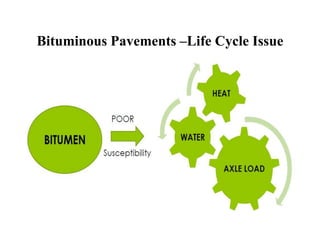
Bituminous Pavements –Life Cycle Issue
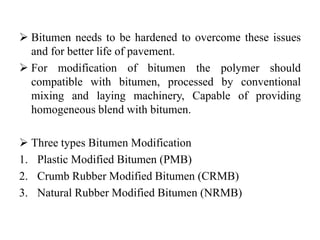
 Bitumen needs to be hardened to overcome these issues
and for better life of pavement.
 For modification of bitumen the polymer should
compatible with bitumen, processed by conventional
mixing and laying machinery, Capable of providing
homogeneous blend with bitumen.
 Three types Bitumen Modification
1. Plastic Modified Bitumen (PMB)
2. Crumb Rubber Modified Bitumen (CRMB)
3. Natural Rubber Modified Bitumen (NRMB)
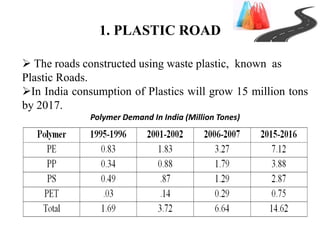
1. PLASTIC ROAD
 The roads constructed using waste plastic, known as
Plastic Roads.
In India consumption of Plastics will grow 15 million tons
by 2017.
Polymer Demand In India (Million Tones)
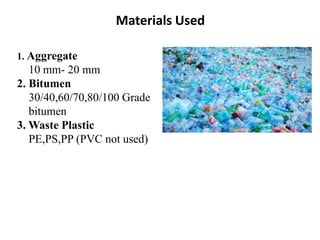
Materials Used
1. Aggregate
10 mm- 20 mm
2. Bitumen
30/40,60/70,80/100 Grade
bitumen
3. Waste Plastic
PE,PS,PP (PVC not used)
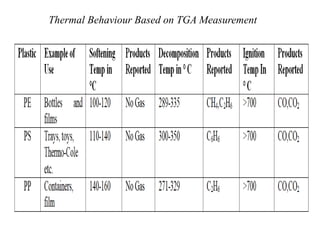
Thermal Behaviour Based on TGA Measurement
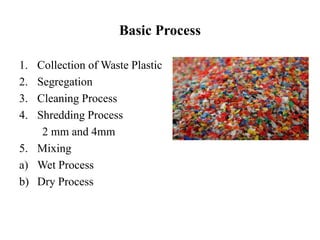
Basic Process
1. Collection of Waste Plastic
2. Segregation
3. Cleaning Process
4. Shredding Process
2 mm and 4mm
5. Mixing
a) Wet Process
b) Dry Process
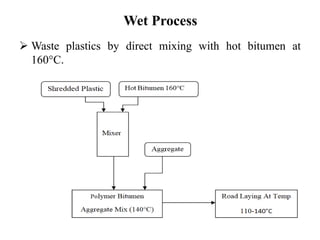
Wet Process
 Waste plastics by direct mixing with hot bitumen at
160°C.
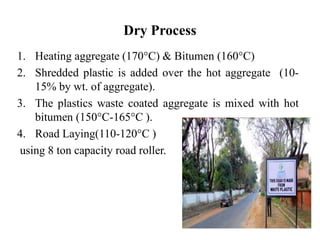
Dry Process
1. Heating aggregate (170°C) & Bitumen (160°C)
2. Shredded plastic is added over the hot aggregate (10-
15% by wt. of aggregate).
3. The plastics waste coated aggregate is mixed with hot
bitumen (150°C-165°C ).
4. Road Laying(110-120°C )
using 8 ton capacity road roller.
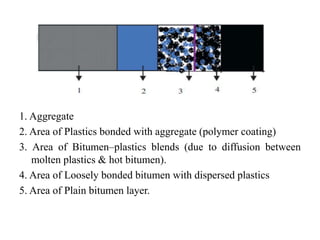
1. Aggregate
2. Area of Plastics bonded with aggregate (polymer coating)
3. Area of Bitumen–plastics blends (due to diffusion between
molten plastics & hot bitumen).
4. Area of Loosely bonded bitumen with dispersed plastics
5. Area of Plain bitumen layer.
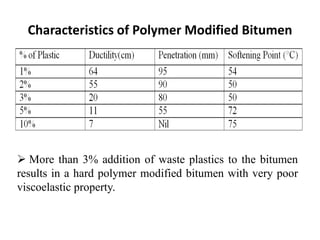
Characteristics of Polymer Modified Bitumen
 More than 3% addition of waste plastics to the bitumen
results in a hard polymer modified bitumen with very poor
viscoelastic property.
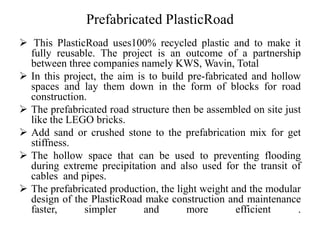
Prefabricated PlasticRoad
 This PlasticRoad uses100% recycled plastic and to make it
fully reusable. The project is an outcome of a partnership
between three companies namely KWS, Wavin, Total
 In this project, the aim is to build pre-fabricated and hollow
spaces and lay them down in the form of blocks for road
construction.
 The prefabricated road structure then be assembled on site just
like the LEGO bricks.
 Add sand or crushed stone to the prefabrication mix for get
stiffness.
 The hollow space that can be used to preventing flooding
during extreme precipitation and also used for the transit of
cables and pipes.
 The prefabricated production, the light weight and the modular
design of the PlasticRoad make construction and maintenance
faster, simpler and more efficient .
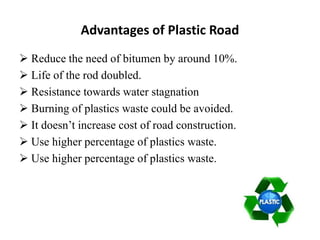
Advantages of Plastic Road
 Reduce the need of bitumen by around 10%.
 Life of the rod doubled.
 Resistance towards water stagnation
 Burning of plastics waste could be avoided.
 It doesn’t increase cost of road construction.
 Use higher percentage of plastics waste.
Disadvantages of Plastic Road
 The presence of chlorine will definitely release noxious
HCl gas. During the road laying process.
2. RUBBERISED ROAD
 Rubberised roads' are made from consists of
regular asphalt concrete mixed with rubber.
 Crumb Rubber Modified Bitumen is a mixture of hot
bitumen and crumb rubber derived from scrap tyres.
 The use of CRMB in road construction for safe disposal
of discarded tyres of automobiles.
 Globally over 15 million tones of waste tyres are
generated, annually. India also contributes approx.
1million tyres annually.
 Currently waste tyres are being utilized for Recycling,
Pyrolysis, Land Fill, Crumb Rubber.
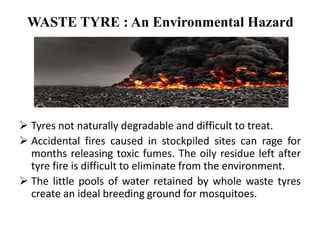
WASTE TYRE : An Environmental Hazard
 Tyres not naturally degradable and difficult to treat.
 Accidental fires caused in stockpiled sites can rage for
months releasing toxic fumes. The oily residue left after
tyre fire is difficult to eliminate from the environment.
 The little pools of water retained by whole waste tyres
create an ideal breeding ground for mosquitoes.
Materials Used
1. Crumb Rubber
 Crumb rubber is recycled rubber produced
from automotive and truck scrap tires by granulation
process (1-10mm).
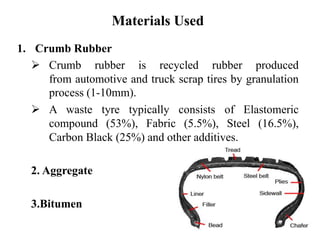
 A waste tyre typically consists of Elastomeric
compound (53%), Fabric (5.5%), Steel (16.5%),
Carbon Black (25%) and other additives.
2. Aggregate
3.Bitumen
Basic Process
1. Collection of Scrap Tyres.
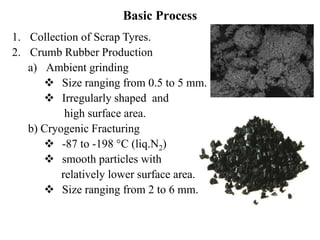
2. Crumb Rubber Production
a) Ambient grinding
 Size ranging from 0.5 to 5 mm.
 Irregularly shaped and
high surface area.
b) Cryogenic Fracturing
 -87 to -198 °C (liq.N2)
 smooth particles with
relatively lower surface area.
 Size ranging from 2 to 6 mm.
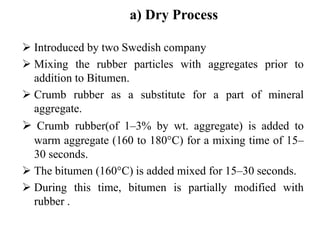
a) Dry Process
 Introduced by two Swedish company
 Mixing the rubber particles with aggregates prior to
addition to Bitumen.
 Crumb rubber as a substitute for a part of mineral
aggregate.
 Crumb rubber(of 1–3% by wt. aggregate) is added to
warm aggregate (160 to 180°C) for a mixing time of 15–
30 seconds.
 The bitumen (160°C) is added mixed for 15–30 seconds.
 During this time, bitumen is partially modified with
rubber .
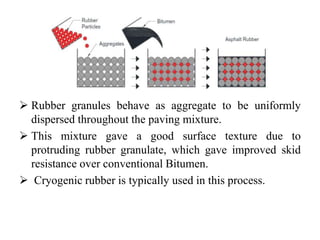
 Rubber granules behave as aggregate to be uniformly
dispersed throughout the paving mixture.
 This mixture gave a good surface texture due to
protruding rubber granulate, which gave improved skid
resistance over conventional Bitumen.
 Cryogenic rubber is typically used in this process.
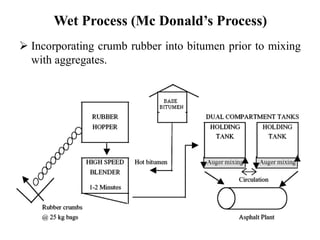
Wet Process (Mc Donald’s Process)
 Incorporating crumb rubber into bitumen prior to mixing
with aggregates.
 During this reaction time the rubber particles absorb some
of the light fractions of Bitumen binder and swell.
 If the temperature is too high or the time is too long
which causes depolymerisation /devulcanisation of
crumb rubber.
Advantages of Rubberised Road
 Rubberized bitumen has higher softening point, giving
more stability to the pavement during hot months.
 Reduce the noise pollution of heavy traffic roads.
 Conventional stone aggregate can be saved to the certain
quantities.
 Improved the skid resistance of road.
 Use higher percentage of Scrap tyre.
 Resistance to cracking, raveling, deformation and creep
failure.
 Improved resistance to stripping due to water repellent
properties.
Disadvantages of Rubberised Road
 The bitumen-rubber materials must be properly selected ,
designed & produced.
 Rubberized asphalt is sticky when applied so it is required
for the roadway to be sprayed with water.
CONCLUSIONS
 The use of waste polymer in bitumen modification will
improves the strength and overall durability of the road.
 The use of waste polymer in bituminous concrete mix
may aid in minimizing the construction cost of the roads.
 Moreover it may also contribute in preventing the
environmental pollution caused by the dumping of
polymer waste materials in ground.
REFERENCES
1. Jiqing Zhu, Bjorn Birgisson, Niki Kringos “Polymer modification of
bitumen: Advances and challenges” in European Polymer Journal 54
(2014) 18–38
2. S.Rajasekaran, Dr. R. Vasudevan2, Dr. Samuvel Paulraj3 “Reuse of Waste
Plastics Coated Aggregates-Bitumen Mix Composite for Road
Application – Green Method” in American Journal of Engineering
Research (AJER). Volume-02, Issue-11, January 2013.
3. William W. Crockford, Danai Makunike, Richard R. Davison, Tom
Scullion and Travis C. Billiter “Recycling Crumb Rubber Modified
Asphalt Pavements” in Texas Transportation Institute Research Report
1333-1F.
4. Davide Lo Presti “Recycled Tyre Rubber Modified Bitumens for road
asphalt mixtures” in Construction and Building Materials. September
2013, 863–881.
5. Prof. S. B. Patil , Prof. A. A. Lole , Prof. N. U. Bavane , Prof. S. S.
Shinde “Use of waste tyres in road construction” in International
Research Journal of Engineering and Technology. Volume: 03 Issue: 12 |
Dec -2016.
6. Jiqing Zhu, Bjorn Birgisson, Niki Kringos “Polymer modification of
bitumen: Advances and challenges” in European Polymer Journal 54
(2014) 18–38
THANK YOU

Polymer Modified Bitumen (PMB) for Road Construction

  • 1.
    POLYMER MODIFIED BITUMEN FORROAD CONSTRUCTION Guide: Dhaneesh K P Jomson Mathachan Asst. Professor S8-Chemical Engg. Dept. Of Chemical Engg GEC-Kozhikode G.E.C. Kozhikode Reg No :GCAOECH060
  • 2.
    CONTENTS 1. INTRODUCTION 2. PLASTICROAD 3. RUBBERISED ROAD
  • 3.
    INTRODUCTION  Bitumen isa by-product of fractional distillation of crude oil.  Current world consumption of bitumen is approximately 120 million tons per year.  In India, flexible pavements with bituminous surfacing are widely used.  Rapid development, exponential increase in traffic, and significant variations in daily and seasonal temperatures have shown some limitations in bitumen binder performance.
  • 4.
  • 5.
     Bitumen needsto be hardened to overcome these issues and for better life of pavement.  For modification of bitumen the polymer should compatible with bitumen, processed by conventional mixing and laying machinery, Capable of providing homogeneous blend with bitumen.  Three types Bitumen Modification 1. Plastic Modified Bitumen (PMB) 2. Crumb Rubber Modified Bitumen (CRMB) 3. Natural Rubber Modified Bitumen (NRMB)
  • 6.
    1. PLASTIC ROAD The roads constructed using waste plastic, known as Plastic Roads. In India consumption of Plastics will grow 15 million tons by 2017. Polymer Demand In India (Million Tones)
  • 7.
    Materials Used 1. Aggregate 10mm- 20 mm 2. Bitumen 30/40,60/70,80/100 Grade bitumen 3. Waste Plastic PE,PS,PP (PVC not used)
  • 8.
    Thermal Behaviour Basedon TGA Measurement
  • 9.
    Basic Process 1. Collectionof Waste Plastic 2. Segregation 3. Cleaning Process 4. Shredding Process 2 mm and 4mm 5. Mixing a) Wet Process b) Dry Process
  • 10.
    Wet Process  Wasteplastics by direct mixing with hot bitumen at 160°C.
  • 11.
    Dry Process 1. Heatingaggregate (170°C) & Bitumen (160°C) 2. Shredded plastic is added over the hot aggregate (10- 15% by wt. of aggregate). 3. The plastics waste coated aggregate is mixed with hot bitumen (150°C-165°C ). 4. Road Laying(110-120°C ) using 8 ton capacity road roller.
  • 12.
    1. Aggregate 2. Areaof Plastics bonded with aggregate (polymer coating) 3. Area of Bitumen–plastics blends (due to diffusion between molten plastics & hot bitumen). 4. Area of Loosely bonded bitumen with dispersed plastics 5. Area of Plain bitumen layer.
  • 13.
    Characteristics of PolymerModified Bitumen  More than 3% addition of waste plastics to the bitumen results in a hard polymer modified bitumen with very poor viscoelastic property.
  • 14.
    Prefabricated PlasticRoad  ThisPlasticRoad uses100% recycled plastic and to make it fully reusable. The project is an outcome of a partnership between three companies namely KWS, Wavin, Total  In this project, the aim is to build pre-fabricated and hollow spaces and lay them down in the form of blocks for road construction.  The prefabricated road structure then be assembled on site just like the LEGO bricks.  Add sand or crushed stone to the prefabrication mix for get stiffness.  The hollow space that can be used to preventing flooding during extreme precipitation and also used for the transit of cables and pipes.  The prefabricated production, the light weight and the modular design of the PlasticRoad make construction and maintenance faster, simpler and more efficient .
  • 16.
    Advantages of PlasticRoad  Reduce the need of bitumen by around 10%.  Life of the rod doubled.  Resistance towards water stagnation  Burning of plastics waste could be avoided.  It doesn’t increase cost of road construction.  Use higher percentage of plastics waste.  Use higher percentage of plastics waste.
  • 17.
    Disadvantages of PlasticRoad  The presence of chlorine will definitely release noxious HCl gas. During the road laying process.
  • 18.
    2. RUBBERISED ROAD Rubberised roads' are made from consists of regular asphalt concrete mixed with rubber.  Crumb Rubber Modified Bitumen is a mixture of hot bitumen and crumb rubber derived from scrap tyres.  The use of CRMB in road construction for safe disposal of discarded tyres of automobiles.  Globally over 15 million tones of waste tyres are generated, annually. India also contributes approx. 1million tyres annually.  Currently waste tyres are being utilized for Recycling, Pyrolysis, Land Fill, Crumb Rubber.
  • 19.
    WASTE TYRE :An Environmental Hazard  Tyres not naturally degradable and difficult to treat.  Accidental fires caused in stockpiled sites can rage for months releasing toxic fumes. The oily residue left after tyre fire is difficult to eliminate from the environment.  The little pools of water retained by whole waste tyres create an ideal breeding ground for mosquitoes.
  • 20.
    Materials Used 1. CrumbRubber  Crumb rubber is recycled rubber produced from automotive and truck scrap tires by granulation process (1-10mm).  A waste tyre typically consists of Elastomeric compound (53%), Fabric (5.5%), Steel (16.5%), Carbon Black (25%) and other additives. 2. Aggregate 3.Bitumen
  • 21.
    Basic Process 1. Collectionof Scrap Tyres. 2. Crumb Rubber Production a) Ambient grinding  Size ranging from 0.5 to 5 mm.  Irregularly shaped and high surface area. b) Cryogenic Fracturing  -87 to -198 °C (liq.N2)  smooth particles with relatively lower surface area.  Size ranging from 2 to 6 mm.
  • 22.
    a) Dry Process Introduced by two Swedish company  Mixing the rubber particles with aggregates prior to addition to Bitumen.  Crumb rubber as a substitute for a part of mineral aggregate.  Crumb rubber(of 1–3% by wt. aggregate) is added to warm aggregate (160 to 180°C) for a mixing time of 15– 30 seconds.  The bitumen (160°C) is added mixed for 15–30 seconds.  During this time, bitumen is partially modified with rubber .
  • 23.
     Rubber granulesbehave as aggregate to be uniformly dispersed throughout the paving mixture.  This mixture gave a good surface texture due to protruding rubber granulate, which gave improved skid resistance over conventional Bitumen.  Cryogenic rubber is typically used in this process.
  • 24.
    Wet Process (McDonald’s Process)  Incorporating crumb rubber into bitumen prior to mixing with aggregates.
  • 25.
     During thisreaction time the rubber particles absorb some of the light fractions of Bitumen binder and swell.  If the temperature is too high or the time is too long which causes depolymerisation /devulcanisation of crumb rubber.
  • 26.
    Advantages of RubberisedRoad  Rubberized bitumen has higher softening point, giving more stability to the pavement during hot months.  Reduce the noise pollution of heavy traffic roads.  Conventional stone aggregate can be saved to the certain quantities.  Improved the skid resistance of road.  Use higher percentage of Scrap tyre.  Resistance to cracking, raveling, deformation and creep failure.  Improved resistance to stripping due to water repellent properties.
  • 27.
    Disadvantages of RubberisedRoad  The bitumen-rubber materials must be properly selected , designed & produced.  Rubberized asphalt is sticky when applied so it is required for the roadway to be sprayed with water.
  • 28.
    CONCLUSIONS  The useof waste polymer in bitumen modification will improves the strength and overall durability of the road.  The use of waste polymer in bituminous concrete mix may aid in minimizing the construction cost of the roads.  Moreover it may also contribute in preventing the environmental pollution caused by the dumping of polymer waste materials in ground.
  • 29.
    REFERENCES 1. Jiqing Zhu,Bjorn Birgisson, Niki Kringos “Polymer modification of bitumen: Advances and challenges” in European Polymer Journal 54 (2014) 18–38 2. S.Rajasekaran, Dr. R. Vasudevan2, Dr. Samuvel Paulraj3 “Reuse of Waste Plastics Coated Aggregates-Bitumen Mix Composite for Road Application – Green Method” in American Journal of Engineering Research (AJER). Volume-02, Issue-11, January 2013. 3. William W. Crockford, Danai Makunike, Richard R. Davison, Tom Scullion and Travis C. Billiter “Recycling Crumb Rubber Modified Asphalt Pavements” in Texas Transportation Institute Research Report 1333-1F. 4. Davide Lo Presti “Recycled Tyre Rubber Modified Bitumens for road asphalt mixtures” in Construction and Building Materials. September 2013, 863–881. 5. Prof. S. B. Patil , Prof. A. A. Lole , Prof. N. U. Bavane , Prof. S. S. Shinde “Use of waste tyres in road construction” in International Research Journal of Engineering and Technology. Volume: 03 Issue: 12 | Dec -2016. 6. Jiqing Zhu, Bjorn Birgisson, Niki Kringos “Polymer modification of bitumen: Advances and challenges” in European Polymer Journal 54 (2014) 18–38
  • 30.