

JNTU COLLEGE OF ENGINEERING, ANANTAPUR.
              PRESENTATION BY….

R.RAGHAVENDRA               K.MADHAVULU
III/IV B.Tech, Civil        III/IV B.Tech, Civil
CONTENTS
    :
1.   SCOPE
2.   RATING METHODOLOGY
3.   PROCEDURE FOR RATING
4.   STRENGTHENING
5.   POSTING
6.   CONCLUSION
7.   REFERENCES
SCOPE :
 INTRODUCTION…

 RATING…
 NECESSITY OF RATING…
 LOADS FOR RATING…
 Poor quality
       *   DEAD LOAD
       *   LIVE LOAD
       *   IMPACT
RATING METHODOLOGY:
  GLOBAL PRACTICES
   LOADS
   STRESSES
   FATIGUE
   DESIGN PHILOSOPHY

  RATIING SYSTEM

        ANALYTICAL METHOD
        CORRELATION METHOD
        LOAD TEST METHOD
ANALYTICAL METHOD
         It is applicable when as built or contract drawings and
    specifications followed are available or when such drawings can be
    prepared by site measurements to an acceptable level of accuracy.
            CORRELATION
                  METHOD
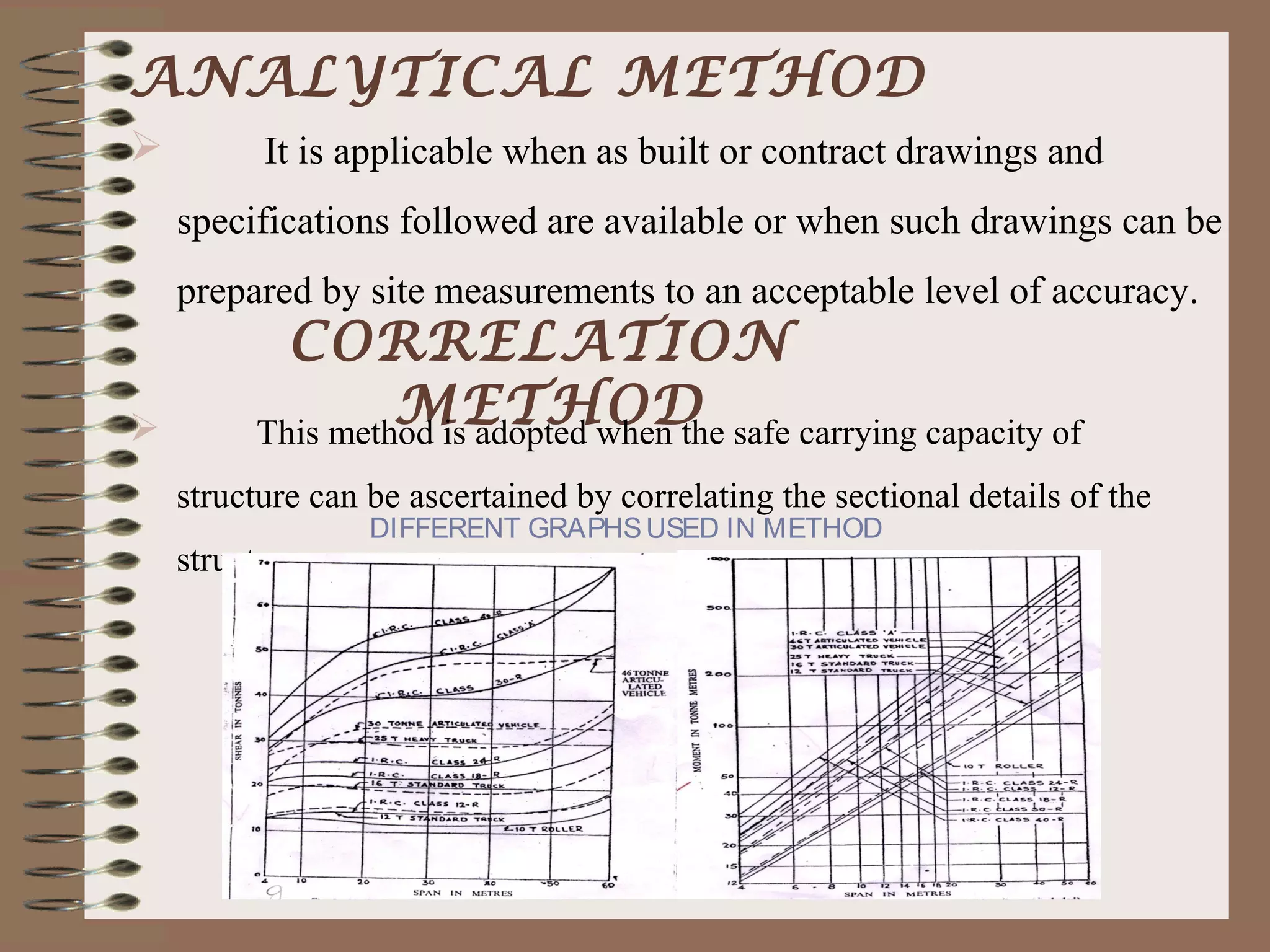
          This method is adopted when the safe carrying capacity of
    structure can be ascertained by correlating the sectional details of the
                  DIFFERENT GRAPHS USED IN METHOD
    structure.
LOAD TEST METHOD
          It is applicable when no construction drawings and specification
    originally followed are available or when such details are not possible to
    be obtained an site.
                PROOF TEST
                FAILURE TEST

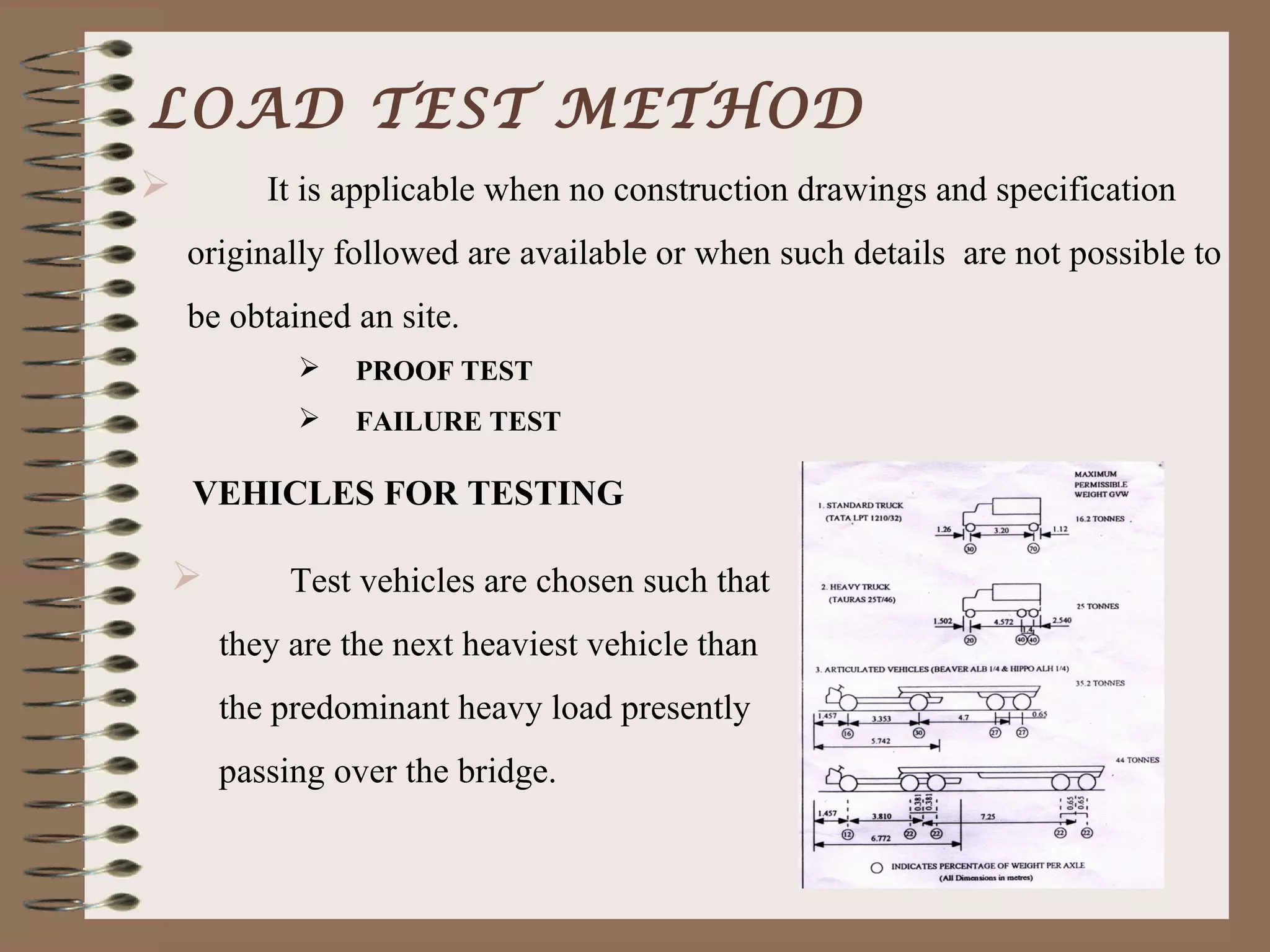
    VEHICLES FOR TESTING

            Test vehicles are chosen such that
        they are the next heaviest vehicle than
        the predominant heavy load presently
        passing over the bridge.
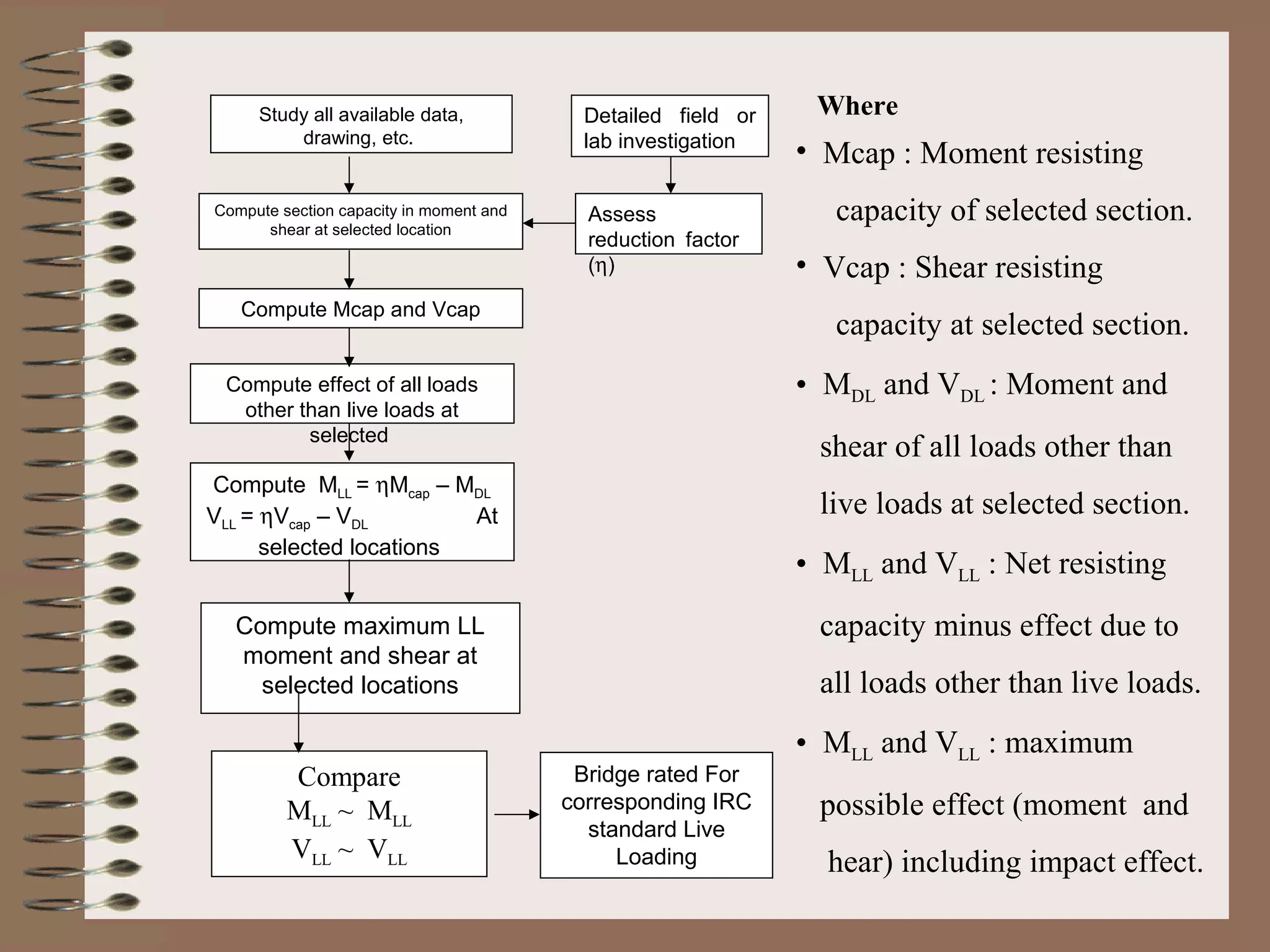
Study all available data,             Detailed field or    Where
         drawing, etc.                     lab investigation
                                                               • Mcap : Moment resisting
Compute section capacity in moment and
      shear at selected location
                                           Assess                 capacity of selected section.
                                           reduction factor
                                           (η)                 • Vcap : Shear resisting
   Compute Mcap and Vcap
                                                                  capacity at selected section.
 Compute effect of all loads                                   • MDL and VDL : Moment and
  other than live loads at
         selected
                                                                shear of all loads other than
Compute MLL = ηMcap – MDL
VLL = ηVcap – VDL        At                                     live loads at selected section.
      selected locations
                                                               • MLL and VLL : Net resisting
  Compute maximum LL                                            capacity minus effect due to
  moment and shear at
    selected locations                                          all loads other than live loads.
                                                               • MLL and VLL : maximum
         Compare                          Bridge rated For
         MLL ~ MLL                       corresponding IRC      possible effect (moment and
                                           standard Live
         VLL ~ VLL                            Loading            hear) including impact effect.
SPACING AND NUMBER OF VEHILES

     Closer spacing of vehicles in urban areas is a frequent possibility.
    Urban traffic is mixed and slow as against the heavy and fast traffic
    for which the rating is proposed and high impact percentage.
 SINGLE LANE BRIDGE
                                       SPACING
        Standard and heavy trucks        30 Mt
           Articulated vehicles          18.5Mt

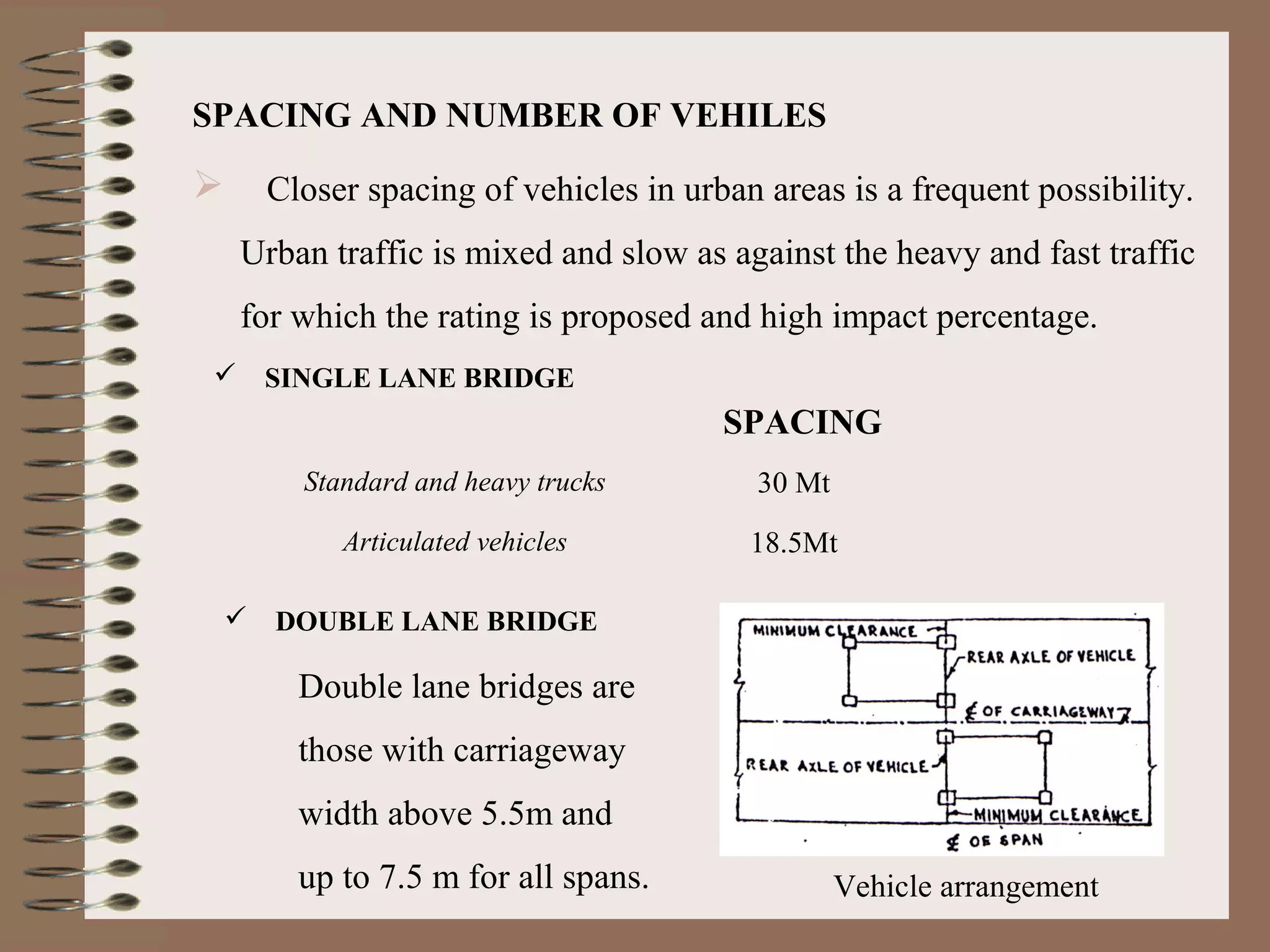
     DOUBLE LANE BRIDGE

        Double lane bridges are
        those with carriageway
        width above 5.5m and
        up to 7.5 m for all spans.               Vehicle arrangement
PROCEDURE FOR
       RATING
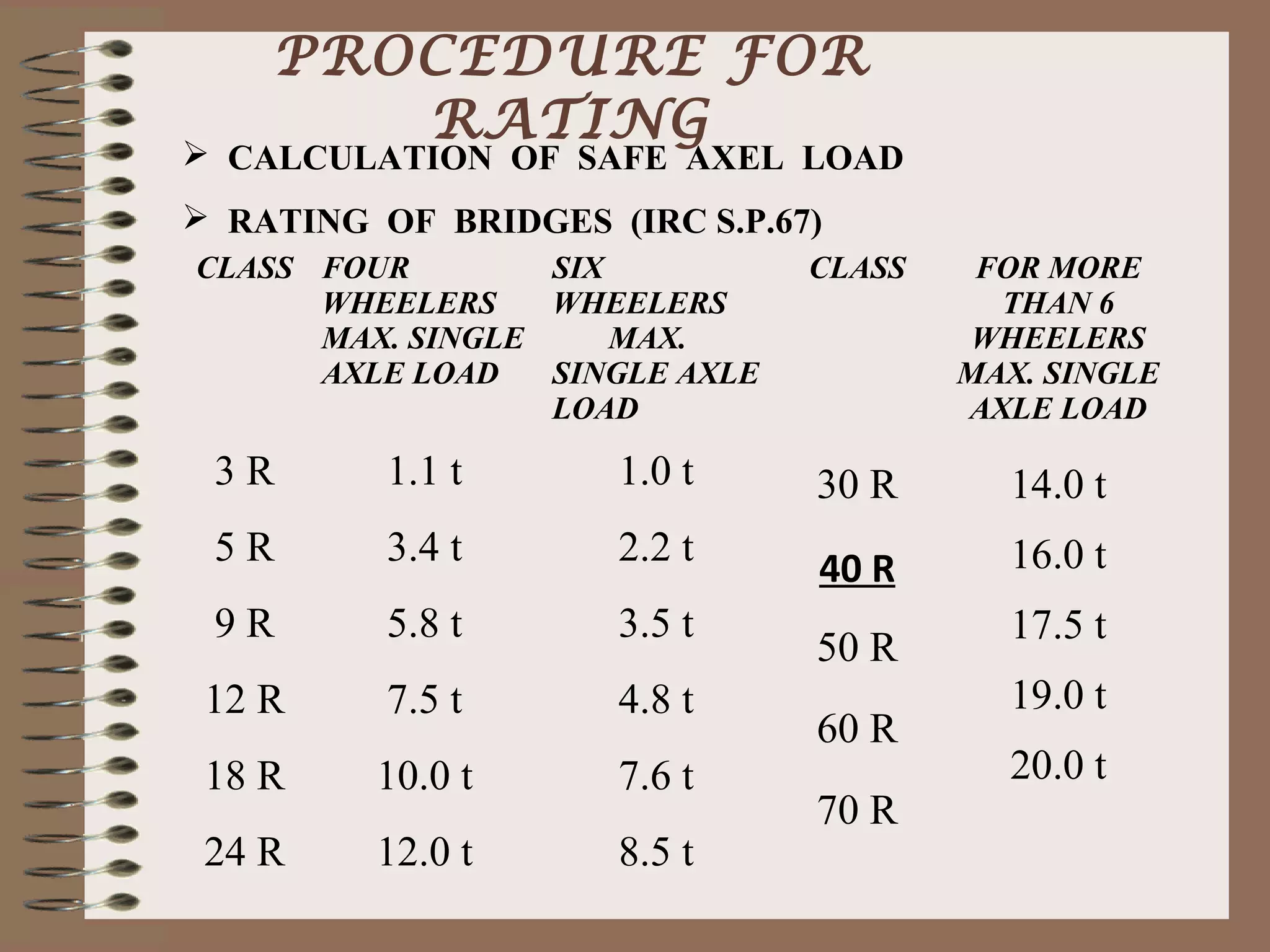
 CALCULATION OF SAFE AXEL LOAD
 RATING OF BRIDGES (IRC S.P.67)
CLASS FOUR        SIX           CLASS    FOR MORE
      WHEELERS    WHEELERS                THAN 6
      MAX. SINGLE     MAX.              WHEELERS
      AXLE LOAD   SINGLE AXLE           MAX. SINGLE
                  LOAD                  AXLE LOAD

 3R       1.1 t      1.0 t      30 R      14.0 t
 5R       3.4 t      2.2 t                16.0 t
                                40 R
 9R       5.8 t      3.5 t                17.5 t
                                50 R
 12 R     7.5 t      4.8 t                19.0 t
                                60 R
 18 R    10.0 t      7.6 t                20.0 t
                                70 R
 24 R    12.0 t      8.5 t
STRENGTHENING :
   ADDITION OF UNSTRESSED OR PRE-SRTESSED STEEL
   INSTALLATION OF EXTERNAL PRE-STRESSED
       REINFORCEMENT
      BONDED REINFORCEMENT
      INCREASE OF THE CONCRETE CROSS-SECTION

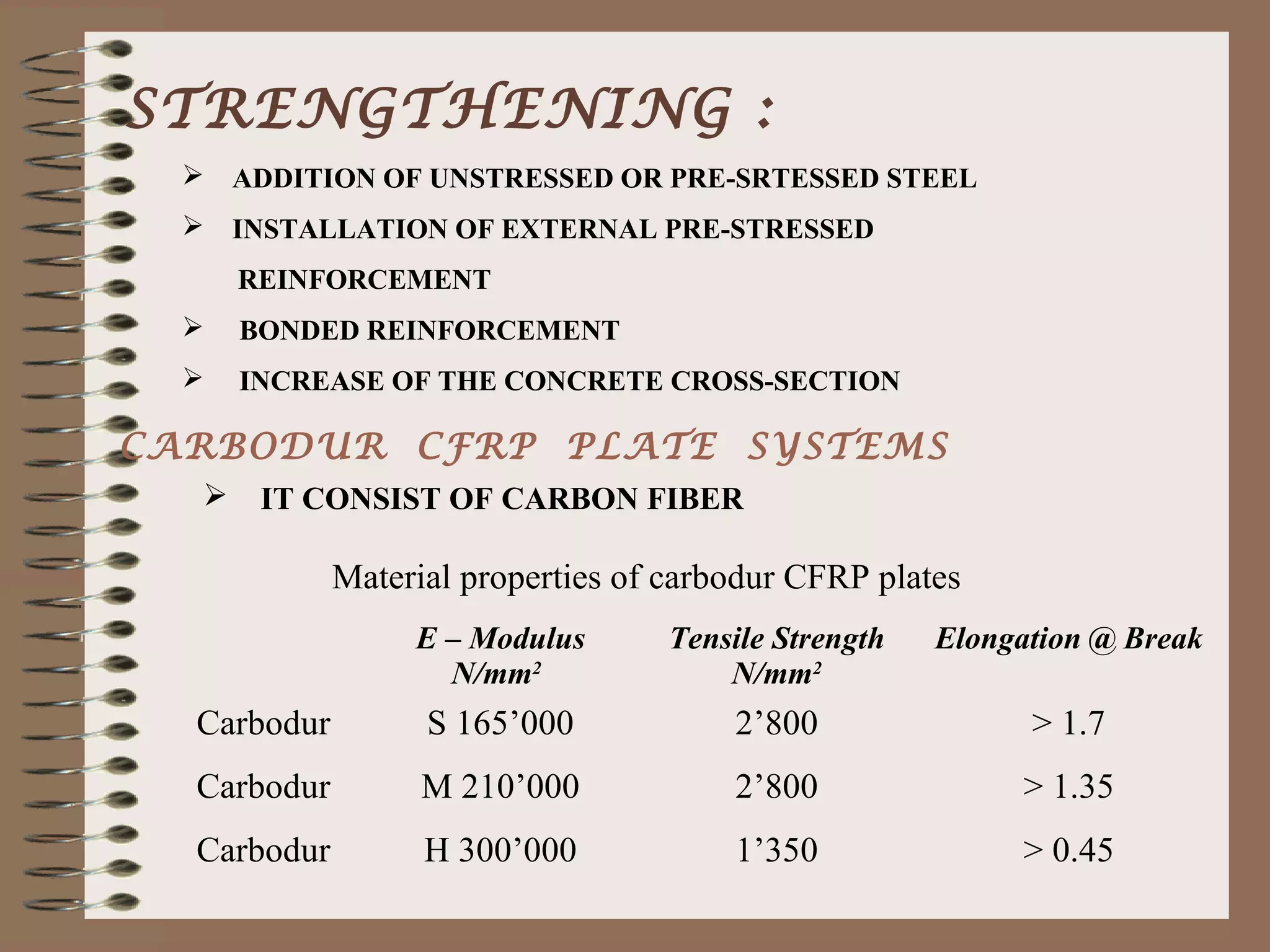
CARBODUR CFRP PLATE SYSTEMS
       IT CONSIST OF CARBON FIBER

             Material properties of carbodur CFRP plates
                  E – Modulus       Tensile Strength   Elongation @ Break
                    N/mm2               N/mm2
  Carbodur         S 165’000            2’800                > 1.7
  Carbodur         M 210’000            2’800               > 1.35
  Carbodur         H 300’000            1’350               > 0.45
BONDING OF CFRP
       PLATES :


                          Test results
   Test Specimen             Fbr [KN]    Ybr [mm]   Εbr
 Specimen 1 Curing              161         70      6.61
  without oscillation
     Specimen 4                 176         75      6.55
Curing with oscillation
POSTING
   Posting is a method to restrict the loading on the existing
    bridge.
          CONDITION              POSTING
         RATING > LOAD        NOT REQUIRED

         RATING < LOAD          REQUIRED


   TRAFFIC RESTRICTIONS
       8 SPEED RESTRICTION 8 FOOT PATH LOADING
      8 GEOMETRIC RESTRICTIION
   ALTERNATIVES TO POSTING
       8 FRAME BARRIERS 8 FREQUENT INSPECTION
     8 LANE LIMITS       8 REPAIR
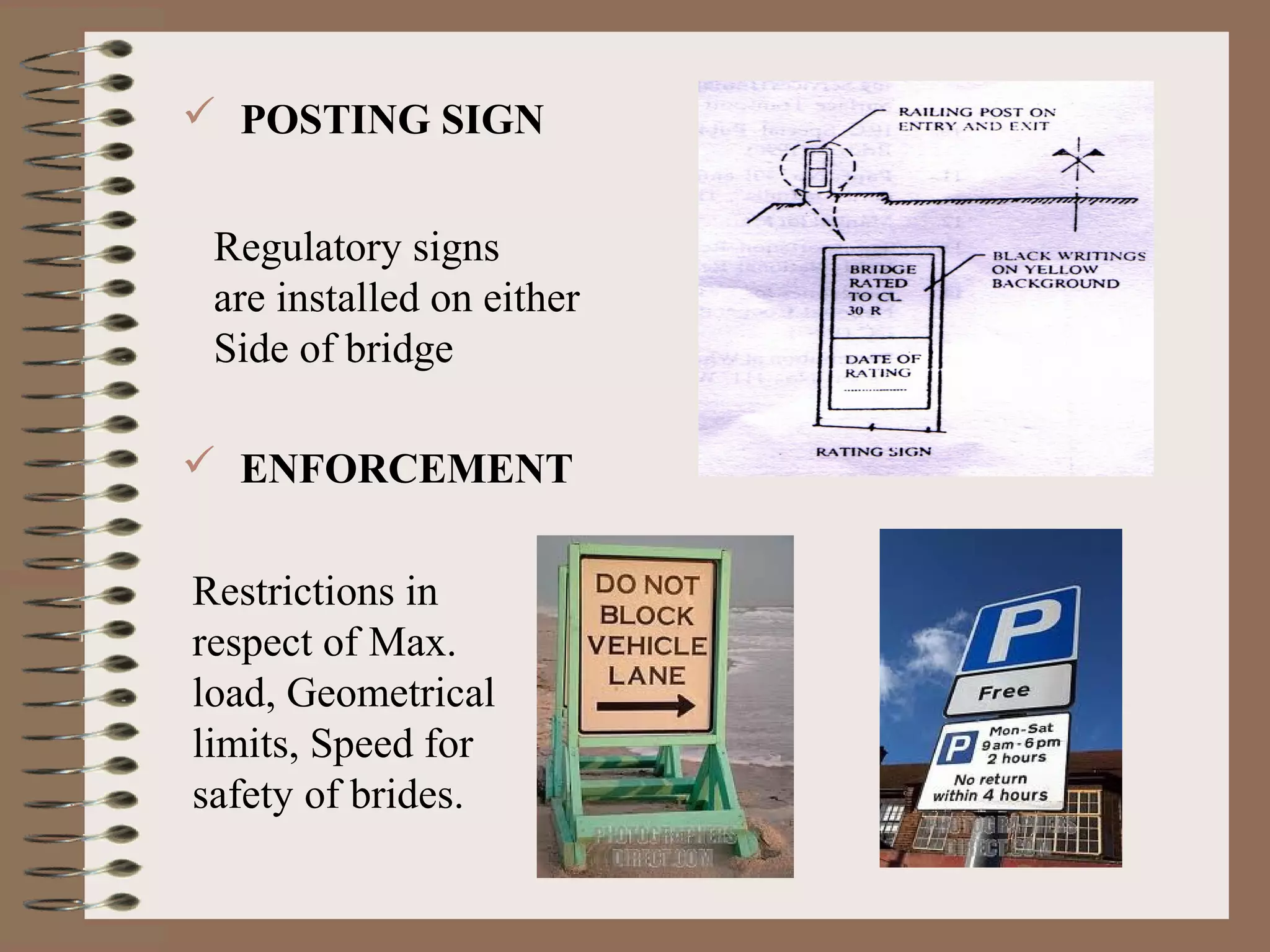
 POSTING SIGN


 Regulatory signs
 are installed on either
 Side of bridge

 ENFORCEMENT

Restrictions in
respect of Max.
load, Geometrical
limits, Speed for
safety of brides.
CONCLUSIO
•            N :
    Rating helps to determine the safe carrying capacity of
  bridges, thus the structure can be made safe for use.
• Accidents can be avoided due to collapse of the old
  bridges which have undergone deterioration by posting.
• Follow-up actions can be taken according the rating
  of bridge such as and this current or future loading on
  the bridge repairs strengthening or demolition of old
  bridge and construction of new bridge.
REFERENCES
     :
* Bridge Engineering –
    D.R.Phatak
* WWW.GOOGLE.COM

* WWW.ALTAVISTA.COM

* Public works department, Nasik

*    Indian Road congress, Special
       Publication 37
?


R.RAGHAVENDRA

Presentation on rating & strengthening of bridges @ jntu hyd by raghavendra

  • 1.
    JNTU COLLEGE OFENGINEERING, ANANTAPUR. PRESENTATION BY…. R.RAGHAVENDRA K.MADHAVULU III/IV B.Tech, Civil III/IV B.Tech, Civil
  • 2.
    CONTENTS : 1. SCOPE 2. RATING METHODOLOGY 3. PROCEDURE FOR RATING 4. STRENGTHENING 5. POSTING 6. CONCLUSION 7. REFERENCES
  • 3.
    SCOPE :  INTRODUCTION… RATING…  NECESSITY OF RATING…  LOADS FOR RATING…  Poor quality * DEAD LOAD * LIVE LOAD * IMPACT
  • 4.
    RATING METHODOLOGY: GLOBAL PRACTICES  LOADS  STRESSES  FATIGUE  DESIGN PHILOSOPHY RATIING SYSTEM  ANALYTICAL METHOD  CORRELATION METHOD  LOAD TEST METHOD
  • 5.
    ANALYTICAL METHOD  It is applicable when as built or contract drawings and specifications followed are available or when such drawings can be prepared by site measurements to an acceptable level of accuracy. CORRELATION  METHOD This method is adopted when the safe carrying capacity of structure can be ascertained by correlating the sectional details of the DIFFERENT GRAPHS USED IN METHOD structure.
  • 6.
    LOAD TEST METHOD  It is applicable when no construction drawings and specification originally followed are available or when such details are not possible to be obtained an site.  PROOF TEST  FAILURE TEST VEHICLES FOR TESTING  Test vehicles are chosen such that they are the next heaviest vehicle than the predominant heavy load presently passing over the bridge.
  • 7.
    Study all availabledata, Detailed field or Where drawing, etc. lab investigation • Mcap : Moment resisting Compute section capacity in moment and shear at selected location Assess capacity of selected section. reduction factor (η) • Vcap : Shear resisting Compute Mcap and Vcap capacity at selected section. Compute effect of all loads • MDL and VDL : Moment and other than live loads at selected shear of all loads other than Compute MLL = ηMcap – MDL VLL = ηVcap – VDL At live loads at selected section. selected locations • MLL and VLL : Net resisting Compute maximum LL capacity minus effect due to moment and shear at selected locations all loads other than live loads. • MLL and VLL : maximum Compare Bridge rated For MLL ~ MLL corresponding IRC possible effect (moment and standard Live VLL ~ VLL Loading hear) including impact effect.
  • 8.
    SPACING AND NUMBEROF VEHILES  Closer spacing of vehicles in urban areas is a frequent possibility. Urban traffic is mixed and slow as against the heavy and fast traffic for which the rating is proposed and high impact percentage.  SINGLE LANE BRIDGE SPACING Standard and heavy trucks 30 Mt Articulated vehicles 18.5Mt  DOUBLE LANE BRIDGE Double lane bridges are those with carriageway width above 5.5m and up to 7.5 m for all spans. Vehicle arrangement
  • 9.
    PROCEDURE FOR RATING  CALCULATION OF SAFE AXEL LOAD  RATING OF BRIDGES (IRC S.P.67) CLASS FOUR SIX CLASS FOR MORE WHEELERS WHEELERS THAN 6 MAX. SINGLE MAX. WHEELERS AXLE LOAD SINGLE AXLE MAX. SINGLE LOAD AXLE LOAD 3R 1.1 t 1.0 t 30 R 14.0 t 5R 3.4 t 2.2 t 16.0 t 40 R 9R 5.8 t 3.5 t 17.5 t 50 R 12 R 7.5 t 4.8 t 19.0 t 60 R 18 R 10.0 t 7.6 t 20.0 t 70 R 24 R 12.0 t 8.5 t
  • 10.
    STRENGTHENING :  ADDITION OF UNSTRESSED OR PRE-SRTESSED STEEL  INSTALLATION OF EXTERNAL PRE-STRESSED REINFORCEMENT  BONDED REINFORCEMENT  INCREASE OF THE CONCRETE CROSS-SECTION CARBODUR CFRP PLATE SYSTEMS  IT CONSIST OF CARBON FIBER Material properties of carbodur CFRP plates E – Modulus Tensile Strength Elongation @ Break N/mm2 N/mm2 Carbodur S 165’000 2’800 > 1.7 Carbodur M 210’000 2’800 > 1.35 Carbodur H 300’000 1’350 > 0.45
  • 11.
    BONDING OF CFRP PLATES : Test results Test Specimen Fbr [KN] Ybr [mm] Εbr Specimen 1 Curing 161 70 6.61 without oscillation Specimen 4 176 75 6.55 Curing with oscillation
  • 12.
    POSTING  Posting is a method to restrict the loading on the existing bridge. CONDITION POSTING RATING > LOAD NOT REQUIRED RATING < LOAD REQUIRED  TRAFFIC RESTRICTIONS 8 SPEED RESTRICTION 8 FOOT PATH LOADING 8 GEOMETRIC RESTRICTIION  ALTERNATIVES TO POSTING 8 FRAME BARRIERS 8 FREQUENT INSPECTION 8 LANE LIMITS 8 REPAIR
  • 13.
     POSTING SIGN Regulatory signs are installed on either Side of bridge  ENFORCEMENT Restrictions in respect of Max. load, Geometrical limits, Speed for safety of brides.
  • 14.
    CONCLUSIO • N : Rating helps to determine the safe carrying capacity of bridges, thus the structure can be made safe for use. • Accidents can be avoided due to collapse of the old bridges which have undergone deterioration by posting. • Follow-up actions can be taken according the rating of bridge such as and this current or future loading on the bridge repairs strengthening or demolition of old bridge and construction of new bridge.
  • 15.
    REFERENCES : * Bridge Engineering – D.R.Phatak * WWW.GOOGLE.COM * WWW.ALTAVISTA.COM * Public works department, Nasik * Indian Road congress, Special Publication 37
  • 16.