

FEARS AND PHOBIAS
• Fear is an adaptive human response. It serves
a protective purpose, activating the automatic
“fight-or-flight” response.
• A phobia is an intense fear of something that,
in reality, poses little or no actual danger
• Normal fears in children
• According to the several studies, the following fears
are extremely common and considered normal:
• 0-2 years – Loud noises, strangers, separation from
parents, large objects.
• 3-6 years – Imaginary things such as ghosts,
monsters, the dark, sleeping alone, strange noises.
• 7-16 years – More realistic fears such as injury,
illness, school performance, death, natural
disasters.
We have only 2 natural fears, we acquire other
fears with time…
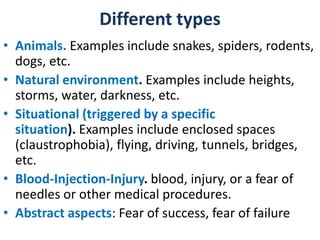
Different types
• Animals. Examples include snakes, spiders, rodents,
dogs, etc.
• Natural environment. Examples include heights,
storms, water, darkness, etc.
• Situational (triggered by a specific
situation). Examples include enclosed spaces
(claustrophobia), flying, driving, tunnels, bridges,
etc.
• Blood-Injection-Injury. blood, injury, or a fear of
needles or other medical procedures.
• Abstract aspects: Fear of success, fear of failure
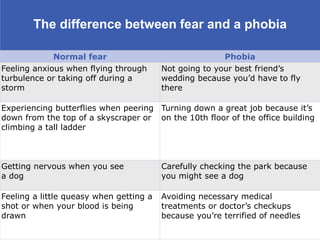
The difference between fear and a phobia
Normal fear Phobia
Feeling anxious when flying through
turbulence or taking off during a
storm
Not going to your best friend’s
wedding because you’d have to fly
there
Experiencing butterflies when peering
down from the top of a skyscraper or
climbing a tall ladder
Turning down a great job because it’s
on the 10th floor of the office building
Getting nervous when you see
a dog
Carefully checking the park because
you might see a dog
Feeling a little queasy when getting a
shot or when your blood is being
drawn
Avoiding necessary medical
treatments or doctor’s checkups
because you’re terrified of needles
WHAT HAPPENS??
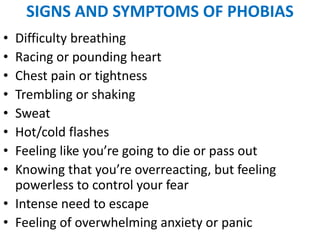
SIGNS AND SYMPTOMS OF PHOBIAS
• Difficulty breathing
• Racing or pounding heart
• Chest pain or tightness
• Trembling or shaking
• Sweat
• Hot/cold flashes
• Feeling like you’re going to die or pass out
• Knowing that you’re overreacting, but feeling
powerless to control your fear
• Intense need to escape
• Feeling of overwhelming anxiety or panic
Treatment
• Flooding
• Systematic Desensitization
• Fast phobia cure-NLP
• Humour
THANK YOU!!

Fears & Phobia

  • 1.
  • 2.
    • Fear isan adaptive human response. It serves a protective purpose, activating the automatic “fight-or-flight” response. • A phobia is an intense fear of something that, in reality, poses little or no actual danger
  • 3.
    • Normal fearsin children • According to the several studies, the following fears are extremely common and considered normal: • 0-2 years – Loud noises, strangers, separation from parents, large objects. • 3-6 years – Imaginary things such as ghosts, monsters, the dark, sleeping alone, strange noises. • 7-16 years – More realistic fears such as injury, illness, school performance, death, natural disasters.
  • 4.
    We have only2 natural fears, we acquire other fears with time…
  • 5.
    Different types • Animals.Examples include snakes, spiders, rodents, dogs, etc. • Natural environment. Examples include heights, storms, water, darkness, etc. • Situational (triggered by a specific situation). Examples include enclosed spaces (claustrophobia), flying, driving, tunnels, bridges, etc. • Blood-Injection-Injury. blood, injury, or a fear of needles or other medical procedures. • Abstract aspects: Fear of success, fear of failure
  • 6.
    The difference betweenfear and a phobia Normal fear Phobia Feeling anxious when flying through turbulence or taking off during a storm Not going to your best friend’s wedding because you’d have to fly there Experiencing butterflies when peering down from the top of a skyscraper or climbing a tall ladder Turning down a great job because it’s on the 10th floor of the office building Getting nervous when you see a dog Carefully checking the park because you might see a dog Feeling a little queasy when getting a shot or when your blood is being drawn Avoiding necessary medical treatments or doctor’s checkups because you’re terrified of needles
  • 7.
  • 8.
    SIGNS AND SYMPTOMSOF PHOBIAS • Difficulty breathing • Racing or pounding heart • Chest pain or tightness • Trembling or shaking • Sweat • Hot/cold flashes • Feeling like you’re going to die or pass out • Knowing that you’re overreacting, but feeling powerless to control your fear • Intense need to escape • Feeling of overwhelming anxiety or panic
  • 9.
    Treatment • Flooding • SystematicDesensitization • Fast phobia cure-NLP • Humour
  • 10.