FATTY ACIDFATTY ACIDSFATTY ACIDS
DEFINATION, CLASSIFICATION&
FUNCTION OF FATTY ACIDS
Presented by: Dr. Jagroop Sidhu
Ph.D Biochemistry
• Fatty acids are carboxylic acids with hydrocarbon side
chains. They are the simplest form of lipids.
• Occurrence
• Fatty acids mainly occur in the esterified form as major
constituents of various lipids.
• They are also present as free (unesterified) fatty acids.
• Fatty acids of animal origin are much simpler in structure in
contrast to those of plant origin which often contain groups
such as epoxy, keto, hydroxy, and cyclopentane rings.
• Even and odd carbon fatty acids
• Most of the fatty acids that occur in natural lipids
are of even carbons (usually 14C – 20C).
• This is due to the fact that biosynthesis of fatty acids
mainly occurs with the sequential addition of 2
carbon units.
• Palmitic acid (16C) and stearic acid (18C) are the
most common. Among the odd chain fatty acids,
propionic acid (3C) and valeric acid (5C) are well
known.
• Saturated and unsaturated fatty acids
• Saturated fatty acids do not contain double bonds,
• while unsaturated fatty acids contain one or more
double bonds.
• Both saturated and unsaturated fatty acids almost
equally occur in the natural lipids.
• Fatty acids with one double bond are
monounsaturated, and those with 2 or more
double bonds are collectively known as
polyunsaturated fatty acids (PUFA).
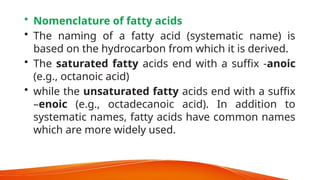
• Nomenclature of fatty acids
• The naming of a fatty acid (systematic name) is
based on the hydrocarbon from which it is derived.
• The saturated fatty acids end with a suffix -anoic
(e.g., octanoic acid)
• while the unsaturated fatty acids end with a suffix
–enoic (e.g., octadecanoic acid). In addition to
systematic names, fatty acids have common names
which are more widely used.
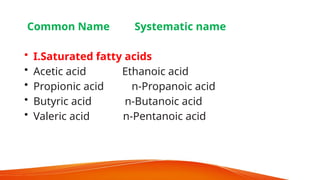
Common Name Systematic name
• I.Saturated fatty acids
• Acetic acid Ethanoic acid
• Propionic acid n-Propanoic acid
• Butyric acid n-Butanoic acid
• Valeric acid n-Pentanoic acid
• Common Name Systematic name
• Caproic acid n-Hexanoic acid
• Caprylic acid n-Octanoic acid
• Capric acid n-Decanoic acid
• Palmitic acid n-Hexadecanoic acid
• Stearic acid n-Octadecanoic acid
• Arachidic acid n-Eicosanoic acid
• Behenic acid n-Docosanoic acid
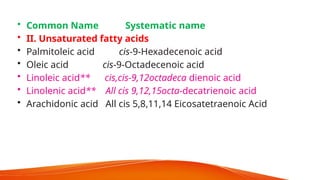
• Common Name Systematic name
• II. Unsaturated fatty acids
• Palmitoleic acid cis-9-Hexadecenoic acid
• Oleic acid cis-9-Octadecenoic acid
• Linoleic acid** cis,cis-9,12octadeca dienoic acid
• Linolenic acid** All cis 9,12,15octa-decatrienoic acid
• Arachidonic acid All cis 5,8,11,14 Eicosatetraenoic Acid
• Numbering of carbon atoms : It starts from the carboxyl carbon
which is taken as number 1. The carbons adjacent to this (carboxyl C)
are 2, 3, 4 and so on or alternately, and so on. The terminal carbon
containing methyl group is known omega carbon. Starting from the
methyl end, the carbon atoms in a fatty acid are numbered as omega
1, 2, 3 etc. The numbering of carbon atoms in two different ways is
given below
7 6 5 4 3 2 1
CH3 CH2 CH2 CH2 CH2 CH2 COOH
ω1 ω2 ω3 ω4 ω5 ω6
• Length of hydrocarbon chain of fatty acids
• Depending on the length of carbon chains, fatty acids are categorized
into 3 groups—short chain with less than 6 carbons; medium chain
with 8 to 14 carbons and long chain with 16 to 24 carbons.
• Shorthand representation of fatty acids
• Instead of writing the full structures, biochemists employ shorthand
notations (by numbers) to represent fatty acids. The general rule is
that the total number of carbon atoms are written first, followed by
the number of double bonds and finally the (first carbon) position of
double bonds, starting from the carboxyl end. Thus, saturated fatty
acid, palmitic acid is written as 16 : 0, oleic acid as 18 : 1; 9,
arachidonic acid as 20 : 4; 5, 8, 11, 14.
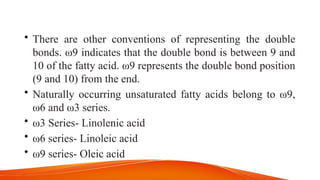
• There are other conventions of representing the double
bonds. ω9 indicates that the double bond is between 9 and
10 of the fatty acid. ω9 represents the double bond position
(9 and 10) from the end.
• Naturally occurring unsaturated fatty acids belong to ω9,
ω6 and ω3 series.
• ω3 Series- Linolenic acid
• ω6 series- Linoleic acid
• ω9 series- Oleic acid
ESSENTIAL FATTY ACIDS
• The fatty acids that cannot be synthesized by the body and,
therefore, should be supplied in the diet are known as essential
fatty acids (EFA).
• Chemically, they are polyunsaturated fatty acids, namely
linoleic acid (18 : 2; 9, 12) and linolenic acid (18 : 3; 9, 12, 15).
Arachidonic acid (20 : 4; 5, 8, 11, 14) becomes essential, if its
precursor linoleic acid is not provided in the diet in sufficient
amounts.
Biochemical basis for essentiality :
Linoleic acid and linolenic acid are essential since humans lack
the enzymes that can introduce double bonds beyond carbons 9
to 10.
Functions of EFA :
1.Essential fatty acids are required for the membrane structure
and function.
2.Transport of cholesterol,
3.Formation of lipoproteins
4.Prevention of fatty liver etc.
• Deficiency of EFA :
• The deficiency of EFA results in phrynoderma or
toad skin, characterized by the presence of horny
eruptions on the posterior and lateral parts of
limbs, on the back and buttocks, loss of hair and
poor wound healing.
• Abnormalities of pregnancy and lactation in adult
females.
• kidney damage.
THANK YOU

Defination, Classification & function of fatty acid.pptx

  • 1.
    FATTY ACIDFATTY ACIDSFATTYACIDS DEFINATION, CLASSIFICATION& FUNCTION OF FATTY ACIDS Presented by: Dr. Jagroop Sidhu Ph.D Biochemistry
  • 2.
    • Fatty acidsare carboxylic acids with hydrocarbon side chains. They are the simplest form of lipids. • Occurrence • Fatty acids mainly occur in the esterified form as major constituents of various lipids. • They are also present as free (unesterified) fatty acids. • Fatty acids of animal origin are much simpler in structure in contrast to those of plant origin which often contain groups such as epoxy, keto, hydroxy, and cyclopentane rings.
  • 3.
    • Even andodd carbon fatty acids • Most of the fatty acids that occur in natural lipids are of even carbons (usually 14C – 20C). • This is due to the fact that biosynthesis of fatty acids mainly occurs with the sequential addition of 2 carbon units. • Palmitic acid (16C) and stearic acid (18C) are the most common. Among the odd chain fatty acids, propionic acid (3C) and valeric acid (5C) are well known.
  • 4.
    • Saturated andunsaturated fatty acids • Saturated fatty acids do not contain double bonds, • while unsaturated fatty acids contain one or more double bonds. • Both saturated and unsaturated fatty acids almost equally occur in the natural lipids. • Fatty acids with one double bond are monounsaturated, and those with 2 or more double bonds are collectively known as polyunsaturated fatty acids (PUFA).
  • 5.
    • Nomenclature offatty acids • The naming of a fatty acid (systematic name) is based on the hydrocarbon from which it is derived. • The saturated fatty acids end with a suffix -anoic (e.g., octanoic acid) • while the unsaturated fatty acids end with a suffix –enoic (e.g., octadecanoic acid). In addition to systematic names, fatty acids have common names which are more widely used.
  • 6.
    Common Name Systematicname • I.Saturated fatty acids • Acetic acid Ethanoic acid • Propionic acid n-Propanoic acid • Butyric acid n-Butanoic acid • Valeric acid n-Pentanoic acid
  • 7.
    • Common NameSystematic name • Caproic acid n-Hexanoic acid • Caprylic acid n-Octanoic acid • Capric acid n-Decanoic acid • Palmitic acid n-Hexadecanoic acid • Stearic acid n-Octadecanoic acid • Arachidic acid n-Eicosanoic acid • Behenic acid n-Docosanoic acid
  • 8.
    • Common NameSystematic name • II. Unsaturated fatty acids • Palmitoleic acid cis-9-Hexadecenoic acid • Oleic acid cis-9-Octadecenoic acid • Linoleic acid** cis,cis-9,12octadeca dienoic acid • Linolenic acid** All cis 9,12,15octa-decatrienoic acid • Arachidonic acid All cis 5,8,11,14 Eicosatetraenoic Acid
  • 9.
    • Numbering ofcarbon atoms : It starts from the carboxyl carbon which is taken as number 1. The carbons adjacent to this (carboxyl C) are 2, 3, 4 and so on or alternately, and so on. The terminal carbon containing methyl group is known omega carbon. Starting from the methyl end, the carbon atoms in a fatty acid are numbered as omega 1, 2, 3 etc. The numbering of carbon atoms in two different ways is given below 7 6 5 4 3 2 1 CH3 CH2 CH2 CH2 CH2 CH2 COOH ω1 ω2 ω3 ω4 ω5 ω6
  • 10.
    • Length ofhydrocarbon chain of fatty acids • Depending on the length of carbon chains, fatty acids are categorized into 3 groups—short chain with less than 6 carbons; medium chain with 8 to 14 carbons and long chain with 16 to 24 carbons. • Shorthand representation of fatty acids • Instead of writing the full structures, biochemists employ shorthand notations (by numbers) to represent fatty acids. The general rule is that the total number of carbon atoms are written first, followed by the number of double bonds and finally the (first carbon) position of double bonds, starting from the carboxyl end. Thus, saturated fatty acid, palmitic acid is written as 16 : 0, oleic acid as 18 : 1; 9, arachidonic acid as 20 : 4; 5, 8, 11, 14.
  • 11.
    • There areother conventions of representing the double bonds. ω9 indicates that the double bond is between 9 and 10 of the fatty acid. ω9 represents the double bond position (9 and 10) from the end. • Naturally occurring unsaturated fatty acids belong to ω9, ω6 and ω3 series. • ω3 Series- Linolenic acid • ω6 series- Linoleic acid • ω9 series- Oleic acid
  • 12.
    ESSENTIAL FATTY ACIDS •The fatty acids that cannot be synthesized by the body and, therefore, should be supplied in the diet are known as essential fatty acids (EFA). • Chemically, they are polyunsaturated fatty acids, namely linoleic acid (18 : 2; 9, 12) and linolenic acid (18 : 3; 9, 12, 15). Arachidonic acid (20 : 4; 5, 8, 11, 14) becomes essential, if its precursor linoleic acid is not provided in the diet in sufficient amounts.
  • 13.
    Biochemical basis foressentiality : Linoleic acid and linolenic acid are essential since humans lack the enzymes that can introduce double bonds beyond carbons 9 to 10. Functions of EFA : 1.Essential fatty acids are required for the membrane structure and function. 2.Transport of cholesterol, 3.Formation of lipoproteins 4.Prevention of fatty liver etc.
  • 14.
    • Deficiency ofEFA : • The deficiency of EFA results in phrynoderma or toad skin, characterized by the presence of horny eruptions on the posterior and lateral parts of limbs, on the back and buttocks, loss of hair and poor wound healing. • Abnormalities of pregnancy and lactation in adult females. • kidney damage.
  • 15.