13-10-2011
FATTY ACIDS
• Fatty acids are carboxylic acids with hydrocarbon side
chain
• Simplest form of lipids
• Key building blocks for lipids
• Chains of carbon atoms with a carboxyl group at one
end, and a methyl group at the other
• May be “free” or attached to another compound
• Determine the characteristics of the fat
• Omega 3
• Omega 6
• Omega 9
Classification of fatty acids
Depending on total number of carbon atoms
1. Even chain fatty acids:
• having carbon atoms 2,4,6 & series
• exapmle: Acetic acid
Butyric acid
Caproic acid
Palmitic acid
2. Odd chain fatty acids:
• having carbon atoms 3,5,7 etc
• Seen in microbial cell walls & also present in milk
• Example: Propanoic
Valeric
Cont..
Depending on the length of hydrocarbon chain
• Short chain = 2-6 carbons
• Medium chain = 8-14 carbons
• Long chain = 16 & above, usually up to 24 carbons
Depending the nature of hydrocarbon chain
• Saturated fatty acids
• Unsaturated fatty acids
• Branched chain fatty acids (e.g. isovaleric
acid)
• Hydroxy fatty acids (e.g. cerebronic acid)
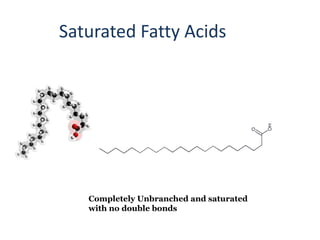
• If all the carbon atoms in the chain are joined
with single bonds, and the remaining bonds are
attached to hydrogen
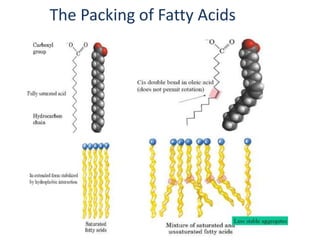
• Long-chain saturated fatty acids stack tightly
and form solids at room temperature
• Short-chain saturated fatty acids are also liquid
at room temperature
SATURATED FATTY ACID
Saturated Fatty Acids
Completely Unbranched and saturated
with no double bonds
UNSATURATED FATTY ACID
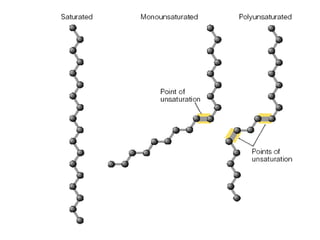
• If adjoining carbons are joined by double bonds
• One double bond = monounsaturated fatty acid
• Two or more double bonds = poly- unsaturated fatty acid
• Monounsaturated and polyunsaturated fatty acids don’t
stack compactly and are liquid at room temperature
Nomenclature of Fatty Acids
COOH
1
2
3
4
5
6
7
8
9
10
11
12
13
14
15
16
17
18
Number of Double Bonds
Position of Double Bonds
Carbon Chain Length
18:3 ( 9, 12, 15)
The most commonly occurring fatty acids have even number of carbon
atoms in an un-branched chain of12-24 carbons
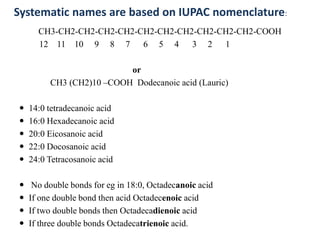
CH3-CH2-CH2-CH2-CH2-CH2-CH2-CH2-CH2-CH2-CH2-COOH
12 11 10 9 8 7 6 5 4 3 2 1
or
CH3 (CH2)10 –COOH Dodecanoic acid (Lauric)
 14:0 tetradecanoic acid
 16:0 Hexadecanoic acid
 20:0 Eicosanoic acid
 22:0 Docosanoic acid
 24:0 Tetracosanoic acid
 No double bonds for eg in 18:0, Octadecanoic acid
 If one double bond then acid Octadecenoic acid
 If two double bonds then Octadecadienoic acid
 If three double bonds Octadecatrienoic acid.
Systematic names are based on IUPAC nomenclature:
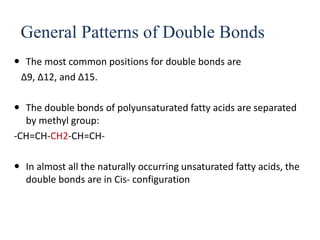
General Patterns of Double Bonds
 The most common positions for double bonds are
Δ9, Δ12, and Δ15.
 The double bonds of polyunsaturated fatty acids are separated
by methyl group:
-CH=CH-CH2-CH=CH-
 In almost all the naturally occurring unsaturated fatty acids, the
double bonds are in Cis- configuration
TWO TYPES OF BOND FORMATION:
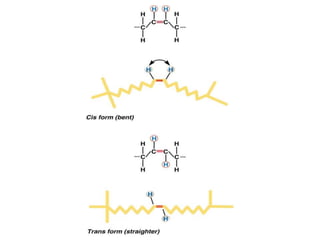
• CIS - hydrogens on the carbons joined by a
double bond are on the same side = the carbon
chain is bent
• TRANS – hydrogens on the carbons joined by
a double bond are on the opposite side = the
carbon chain is straighter
Physical Properties of Fatty Acids
 The physical properties of fatty acids are largely determined
by the length and degree of unsaturation of the hydrocarbon
chain.
 The longer the chain and the fewer the double bonds, the
lower is the solubility in water, and higher is the melting point.
• Addition of double bonds decreases the melting point
whereas, increasing the chain length increases the melting
point. For example; 4:0 MP -7.9 C, 12:0 MP 44.2 C, 16:0 MP
62.7 C, 18:1 MP 10.5 C, 18:2 MP -5.0 C, 18:3 MP -11 C.
Chemical Properties of fatty acids
• Hydrogenation
• Halogenation
• Salt formation
• Ester formation
Isomerism
• A double bond in Fatty acid chain permits two types of
geometrical isomers, cis and trans.
• Cis isomers have a curved configuration.
• Trans isomers have a linear configuration.
• Due to curve configuration cis unsaturated fatty acids
have a lower melting point as compared to there trans
counterpart.
• Most of the natural unsaturated fatty acids have cis
double bonds.
The Packing of Fatty Acids
Essential fatty acids
• The fatty acids that can not be synthesized by the
body, & therefore, should be supplied in the diet
is known as essential fatty acids
• Chemically, they are polyunsaturated
• Example:
- Linoleic acid (18:2,9,12)
- Linolenic acid (18:3,9,12,15)
- Arachidonic acid (20:4,5,8,11,14)
Function of EFA
• Structural elements of tissue
• Structural elements of gonads
• Synthesis of prostaglandins and other compounds
• Structural components of mitochondrial membrane
• Serum level of cholesterol
• Effect on clotting time
• Effect on fibrinolytic activity
• Role of EFA in fatty liver
• Role in vision

fatty acids.pptx

  • 1.
  • 2.
    FATTY ACIDS • Fattyacids are carboxylic acids with hydrocarbon side chain • Simplest form of lipids • Key building blocks for lipids • Chains of carbon atoms with a carboxyl group at one end, and a methyl group at the other • May be “free” or attached to another compound • Determine the characteristics of the fat
  • 4.
    • Omega 3 •Omega 6 • Omega 9
  • 5.
    Classification of fattyacids Depending on total number of carbon atoms 1. Even chain fatty acids: • having carbon atoms 2,4,6 & series • exapmle: Acetic acid Butyric acid Caproic acid Palmitic acid 2. Odd chain fatty acids: • having carbon atoms 3,5,7 etc • Seen in microbial cell walls & also present in milk • Example: Propanoic Valeric
  • 6.
    Cont.. Depending on thelength of hydrocarbon chain • Short chain = 2-6 carbons • Medium chain = 8-14 carbons • Long chain = 16 & above, usually up to 24 carbons
  • 7.
    Depending the natureof hydrocarbon chain • Saturated fatty acids • Unsaturated fatty acids • Branched chain fatty acids (e.g. isovaleric acid) • Hydroxy fatty acids (e.g. cerebronic acid)
  • 8.
    • If allthe carbon atoms in the chain are joined with single bonds, and the remaining bonds are attached to hydrogen • Long-chain saturated fatty acids stack tightly and form solids at room temperature • Short-chain saturated fatty acids are also liquid at room temperature SATURATED FATTY ACID
  • 9.
    Saturated Fatty Acids CompletelyUnbranched and saturated with no double bonds
  • 11.
    UNSATURATED FATTY ACID •If adjoining carbons are joined by double bonds • One double bond = monounsaturated fatty acid • Two or more double bonds = poly- unsaturated fatty acid • Monounsaturated and polyunsaturated fatty acids don’t stack compactly and are liquid at room temperature
  • 13.
    Nomenclature of FattyAcids COOH 1 2 3 4 5 6 7 8 9 10 11 12 13 14 15 16 17 18 Number of Double Bonds Position of Double Bonds Carbon Chain Length 18:3 ( 9, 12, 15) The most commonly occurring fatty acids have even number of carbon atoms in an un-branched chain of12-24 carbons
  • 14.
    CH3-CH2-CH2-CH2-CH2-CH2-CH2-CH2-CH2-CH2-CH2-COOH 12 11 109 8 7 6 5 4 3 2 1 or CH3 (CH2)10 –COOH Dodecanoic acid (Lauric)  14:0 tetradecanoic acid  16:0 Hexadecanoic acid  20:0 Eicosanoic acid  22:0 Docosanoic acid  24:0 Tetracosanoic acid  No double bonds for eg in 18:0, Octadecanoic acid  If one double bond then acid Octadecenoic acid  If two double bonds then Octadecadienoic acid  If three double bonds Octadecatrienoic acid. Systematic names are based on IUPAC nomenclature:
  • 15.
    General Patterns ofDouble Bonds  The most common positions for double bonds are Δ9, Δ12, and Δ15.  The double bonds of polyunsaturated fatty acids are separated by methyl group: -CH=CH-CH2-CH=CH-  In almost all the naturally occurring unsaturated fatty acids, the double bonds are in Cis- configuration
  • 16.
    TWO TYPES OFBOND FORMATION: • CIS - hydrogens on the carbons joined by a double bond are on the same side = the carbon chain is bent • TRANS – hydrogens on the carbons joined by a double bond are on the opposite side = the carbon chain is straighter
  • 18.
    Physical Properties ofFatty Acids  The physical properties of fatty acids are largely determined by the length and degree of unsaturation of the hydrocarbon chain.  The longer the chain and the fewer the double bonds, the lower is the solubility in water, and higher is the melting point. • Addition of double bonds decreases the melting point whereas, increasing the chain length increases the melting point. For example; 4:0 MP -7.9 C, 12:0 MP 44.2 C, 16:0 MP 62.7 C, 18:1 MP 10.5 C, 18:2 MP -5.0 C, 18:3 MP -11 C.
  • 19.
    Chemical Properties offatty acids • Hydrogenation • Halogenation • Salt formation • Ester formation
  • 20.
    Isomerism • A doublebond in Fatty acid chain permits two types of geometrical isomers, cis and trans. • Cis isomers have a curved configuration. • Trans isomers have a linear configuration. • Due to curve configuration cis unsaturated fatty acids have a lower melting point as compared to there trans counterpart. • Most of the natural unsaturated fatty acids have cis double bonds.
  • 21.
    The Packing ofFatty Acids
  • 22.
    Essential fatty acids •The fatty acids that can not be synthesized by the body, & therefore, should be supplied in the diet is known as essential fatty acids • Chemically, they are polyunsaturated • Example: - Linoleic acid (18:2,9,12) - Linolenic acid (18:3,9,12,15) - Arachidonic acid (20:4,5,8,11,14)
  • 23.
    Function of EFA •Structural elements of tissue • Structural elements of gonads • Synthesis of prostaglandins and other compounds • Structural components of mitochondrial membrane • Serum level of cholesterol • Effect on clotting time • Effect on fibrinolytic activity • Role of EFA in fatty liver • Role in vision